Three weeks before the quarterly CBAM report, a German importer of ductile iron pipe fittings emailed me. "Can you help us with a CBAM data pack from our Chinese foundry?" Attached were seven spreadsheets, five WeChat screenshots, and a PDF of a "verification certificate" in Chinese.
Here's the problem: none of it was usable. The emissions numbers were all-in (not split direct vs. indirect), the electricity factor came from a 2021 provincial average, and the "verification certificate" was actually a business license copy from WeChat.
That's not a data pack. That's a liability.
This article is for EU importers of gray iron, ductile iron, and steel castings from China. You'll learn what a compliant CBAM data pack must contain, how to verify it in one hour or less, and the seven red flags that mean the pack will cost you money. No fluff.
Why the CBAM Data Pack Is No Longer Optional
Between October 2023 and December 2025, importers filed quarterly CBAM reports with "minimal data"—or even estimated values. The EU Commission tolerated gaps because the machinery wasn't fully built yet.
On January 1, 2026, that tolerance ends. Your declaration must reflect verified actual embedded emissions for every tonne of castings entering the EU. If you don't have the data, you use the Commission's default values. They're deliberately conservative. For cast iron, default values can sit 30–60% above what a modern, well-run Chinese foundry actually emits.
Let me translate that into money. Suppose you import 1,000 tonnes of gray iron castings annually. At €90 per tonne of embedded CO₂ (the 2026 CBAM certificate price estimate), the difference between a default value of 2.2 tCO₂e/t and an actual value of 1.4 tCO₂e/t is €72,000 per year. For a mid-size importer doing 5,000 tonnes, that's €360,000.
Avg. 2025 CBAM certificate prices (Q1): ~€75–85/tonne; 2026 futures market suggests €90–110/tonne. Commission default values for cast iron are published in the Implementing Regulation. Source: EU Commission CBAM registry (public).
The headache isn't a regulatory burden you should avoid—it's a negotiating lever. If you're not using actual data, you're literally paying your competitor's carbon bill. This is no longer an unfunded mandate. It's a line item.
What a Credible CBAM Data Pack from a Chinese Foundry Must Contain
A data pack is a structured file set—typically Excel + PDF—that gives you the embedded emissions of the specific goods you're importing, plus the methodology and evidence trail to back it up. It is NOT:
- a scan of an ISO 14064 certificate with no calculation detail
- a single CO₂ tonne figure with no breakdown
- a company-wide "sustainability report" with average emissions
- an email attachment that says "per your request, our carbon emissions are 800 tonnes"
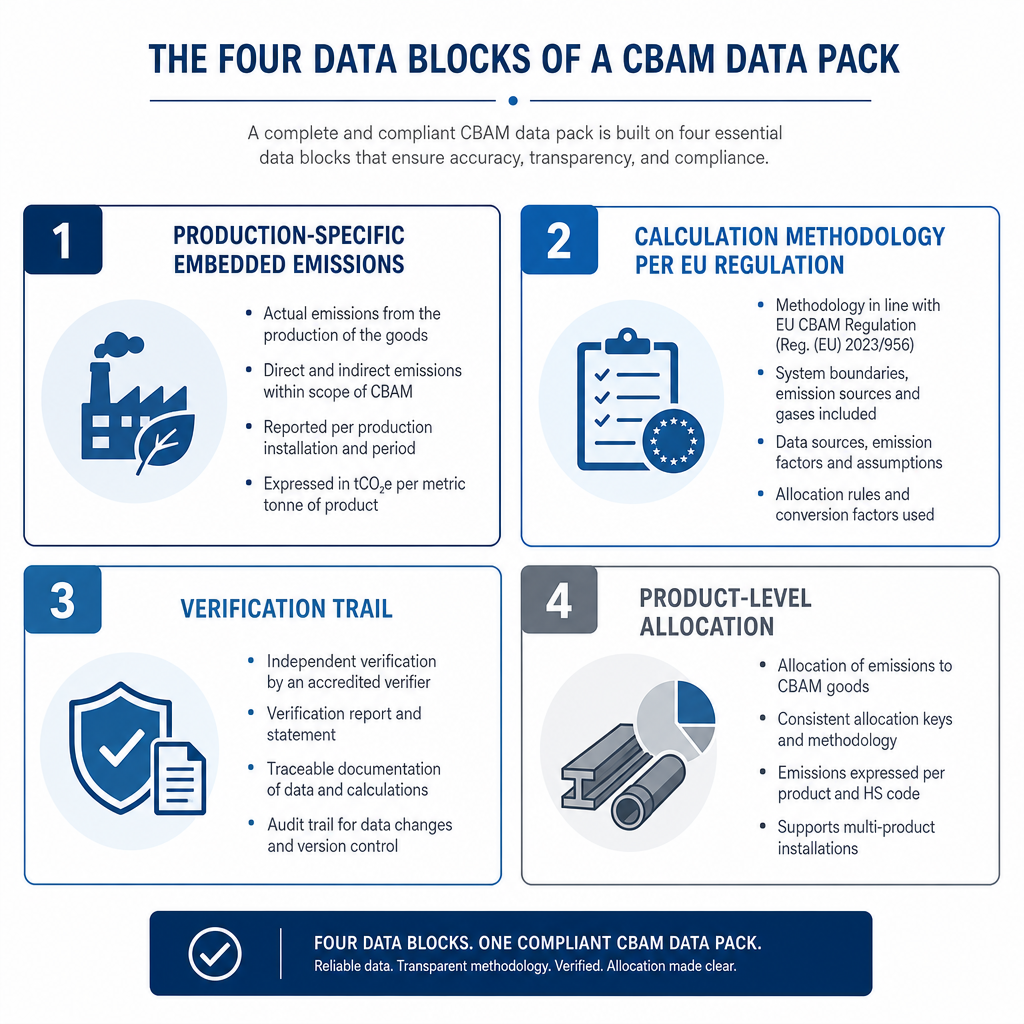
Here's what a compliant pack looks like:
The Four Data Blocks You Can't Do Without
Block 1: Production-specific embedded emissions
The embedded emissions of the actual castings you're importing. Not the factory average. Not "similar products." The specific production batches, furnace runs, and energy inputs that went to your order. This must be broken into:
- Direct emissions (Scope 1): coke, natural gas, diesel, other fuels burned on-site
- Indirect emissions (Scope 2): purchased electricity and steam
- Precursor emissions: scrap melting, alloying elements, mold materials
A foundry that can't split direct and indirect for you hasn't really measured—they've guessed.
Block 2: Calculation methodology
This is the recipe. The pack should state exactly which methodology was used: the EU CBAM Implementing Regulation (Annex IV), the ISO 14064 standard, or a recognized LCA-based framework. It should list the emission factors used for electricity and natural gas, with sources and dates.
If you see a number for "China electricity emission factor" without a year or source, it's a red flag. The correct marginal grid factor for 2024–2025 is roughly 0.58–0.60 kg CO₂/kWh (published in China's annual "Emission Factors for Grid Electricity" report, updated each year). A lot of foundries use outdated provincial factors that understate emissions by 30%.
Block 3: Verification trail
Who signs off on this data? Ideally an independent third-party verifier (e.g., TÜV, SGS, Bureau Veritas, or a CNAS-accredited Chinese verification body). But even without formal verification, the pack should include primary evidence: electricity bills, fuel invoices, melting logs, batch records, and meter readings. This is the evidence you'll need if customs audits.
If the foundry can't produce a single electricity bill or undated furnace logs, the data is not verifiable. An audit will destroy it.
Block 4: Product-level allocation
Castings come in different weights, grades, and heat-treatment requirements. A credible pack shows how factory-wide emissions are allocated to specific products. This is the most commonly botched step. If a foundry divides total annual emissions by total annual tonnes, they've given you a factory average—not product-specific data. A large ductile iron bevel gear box has a completely different emissions profile than a thin-wall gray iron brake disc. If the allocation isn't based on production time, energy metering, or material flow, it's made up.
What "Production-Specific" Really Means
It's the difference between weighing a steak and guessing its weight by looking at the cow.
The CBAM regulation defines embedded emissions as those "embedded in the production of the goods". That means the emission sources and quantities specific to the facility producing your goods. If your foundry supplies a shared "carbon report" across all its customers with the same CO₂e/t figure, they've given you a lie.
Production-specific also means batch-level. If you ordered 200 tonnes in March, the pack should reference the March production cycle, or at least a defined quarterly period that your batch falls within. A vague "annual average for 2024" covering a period when the foundry was running at 30% capacity is not representative of your order.
Capacity utilization matters enormously for emissions intensity. When a foundry operates at 40% capacity, fixed energy use (idle furnace heating, facility lighting) spreads over fewer tonnes, pushing up emissions per tonne. A good foundry will account for this. A sloppy one won't.
How to Verify Your Foundry's CBAM Data Pack
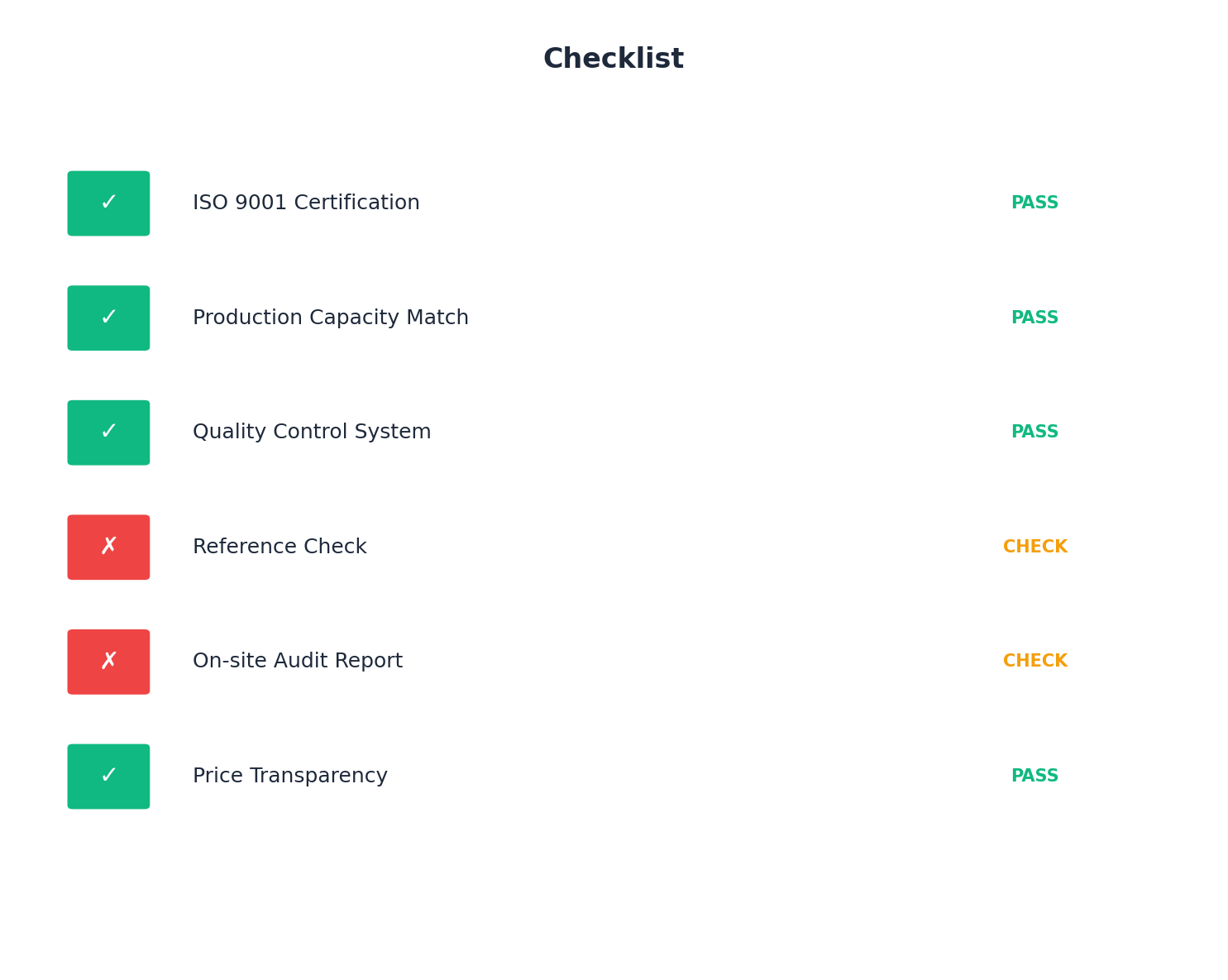
You don't need a PhD in carbon accounting. You need a checklist. Here's the 7-point verification I run on every pack that crosses my desk:
The 7-Point Verification Checklist
- Boundary clarity. Did they clearly state what's included? (e.g., "Scope 1 + Scope 2 only, no upstream scrap) or "cradle-to-gate including scrap supply"? Ambiguity here means the number is meaningless.
- Calculation reproducibility. Can you or your accountant re-run the calculation from the raw data? If the Excel formula cells are locked or the methodology annex is a single paragraph of generalities, it's not reproducible.
- Data source traceability. Can they show the electricity bill for the month in question? The natural gas procurement record? The weighbridge tickets for scrap? Traceability is what converts a claim into evidence.
- Allocation method disclosed. How did they allocate factory-level emissions to your product? If the documentation doesn't say allocation by production hours (or similar), you can't know if the number is relevant to your product.
- Emission factor credibility. Check the electricity CO₂ factor they used. Is it the current provincial grid factor or the national average? International best practice for CBAM uses the country-average electricity mix (published annually). If your foundry used a 0.8 kg CO₂/kWh factor—way above the real Chinese grid average of ~0.58—they've either overcompensated in an attempt to be "safe" or used junk data.
- Third-party verification. Is there a verifier's stamp, passport number, and a declared statement of their accreditation? A vague "verified by our sustainability team" is not independent confirmation.
- Plausibility check. Does the number pass the smell test? For gray iron castings, realistic embedded emissions for a good Chinese foundry are around 1.2–1.7 tCO₂e/t. If your foundry reports 1.1 with no explanation, or 3.5, ask how. A credible pack explains anomalous values.
A pack that passes all seven checks in ninety minutes or less is a pack you can base a CBAM declaration on. Anything that takes more than two hours of follow-up questions doesn't pass—it's a research project.
The 7 Red Flags That Mean "Stop"
Not every data pack is outright fraud. But these red flags will tell you the pack will cost you money, if not at customs, then in penalties:
- The "global average" game. They gave you one number for their whole factory and every customer gets the same. Your actual castings may be significantly cleaner—or dirtier. Either way, it's not production-specific.
- Refusal to share raw data. An clean evidence trail is standard. If they say "we can't share our electricity bills due to confidentiality," that's a red flag. You don't need to see the commercial section of their contract with the utility. You need the meter readings and invoices, which are not trade secrets.
- Suspiciously round numbers. 1.50 tCO₂e/t. 800 t total. No decimals. Real measured data almost never comes out in whole numbers. Round numbers usually mean synthetic calculations or benchmark assumptions, not measurement.
- Methodology in a single paragraph. One page of generic text on "emissions were calculated in accordance with ISO 14064" with zero detail on sources, factors, and boundaries. If they can't write a proper methodology annex, they don't have one.
- Unrealistic precision. On the other end: "0.00" or "1234.56" tCO₂e with no supporting measurement resolution. Precision without accuracy is a marketing gimmick, not data.
- Verification without substance. A scanned "verification statement" from a company with no verifier name, no accreditation number, and no personal liability. Real verifiers stand behind their stamp.
- No data, instead "consult our parent company." If the foundry tells you to ask their group HQ for a "corporate level" carbon report, you're not getting product-specific data. You're getting a brochure.
What to Do When the Data Pack Falls Short
Okay, you got a pack that doesn't pass. Define "falls short":
When it's missing one data block—say, they have production-specific numbers but the methodology is thin. Press for the missing piece. A foundry with genuine data has the ability to document it. A foundry with a PR pack doesn't.
When the data is suspicious but they promise to fix it—treat that promise as a 90-day term sheet. Put a milestone into the contract: "Foundry shall deliver a compliant CBAM data pack for each shipment no later than 30 days after delivery. Failure to deliver allows buyer to withhold 20% of invoice." That gets their attention.
When they simply refuse—re-source. I can't overstate this enough. In 2024, I had a client in Italy who couldn't get any carbon data from their iron foundry in Shandong. They switched to a foundry in Anhui that had the data ready in two weeks. Same quality, same price, and the new foundry's embedded emissions were 18% lower. The original foundry lost a €900K/year customer, not because they couldn't measure, but because they couldn't be bothered. Your EU CBAM declaration can't be "not bothered."
When you need the data immediately because a shipment is in transit—the pragmatic stopgap is to use default values for that shipment, while building a switch-out plan. Defaults for iron castings are punitive but legal. Use them twice at most. Then make the change.
Frequently Asked Questions
Can my Chinese foundry provide an official CBAM data pack?
There's no "official" CBAM data pack issued by the European Commission. The pack is your commercial input into your own CBAM declaration. What makes it credible is the calculation method, the production-specific data, and the verification trail behind it.
What if my foundry refuses to share its carbon data?
After January 1, 2026, that refusal has a price: you can't claim actual emissions, so you default to the Commission's default values—which are set deliberately high. You'll overpay on every shipment. If a foundry won't share data, re-source. Plenty of Chinese foundries will.
Can I just use CBAM default values to avoid the headache?
You can, but the gap is significant. Defaults for cast iron can be 30-60% above a good foundry's actual emissions. For large importers, that's six figures per year. Using defaults is a legitimate stopgap while you build the data collection. It's not a long-term sourcing strategy.
Is third-party verification legally required for CBAM data packs?
For most imports, CBAM doesn't mandate third-party certification of embedded emissions. But the declaration is signed under penalty of misstatement. If customs audits you and your actual data doesn't hold up, the consequences are worse than a verification invoice. Treat independent verification as cheap insurance.
What's the difference between direct and indirect emissions for cast iron?
Direct emissions come from the foundry's own processes: melting scrap, coke combustion, natural gas for annealing. Indirect emissions come from the electricity the foundry buys—China's grid is still heavily coal-based, so this can be significant. A credible data pack separates both, because CBAM applies different formulas and the EU ETS carbon price passes through differently.
Next Steps
You've got three options, depending on where you are in your sourcing cycle:
- You're already sourcing from China—request a full CBAM data pack from your foundry today using the 7-point checklist above. Give them a two-week deadline. If they produce it, verify it. If they don't, you have your answer, and you have time to re-source.
- You're mid-RFQ—make the CBAM data pack a mandatory bid document. In your RFQ, write: "Bidders must provide a CBAM-compliant data pack covering the quoted products, including direct and indirect embedded emissions, methodology, and verification evidence." This filters foundries that are serious from those who are just chasing POs.
- You don't have a Chinese foundry yet—use this guide to pre-qualify suppliers from day one. Ask for a sample pack during the qualification phase, before you ever send a PO.
Look, CBAM isn't going away. The EU Commission is hiring more customs auditors, not fewer. The default carbon price will rise as the ETS phase-out schedules ramp up. Suppliers who give you actual, verified, production-specific data aren't doing you a favor—they're giving you an asset that protects your margins.
If you need help evaluating a data pack, reach out. A one-hour desk review of your foundry's pack, done by someone who's read thousands of them, saves you from a customs audit that takes 18 months of your life.
Ciao, and happy sourcing.