€352,500.
That's the gap between CBAM default values and actual emissions reporting on a single 500-metric-ton order of aluminum extrusions. One order. One product category. One reporting decision.
€352,500 is not a rounding error. On a single purchase order, that's a margin problem big enough to change which suppliers you qualify next year.
Here's the scenario. You import extruded aluminum profiles from a Guangdong supplier whose electricity mix runs 70% hydropower. Your customers in Germany and France want those extrusions to stay cost-competitive against domestic producers. Under the CBAM default value method, that 500 tons is treated as roughly 7,500 tCO2e — the Chinese national average for this product category, inflated by the status quo multiplier. At €75 per CBAM certificate, that's €562,500 in certificates alone.
With substantiated actual emissions — not greenwashing, just properly documented 70% hydropower — the same order drops to roughly 2,800 tCO2e. That's €210,000. A €352,500 difference. Same shipment. Same supplier. Same port of entry.
Not voodoo. Not accounting tricks. Just your supplier's hydro contracts, utility bills, and production records arranged in the format the EU already mandated.
One honest disclaimer before we get into the weeds: those figures round broadly. The exact embedded emission intensity depends on your supplier's production route, the verification method you use, and the CBAM implementing regulation that applies to your goods. But the order of magnitude is correct. And orders of magnitude like this change purchasing decisions.
If you're an EU importer who hasn't invested in actual emissions data yet, this article walks you through the mechanics, the costs, and the exact steps to get supplier data that stands up to EU scrutiny.
I'm writing this from a procurement perspective — fifteen years buying castings, forgings, and extruded parts in China. I've watched dozens of importers ignore CBAM data collection because "the certificates don't start until 2026." Well, it's August 2026 now. The certificates have started. And the gap between informed and uninformed importers is already showing up on the P&L.
How CBAM Default Values Actually Work
Let's be clear about what a "default value" is under CBAM. It's not a neutral estimate of what your goods actually emit. It's a simplified fallback for importers who cannot substantiate actual embedded emissions. And by design, it penalizes you.
During the transitional period — October 2023 through December 2025 — default values were set at 110% of the exporting country's average emission intensity for comparable goods. China steel, China aluminum, China cement: if you didn't provide actual data, you got the national average plus 10%. This is the number that most importers built their early forecasts on. It sounds uncomfortable but tolerable.
Then came the definitive regime.
By the time the implementing rules were finalized in 2025, the message was clear: the fallback route was going to cost you. Not by a little. By design.
From 2026 onward, the math changes in two ways:
- Simple goods — ingots, billets, raw aluminum, basic ferrous products. If you can't substantiate actual emissions, the default is still based on the exporter's average intensity. But for many product classes, that average is moving up as data quality demands increase.
- Complex goods — extrusions, castings, forgings, finished parts. This is where it hurts. Complex goods require tracing embedded emissions through every production step. If you can't do that, the default value applies with a punitive multiplier that starts near 1.25 in 2026 and climbs toward 2.0 by 2034.
The bottom line: in 2030, using default values for a complex cast part could mean paying for roughly twice the actual carbon content — on top of the 110% average inflator.
There's a reason the EU designed it this way. The Commission doesn't want default values to be the easy path. They want them to be the expensive path, so importers invest in real data. As a buyer, that means the default value is effectively a tax on lazy documentation. You're paying extra for not having your supplier's energy bills organized.
Here's the part that trips up most importers: the goods they buy from China are almost always complex goods. A die-cast aluminum housing, a forged steel flange, an extruded profile with surface treatment — each involves multiple processing steps, each with its own emissions. The default value multiplier compounds across those steps. So by the time you reach a finished component, the default value can represent two to three times the actual emissions of a reasonably efficient supplier.
Let me make that concrete. A sand-cast aluminum housing weighs 4.2 kg. Your supplier melts, casts, heat-treats, machines, and powder-coats each one. Under the default route, that finished piece gets assigned something close to 12.6 kgCO2e per kg before freight. Your supplier's actual metered energy across those five steps comes to 5.8 kgCO2e per kg. On a 50,000-piece annual order — 210 tons of finished castings — that's a gap of roughly 1,428 tCO2e. At €75 per certificate, that's about €107,000 a year. Same part. Same factory. Same customer. The only variable is how you report it.
The Real Price Tag of Actual Emissions Reporting
OK, so actual emissions reporting can save you six figures on a single order. What does it cost?
Let's get real about what this costs, because this is where most importers get stuck.
The direct costs
- Supplier data collection: Free, assuming your supplier has someone who can read their own utility bills and production records. Realistically, your purchasing team will spend 8 to 15 hours per supplier pulling this together.
- Third-party verification: €3,000 to €15,000 per facility per year, depending on facility size, number of product lines, and the verifier you choose. In China, credible GHG verification under ISO 14064-3 runs around €5,000 to €8,000 for a mid-sized foundry.
- Methodological support: CBAM consultants, legal review of your reporting structure — €2,000 to €10,000 one-time, depending on how much you need and how prepared you already are.
These numbers are negotiable. A multi-year verification contract usually shaves 20-30% off the annual rate, especially if you bundle several facilities into one audit.
The hidden costs
Your supplier's accounting system probably doesn't track energy input at the product-line level. Somebody has to separate the melting furnace's electricity from the overhead lighting. That takes time and, sometimes, new metering equipment — a few thousand euros, often split between you and the supplier.
Then there's internal coordination across procurement, finance, and compliance. If you're a mid-sized importer, those are your own hours. Don't underestimate them.
So when is actual reporting NOT worth it?
If you import less than 100 tons of CBAM goods per year, and your supplier runs on a typical coal-based energy mix, the savings from actual reporting can be small. Let's say the gap between default and actual is only 20%. On a 100-ton order, that's maybe €8,000 to €12,000 in certificate savings. If verification costs €8,000, you've just broken even.
From the field, the breakeven usually lands between 60 and 120 tons of covered goods per year, assuming a 25-40% gap between default and actual. Below that, verification eats the savings.
Robert Davis, a Georgia hardware wholesaler who spends about $1.5M a year on imported castings, told me how he thinks about this cost-benefit problem:
"I always request a cost breakdown before signing. If CBAM adds €120,000 to a shipment, I need to see that line item — not have it buried in a vague quote. Once I see the numbers, the decision writes itself."
That's the mindset shift. The cost question isn't "does actual reporting cost money?" It's "does the certificate gap exceed the verification cost?" And on any serious order volume, it does.
The Decision Framework: Five Variables That Decide Your Move
Not every importer needs to go full actual-emissions-reporting tomorrow. Run this framework before you commit a single budget line to verification.
Variable 1: Annual import volume
The more tonnage, the more the per-ton certificate gap matters. If you import 1,000+ tons of covered goods a year, actual reporting is a no-brainer. If you're under 100 tons, do the math first.
Variable 2: Supplier's energy mix
This is the single biggest lever. A supplier running on hydropower, natural gas, or a high share of scrap-based EAF steel has actual emissions far below the national average. That's where the value hides. Coal-heavy suppliers? The gap shrinks — but so does the cost pressure on them to improve.
Variable 3: Data maturity of your supplier
Ask your supplier if they have ISO 14001 certification, a completed carbon footprint study, or any existing energy monitoring. You'd be surprised: some mid-sized Chinese foundries already produce EPDs because their European customers asked. Those are the suppliers where actual reporting is cheap. If you're starting from zero, start with your most data-mature supplier first — run a supplier carbon audit before you commit to a program.
Variable 4: Contract duration
One-off spot buys don't justify a verification investment. Long-term supply contracts — the kind where you'll be hit with CBAM certificates for three to five years — absolutely justify it. The verification cost amortizes fast.
Variable 5: Product complexity
Raw aluminum ingot (simple good) versus a machined, surface-treated aluminum housing (complex good) have completely different default value multipliers. The more complex the good, the bigger the need for actual data.
A simple rule of thumb:
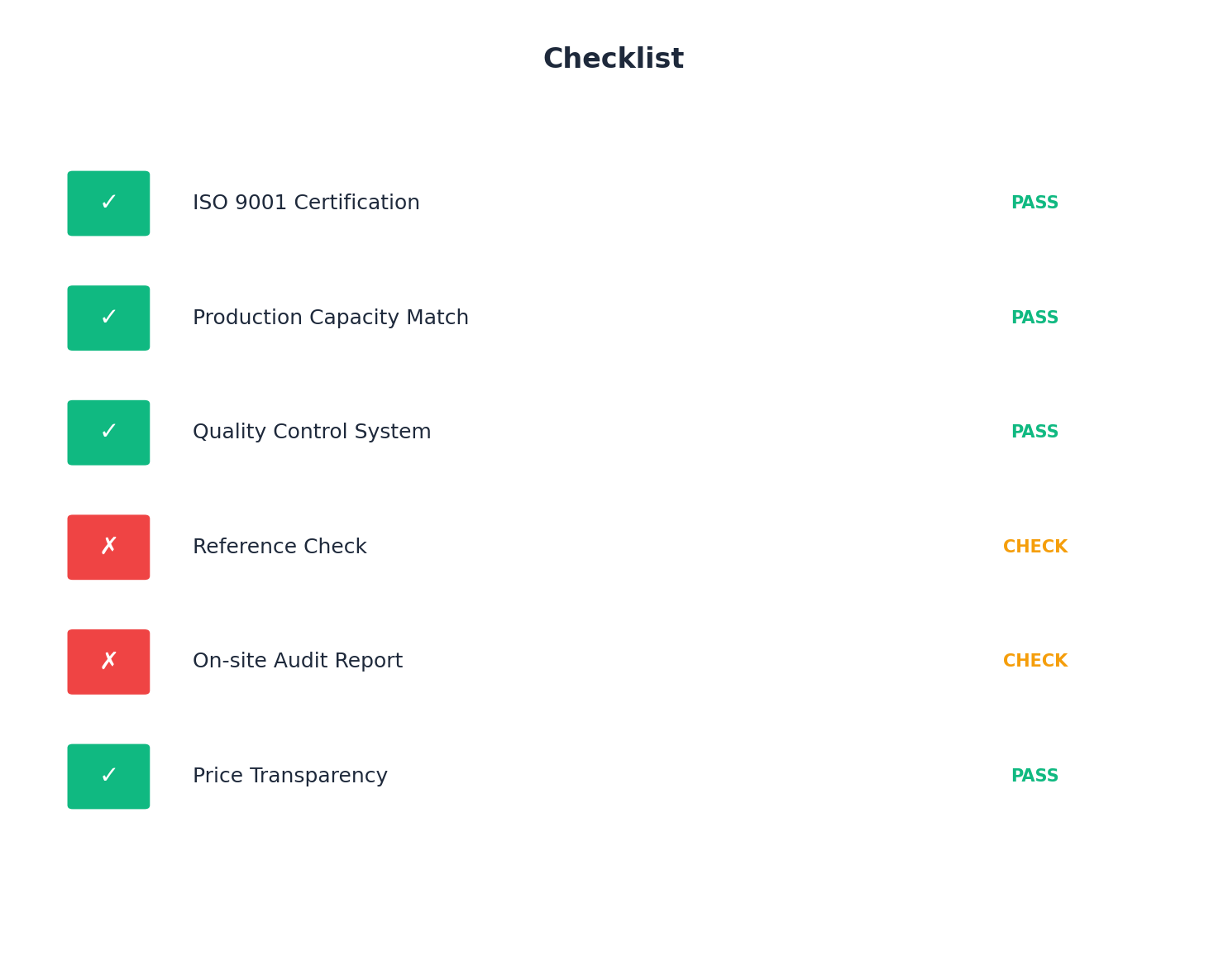
- If the certificate bill under default values is more than 3× your estimated cost of actual reporting → start actual reporting immediately.
- If it's between 2× and 3× → start with one pilot supplier, document the process, then expand.
- If it's under 1.5× → quantify first, but don't scramble. The gap will widen in 2030.
The thing most people miss: they treat CBAM as an environmental issue. It's not. It's a purchasing margin issue. Every euro you spend on default values is a euro you don't spend on better raw materials, better surface finish, or better logistics.
Five Steps to Get Real Emissions Data From Your Supplier
You've decided to invest in actual emissions data. Now what? Use this sequence. It's the same one I've used to qualify casting and extrusion suppliers for European buyers.
Step 1: Send the right questionnaire
Don't ask your supplier "are you green?" Ask for specific numbers: annual electricity consumption in MWh, fuel consumption (natural gas, coal, diesel), raw material input including scrap ratio, and production output in tons of finished goods. The CBAM implementing regulation (EU) 2023/1773 has a structured reporting format — use it directly. It's not a suggestion; it's the format the EU expects.
Practically: print the reporting annex, mark the blank cells, and attach it to your RFQ as an appendix. You are not asking for a favor. You are specifying a deliverable.
Step 2: Require aggregate-level emissions intensity
Have your supplier calculate embedded emissions per ton of product in kgCO2e per ton, using the CBAM methodology. If they don't know how, send them the relevant Annex. Many Chinese suppliers will push back; some will say "we don't measure that." That's fine. That's yours to solve with the next step.
A useful sanity range: for aluminum castings, embedded emission intensity runs anywhere from about 4 to 13 kgCO2e per kg depending on energy mix and scrap ratio. Your supplier should land somewhere in that range — and you should understand why.
Step 3: Cross-verify the data
You don't need a full third-party audit at first. Look at the utility bills yourself. Compare a supplier's declared electricity consumption against their production volume. If a foundry says they use 40,000 MWh/year and produce 10,000 tons of castings, that's 4.0 MWh per ton — in range for a medium-scale casting operation. If it's 8 MWh per ton, you've got a problem. Your back-of-the-envelope check is the cheapest audit you'll ever buy.
Typical figures for aluminum die casting sit around 0.8-1.8 MWh per ton of output; sand casting with heat treatment runs 3.0-5.5 MWh. Anything outside those bands deserves a phone call.
Step 4: Get third-party verification
For goods where the certificate gap is large, invest in ISO 14064-3 verification or an equivalent third-party assessment. This is what makes the data defensible when customs authorities question it. But choose the verifier carefully — they need to understand CBAM embedded emission rules, not just general carbon accounting.
Step 5: Put it in the contract
Make the CBAM data a contractual deliverable. For every new order of covered goods, require the supplier to provide the emissions calculation with each shipment, plus a quarterly data pack. Robert Davis calls this the wordless negotiation:
"When a foundry tells me 'it's just carbon compliance,' I ask for their data collection methodology. If they can't explain how they measured, I assume they're using default values — and I negotiate accordingly."
Smart suppliers will start to treat carbon data as a sales asset. The ones who don't are telling you exactly who you'll be paying the default-value markup for.
Six Traps That Will Cost You
Even importers who intend to do the right thing get caught by these.
Trap 1: Marketing numbers vs. regulatory numbers
A supplier's shiny CSR report about "20% carbon reduction" does not equal CBAM embedded emissions. Different boundary, different calculation method. Ask for the CBAM-specific number, not the website factoid.
Trap 2: Using the grid average without checking power purchase agreements
If your supplier buys green power directly through a PPA with a renewable developer, that can reflect in their scope 2 emissions. But you need the PPAs documented, not just an assertion. The European Commission will not accept "trust me, it's green."
In practice, the PPA contract, the renewable energy certificates, and the matching quarter's production logs all need to live in the same file as your declaration.
Trap 3: Forgetting upstream materials
For complex goods, embedded emissions include the upstream raw materials — imported aluminum ingots, alloys, coatings. If you only count the manufacturing energy, you're under-reporting, and you'll fail verification. This is the most common mistake in real-world reports.
Trap 4: Underestimating the penalty
If you don't have enough CBAM certificates at the end of the year, the penalty can reach €100+ per ton of CO2e not covered, adjusted for inflation. It's not the cost of certificates — it's worse. And the Commission can calculate the amount based on default values if your data gets rejected.
Trap 5: Thinking 2026 is "the start"
By August 2026, the first provisional certificates have already been required. If you're reading this and your supply contracts don't include emissions data, you're already behind. The two-year transition period was the warning. The penalty is the punchline.
The first annual surrender deadline — May 31, 2027 — is closer than it looks. This year's orders are this year's data. There is no "catch up later" in CBAM.
Trap 6: Treating it as an EU problem
You might be in the US and think "CBAM is not my problem." If you export any steel or aluminum-containing product to the EU — even as a component of an automotive part — the compliance burden cascades down the supply chain. Robert's been watching this from Georgia:
"My European customers are starting to ask about our carbon data. They don't have a choice — their customers demand it. So if it's coming through them, it's coming to me."
The question is not whether the data will be demanded. It's who pays for the inefficiency between now and when you have it.
FAQ
Why bother with actual emissions reporting during the transitional period?
The transition period reports let you use default values. But the data you collect during 2023-2025 becomes the foundation for the definitive regime. Every clean utility bill you digitize today is a step you won't have to redo under deadline pressure.
My supplier says they're ISO 14064 certified. Can I use their data directly?
Maybe. Check that the data boundaries match CBAM's embedded emissions requirements at the product level rather than the corporate level. You will likely need the data restructured per the CBAM methodology and typically a third-party verification step.
How much are CBAM certificates going to cost?
EU ETS allowances have ranged from about €55–90 per tonne in recent years, and many analysts expect upward pressure as allowances tighten. For 2026 planning, €75–100 per tonne is a reasonable working assumption. But the certificate price matters less than the multiplier difference between default and actual.
My goods aren't in the CBAM scope. Do I care?
CBAM covers steel, aluminum, cement, fertilizer, electricity, and hydrogen at the CN code level. If you buy finished products made from these materials, downstream goods can be caught via indirect rules and through your customers' compliance cascade. "Out of scope" is often just "not yet."
What if I can't get actual data from my supplier?
Then you're locked into default values — and their multipliers. The alternative is to switch suppliers. If two suppliers are otherwise equal, the one with measurable carbon data is the one whose parts cost less in the EU market. That's the new pricing reality.
The Bottom Line
CBAM is a lot of things: a regulatory mechanism, a climate policy, an accounting headache. But for EU importers, it's most practically a cost line that varies wildly based on one question:
Did you document your supplier's actual emissions — or didn't you?
The difference on a single aluminum extrusion order can be €350,000. Across a year of regular imports, it becomes a competitive advantage the size of a whole team. Or a cost disadvantage you'll be explaining to your CFO and your largest customer.
Once you've seen the CBAM default value markup vs actual emissions gap for your own product lines, you'll never look at a supplier quote the same way.
The tools exist. The suppliers can produce the data — many already do, because their other European customers ask for it. What's missing is usually a buyer with a clear process and a supplier contract that says carbon data is a deliverable, not a favor.
Use this. It's cheaper than the alternative. And when your German customer asks why your component carries a 40% smaller footprint than the default-value benchmark, you can answer with a binder, not a story.
And if you're a US or EU buyer with an active CBAM-covered supply chain, don't wait until the certificates are due. By the time they're due, the data can't be fixed retroactively — only priced.