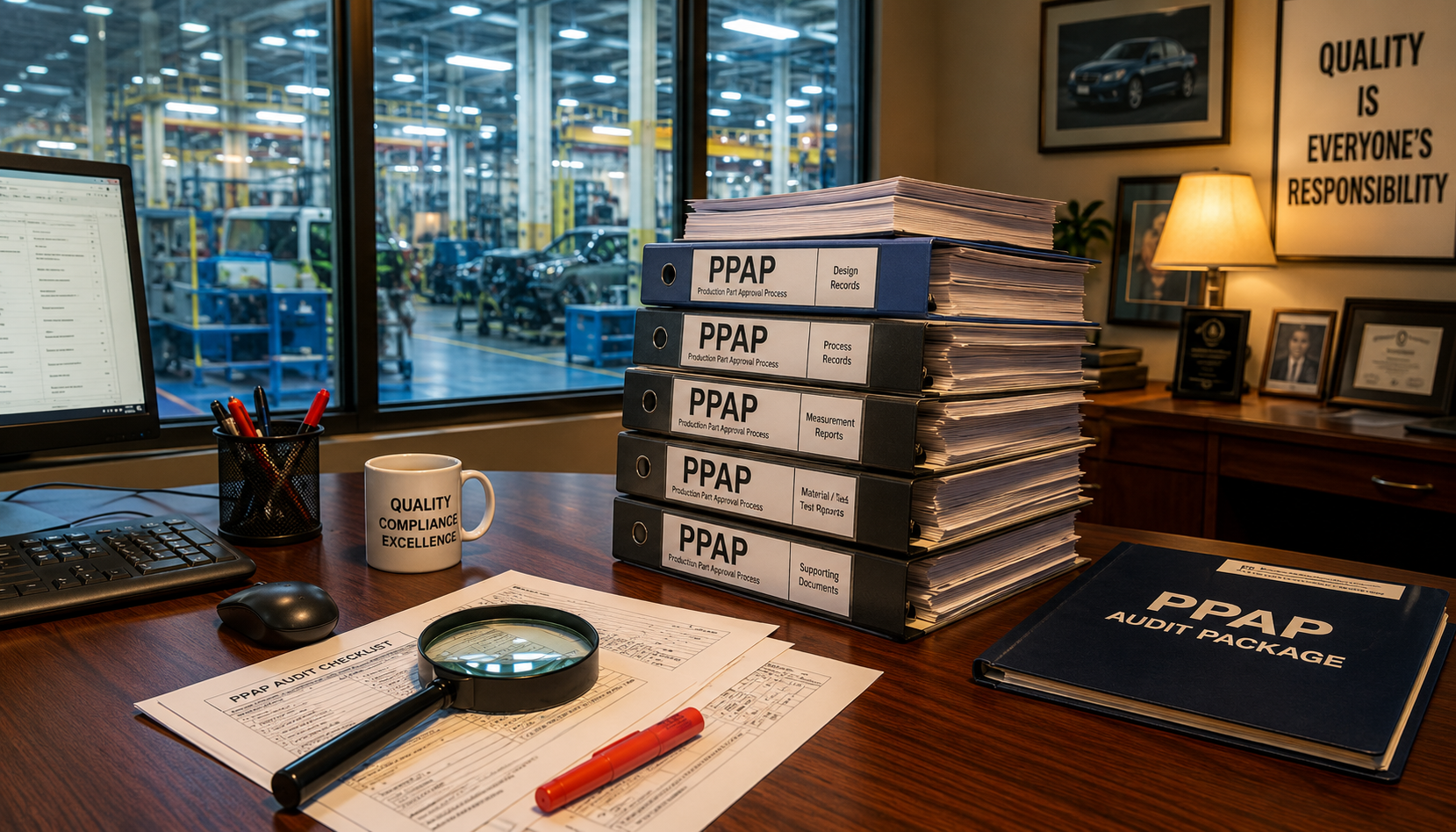
PPAP Chinese Supplier Automotive: 5 Hidden Traps in Every Submission
You just received a PPAP submission from your Chinese supplier. Every page is signed. All 18 elements are present. The dimensional results look perfect — Cpk values of 1.67 across all critical characteristics. Material test reports from a CNAS-accredited lab. The control plan is detailed. Feels good, right?
Don't trust it.
Not yet.
Last year alone, my team audited 22 PPAP submissions from Chinese automotive suppliers. 17 of them had at least one document that couldn't be verified. Five had material test reports that were completely fabricated — the lab on the letterhead confirmed they never tested that batch. Three submitted dimensional results with measurements that were statistically impossible (all 12 dimensions at exactly 1.67 Cpk? That's not capability, that's a copy-paste).
This isn't about bashing Chinese suppliers. Many of them are world-class. But the pressure to deliver perfect PPAPs — combined with the distance, language barriers, and a fundamental misunderstanding of what PPAP actually requires — creates a perfect storm for document manipulation.
Here are the five traps I see in almost every PPAP from China, and exactly how to catch them before they cost you a production run.
Why a "Perfect" PPAP from China Should Worry You
PPAP (Production Part Approval Process) was designed for a supply chain where engineers visit each other's factories, where quality managers speak the same language, and where a "sign-off" means someone actually verified the data. That's not the reality of sourcing from China.
Your supplier's sales engineer — who you've been emailing with — likely doesn't understand the technical content of the PPAP documents. The quality manager who prepared the submission may be working from a template given to them by a previous customer. And the person who signed the warrant? That's often the general manager, who signs because the customer asked for a signature, not because they personally verified the data.
I'm not exaggerating. In 2024, we audited a well-known casting supplier in Ningbo. Their PPAP for a steering knuckle looked flawless. On-site, we found the dimensional inspection was done with a caliper — not a CMM. The "capability study" was just the target values typed into a spreadsheet. The material test report? They used data from a different alloy supplier. "Same material, different batch, what's the difference?" the quality manager said. He wasn't trying to cheat. He genuinely didn't understand why it mattered.
"I have seen PPAP submissions from China that were 100% complete and 80% wrong. The documents are there, but the substance is missing." — Quality Director, German OEM, Shanghai plant
That's the real risk. Not malice — but a gap in understanding what PPAP actually means. And that gap is where your program gets derailed.
Trap #1 — Material Test Reports That Were Never Run
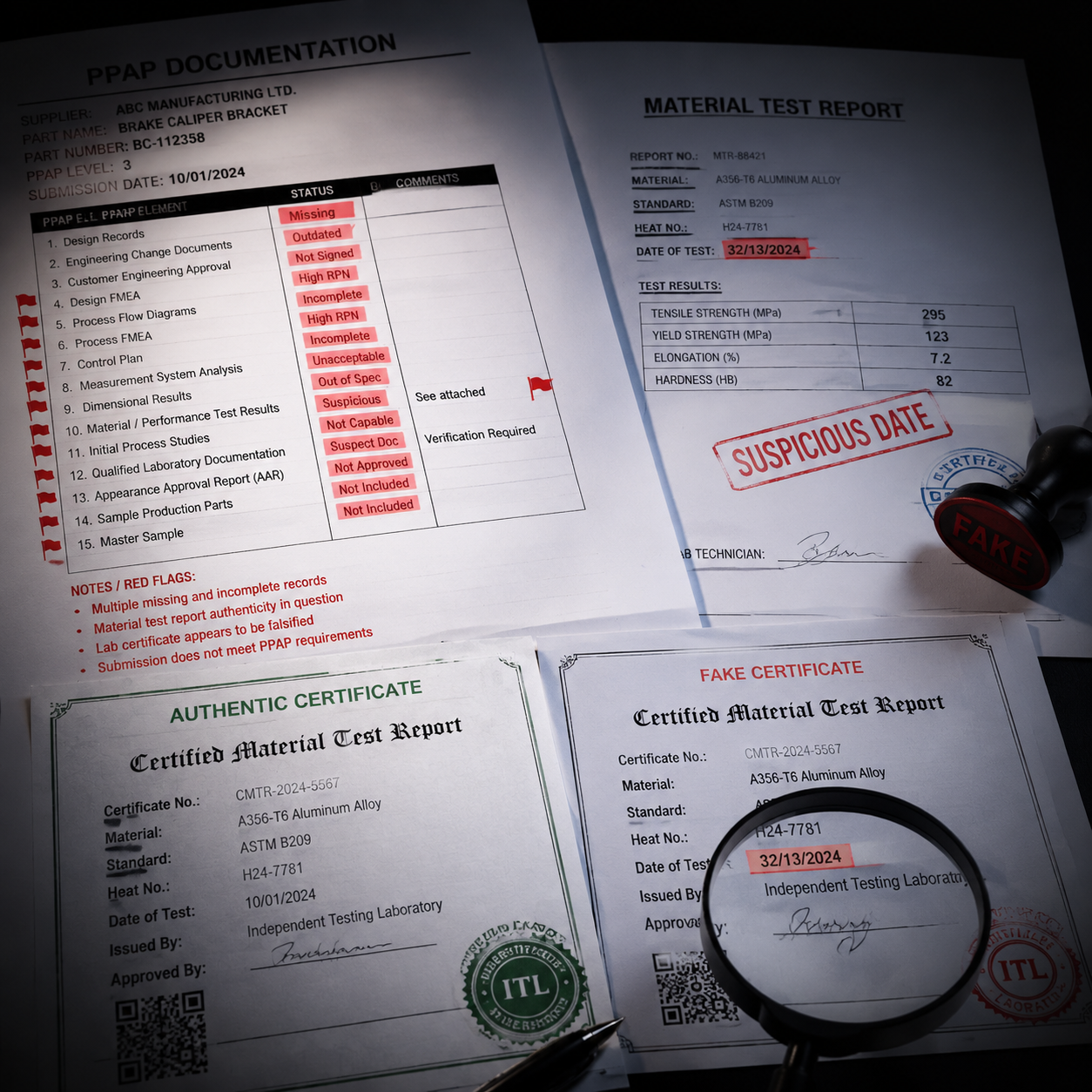
Material test reports (MTRs) are the most commonly faked document in Chinese PPAP submissions. Period.
We see two patterns:
- The photocopy: The supplier takes an old MTR from a previous batch, changes the date and batch number, and submits it as new. The lab logo, the chemical composition values, even the signature — all identical, just with a new date.
- The phantom lab: The MTR lists a testing laboratory that either doesn't exist, or exists but has never tested that supplier's material. We once had a supplier submit an MTR from "Shanghai Materials Testing Center" — the phone number was disconnected, and the address was a residential building.
How to catch it
- Check the date. If the MTR is dated on a Chinese national holiday (Spring Festival, National Day), the lab was closed. We caught one dated on Chinese New Year's Day — the supplier just picked a random date.
- Call the lab. Seriously. Use the phone number on their actual website, not the one on the MTR. Ask if they tested batch #XYZ for Supplier ABC. Most labs keep records for at least 5 years.
- Look at the composition. If the carbon content is exactly 0.30% and the manganese is exactly 0.80% — perfect round numbers — that's suspicious. Real test results have variation: 0.31%, 0.79%, etc.
- Cross-check with the mill certificate. If the supplier used domestic Chinese steel, request the original mill certificate from the steel mill. Compare the heat number. If they don't match, you have a problem.
One more thing: In 2023, we audited a supplier in Jiangsu who had submitted MTRs from "Intertek Shanghai" for two years. When we called Intertek, they had no record of that supplier ever using their services. The supplier had been downloading Intertek report templates from the internet and filling them in. Two years. Twenty-three shipments. All with fake MTRs.
Trap #2 — Dimensional Results That Don't Match Reality
A perfect dimensional report is not a sign of quality. It's a sign that someone typed the target values into a spreadsheet and called it a day.
Here's what real dimensional data looks like: it has variation. Every measurement is slightly different. The Cpk is good — maybe 1.33 or 1.67 — but the individual values cluster around the nominal, with some spread. That's process capability.
Here's what fake data looks like: all 12 dimensions show Cpk of exactly 1.67. The individual measurements are within 0.01mm of nominal every single time. The sample-to-sample variation is near zero. That's not a capable process — that's a fabricated spreadsheet.
"If the dimensional report looks too good to be true, it probably is. Real processes have variation. Zero variation means zero measurement." — Dr. Li, Quality Systems Auditor, Shanghai
How to catch it
- Request the原始CMM data. Any serious dimensional inspection uses a coordinate measuring machine (CMM) that saves the raw measurement files. If the supplier can't provide the原始CMM data, ask why. If they say "the software doesn't export," that's a red flag — every modern CMM exports CSV or native format.
- Check the measurement equipment calibration. The calibration certificate should be current and from an accredited lab. If the calipers expired six months ago, the data is unreliable.
- Ask for the operator name and shift. Then follow up: "Can I speak with the operator who measured these parts?" If they hesitate or can't produce the person, the data was likely never collected.
- Compare with your own inspection. When the parts arrive, measure a few critical dimensions yourself. If your measurements differ from the PPAP by more than 10%, you have a problem — either with their measurement system or their honesty.
Trap #3 — The "We Don't Need PPAP" Lie
You'll hear this from some Chinese suppliers, especially smaller ones who are used to supplying domestic or aftermarket customers:
"PPAP? We've been making this part for 10 years. No customer has ever asked for PPAP. Your requirements are too strict."
Translation: they don't have a quality system that can produce PPAP-compliant documentation. And if they don't have the documentation, they likely don't have the process control either.
I had a supplier in Wenzhou tell me, "We don't do PPAP. We do quality inspection at the end of the line. If the part is good, we ship it. That's our PPAP." He wasn't being difficult — he genuinely believed that final inspection was equivalent to process approval. He had never worked with a Tier-1 automotive customer before.
How to handle it
- Don't negotiate on PPAP. If you're sourcing automotive components, PPAP Level 3 is non-negotiable. Any supplier who pushes back on this is not ready for your business.
- Offer a path. Some smaller suppliers are willing to learn. If the supplier has good technical capability but lacks PPAP knowledge, consider investing in a supplier development program — help them set up the documentation. We've done this with several suppliers and it paid off.
- Walk away if they push back twice. If after explaining the requirement, the supplier still resists, move on. The cost of a failed PPAP — production delays, line stoppages, re-audit costs — far outweighs any price savings.
Trap #4 — Process Flow Diagrams That Describe a Fantasy Factory
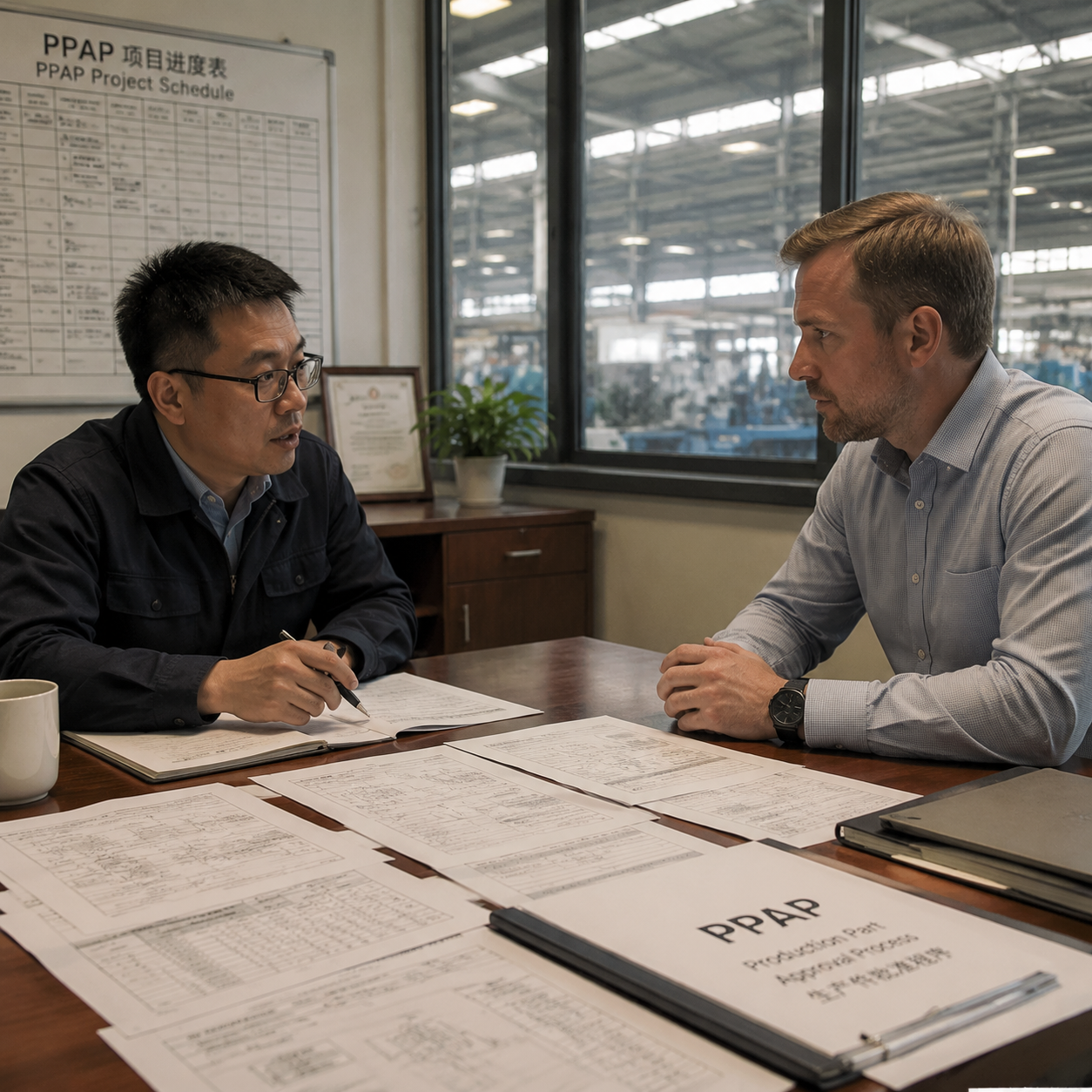
The process flow diagram (PFD) is supposed to show how the part is actually made — every step from receiving raw material to final shipping. But many Chinese suppliers submit a generic PFD that doesn't match their actual production line.
Common gaps we find:
- Missing operations: The PFD shows 8 steps, but the factory actually does 12. They "forget" to include the heat treatment step, or the surface finishing step, or the in-process inspection. These omissions hide quality risks.
- Wrong sequence: The PFD shows inspection after machining, but in reality, inspection happens before machining (or not at all). The sequence matters for process control.
- Fake equipment: The PFD lists a "CMM inspection station" but the factory doesn't own a CMM. We've seen this more than once.
How to catch it
- Walk the line. Print the PFD and physically walk through the factory, step by step. Check that each station exists, that the equipment matches, and that the operators are following the documented sequence.
- Take photos. Document each station with timestamped photos. Compare against the PFD later in the office.
- Ask the operator. "What happens after this step?" If the operator's answer doesn't match the PFD, you've found a gap.
- Look for undocumented rework loops. Many factories have a rework bench that doesn't appear on the PFD. Rework that isn't documented is rework that isn't controlled.
Real example: A supplier's PFD for an aluminum casting showed "T6 heat treatment" as step 7. On-site, we found the T6 furnace was broken and had been for 8 months. The supplier was sending castings to a third-party heat treater — but that wasn't documented in the PFD or the control plan. When we asked about it, the quality manager said, "Oh, that's temporary. We'll fix the furnace next month." Eight months is not temporary.
Trap #5 — Capability Studies with No Actual Data
Capability studies (Cpk/Ppk) are supposed to demonstrate that your supplier's process can consistently produce parts within specification. But we routinely see capability studies based on 5 parts, not 30. Or studies where the data was simulated, not measured.
The telltale signs:
- Sample size of 5 or 10. PPAP requires a minimum of 30 parts for a valid capability study (some customers require 100). A study with 5 parts tells you nothing about process stability.
- All Cpk values are identical. If every dimension comes back at exactly 1.67, that's not real data. Real capability varies by dimension — some will be 1.3, others 1.8, others 2.1.
- No control chart. A capability study without a control chart (X-bar and R chart) is incomplete. The control chart shows whether the process was in control during the study. Without it, the Cpk value is meaningless.
- Data that's too "clean." Real measurement data has noise. If every data point is perfectly centered with minimal spread, someone likely typed in the nominal values.
How to catch it
- Ask for the原始data file. Not the summary, not the report — the原始measurement data. Load it into Excel and look at the distribution. Is it normally distributed? Are there any outliers? Does the data look plausible?
- Plot the data yourself. Generate a histogram and a control chart. If the data looks too perfect or has suspicious patterns (e.g., all values within 2% of nominal), question it.
- Request a re-study on a different batch. Ask the supplier to run a new capability study on the next production batch. Compare the results. If the Cpk values change dramatically, the original study was likely cherry-picked or fabricated.
- Verify the measurement system. A capability study is only as good as the measurement system. Ask for the GR&R (Gauge Repeatability and Reproducibility) study. If the GR&R is > 30%, the capability data is unreliable anyway.
The 12-Point PPAP Audit Checklist
Use this checklist every time you receive a PPAP from a Chinese supplier. It takes 30 minutes and it will save you from the traps above.
- Verify the supplier's PPAP training. Ask for records. Who in the organization has been trained on PPAP? If no one has, the submission is likely template-based.
- Cross-check MTR dates against the factory holiday calendar. If the test report was issued during a shutdown, it's fabricated. Request the原始mill certificate.
- Call the testing lab. Use the phone number from the lab's official website. Confirm batch number and test date.
- Request原始CMM data files. Reject PDF summaries alone. Look for measurement variation that indicates real inspection.
- Plot the dimensional data yourself. Check for statistical impossibilities — identical Cpk values, zero variation, perfect round numbers.
- Walk the process flow. Print the PFD and physically verify each station. Photograph each step. Compare.
- Check calibration certificates. All measurement equipment should have current, accredited calibration. Reject expired certificates.
- Review the control plan against the PFD. Every step in the PFD should have a corresponding control in the control plan. Gaps are risks.
- Audit the capability study methodology. Minimum 30 parts. Control chart included. Raw data available. GR&R ≤ 30%.
- Check the warrant signature. Who signed? Do they have the authority? Is the signer still employed at the supplier? (We've seen a warrant signed by someone who left the company 2 years prior.)
- Verify the supplier's次级supplier management. If any material or process is subcontracted, the PPAP must include those次级suppliers' approvals.
- Conduct a physical part inspection. When the parts arrive, measure critical dimensions yourself. Compare against the PPAP data. Discrepancies > 10% trigger a full audit.
Print this checklist. Keep it on your desk. Every PPAP from China goes through these 12 points before you sign off. No exceptions.
Why This Matters More Than You Think
A bad PPAP doesn't just mean paperwork problems. It means:
- Production line stoppages when parts don't fit — costing $10,000–$50,000 per hour in an automotive plant
- Safety recalls if material properties don't meet specifications — the cost of a recall runs from $10 million to $500 million depending on severity
- Lost trust with your customer — once you ship bad parts, it takes years to rebuild confidence
- Missed program launches — a PPAP that fails validation can delay a vehicle program by weeks or months
I've seen all of these happen. Every single one was avoidable with proper PPAP verification.
The suppliers who get PPAP right — and there are many excellent Chinese suppliers who do — welcome your audit. They're proud of their data. They'll walk you through their process without hesitation. They don't cut corners because they understand that PPAP is not a paperwork exercise. It's proof that they can make your part, consistently, every time.
Those are the suppliers you want to partner with.
FAQ — PPAP Chinese Supplier Automotive
Is PPAP mandatory for Chinese automotive suppliers?
If you're a Tier-1 or Tier-2 supplier exporting to global automakers, yes — PPAP Level 3 is the baseline expectation. Chinese suppliers who claim "we don't do PPAP" are not ready for international automotive business. That statement alone should be a red flag. Even if they make good parts, they can't prove it consistently, and that's a risk your customer won't accept.
What is the most commonly faked PPAP document from Chinese suppliers?
Material test reports and dimensional results are the two most commonly manipulated documents. We've seen suppliers photocopy an old test report from a different batch, change the date, and submit it as new. Dimensional reports often show measurements that were never taken — the numbers look too perfect, with no variation across samples. Always request原始CMM data files, not just PDF summaries.
What level of PPAP is typically required for Chinese suppliers?
Level 3 is the most common requirement for production parts sourced from China. It requires the supplier to submit all 18 elements including design records, FMEA, control plan, dimensional results, material test reports, and capability studies. Do not accept Level 1 or 2 for critical safety-related components. Level 5 (full on-site review) may be required for high-risk parts like steering, braking, or airbag components.
How do I verify a Chinese supplier's PPAP submission is authentic?
Cross-check the test report date against the factory's production schedule and holiday calendar. Request原始CMM data for dimensional results — reject PDF-only submissions. Verify the testing lab's accreditation (CNAS certification is the Chinese equivalent of ISO/IEC 17025). And most importantly, conduct an on-site audit to confirm the process flow and control plan match what is documented. If you can't visit in person, hire a third-party inspection agency to do it for you.
What happens if a Chinese supplier fails PPAP?
The supplier must submit a corrective action plan with root cause analysis and a timeline for re-submission. Allow a maximum of 30 days for corrections. If the second submission also fails, initiate a supplier development program or begin qualifying an alternative source. In our experience, the second failure rate among Chinese suppliers is around 35%. Don't give unlimited chances — each failed submission costs you time and money.
Your Next Step
You don't need to be a PPAP expert to catch these traps. You just need to know what to look for — and to trust your instincts. If something feels off about a submission, it probably is.
Start with the 12-point checklist on your next PPAP review. It takes 30 minutes and it will save you from the most common — and most costly — mistakes.
And if you don't have the internal resources to audit PPAP submissions from Chinese suppliers, you don't have to go it alone. That's exactly what we do at Interstate International — we act as your on-the-ground quality team in China, verifying PPAP documents, auditing suppliers, and making sure what's on paper matches what's happening in the factory.
Need help verifying a PPAP from your Chinese supplier?
We'll audit your submission against the 12-point checklist and give you a pass/fail decision within 48 hours. Contact our procurement team to get started.
Hans Weber is an Automotive Procurement Specialist with 18 years of experience in Tier-1 supply chain management. He has conducted over 200 PPAP audits across China, Southeast Asia, and Europe. The data and examples in this article are based on his personal audit experience.
Need a Verified Casting Supplier?
We've audited 200+ foundries across China. Tell us your requirements — material, quantity, tolerances — and we'll match you with 3 qualified suppliers that have already passed our technical vetting. Each comes with a full audit report.
Get Matched with Suppliers →- ✓ 1,700+ vetted foundries
- ✓ 40+ QA engineers
- ✓ Serving buyers in 22 countries
- ✓ ISO 9001 / IATF 16949 capable