China Casting Landed Cost Calculator 2026: Run the Real Numbers
That foundry in Hebei quoted you $2.80/kg FOB for ductile iron GGG50. Sounds like a win. Here's the catch: by the time that container rolls through your dock in Houston, you're paying close to $3.92/kg. That's a 40% uplift nobody put on the original quote.
Skip this calculation on your next order and you're not comparing suppliers. You're gambling.
This is the 2026 math. Section 301 rates moved, freight re-priced itself twice in twelve months, and the old "just add 15% for shipping" rule of thumb is dead. Below is how to calculate your true landed cost for Chinese castings in five steps — with exact rates and realistic numbers to plug in.
The Landed Cost Formula for 2026
Every dollar you'll actually pay sits in this equation:
Landed Cost = FOB Price + Section 301 Tariff + MFN Duty + Ocean Freight + Marine Insurance + Customs Brokerage + Inland Trucking (China side) + Inland Trucking (US side)
Six of those eight line items are beyond the FOB quote. Most buyers who get burned simply never asked for them. The supplier won't volunteer freight, and the tariff is your problem, not theirs.
Here's what each line looks like in 2026, from the biggest to the most annoying.
Use the Calculator Right Here
Rather read than type? Use the live calculator below. It's the same math I walk through step by step further down.
Step 1: Section 301 — The Line Item That Breaks Budgets
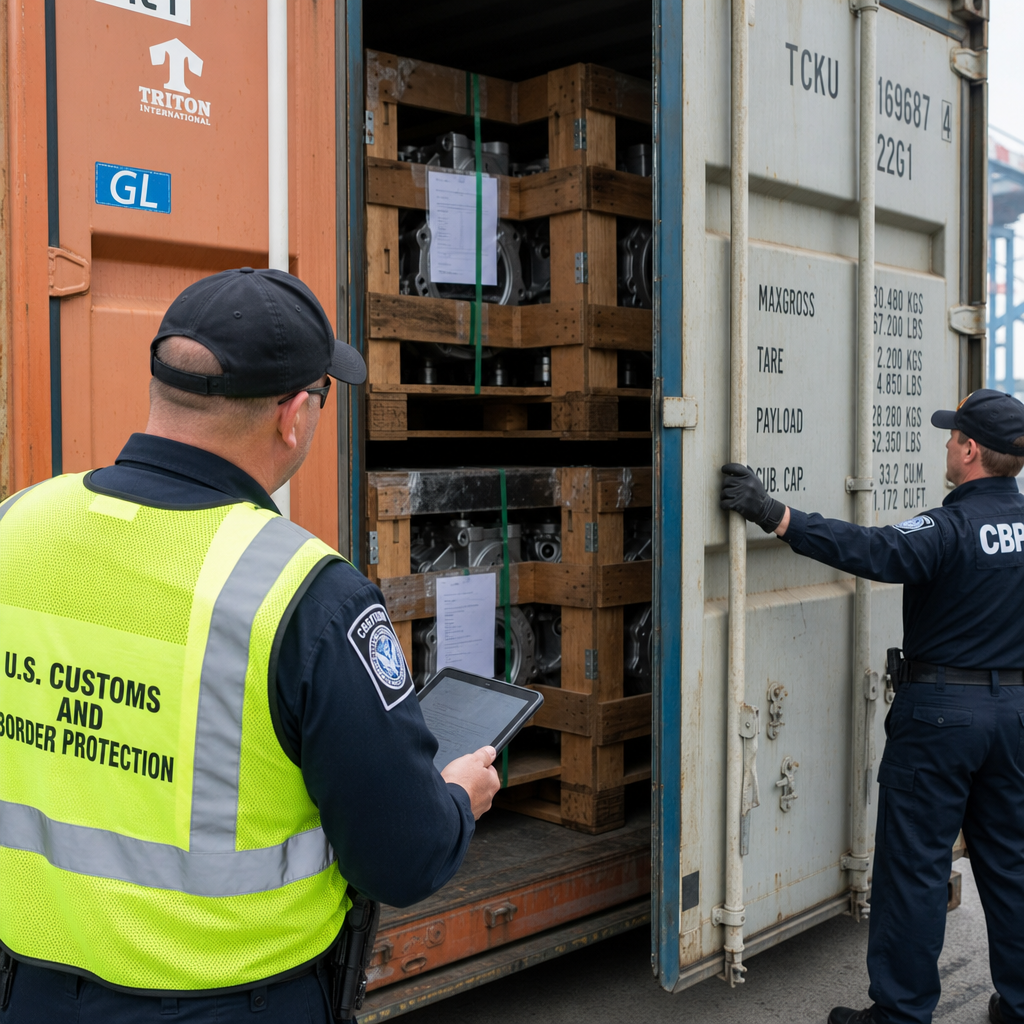
Section 301 is a tariff on imports from China, and for most castings it's sitting at 25% in mid-2026. But don't just assume that number applies to you. Three exceptions matter:
- Pipeline system castings carry an extra 30% escalation from September 2025 — total Section 301 at 55%.
- A separate category of machinery castings moved to 50% in the last review cycle.
- HTS codes that overlap with semiconductor manufacturing equipment also sit at 50%.
The rule: check the current Section 301 rate for your exact HTS code before you price anything. Ask your customs broker for a written rate confirmation. Ten minutes of verifying now saves you a five-figure surprise later.
Here's the part that confuses a lot of buyers: Section 301 is calculated on the transaction value — effectively the FOB price, not CIF. Freight and insurance are not part of the duty base. So if a supplier quotes you FOB, the tariff is simply: tariff rate × FOB value.
Step 2: MFN Duty — Small, but It Adds Up
On top of Section 301, most castings carry a Most Favored Nation (MFN) duty. These are the baseline rates that apply to pretty much every country:
- Ductile iron fittings and castings, HTS 7325.10.00 — 3.9%
- Cast iron articles, HTS 7325.99.50 — 3.9%
- Cast gear boxes and parts, HTS 8483 — 2.5%
- Aluminum castings, HTS 8708 (auto parts) — 2.5%
So a typical ductile iron casting from China: 25% Section 301 + 3.9% MFN = 28.9% total tariff. Pipeline castings: 55% + 3.9% = 58.9%. On a $56,000 FOB order, that's the difference between $16,184 and $32,984 in duty. Know which one you're signing up for.
Step 3: Ocean Freight — The Unpredictable One
Ocean freight is where budgets go to die. A 40-foot container from Shanghai to Los Angeles cost about $1,200 in early 2024, then jumped past $5,000 during the Red Sea disruptions. For 2026 planning, budget $3,000 to $5,000 per 40' container, depending on the route and whether you have a contract rate or you're buying spot.
Spot freight swings $1,500 or more per container depending on the month. Contract rates are steadier but lock you in. If you're sourcing castings continuously, book a contract rate with a freight forwarder now — don't wait until you have a PO in hand.
Volume logic matters too. Twenty tons of ductile iron fits roughly 10 to 12 pallets, which is somewhere between an LCL shipment and a full 20' container. Full-container loads always win on cost per kilogram because the fixed cost spreads across more weight.
Step 4: Insurance, Brokerage, and Both Truckings
These are the small line items that everyone forgets, and together they quietly eat 2% to 4% of your total cost.
- Marine insurance: 0.3% to 0.5% of the declared value. Don't skip it. A container of ductile iron worth $60,000 inside a vessel fire is a $60,000 lesson.
- Customs brokerage: $150 to $400 per entry. If your shipment triggers a customs exam, add another $200 to $500.
- Inland trucking, China side: $400 to $1,200, depending on how far the foundry sits from the port. A Hebei foundry ships from Tianjin — that's cheap. A foundry in Sichuan ships from Shanghai or Shenzhen, and trucking doubles.
- Inland trucking, US side: $300 to $800 from the port to your warehouse. Ports like LA and Long Beach add chassis fees and often appointment delays.
Demurrage and detention are the silent killers. Containers sitting at the port past the free time run $100 to $200 per day. A delayed customs exam can easily burn $1,000 before the container even leaves the terminal.
The Worked Example: 20 Tons of Ductile Iron
Let's make it concrete. Here's a real quote structure for 20,000 kg of ductile iron GGG50 at $2.80/kg FOB, shipped from Tianjin to Houston in one 40' container:
| Line Item | Basis | Amount |
|---|---|---|
| FOB value (20,000 kg × $2.80) | — | $56,000 |
| Section 301 tariff (25%) | FOB value | $14,000 |
| MFN duty (3.9%) | FOB value | $2,184 |
| Ocean freight (1 × 40' container) | — | $4,500 |
| Marine insurance (0.5%) | FOB value | $280 |
| Inland trucking, China (Tianjin port) | — | $500 |
| Customs brokerage | — | $250 |
| Inland trucking, US (Houston) | — | $650 |
| Total landed cost | $78,364 | |
| Landed cost per kg | $3.92 | |
| Uplift vs FOB | 1.40× |
Now you see why "add 15%" doesn't work anymore. On this order, the uplift is 40%. If that foundry had quoted you a pipefitting under the pipeline escalation, the same order would land at $4.95/kg — a 77% uplift. And that's why the landed cost calculator isn't a nice-to-have. It's the difference between a good buy and a bad one.
Build Your Own Spreadsheet in 5 Steps
You don't need a tool subscription to run this math. Set up a spreadsheet with these five lines:
- Get the real FOB quote. Make the supplier break out the unit price per kg, mold cost, tooling amortization, packing, and any surface treatment charges. Lump-sum quotes hide margin.
- Verify the HTS code with your broker. Write the code down and get the current Section 301 and MFN rate confirmed in writing. HTS codes change; last year's code may be wrong this year.
- Get a freight quote in writing. Use a forwarder, not a spot-rate portal. Ask for the rate valid for 30 days, including THC, documentation fees, and any peak-season surcharges.
- Estimate inland costs on both sides. Ask the foundry "how much to deliver to the port?" and "which port?" Then quote your own port-to-warehouse trucking. Chinese inland trucking is regional, and the range is wide.
- Add a 5% buffer. Currency swings, demurrage, a customs exam, a fuel surcharge — one of these will happen. A 5% buffer is the difference between a smooth landing and an emergency wire transfer.
Is China Still Competitive? Run the Same Math on Other Countries
Here's the question every buyer asks after seeing a 40% uplift: shouldn't I just source from India, Vietnam, or Mexico? Sometimes yes. The table below is a fair 2026 comparison for ductile iron castings:
| Country | FOB Ductile Iron ($/kg) | Section 301 | Typical Landed ($/kg) | Lead Time |
|---|---|---|---|---|
| China | $2.20 – 3.20 | 25% (some 50%) | $3.90 – 5.40 | 6–10 weeks |
| India | $2.60 – 3.80 | 0% | $3.40 – 4.80 | 8–12 weeks |
| Vietnam | $2.90 – 4.00 | 0% | $3.80 – 5.20 | 8–14 weeks |
| Mexico | $4.50 – 6.50 | 0% (USMCA) | $5.00 – 7.20 | 3–6 weeks |
India wins on paper because it dodges Section 301 entirely. The gap is real: roughly $0.50–0.60/kg on a typical ductile iron order. On 20 tons, that's $10,000–12,000 a container.
But "paper" is doing a lot of work there. India's foundry capacity for complex castings — thin-wall ductile iron, tight tolerances, consistent metallurgy at volume — is still a fraction of China's. You might wait 12 weeks instead of 8. Vietnam has serious quality but caps out on capacity fast. Mexico wins on lead time and logistics, not price.
The honest 2026 takeaway: for simple, heavy, commodity castings, India is often cheaper. For complex, high-volume, tight-tolerance parts, China still delivers the best quality-per-dollar. Run the full landed cost for both before you decide. The calculator above works for any country — just set Section 301 to 0% and adjust the freight.
When China Still Wins in 2026
Don't let the tariff scare you into a bad sourcing decision. China still dominates in four scenarios:
- Complex castings. Lost-foam, investment-cast geometry, thin sections under 5mm, internal channels. China's foundry density means more shops with proven tooling for hard parts.
- Mold and tooling. Chinese tooling is still 30% to 50% cheaper than most alternatives, and tooling amortized over a large order dilutes the landed-cost hit.
- Volume. If you need 50 tons a month, most Indian and Vietnamese foundries physically can't scale that fast. China can.
- Certification maturity. ISO 9001, IATF 16949, DIN EN-GJS certification, third-party inspection — Chinese export foundries have been through the dance for 20 years. Your QC team won't have to hold their hand.
The math changes by part category. Run it both ways. Sometimes the "expensive" country is cheaper per good part, and sometimes China still wins despite the tariff.
Six Landed-Cost Mistakes That Cost Buyers Real Money
You'd think this would be boring. It's not. These six errors show up in procurement teams every single quarter:
- Comparing FOB quotes like they're final prices. If you're comparing a $2.80/kg FOB quote from China with a $3.20/kg FOB quote from India, you're not comparing real prices. Landed cost or nothing.
- Assuming 25% Section 301 covers everything. Pipeline castings are at 55%. Some machinery castings at 50%. Verify your HTS code, every time.
- Miscoding the HTS number. An incorrect classification doesn't just delay your shipment. It triggers penalties, re-assessments, and sometimes a customs audit of every shipment for the past three years.
- Forgetting inland trucking on the China side. A foundry 800 km from the port adds $800–1,200 in trucking that some suppliers quietly build into their FOB price. Ask for it as a separate line.
- Ignoring demurrage and detention. At $100–200 per day per container, a two-week customs delay costs more than the brokerage itself. Plan your delivery calendar with buffer.
- Buying spot freight at the last minute. Spot rates are 20% to 40% higher than contract rates in volatile periods. Book forwarder capacity when you send the PO, not when the castings are ready to ship.
Frequently Asked Questions
What's the typical landed cost uplift for Chinese castings in 2026?
Between 25% and 50% on top of the FOB price, depending on Section 301 tariff rates (25-50%), MFN duty (0-3.9%), ocean freight, insurance, customs brokerage, and inland trucking. On a typical ductile iron order, landed cost lands at roughly 1.40× the FOB quote. For pipeline-exempt classifications, the uplift can pass 75%.
How is Section 301 calculated on castings? On FOB or CIF?
Section 301 is calculated on the transaction value — effectively FOB price, not CIF. Ocean freight and insurance are not part of the duty base. The importer pays the tariff on the merchandise value, then freight and other charges are separate. If someone quotes you "all-in including duty," ask them to show the FOB base they used.
Are castings from other countries cheaper than China after tariffs?
Often, yes. India avoids Section 301 entirely and typically lands at $3.40-4.80/kg for ductile iron, versus China at $3.90-5.40/kg. Vietnam sits close to China but has limited capacity for complex castings. Mexico wins on speed, not price. For high-volume complex castings, China can still win on quality-per-dollar — run the full calculator both ways before you commit.
What is the current duty on ductile iron castings from China?
As of mid-2026, most ductile iron castings under HTS 7325.10.00 carry a 3.9% MFN duty plus a 25% Section 301 tariff, totaling 28.9%. Certain pipeline-related castings face an additional 30% escalation from September 2025, bringing the total to 58.9%. These rates change; verify with your customs broker for your specific HTS code.
FOB vs DDP — which should I use for my first China casting order?
FOB gives you transparency because you see each cost line: tariff, freight, insurance, brokerage, trucking. DDP gives you one total price but hides the breakdown, and some DDP quotes build a buffer into the margin for tariff risk. For your first order, get an FOB quote and build the landed cost yourself. For repeat orders, DDP only makes sense if the supplier shows you the math.
Before You Sign That PO
The tariff landscape isn't going to quietly go away in 2026. Section 301 rates are baked into the system, freight will keep moving, and the word "calculator" in this article's title is there for a reason: you should literally run this math on every quote that lands on your desk.
Here's your checklist, in order:
- Get the FOB quote with every line item broken out.
- Confirm the HTS code and current duty rate with your broker in writing.
- Get a 30-day freight quote from a forwarder, not a spot portal.
- Ask the foundry for inland trucking to the port, itemized.
- Add insurance, brokerage, US trucking, and a 5% buffer.
- Then — and only then — compare it against India, Vietnam, or Mexico.
The math doesn't lie. Run it before you sign the PO, not after.
Need a second set of eyes on a live quote? Get a landed-cost breakdown within 48 hours — send your FOB quote and part spec here, and we'll run it both ways for you. No charge, no obligation.
Related reading: The Casting Sourcing Guide: How to Shortlist Factories Without Getting Burned · China Casting Supplier Verification Checklist (7 Points)
Need Help with China Casting Landed Cost Calculator 2026: The Real Numbers?
Get matched with 3 verified foundries in 24 hours. No markup, transparent pricing.
Request Quotes →