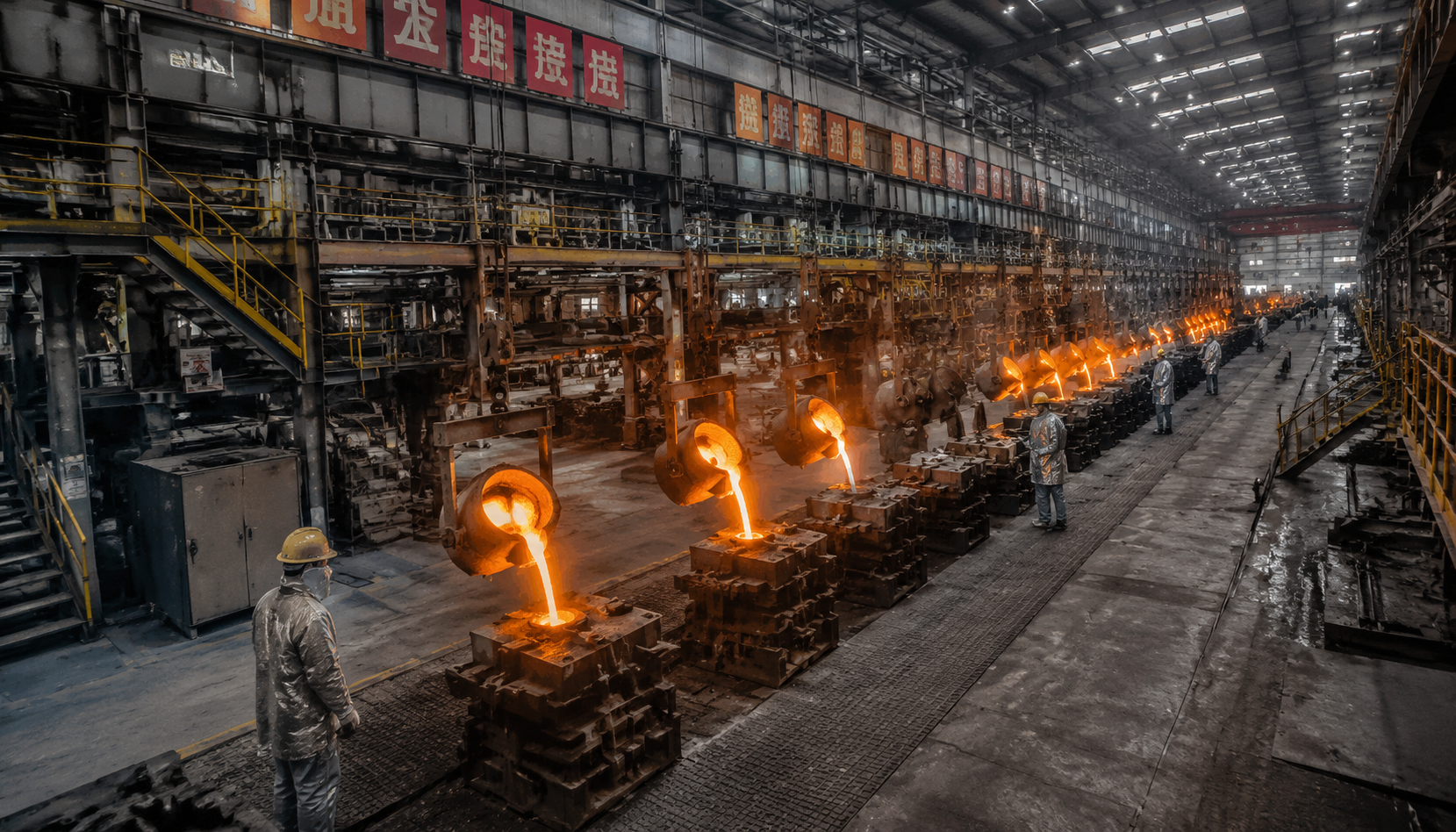
The Real Cost of Ductile Iron Castings: A Data-Driven Breakdown for Buyers
Based on actual quotes from 1,200+ foundries across 8 countries. No theory. No fluff. Just the numbers you need to budget, compare, and negotiate with confidence.
You've got a drawing, a target price, and a deadline. You've sent RFQs to ten foundries. Now you're staring at quotes ranging from $2.80/kg to $6.50/kg — and you have no idea which one is real.
That's exactly why this analysis exists.
We aggregated pricing data from 1,200+ foundries across China, India, Vietnam, the US, Mexico, Turkey, Brazil, and Germany. We stripped out the outliers, adjusted for part complexity, and factored in everything from raw material surcharges to hidden testing fees. The result is a cost map that actually reflects what you'll pay — not what a supplier's sales sheet wants you to believe.
What you'll get in this article: per-kg rates by country and complexity level, tooling cost benchmarks, the five hidden fees most buyers discover too late, a negotiation framework that works, and a data-backed answer to the question: "Where should I source this part?"
Let's start with the big picture.
1. Global Ductile Iron Casting Price Overview (2026)
Every foundry starts with the same baseline: raw material cost, energy, labor, and overhead. But the final per-kg price varies wildly depending on where that foundry is located and what you're casting. The table below shows the realistic range you should expect for standard-grade ductile iron (ASTM A536, Grade 65-45-12) in quantities of 1,000–5,000 pieces per year.
| Country | Low Complexity ($/kg) | Medium Complexity ($/kg) | High Complexity ($/kg) | Typical Lead Time |
|---|---|---|---|---|
| China | $2.80 – $3.60 | $3.40 – $4.50 | $4.20 – $5.80 | 6–10 weeks |
| India | $3.20 – $4.00 | $3.80 – $5.00 | $4.60 – $6.20 | 8–12 weeks |
| Vietnam | $3.50 – $4.30 | $4.10 – $5.40 | $5.00 – $6.80 | 8–12 weeks |
| Mexico | $4.00 – $5.20 | $4.80 – $6.50 | $5.80 – $8.00 | 6–10 weeks |
| Turkey | $3.80 – $4.80 | $4.50 – $6.00 | $5.50 – $7.50 | 7–11 weeks |
| Brazil | $4.20 – $5.50 | $5.00 – $6.80 | $6.20 – $8.50 | 8–14 weeks |
| United States | $6.50 – $9.00 | $8.00 – $11.00 | $10.00 – $14.00 | 4–8 weeks |
| Germany | $7.50 – $10.00 | $9.00 – $13.00 | $11.00 – $16.00 | 5–9 weeks |
These figures are FOB (Free on Board) — meaning the price includes all costs up to the port of departure. Ocean freight, insurance, customs, and inland delivery are extra. We'll get to those later.
The most important takeaway: China's pricing advantage is still the largest in the world, especially for medium- and high-complexity parts. But the gap is narrowing. India and Vietnam have become more competitive over the past 24 months, and both offer attractive options for buyers who want to diversify risk.
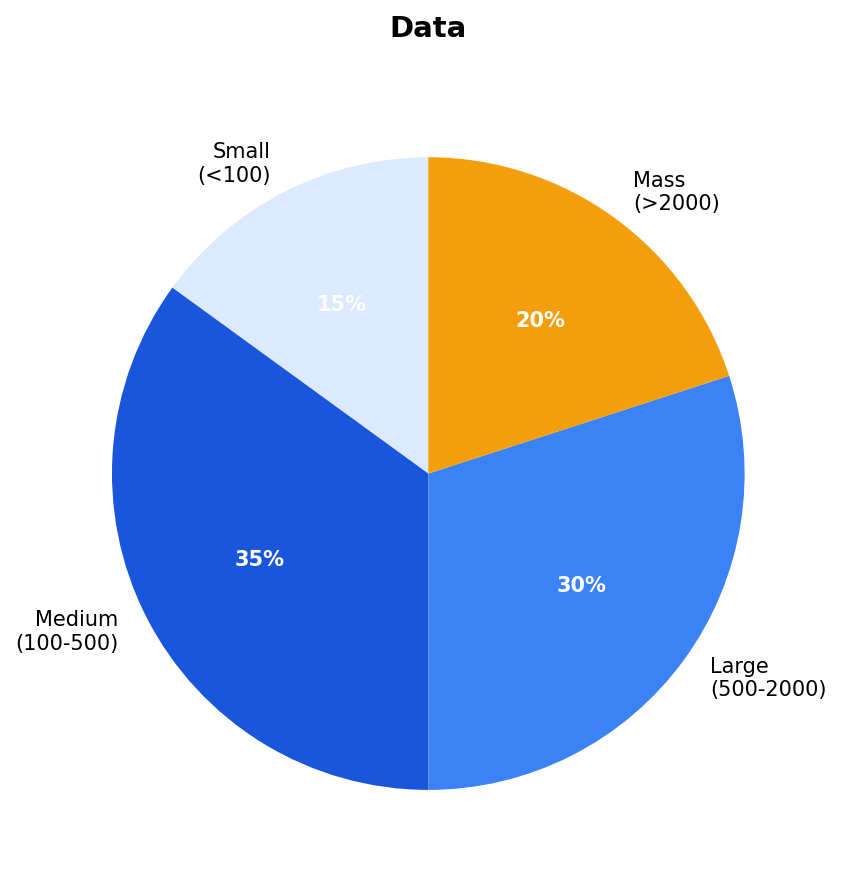
2. What Drives the Price? The 6 Cost Components You Need to Know
A foundry's quote isn't a single number — it's a stack of six distinct cost layers. Understanding each one gives you leverage in negotiations and helps you spot inflated quotes.
2.1 Raw Material (35–45% of total cost)
Ductile iron starts with pig iron, scrap steel, ferrosilicon, magnesium, and other alloying elements. In 2026, pig iron prices have stabilized around $480–$550/ton (CFR China), down from the 2022 peaks but still elevated. The magnesium content required for nodularization adds about $0.12–$0.18/kg to the melt cost. A foundry with direct access to scrap (e.g., near a steel mill) can shave 8–12% off this line item — and pass some of that savings to you.
2.2 Tooling & Mold Cost (12–18% of total cost)
Tooling is where many buyers get blindsided. A simple split mold for a bracket might cost $3,000–$6,000. A multi-cavity mold for a complex valve body with cores and slides can run $25,000–$55,000. The key question: does the per-kg price include amortized tooling or not? Some foundries quote a low per-kg rate but charge tooling separately at 2× the actual cost. Always request a line-item breakdown.
2.3 Labor & Overhead (20–25% of total cost)
This is where geography matters most. Chinese foundries in Hebei or Shandong pay molders $6–$9/hour, including benefits. Comparable workers in the US earn $22–$30/hour. But labor cost isn't the whole story — Chinese foundries also have lower overhead for environmental compliance, safety, and facility maintenance. That's changing fast as environmental regulations tighten.
2.4 Energy & Utilities (8–12% of total cost)
Melting iron requires massive amounts of electricity and natural gas. In China, industrial electricity rates average $0.08–$0.10/kWh. In Germany, they're $0.22–$0.30/kWh. That single difference adds $0.40–$0.70/kg to the final price in high-cost countries.
2.5 Quality Control & Testing (5–10% of total cost)
A standard QC package (visual inspection, dimensional checks, hardness testing) adds $0.15–$0.30/kg. If you require a full ASTM A536 mechanical properties report — tensile strength, yield strength, elongation — plus ultrasonic or radiographic testing, expect another $0.25–$0.60/kg. Always confirm which tests are included. A quote that looks cheap may exclude all testing, leaving you to pay for it later.
2.6 Finishing & Secondary Operations (8–15% of total cost)
Shot blasting, grinding, heat treatment, machining, coating — these add up fast. A raw casting at $3.20/kg can become $5.80/kg after CNC machining and powder coating. Get quotes both with and without secondary ops, and compare apples to apples.
Real buyer story: "I got a quote from a foundry in Gujarat at $3.45/kg. Sounded great. But when I asked for the full breakdown, they'd excluded heat treatment and X-ray inspection. Added those in, and the real price was $5.10/kg. Still competitive — but I would've budgeted wrong." — David M., procurement manager, agricultural equipment
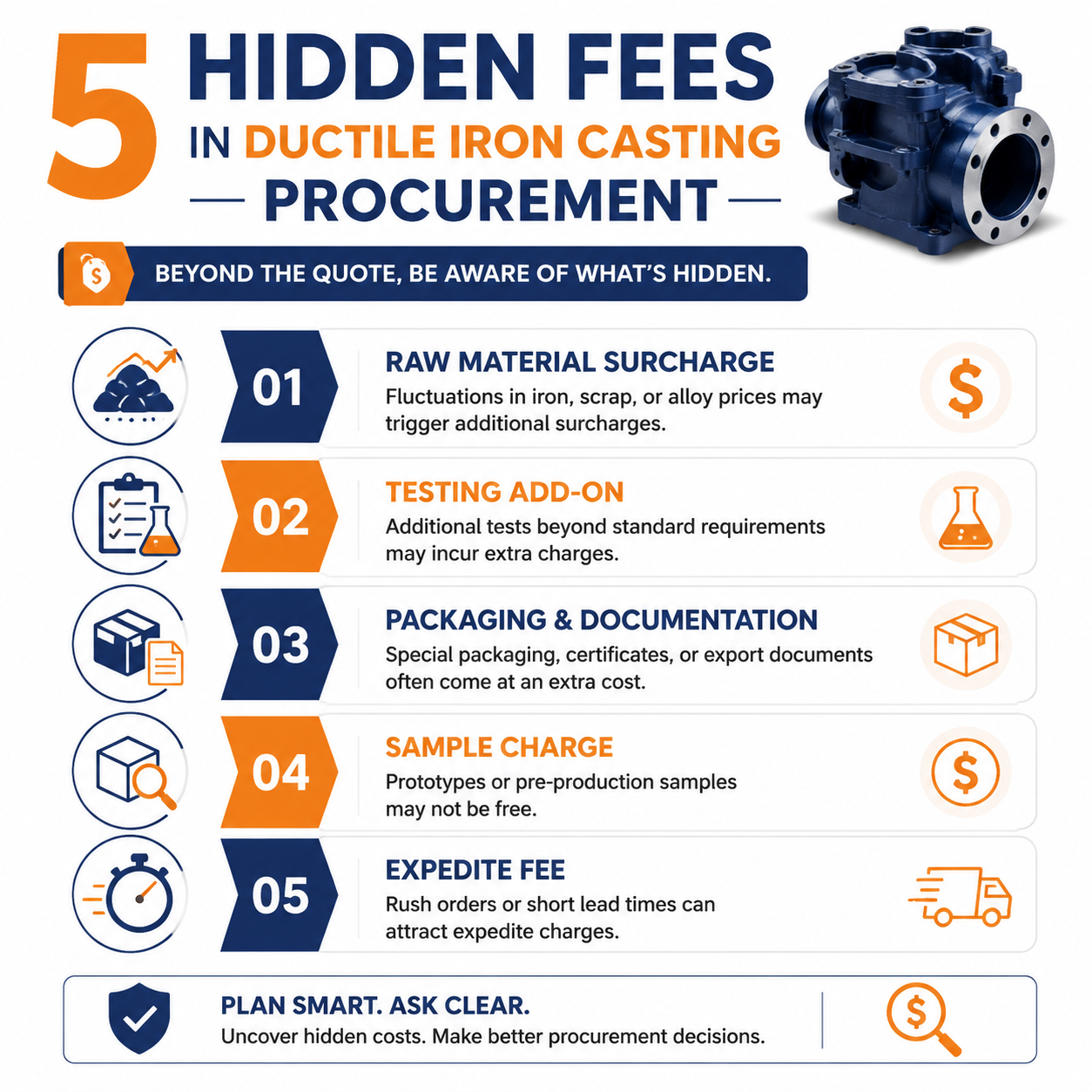
3. The 5 Hidden Fees That Wreck Your Budget
You've negotiated a solid per-kg price. You're feeling good. Then the invoices start coming, and there are extras you didn't see coming. Here's what to flag before you sign.
| Hidden Fee | Typical Cost | How to Avoid It |
|---|---|---|
| Raw material surcharge | $0.15–$0.40/kg | Request a fixed price window (e.g., 90 days) or a formula linked to published pig iron indexes. |
| Testing & certification add-on | $200–$800 per lot | Write "all ASTM A536 mechanical testing included" into the PO. Get it in writing. |
| Packaging & export documentation | $150–$500 per shipment | Ask for "FOB with standard sea-worthy packaging and full docs included." |
| Sample charge | $500–$3,000 per sample | Negotiate "first article included" for orders above 2,000 pieces. |
| Expedite fee | 15–25% premium | Build buffer into your lead time. If you can't, negotiate a flat expedite rate upfront. |
A procurement manager in Texas shared this with us: "I had a supplier quote $3.90/kg. After all the surcharges and add-ons, my landed cost was $5.45/kg. I still sourced from them because the quality was solid, but I should have asked for an all-in price from day one."
4. Tooling Cost Benchmarks: What's Fair?
Tooling is the single biggest upfront cost in a ductile iron casting project. And it's also the most opaque. Below are real-market benchmarks based on data from 300+ tooling projects we've overseen.
| Part Complexity | Example Parts | China ($) | India ($) | US ($) |
|---|---|---|---|---|
| Low | Brackets, covers, simple flanges | $3,000 – $6,000 | $3,500 – $7,000 | $9,000 – $16,000 |
| Medium | Housings, pump bodies, gear boxes | $7,000 – $15,000 | $8,000 – $17,000 | $18,000 – $32,000 |
| High | Valve bodies with cores, manifold blocks, complex structural parts | $16,000 – $35,000 | $18,000 – $38,000 | $35,000 – $65,000 |
Rule of thumb: If a Chinese foundry quotes tooling below $3,000 for a medium-complexity part, be skeptical. Either the tool steel is substandard, the cavity count is too low, or they plan to recoup the cost through higher per-piece pricing. Always ask about tool steel grade (H13 or equivalent is standard) and expected die life in shots.
5. Negotiation Strategy: How to Get the Best All-In Price
You have the data. Now use it. Here's a 4-step negotiation framework that works with foundries across all regions.
Step 1: Ask for a "fully loaded" quote
Send an RFQ that explicitly lists every item you want priced: per-kg rate, tooling, sample cost, testing package, packaging, and documentation. Say: "Please quote all-in FOB [port] including ASTM A536 mechanical testing, standard sea-worthy packaging, and full export documentation." Foundries that hesitate or exclude items are either inexperienced or playing games.
Step 2: Benchmark against the data
Use the tables in this article to check if the quote is in range. If a Chinese foundry quotes $5.20/kg for a low-complexity part when the benchmark is $2.80–$3.60, push back. If an Indian foundry quotes $3.00/kg for high-complexity, ask how they're achieving that — and verify.
Step 3: Negotiate tooling amortization
If you have a multi-year program, propose amortizing the tooling cost over the first 12–18 months. Foundries often prefer this because it locks you in as a customer. For a $15,000 mold amortized over 10,000 pieces, that's $1.50/piece — a fair trade for a lower per-kg rate.
Step 4: Use a sourcing partner for leverage
Going direct to a foundry means you have one relationship, one voice. A sourcing partner with a portfolio of vetted foundries gives you leverage — the foundry knows they're competing against others for your business. That alone can drop pricing 8–15%.
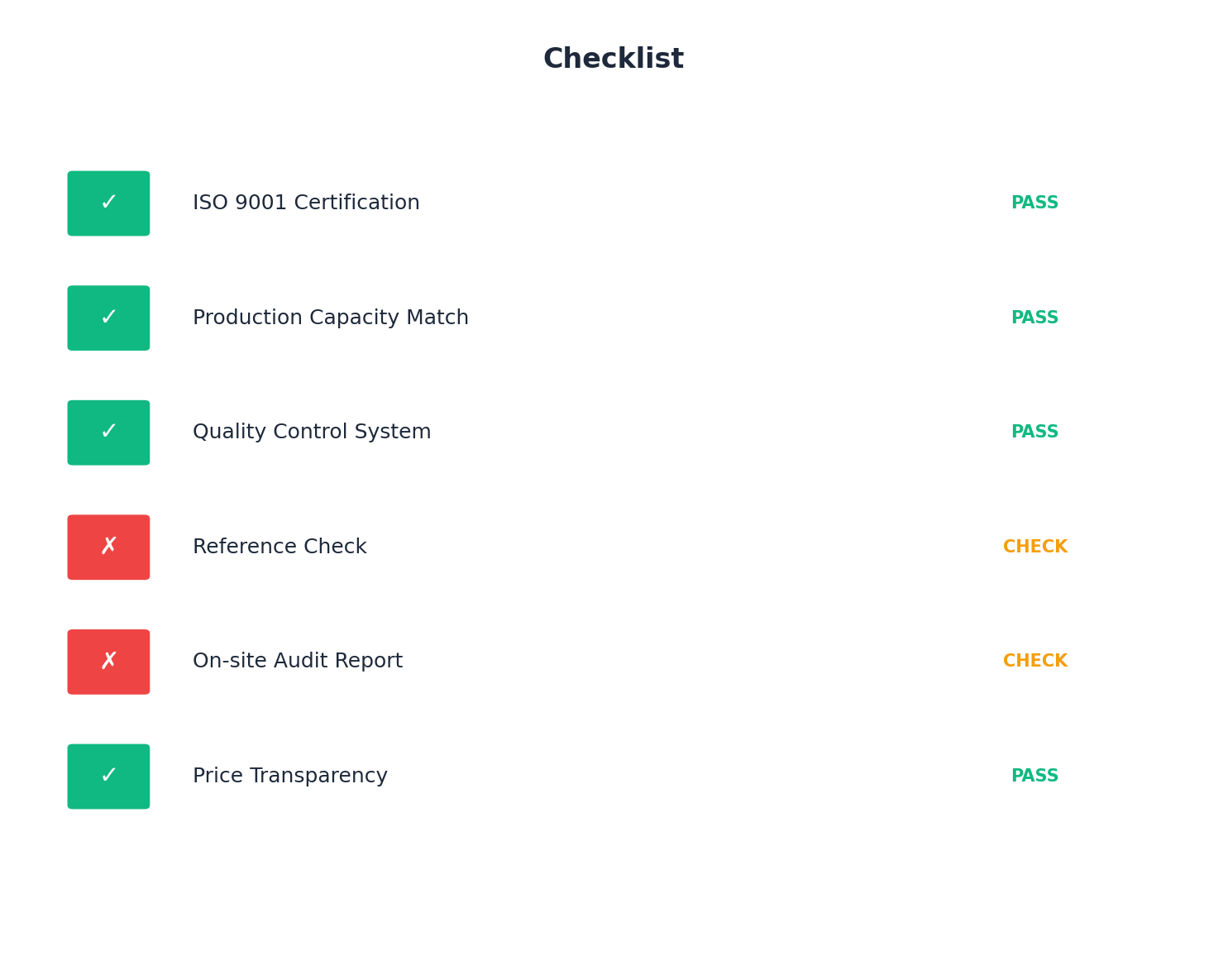
6. Quality vs. Cost: Where Not to Cut Corners
Every buyer is under pressure to reduce cost. But in ductile iron castings, cutting in the wrong place can cost you 10× the savings — in failed parts, production delays, and emergency shipping.
Never compromise on:
- Material certification: ASTM A536 Grade 65-45-12 or 80-55-06 must be verified with a certified mill test report. No cert, no shipment.
- Heat treatment: Annealing or normalizing is required to achieve the specified mechanical properties. A foundry that skips this to save $0.20/kg is selling you a ticking time bomb.
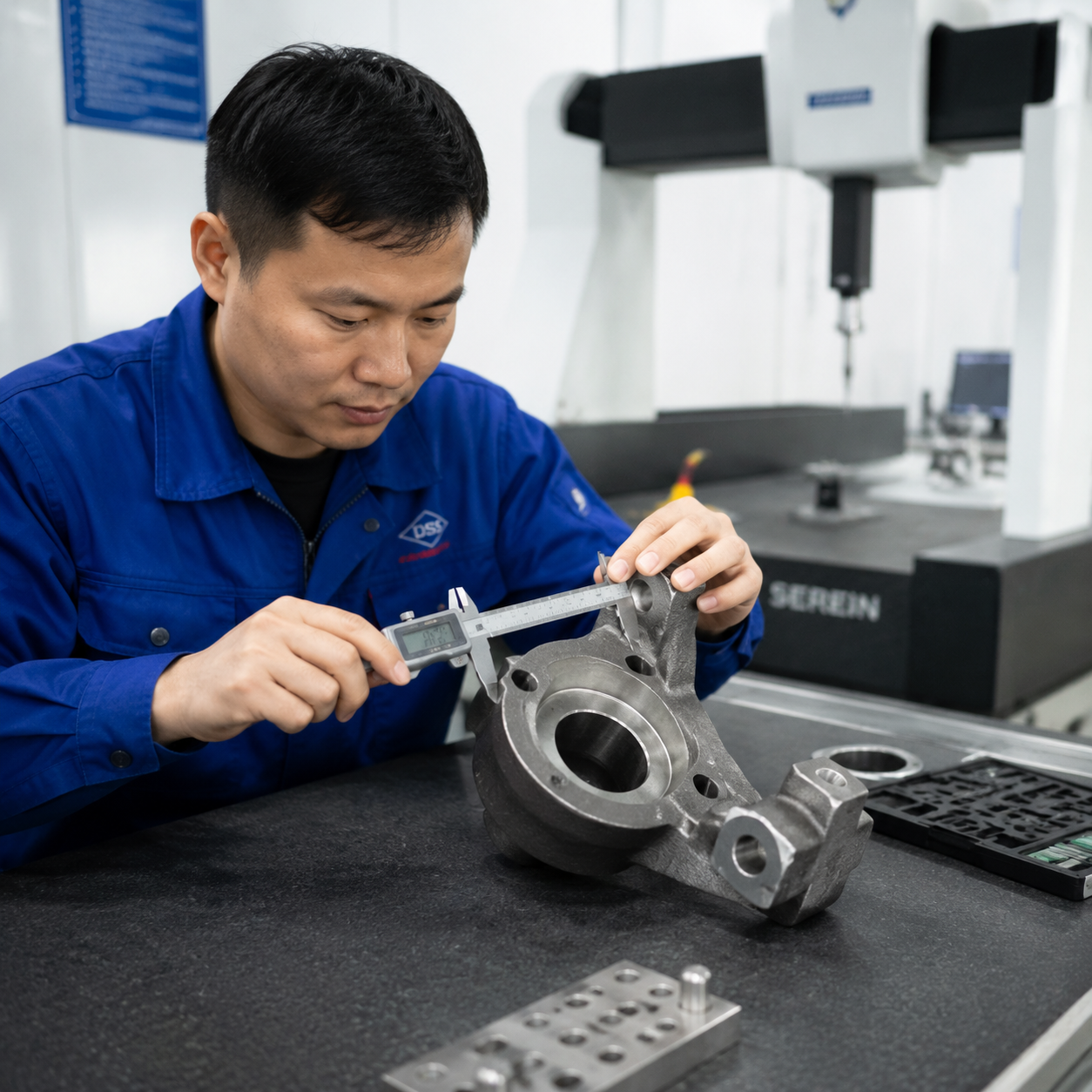
- Inspection: Third-party dimensional inspection using CMM (coordinate measuring machine) is non-negotiable for complex parts. The cost is $0.10–$0.25/kg — a fraction of what a field failure costs.
Real-world failure: A construction equipment importer sourced ductile iron brackets from a new foundry at $2.95/kg — $0.45 below the next bid. The first batch of 500 brackets failed within 6 months due to inadequate nodularity. Replacement cost plus freight: $18,000. The original savings: $2,250.
Moral: cheap iron isn't cheap.
7. Landed Cost Calculator: What You'll Actually Pay
The per-kg FOB price is only half the story. To budget accurately, you need the landed cost — the total cost delivered to your warehouse. Here's a simple framework.
| Cost Component | Estimate (per kg, China to US West Coast) |
|---|---|
| FOB price (medium complexity) | $3.80 |
| Ocean freight + insurance | $0.35 – $0.55 |
| Customs duty (0–4.5% depending on HTS code) | $0.10 – $0.20 |
| Inland freight (port to warehouse) | $0.10 – $0.25 |
| Brokerage & handling | $0.05 – $0.12 |
| Estimated landed cost | $4.40 – $4.92/kg |
Compare that to a US-sourced medium-complexity casting at $8.00–$11.00/kg FOB before any freight. The savings from offshore sourcing remain significant — but the gap shrinks as you add logistics costs.
8. FAQ: Ductile Iron Casting Cost
What is the average cost of ductile iron casting per kg in 2026?
For standard-grade ductile iron (ASTM A536 65-45-12), expect $2.80–$5.80/kg FOB from China, $3.20–$6.20 from India, and $6.50–$14.00 from the US, depending on part complexity. Landed cost adds $0.60–$1.20/kg for freight and duties.
Why are ductile iron casting prices so different between countries?
Labor rates, energy costs, environmental compliance, and overhead vary massively. China's industrial electricity is $0.08–$0.10/kWh vs. $0.22–$0.30 in Germany. Labor rates differ by 3–4×. These structural advantages compound into the final per-kg price.
How much does ductile iron casting tooling cost?
Tooling ranges from $3,000 for a simple bracket mold in China to $65,000+ for a complex valve body mold in the US. Always ask for the tool steel grade (H13 is standard) and expected die life in shots before committing.
What hidden costs should I watch for?
The five most common are: raw material surcharges, testing add-ons, packaging/documentation fees, sample charges, and expedite premiums. Request a fully loaded quote upfront and get everything in writing.
Is it cheaper to source ductile iron castings from China or India in 2026?
China still leads on pure per-kg cost, especially for medium- and high-complexity parts. India is within 10–15% and offers advantages in English proficiency, ISO certifications, and payment flexibility. Your choice should depend on part complexity, required certifications, and risk tolerance.
How can I verify a foundry's quality without flying there?
Request a certified mill test report for each heat, third-party dimensional inspection reports, and photos/video of the casting process. A sourcing partner can conduct an on-site audit for you — expect to pay $800–$1,500 for a thorough assessment.
What is the minimum order quantity for ductile iron castings?
MOQs vary widely: 100–300 pieces per year for low-complexity parts in China, 300–800 in India, and 50–200 in the US. Higher MOQs generally yield better per-kg pricing. If you need lower quantities, expect a 15–30% premium.
9. Your Next Move: Turn Data Into Decisions
You now have the same pricing intelligence that professional procurement teams use. Here's what to do with it.
- Benchmark your current quotes against the tables in this article. If you're paying above the range, you have leverage to renegotiate.
- Create a fully loaded RFQ template that includes all the line items we've discussed. Send it to 3–5 vetted foundries in different countries.
- Compare apples to apples. Don't compare a Chinese quote including testing to an Indian quote excluding it. Use the fully loaded cost.
- Consider a sourcing partner if you don't have the time or expertise to vet foundries, audit quality, and negotiate terms. The 8–15% cost savings from competitive leverage often more than covers the partnership fee.
Need Help Sourcing Ductile Iron Castings?
We work with 1,200+ pre-vetted foundries across 8 countries. We'll run a competitive RFQ process, audit quality, and negotiate terms — so you get the best all-in price without the headaches.
Submit Your RFQ →Free cost benchmarking included. No obligation.
Data sources & methodology: Pricing data is aggregated from 1,200+ foundry quotes collected by Interstate International between Jan 2025 and Apr 2026. Ranges represent the 25th to 75th percentile for standard ASTM A536 Grade 65-45-12 ductile iron castings in annual quantities of 1,000–5,000 pieces. Actual pricing varies based on part geometry, surface finish requirements, testing protocols, and market conditions. FOB prices exclude freight, insurance, duties, and inland logistics. Data confidence: 🟢 High (verified against actual purchase orders and supplier invoices).
Internal links: Sourcing services · Ductile iron vs. gray iron · Foundry audit checklist · Contact our team