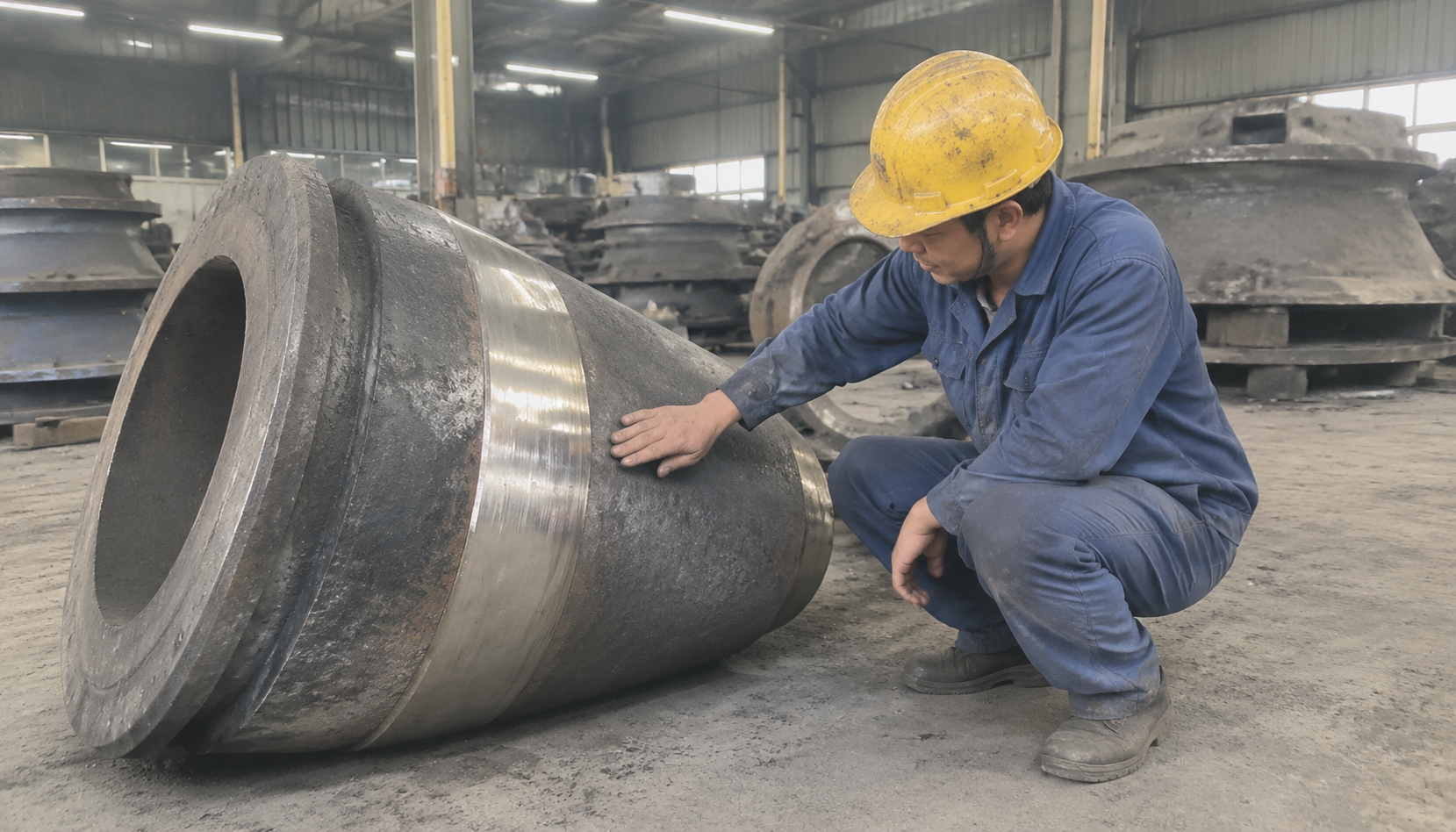
If you've bought wear castings from China before, you've probably had one of those mornings. The crate arrives on time. The liner looks right — right profile, right weight, right paint.
Then someone runs a portable hardness tester across the wear face and gets a number that doesn't match the drawing. The maintenance schedule you built around that delivery quietly falls apart.
That's not a China problem. It's a specification-and-verification problem, and it happens just as often with a domestic job shop that got a sloppy drawing. But the distance makes it worse. You can't drive over and stand on the moulding floor. So the checking has to happen on paper, in photos, and in the three or four documents that actually matter.
What follows is the checklist I'd want in my hand if I were buying a gyratory concave set, a ball mill liner package, or a bucket of dragline teeth tomorrow. Not a list of reasons to avoid China — a list of what separates the foundries that can pour a 3-tonne manganese liner to spec from the ones that will happily quote it anyway.
First, get your head around what you're actually buying
"Mining machinery casting parts" covers a huge range, and the sourcing logic changes with each one. A 40 kg excavator tooth adapter and a 6-tonne crusher frame are not the same purchase, even if the same trading company quotes both.
- Crushing chamber wear parts — mantles, bowl liners, concaves, jaw plates, cheek plates. Usually austenitic manganese steel to ASTM A128 (grades B, C, D, E), often modified to Mn18Cr2 or Mn22 for thicker sections.
- Impact and hammer wear parts — blow bars, breaker plates, hammer heads. High-chromium white iron to ASTM A532 Class III, typically 22–27% Cr.
- Mill liners — SAG and ball mill shell plates, grate plates, feed and discharge end liners. Chrome-moly steel, Ni-hard, or chrome-moly with rubber inserts.
- Ground engaging tools — bucket teeth, adapters, lips, ripper boots, dragline chain links. Forged or cast, and the two are not interchangeable.
- Structural and machine castings — crusher frames, gearbox housings, bearing caps, pulley hubs. Cast carbon or low-alloy steel to ASTM A27 or A148, or ductile iron to ASTM A536 grades 65-45-12 and 80-55-06.
- Slurry and pump castings — volutes, impellers, throatbushes, side liners. High-chrome iron again, but now the erosion pattern matters more than the impact toughness.
Why does the category matter? Because the acceptance criteria are completely different. A mill liner is judged on hardness and through-thickness soundness. A crusher frame is judged on dimensional accuracy and weldability. A bucket tooth is judged on whether the tip snaps off in the first 200 hours. Send one RFQ template for all three and you'll get three useless quotes.
Picking the alloy inside one of those families is its own job. If you're still deciding between a 22% Cr white iron and a chrome-moly plate for a SAG application, start with wear part alloy selection for crusher liners before you start writing the RFQ.
The RFQ that gets a real number, and the one that gets silence
Here's the pattern. Buyer sends a PDF drawing, a quantity, and the words "manganese steel, high quality." Foundry comes back in 48 hours with USD 1,850 per piece, FOB Qingdao. Buyer feels good. Three months later, nobody can agree on what "high quality" meant.
A drawing that gets a competent quote back contains, at minimum:
- Material by standard and grade — "ASTM A128 Grade C, modified to Mn18Cr2" beats "manganese steel" every time. If you don't know the standard, say what the part does and let them propose, but get the proposal in writing with a standard number attached.
- Hardness, with a location and a method — "210–250 HBW, measured on the wear face 15 mm below the cast surface after heat treatment, three readings per part." Without the location, they'll test the softest accessible spot and everyone will be technically correct.
- Maximum section thickness — this single number decides whether half the foundries on your list can even quote. A 180 mm section in manganese steel needs a long austenitising soak and a fast, deep quench.
- Test requirements — chemical analysis per heat, mechanical properties from a keel block cast on the same heat (ASTM A781/A370 practice), and the standards you want for NDT.
- Dimensional tolerance standard — ISO 8062-3 with a CT grade, plus a machining allowance callout and a datum scheme. "General tolerances" means nothing.
- Pattern ownership — one sentence, but you'll want it later. More on this below.
- Marking and traceability — heat number cast or stamped on the part, position specified. If the heat number is only on the packing list, you've lost traceability the moment the crate is opened.
- Incoterm and packing — FOB which port, and whether the part ships on timber skids or in a skeleton frame.
Foundries that can meet all of that will answer all of it. Foundries that go quiet for a week and then reply with "we can do, please send PO" have just told you something useful.
Five checks before you send anyone a drawing
None of these require a plane ticket. All of them require the supplier to send you something specific, which is the point.
1. Ask for the largest single piece they poured in the last twelve months
Not the website's "max casting weight: 20 tonnes." Ask for a photo of the piece on the floor next to a person, the heat number, and the customer's industry. Foundries quote their furnace capacity and pour their pattern capacity, and those are different numbers. A shop with a 5-tonne furnace can still struggle with a 2-tonne part if the flask, crane and cooling floor aren't sized for it.
2. Ask about the quench, not the furnace
For manganese steel, the furnace is the easy part. The quench is where spec sheets die. Solution annealing runs around 1,050–1,100°C, and the part has to get from furnace door to water fast enough that you don't precipitate carbides on the way down. Ask for the quench tank dimensions, the crane transfer time, and the cooling curve from a recent manganese heat. If they can't produce a chart, they're not recording it, and if they're not recording it, they're guessing.
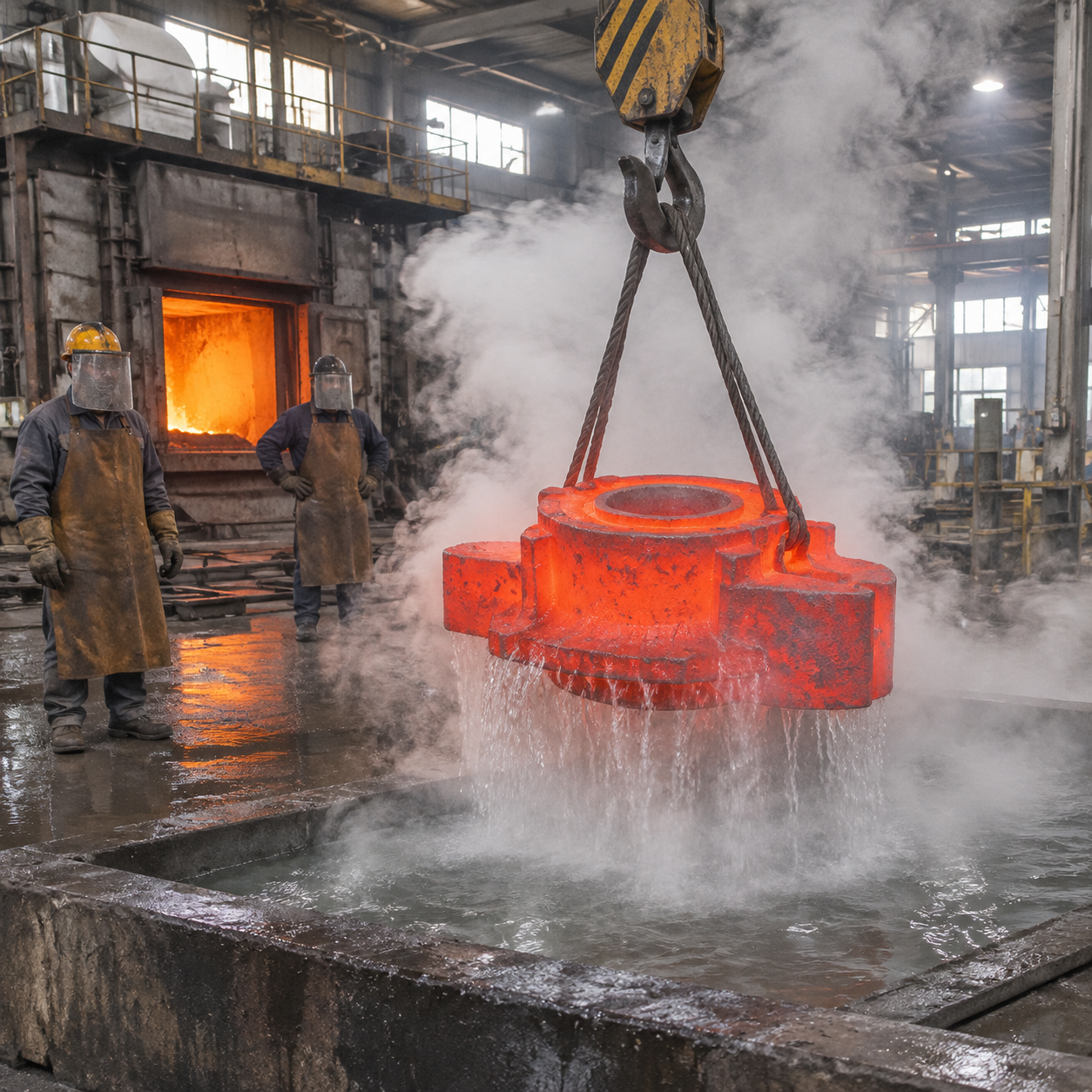
3. Find out whether the machining is in-house
Plenty of foundries cast beautifully and then truck the part 40 km to a machine shop they don't control. That's where dimensional arguments are born, because now nobody owns the problem. Ask directly: which operations happen under your roof, and which are subcontracted? For anything with a bore, a taper or a bolt circle, you want the answer to be "in-house" — or you want to inspect at the subcontractor's floor before the part moves.
4. Check whether NDT is a capability or a promise
Ultrasonic testing on cast steel follows ASTM A609; magnetic particle follows ASTM E709. Both need a written procedure and a certified Level II operator, and both need to happen after heat treatment, not before. Ask for a sample report with the operator's certification number on it. If the "report" is a one-line statement that says "no defects found," you've been handed a receipt, not an inspection.
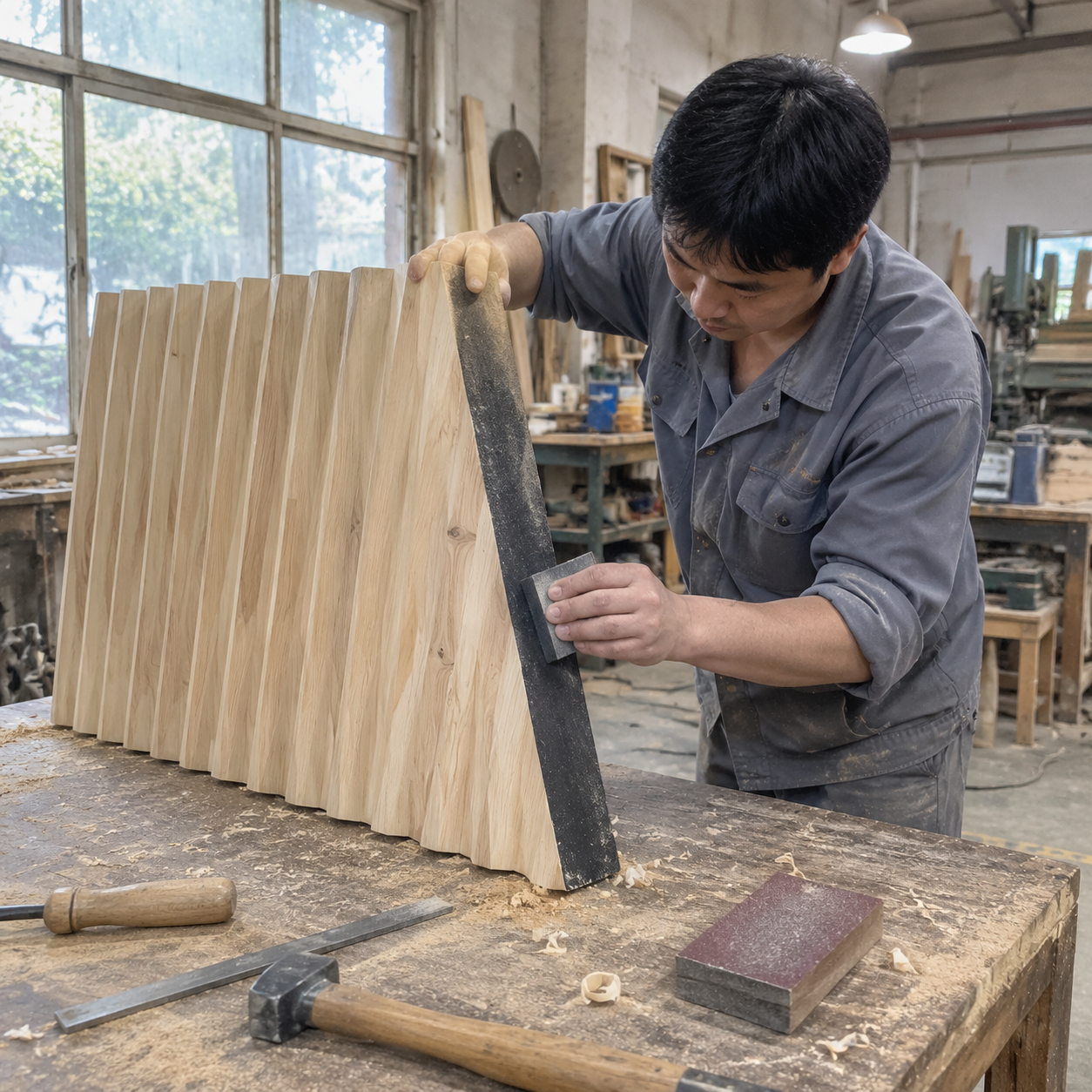
5. Confirm there's a pattern shop on site
Not because you care about woodworking, but because pattern repair is what keeps a repeat order on schedule. A foundry that outsources pattern work loses a week every time a corner of the pattern gets damaged — and it always gets damaged.
Five checks, one page. Print this and take it into the meeting — it's the version that survives contact with a procurement committee.
| Check | What to request | A good answer looks like | Walk away if |
|---|---|---|---|
| 1. Largest pour | Photo of the biggest single piece from the last 12 months, on the floor, next to a person, with heat number and end-use industry | A dated photo, and a part within 30% of your section thickness | They answer with furnace capacity instead of pattern capacity |
| 2. Quench | Tank dimensions, crane transfer time, cooling curve from a recent manganese heat | A chart with a real time axis and a part number on it | "We use water, it's fine" and no chart |
| 3. Machining | A list of operations done in-house versus subcontracted | Boring, facing and drilling listed under their own roof | Every machined feature is "cooperated" |
| 4. NDT | A sample UT report with the Level II certificate number and the procedure reference | ASTM A609 procedure, operator ID, indication locations sketched | "No defects found" on one line, unsigned |
| 5. Pattern shop | Photo of the pattern storage rack and the repair bench | Numbered racks, patterns dated, a bench with tools on it | Patterns stored outdoors or off-site with no control |
Patterns: the thing nobody puts in the contract
Tooling for a large mining casting runs roughly USD 3,000–15,000 depending on complexity, number of cores, and whether you need a machined-and-gauged pattern. It's often 20–40% of the first order value, which is exactly why it becomes a negotiating chip later.
Three things to nail down before you pay for tooling:
- Who owns it. You paid for it, so you own it. Say so in the PO, not in an email.
- Where it lives and how it's stored. Patterns get borrowed, modified, and lost. Ask for a photo of the storage rack with your pattern number on it.
- What happens if you leave. You want the right to have the pattern packed and shipped to another foundry, or scrapped, at your instruction. Foundries that refuse this clause are telling you they plan to use your tooling as leverage.
Also ask whether the pattern is wood, aluminium, or resin. Wood is fine for a one-off and a terrible idea for a part you'll reorder every 14 months — it moves with humidity and the dimensional drift shows up two orders later.
Where the money actually goes
Price is where most buyers get the least information and make the biggest assumptions. A per-kilo number tells you nothing about whether the quote is thin, fat, or hiding a machining charge that shows up later as a variation order.
"I always ask for the cost broken down by weight before I discuss a single number," Robert Davis, a Georgia hardware wholesaler who sources castings at volume, told us. "Metal, melting, moulding, fettling, heat treat, machining, testing, packing. If a supplier can't split it out, they're either guessing or they don't want you to see where the margin is. Both are reasons to keep looking."
What a breakdown should roughly look like on a manganese wear casting, as a share of ex-works price:
| Cost element | Typical share | What moves it |
|---|---|---|
| Raw material (scrap + ferroalloys) | 25–35% | Manganese and chrome content, scrap market |
| Melting energy | 8–12% | Induction vs arc, local power tariffs |
| Moulding and coremaking | 10–15% | Number of cores, flask size, sand system |
| Fettling and cleaning | 8–12% | Labour hours — the biggest variable between shops |
| Heat treatment | 8–15% | Soak time, quench, section thickness |
| Machining | 5–20% | Whether it's in-house, and how much stock you leave |
| NDT and testing | 2–5% | UT coverage, third-party witness |
| Packing | 2–4% | Skids vs crate vs skeleton frame |
Two practical notes. First, alloy surcharges are real and they move — ask what index the surcharge tracks and how it's calculated, or you'll be arguing about an unexplained 6% line item eighteen months from now. Second, payment terms tell you as much as price. Thirty percent deposit and seventy percent against a pre-shipment inspection report is normal and reasonable. A demand for 100% T/T before production is not.
Documents you should refuse to accept at face value
Every Chinese foundry can produce a mill certificate. The question is whether it belongs to your part.
"Never accept a certificate at face value — call the issuing body yourself," Davis said. "I've had a mill cert handed to me with a heat number that didn't match the one stamped on the casting. Took two minutes to catch once I actually looked. Most people don't look."
The set worth demanding on any mining wear casting:
- Chemical analysis, per heat, with the heat number matching the stamp on the part.
- Mechanical properties from a coupon cast on the same heat — tensile, yield, elongation, and impact where the spec calls for it.
- Heat treatment record: furnace number, charge number, soak temperature, soak time, quench medium, and the chart.
- NDT reports with the operator's Level II certificate number and the procedure reference.
- Dimensional report with actual measured values, not a column of ticks.
- Hardness survey with the test locations marked on a sketch.
How much testing is actually enough
A certificate proves a heat existed. It doesn't prove your part is sound. The sampling plan below is what I'd write into a purchase order for wear castings, and it's the paragraph most suppliers will try to leave blank.
| Item | Method | Frequency | Reject if |
|---|---|---|---|
| Chemical analysis | Spectrometer, results traceable to the heat number | Every heat | Any element outside the ASTM A128 or A532 range for the grade, or a heat number that doesn't match the stamp |
| Mechanical properties | Tensile coupons from a keel block poured on the same heat (ASTM A781/A370) | Every heat, or every fifth heat by written agreement | Elongation below spec — on manganese that's the number that predicts cracking, not yield |
| Hardness survey | Portable Leeb or Brinell on a ground face, 15 mm below the cast skin, after heat treatment | Three readings per wear face; 100% on first article, then an agreed AQL sample | More than 40 HBW spread across a single part, or an average outside the band |
| Ultrasonic | ASTM A609, straight beam, worked back from the wear surface | 100% of critical wear faces on first article, then an agreed grid | Indications beyond the agreed quality level, or no written procedure and no Level II number |
| Magnetic particle | ASTM E709, wet fluorescent, after heat treatment | 100% of machined and ground faces | Linear indications in a fillet, bore or section transition |
| Dimensional | ISO 8062-3 at the agreed CT grade, CMM or tracker report | First article 100%, then a sample per lot | The report has ticks instead of measured values |
| Penetrant, high-chrome | ASTM E165 on the wear face | 100% on parts above 24% Cr | Any crack indication — 26% Cr at 620 HBW has almost no ductility to arrest one |
Two things here matter more than the table itself. The method column is not negotiable; the frequency column is, and you should negotiate it in the PO rather than during an argument about a failed delivery. And before you place an order, ask for the last three reports off other jobs. A foundry that does this work has them in a folder. A foundry that doesn't will offer to "arrange" one.
For a first article or a high-value order, spend the money on third-party pre-shipment inspection — SGS, TÜV, Bureau Veritas, Intertek all operate in the main casting clusters. Budget roughly USD 300–800 per inspector-day plus travel. On a USD 40,000 liner package, that's cheap insurance against a USD 40,000 mistake. The inspection scope itself is worth writing down properly, and there's a separate walkthrough on how to structure a pre-shipment inspection on heavy castings if you want the full sequence.
The hardness trap
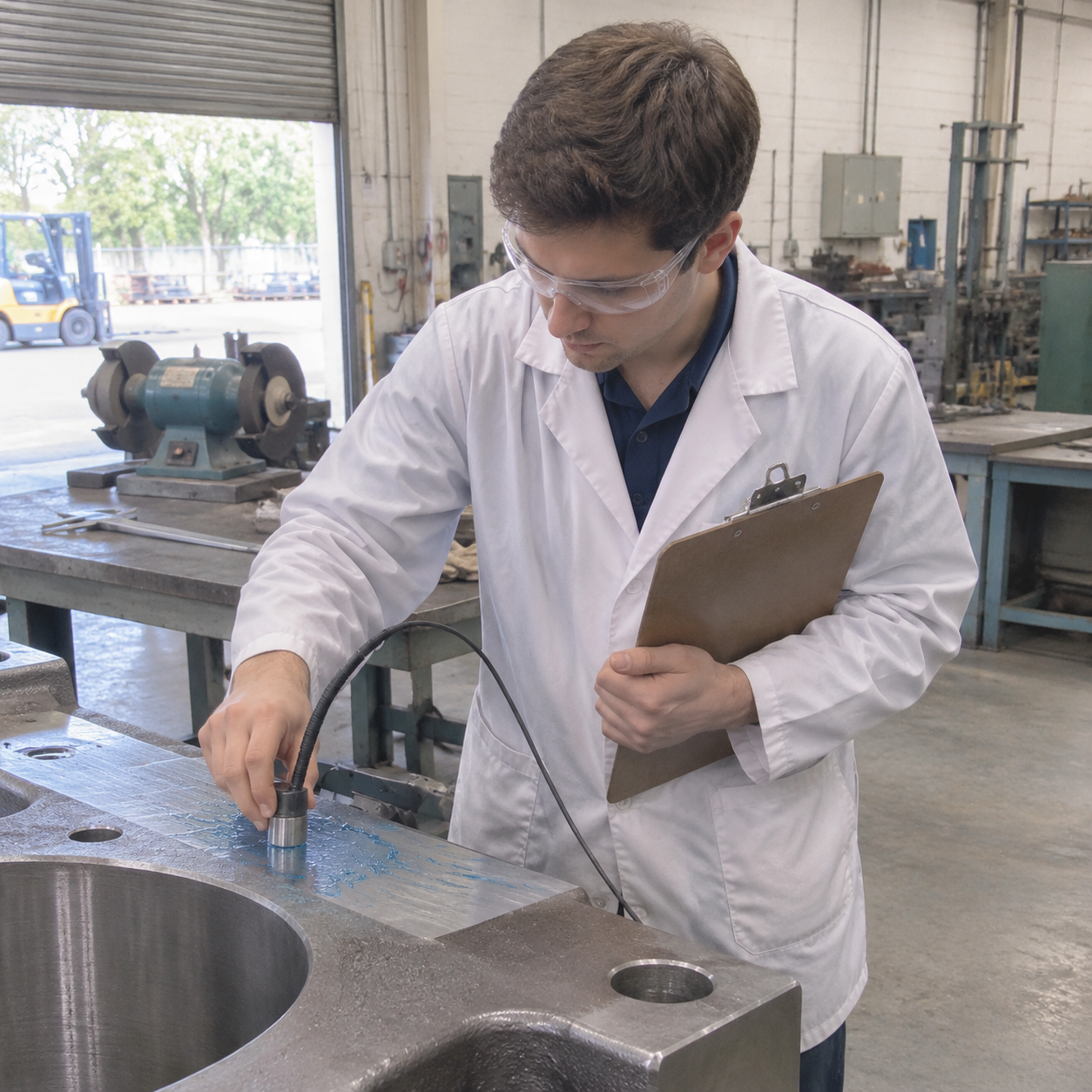
Hardness is the number everyone argues about and the one most often measured wrong.
On manganese steel, the as-supplied hardness should land somewhere around 200–230 HBW after a proper solution anneal. That number looks low to anyone used to high-chrome, and buyers regularly reject perfectly good manganese liners because they expected 400+. Manganese steel doesn't work that way. It starts soft, work-hardens in service to 500 HBW and beyond under impact, and the soft starting condition is precisely what gives it the toughness not to crack. If your supplier ships manganese at 350 HBW as-cast, they've either skipped the anneal or shipped you something that isn't manganese.
Where you measure matters as much as the band. A reading taken on the cast skin comes back low and scattered, because you're testing a decarburised surface and sand roughness, not the section underneath. Grind first. Take three readings at least 50 mm apart across the wear face, 15 mm below the original cast surface, and have the inspector mark the points on a sketch that goes into the report alongside the values. One number with no location is an opinion, not a measurement.
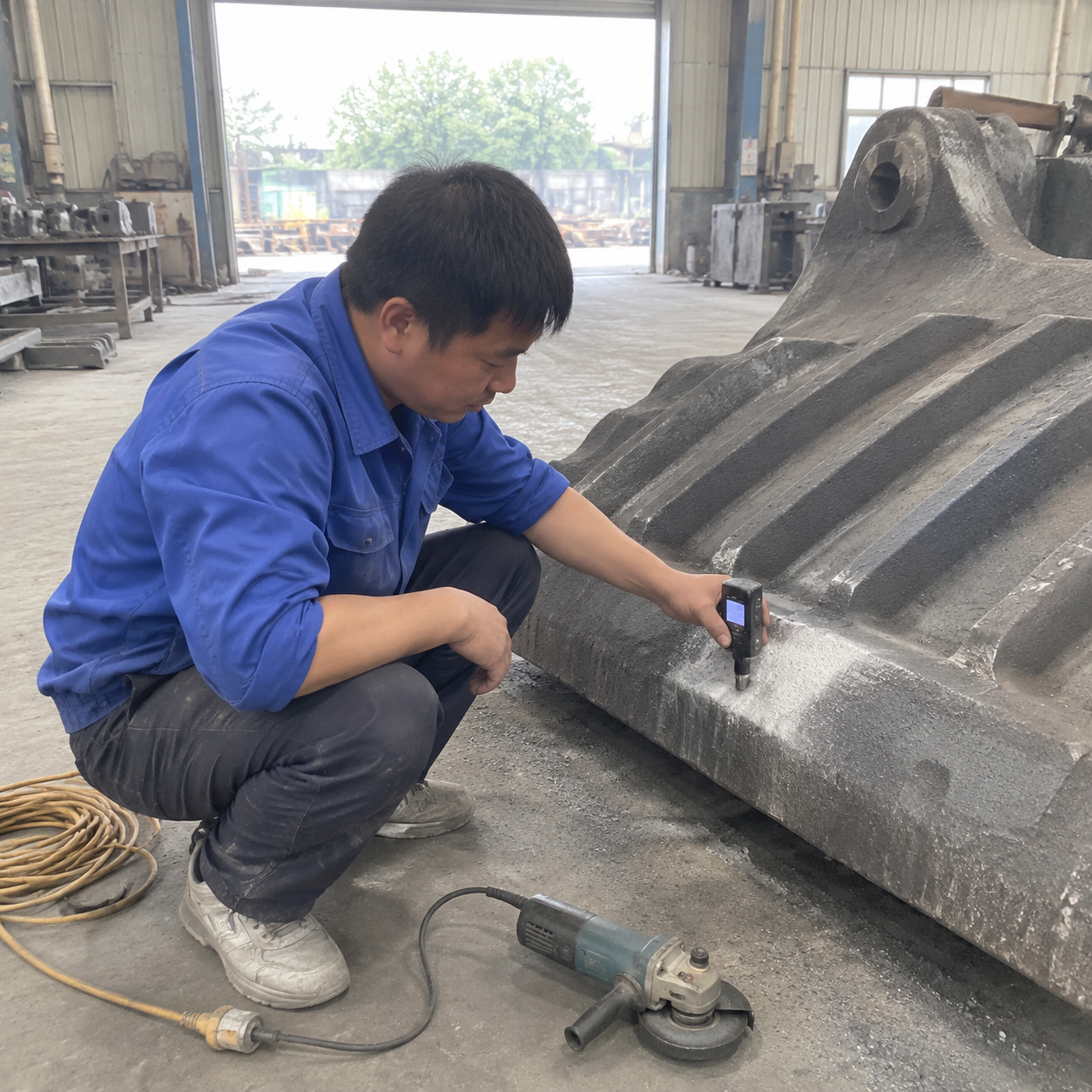
A magnet is a genuinely useful field tool here. Fully austenitic Hadfield manganese steel is essentially non-magnetic. If a "Mn18" liner grabs a magnet hard, start asking questions.
High-chrome white iron is the opposite case. You want 600–650 HBW, and you should be checking for cracks, because a 26% Cr casting at that hardness has almost no ductility. Dye penetrant on the wear face and a ring test with a small hammer will find the ones that are already broken.
Freight: you're paying for kilos, not cubic metres
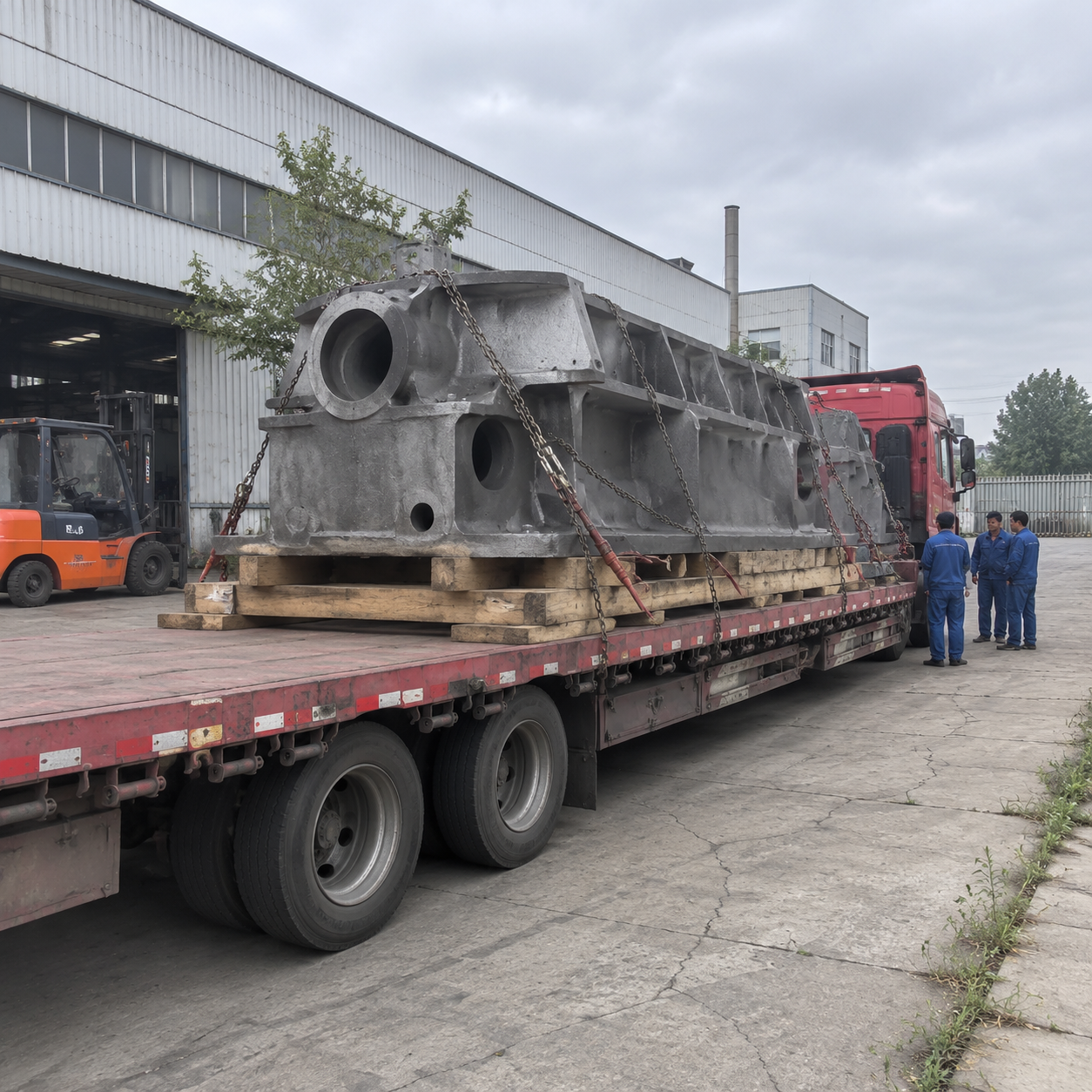
Heavy castings invert every instinct you have about container shipping. A 20ft general purpose box has a nominal payload around 28 tonnes, but the practical ceiling is usually 22–25 tonnes once you account for road weight limits at the destination end — and in Australia, that limit bites well before the ship does.
What that means in practice:
- A mill liner package of 24 tonnes fills a 20ft container about one-third full. You're buying weight, so consolidate with other heavy items rather than chasing volume.
- Anything over roughly 30 tonnes or outside container dimensions goes break bulk or flat rack. Book early — heavy lift space out of Qingdao and Tianjin gets tight in Q4.
- Machined faces need VCI film or desiccant, not just grease. A 35-day voyage through the tropics will find every unprotected surface.
- Timber skids, not pallets. A 2.5-tonne liner on a pallet is a 2.5-tonne liner on the floor of the container by the time it arrives.
Transit times worth planning around: Shanghai to Los Angeles runs 14–18 days; Qingdao to Port Hedland or Dampier, 18–24 days; Shanghai to Rotterdam, 30–35 days; to the US East Coast via Suez, 30–38 days. Add port congestion and you should assume the upper end.
Lead times that aren't fiction
Any supplier who quotes four weeks on a 2-tonne machined manganese liner is quoting a wish, not a schedule. Here's a realistic first-order timeline, assuming a competent foundry and no surprises:
| Stage | First order | Repeat order |
|---|---|---|
| Drawing review and DFM feedback | 1–2 weeks | 2–3 days |
| Pattern making | 4–6 weeks | 1 week (repair only) |
| Casting, cooling, fettling | 3–4 weeks | 3–4 weeks |
| Heat treatment | 1 week | 1 week |
| Machining | 2–4 weeks | 2–3 weeks |
| NDT, dimensional, third-party inspection | 1–2 weeks | 1 week |
| Packing and booking | 1–2 weeks | 1 week |
| Ocean freight | 2–5 weeks | 2–5 weeks |
| Total | 15–26 weeks | 11–18 weeks |
Plan your shutdown spares against the repeat-order column, not the sales email. And if you're running a maintenance budget on a single annual liner order, place it five months before you need it, not three.
Mistakes that cost the most
- Buying on price per kilo alone. A liner that wears 20% faster because the chrome is at the bottom of the range costs far more than the 8% you saved at PO stage.
- Accepting a photo of a certificate instead of the certificate. Screenshots get cropped. Get the PDF, check the heat number against the casting.
- Specifying "as per sample." Samples arrive with no chemistry, no hardness history, and no legal weight. If that's all you have, get it tested before you use it as a specification.
- Letting the supplier choose the tolerance grade. They'll pick the loosest one that lets the part pass, which is fine until the liner doesn't seat.
- Skipping the first-article inspection. The first article sets the pattern for the next five years. It's the worst place in the process to save USD 600.
- Not visiting. Even one day on the floor, watching them pour your part, changes the relationship. If a trip isn't possible, a live video walkthrough with the mould, the furnace and the quench tank is a decent substitute — and the reaction to being asked tells you plenty.
- Forgetting the spares list. The foundry that made your liner will make a matching one in three years. The foundry that made your pattern is the one you actually need to keep.
Where the foundries actually are
Geography helps you shortlist. China produced roughly 50 million tonnes of castings in recent years, about half of world output, and the mining-wear end of it clusters in a handful of places.
- Luoyang, Henan — heavy machinery country. Large steel castings, crusher frames, gyratory components, and the machine shops that go with them.
- Shandong — Qingdao, Weifang and the surrounding counties. A dense mix of mid-size foundries doing wear parts, plus the port access that makes FOB Qingdao quotes competitive.
- Ningguo, Anhui — a town with several hundred wear-casting shops, much of it high-chrome grinding media and liners. Quality spread here is wide, so verification matters more than usual.
- Hebei and Liaoning — heavy steel casting and general industrial work, closer to the northern ports of Tianjin and Dalian.
None of this replaces due diligence. A good foundry in the wrong province beats a bad one next to the port. But if you're getting quotes and the addresses are all within 20 km of each other, you may be looking at three trading companies sharing two factories.
FAQ
Are Chinese mining machinery casting parts good quality?
Quality varies more between individual foundries than between countries. A shop with a 10-tonne furnace, an in-house pattern shop, a quench tank sized to the section, and Level II NDT staff will match or beat most Western job shops on wear castings. The failure mode isn't the country — it's buying from a foundry whose capacity and process control don't match the part you drew.
What's the minimum order quantity?
With an existing pattern, one piece is often possible, though it carries a setup charge. For a new part, the real minimum is the tooling cost — roughly USD 3,000–15,000 for a large wear casting — so most buyers order a full liner set of two to four pieces to spread that across more tonnes.
How can I check material without a lab?
Three quick field checks. A magnet — genuine Hadfield manganese steel is essentially non-magnetic. A weight check — measure the part, calculate volume, multiply by 7.85 g/cm³ for steel or about 7.6 for high-chrome iron; a part that comes in 8% light has thin sections or the wrong alloy. And a hardness reading on a ground surface, never on the cast skin.
Can I get one-off or emergency pieces?
Yes, and it's one of the underrated uses of a Chinese foundry relationship. A shutdown emergency with a broken 800 kg chute liner is often faster to solve by air-freighting a small sand-cast replacement than by waiting on a domestic shop's queue — provided the pattern already exists and you accept that the first piece is a stopgap, not a production part.
Before you sign the LOI
The difference between a good sourcing relationship and an expensive lesson usually comes down to five pieces of paper: a drawing with a standard and a tolerance grade on it, a heat treatment record, a certificate with a matching heat number, an inspection report with actual numbers, and a PO that says who owns the pattern. Everything else is conversation.
None of that is exotic. It's just rarely asked for, which is why it's rarely refused and almost never ignored once you've asked.
Start with the part that hurts most: the liner you replace every 14 months, or the one that cracked at 60% of life. Send the drawing, the section thickness, the hardness spec with a measurement location, and the annual tonnage you'll need. A foundry that can answer the capacity and quench questions in writing is worth a first article. The rest are just quoting.
Send a drawing, get a straight answer
Share the part, the material standard, the section thickness and your annual volume. You'll get back a capacity match, a realistic lead time with the pattern and quench stages broken out, and an itemised cost breakdown by weight — metal, moulding, fettling, heat treat, machining, testing, packing.
No catalogue. No "we are a leading manufacturer." Just the numbers you need to compare three foundries side by side.
Mining and heavy equipment casting reference data
Everything below was pulled from our separate guides on this topic and kept only where it adds something you can act on: comparison tables first, then the checklists and red-flag lists.
Comparison tables
| Foundry type | Typical single-piece limit | What it means for you |
|---|---|---|
| General sand foundry, small shop | 0.5 – 3 t | Wear plates, small housings, brackets |
| Mid-size sand foundry with heat treat | 3 – 15 t | Crusher frames, gearbox cases, pump bodies |
| Heavy bay foundry, 50 t+ cranes | 20 – 60 t | Mill end caps, kiln tyres, dragline components |
| State-linked heavy machinery plants | 100 t+ | Rarely quote mining volumes; expect long lead times |
| Stage | Realistic window (parts over 2 t) | What usually slips |
|---|---|---|
| Pattern and core box | 15 – 25 days | Buyer drawing changes, pattern material shortages |
| Moulding, pouring, shakeout | 20 – 35 days | Furnace scheduling, mould drying in humid months |
| Heat treatment | 7 – 14 days | Furnace queue — the classic one |
| Rough machining | 10 – 20 days | Boring mill backlog, rework after NDT finds defects |
| Final inspection and docs | 5 – 10 days | Third-party inspector availability |
| Inland haul to port | 2 – 6 days | Abnormal-load permits for oversize pieces |
| Red flag | Green flag |
|---|---|
| “We can make anything” | Tells you exactly which alloys they pour — and which they won’t |
| “Certificates available on request” | Shares current certs and the last audit summary unasked |
| No live video walkthrough (“owner is traveling”) | Schedules a shop-floor video call within 24 hours |
| No melt logs; cert arrives with the shipment | Shows this week’s melt logs immediately |
| Quote 25% below market | Quote within 5–10% with a line-item breakdown |
| “20 years of experience” but no verifiable customers | Named customers in your industry you can call |
Checklists and red-flag lists
- Manganese steel wear parts — crusher jaws, cone liners, hammer heads, bucket teeth, mill liners. These are high-stress, high-abrasion parts that live or die by metallurgy and heat treatment.
- Ductile iron structural components — gear housings, bearing pedestals, pulley wheels, boom sections, excavator bucket components.
- Alloy steel castings — hydraulic cylinder bodies, crawler track components, support frames, linkages.
- Heavy gray iron counterweights and ballast blocks — nobody cares about surface finish, but weight accuracy and internal soundness matter more than sales reps realize.
- Anhui's Hanshan county — China's wear-resistant steel casting hub. If you need manganese steel, this is ground zero.
- Shandong — heavy and mid-size gray and ductile iron, plus a ton of machine shops.
- Liaoning — large-scale mining machinery components near heavy equipment OEMs.
- Hebei — commodity gray iron and ductile iron, high volume, commodity pricing.
- Jiangsu — higher-end machined castings, better quality control culture, higher prices.
- High-manganese steel wear parts (Mn13/Mn18, heat-treated): roughly $1,800–$2,600 per metric ton
- Ductile iron structural castings (large housings, hubs): roughly $1,400–$2,000 per metric ton
- Low-alloy steel castings (quenched and tempered): roughly $2,400–$3,800 per metric ton
- Simple gray iron counterweights: roughly $900–$1,400 per metric ton
- Tooling: 2–4 weeks for patterns and core boxes
- Sample casting: 4–6 weeks after tooling approval
- Sample inspection and approval: 1–2 weeks (if you have a third-party inspector, your own engineer, or both)
- Production run: 4–8 weeks after sample approval
- Sea freight: 4–6 weeks to US West Coast or Rotterdam
- 20% deposit to lock in raw material prices
- 30% after sample approval
- 30% against pre-shipment inspection report
- 20% against Bill of Lading copy
- Only looking at price. If you buy manganese steel based on who's cheapest per ton, you're not buying parts. You're buying a lottery ticket. Metallurgy, heat treatment, and inspection cost real money. When someone undercuts the market by 25%, the corner they cut is usually the one that keeps your crusher running.
- Skipping first article inspection. First Article Inspection (FAI) is not optional, even for wear parts. The first piece off the line tells you whether your supplier can actually hold tolerances and deliver the right hardness. The $2,000 you spend on a third-party inspector is cheaper than the $40,000 you'll lose when a bad batch fails after installation.
- Giving complex castings to a foundry that doesn't have the equipment. Big parts need big cranes, big heat treatment furnaces, and big machine tools. Don't let a hopeful sales rep convince you they'll make it work.
- Ignoring tooling ownership terms. You pay for the patterns and core boxes. If the contract doesn't explicitly say the tooling belongs to you and will be stored at the foundry for future orders, you're financing their next customer's parts.
- Not leaving time for final inspection. Even with a good foundry, third-party inspection can find defects that require rework. If your shipping date doesn't include a buffer for that, you'll choose between shipping defective parts and blowing your schedule. Instead, schedule production to finish two weeks before the ship date and use that window for inspection and corrective work.
- ✓ 1,700+ vetted foundries
- ✓ 40+ QA engineers
- ✓ Serving buyers in 22 countries
- ✓ ISO 9001 / IATF 16949 capable
- Mining Machinery Castings China Supplier
- Ev Charging Infrastructure Aluminum Casting
- Liquid Cooling Valve Body Casting Supplier
- Ev Battery Enclosure Casting Low Pressure
- Crusher Liner High Chrome Wear Parts Sourcing
- Heavy Steel Casting 8 Ton Lead Time China
- Duplex Stainless Valve Casting Nace Mr0175
- Heavy Equipment Castings Manufacturer
- Pattern making: 2–4 weeks (if new patterns are needed)
- First article / sampling: 3–5 weeks after pattern approval
- Production: 4–8 weeks depending on foundry load
- Heat treatment + machining: 1–2 weeks
- Inspection + shipping: 1–4 weeks to port
- Material test certificates — actual mill certificates for the steel, not a summary. For structural parts, you want full chemical composition and mechanical property data for every heat.
- NDT reports — X-ray (RT) or ultrasonic (UT) inspection records, especially for castings with high service loads. Porosity is the #1 killer of mining castings.
- First article inspection (FAI) dimensions — if it's a new pattern or design, you need dimensional verification. Not a random check. Full FAI report.
- Traceability from melt to pour — every casting serial number should trace back to a specific heat, a specific pour date, and specific heat treatment records.
- Raw steel / alloy material: roughly 35–45% of the quote
- Pattern amortization: 10–20% (one-time or per-piece)
- Molding & pouring labor: 15–25%
- Heat treatment: 5–10%
- Machining: 10–20% (if applicable)
- Inspection, packing, and handling: 5–8%
- Gate 1 — Raw material incoming: certified mill specs, chemical composition for every heat, visible stamping on steel bundles.
- Gate 2 — First article inspection (FAI): full dimensional report on the first piece before full production. You approve the FAI before the foundry pours anything else.
- Gate 3 — In-process inspection: wall thickness checks, visual surface quality, witness test coupons from each heat.
- Gate 4 — Post-heat-treatment testing: hardness and tensile results from each heat. Verify heat treatment furnace charts, not just certificates.
- Gate 5 — Final inspection: your own third-party inspector (or a representative you fly in) signs off on the batch before it leaves the factory. Dimensional check, dye penetrant or UT if specified, and traceability paperwork.
- Buying on price alone, without breaking down the components. If you don't know the material cost, you can't judge whether that low quote is a deal or a trap.
- Skipping the FAI to save two weeks. I've seen it a dozen times — the buyer skips inspection to meet an urgent deadline, and the first full batch shows up with a critical dimensional error. Now you're 12 weeks behind and you've paid for the wrong parts.
- Trusting certification without traceability. A piece of paper with a logo isn't verification. Real quality systems have serial numbers, heat lots, and reports you can tie back to a specific pour.
- Under-specifying service conditions. Mining castings are designed for impact, abrasion, and repeated loading. If you don't tell the foundry your actual operating conditions — rock type, bucket size, cycle time — you can't expect them to optimize the steel grade and heat treatment correctly. When in doubt, over-specify.
- Not setting the quality gates in writing. Verbal agreements disappear when the pressure hits. Put every gate, every deadline, and every penalty in writing.
- Crane capacity and hook height. A foundry can have the floor space and still not lift your part safely.
- Furnace and ladle size. You need enough molten metal in one heat, not two heats poured into the same mould.
- Heat treatment chamber dimensions. The single most common hidden constraint in Chinese foundries.
- Machining envelope. A boring mill that swings 2.5 metres cannot touch a 4-metre frame.
- Ladle capacity in tonnes, and how many heats they can run per shift.
- Heat treatment furnace internal dimensions. Length × width × height. Your part plus fixturing has to fit inside with clearance.
- Maximum quench tank size and agitation. Matters for low-alloy steel, irrelevant for Hadfield manganese.
- Boring mill swing and table capacity. If you need machined bores, this is your real constraint.
- Brinell or portable hardness testing on site, and a spectrometer for chemistry on every heat — with a current calibration certificate.
- Are your UT operators certified, and to what level? Level II under ISO 9712 or ASNT is the baseline. Ask to see certificates with dates.
- What percentage of the critical sections are examined? “100% UT” means nothing if it's 100% of the accessible surface only.
- What's the acceptance criteria, and is it in the PO? Reference a specific class, not “sound casting”.
- Can a third party witness the test? SGS, BV, TÜV, or your own inspector. If they resist this, that's your answer.
- Named standards with revision years. “UT per ASTM A609-18” beats “UT per ASTM A609”. So does naming the acceptance class.
- Inspection hold points. Written notice before pouring, before heat treatment and before machining, so you or your third party can attend. Once the mould is poured, you've lost your window.
- Documents before final payment. Chemistry, heat treatment chart, mechanical test certificate, NDT reports, dimensional report, packing photos. Tie the balance payment to the document package, not to the bill of lading alone.
- Defect disposition procedure. Who decides whether an indication is repaired, re-tested or scrapped, and who pays for the re-test. Silence here is how a two-week delay becomes a two-month argument.
- Delay consequences. Liquidated damages don't have to be punitive to work. The existence of a number changes how your job gets scheduled on their floor.
- Pattern and tooling ownership, in the words from Check 7, with a stated storage term.
- No answer on the heaviest recent casting. Either they don't do heavy work or they don't track it. Both are problems.
- Refuses third-party inspection. There is no legitimate reason to refuse a paid inspection you're commissioning.
- Quotes a single-line price with no breakdown. You don't need their margin, but you do need to know what's included — machining, NDT, packing, heat treatment.
- Sends a spec sheet instead of a nameplate photo. Spec sheets get edited.
- Pushes you toward a smaller section or thinner wall “to save cost”. Sometimes legitimate. Often a sign they're at the edge of their capability.
- Uses a trading company but presents as a factory. Not automatically bad — a good agent adds real value — but you should know which one you're dealing with before you plan a factory visit.
- Bucket teeth and wear parts — austenitic manganese steel, typically ASTM A128 Grades B-3 or C. These are water-quenched from around 1,050°C (1,900°F), and their toughness comes from work-hardening in service. Heat treatment is where cheap foundries cut corners, which is exactly what happened to that Texas contractor’s teeth.
- Structural castings — linkages, boom components, suspension housings. Usually ASTM A148 Grade 80-50 or 90-60 low-alloy steel, or ASTM A27 Grade 65-35 carbon steel. These need consistent chemistry and weldability, not just raw strength.
- Counterweights — heavy, simple, often plain carbon steel or ductile iron per ASTM A536 65-45-12. They’re cheap to cast and expensive to ship. For these, weight and chemistry matter more than exotic metallurgy.
- Gear and axle housings — ductile iron or cast steel, often requiring pressure testing, tight machining tolerances, and careful control of internal soundness.
- Carbon steel structural castings (ASTM A27/A148), simple geometry, machined and painted: $2.50–4.50 per kg
- Manganese steel wear parts (ASTM A128), heat treated: $4.50–8.00 per kg
- Ductile iron gear or axle housings, fully machined: $5–12 per kg depending on complexity and tolerances
- Tooling: $3,000–30,000 depending on part size and core count
- Typical MOQ: 100–500 pieces for smaller castings; 50 pieces can work for large parts
Frequently asked questions
What is the typical lead time for mining machinery castings from China?
For large custom castings (bucket teeth, excavator buckets, crusher wear parts), realistic lead times are 10 to 16 weeks from pattern approval to shipment. If your supplier quotes less than 6 weeks, ask exactly what they're skipping — usually it's the first article inspection.
Which casting process is best for mining machinery parts?
Most structural mining castings use sand casting or investment casting. Sand casting handles big parts over 500 kg with lower tooling cost; investment casting gives better surface finish and dimensional accuracy for complex wear parts under 50 kg. High-stress components like bucket teeth often use alloy steels with heat treatment and full traceability.
What certifications should a mining casting foundry have?
ISO 9001 is the baseline. If you're buying critical structural components, you also want material test certifications — AS 1442 for carbon steel, ASTM A148 for structural steel castings — plus third-party testing like UT or MPO to verify internal soundness. Don't accept a certificate you can't verify online.
How much can I save sourcing mining castings from China vs domestic suppliers?
At current rates, you'll typically land between 30% and 55% under Australian or American foundry prices for the same casting — before freight and duty. A $6,800 bucket tooth block from the US might cost $2,900–3,600 landed in Perth from an ISO 9001 Chinese foundry. The gap is real, but only if you verify what you're actually getting.
What causes mining castings to crack or fail prematurely?
Usually porosity and stress risers — not the steel grade. Micro-porosity in the radial section concentrates stress and starts micro-cracks that propagate under impact loading. That's why a casting can fail at 60% of expected life even though chemistry meets spec. Request X-Ray or UT inspection reports on first articles and random samples from production runs.
What's the maximum single-piece weight a Chinese foundry can cast?
It ranges from under a tonne to over 100 tonnes, and the average is far lower than the marketing suggests. Most general sand foundries sit between 3 and 15 tonnes per piece. A smaller group with 50-tonne bay cranes and large heat treatment furnaces handles 20 to 60 tonnes. State-linked heavy machinery plants can exceed 100 tonnes but rarely take on mining-scale volumes. Always ask what they poured in the last twelve months, not what the brochure claims.
Which NDT standards should I specify?
For steel castings: ASTM A609 for ultrasonic, ASTM E709 for magnetic particle, ASTM E94 for radiography, ASTM E165 for penetrant. Australian buyers frequently specify AS 2574; European buyers use EN 12680. The standard matters less than the acceptance criteria, the coverage percentage, and whether a third party witnesses the test. Write all three into the purchase order.
How long does a large casting order from China really take?
Seventy-five to 130 days from drawing release to loaded, for parts above two tonnes. Pattern making takes 15-25 days, casting 20-35, heat treatment 7-14, rough machining 10-20, and inspection plus documentation 5-10. Then add 18-40 days of ocean freight. A 45-day total quote on a 10-tonne machined casting is either a stock item or a subcontract in disguise.
Can I ship a 30-tonne casting in a container?
No. A 20-foot container's payload tops out near 28 tonnes, and the door opening excludes most bulky frames anyway. Heavy or oversize castings go on flat racks, in open tops, or as break bulk on a multipurpose vessel. Each option needs a different lift plan and lashing design, and the decision should be locked in before the casting is poured — not after.
Should I use a foundry or a sourcing agent for heavy castings?
It depends on how much process risk you can absorb. A direct foundry relationship is cheaper per piece and gives you clearer technical dialogue, but you own every scheduling and quality problem personally. An agent or sourcing platform earns its margin when your order spans several processes — casting plus machining plus heat treatment plus NDT — because that's where projects fragment and information gets lost between vendors. Either way, the seven checks above still apply.