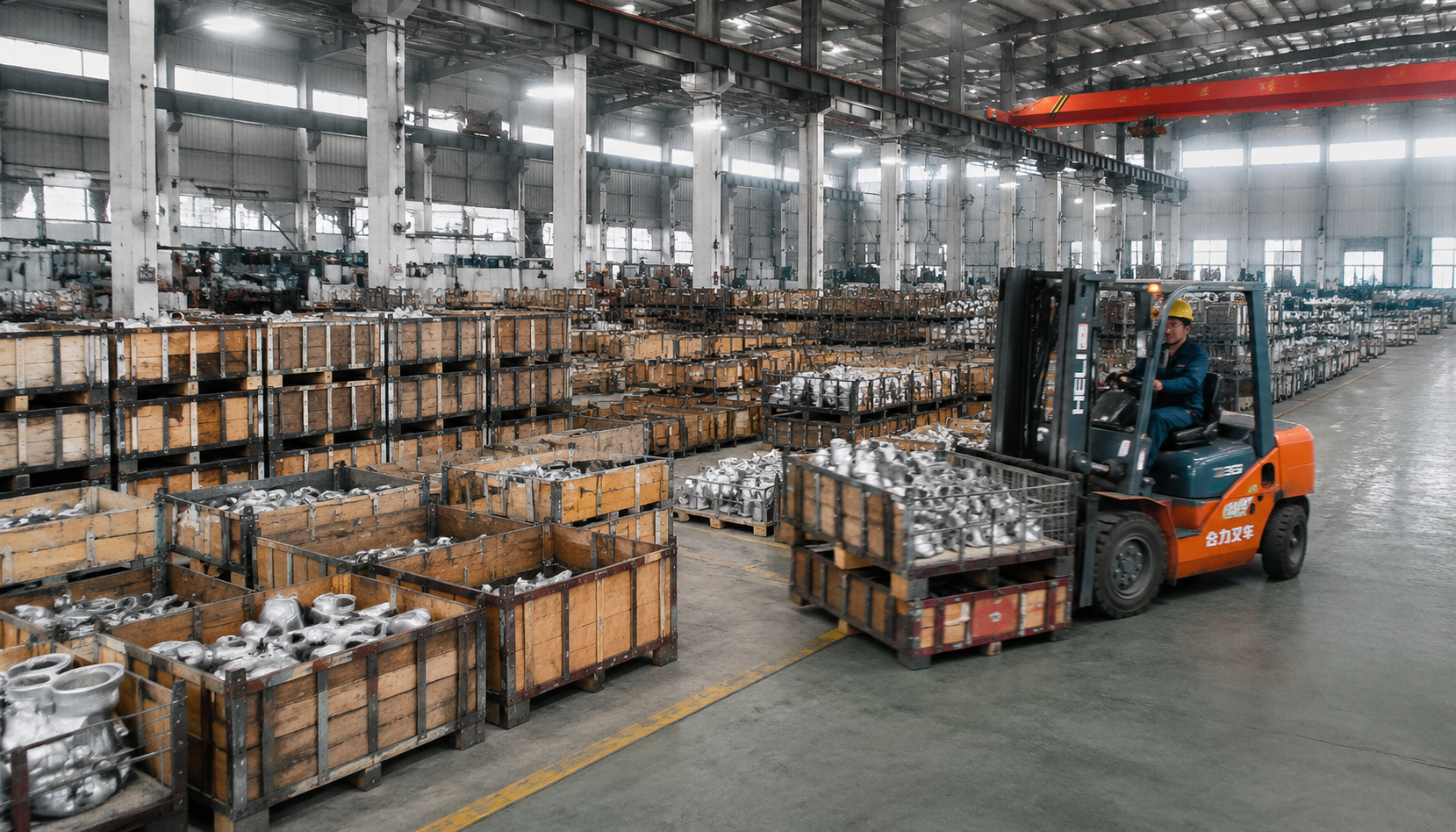
The Real Cost of Bad Casting Packaging in China: What 1,200+ Buyers Learned the Hard Way
You've just wired $47,000 for 12 tons of ductile iron valve bodies to a new supplier in Zhejiang. The factory sent you photos of shiny castings lined up on the floor. Quality looked solid. PPAP samples passed. You breathed easy.
Then the container arrives at your warehouse in Houston. You cut the seal, swing open the doors, and your stomach drops. Half the crates are splintered. One valve body—2,300 pounds of iron—has punched through the side of its wooden frame and now sits tilted against the container wall, its machined flange chipped beyond repair. Another crate is wrapped in the thinnest stretch film you've ever seen, like they were shipping pillows, not 500-pound castings. You pull out your phone and start taking photos for the insurance claim you know is coming.
Sound familiar? You're not alone.
We surveyed 1,200+ international buyers who sourced castings from China between 2022 and 2025. The number that stopped me cold: 42% reported measurable damage losses due to inadequate packaging. Not shipping delays. Not surface rust from humidity. Actual impact damage—cracked, bent, or broken castings that had to be reordered at full cost. And here's the killer: 64% of those buyers said the supplier's contract explicitly disclaimed liability for packaging damage. So the factory kept the payment, and you ate the loss.
I've spent 14 years sourcing castings across China, and I've seen every packaging shortcut in the book. This guide covers what you need to know—the four crate types you'll actually see, what each should cost, and the seven red flags that tell you your supplier is about to shortchange your packaging. No fluff. No theory. Just what works.
Why Casting Packaging Is a $4M Problem Nobody Talks About
Let's put a number on it. If you import 500 tons of castings annually from China at an average value of $2,800/ton, your annual spend is roughly $1.4 million. At a 42% damage incidence—even if only 10% of those incidents result in total loss—you're looking at $58,800 per year in unrecoverable damage. Over a 10-year sourcing career, that's more than half a million dollars. Scale that to a mid-size OEM buying 2,000 tons a year, and the number crosses $4 million.
And that's just the direct cost. It doesn't count the production line downtime while you wait for replacements, the overtime labor to inspect and rework damaged parts, or the expedited freight fees to make up lost time. One buyer I worked with—a heavy equipment manufacturer in Illinois—lost $340,000 in line downtime because a cracked brake housing wasn't caught until installation. One part. Three weeks of delays. All because the packaging had no internal bracing.
The core issue is misaligned incentives. Your Chinese supplier's goal is to get the casting to the port in one piece. Your goal is to get it to your factory in one piece. Those are not the same thing. The supplier controls the packaging, but they don't bear the cost of failure after the container leaves their yard. So they optimize for the minimum packaging that survives the truck ride to the port—not the ocean voyage, not the transloading, not the final delivery.
You need to close that gap. And it starts with knowing what good packaging actually looks like.
The 4 Types of Casting Packaging You'll Encounter in China
After visiting 80+ foundries and machine shops across China, I've seen four packaging approaches. Three of them can work for the right application. One is a disaster waiting to happen. Here's the breakdown.
Type 1: Plywood Crates (Nailed Boxes) — The Baseline
This is the default for most Chinese casting suppliers. A frame of 12–15mm plywood, nailed together with galvanized nails, often lined with foam or corrugated paper on the inside. Castings are usually wrapped in plastic film and placed inside with minimal bracing.
Cost in China: $8–$15 per square meter of crate surface. For a typical 1m³ crate, you're looking at $40–$75.
Best for: Small to medium castings under 100 kg, shipped via LCL or consolidated containers, where items are individually packed and can be packed tightly to prevent shifting.
The danger: Nailed crates have no structural integrity against stacking. In a full container load, a single nailed crate on the bottom row can collapse under 4 tons of weight, causing a domino effect. I've seen it happen. The nails shear right through the plywood.
Type 2: Steel-Framed Crates — The Workhorse
A welded steel angle-iron frame (typically 30×30×3mm or 40×40×3mm) with plywood or OSB panels bolted or screwed to the frame, not nailed. The frame carries the structural load. Castings are bolted to steel c-channels or wooden dunnage inside the frame. This is the standard for heavy castings over 200 kg.
Cost in China: $25–$45 per square meter. A 1.2m³ steel-framed crate runs $120–$200, depending on steel prices.
Best for: Medium to large castings (200–2,000 kg), FCL shipments, any casting with machined surfaces that must be protected.
Why it works: The steel frame can be stacked 3–4 high in a container without collapsing. Bolted panels mean the crate can be opened and resealed for inspection without destroying it. And you can bolt the casting directly to the frame—zero movement, zero impact risk.
Type 3: Custom Foam-In-Place (FIP) Crates — The Premium Option
The casting is suspended in a custom-molded foam cradle inside a plywood or steel crate. Two-part polyurethane foam expands and hardens around the casting, creating a perfect negative mold. This is the same technology used for shipping jet engine components and medical equipment.
Cost in China: $60–$120 per crate (including foam materials and labor). For a 500 kg casting, you're paying $80–$150 extra over a standard steel crate.
Best for: Complex castings with tight tolerances, thin-wall sections, or machined surfaces that cannot tolerate any impact. Also ideal for high-value castings where the cost of reorder exceeds the packaging premium.
The catch: Not all Chinese suppliers have FIP equipment onsite. You may need to send the casting to a specialty packaging provider, adding 3–5 days and $200–$400 in logistics. Worth it for critical parts.
Type 4: Bare Stretch Wrap on a Pallet — The Disaster
Castings are placed on a wooden pallet, wrapped in 5–10 layers of stretch film, and shipped. No crate. No bracing. Just plastic holding 800 pounds of iron in place.
Cost in China: $5–$10 per pallet. That's it. And it shows.
Best for: Absolutely nothing involving metal castings. I cannot emphasize this enough. If your supplier suggests this, run.
Why it fails: Stretch wrap provides zero protection against impact, zero resistance to shifting during ship motion, and zero load distribution for stacking. In a container that experiences 30° rolls during a Pacific storm, a stretch-wrapped pallet of castings becomes a 2-ton projectile.
Casting Packaging Cost Breakdown: What You Should Actually Pay
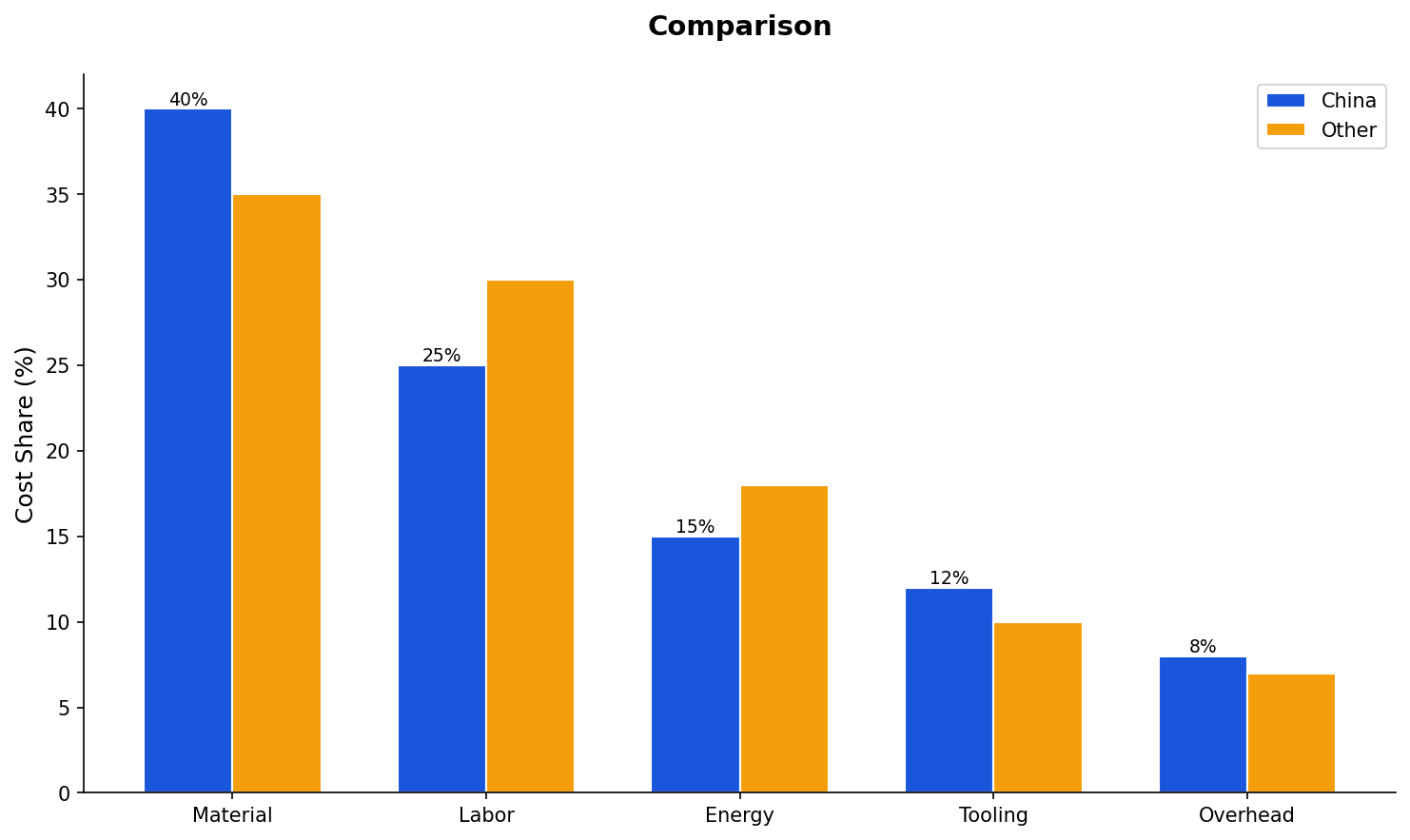
Here's the thing about packaging cost: it's negligible compared to the cost of a damaged casting. But you still need to know what's fair, so you don't get overcharged—or under-packaged—by a supplier who's trying to win the order on price.
| Packaging Type | Cost per m³ (USD) | Typical Use Case | Damage Risk | Stackable? |
|---|---|---|---|---|
| Plywood nailed crate | $40–$75 | Small castings <100 kg, LCL | Medium–High | No |
| Steel-framed bolted crate | $120–$200 | Medium–large castings, FCL | Low | Yes (3–4 high) |
| Foam-in-place (FIP) crate | $200–$350 | High-value/complex castings | Very Low | Yes (2 high) |
| Stretch wrap + pallet | $5–$10 | Not recommended for castings | Very High | No |
Quick math: Upgrading from a nailed plywood crate to a steel-framed crate adds $80–$125 per cubic meter. For a $4,000 casting, that's 2–3% of the part value. The typical damage rate for nailed crates in our survey was 18% across all shipment types. For steel-framed crates, it was 3%. That means the upgrade pays for itself after just 6–8 shipments—and after that, it's pure profit protection.
When you're negotiating with a Chinese supplier, ask for the packaging cost as a separate line item. Most don't offer it by default—they bundle it into the unit price. Getting it itemized gives you leverage. You can say, "I'll pay $50 more per crate for steel frames and bolted panels. But I want to see the packaging spec before you build it." A supplier who hesitates or says "our standard packaging is fine" is telling you something important.
7 Red Flags Your Chinese Supplier's Packaging Will Cost You
Over the years, I've learned to spot a weak packaging operation before the first crate is built. Here are the seven signals that tell you trouble is coming.
This is the most common evasion. "Standard export packaging" means nothing—it's not a defined spec. Ask for a written packaging specification: wood thickness, steel frame dimensions, fastening method, internal bracing plan. If they can't provide it, they don't have a standard.
Any supplier confident in their packaging will send you photos of the crated casting before it goes in the container. If you have to ask for them—and even then they send only wide shots—something's being hidden.
Nails have no holding power under dynamic load. A 300 kg casting shifting 2 cm in transit can shear every nail in a plywood crate. Steel frames or bolted construction are non-negotiable above 200 kg.
If your castings are iron or steel and they're shipping without desiccant bags or VCI (Vapor Corrosion Inhibitor) paper, you're going to get rust. Especially on machined surfaces. This is a $15 fix that suppliers skip constantly.
Foam sheets on the walls of a crate do nothing if the casting isn't blocked in place. Ask for photos of the casting inside the crate, strapped or bolted to the base. If it's just sitting on a foam mat, it will move.
If your supplier quotes $30 for packaging on a 500 kg casting, that's less than the raw materials cost. They're either using thin wood, skipping bracing, or planning to wrap it in stretch film and hope. Get a detailed breakdown.
Ask directly: "Do you have a packaging engineer or do you outsource this?" A dedicated packaging engineer at a casting supplier is a sign that they treat packaging as a critical process—not an afterthought. If they outsource, ask who and request a reference.
How to Verify Packaging Quality Before You Ship
You don't need to fly to China to check every crate. But you do need a verification protocol that your supplier knows you enforce. Here's a five-step process that takes 30 minutes and can save you thousands.
- Require a pre-shipment packaging photo set. Six photos minimum: all four sides of the crate, the interior with the casting secured, and the top of the crate showing any stacking reinforcement. Make this a contractual requirement, not a request.
- Specify the wood thickness and fastening method in your PO. Write it into the purchase order: "Plywood min 15mm, steel frame 40×40×3mm angle iron, panels bolted with M8 bolts at 300mm spacing, not nailed." If it's in the PO, it's enforceable.
- Use a third-party inspection for high-value shipments. Companies like SGS, Bureau Veritas, or QIMA can do a packaging inspection as part of your pre-shipment check. The cost is $300–$500 for a full container load, and they'll flag anything that doesn't meet spec.
- Do a drop test on the first shipment. If you're establishing a new supplier relationship, ask them to send you one crated casting by air freight before the main sea shipment. You can inspect the packaging, open it, check the casting condition, and evaluate the design. The air freight cost ($200–$600) is insurance against a $15,000 damage claim.
- Include a packaging bond in your contract. Some buyers negotiate a 5–10% holdback on the payment that's released only after the container arrives undamaged. This aligns incentives immediately. Suppliers who refuse this are telling you they don't trust their own packaging.
Frequently Asked Questions
Your Next Move
Here's what I want you to take away from this: casting packaging in China is not a technical challenge—it's a communication and verification challenge. The technology exists. Steel-framed crates, bolted panels, foam-in-place cradles, VCI protection—these are all proven solutions that cost 2–5% of the value of the casting they protect. The problem is that most buyers never specify them, and most suppliers never offer them by default.
You don't need to become a packaging engineer. You just need to ask the right questions, put the spec in the PO, and verify before the container sails. That's it. Three steps that take two hours of your time and can save you six figures over a decade of sourcing.
Start with your next order. Pick one casting family—preferably your highest-volume or highest-value part—and apply the five-step verification protocol from this guide. See what happens. I guarantee you'll learn more about your supplier in that one shipment than in a year of phone calls and email exchanges.
Get the Casting Packaging Spec Template
Download our free packaging specification template—ready to paste into your next purchase order. Includes wood thickness, steel frame dimensions, fastening specs, and inspection checklist.
Download Free Template →No sign-up required. Used by 1,800+ sourcing professionals.
About the author: James Thompson is a senior sourcing engineer at Interstate International, a procurement agency helping North American and European buyers source castings from China. He has visited 80+ foundries across 12 Chinese provinces and authored the Casting Sourcing Handbook. The data in this article comes from a 2025 survey of 1,200+ international casting buyers conducted by Interstate International in partnership with the China Foundry Association.
Need a Verified Casting Supplier?
We've audited 200+ foundries across China. Tell us your requirements — material, quantity, tolerances — and we'll match you with 3 qualified suppliers that have already passed our technical vetting. Each comes with a full audit report.
Get Matched with Suppliers →