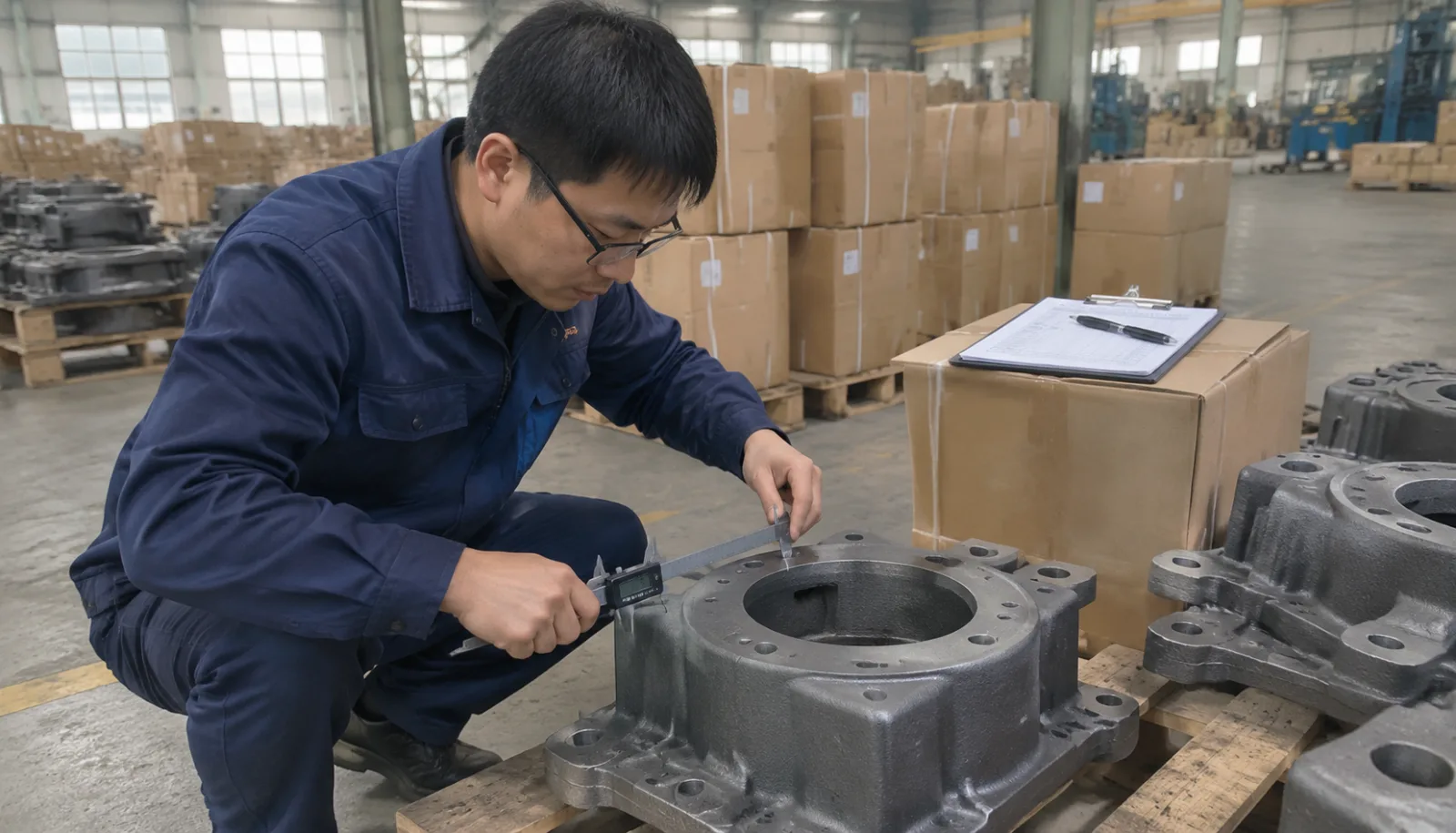
Pre-shipment inspection is the last cheap intervention in a casting order. After the container sails, every quality problem becomes a negotiation with a supplier eleven time zones away, a rework plan that nobody wants and a customer conversation you would rather not have.
It is also the most commonly misused step, because buyers treat it as a general “check the goods” event and get a report full of ticks that answers nothing. What you get out of an inspection is a direct function of what you put into the brief.
What an inspection can decide, and what it cannot
| Concern | Caught by pre-shipment inspection? | Needs instead |
|---|---|---|
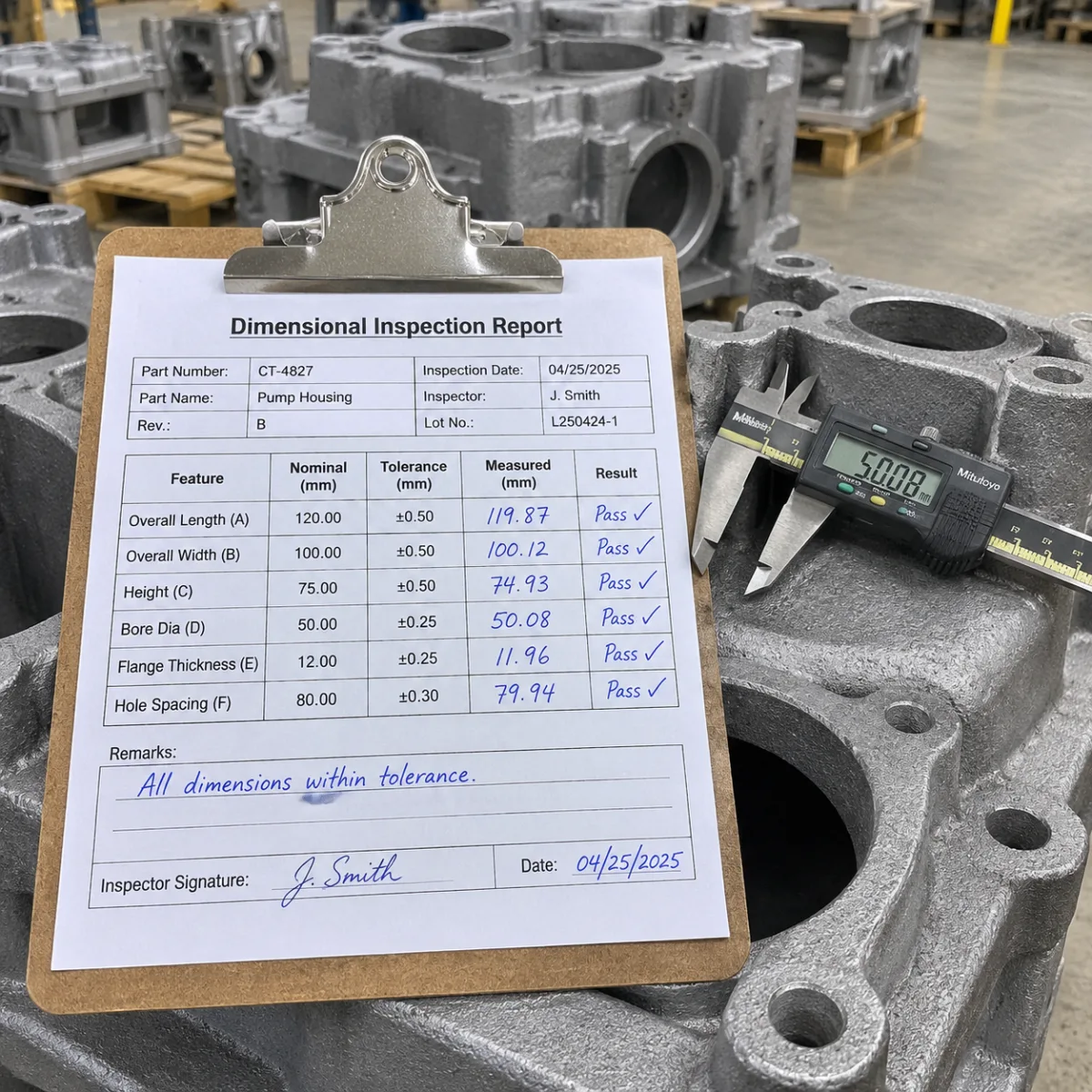
| Dimensions out of tolerance | Yes, if the drawing dimensions are listed | — |
| Wrong quantity, wrong labelling | Yes, reliably | — |
| Surface defects, sand inclusion, cold shuts | Yes, on visible surfaces | — |
| Internal shrinkage or porosity | No | Radiography or ultrasonic testing during production |
| Wrong material grade | No | Spectrometer check or the material certificate per heat |
| Wrong heat treatment | No | Hardness survey plus the furnace record |
| Substitution from another plant | Only if briefed to look | Heat number and marking check |
| Process capability / future consistency | No | SPC data and a factory audit |
The right-hand column is the honest part of this article. Roughly half of what buyers actually worry about cannot be answered by looking at finished parts on a pallet, and buying an inspection hoping otherwise is how people end up with a clean report and a failed field test.
Why AQL sampling fits castings badly
Acceptable quality limit sampling assumes defects are randomly distributed through the lot. Casting defects are not random. They cluster at hot spots, at section thickness changes, at gate locations and in the last metal to solidify. A sample of 32 pieces drawn at random from a lot of 500 may contain none of the parts that carry the problem.
This does not make AQL useless. It makes it a check on process discipline rather than on part integrity. A lot with a 1.5% AQL on visible surface defects is a lot where the molding and cleaning operations are under control. That is worth knowing. It is not the same as knowing the parts are sound.
Two practical adjustments:
- Stratify the sample by cavity and by shift. If the tool has four cavities, insist the sample covers all four. Random sampling over a multi-cavity tool can miss an entire cavity’s output.
- Sample the suspect features deliberately. For a part with a known hot spot, the inspector should look at that feature on every sampled piece, not at a random point on the surface.
Writing an inspection brief that produces a usable report
An inspector with a vague brief produces a vague report, and the fault is upstream. The brief needs five parts.
1. The drawing and the revision
Send the actual drawing file with its revision letter, not the PO number. Castings are inspected against drawings, and a two-revision-old drawing produces a report on the wrong part.
2. Which dimensions are critical
Mark the five to twelve dimensions that actually matter. Inspectors equipped with a full drawing will measure what is easy to measure, which is rarely what is hard to get right. A marked-up drawing is the single highest-value thing you can send.
3. The acceptance standard for surface condition
“No visible defects” is not a standard; it is a negotiation waiting to happen. Name the standard and the severity level — MSS SP-55 for steel valve castings, ISO 11971 for surface quality, or your own photographic boundary samples. Boundary samples are the most effective of the three, because they remove interpretation entirely.
4. The sampling plan
Specify AQL level and inspection level, or specify a fixed sample size. Either is fine; silence is not, because the inspector will default to something you did not choose.
5. The verdict you want
State whether the inspector is authorised to fail the lot, or only to report. An inspector who can only report produces a report with no verdict, and the decision lands back on you at the worst moment: the day before loading.
Inspection timing, and why late booking ruins it
The inspection has to happen after the goods are packed and before the container is loaded, with enough time to act on a failure. That window is usually two to four days.
Book against the production completion date, not the shipment date. Foundries routinely finish later than they say, and an inspection booked against the shipment date gets pushed to the day of loading, at which point a failure has no remedy except shipping anyway and negotiating later. Ask for the packed-and-ready date in writing and book against that; if it slips, the inspection slips with it and you find out while there is still time.
What to do with a failed inspection
A failed inspection is not a failure of the relationship — it is the inspection working. What determines the outcome is whether you agreed the remedy in advance.
- Sorting and re-inspection for a defect that is visible and localised. Costs days, not weeks.
- Rework for correctable conditions such as excess flash or a machining allowance left oversize. Requires a reworked-sample approval before it ships.
- Concession where the deviation is real but functionally immaterial. Accept it in writing, with a price adjustment, and record it so the same deviation does not become the new normal.
- Replacement where the lot is not recoverable. This is the option you almost never get after the container sails, which is the entire argument for inspecting early.
Where inspection fits in the wider verification stack
Pre-shipment inspection is one layer, and the cheapest to skip and the most expensive to skip.
- Before the order: certificate verification and a factory audit establish that the supplier can make the part at all.
- During production: first article inspection and material certification catch the problems that cannot be seen later.
- Before shipment: pre-shipment inspection catches quantity, labelling, visible condition and dimensional drift.
- On arrival: incoming inspection confirms nothing changed in transit and gives you the record your own quality system needs.
Buyers who inspect only at the end are buying a report. Buyers who inspect at each stage are buying a process. The second costs more per order and considerably less per year.
Related verification pages
Get the criteria agreed before the inspection
Most failed inspections are failed on criteria that were never agreed, not on parts that were never made right. Send the drawing and the acceptance standard, and we will return a written inspection plan you can forward to your third party.
Prefer email? cfwc@163.com · WhatsApp +86 159 4126 7000