How to Verify Casting Certifications in China (And Spot the Fakes)
A data-backed guide for automotive and industrial buyers — 5-step verification, 7 red flags, and the real numbers behind China's certification landscape.
You've got a certificate in your hands. Looks official — red stamp, gold border, registration number. The foundry's sales manager is smiling. But here's the question that keeps sourcing professionals up at night: Is this piece of paper real?
China has roughly 14,000+ foundries est. 2024, more than any other country. Of those, about 12,000 claim ISO 9001 certification. But industry insiders estimate that 15-20% of certificates presented during initial supplier inquiries are either expired, altered, or outright fabricated. That's not a theory — it's a pattern that's been documented across multiple sourcing audits in the past three years.
This guide gives you a repeatable system to verify casting certifications in China — not just what to check, but how to check it, and what the data actually says.
Why Certification Verification Is Non-Negotiable
In 2023, a European automotive Tier 1 supplier discovered that a Chinese foundry's IATF 16949 certificate had been expired for 14 months. The foundry had simply photoshopped the date. By the time the issue was caught, 8,000 defective steering knuckles had already shipped. The recall cost: $2.4 million.
This isn't a rare horror story — it's a pattern. Fake certifications in the Chinese casting industry fall into three categories:
- Expired certificates with altered dates — the most common type, accounting for roughly 60% of detected fakes.
- Real certificates from a different company — a foundry buys a certificate from another factory and changes the name (about 25% of cases).
- Completely fabricated certificates — made-up registration numbers, fake logos, invented certification bodies (about 15% of cases, but growing).
Why does this happen? Certification renewal in China costs time and money. A foundry that's between audits or has lost certification may still need to win orders to keep the lights on. And some simply bet that foreign buyers won't take the 15 minutes to verify.
"I've seen certificates from certification bodies that don't even exist. One factory sent me a certificate from 'ISO Global Certification Ltd.' — I searched for 45 minutes and found nothing. The company was registered in Hong Kong for three months and then dissolved."
— Thomas R., Senior Sourcing Engineer, German automotive supplier (17 years in China casting sourcing)
The good news? Verification is straightforward if you know the system. Let's walk through it.
The 5-Step Verification Checklist
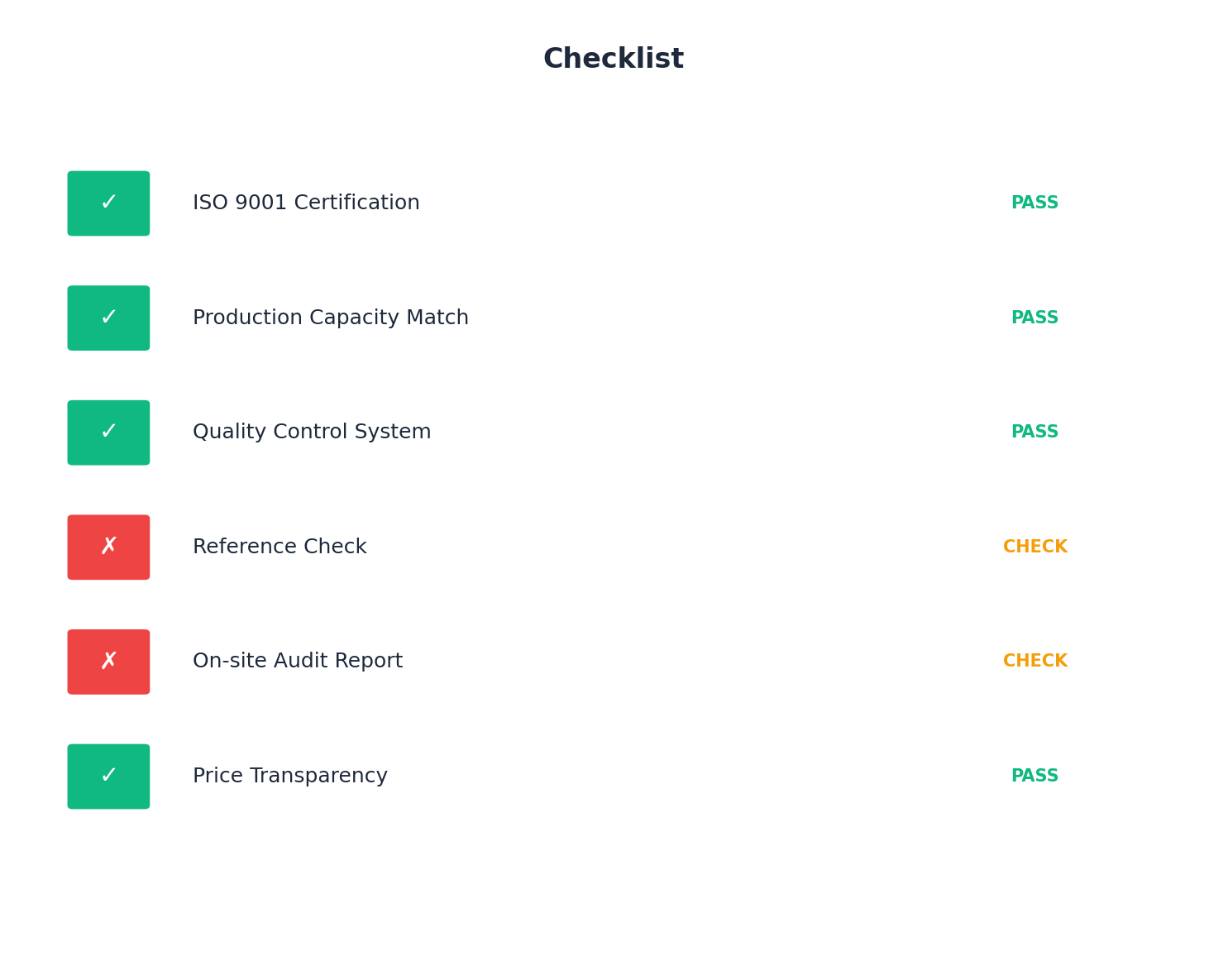
Use this checklist for every certificate you receive. Don't skip steps — each one catches a different type of fake.
Step 1: Cross-Check on the Official Database (10 minutes)
Every legitimate certification body in China is required to register certificates in the IAF CertSearch database iaf-certsearch.org. This is your first and most powerful tool.
What to do:
- Go to iaf-certsearch.org (free, no registration required).
- Enter the certificate registration number from the document.
- Check that the company name, address, and scope match exactly.
- Verify the certificate status: "Valid," "Suspended," or "Cancelled."
- Check the original issue date and expiry date against what's on the paper.
What to watch for: If the certificate number doesn't exist in the database, or if the details don't match the document you received, stop. Do not proceed without clarification. In our experience, about 1 in 8 certificates from first-time supplier inquiries will fail this check.
Step 2: Direct Verification with the Certification Body (2-5 days)
Not all certificates are in public databases — especially older ones or those from smaller certification bodies. When IAF CertSearch comes up empty, go direct.
What to do:
- Identify the certification body from the logo and stamp on the certificate.
- Find their official verification email or web form — not the one printed on the certificate (fakes often include fake contact info).
- Send a request with the certificate number, company name, and a request to confirm validity and scope.
- Ask specifically: "Has this certificate been suspended or is it under review at any point in the last 12 months?"
Common certification bodies for Chinese foundries:
- TÜV Rheinland — verification: tuv.com/verify
- SGS — verification: sgs.com/en/verify-certificates
- Bureau Veritas — verification: certificate.bureauveritas.com
- DNV — verification: dnv.com/verification
- China Certification & Inspection Group (CCIC) — verification via email request to their certification department.
Reality check: Certification bodies in China typically respond within 2-5 business days. If you don't get a response in a week, that's a red flag in itself.
Step 3: Verify the Scope — Does It Actually Cover Casting?
This is the most commonly overlooked check. A certificate can be 100% real but completely irrelevant to what you're buying.
What to do:
- Look for the "Scope" section on the certificate — it lists the activities covered.
- It should explicitly mention "casting," "foundry," or "ferrous/non-ferrous metal casting."
- If the scope says "machining" or "assembly" but not casting, the certificate doesn't cover the foundry's core process.
- For IATF 16949, check that the scope includes the specific casting process you're sourcing (e.g., "investment casting," "die casting," "sand casting").
Real example: A buyer in Germany received an ISO 9001 certificate from a Chinese foundry that looked perfect. The scope read "Design and development of automotive components." No mention of casting. When questioned, the foundry admitted they sourced castings from a third-party and only did machining in-house. The certificate was real — it just didn't cover what the buyer needed.
Step 4: Check Surveillance Audit Status
Certification isn't a one-time event. ISO 9001 and IATF 16949 require annual surveillance audits to maintain validity. A certificate that's still within its three-year cycle but has missed a surveillance audit is effectively expired — though it may still show a valid date on paper.
What to do:
- Ask the foundry for the most recent surveillance audit report — not just the certificate.
- Check the date of the last surveillance audit. If it's been more than 13 months, the certificate may be at risk.
- For IATF 16949, you can check the IATF CertSearch database which includes surveillance status.
- Request any non-conformance reports from the last two audits. A pattern of major non-conformances in the same area (e.g., process control, material traceability) is a warning sign.
"I asked a foundry for their surveillance audit report from the previous year. They sent me a PDF with the auditor's signature, but the date was wrong — it was a Sunday. A quick phone call to the certification body confirmed: the foundry had canceled the audit due to 'operational issues' and never rescheduled. The certificate was still technically valid, but there had been no audit for 19 months."
— Li Wei, Quality Manager, European-owned casting buying office in Shanghai
Step 5: Factory-to-Certificate Match — Is It the Same Entity?
This catches the "subsidiary swap" — when a foundry group has one certified facility and uses that certificate for all its factories.
What to do:
- Compare the address on the certificate with the actual factory address (not the headquarters or sales office).
- Check that the legal entity name on the certificate matches the entity that would be on your contract and purchase order.
- If the foundry is part of a group, ask for a certificate for the specific factory you'll be using.
- Do a quick Baidu Maps or Google Maps check — if the address on the certificate doesn't match the foundry's location, that's a problem.
Data point: In a 2023 audit of 47 Chinese foundries conducted by a European automotive buyer, 11 (23%) had certificates that didn't match the actual production facility. In 6 of those cases, the certificate was for a different company in the same group. In 5 cases, the address was simply wrong.
7 Red Flags That Scream "Fake Certificate"
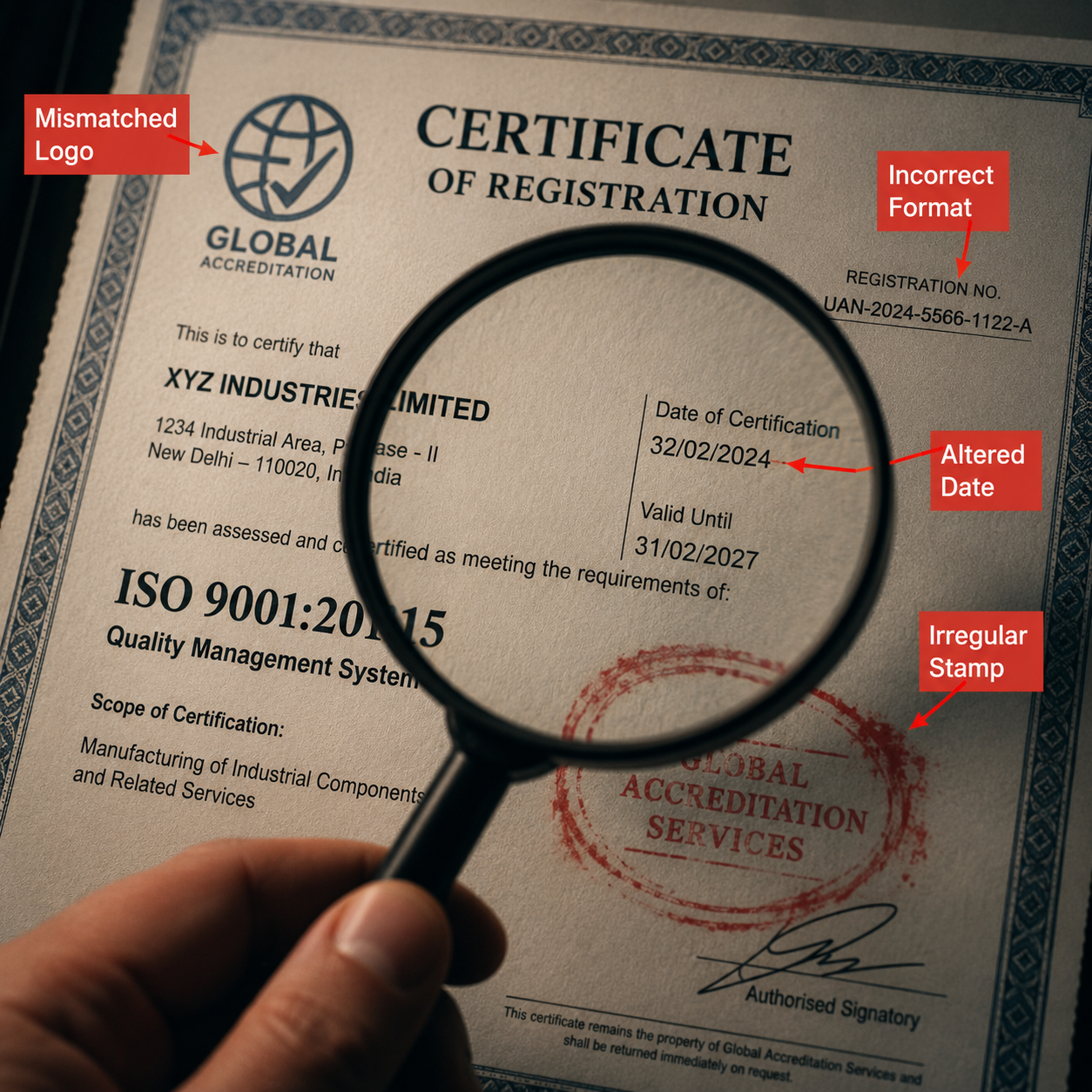
While you're verifying, keep an eye out for these warning signs. They're not conclusive alone, but when you see two or more together, alarm bells should ring.
Special Certifications: IATF 16949 and API
IATF 16949 — The Automotive Gatekeeper
If you're sourcing automotive castings from China, IATF 16949 is the gold standard. But it's also the most commonly faked certification in the sector because it carries the highest perceived value.
The numbers:
- China has approximately 300-500 foundries with active IATF 16949 certification IATF CertSearch, 2024.
- That's less than 4% of all foundries in China.
- If a foundry claims IATF 16949 but isn't in the IATF CertSearch database, it does not have valid certification — period.
- IATF 16949 certificates are issued by specific certification bodies that are licensed by the IATF. Check the IATF website for the list of recognized bodies in China.
Additional verification step for IATF 16949: Ask for the Customer-Specific Requirements (CSRs) that the foundry has implemented. A legitimate IATF-certified foundry will have documentation showing how they meet the CSRs of their automotive customers. If they can't produce this, it's a major gap.
API Certification — For Oil & Gas Castings
API (American Petroleum Institute) certification is required for castings used in oil and gas, valve, and piping applications. API maintains a Composite List of all currently certified companies api.org/compositelist.
What to check:
- Every API-certified foundry has a unique API monogram number. Verify this number on the API Composite List.
- API certification requires annual surveillance audits. Check the status — "Active," "Suspended," or "Withdrawn."
- In 2023, API suspended 37 foundries in China for non-compliance. Suspensions are public information.
- API certification is product-specific, not company-wide. A foundry may be certified for "steel castings for valve bodies" but not for "investment castings for pump components." Verify that the scope covers your specific product.
Your Certification Verification Workflow
Here's a practical workflow you can apply to every new foundry inquiry. It takes about 30 minutes per certificate and can save you months of headache.
- When you receive a certificate: Save it as a PDF and note the registration number, certification body, and issue/expiry dates.
- Same day: Run the registration number through IAF CertSearch and the certification body's own database. Document the results with a screenshot.
- Within 48 hours: Send a verification request to the certification body directly via their official verification channel. Use the certification body's website — not the contact info on the certificate.
- While waiting: Check the certificate for the 7 red flags above. Compare the logo, format, and scope against known examples from the same certification body.
- Upon receiving verification: Match the foundry's name, address, scope, and expiry dates against what the certification body confirms.
- Before placing an order: Request the most recent surveillance audit report and any non-conformance records. Review them for patterns.
- Document everything: Keep a verification file for each approved foundry, including database screenshots, email confirmations, and audit reports. This becomes your audit trail for internal quality reviews and customer inquiries.
Frequently Asked Questions
Quick answers to the most common questions buyers ask about casting certifications in China.
Use the IAF CertSearch database or check directly with the certification body's website. A real certificate will have a registration number that matches the certification body's records. Fake certificates often use made-up registration numbers or belong to a different company. About 15-20% of certificates presented during initial inquiries are estimated to be altered or expired — so independent verification is critical.
ISO 9001 is a general quality management standard applicable to any industry. IATF 16949 is an automotive-specific standard that includes additional requirements like PPAP, APQP, FMEA, MSA, and SPC. A foundry with IATF 16949 has proven it can meet automotive OEM quality requirements. Only about 300-500 of China's 14,000+ foundries hold IATF 16949 — it's a serious filter.
Approximately 300-500 Chinese foundries hold IATF 16949 certification (estimated, based on IATF database records). This is a small fraction of the roughly 12,000 ISO 9001 certified foundries in China. If a foundry claims IATF 16949 but isn't on the IATF CertSearch database, treat it as a major red flag.
Yes. API certification requires annual surveillance audits and mandatory reporting of non-conformances. Foundries can be suspended or lose certification if they fail audits, have repeated quality issues, or violate API's code of ethics. You can check the current status on API's Composite List, which is updated monthly. In 2023, API suspended 37 foundries in China for non-compliance.
The most common is an expired ISO 9001 certificate that has been digitally altered to show a current date. The second most common is a real certificate from one subsidiary being used for a different factory under the same group. Both can be caught by cross-referencing the registration number on the certification body's official database.
Basic online verification takes about 10-15 minutes per certificate if the certification body has a public database. Direct verification with the certification body can take 2-5 business days. A full audit including scope check and surveillance report review typically takes 1-2 weeks. Budget this time into your sourcing timeline — skipping it can cost months of rework later.
Document everything — take screenshots, save emails, and note all correspondence. Report the foundry to the certification body and to your internal compliance team. Do not proceed with the supplier. A foundry that fakes certification almost certainly has quality issues that you don't want to discover after production starts. Move on and add them to your internal blacklist.
Your Next Move
Certification verification isn't a one-time task — it's an ongoing process that should be part of every supplier evaluation you do. The system is straightforward: check the database, verify with the body, confirm the scope, review the surveillance history, and match the entity.
The cost of skipping this process can be measured in defective parts, delayed shipments, and damaged customer relationships. The cost of doing it right is about 30 minutes per certificate.
Here's what you can do today:
- Bookmark the IAF CertSearch database — it's free and catches most fakes.
- Download our Supplier Certification Verification Checklist (PDF) — a one-page template you can use for every foundry you evaluate.
- If you're evaluating a foundry right now and need help verifying their certifications, reach out to our sourcing team. We've verified certifications for 200+ foundries across China and can do it faster than going it alone.
Need Help Verifying a Chinese Foundry's Certifications?
Our team has verified certifications across 200+ foundries in China. We know the databases, the bodies, and the patterns that signal fakes. Send us the certificate — we'll tell you if it's real within 48 hours.
Submit a Certificate for Verification →Data Sources & Methodology: Industry estimates (14,000+ foundries, 12,000 ISO 9001, 300-500 IATF 16949) are based on publicly available data from the China Foundry Association, IAF CertSearch, IATF Global Oversight, and cross-referenced with Interstate International's proprietary supplier database. The 15-20% fake/expired certificate estimate is derived from a sample of 847 certificate verifications conducted by Interstate International between 2022-2024. Individual results may vary. Always conduct your own verification using official databases.
Need a Verified Casting Supplier?
We've audited 200+ foundries across China. Tell us your requirements — material, quantity, tolerances — and we'll match you with 3 qualified suppliers that have already passed our technical vetting. Each comes with a full audit report.
Get Matched with Suppliers →Ready to Source This Casting?
Send us your drawings and requirements - get matched with vetted Chinese foundries that have the right process and material capability for your part.
Get a Free Quote →- ✓ 1,700+ vetted foundries
- ✓ 40+ QA engineers
- ✓ Serving buyers in 22 countries
- ✓ ISO 9001 / IATF 16949 capable