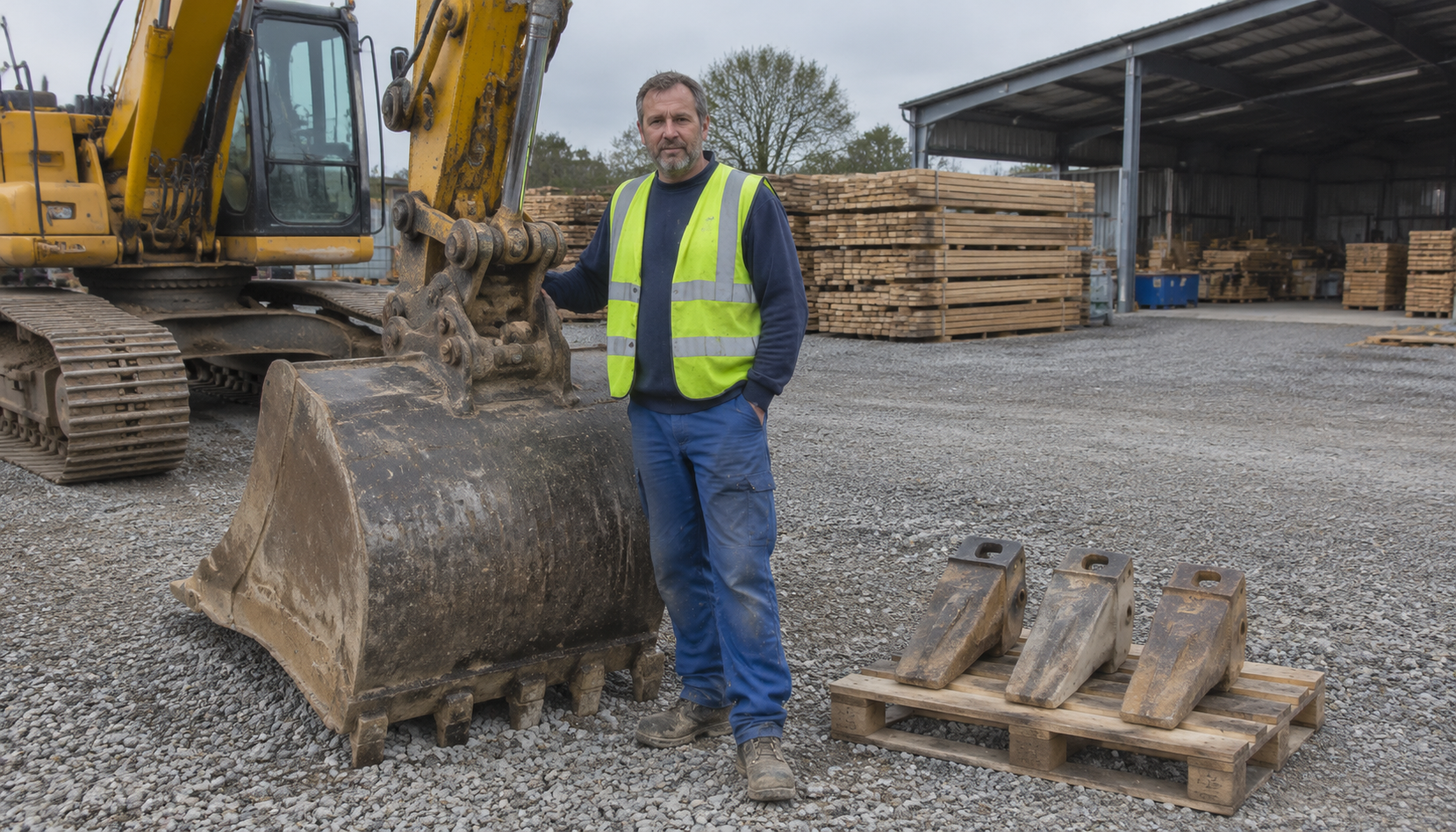
A mobile jaw crusher sitting idle costs a quarry somewhere between $4,000 and $12,000 a day in lost production — and that's before you count the haul trucks stacking up behind it, which is where the real money goes in an iron ore pit. Ask any maintenance manager in the Pilbara why they're obsessive about wear-part supply, and you'll hear a version of the same line: the part that stopped the plant was, nine times out of ten, a jaw plate with a unit price under $900.
That gap — cheap part, ruinous downtime — is the whole reason supplier selection for construction machinery castings deserves more than a price comparison spreadsheet. Get the supplier right and the part disappears into your maintenance schedule. Get it wrong and you'll spend the next eighteen months chasing heat numbers, arguing about shrinkage, and explaining to your operations manager why the same tooth keeps snapping.
Let's start with what the tonnage actually looks like.
Castings Are 15–25% of the Machine and Most of the Downtime
Take a 25-tonne excavator. Roughly 15–25% of its operating weight is cast metal, and that figure climbs once you count the counterweight, the track components and the hydraulic housings. On a jaw crusher the share is higher still.
But weight share isn't the interesting number. Failure share is.
Pull the maintenance log from any quarry or earthworks fleet and you'll find cast components account for the majority of unplanned stoppages — not because they're badly made, but because they're the parts doing the grinding. Bucket teeth, cutting edges, wear plates, jaw and cone liners, blow bars, track pads, dipper lips. These are consumables by design. The metal is supposed to be sacrificed.
Which splits your supplier question into two completely different problems:
- Wear castings — high-manganese and high-chrome consumables. Bought on life-per-dollar and availability. A bad batch shows up in weeks.
- Structural castings — booms, end bosses, track frames, gearbox housings, swing circles. Bought on dimensional accuracy, NDT and consistency. A bad batch shows up as a fatigue crack at 4,000 hours, long after the paperwork is filed.
Most buyers run both through the same supplier search and then wonder why one of the two keeps disappointing them. The foundry that pours a beautiful 18kg bucket tooth in high-manganese steel is often not the foundry that can hold ISO 8062 CT11 on a 900kg track frame. Different moulding line, different melting practice, different shop culture.
Where the Tonnage Actually Comes From
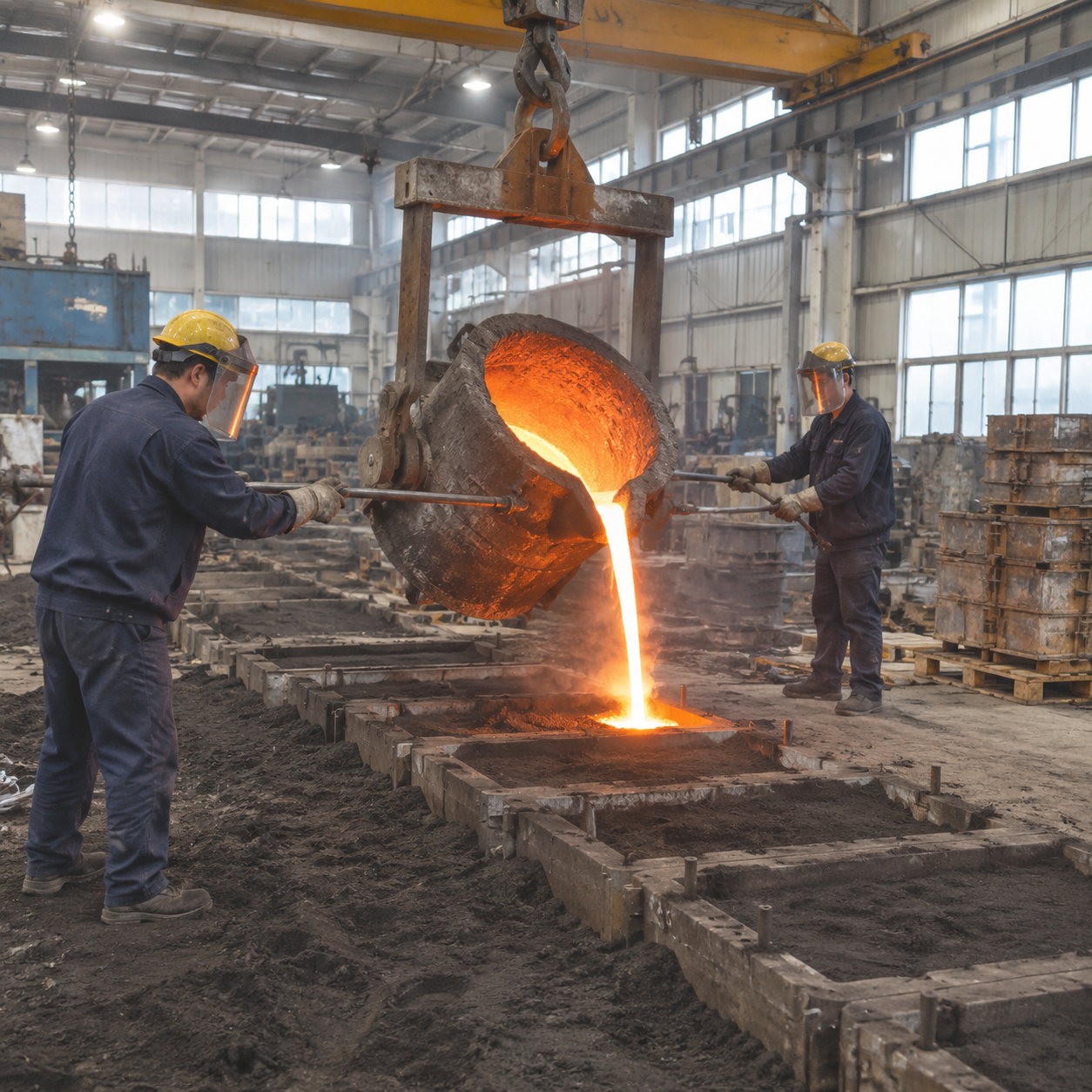
Global casting output runs around 110 million tonnes a year. China alone pours roughly 50 million of that — call it 45% — and a meaningful slice of it lands in construction and mining equipment. That dominance is why almost every serious sourcing conversation ends up in a Chinese foundry cluster eventually, whether the buyer admits it at the start or not.
The clusters matter because they specialise:
- Henan and Hunan — high-manganese and high-chrome wear castings. Deep bench of small and mid-size foundries, highly competitive on bucket teeth, hammers and liners. Also the highest concentration of traders posing as manufacturers.
- Shandong and Jiangsu — larger steel castings, structural work, gearbox and housing castings. More likely to hold ISO 9001 plus a customer-specific audit from a European OEM.
- Zhejiang and Fujian — investment casting and smaller precision parts, plus a lot of the machining capacity that feeds the wear-parts trade.
- India (Coimbatore, Belgaum, Rajkot) — strong on volume wear parts, generally 8–15% cheaper on simple geometry. Consistency on manganese chemistry is the recurring complaint.
- Turkey and Eastern Europe — shorter sea freight into the EU, useful when you're carrying a two-week replenishment window. Price sits between China and Western Europe.
None of this tells you which supplier to pick. It tells you where the shortlist should be drawn from, and which questions will get a straight answer versus a rehearsed one.
Process Match Beats "Capacity" Every Time
Every foundry website says "annual capacity 30,000 tonnes." It's the least useful number in the industry. Thirty thousand tonnes of grey iron brake drums tells you nothing about whether they can pour a 1.2-tonne Mn18 jaw stock without shrinkage porosity in the thick section.
What you want to know is the process behind the number:
| Process | Typical part | Weight range | What it's good at |
|---|---|---|---|
| Green sand / resin sand | Jaw plates, track frames, housings | 5–3,000 kg | Heavy sections, wear parts, structural |
| Lost foam (EPC) | Complex housings, brackets | 1–200 kg | Fewer cores, good surface, medium volume |
| Investment casting | Bushes, links, small precision parts | 0.05–50 kg | Tight tolerance, fine detail, higher cost/kg |
| Centrifugal | Sleeves, liner rings, pipe | 20–2,000 kg | Dense, uniform wall, good for abrasion |
Ask a supplier what moulding line your part will run on, and what the pattern-to-pour cycle looks like. If the answer is vague, they either don't know their own floor or they're planning to subcontract the pour. Both are things you need to hear before you pay for tooling, not after.
Hardness Is the One Number Buyers Check and the One That Proves Least
High-manganese steel is the standard for impact-abrasion parts, and ASTM A128 is the spec everyone quotes. The grades you'll meet:
- Grade B (Hadfield, ~11–14% Mn) — the baseline. Cheap, tough, work-hardens under impact.
- Grade C (~14% Mn) — the workhorse for crusher liners and bucket teeth.
- Grade D (~18% Mn) — higher wear resistance, needs proper solution annealing at roughly 1,050–1,100°C and a water quench. Skip the quench and you get a brittle part that cracks in the first week.
- Grade E (~22% Mn) — for the nastiest abrasive conditions. Expensive, and only worth it where you've already proven the cheaper grades fail.
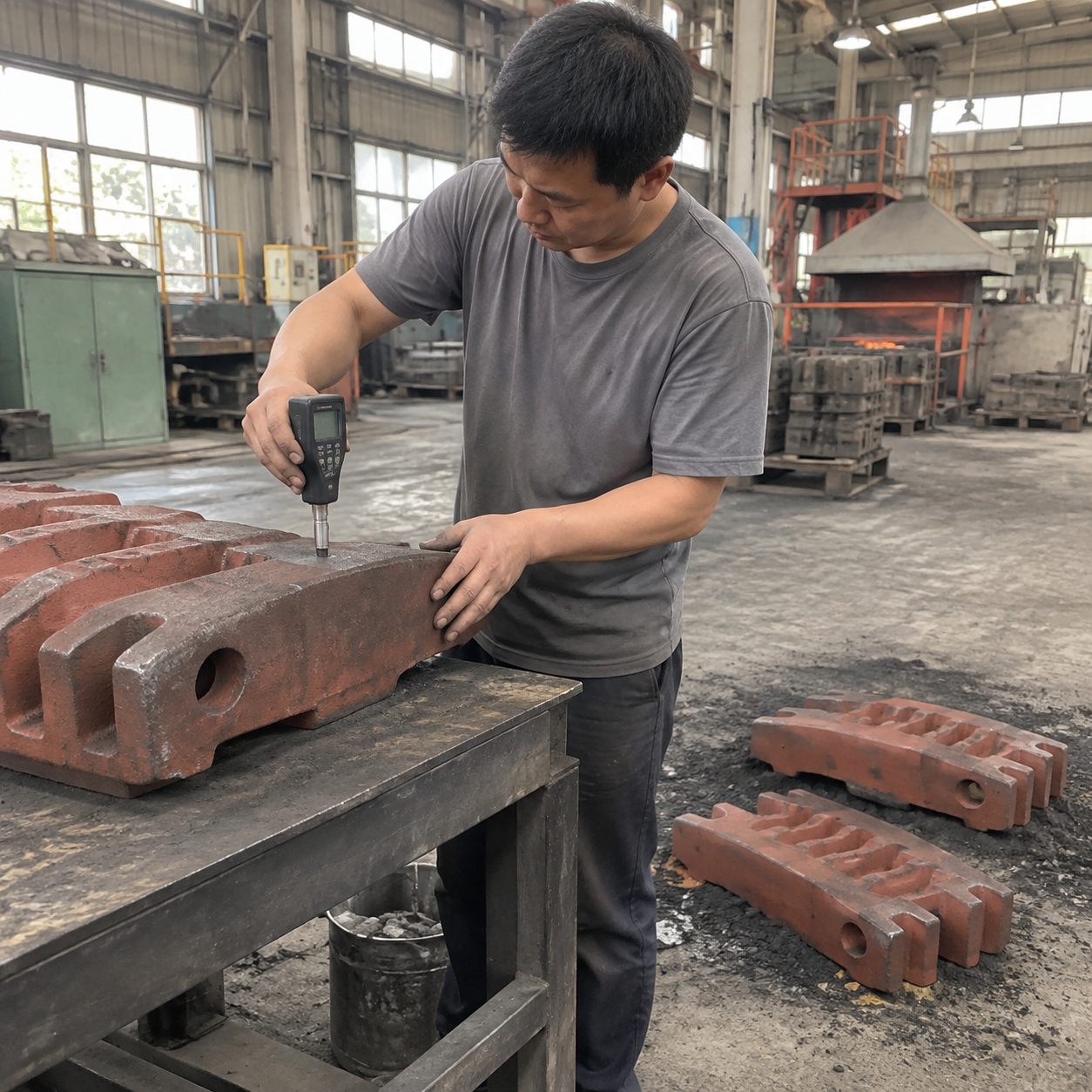
Here's the thing. As-cast and properly heat-treated Mn18 both measure somewhere around 180–220 HBW on a portable hardness tester. A part that's been correctly solution-annealed and a part that was pulled from the furnace two hours early will read almost identically on your gauge at goods-in.
The difference shows up at 400 hours, when one has work-hardened to 450–550 HBW in service and the other has cracked through the eye.
So hardness alone is a weak acceptance test for manganese steel. What you actually want:
- The heat treatment chart — a furnace curve with soak temperature, hold time and quench start. Real foundries generate these automatically and can email you the file.
- The spectro report against the heat number — carbon, manganese, chromium, and crucially phosphorus and sulphur. High phosphorus in manganese steel is a crack starter.
- The impact test if the part is safety-relevant — un-notched Charpy at room temperature, typically 100J+ for a decent Mn18.
For structural castings the spec shifts entirely — ASTM A148 for low-alloy steel, ASTM A27 for carbon steel, EN 10293 in European drawings. There, dimensional conformance to ISO 8062 CT grades and NDT results matter far more than surface hardness.
Six Questions That Separate Foundries From Traders
Roughly half the "manufacturers" listed on any B2B platform for casting parts are trading companies with a rented office and a photo library. That's not automatically disqualifying — a good trading partner can consolidate five foundries and absorb your quality risk. What kills you is not knowing which one you're dealing with.
These six questions do the sorting. Ask them in the first call, before any drawing leaves your desk.
- "Is the steel melted in your own furnace, or do you buy ingot?" In-house electric induction melting with a spectro on site is the answer you want. "We source from a qualified mill" is fine for structural work and a red flag for wear parts, because it means nobody controls the manganese balance.
- "Can I see a heat number on a part you shipped last month?" If the heat number isn't stamped, cast or tagged, the batch wasn't tracked. No tracking means no traceability, no matter what the certificate says.
- "Who owns the pattern after I pay for it?" You do. Get that in writing, plus a clause that the pattern is returned or destroyed on request. Foundries that resist this clause are planning to run your tooling for someone else.
- "Is final machining in-house?" Outsourced machining means your bore tolerance depends on a relationship you can't see. Ask how many CNC machines sit under the same roof.
- "Do NDT reports ship with the parts, or only on request?" The right answer is "with the parts, every time."
- "What's your scrap rate on this part family over the last three months?" Everyone hesitates here. A supplier who gives you a number — even an ugly one — is telling the truth. A supplier who says "very low, under 1%" on a heavy-section manganese casting is either lying or doesn't measure.
Lead Time: The Part Nobody Tells You
Quoted lead times for construction machinery castings cluster around "30–35 days." Actual lead times cluster around 55–80 days for a first article, and 45–60 days for repeat orders. Here's why the two numbers never match.
The 30-day quote usually covers the pour. It doesn't cover pattern making (2–4 weeks for a new tool, longer for multi-part patterns), solution annealing and quench, machining queue, or the inspection and packing tail. Add 25–35 days of ocean freight if you're shipping to Europe or the US East Coast, and a first order landing at your dock in under 10 weeks is genuinely fast.
What you should be measuring isn't the quoted lead time. It's the on-time delivery rate over the last 12 months, and whether the supplier will put a late-delivery penalty in the contract. The ones who will are the ones who plan their furnace schedule.
One practical lever: ask whether your part can run on a scheduled pattern cycle — the same moulding line, the same week, every month. Foundries that run repeat work on a fixed cycle hit their dates far more reliably than foundries squeezing jobs in around other people's orders.
Price Is Only About a Third of Your Real Cost
Buyers love a unit-price comparison because it's the only number that fits neatly in a spreadsheet. It also explains almost nothing about what the part costs you.
Break down the true cost of a wear casting over its service life and the picture looks roughly like this: purchase price around 30–40%, replacement labour and machine downtime around 40–50%, and the rest split between inventory carrying cost and the administrative drag of chasing deliveries.
Which means a bucket tooth at $95 that lasts 700 hours beats a $70 tooth that lasts 420 hours by a wide margin — and the $70 tooth looks cheaper on every purchase order you'll ever raise.
Robert Davis, a construction hardware wholesaler in Georgia who moves about $1.5M a year in wear parts and small castings, put the same point more bluntly when I asked him how he compares quotes: "I stopped buying on unit price after the second season. Now I ask every supplier for the same thing — what's the wear life you'll stand behind, and will you put a replacement clause on it. The ones who go quiet at that question were selling me somebody else's scrap."
For buyers running high-throughput mining applications — Australian iron ore, Chilean copper, Canadian oil sands — the downtime side of that equation dwarfs everything else. A stopped primary crusher in a Pilbara pit doesn't just lose the crusher's throughput; it backs up the haul fleet, the stockpile, and the processing plant downstream. Under that math, buying wear parts on unit price rather than wear life isn't a preference. It's a slow way of losing money.
The other thing a pure price comparison hides is alloy substitution. A supplier quoting 15% below the market on "high manganese" is very often pouring a low-alloy or medium-manganese grade and calling it Mn18. It machines easier, it pours cleaner, and it fails in the field at one-third the life. You cannot see the difference at goods-in. You see it in the first month of operation, when your maintenance team starts asking why they're changing teeth twice as often.
Certification Is a Starting Point, Not a Verdict
ISO 9001 is table stakes and tells you almost nothing specific. Plenty of foundries hold it and still ship parts with shrinkage porosity in the thick section. What it does tell you is that somebody external has looked at their process documentation at least once a year.
What to actually verify:
- Scope of the certificate — does it cover "manufacture of steel castings," or just "sales of machinery parts"? A trading company's ISO certificate is real, and irrelevant to your part.
- EN 10204 3.1 material certificates — issued by the manufacturer's own independent inspection department, tied to the heat number. A 2.2 certificate is a statement, not a test result.
- NDT certification of the operators — UT and MT technicians should hold Level II under ISO 9712 or ASNT. Ask for the certificates, not the company's NDT capability statement.
- Heat treatment records — the actual furnace chart, not a stamped "heat treated" box on the packing list.
- Customer-specific audits — if a European or Japanese OEM has audited the plant in the last three years, ask which one and when. That's the strongest single signal available.
Robert Davis has a one-line version of this that's worth stealing. "Ask for the certificate number before you send the drawing," he told me. "Half of them go quiet right there. The ones who send a number you can ring up at the accreditation body — those are your shortlist."
He's right, and it takes about four minutes. Certification bodies will confirm on the phone whether a certificate number is live and what scope it covers. Do that for every shortlisted supplier. It costs nothing and eliminates the ones who photocopied somebody else's certificate into a brochure.
The Seven-Point Plant Visit
If the order is worth more than about $50,000 a year, go and look. Not for the showroom tour — for these seven things, in this order, ideally without a scheduled appointment.
- The melting shop. Induction furnaces, a spectro lab next door, and a log of the last ten heats. If the spectro room is locked or "being calibrated," you've learned something.
- The moulding line. Is it mechanised or hand-rammed? For parts above 200kg, hand-rammed sand with an experienced crew can be excellent — but you want to see the crew, and their average tenure.
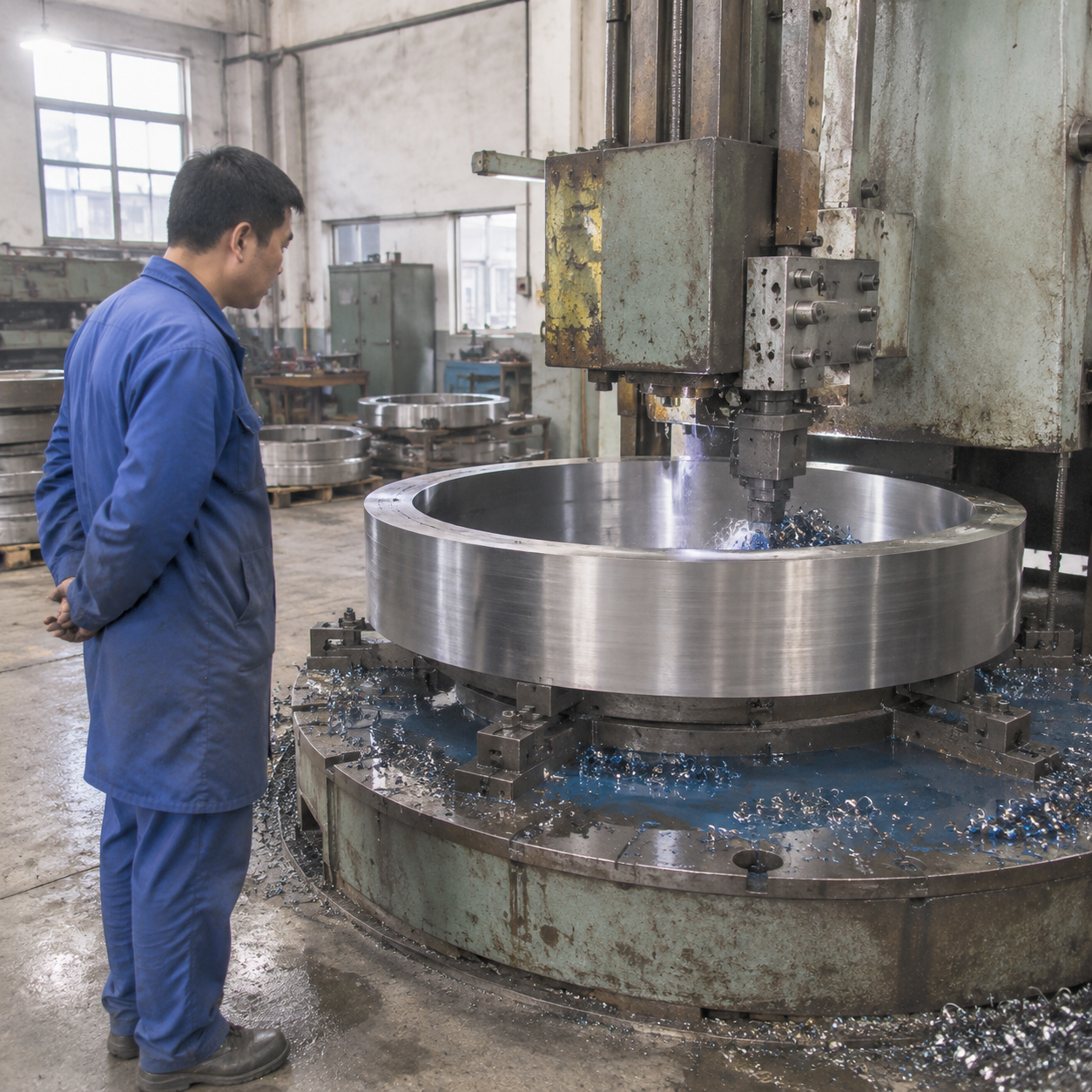
- The heat treatment furnace. Look for a chart recorder or a data logger. Ask to see yesterday's curve for a manganese job. A furnace without recorded curves is a furnace doing whatever the operator feels like.
- The machine shop. Count the machines and see what's actually cutting. A foundry that machines everything in-house will have chips on the floor.
- The lab and NDT bay. UT equipment, magnetic particle benches, a hardness tester that gets used. Check calibration stickers — an out-of-date sticker is a habit, not an accident.
- The scrap yard and rework area. Every foundry has one. Size and organisation tell you more about real quality than any certificate. Ask what the top three defect modes were last quarter.
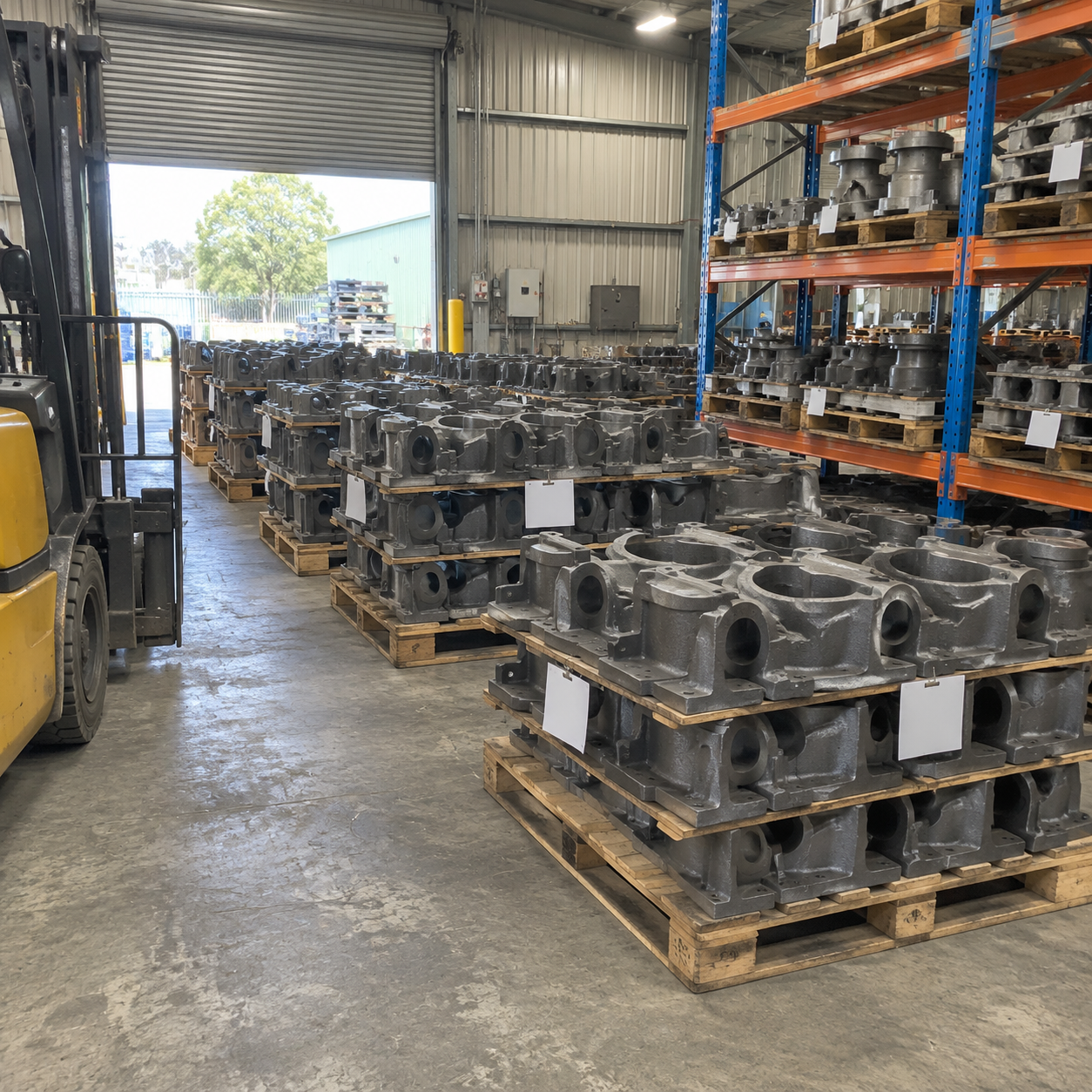
- The loading bay and finished goods area. Parts stacked on timber, tagged, protected from rain. Parts in a puddle with no tag means your part will arrive in a puddle with no tag.
Two hours on the floor beats forty pages of brochure. And the questions the plant manager can't answer — those are the ones you needed answered.
Mistakes That Cost Buyers Real Money
These show up again and again across construction equipment supply chains. None of them are exotic. All of them are avoidable with a clause or a question.
- Specifying "high manganese steel" instead of a grade. Write ASTM A128 Grade C or Grade D on the drawing. "High manganese" is a marketing phrase that covers anything from 11% to 14% Mn with whatever carbon the foundry felt like.
- Paying for the pattern and not owning it. Six months later, a competitor is selling an identical part. Check the tooling clause before you sign the PO.
- Accepting a first article without a dimensional report. "It fits" is not a check. Get the CMM or manual dimensional record against the drawing, with the specific features called out.
- Not specifying the packing. Heavy castings shipped loose in a container arrive with chipped edges, bent bosses and a rejected incoming inspection. Specify sea-worthy packing, steel-banded, on timber.
- Skipping pre-shipment inspection on the first order. $400 of third-party witness inspection on order number one has saved more buyer-supplier relationships than any contract clause ever written.
- Single-sourcing a consumable. Wear parts are consumables — you need two qualified sources, even if the second one only gets 20% of volume. Qualifying a new foundry from scratch during a breakdown is the worst possible time.
Frequently Asked Questions
What's the minimum order quantity for construction machinery castings?
On a new pattern, most foundries want 1–3 tonnes or 20–50 pieces, whichever comes first. Below that, pattern amortisation swamps the unit price. Once the tool exists, repeat orders of 5–10 pieces are usually negotiable — but expect to pay a small-lot premium.
How long should a high-manganese jaw plate actually last?
In hard abrasive rock like granite, a properly solution-annealed Mn18 plate typically runs 600–1,200 operating hours. Softer limestone can push past 2,000. If you're getting 300 hours out of a plate, the alloy or the heat treatment is wrong — the rock isn't the variable.
How do I confirm the part is really high-manganese steel?
Match the heat number on the part to the spectro report and the heat treatment chart. Then check phosphorus — anything above 0.05% in a manganese steel is a crack risk, and it's a number lazy foundries let drift. A handheld XRF will confirm manganese content at goods-in, but it won't tell you about the heat treatment, which is where most failures originate.
Is buying through a trading company a bad idea?
No. A good one manages quality across several foundries, handles consolidation and takes the communication burden off you. The problem is a trader presenting as a foundry. Ask which plant poured the last batch, and whether you can visit it unannounced. A good trading partner says yes immediately.
Should I use third-party inspection?
On the first order, yes. Above roughly $20,000 per shipment, yes on every order. Pre-shipment inspection providers like SGS, BV, TUV and Intertek all run witness inspections on castings, typically $300–800 per inspector-day plus travel. Budget it into the first order, not the tenth — by then the pattern is proven and the money is better spent on a plant visit.
What to Do Next
If you're starting a supplier search, do these four things in order and you'll skip most of the failure modes above.
One. Split your requirement into wear castings and structural castings, and search separately. They are different supply chains with different quality metrics, and the foundry that wins one rarely wins the other.
Two. Shortlist five suppliers, then ring the accreditation body on each ISO certificate before you send a single drawing. Four minutes per supplier. Expect to lose one or two.
Three. Send the same drawing and the same specification to all of them, with the grade written out in full — ASTM A128 Grade C, ISO 8062 CT11, EN 10204 3.1 certificate with shipment. Compare the responses as much as the prices. The supplier who asks two good technical questions back is worth more than the one who quotes 12% lower with no questions at all.
Four. Place a first order small enough to survive if it goes wrong, and big enough to be a real production run. Then inspect it. Then decide about the second order.
The part on your crusher costs less than a day of downtime. The supplier decision behind it decides how many of those days you get.
Get the Supplier Vetting Pack
A one-page plant audit checklist, the six qualification questions as a printable sheet, and a heat-number traceability template you can send straight to a shortlisted foundry. No sales call, no drip campaign — just the documents.