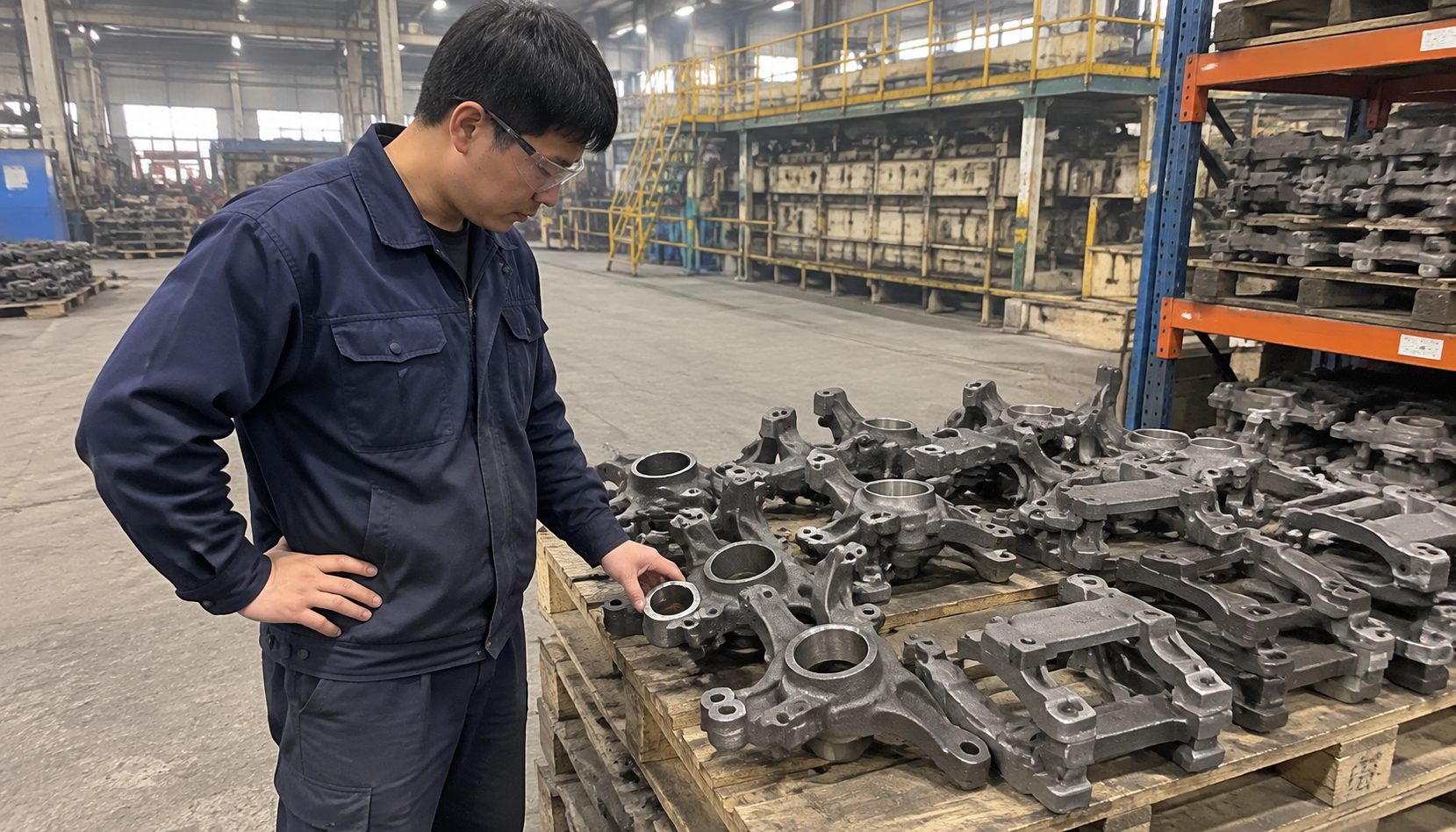
I spent four hours in a meeting room in Jiangsu last March with a supplier who was absolutely certain their PPAP file was complete. Eighteen elements. Tabbed, bound, handed over in a blue folder with the company logo embossed on the front. Very reassuring if you only look at the cover.
Element 11 was the problem. Process capability studies, Cpk. The supplier had submitted capability data for the machined bore diameter. Fine. But it was six months old, taken from a trial run of 42 pieces, and computed against a tolerance they had widened themselves two revisions earlier. The real Cpk on their ongoing production was somewhere around 1.02. Not 1.67. To an OEM customer of mine, that gap is the difference between a part that ships and a containment action with your name on it.
That supplier is still in business. They still quote aggressively. And if you buy OEM cast iron parts for automotive programs on price alone, you will probably find them.
This article is the checklist I run before I release a purchase order on cast iron automotive components. Seven items, in order, and none of them are negotiable. It takes about three weeks of desk work and one factory visit. It is substantially cheaper than a stop-ship.
Why OEM cast iron is a different animal from aftermarket cast iron
If you came out of the aftermarket side of this business, your instincts will work against you here. The priorities invert.
Aftermarket buyers weight price heavily, tolerate cosmetic defects like minor sand inclusion or roughness on non-critical surfaces, and rarely chase lot-level traceability. A part that functions and looks acceptable sells. The liability chain is short.
OEM automotive procurement runs the other way. Traceability comes first, process capability second, delivery reliability third, and price fourth — not because buyers are generous, but because the cost of a failure downstream dwarfs any saving upstream. A single containment event on a brake caliper bracket or a steering knuckle wipes out several years of unit-price advantage. Your customer will send you the bill, and their customer will send them a bigger one.
A rough cast iron automotive part from an Asian foundry typically lands at $1.20–$2.60/kg depending on grade, section thickness and annual volume. Machined and dimensionally inspected, $2.40–$4.50/kg. If a quote comes back at $0.90/kg for a ductile iron control arm, you are not looking at a bargain. You are looking at a material substitution, a scrap-rate assumption that hides failures, or a foundry that has no idea what it costs to make the part properly. Sometimes all three.
The four-part reality of an automotive cast iron program
- The casting itself — grade, nodularity, microstructure, casting defects.
- The machining — often not done by the same shop, which is where traceability quietly breaks.
- The documentation — PPAP, control plans, FMEA, MSA. This is what gets audited, and it is what most suppliers are worst at.
- The capacity commitment — not total floor capacity, but the slice allocated to you in the month you actually need it.
Most buyers vet part one and assume the other three follow. They don't.
Check 1: Read the IATF 16949 certificate properly, not just the logo
Every foundry that wants your automotive business will tell you they are IATF 16949 certified. Roughly 1,200+ foundries in Shandong province alone hold some form of quality certification, and the ones with genuine IATF 16949:2016 automotive certification are a much smaller subset. So ask for the certificate and read four things on it.
The issuing body. IATF 16949 certificates are issued by IATF-recognised certification bodies. Cross-check the body against the IATF public list maintained by the IAOB (International Automotive Oversight Bureau). A certificate from an unrecognised registrar is decoration. For a walk-through of that verification step, see our IATF certificate verification guide.
The scope statement. This is where it usually falls apart. A scope that reads "manufacture of machined metal components" does not cover the casting process. If the foundry is a separate legal entity from the machine shop — very common — you need two certificates, or a clear supplier-managed chain with your name on the flow-down.
The validity dates. Certificates are typically three years with annual surveillance. Check that a surveillance audit has actually been recorded for the current year, not just that the expiry date is in the future.
The site address. The one that matches where your parts will be made. Not the group headquarters.
Ask for the last audit report summary too. Not because you'll read all of it, but because a supplier who refuses to share any of it is telling you something. Also ask for the corrective action log from the most recent external audit. A foundry with zero open findings is either excellent or paperwork-fictional, and usually the second.
Where VDA 6.3 fits in
If your customer base includes German OEMs or their Tier-1s, VDA 6.3 will come up. It is a process audit method, not a certification, and its scoring is brutally practical — it asks whether the process is actually capable, not whether a document exists. Ask for the most recent VDA 6.3 result including the individual element scores. A supplier scoring 85%+ overall but dropping to 70% on element 6 (process control) is telling you exactly where to focus your visit.
There is a Brazilian Tier-2 buyer I know who puts it well: "Certificates prove you paid auditors. The process audit proves you know how to run a line." She's right, and she still makes everyone submit both.
Check 2: Audit the PPAP file before you pay for tooling
PPAP Level 3 under AIAG's PPAP 4th Edition is the default for most OEM cast iron programs, which means the supplier submits all 18 elements to you. Most suppliers will hand over a folder and expect you to be impressed by the thickness. Ignore the thickness. Check these five elements, in this order — and if you want the full element list, we've published a PPAP element-by-element walkthrough.
Element 11 — Process capability
Require Cpk ≥ 1.67 on all special characteristics, computed from at least 25 subgroups taken from ongoing production, not from a trial run. Trial-run capability data is a marketing document. Check which dimensions the capability was calculated on — it is almost never the one that actually drifts. On a cast iron knuckle, the dimensions that drift are the machined bore position relative to the casting datum, and the wall thickness on the thinnest section.
Element 8 — Measurement system analysis
GR&R below 10% on every gauge used for a special characteristic, below 30% for everything else, calculated under AIAG MSA 4th Edition. A supplier who measured bore diameter with a calibrated plug gauge and reported a GR&R of 4% is either lying or measuring something easier than what you specified. Ask for the raw MSA study, not the summary table.
Element 9 — Dimensional results
Full dimensional layout on 8 consecutive production pieces — not one. Ballooned drawing, every dimension accounted for, with the measurement method named. If they only measured the dimensions they know are stable, you'll find out which ones they skipped during your first incoming inspection.
Element 17 — Material and performance test results
For cast iron this means tensile test per ASTM E8/E8M or ISO 6892-1, hardness per ISO 6506-1 (Brinell) or ASTM E10, microstructure, and — for ductile iron — nodularity and residual magnesium. Testing must come from the actual production lot, and from the casting itself or an integrally cast test bar, not from a separately poured coupon in a different mould. Those are not the same material. If the supplier cannot explain the difference between an attached test bar and a separately cast test coupon, stop there.
Element 13 — Part Submission Warrant
Signed by someone with authority, with the actual submission level marked. I have seen warrants signed by an account manager with no quality function involved, submitted as Level 2 when the contract said Level 3. That's a documentation failure with a signature on it. It usually predicts other things.
Total time for this check: about two days if the supplier is organised. If they need three weeks to assemble the file, they were never maintaining it in the first place.
Check 3: Material grade is where substitutions happen silently
This is the part of OEM cast iron sourcing that gets buyers into the most trouble, because the paperwork can look perfect while the metal is wrong.
An automotive drawing will usually specify something like ASTM A536 65-45-12, or EN 1563 EN-GJS-500-7, or a customer-specific grade. A Chinese foundry will quote against GB/T 1348 QT500-7. These are broadly comparable but not identical, and "broadly comparable" is how a wall thickness that should be 6 mm becomes 5.3 mm with the same tensile number on the certificate.
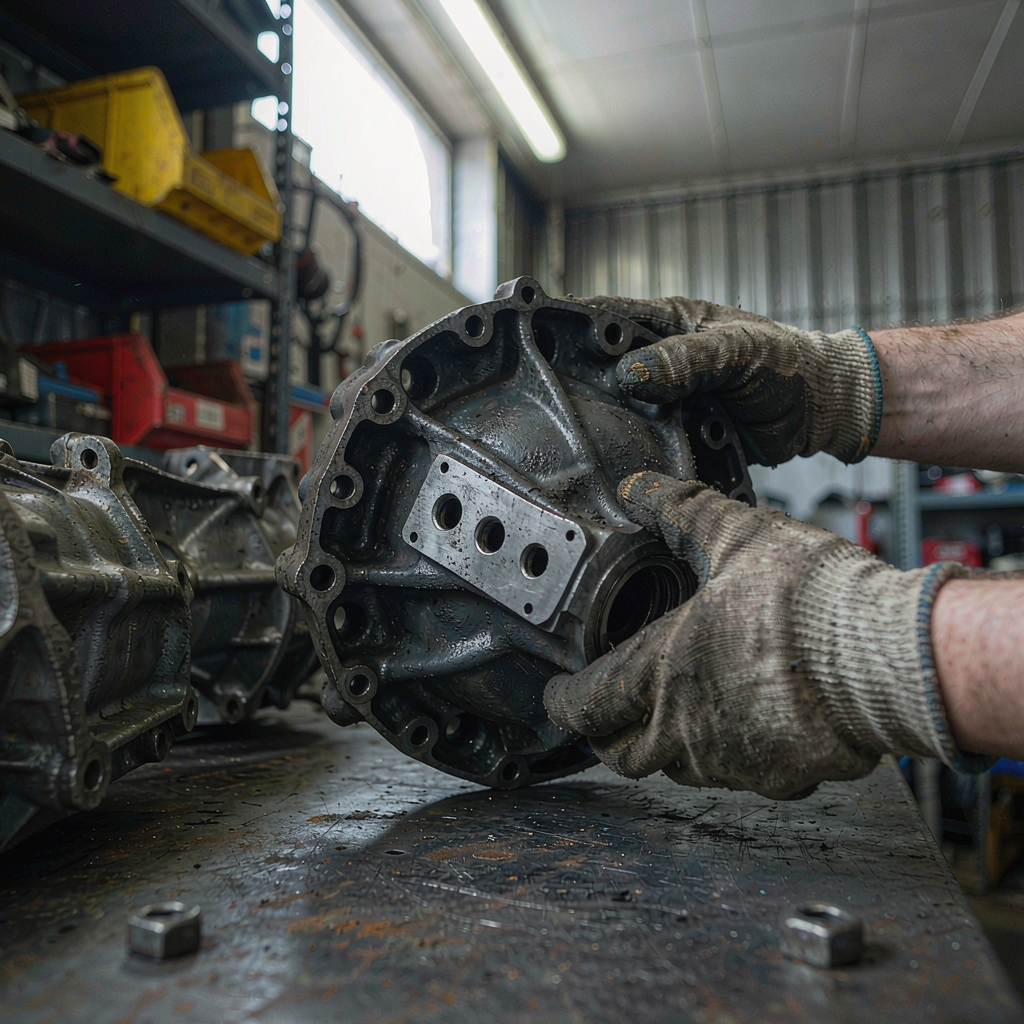
The ductile iron grade cross-reference you actually need
Four standards cover almost every automotive ductile iron drawing you'll see. They map to each other only approximately. Here is the working version:
| ASTM A536 | ISO 1083 / EN 1563 | GB/T 1348 | Typical automotive use |
|---|---|---|---|
| 65-45-12 | 450-10 (GJS-450-10) | QT450-10 | Brackets, pump housings, general structural |
| 80-55-06 | 500-7 (GJS-500-7) | QT500-7 | Control arms, knuckles, spring seats |
| 100-70-03 | 700-2 (GJS-700-2) | QT700-2 | High-strength safety parts, crankshafts |
| 120-90-02 | 900-2 (GJS-900-2) | QT900-2 | Extreme-strength parts; ADI alternatives |
The number pair in ASTM A536 is tensile strength (ksi) then yield strength (ksi) then elongation (%). The ISO/EN and GB designations use tensile (MPa) then elongation (%). Do not read 65-45-12 as a metric designation; it isn't. For a fuller comparison of what changes between the systems, see our ductile iron grade comparison.
What to put in the purchase order, not just the drawing
- Grade plus specification reference — e.g. "ASTM A536 65-45-12" and separately "EN-GJS-500-7" if your customer works in both systems.
- Nodularity minimum — 85% is common for automotive ductile iron; some OEMs specify 90% on safety-critical parts. Specify the rating method (ASTM A247, ISO 945-1, or ASTM E2567), and specify that the rating comes from a polished sample taken from the casting, not a separately cast test bar.
- Residual magnesium range — typically 0.035–0.055% for nodularity, and it drifts with the magnesium treatment process. State both the lower bound (nodularity) and the upper bound (carbide risk).
- Tramp and reverse-nodularising elements — Pb, Sb, Bi, Ti, As, Sn, and sometimes Al. The allowable limits are in parts per million, and they come from the scrap steel stream. A foundry buying cheap scrap introduces them. Put the ppm caps in the PO, not just the grade name.
- Matrix structure — ferritic, pearlitic, or as-cast. Two castings with the same tensile strength can machine completely differently based on pearlite content.
- Hardness range at a specified location — not a blanket "170–230 HBW" across the part, because it isn't uniform.
Ask for the metallurgical report from the last three production heats, and cross-reference the heat numbers against the shipping records. If the heat numbers on the reports don't appear in the dispatch documents, the reports came from somewhere other than your parts.
One more thing people miss: ask how the foundry controls its charge mix. A foundry running 60% purchased scrap steel and 40% returns is a different metallurgical animal from one running a controlled charge with known chemistry. The certificate looks the same. The drift over 18 months does not.
Check 4: Dimensional consistency — the tolerance that dies quietly
Cast iron moves. It shrinks on solidification, it distorts on cooling, and the amount it distorts depends on section thickness variation, mould rigidity, and pour temperature. This is normal and it is manageable. What is not manageable is a foundry that treats casting tolerance as a fixed number rather than a process output.
ISO 8062-3:2007 defines casting tolerance grades from DCTG 1 to DCTG 16. For automotive sand castings, DCTG 7–9 is realistic for as-cast dimensions, with DCTG 5–6 achievable on well-controlled lines for critical dimensions. When a quote promises DCTG 4 across the whole part on a green sand line, ask which line, and ask to see the last three capability studies on the dimension in question. We cover the grade table in more detail in our ISO 8062 tolerance grades explainer.
The datum question
The most common crossover failure in OEM cast iron parts is the datum shift between casting and machining. The foundry locates the part one way in the mould; the machine shop locates it another way in the fixture. Both are internally consistent. The stack-up is not.
Before you approve anything, get both parties to sign off on a single datum scheme that references the machined surfaces as primary datums and the casting as the locating feature. This conversation costs one hour. Skipping it costs a re-fixture and often a pattern change.
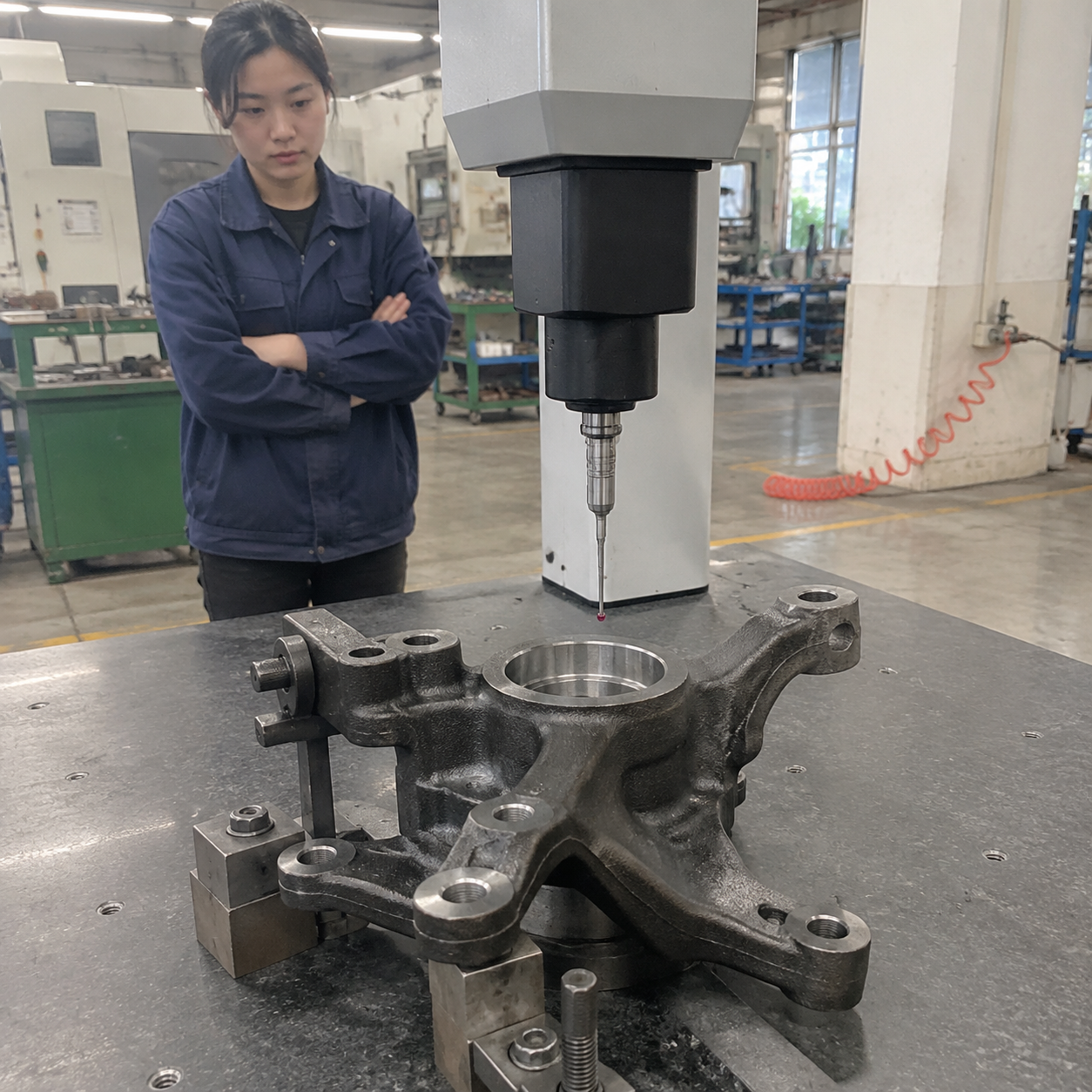
What to verify during the factory visit
- A CMM on site, calibrated, with a program that actually matches your drawing revision.
- First-article inspection done on the production tool, not a prototype tooling.
- Gauges at the line, in use, not in a cabinet.
- Evidence that out-of-tolerance parts get segregated rather than reworked-and-returned to the same bin.
That last one is worth watching for twenty minutes. Walk past the deburring station and watch what happens when a part fails a check. If it goes back onto the same pallet with no tag, you have your answer about the Cpk data.
Check 5: Tooling ownership and the drawing-change trap
This is not a technical issue and it is the one people skip because it feels like paperwork. It is not paperwork. It is leverage.
When you pay for casting tooling — patterns, core boxes, and any machining fixtures — that tooling should be unambiguously yours. In your name, on the supplier's floor, listed in an annex to the supply agreement, with a right of retrieval and a defined transfer process.
Three things that need to be written down:
Ownership and marking. The tooling is your property, physically marked as such, and listed in a tooling register with the date of manufacture, expected life in shots, and accumulated shot count.
Maintenance obligation. Who maintains it, who pays for normal wear, and at what point the tool is declared worn out. Pattern wear on a high-volume ductile iron part can show up as dimensional drift on wall thickness long before the pattern is visibly degraded.
Drawing change. A single revision on your side can require a pattern modification, a new core box, or in the worst case a new tool. Decide in advance who pays and what the lead time is. Foundries will quote a low tooling cost up front and recover it through change orders later. Ask for the modification rate card at the time of the original order, not after the engineering change notice lands.
The transfer clause matters more than people think. If the relationship sours or the supplier's capacity collapses, you want to be able to pull the tool into a new foundry within weeks. A foundry that has never transferred tooling out will not do it smoothly under pressure. Ask for the transfer procedure in writing at the start.
Check 6: Take the unit price apart before you compare anything
Comparing two quotes for OEM cast iron parts is meaningless until you've broken both into the same lines. A per-kilogram price hides the scrap rate, the machining allowance, the inspection scope, and the tooling amortisation — which is exactly why it's used.
Ask every supplier to submit a cost breakdown with nine lines:
- Charge materials — pig iron, scrap steel, returns, alloys, inoculant, magnesium treatment
- Melting energy — induction furnace consumption per tonne, at their actual electricity rate
- Moulding and core making — sand cost, binder, consumables
- Fettling and cleaning — shot blast, grinding, labour
- Machining — cycle time per part, tooling cost per part
- Inspection and testing — CMM time, tensile testing, metallography, NDT if specified
- Packaging — this is a bigger number than people expect for automotive parts with damage risk
- Tooling amortisation — spread across the agreed volume, and stated separately
- Scrap allowance — the assumed internal reject rate
Line 9 is the one to interrogate. A well-run ductile iron foundry for automotive castings runs an internal reject rate in the 3–6% range. A poorly run one runs 10–15% and prices it in — or doesn't, and discovers the problem after you've placed the order, at which point the conversation becomes about requesting a price increase.
"I learned to ask for the scrap assumption the hard way. We had a supplier quote us a bracket assembly at a number nobody else could touch. Two years in, we were paying an annual price increase every quarter and their scrap rate was still in double digits. They had never priced it correctly in the first place, so the price was never real." — James Parker, automotive aftermarket distributor, Michigan, $800K annual castings spend
James buys aftermarket, so his weighting is different from yours — he'll tell you himself that price is 50% of his decision, quality 30%, delivery 20%. But his point about the scrap assumption applies to your OEM program even harder, because you're the one who absorbs the consequences of a supplier whose process yield is worse than they think it is.
Energy is worth a line of its own. Induction melting of cast iron runs roughly 500–600 kWh per tonne in a decent shop. At a Chinese industrial electricity rate of about $0.09–0.12/kWh, that's $45–$72 per tonne of metal melted, before any alloy or labour. A quote that doesn't reflect that number either is using a different process or is not accounting for energy.
Check 7: Verify capacity the way a production planner would
Every foundry will tell you they have capacity for your program. Total installed capacity is irrelevant. What matters is the slice available during the specific months you need it, given everything else already committed to that line.
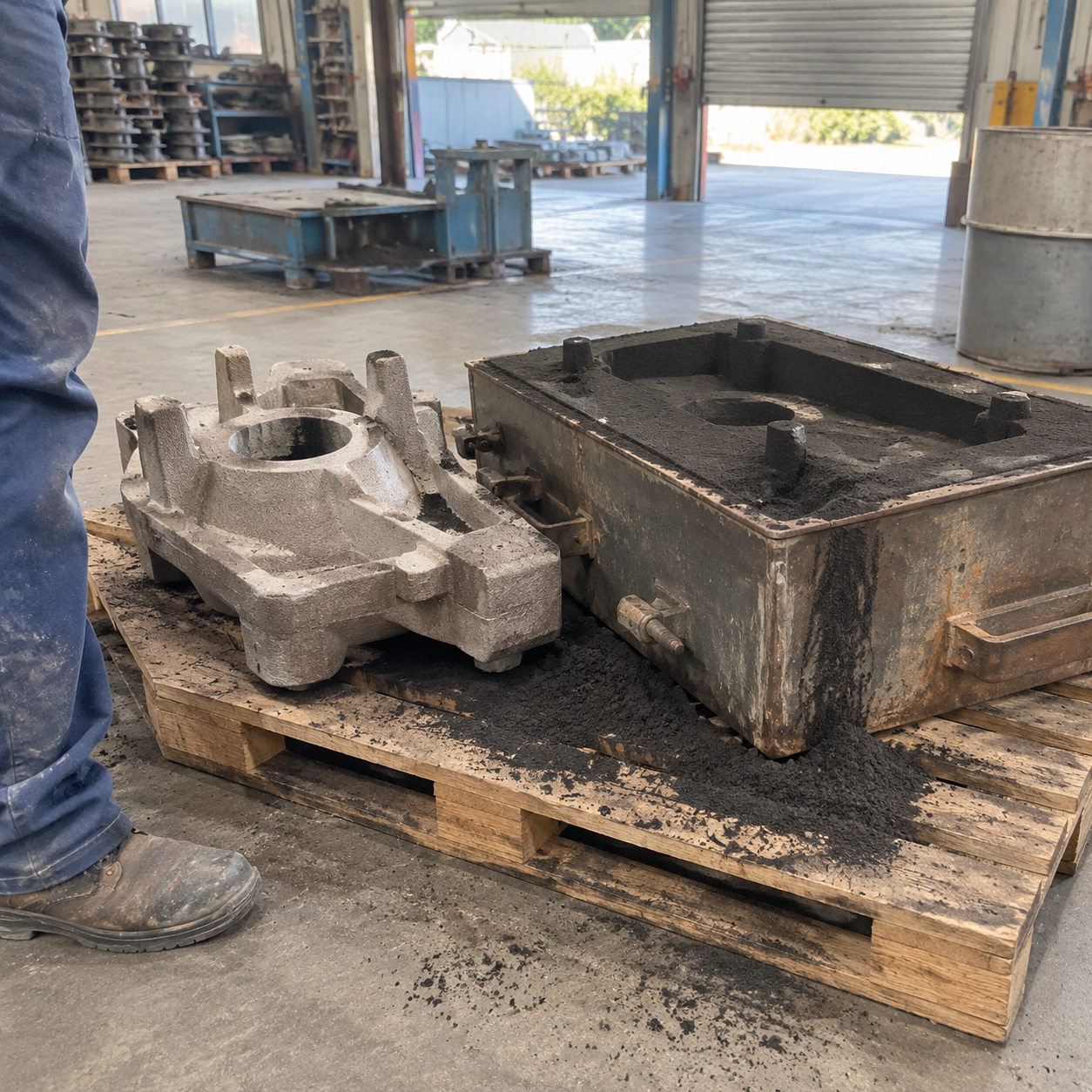
Ask four questions during the visit, ideally with the production planner in the room and not only the sales manager:
How many shifts are you running on this line, and how many do you want to run? A line running two shifts with a third available is a line with real headroom. A line already running three shifts at 95% is a line that will push your order to the following week when something else goes wrong.
Which customers share this line? Not names, but the count and the share of hours. If 60% of the line's hours belong to one customer, their pull will always beat yours.
What was your on-time delivery rate last year, and what was the worst month? The average is a comfort blanket. The worst month is the real risk profile. A foundry at 96% annual OTD with a 71% month somewhere in there is telling you exactly what happens in a bad quarter.
What happens in the twelve days around Chinese New Year? Most foundries shut or run skeletal crews. If your program runs year-round and you're not planning builds around that, you'll be expediting in February.
"Our last foundry switch happened because of a February. They quoted ten weeks, delivered sixteen, and the sixteen was because of holidays nobody mentioned in the commercial discussion. We now ask for a twelve-month delivery calendar with the blackout weeks marked before we sign anything." — James Parker
That's an aftermarket perspective again, and it holds up. Delivery failures at the Tier-1 level are expensed differently — a line stoppage at an OEM assembly plant can run into tens of thousands of dollars per hour, and it is recovered from the supply chain. The calendar conversation is cheap insurance.
The 7-point checklist, condensed
Print this. Take it to the factory visit. It's the working version of everything above.
| # | Check | What specifically to verify | Fail condition |
|---|---|---|---|
| 1 | IATF 16949 scope | Issuing body on the IATF/IAOB list, scope covers casting, site address matches, current surveillance recorded | Scope covers machining only |
| 2 | PPAP Level 3 file | Element 11 Cpk ≥ 1.67 from production, element 8 MSA, element 9 eight-piece layout, element 17 material from the actual lot | Capability data from a trial run |
| 3 | Material grade | Nodularity per ASTM A247/ISO 945-1, residual Mg range, tramp elements, matrix structure, hardness at specified location, heat number cross-reference | Report heat numbers not in dispatch records |
| 4 | Dimensional control | ISO 8062 DCTG grade realistic for the line, single datum scheme signed by foundry and machine shop, CMM program matches drawing revision | Separate datum schemes, no reconciliation |
| 5 | Tooling | Ownership in your name, marking, shot count register, maintenance obligation, change-order rate card, transfer procedure | Tooling unlisted, ownership implied |
| 6 | Cost breakdown | Nine lines submitted, scrap assumption stated and realistic, tooling amortisation separated from unit price | Per-kg price with no structure behind it |
| 7 | Capacity | Shifts on the specific line, customer hour share, worst-month OTD, holiday blackout calendar | "We have plenty of capacity" with no data |
Common mistakes to avoid
Treating ISO 9001:2015 as equivalent to IATF 16949:2016. It isn't close. ISO 9001 asks whether you have a process. IATF 16949 asks whether the process is capable, measured, and improving. In a foundry, that difference is the whole game.
Approving PPAP on document completeness. A complete-looking folder with a stale Cpk study and a copied MSA is worse than an incomplete folder, because it hides the problem behind a checklist.
Paying tooling without a tooling register. Money spent on unregistered tooling is money spent on the supplier's asset. When you need to move, you have no lever.
Accepting an attached test bar report for a part that will be tested from the casting. Different cooling rate, different properties. Ask which one your drawing requires and hold the supplier to it.
Using an aftermarket price benchmark to negotiate an OEM program. The two products have different inspection scope, different documentation burden, and different liability. Pricing them against each other gets you a supplier who doesn't understand the difference either.
Skipping the process audit because the certificate looked fine. The certificate is a snapshot of a system. VDA 6.3 or an equivalent process audit is a snapshot of a Tuesday afternoon in the plant. You care about Tuesday afternoons.
FAQ
Is IATF 16949 mandatory for cast iron automotive parts?
For any part that ends up in a production vehicle, yes. IATF 16949:2016 replaced ISO/TS 16949 and is the baseline requirement flowing down from virtually every OEM. ISO 9001:2015 alone tells you almost nothing about process control in a foundry. If the part is going into tooling, aftermarket kits, or non-automotive industrial equipment, the requirement may be relaxed — but check with your customer's quality function rather than assuming.
What PPAP level do OEM cast iron parts usually require?
Level 3 is the default for most automotive cast iron programs under AIAG PPAP 4th Edition: the supplier submits all 18 elements to you and retains a sample. Level 2 requires submission only for designated elements. Level 5 is a review at the supplier's site with full supporting data. Some customers use Level 3 for the initial submission and drop to a reduced level after two years of stable delivery — but that's a decision in writing, not an assumption.
How much do OEM cast iron parts cost per kilogram?
Rough castings from Asian foundries typically run $1.20–$2.60/kg depending on grade, section thickness and order size. Machined and inspected automotive parts generally land at $2.40–$4.50/kg. Ductile iron with high nodularity requirements, thin walls, or extensive NDT sits at the top of those bands. Quotes substantially below the floor of the range deserve a hard look at the material spec and the scrap-rate assumption.
What is the difference between QT450-10 and GJS-450-10?
On paper, very little — GB/T 1348 QT450-10 and EN 1563 EN-GJS-450-10 both specify ductile iron with 450 MPa minimum tensile strength and 10% minimum elongation, and both map to ASTM A536 65-45-12 and ISO 1083 450-10. In practice, the standards differ in trace element limits and heat treatment practice, and no grade name specifies nodularity. Write the nodularity percentage per ASTM A247 or ISO 945-1, the residual magnesium range, and the tramp element limits into the purchase order directly rather than relying on the grade designation to carry them.
How long does cast iron tooling take for an automotive part?
Plan 8–14 weeks from drawing release to first article for a typical pattern and core box, plus 2–4 weeks for dimensional and metallurgical verification. Machining fixtures and gauges are separate and often the longer delay. If a supplier quotes four weeks for automotive-grade tooling, ask what they're skipping.
Can one supplier handle both casting and machining?
Sometimes, and it simplifies traceability considerably when they do. But a large share of automotive cast iron parts are cast at one facility and machined at another. That's fine as long as the datum scheme is agreed between both, the PPAP is submitted as a single package covering both operations, and you know which legal entity your purchase order actually binds.
Next step
If you're currently evaluating foundries for an automotive cast iron program, the seven checks above are the ones that separate a supplier you can live with from one you'll be firefighting for three years.
The most useful thing you can do this week is request three documents from every supplier on your shortlist: the IATF certificate with the scope page, the last three heats of metallurgical reports with heat numbers, and a nine-line cost breakdown. The suppliers who can produce all three within five business days are showing you how they operate. The ones who can't are also showing you.
See the China foundry audit checklist
If you'd rather have someone walk a foundry floor with this checklist in hand and a camera out, get in touch. That's the part that's hardest to do from a desk 6,000 km away.
Need Help with OEM Cast Iron Parts for Automotive: 7-Point Pre-PO Check?
Get matched with 3 verified foundries in 24 hours. No markup, transparent pricing.
Request Quotes →