Two numbers worth carrying into your next sourcing meeting.
China builds roughly 19 million motorcycles a year. The IATF 16949 certificate database lists well over 20,000 active sites across mainland China, most of them feeding the auto chain. And of the aluminium casters inside that pile, maybe 1,200 can run an 800-tonne machine through a full shift without stopping twice to sort out a shot timer or a plugged die spray line.
That last figure is mine. Three years of factory visits across Guangdong, Zhejiang and Chongqing, two rounds of PPAP audits, and a notebook full of rejection rates and half-finished capacity studies. Put a wide error bar on it. The point survives the error bar: you are not shortlisting from twenty thousand. You are shortlisting from a few hundred shops that can hold your drawing and hand you a clean file on the first submission.
Most buyers get this wrong. They collect twenty quotations, take the cheapest three, and discover at PPAP that the "IATF-certified" factory subcontracts the machining to a shop two blocks away with no calibration records. The schedule slips. The launch slips. Somebody in purchasing takes a call from the programme manager and spends the next six weeks explaining.
What follows is a filter, not a buyer's guide to "finding a great partner." Run it before you spend a single PPAP slot.
The Numbers That Should Shape Your Shortlist
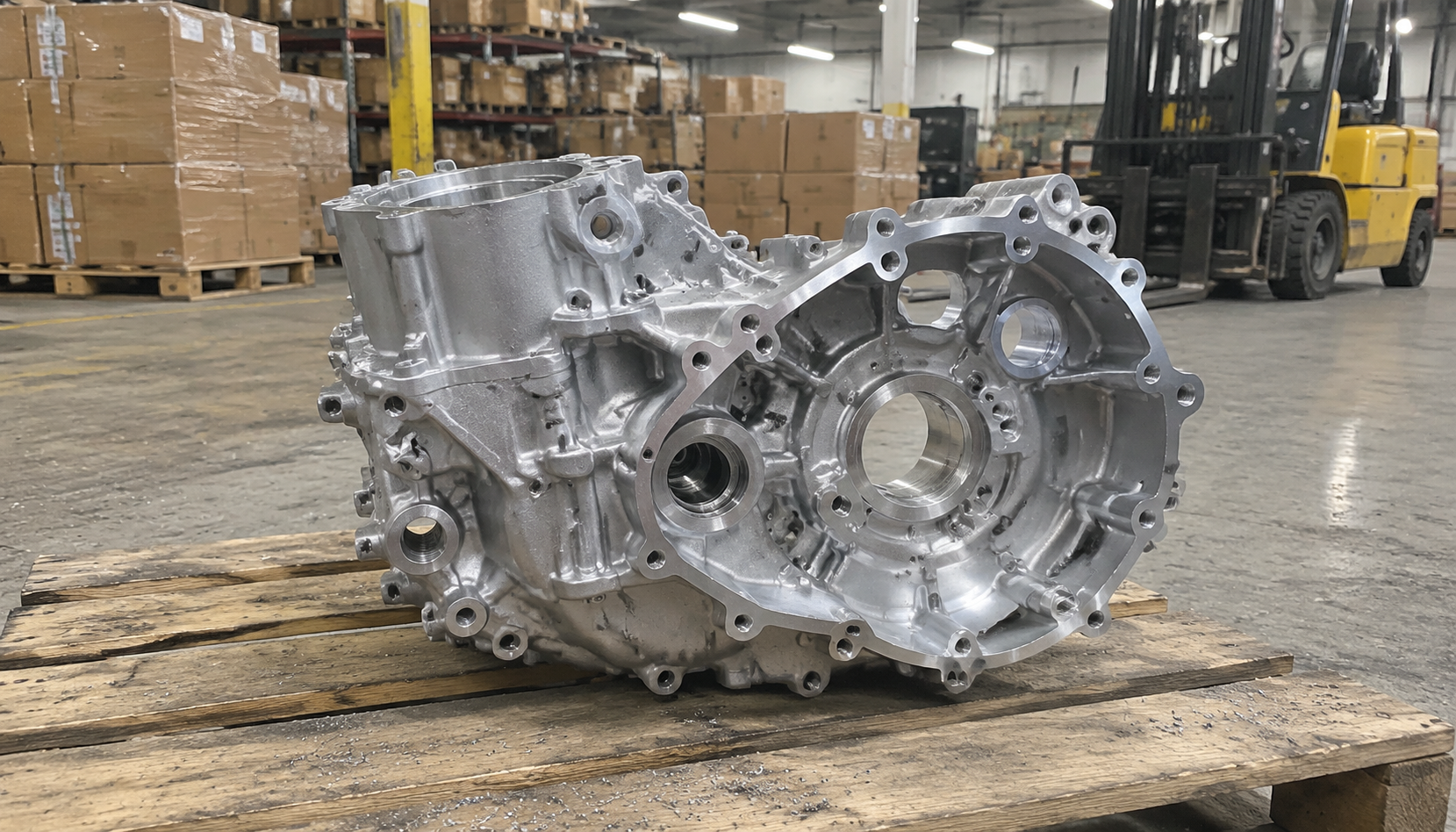
A 125cc commuter carries roughly 25–45 kg of aluminium castings. A 600cc sport bike runs 45–70 kg. Crankcase halves, cylinder head, cylinder block on liquid-cooled models, wheel hubs and rims on cast-wheel bikes, fork lowers, triple clamps, swingarm pivot castings, brake caliper bodies, and a long tail of covers and brackets.
That spread matters because it splits your supplier list into two completely different categories:
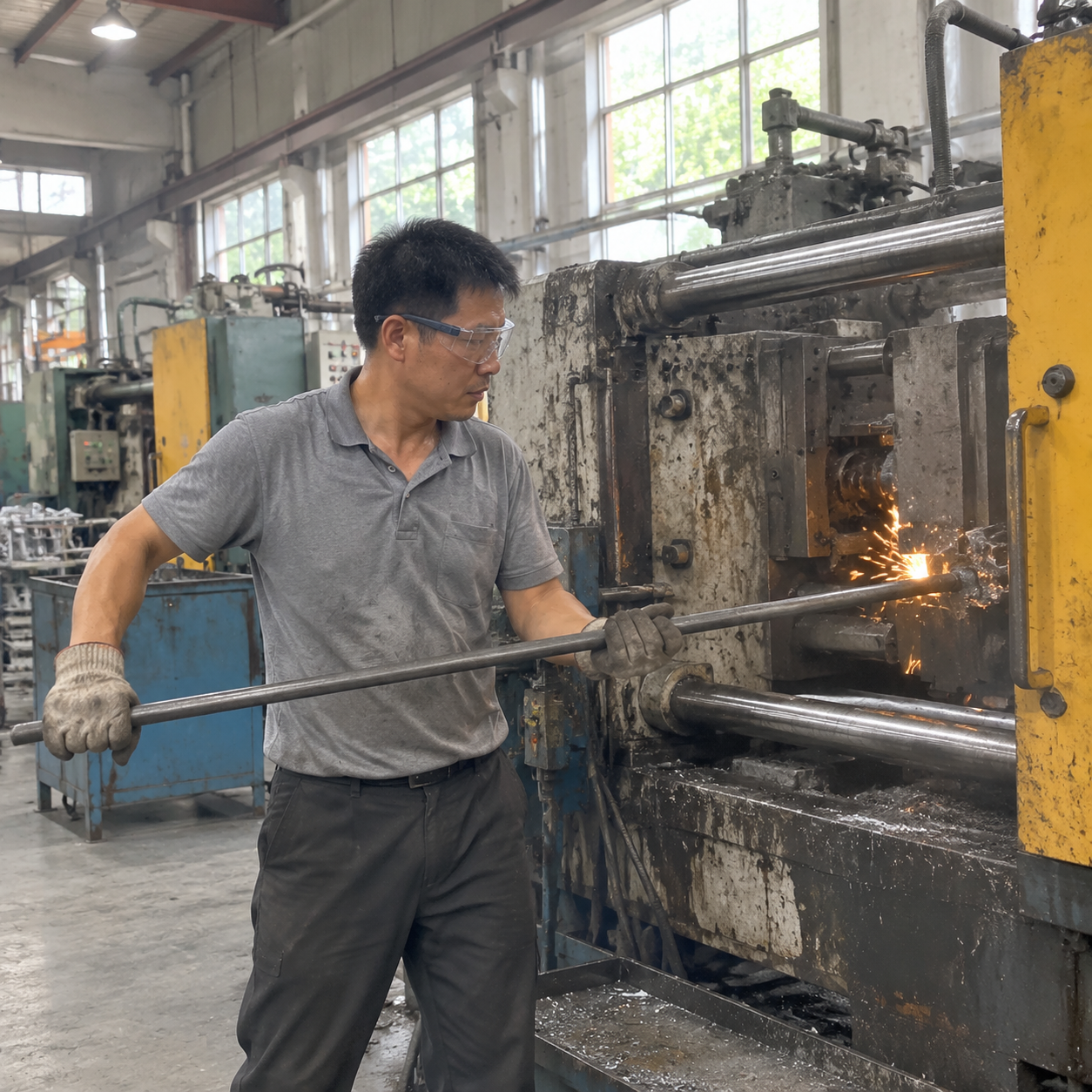
- High-pressure die casting (HPDC) — thin walls, high volume, tight dimensions, minimal machining. Crankcase covers, caliper bodies, small structural brackets.
- Gravity and low-pressure permanent mould casting — thicker sections, pressure-tightness requirements, heat-treatable material. Cylinder heads, wheel hubs, fork lowers, structural frame nodes.
A factory running a battery of 1,250-tonne cold chamber machines is not the same factory that can deliver a pressure-tight cylinder head with ductility above 7%. Different equipment. Different operators. Different metallurgy, different degassing regime, different heat treat qualification. Sending one RFQ to both types wastes everyone's week — and worse, it teaches the wrong suppliers to bid on your parts.
So before anything else, split your RFQ into "HPDC parts" and "permanent mould parts" and source them separately. You'll lose a week doing the split. You'll save two months on the back end.
Certification: Reading Between the Lines of an IATF 16949 Certificate
Everyone claims IATF 16949. Half of what lands in your inbox is expired, scoped wrong, or issued to a different legal entity than the one quoting you.
Here's the run-through I do before any technical discussion happens.
1. Check the certificate number on the IATF database, not the PDF. The IAOB maintains a public certificate validity check. A supplier that sends a PDF but can't give you a number that resolves there is a red flag — not automatically a fraud, but you need to understand why. Our IATF scope check walkthrough covers the database steps and the four things that usually fail.
2. Read the scope statement. "Manufacture of aluminium die castings" is good. "Trading of metal parts" with the manufacturing site listed elsewhere is a different animal. If the scope mentions design and the supplier says they'll "follow your drawing," fine — but ask who actually owns the process FMEA.
3. Confirm the legal entity matches the quotation. Chinese suppliers often quote under a trading company and produce under a separate WFOE or joint venture. Legal, common, and a problem for you: the IATF certificate you're shown may belong to a company with no contractual relationship to your purchase order. Get the producing entity's full registered name in writing, and put it on the PO.
4. Ask for the last surveillance audit report. Not the summary page — the report. Any non-conformity in the last twelve months should have a documented closure with evidence attached. If they hesitate, you've learned how they'll handle your PPAP non-conformances.
5. Check the ISO 9001 scope around the edges. Plenty of Chinese casters hold ISO 9001 for the whole site but IATF only for one workshop or one product line. If your part is made in a building that isn't covered, you've bought a paper tiger.
One more thing, and it's the part that gets skipped. Certification is a floor, not a ceiling. A factory can hold a perfectly valid IATF certificate and still hand you casting porosity that fails a 6-bar leak test on the second shift. The certificate tells you the systems exist. It says nothing about whether anyone on the floor actually uses them.
Process Fit: Why Your Engine Case and Your Fork Lower Need Different Suppliers
If you're sourcing a mix of motorcycle castings in one RFQ, stop. Split it. Then match each part family to the right process before you open a single quotation.
| Part family | Typical process | Material | Wall thickness | Key risk |
|---|---|---|---|---|
| Crankcase halves | HPDC | ADC12 / A383 | 2.5–4 mm | Porosity at bearing bosses |
| Cylinder head | Gravity or low-pressure | A356-T6 | 4–6 mm | Shrinkage, combustion chamber roundness |
| Wheel hubs | Gravity / low-pressure | A356-T6 | 5–8 mm | X-ray acceptance, runout |
| Fork lowers | Gravity | A356-T6 | 4–6 mm | Dimensional drift after heat treat |
| Brake caliper bodies | HPDC or gravity | ADC12 / A356 | 3–5 mm | Pressure tightness, bore finish |
| Engine covers | HPDC | ADC12 | 2–3 mm | Cosmetic porosity after anodising |
The process split isn't academic. A shop that's excellent at HPDC often has zero gravity casting capability, and the reverse holds just as firmly. Their melting department runs different alloys through different degassing regimes. Their T6 oven may not be qualified for your section thickness. Their CMM programmers are trained on different geometry and different datum schemes.
Asking a die caster to quote a gravity-cast fork lower will get you a number. It just won't be his number — it'll be built on outsourcing the casting to someone else. Which brings us to the subcontractor question further down.
Material Grades: A356 vs ADC12 and the Wrong Question Buyers Ask
The most common mistake I see in RFQs is a drawing that says "aluminium alloy, grade as per supplier standard" and nothing else. That isn't a specification. It's a wish with a title block.
For motorcycle castings, the two alloys you'll see over and over are A356 (in China often written ZL101A / ZAlSi7MgA) and ADC12 (equivalent to A383, sometimes A384).
A356 is a heat-treatable Al-Si-Mg alloy. In the T6 condition it gives you tensile strength around 260–280 MPa, elongation of 7–10%, and good pressure tightness in permanent mould casting. It's the right call for cylinder heads, wheel hubs, fork lowers, and anything with a fatigue requirement attached.
ADC12 is a high-silicon die casting alloy, not heat-treatable, with tensile strength around 230–310 MPa depending on section thickness but elongation typically only 1–3%. Correct for thin-wall HPDC covers, brackets, and high-volume small parts where dimensional stability matters more than ductility.
The wrong question is "which one is better?" Neither. The other wrong question is "can you cast this part in the material my drawing says?" — because the answer is always yes, and it costs you nothing to say yes.
The right questions look like this:
- What's the ingot source, and can you show me the mill certificate for the last heat?
- How do you control alloy composition drift between melts — spectroscopy on every heat, or one sample per shift?
- What's your hydrogen degassing regime for A356, and do you record the readings?
- If the drawing calls for T6, which furnace, what quench delay from cast to quench, and who signs the hardness check?
A supplier who answers all four in one email is worth a flight. One who replies "yes we can do T6, we have heat treatment" and stops there is telling you heat treatment is a black box they don't own. If you want the fuller comparison — including where A356 and ADC12 behave similarly and where they absolutely don't — see our A356 versus ADC12 breakdown.
What Goes in the RFQ Package Before Anyone Quotes You
Half the bad quotations you'll receive aren't the supplier's fault. They're yours, because the package you emailed left the hard parts undefined and the caster filled the gap with an assumption that favoured his price.
A package that survives a technical review contains seven things. Not eight, not four:
- A 2D drawing with a real datum scheme and GD&T. Not a PDF of a CAD screenshot. Datums that match how the part locates in the vehicle, and tolerances you can actually defend to your own design team.
- A 3D model in STEP. Casting model and finished model separately, or the supplier will guess how much stock you want left on machined faces.
- The alloy, by standard designation. A356-T6, ADC12, with the governing standard. Plus whether you'll accept a Chinese GB equivalent, and under what test evidence.
- Porosity acceptance criteria. ASTM E505 severity level plus the zones on the drawing where it applies. See our notes on ASTM E505 acceptance levels if you need the phrasing.
- A cosmetic acceptance boundary. Especially for anodised or powder-coated parts, where a 3% internal void shows up as a visible pit after finishing and suddenly becomes a rejection at your line, not theirs.
- Annual volume, ramp curve, and expected programme life. Casters price tooling and machine allocation off this. Give them a number and they'll quote reality; give them "TBD" and they'll quote hope.
- PPAP level and submission date. Level 3 and a date, in the package, before you send it. Otherwise you'll be negotiating both after the tooling is already cut.
Add one page of packaging and labelling requirements and you're done. That package takes an afternoon to assemble and it will change the spread of quotations you get back more than any negotiation tactic.
PPAP and the Paper Trail That Reveals a Real Factory
If you're Tier-1, or you supply a motorcycle OEM directly, you'll run PPAP. Level 3 is standard. The submission pack has 18 elements and most of them can be produced by anyone with a printer and a quiet afternoon.
Some don't lie easily.
Process flow diagram. The moment a supplier can't produce one that matches his actual shop floor, you've learned something useful. Ask him to walk you through it on a video call while standing next to the line. If the flow says trimming → deburr → leak test → machining, and the leak test rig isn't physically in that sequence, you have a problem that no amount of rework will fix.
PFMEA. Should be specific to your part, not a generic template. Look for 15–25 line items with severity, occurrence and detection scores that vary by failure mode. If every row reads 3/3/3, it was copy-pasted off a training slide in 2019 and never touched since.
Control plan. This is the document that ties everything together. Every characteristic on your drawing should appear with a sample size, a frequency, and a control method. Watch for the trap where the control plan lists "100% visual" for porosity instead of X-ray or leak test. Visual inspection doesn't find internal shrinkage, and the person writing that line knows it.
MSA and capability studies. For critical dimensions you want Cpk at 1.67 or above during PPAP. Ask for raw data, not the summary table. A Cpk calculated on 30 parts from one cavity during a good shift means almost nothing — ask how many cavities, which shift, and whether the study ran across a tool change.
Material and performance reports. Chemical composition, tensile, hardness, and for A356 parts, microstructure. The photo should show modified eutectic silicon, fine and rounded, not coarse acicular plates. If the supplier can't tell you whether he runs a modifier — usually Sr or Na — he isn't controlling the thing that decides your elongation.
PSW signature. The Part Submission Warrant needs a signature from someone with authority to bind the quality system. If it comes back signed by a sales engineer, ask who in quality actually approved it and get that name on the document.
I've watched PPAP packs arrive complete, bound, indexed and beautiful, and still fail at the dimensional report stage. A complete file is not a good file. The good file is the one where every number traces back to a calibrated instrument and a specific date.
Dimensional Reality: CMM, X-Ray, and What to Ask For
Motorcycle castings carry tight tolerances. A wheel hub mounting face typically runs 0.1 mm flatness with 0.05 mm runout to the bearing bore. A crankcase half runs 0.05–0.08 mm on main bearing bore position. A cylinder head deck can spec 0.03 mm flatness across the whole face.
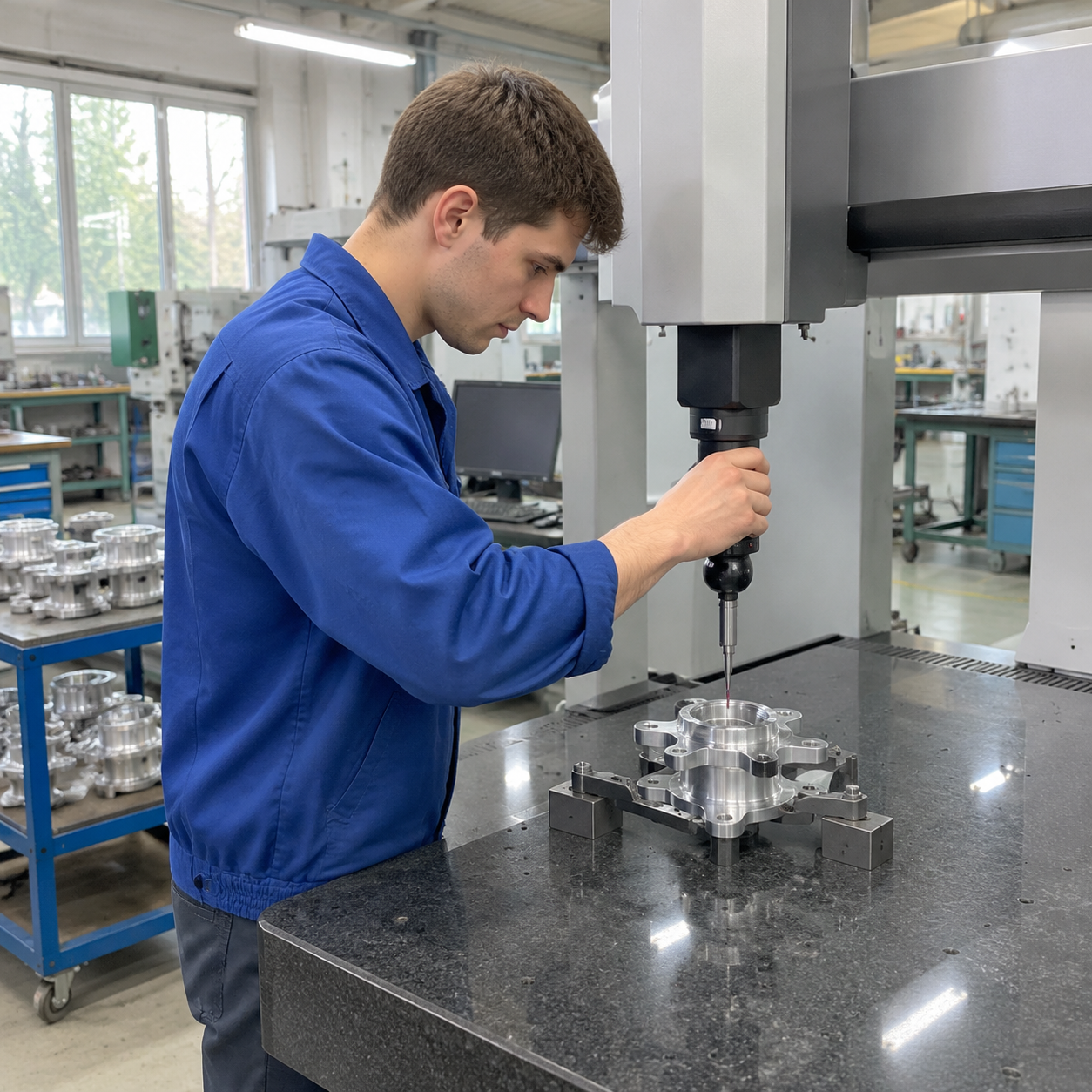
Hitting that in production, shift after shift, needs three things: a calibrated CMM with a proper program, a controlled fixture, and a supplier who actually runs the machine rather than wheeling it out for customer audits.
Ask these in the technical review:
- Which CMM model, and when was it last calibrated by an accredited lab?
- How many parts per shift do you measure, and do you record ambient temperature during measurement?
- Who writes and signs off the CMM program — you, or the customer?
- If a dimension drifts out of tolerance mid-run, what's the reaction plan and who owns disposition?
For porosity you want radiography, or for thin-wall parts a combination of X-ray and pressure leak test. ASTM E505 is the reference standard for aluminium casting radiography — cite it in your specification by revision, not just by number. If the supplier works to an in-house standard instead, ask to see it in writing before PPAP starts, not after the first rejection.
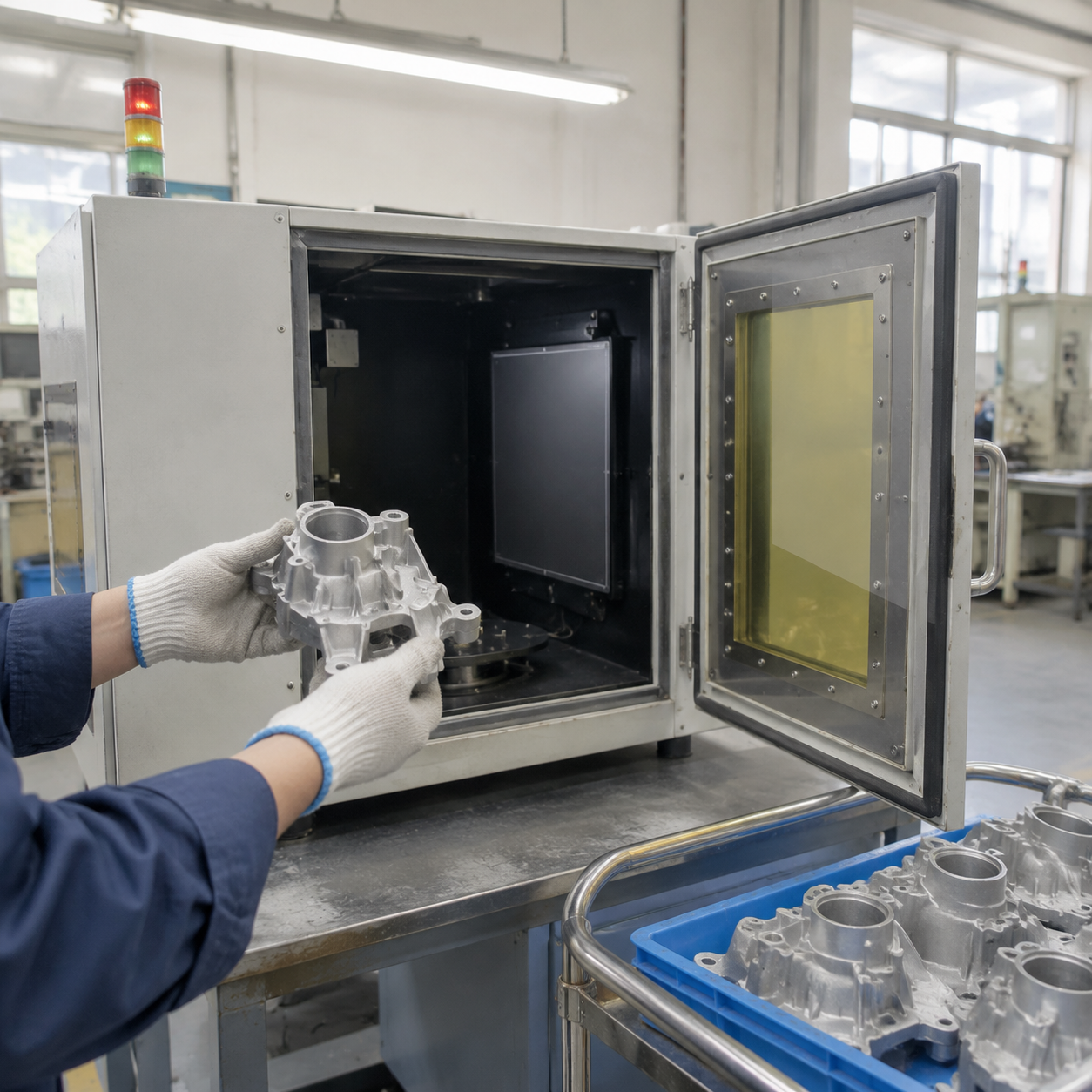
On leak testing specifically, get the test method nailed down before tooling. Air-decay pressure testing at 1.5 bar for 30 seconds is not the same acceptance as 6 bar held for two minutes, and the caster will quote the cheaper one if you don't specify. Ask for the leak rate in the units your drawing uses — cc/min or mbar·L/s — plus the fixture concept and whether the fixture is part of his tooling quote or yours.
One word on cosmetic castings. If your part is visible — engine cover, fork lower, caliper body — porosity that passes X-ray at 3% internally can still show as pits after anodising or powder coating. Ask specifically about the cosmetic acceptance zone and how it's controlled. Most Chinese casters have a visual boundary definition for machined surfaces. Far fewer have one for anodised surfaces. Get it in writing, with a photo reference plate.
Reading the Quotation: Where the Money Actually Sits
Quotations from Chinese casters are rarely comparable in the form they arrive. One quotes per piece with tooling separate. One quotes per kilogram. One bundles machining into a single line called "processing." Before you rank anything, normalise the format — then check that the components are actually broken out.
| Line item | What a real breakdown shows | Red flag |
|---|---|---|
| Material | Net weight × alloy price, plus 3–5% melt loss and runner/overflow return | A round number that never moves when the alloy index moves |
| Casting | Machine hourly rate × cycle time ÷ cavities, adjusted for yield | Omitted entirely, or buried in "unit price" |
| Machining | Setup plus cycle time at a stated hourly rate, per operation | "Machining included" with no hours and no rate |
| Finishing | Per-part or per-kg rate for shot blast, trim, anodise, powder coat | Lumped into "miscellaneous" |
| Tooling | Die cost, fixtures, gauges, and try-out shots, itemised separately | One lump sum with no fixture or gauge list |
| Packaging | Per-unit cost with a photo of an actual export carton | "Standard export packing" with no definition |
Two things to do with this table. First, ask every shortlisted supplier to re-quote in this format. Most will, and the ones who can't are usually the ones who don't know their own cost structure. Second, look at the material line across all quotes. Alloy is a commodity — if one caster is quoting 30% less for the same net weight and the same grade, he's either using a different grade, running thinner walls, or planning to recover the difference in scrap allowance. None of those are savings. They're deferrals.
And get the piece price stated per part, with the casting weight and the gross shot weight written next to it. Per-kg pricing hides yield problems in a way per-part pricing never does.
Scale, Capacity, and the Subcontractor Question
Here's where a lot of buyers get surprised. A supplier quotes you on a 20,000-piece-per-year programme. His factory looks adequate. Six months in you find out the casting is made in his shop but the machining goes to a neighbour, the heat treat to a third shop, and the anodising to a fourth.
That's not automatically disqualifying. But you need it upfront, because every subcontractor is a separate quality system you now depend on and have no audit rights over unless you negotiated them.
Ask directly, in writing:
- Which operations happen on your site, and which are outsourced?
- For each outsourced operation, who is the supplier, and are they IATF or ISO certified?
- Do you hold a supplier quality agreement with them, and can you show me the last audit report?
- Who signs the PPAP element for outsourced operations?
A supplier who answers honestly and hands you a proper subcontractor list is worth more than one who says "all in-house" and turns out to be wrong at the site visit. Honesty about a weakness you can manage beats confidence you can't verify.
On capacity, the number that matters isn't the annual tonnage figure in the brochure. It's machine-hours per week that can be dedicated to your part family without displacing another customer. Ask for a capacity study showing current loading against your forecast, by machine size. If they're at 85% utilisation and your programme ramps in Q3, you'll be the one getting delayed the week a bigger customer calls.
The Site Visit: What You'll Actually Learn in Four Hours
No volume of documentation replaces walking the floor. But most site visits are wasted, because the buyer tours the showroom, shakes hands, eats a long lunch, and flies home with a gift bag and no new information.
If you're going to fly to Guangdong or Chongqing, spend the four hours on five things. Our half-day site visit checklist has the full version; the short one is below.
Watch the melting department. Is the furnace clean? Is the degassing unit actually running, or sitting there while the operator charges scrap around it? Are ingots stacked under cover or sitting outside in the rain? Are they charging returns back into the melt with no scrap control plan? Any one of those answers tells you more about your casting than the CMM room will.
Walk the die storage. Dies rusty or stacked on the floor means maintenance is poor. Dies on racks, tagged, with a maintenance log on the wall, means you've found a shop that takes itself seriously. Count the dies. It tells you how many customers they actually serve.
Check calibration stickers. Every measuring instrument on the floor should carry a current label. Pick three at random. If one is expired, ask why — and listen to whether the answer is a system failure or a system that caught it.
Talk to an operator with the sales manager out of earshot. Ask how he handles a part that fails leak test. His answer tells you whether the control plan lives on paper or in practice, and no amount of audit preparation fixes that difference.
Look at the rejection bins. Every foundry has them. A shop with visible, sorted, tagged rejects has a functioning quality system. A shop where rejects are piled in a corner and mixed with scrap does not — and the parts in that pile are the ones that will fail on your line six months from now.
Common Mistakes Buyers Make
Six patterns I've watched repeat across different companies and different programmes:
1. Treating the quotation as the shortlist. The cheapest quote is usually the one that hasn't thought about your tolerances. The realistic quote is often third or fourth down.
2. Skipping the process audit because the supplier is "trusted." Good suppliers change management, change equipment, and lose key technicians. Audit cycles exist for exactly that reason.
3. Accepting a scope certificate without verifying the producing entity. Covered above, and still the single most common paperwork failure I see.
4. Not specifying porosity acceptance criteria. "No visible porosity" is not a specification. ASTM E505 severity levels, or a customer-defined drawing zone, is a specification.
5. Letting the supplier choose the alloy "to optimise cost." If you asked for A356-T6 and got ADC12, you didn't get a cost optimisation. You got a different part with a third of the fatigue life and a new validation problem.
6. Forgetting the tooling ownership clause. Before you place a die with a Chinese caster, get a written tooling ownership and retrieval agreement. Who owns the die, how it's marked, what happens if the relationship ends, who pays freight on transfer, and what condition it must be returned in. Boring until it isn't.
FAQ
How long does it take to qualify a new motorcycle casting supplier in China?
Realistically 10–16 weeks from first RFQ to PPAP approval, assuming drawings are finalised and tooling isn't delayed. Die fabrication alone runs 6–10 weeks for a mid-complexity part. If a supplier promises six weeks total, ask what he's skipping.
What's a reasonable price range for motorcycle castings from China?
For ADC12 die castings, roughly $3.50–$6.00 per kg at the factory gate, plus machining and finishing. For A356-T6 permanent mould parts, $4.50–$8.00 per kg depending on complexity and heat treat. Wheel hubs and fork lowers sit at the higher end because of X-ray and dimensional requirements. Anything well below the range usually means a smaller machine, a thinner wall, or a shortcut you'll find at PPAP.
Do I need to visit the factory before placing an order?
For a first order of any real volume, yes. Go yourself, send someone who knows castings, or hire a third-party inspector for a process audit. Video tours are useful for screening, not for qualification.
Can a Chinese supplier handle both casting and machining?
Many can, and integrated casting-plus-machining is often the better choice because it puts dimensional responsibility on one party. Verify that the machining is genuinely in-house and that the CMM program covers your critical features, not just the casting envelope.
Who pays for tooling, and how do I protect it?
The buyer normally pays, either upfront or amortised into the piece price. Get the ownership and retrieval agreement signed before the die is cut — see our template notes on tooling ownership for Chinese casters. Mark the die with your company name, photograph it before shipment, and keep the die drawing package in your own file, not just theirs.
What about motorcycle castings for the aftermarket rather than OEM?
Aftermarket work tolerates more cosmetic variation and lighter PPAP. But if the part is safety-related — brake calipers, fork lowers, wheel hubs — don't relax material or X-ray requirements just because the volume is lower. The liability follows the part, not the channel.
Next Steps
If you take one thing from this, take the split. Separate HPDC parts from permanent-mould parts in your RFQ. Then check certification scope, then process fit, then PPAP depth, then visit.
Four filters. Most buyers run one or two and then wonder why the launch slips.
A short action list for this week:
- Re-cut your RFQ package by casting process, not by part number.
- Pull the IATF certificate numbers from your current shortlist and verify each one on the IAOB database.
- Write a one-page porosity and dimensional acceptance spec for each part family and attach it to the RFQ.
- Ask each candidate for a subcontractor list, in writing, before you send drawings.
- Request a cost breakdown in the six-line format above, then compare material lines across quotes.
- Book one site visit — even a half day — for the top two candidates.
The factories that pass all four filters are rare. But they exist, and once you've found two or three, your next programme gets a lot easier. So does your next PPAP.
Get a costed quote on your casting project
Send the drawing, material grade and annual volume. You get a transparent quote within 24 hours from verified foundries - metal, casting, machining and tooling shown on separate lines.
Or email cfwc@163.com · WhatsApp +86 159 4126 7000