The flight to Wenzhou lands at 2 a.m. You've been awake for 18 hours. Your buyer's schedule was packed, so you're here to visit that "high-end investment casting factory" you found online. Website looked clean. Sales rep was responsive. Price? Half of what your current supplier charges.
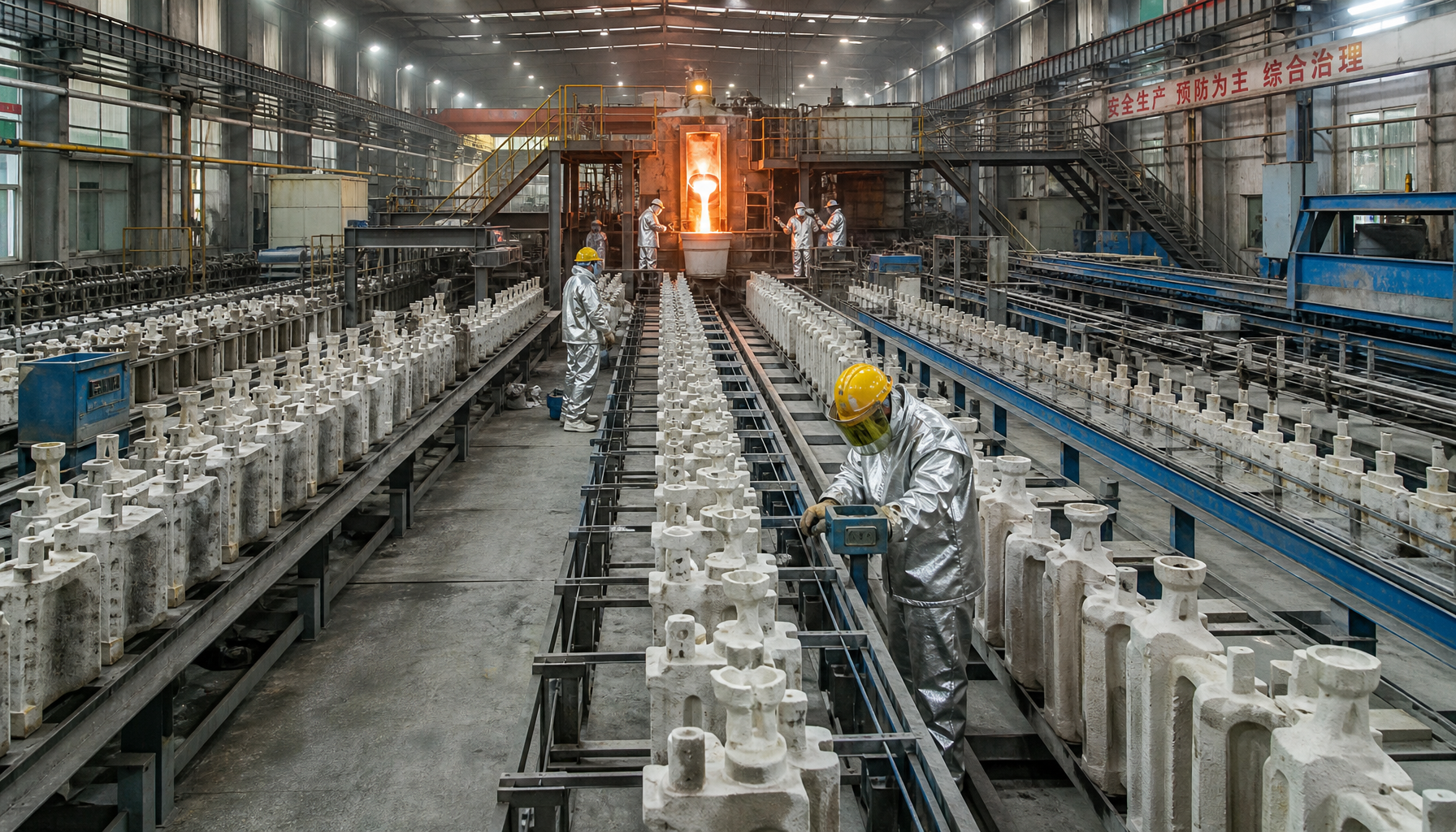
Next morning, you see the real place. The wax injection presses are older than your car. The shell room has a guy in sandals dipping ceramic shells — no humidity control, no time stamps, no records of slurry viscosity. They have a spectrometer, but no one can tell you the last time it was calibrated. The "quality manager" shrugs and says, "We will fix problems after you come inspect."
Sound familiar? If you're searching for a silica sol investment casting supplier China and picking the cheapest quote, this scenario is waiting for you. I've spent seven years helping buyers source castings in Zhejiang, Hebei, and Jiangsu. I've seen exactly what breaks. This article is the checklist I wish every first-time buyer had before they wired a deposit.
First, the landscape: where you're actually shopping
China's investment casting industry isn't one market — it's several clusters with very different personalities. Know where your quote is coming from.
Industry estimates put the number of active investment casting foundries in China at roughly 1,500 to 1,800 (that's an estimate — no government registry tracks them all). But most export-oriented silica sol foundries sit in four places:
- Zhejiang (Wenzhou, Yongjia): The largest export cluster. You'll find everything from 20-person shell shops to 800-worker foundries doing pump and valve castings for Europe. Capacity is deep; quality is inconsistent.
- Hebei (Cangzhou): The price-first cluster. Carbon steel and low-alloy parts in high volume. If your drawing demands tight wall sections or Ra 3.2 surface, you'll need to handhold them harder.
- Jiangsu (Suzhou, Wuxi): The engineering-heavy tier. More IATF/AS9100-certified foundries, more automation, higher costs. This is where automotive and med-tech buyers usually land.
- Shandong (Dongying, Zibo): Growing fast, especially for stainless and duplex alloys. Strong petrochemical supply chain, but export documentation can be rougher.
Here's the uncomfortable truth: the cluster matters less than the individual foundry. I've seen a Wenzhou bunker shop hold CT4 tolerances, and a shiny Jiangsu "AS9100" foundry that couldn't pass a spectro audit with a month of prep. So your job isn't to pick a region — it's to verify a specific floor.
What actually breaks with silica sol investment casting
Before you start auditing suppliers, understand what can go wrong. Silica sol (colloidal silica) is what makes modern investment casting so precise — the binder allows thinner shells and better surface finish than traditional water glass. But that precision cuts both ways.
Here are the five failure modes that show up in buyer disputes, in rough order of frequency:
1. Chemistry drift on the certified material
The foundry gives you an ASTM A732 cert saying 316L. Your lab later finds the actual melt runs 0.03% too high carbon, or manganese is pushing the top of spec. In heat-exchanger or food-grade applications, that's a recall-level failure. The root cause: shops that melt in 500 kg furnaces but only calibrate their spectro once a year.
2. Shell cracking and flexing
Thin shells crack during firing. The foundry patches them, you can't see it until the part's machined surface opens up a line of shrinkage. You'll blame the casting. Actually the slurry control was wrong — viscosity was drifting, humidity wasn't logged, and the shell build schedule was "we'll get to it."
3. Warped wax patterns = out-of-tolerance castings
Wax injection pressure varies because the operator changes cooling time to hit the output target. Result: patterns warp after assembly, and your 120 mm flat surface comes out with 0.8 mm of bow. That's not a tolerance problem — that's a process-control problem.
4. Surface pinholes hiding in "shot-blasted" parts
After shot blasting, a casting looks gorgeous. Until it's polished. Then you see a honeycomb of micro-shrinkage that the blasting covered. Suppliers don't intentionally hide this — but if their QC never does a section cut on the first article, they simply don't know.
5. "Good enough" dimensional shortcuts
The foundry measures only the three datums on your drawing and skips the rest. You get parts that fit their own fixtures but nothing else. When you reject, they say the drawing wasn't clear.
The pattern here? Every failure is a process failure, not a bad-luck failure. And process failures are 100% detectable before you place a production order.
The early red flags — spotted before you even visit
Start screening suppliers the day they reply to your RFQ. Some red flags are instant disqualifiers:
- They quote 48 hours after receiving a complex casting. Real shell shops need to review the part for wall-thinning, core removal, and alloy charge. A blazing fast quote means they either quoted your part blind or they're a trading company pretending.
- They claim "we do everything" — sand casting, die casting, investment casting, machining, forging. Nothing kills quality faster than a factory that's never mastered one process. Specialists exist for a reason.
- They dodge the spectro calibration question. The best investment casting foundries show you the calibration cert for their spectrometer without you asking. If you ask and get a "we can send after you order," walk.
- They ask for 50% deposit. Standard terms in the industry are 30% after order, 70% before shipment, or a negotiated 30-40% max. A 50% upfront ask is a sign they need your money to pay for another order — yours becomes collateral.
- Every system is "certified" but no one can name the slay ring of their kiln schedule. Deep casting knowledge shows in small, specific details. Bullshitters talk in adjectives.
But here's the thing: you can't catch all red flags on email. The serious due diligence starts when you visit, or send someone to visit.
The 11-step due-diligence checklist for a silica sol investment casting supplier
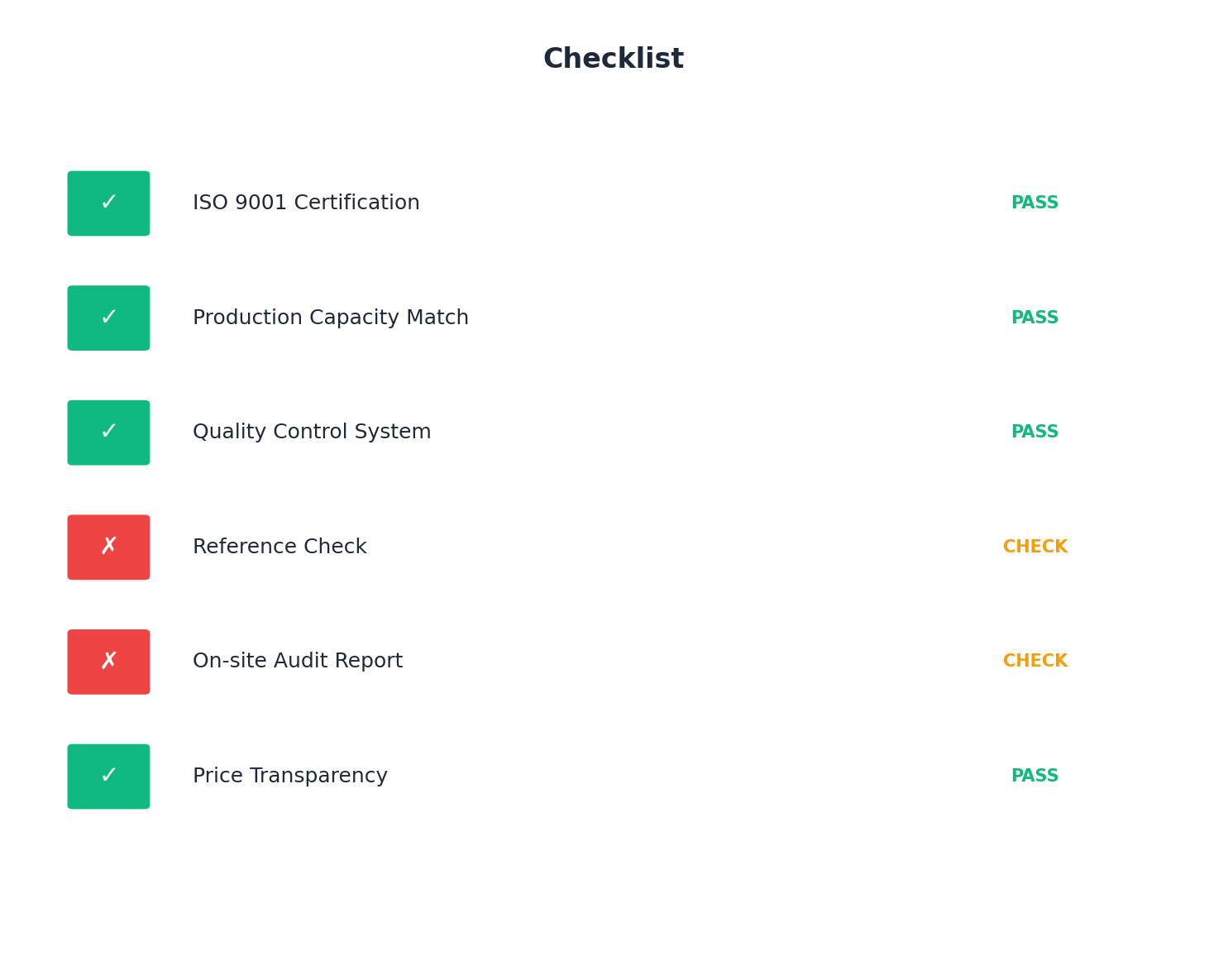
Bring this list. Print it. Check every item — no exceptions. You'd be surprised how many purchase orders get signed with only five of these verified.
Step 1: Confirm the legal entity and the physical floor
Check their business license. Then check that the "factory address" on their website is actually where the casting floor is. Many trading companies rent a desk in the same building as a real foundry and tell you that's their plant. If they dodge a video call from inside the production floor, that's the answer.
Step 2: Watch their shell room like it's a cleanroom
In silica sol investment casting, the shell room is where quality is born. Look for: temperature and humidity gauges on the wall that are actually running, slurry viscosity measurement tools nearby (Ford cup or a rheometer), timers for drying, and logs — real logs with signatures. If you see dipping stations with no records, the process is in the operator's head, which is where good castings go to die.
Step 3: Count the melting and pouring seriousness
Do they have a metallurgical thermometer? Calibrated spectro? Is there separation between the furnace area and the shell area? In a quality foundry, you'll smell burnt additives and see temperature readouts posted per heat. If the melter is "using his judgment" on temp, add this to your risk list.
Step 4: Demand to see a first article — physically
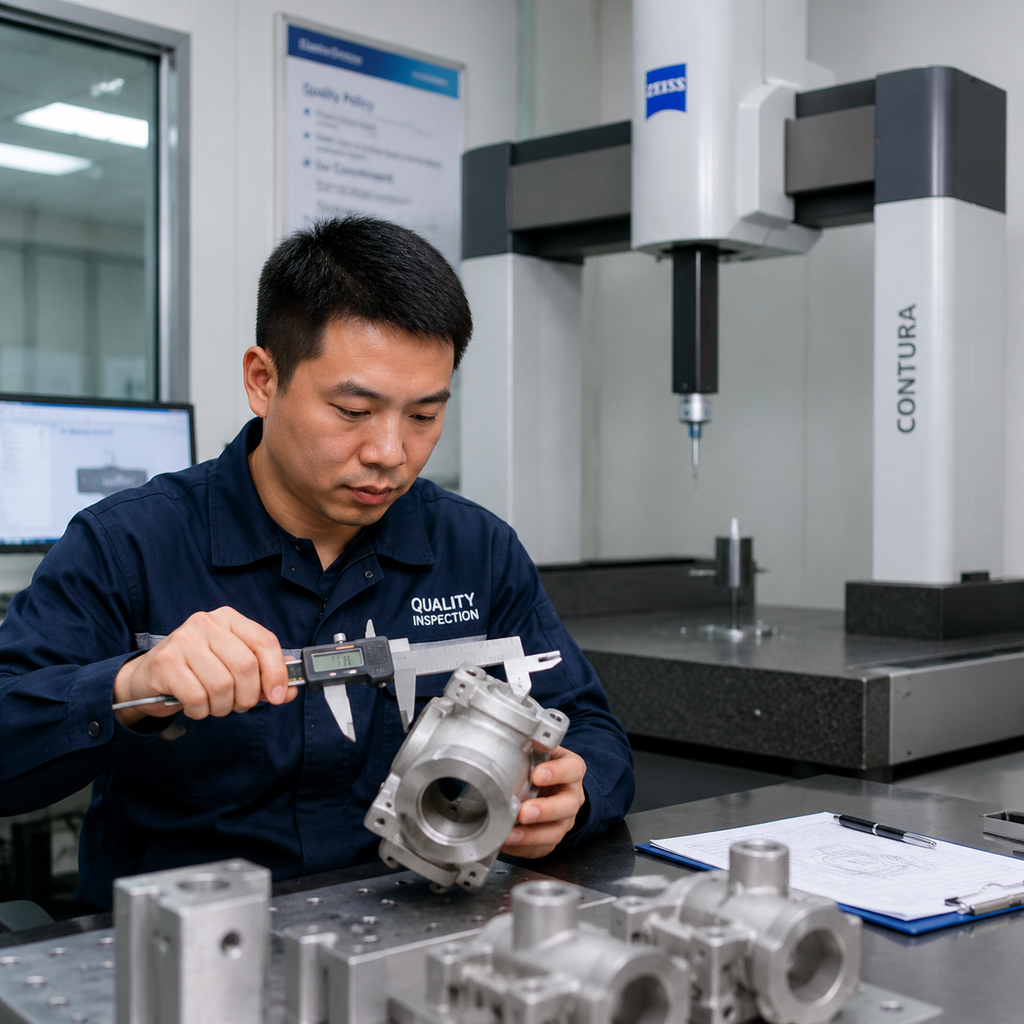
Not a photo. Not a "we can send you one after sample production." Open the box, look at the runner systems, check where they gated, feel the surface finish. Bring a digital caliper and check their claimed dimensions against your print on the spot. It takes 15 minutes and tells you more than 50 emails can.
Step 5: Ask about their "first article approval" process
Every serious export foundry has a formal FAIR (First Article Inspection Report) process — layout sheets, CMM reports, spectro certs, surface finish samples, and a signed approval from you before mass production starts. If their answer is "we just send samples," you're signing a blank check.
Step 6: Verify certs with a phone call, not a scan
ISO 9001:2015 is table stakes. IATF 16949 or AS9100 matter if you're automotive or aerospace. But here's the trick: look at the certificate number and call the issuing body (like TÜV, SGS, or Intertek). Fake certificates in China have gotten sophisticated — one buyer I know received a "TÜV SÜD" certificate from a "TÜV SÜD" that turned out to be a printing shop. Call. Verify.
Step 7: Inspect their in-house machining and finishing
If your part needs post-machining, you want it done either in the same building or by a machine shop you've also audited. The moment a casting gets shipped across town for machining, tolerances and responsibility both get murky. Understand who's accountable for the final, machined part — the foundry or the machinist. Get that chain of responsibility in writing.
Step 8: Talk to the workers, not just the sales rep
If you're visiting, ask the shell dipper what happens when the humidity is high. Ask the furnace operator what alloy he's melting and how he knows it's the right one. If the workers look at the sales guy for permission before answering, you don't have a real foundry — you have a guided tour.
Step 9: Check export records
Ask for recent customs declaration records (报关单) or shipping documents. Any serious exporter has a pile of airway bills and bill of ladings they can show — with some details redacted. If they claim exports to the US or Europe but have zero docs, you're looking at a newly born trading operation with a rented floor.
Step 10: Get a third-party inspection in your contract
Make it a contractual requirement: "Final acceptance based on pre-shipment inspection by a recognized third-party (SGS, TÜV, Bureau Veritas) using AQL 2.5." If you're spending less than $10,000, a full-time inspection may not make sense — but you can still pay $300-500 for a third party to do a dimensional and surface spot check. That small cost kills most of the horror stories.
Step 11: Check the payment terms again
Final terms should protect you. Common smart structure: 30% advance, 40% against first article approval, 30% against shipping documents. Don't fall for the "100% T/T before production" line. There are 1,500+ foundries in China — none of the good ones need your money to buy wax.
What you should actually pay (and what "too cheap" looks like)
Price is the lazy buyer's due-diligence shortcut. You don't hear negotiation ranges in blogs often because everyone's part is different. But here's a rough framework (mark these as estimates — actual pricing depends on geometry, alloys, and volume):
| Alloy type | Typical unit price (China, estimated) | What makes it rise |
|---|---|---|
| Carbon steel (CS/1035) | $4.50–7.00 / kg | Simple geometry, high volume |
| Stainless 304/316 | $7.50–12.00 / kg | Wall thickness, surface finish |
| Low-alloy steel (4140/8620) | $6.00–10.00 / kg | Heat treatment requirements, testing |
| Duplex / super alloys | $12.00–20.00+ / kg | Charge cost, NDT requirements |
A red flag? When a foundry quotes 40% below the next bid with no explanation. Cheap quotes come from somewhere: cheaper alloy (using remelted scraps from unknown origins), thinner shells, skipped QC, or a melting process that takes shortcuts. Your cost-savings game will evaporate the moment you need to re-run a lot or air-freight a replacement order.
Rule of thumb: ask for the cost breakdown — tooling, wax pattern, shell, melting, finishing, QC, and overhead. A foundry that gives you a transparent breakdown (even with some figures rounded) is showing a process. A foundry that says "we just calculate it by weight" is hiding chaos.
Quality control: what actually works on the ground
You don't need to become a metallurgist to protect yourself. You need a system. The buyers who consistently get good castings from China run a repeating loop:
- First article inspection (FAI): Before ANY production order, the foundry sends you a complete FAI package: dimensional report, spectro chemical analysis, mechanical test results, surface finish photos. You sign off in writing. This is non-negotiable.
- In-process inspection visits: For critical orders, schedule inspection at two points: during wax pattern/assembly stage (week 1-2) and after knockout before finishing (week 3-4). Catching shell defects before polishing saves everyone money.
- Pre-shipment inspection (PSI): Third-party QC at AQL 2.5, 50% dimensional check, and visual per Chinese standard or your own workmanship criteria. Put this in the contract even if you trust the foundry.
- Sample retention: Ask the foundry to keep one first-article casting for six months for dispute resolution. That $40 piece of steel could save you a $50,000 argument later.
One more thing: get the "right" certification per order. Material certs should reference the standard that matches your application — ASTM A732 for general castings, ACI (Alloy Casting Institute) designations for corrosion-resistant alloys, EN 10204 3.1 for EU projects. If the foundry asks "which cert do you need?", that's actually a good sign. If they give you whatever cert they happen to have, that's not.
Shipping, Incoterms, and the paperwork jungle
Silica sol castings are dense, heavy, and often oddly shaped. Shipping strategy affects your total cost more than the casting price itself. On a 1,000 kg order, ocean freight from Ningbo to Los Angeles can run $800–1,500 depending on season. Air freight on a 20-day lead time could multiply your logistics cost 5x. Don't pick air freight for castings unless there's a crisis.
On Incoterms, here's my blunt advice: use FOB or EXW, not DDP when you're dealing with a newly-verified foundry. DDP sounds easy, but it puts the freight forwarder in charge of customs clearance on your side, and if anything goes wrong with import duties or brokerage, the time it takes to unwind a DDP dispute is brutal. You keep control with FOB (goods loaded on the vessel, then yours).
Paperwork you'll want in every order:
- Commercial invoice and packing list (with weights, box numbers, pallet count)
- Material certificate with heat number
- Test report for tensile/yield/hardness if applicable
- Dimensional inspection report summary
- Photos of the loaded containers/pallets
- Original Bill of Lading (check it against the actual container numbers)
Tip: name your own freight forwarder on the order. When a foundry insists on their own forwarder, you lose visibility into container status — and you're at their mercy for late loading.
Frequently asked questions
What is the typical lead time for silica sol investment casting orders in China?
For a new casting with tooling, plan 6–8 weeks for tooling and 4–6 weeks for production after approval. Repeat orders usually run 30–45 days, depending on shell capacity and surface finish requirements.
What tolerances can a silica sol investment casting hold?
Most Chinese foundries hold ISO 8062 CT6–CT7 linear tolerances for steel castings. Typical achievable is ±0.05 mm on critical small features and ±0.5% of the nominal dimension. My rule: if a supplier prints CT5 on a 400 mm part without quoting extra process control, they're fooling you.
What is the minimum order quantity for silica sol investment castings?
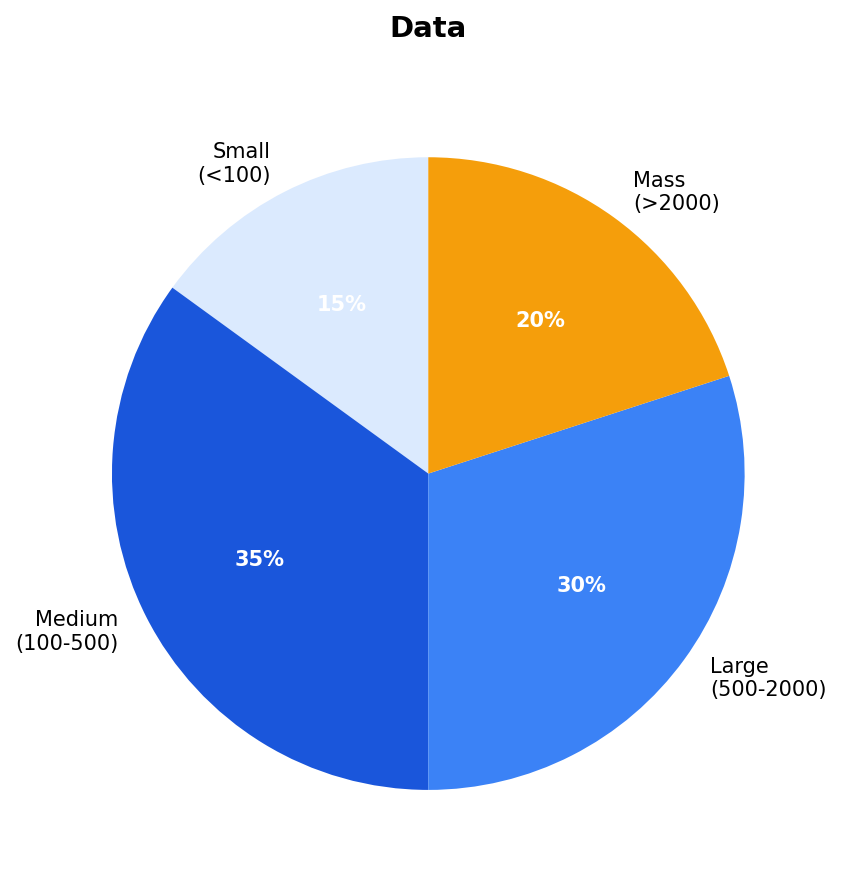
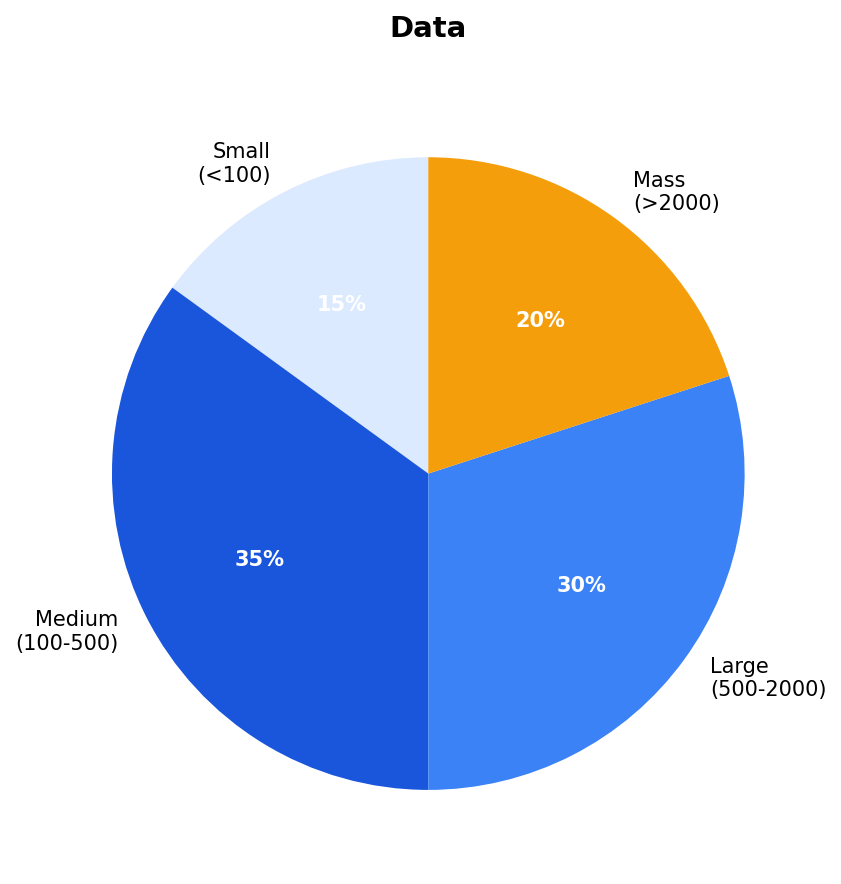
MOQs range from 100 to 2,000 pieces depending on part weight and shell cost. Small 100 g parts see MOQs around 500–1,000; large 5 kg+ castings can run at 200–500. Lower MOQs usually double your unit price.
How do I verify a Chinese investment casting foundry before paying?
Verify the place you've seen, not the email you've exchanged with. Do a live video walkthrough, order a first-article inspection from a third-party QC firm, and ask for recent customs export records. If a purported factory can't show exports on similar alloys, that's your answer.
Next steps: turn this checklist into your sourcing system
Searching for a silica sol investment casting supplier in China is like getting into a kayak in whitewater — you can paddle hard, but without the right gear, you'll just spin. The gear here is structure:
- Shortlist 5–7 suppliers using this checklist's first 5 steps (legal entity, shell room videos, first article, certs, pricing transparency).
- Send the same RFQ to all of them: same drawing, same quantity, same target alloy, same Incoterm. Demand the same document pack.
- Build a comparison table. Rank on price, transparency, response speed, and willingness to accept your inspection terms. The foundry that asks the most follow-up questions about your casting is usually the one that reads drawings carefully.
- Do one pilot order before scaling.
That's the process. It's not glamorous. But it'll save you from the 2 a.m. Wenzhou landing, the sandals in the shell room, and the phone call where your quality team tells you the material cert is wrong.
The buyers who consistently source good castings from China aren't lucky. They're systematic. Print the 11-step checklist, put it at the top of your desk, and treat it like the critical purchase order it is.
Run the checklist before you pay anything.
Download the full 11-step supplier audit PDF for free, and use it on your next RFQ. Send your casting drawing to a shortlist of vetted foundries, compare their responses side by side, and keep this checklist in the contract.
Get the 11-Step Vendor Audit PDF →- ✓ 1,700+ vetted foundries
- ✓ 40+ QA engineers
- ✓ Serving buyers in 22 countries
- ✓ ISO 9001 / IATF 16949 capable