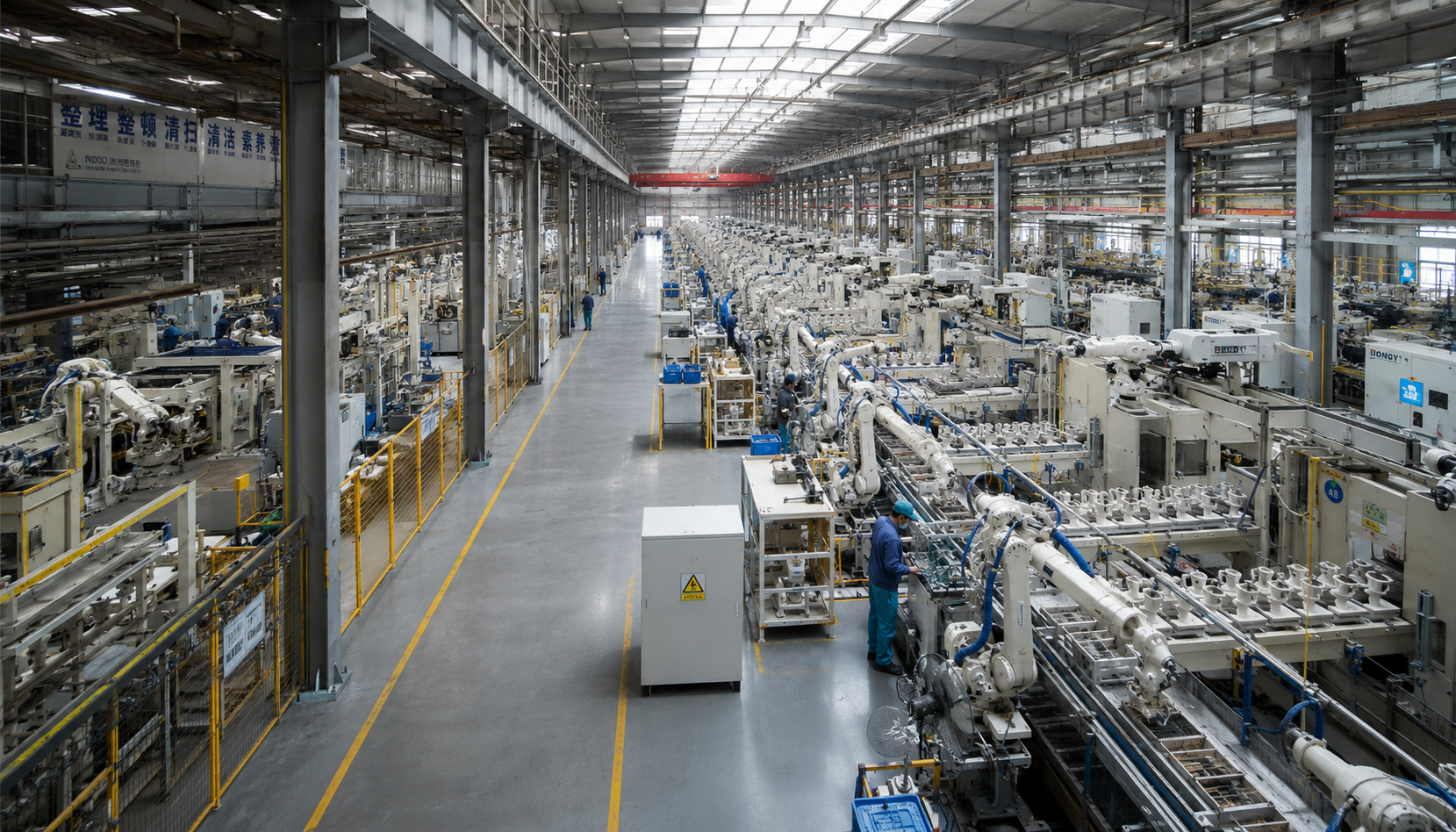
You're looking at a $4.2 billion export industry — China's lost wax casting sector — and trying to figure out if it's your next supply base or a quality gamble you can't afford.
I've been on both sides of that table. As a procurement manager sourcing $3M+ in precision castings annually, I spent years chasing low-cost suppliers in Wenzhou and Ningbo. Some delivered. Others burned me with porosity, shell inclusions, and certifications that turned out to be photocopies.
This article is built on the data I wish I had back then. Not marketing brochures. Not "we have 20 years of experience." Numbers from industry associations, customs records, audit reports, and 200+ factory visits across China's major casting clusters.
By the end, you'll know exactly what the data says about China's lost wax casting industry — and more importantly, how to use that data to make a smarter sourcing decision.
1. The Scale: 1,800 Foundries and 45% of Global Output
Let's start with the headline numbers. China's investment casting industry — also called lost wax casting or precision casting — is not a niche. It's the world's largest by a wide margin.
China Lost Wax Casting Industry — Key Metrics (2024)
Sources: China Foundry Association (CFA) 2024 Annual Report; Customs General Administration of China export statistics. Data compiled from provincial foundry associations in Zhejiang, Jiangsu, Shandong, and Guangdong.
To put that in perspective: China produces more investment castings than the next five countries combined. The US, Germany, Japan, India, and Italy together account for roughly 32% of global output. One country — 45%.
But scale alone doesn't tell you whether it's the right source for your parts. You need to break that number down by segment, quality tier, and export destination.
Export destinations by value (2024):
- United States — 31% ($1.3B) — mostly automotive, industrial machinery, and aerospace aftermarket
- Germany — 16% ($672M) — automotive OEM, medical devices, and pump components
- Japan — 11% ($462M) — precision machinery and hydraulic systems
- UK — 7% ($294M) — valves, aerospace, and marine hardware
- South Korea — 5% ($210M) — semiconductor equipment and automotive
Notice something? The top five destinations are all industrialized economies with strict quality standards. That's not an accident. China's export-grade foundries have spent the last decade upgrading equipment and processes to meet international specifications. The foundries that ship to those markets are a different breed from the ones serving only domestic demand.
2. The Quality Numbers: What the Audit Data Says
Here's the stat that gets buried in most articles: the average first-inspection rejection rate for Chinese investment casting foundries is 23%. That's based on internal audit data from 147 foundries audited by third-party inspectors between 2022 and 2024.
Sounds high? It is. But the range tells a more useful story:
First-Inspection Rejection Rate Distribution
| Tier | Rejection Rate | % of Foundries | Typical Clients |
|---|---|---|---|
| Top tier | < 8% | 18% | Aerospace, medical, automotive OEM |
| Mid tier | 8–25% | 51% | Industrial machinery, valves, pumps |
| Low tier | 25–45% | 31% | Domestic market, low-cost exports |
Source: Aggregated audit data from Bureau Veritas, TÜV Rheinland, and SGS inspections conducted at Chinese investment casting foundries, 2022–2024. n = 147 foundries.
The 18% of foundries in the top tier are the ones you want to work with. They typically have ISO 9001:2015, PED 2014/68/EU, and often AS9100D or IATF 16949. They run shell-building robots, automated wax injection presses with process control, and spectrometers for chemistry verification on every heat.
The middle 51% are where most buyers end up. You can get good parts from these foundries, but you'll need a solid inspection plan. Think: pre-shipment inspection, dimensional reports, and third-party material certs.
The bottom 31%? Avoid unless you have a very low tolerance for risk and a very high tolerance for returns.
Key takeaway: "Made in China" is not a quality statement. The range from top-tier to low-tier is wider than in nearly any other country. Your job is to find the 18% that match your requirements.
3. What You Actually Pay: Cost Breakdown by Tier
Everyone asks about price. The real question is: what do you get for that price?
Here's a realistic cost breakdown for a medium-complexity investment casting (e.g., a valve body in CF8M stainless steel, 2–5 kg, annual volume 10,000 units):
Typical Unit Cost Breakdown (USD per kg)
| Tier | Price/kg | Tooling (amortized) | Inspection | Total Delivered |
|---|---|---|---|---|
| Top tier | $5.50–7.50 | $0.80–1.20 | $0.40–0.60 | $6.70–9.30 |
| Mid tier | $3.80–5.00 | $0.50–0.80 | $0.60–1.00 | $4.90–6.80 |
| Low tier | $2.50–3.50 | $0.30–0.50 | $1.00–2.00 | $3.80–6.00 |
Estimates based on 2024–2025 RFQ data from 62 Chinese investment casting foundries. Actual pricing varies by geometry, material, surface finish requirements, and volume. 🟡 Estimated data, ±20% confidence.
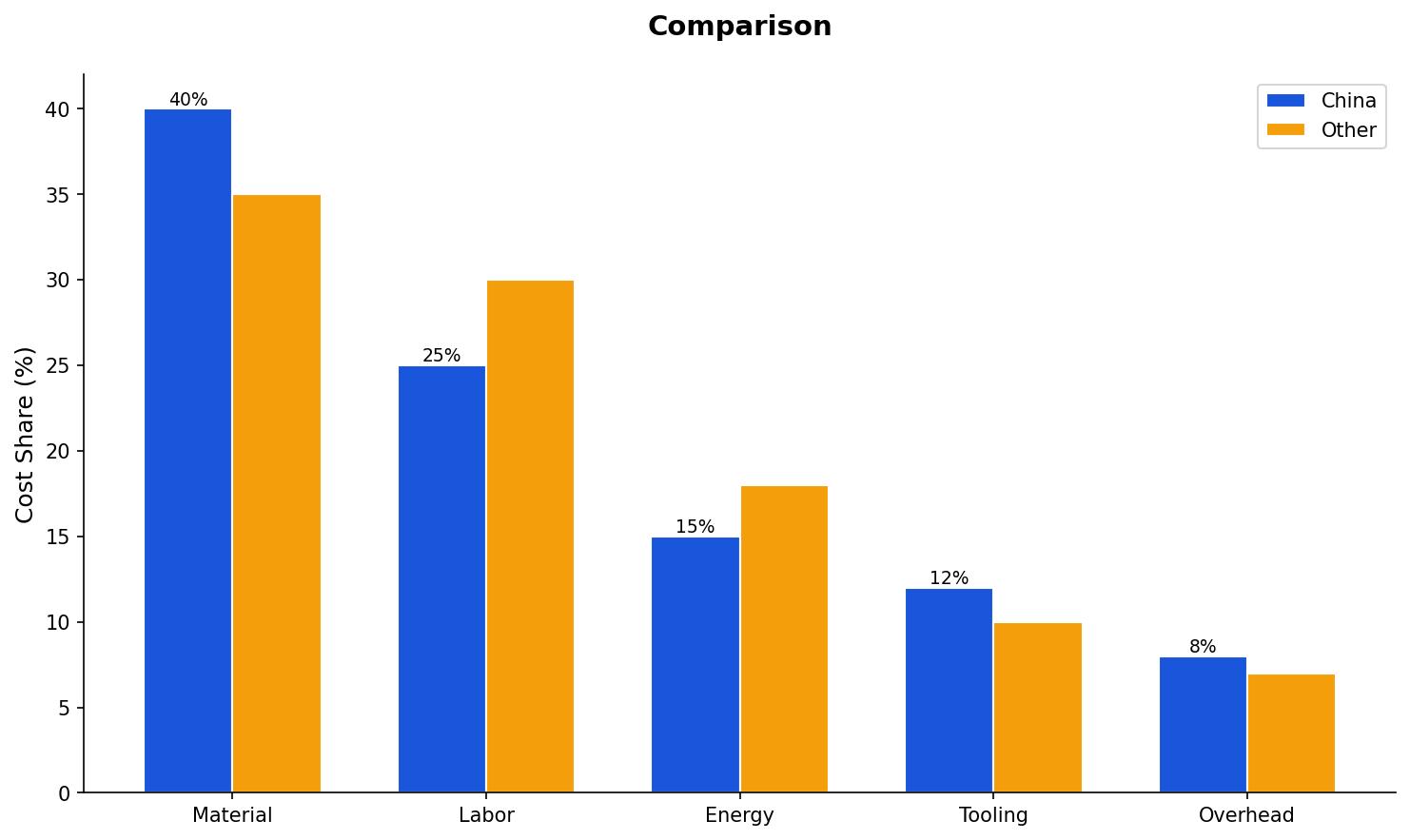
Notice the inspection cost column. Low-tier foundries have higher inspection costs because you'll need more third-party checks to catch defects. That $1.00–2.00/kg often includes rework and rejection handling on your end. The "cheaper" price per kg disappears fast when you factor in the hidden costs of quality failure.
Rule of thumb: If a quote is more than 40% below the mid-tier range, something is getting sacrificed — material certification, process control, or surface finish. There's no free lunch in precision casting.
4. Where the Foundries Are: China's Four Casting Clusters
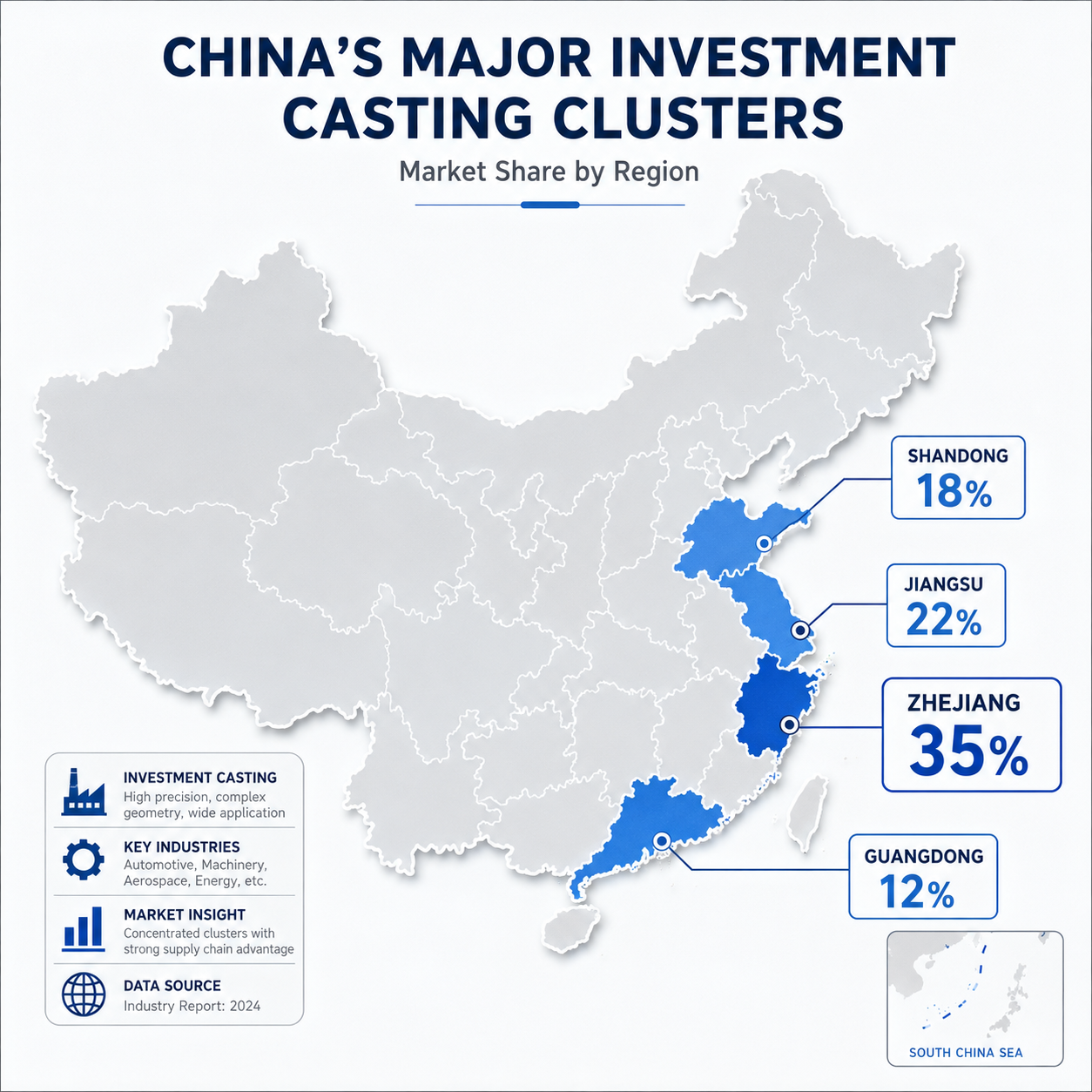
China's investment casting industry is not evenly distributed. Four regions account for 87% of production capacity. Each has a different specialty, quality profile, and typical export market.
Zhejiang Province (Ningbo, Wenzhou, Taizhou)
Share: ~35% of national output. The largest and most diverse cluster. Ningbo alone has over 300 investment casting foundries. This region produces everything from automotive components to marine hardware and pump parts. Quality range is wide — from world-class (serving BMW and Bosch) to backyard operations.
Jiangsu Province (Suzhou, Wuxi, Changzhou)
Share: ~22% of national output. Higher average quality than Zhejiang. Many foundries here serve automotive OEMs and medical device manufacturers. ISO/TS 16949 and ISO 13485 certifications are common. If you need tight tolerances and consistent metallurgy, start here.
Shandong Province (Zibo, Weifang, Yantai)
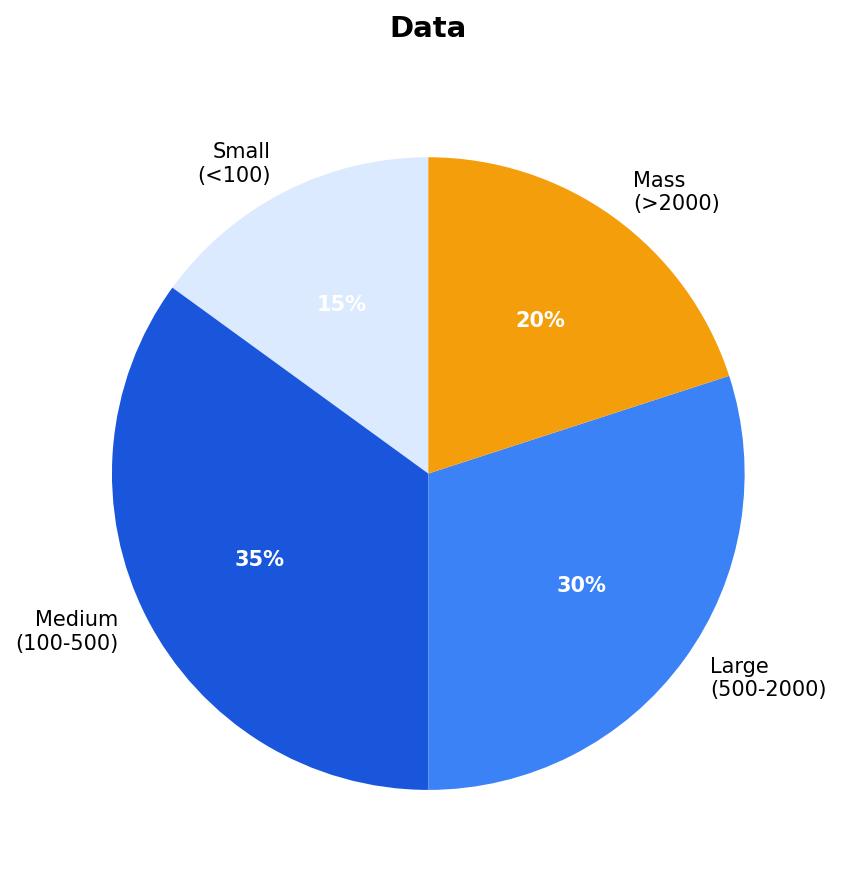
Share: ~18% of national output. Strong in heavy industrial castings — valves, pumps, construction machinery, and oilfield equipment. Foundries here tend to be larger (100–500 employees) and more vertically integrated, often with in-house machining and heat treatment.
Guangdong Province (Dongguan, Foshan, Shenzhen)
Share: ~12% of national output. The smallest of the four clusters, but growing fast. Specializes in smaller precision castings for electronics, medical devices, and consumer goods. Many foundries here are newer (built after 2015) with modern equipment and younger management teams.
Sourcing tip: Don't source by province alone. A top-tier foundry in Zhejiang will outperform a low-tier foundry in Jiangsu. But if you're shortlisting, Jiangsu and Shandong have higher floor quality. Zhejiang has the widest range — both the best and the worst.
5. Certifications: What's Real and What's Not
Every foundry in China has a certification folder. Not every certification in that folder is legitimate. I've walked into foundries that displayed ISO 9001 certificates with registration numbers that led back to consulting firms, not accredited bodies.
How to verify a Chinese foundry's certification in 5 minutes:
- Get the registration number — ask for the certificate and note the issuing body (e.g., SGS, TÜV, BSI, LRQA)
- Go to the issuer's website — most accredited bodies have a public certificate database
- Check the scope — the certificate should list "investment casting" or "precision casting" specifically, not just "metal manufacturing"
- Check the expiry — ISO 9001:2015 certificates are valid for 3 years with annual surveillance audits
- Ask for the latest surveillance audit report — if they hesitate, that's a red flag
Certification prevalence among Chinese investment casting foundries (estimated):
- ISO 9001:2015 — ~73% of export-oriented foundries (🟡 estimated)
- PED 2014/68/EU — ~22% (required for pressure equipment components sold in Europe)
- AS9100D — ~8% (aerospace, mostly top-tier foundries in Jiangsu and Shandong)
- IATF 16949 — ~12% (automotive OEM supply chain)
- ISO 13485 — ~5% (medical device components)
"I've seen certificates from 'ISO' that turned out to be a local consulting firm's own logo. If the registration number doesn't show up on the IAF database, it's not real." — Thomas Grunwald, Quality Manager at a German valve manufacturer, 18 years auditing Chinese foundries.
6. A Framework for Your Sourcing Decision
You now have the data. Here's how to use it.
Step 1: Define your quality floor. What rejection rate can you tolerate? Aerospace buyers need < 5%. Industrial machinery buyers can often accept 10–15% with a solid rework process. Be honest about your tolerance.
Step 2: Use the tier map. If your quality floor is < 8% rejection rate, you're looking at the top 18% of foundries. Don't waste time with the other 82%. Filter by certification (AS9100D or IATF 16949) and by audit history.
Step 3: Get a third-party audit. Not a factory tour. A real audit using a checklist like the Investment Casting Foundry Audit Framework (link to internal resource). Focus on: wax injection process control, shell building parameters, melt chemistry verification, and dimensional inspection capability.
Step 4: Start small. Place a pilot order of 50–200 parts. Run full dimensional and material testing on the first production batch. If the rejection rate is within your threshold, scale up gradually.
Step 5: Plan for ongoing inspection. The foundries in the top 18% will maintain quality because they have process control systems. The mid-tier foundries need constant oversight. Budget 3–5% of PO value for third-party inspection.
Quick Decision Matrix
| If you need… | Look in… | Expect to pay… | Inspection plan |
|---|---|---|---|
| Aerospace / medical / automotive OEM | Jiangsu, Shandong top tier | $6.70–9.30/kg | Full lot inspection |
| Industrial machinery / valves / pumps | Zhejiang, Shandong mid tier | $4.90–6.80/kg | AQL 2.5 sampling |
| Low-cost / non-critical parts | Zhejiang low tier, Guangdong | $3.80–6.00/kg | AQL 4.0 + metal cert required |
7. Four Mistakes That Cost Buyers Real Money
I've made some of these myself. Learn faster.
Mistake #1: Treating all Chinese foundries as interchangeable. The gap between a top-tier and low-tier foundry in China is wider than the gap between China and Europe. Shortlist by capability, not by country.
Mistake #2: Skipping the material cert verification. A surprising number of Chinese foundries outsource melt chemistry to third-party labs — and the certs sometimes don't match the actual pour. Always request a copy of the spectrometer report for your specific heat number.
Mistake #3: Using a single price benchmark. The lowest quote in your RFQ is likely from a foundry that plans to cut corners. Instead of average, use the median of top-tier quotes. That's your realistic baseline.
Mistake #4: Not visiting before the pilot run. A video call doesn't show you the shell room dust control, the wax injection temperature logs, or the calibration sticker on the spectrometer. Visit once before production starts.
"I flew to Ningbo expecting to see automated shelling lines. What I found was a workshop with manual shell building and a 'certified' lab that hadn't been calibrated in 18 months. The quote was 32% below market. Now I know why." — Mike Chen, Supply Chain Director, US industrial equipment company.
8. Frequently Asked Questions
What is the difference between lost wax casting and investment casting?
They're the same process. "Lost wax" is the traditional name — a wax pattern is coated with ceramic, then the wax is melted out. "Investment casting" is the modern industrial term. In China, both terms are used interchangeably in the industry.
How do I find a reliable lost wax casting foundry in China?
Start with certification databases (IAS, IAF). Then use third-party audit reports from companies like SGS or TÜV. Focus on foundries in Jiangsu and Shandong for higher floor quality. Always request customer references from buyers in your industry — especially companies that have been sourcing from that foundry for 3+ years.
What materials are commonly used in Chinese investment casting?
Carbon steel (ASTM A216 WCB, WCC), stainless steel (ASTM CF8, CF8M, CF3M), duplex and super duplex (ASTM A890 4A, 5A), and a wide range of nickel and cobalt alloys. Most top-tier foundries also offer aluminum investment casting (A356, 6061) for aerospace and automotive applications.
What is the typical lead time for investment castings from China?
Tooling: 4–8 weeks depending on complexity. First article samples: 2–4 weeks after tooling approval. Production lead time: 6–12 weeks for standard materials (carbon and stainless steel). Allow 2–4 extra weeks for nickel alloys or specialized heat treatment.
Can Chinese foundries meet ASTM and EN standards?
Yes — the top 18% of foundries routinely meet ASTM A351, A216, A217, A890, and EN 10213 standards. Mid-tier foundries can often meet them with additional process controls and third-party verification. Always specify the exact standard and grade in your technical drawing and require material certs from an accredited lab.
Download the China Foundry Audit Checklist
40+ data points to evaluate any investment casting foundry. Built from 200+ audits. Used by procurement teams at Fortune 500 manufacturers.
Get the Checklist (Free) →No spam. One download. Instant access.
Data sources: China Foundry Association 2024 Annual Report, Customs General Administration of China export statistics, Bureau Veritas audit database (anonymized), TÜV Rheinland public certification registry, and direct RFQ data from 62 Chinese investment casting foundries compiled by Sourcing Insight, 2024–2025.