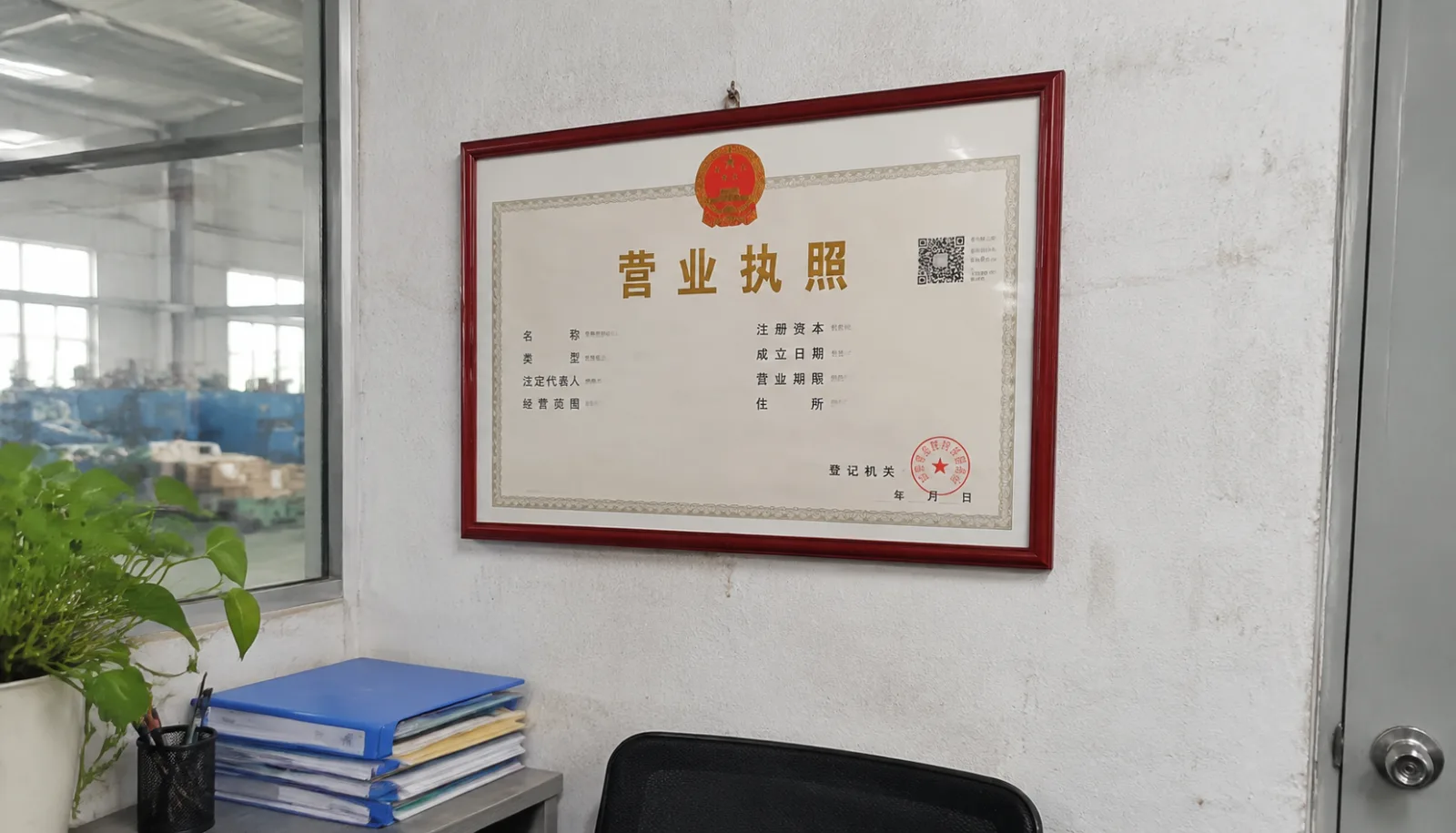
Before you audit a foundry, before you request a sample, and certainly before you wire a deposit, there is a cheaper test that takes about ten minutes: read the business license properly.
Not glance at it. Read five fields. Because the most common problem in casting sourcing is not a bad foundry — it is a trading company presenting itself as one, and the license states which it is in language plain enough to settle the question.
The five fields that matter
| Field | What to read for |
|---|---|
| Unified social credit code | 18 characters, must match invoice, contract and customs documents |
| Company name and entity type | Limited company vs individual business vs branch office |
| Legal representative | The person who can bind the company; check against who signs your contract |
| Registered capital and paid-in capital | A rough scale indicator, not proof of solvency |
| Business scope | Manufacturing of castings, or wholesale of metal products — the decisive line |
The credit code, decoded
The eighteen characters are not random. They are structured:
- Character 1 — the registration authority.
9means market regulation, which is where ordinary companies register. - Character 2 — the entity category.
1means an enterprise, so91at the front is the normal prefix for a limited company.92is an individual business and93a farmer cooperative — neither is a manufacturing company in the sense you are buying from. - Characters 3–8 — the administrative division code of the registering authority. This tells you which city, and often which district, the company is actually registered in.
- Characters 9–17 — the organisation code, the company’s own identifier.
- Character 18 — a check digit.
Two practical uses. First, if a supplier’s website claims a plant in one province and the code’s division digits point to another, ask why. Second, the code is the key you use to search every other register — tax, customs, court judgments, environmental permits — so getting it in writing early saves a week later.
The business scope trap
This is where most misrepresentation actually lives, and it is rarely a lie. Chinese business scopes are long lists, and the difference between them is a few characters.
A manufacturing scope contains language such as:
- 铸件制造 / 铸造加工 — casting manufacture, casting processing
- 金属制品生产 — production of metal products
- 机械零部件加工 — machining of mechanical components
A trading scope contains language such as:
- 金属材料销售 — sale of metal materials
- 五金产品批发 / 零售 — wholesale or retail of hardware
- 货物进出口 — import and export of goods
Manufacture versus sale. That is the whole test. A company whose scope covers only sale and import-export is a trader, and a trader is a perfectly reasonable counterparty — as long as the price, the audit rights and the liability reflect that. What you do not want is to pay a foundry’s price for a broker’s margin while believing you have a plant behind you.
One caveat: a large group may legitimately hold a trading subsidiary, and the factory may be a separate legal entity. That is common and not automatically a problem. The question to ask is which entity will appear on the invoice, and whether you have a contractual relationship with the one that owns the furnace.
The two permits a trader cannot produce
If the scope leaves you uncertain, these two documents settle it faster than anything else in the pack.
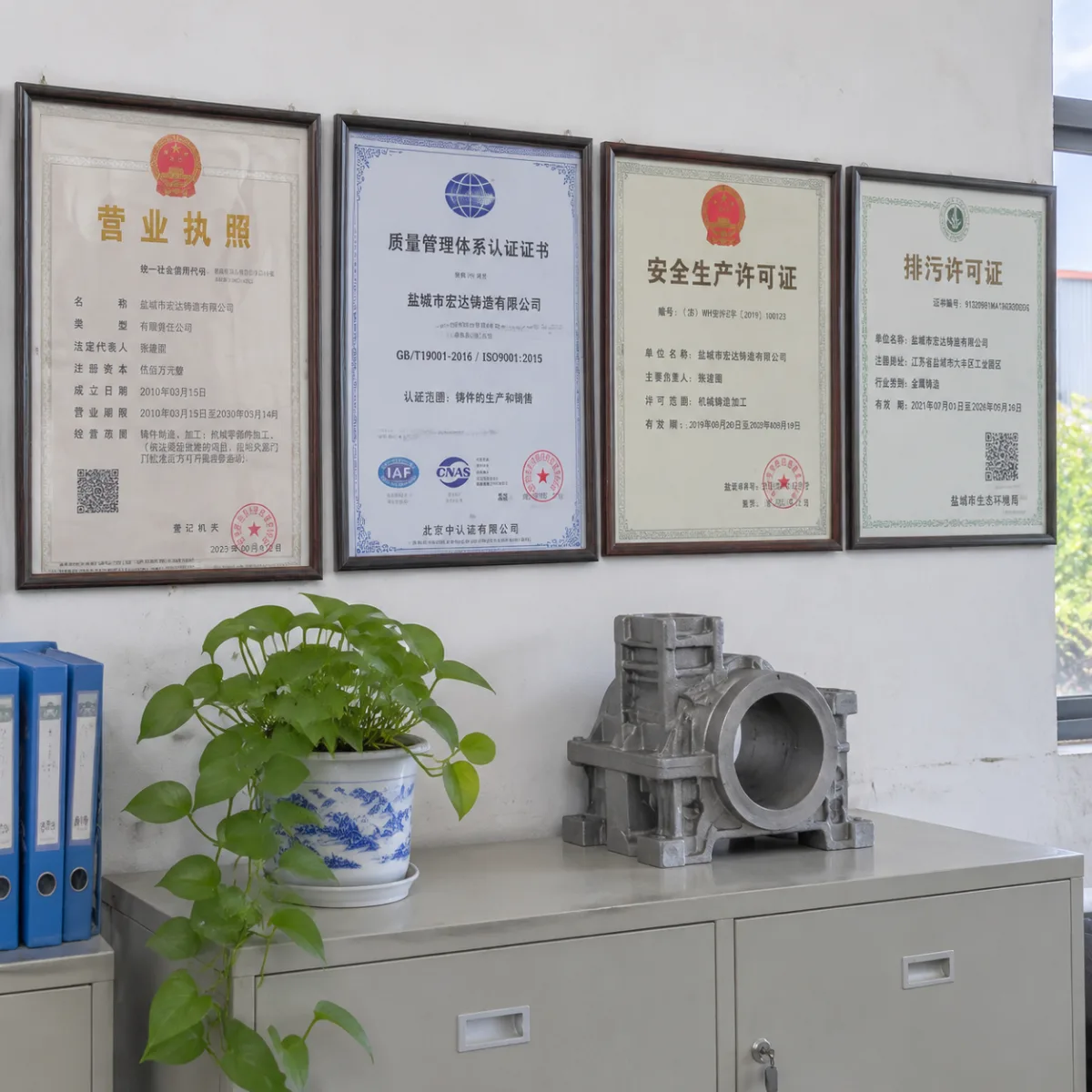
Pollution discharge permit (排污许可证)
Casting plants run melting furnaces and are therefore inside China’s discharge permitting regime. The permit is public, searchable on the national permit platform, and it records the plant address, the production equipment and the permitted capacity. A trading company has no furnace, so it has no permit, and it cannot obtain one for an address it does not operate.
Ask for the permit number and check the address. If it matches the factory you plan to visit, you have established something no certificate can: that the entity you are paying is permitted to melt metal at that location. If the permit shows a capacity far below what you are being quoted, that is also worth knowing before you place a 200-tonne order.
Environmental impact approval (环评批复)
The environmental impact assessment approval for the project, usually issued when the plant was built or expanded. It names the project, the location and the approved production scale. Together with the discharge permit it forms a pair that is very hard to assemble for an entity that does not own a plant.
Cross-checks worth doing while you are there
- Registered address versus factory address. A registered office in a city centre and a plant in an industrial park is normal. A registered address that is a residential unit, combined with a claimed 20,000 m² plant, is worth a question.
- Establishment date versus claimed experience. “Twenty years of casting experience” on a company incorporated three years ago is not necessarily false — the team may have come from elsewhere — but the entity you are contracting with has a three-year record, and that is the one that can be sued.
- Abnormal operations list (经营异常名录). Companies that fail to file annual reports or cannot be reached at their registered address get listed. It is public and it is a reliable signal of an entity that is not being maintained.
- Serious violations list (严重违法失信名单). A shorter, more serious list. Any appearance on it ends the conversation.
- Legal representative versus signatory. If your contract is signed by someone who is neither the legal representative nor clearly authorised, ask for the authorisation. Enforcing a contract against a company whose signature was unauthorised is exactly as difficult as it sounds.
What a trader posing as a foundry looks like
- Scope is sale and import-export only, with no manufacturing language anywhere.
- No pollution discharge permit, and a vague answer when asked why.
- No factory address on the license that corresponds to any industrial site.
- The plant visit is “our partner factory” rather than “our plant” — and the partner changes between visits.
- Quotations always arrive a day late, because they are being relayed.
- The person answering technical questions cannot answer a question about furnace capacity or molding line without checking.
When to walk away
Three findings justify stopping: the company appears on the serious violations list; the license entity, the invoice entity and the plant entity are three different companies with no visible relationship; or the supplier refuses to provide the credit code at all. The last one is unusual and almost always deliberate.
Everything else — a trader with a clear scope, a young company with experienced staff, a group structure with a separate manufacturing entity — is a fact to price in, not a reason to leave. The point of reading the license is not to find perfect suppliers. It is to know which of the three things you are actually buying from.
Related verification pages
Have a license you want read?
Send the company name and the unified social credit code, or the license scan. We check the scope against the process you are buying, the registered address against the plant address, and the pollution permit against the claimed capacity — and tell you what does not line up.
Prefer email? cfwc@163.com · WhatsApp +86 159 4126 7000