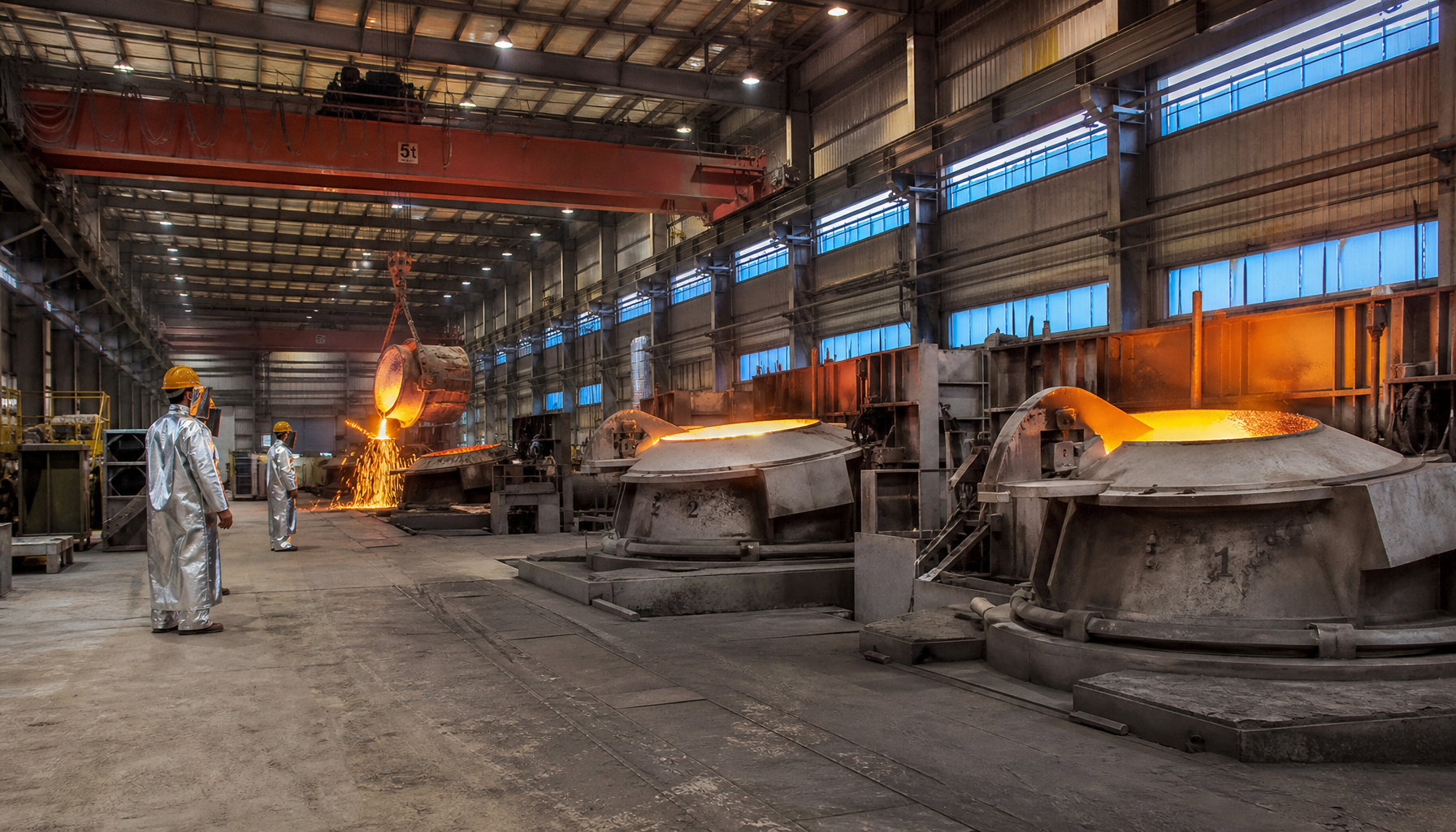
China poured roughly 52 million tonnes of castings in 2023 — close to 45% of everything cast on the planet. The same industry body that publishes that figure estimates the number of foundries doing the pouring at somewhere between 15,000 and 25,000, down from over 26,000 a decade ago as environmental enforcement closed the smaller ones.
So on one side: a global supply base with no real competitor. On the other: a supplier list where the gap between the best and the worst is measured in orders of magnitude, not percentages.
Here's the part that costs buyers real money. A quote that comes in 22% below everyone else isn't usually a bargain and it isn't always a scam. Most of the time it's a trading company quoting a foundry they don't control, or a foundry quoting a process they've never run at your wall thickness. Both look identical on a PDF. Neither is visible in a sample.
What follows is the verification sequence that actually separates them. Seven steps, in the order that matters, with the specific documents and questions that either produce evidence or produce excuses.
Why a verified supplier still beats a cheap one
Run the arithmetic on a failed first order. Tooling that has to be re-cut: $4,000 to $25,000 depending on cavity count. Twelve weeks of production you can't schedule around. A container sitting at port while you argue about who owns the scrap. Air freight to cover the gap. A quality engineer on a plane. And in regulated categories — pressure equipment, automotive, medical — a recall trace that lands on your name, not the foundry's.
Typical landing cost of a bad first casting order runs 30% to 60% of the order value once you count everything. The verification process described below costs a few hundred to a few thousand dollars and about three weeks of calendar time. That's not a cost-benefit analysis. It's just arithmetic.
The 7-step verification sequence
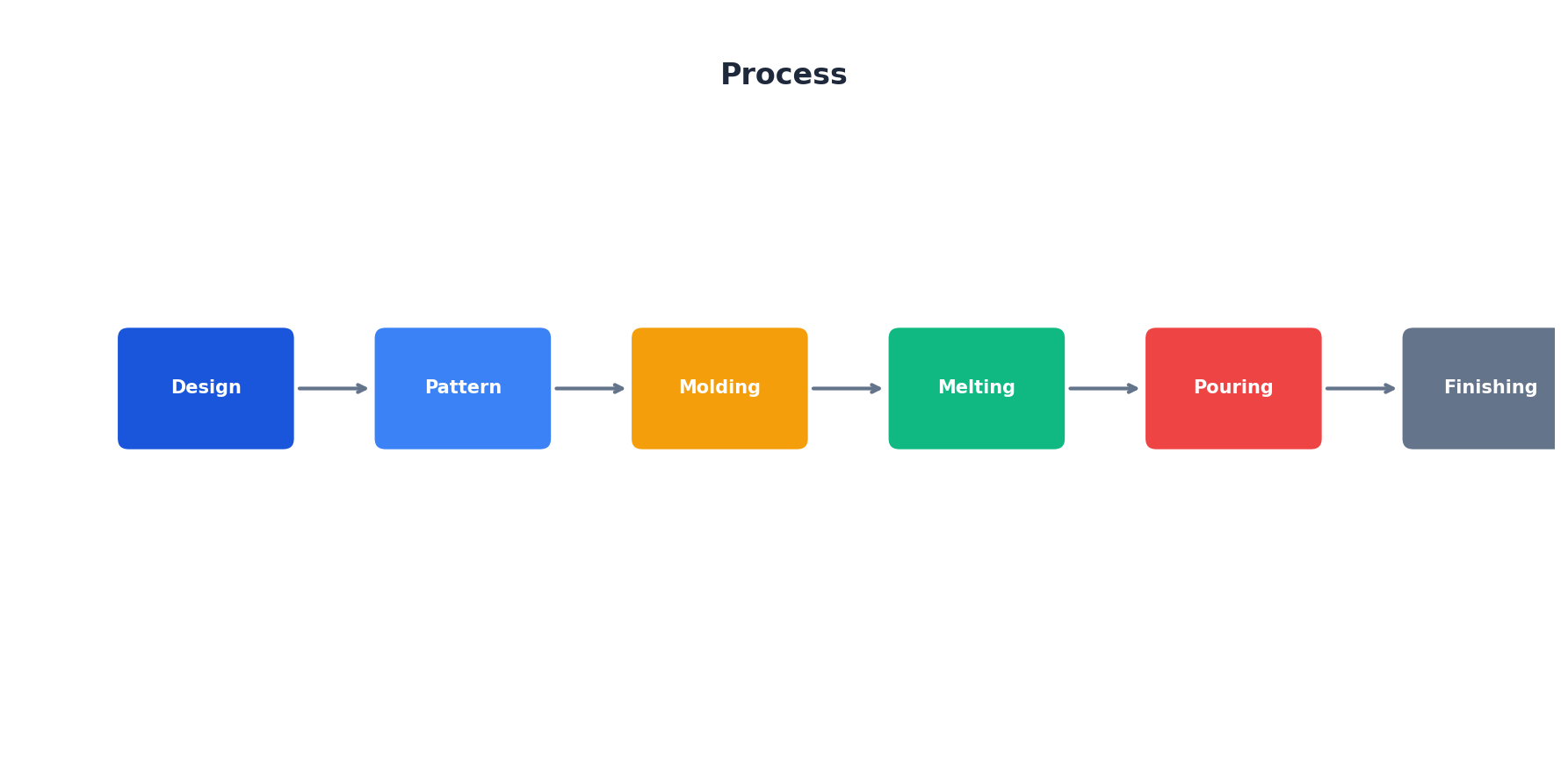
Step 1 — Verify the legal entity, not the salesperson
Every Chinese company that can legally export holds an 18-character Unified Social Credit Code. Get it before you get a price. Then open the National Enterprise Credit Information Publicity System at gsxt.gov.cn and check five things.
- Registered name versus the name on your quote. A mismatch isn't automatically a problem — plenty of factories trade under a brand name — but you need to know who is legally on the other side of the PO.
- Operating status. "In operation" (存续/在营) is what you want. "Revoked", "deregistered", or "listed as abnormal" (经营异常) is a stop sign, regardless of how good the price looks.
- Business scope. It should include casting, metal products, or machinery manufacturing. A scope that reads only "trade and import/export services" tells you exactly what kind of company you're talking to. Watch for the hybrid too: a scope that lists both manufacturing and wholesale distribution is common and legitimate, but when the manufacturing line is worded as "metal products sales" rather than "metal products manufacturing", you're looking at a reseller with a registration address.
- Registered capital and paid-in capital. These are different numbers. A company with 50 million RMB registered and 300,000 RMB actually paid in is a shell with ambitions.
- Registered address versus plant address. If they differ, ask which one the furnaces are in.
Then confirm export rights through the customs enterprise credit platform. A foundry without a registered customs consignor record exports through a third party, which means your goods sit in someone else's name on the bill of lading. That's a detail worth resolving before deposit, not after.
Step 2 — Confirm you're talking to a foundry, or know that you aren't
Trading companies aren't inherently bad. Some of them are excellent, hold inventory, consolidate several processes, and handle documentation better than a plant manager ever will. But the risk profile is different, and pricing yourself against a factory quote that's actually a trader's margin on top of a factory quote is a waste of your negotiating time.
Four checks, in order of reliability.
Ask for the pollutant discharge permit. Only an operating foundry holds one, and it's issued per physical site with the melting capacity written into the document. A trading company will either not have it or send you a partner's copy with a different company name on the header.
Request a live, unedited video walk. Not a corporate video. A phone call where you ask the person to walk from the melting bay to the pattern shop to the finishing area without cutting. Give them a timestamp to hold up. Foundries do this in three minutes. Traders stall, reschedule, or show you the same four minutes of footage in a different order.
Look at the product range. A foundry's catalogue clusters — grey iron and ductile iron, or aluminium die casting, or investment casting in stainless. A catalogue spanning sand casting, die casting, forging, and machined assemblies is a trading company every time.
Match the certificate name to the license name. The entity on the ISO 9001 certificate should be the entity that answers your emails. If the certificate belongs to "Ningbo XX Casting Co." and your quote comes from "Ningbo XX Import & Export Co.", you now know the structure.
Step 3 — Validate the certificates, not the PDFs
Certificates are the most forged documents in the sourcing chain, and the forgery is usually lazy — an expired validity date, a certification body that doesn't exist, a scope that covers casting but not the alloy you need.
Check these against the issuing registries, not against the scan:
- ISO 9001 — find the certification body on the IAF CertSearch database and confirm the certificate number is live.
- IATF 16949 — verify against the IATF's own customer portal. This one is worth checking carefully; the number of Chinese foundries claiming it far exceeds the number holding it validly for the relevant product scope.
- PED 2014/68/EU — for pressure equipment, the notified body must appear in the European Commission's NANDO database. A "PED certificate" issued by a body not listed in NANDO is decorative.
- ISO 14001 and ISO 45001 — useful as a proxy for whether the plant survives environmental inspections. A foundry that was shut down for two months last year for emissions will be shut down again during your production run.
One clarification that saves buyers weeks: ASTM is not a certification. ASTM A48, ASTM A536, ASTM A356 are material and testing standards. A foundry cannot be "ASTM certified." It can be capable of producing material that conforms to ASTM A536 Grade 65-45-12, and it can prove that with a heat-specific test report. Any supplier presenting ASTM as a certificate has either misunderstood the standard or is hoping you have.
And the certificate that arrives as a PDF with nothing but a logo. Most "material certificates" buyers receive are a single page: company wordmark at the top, a table of element percentages, a red signature stamp at the bottom. Nothing on that page tells you whether the numbers came off an optical emission spectrometer or off the same template the sales rep pastes into every quote. Here is how to separate a real test report from a decorated one.
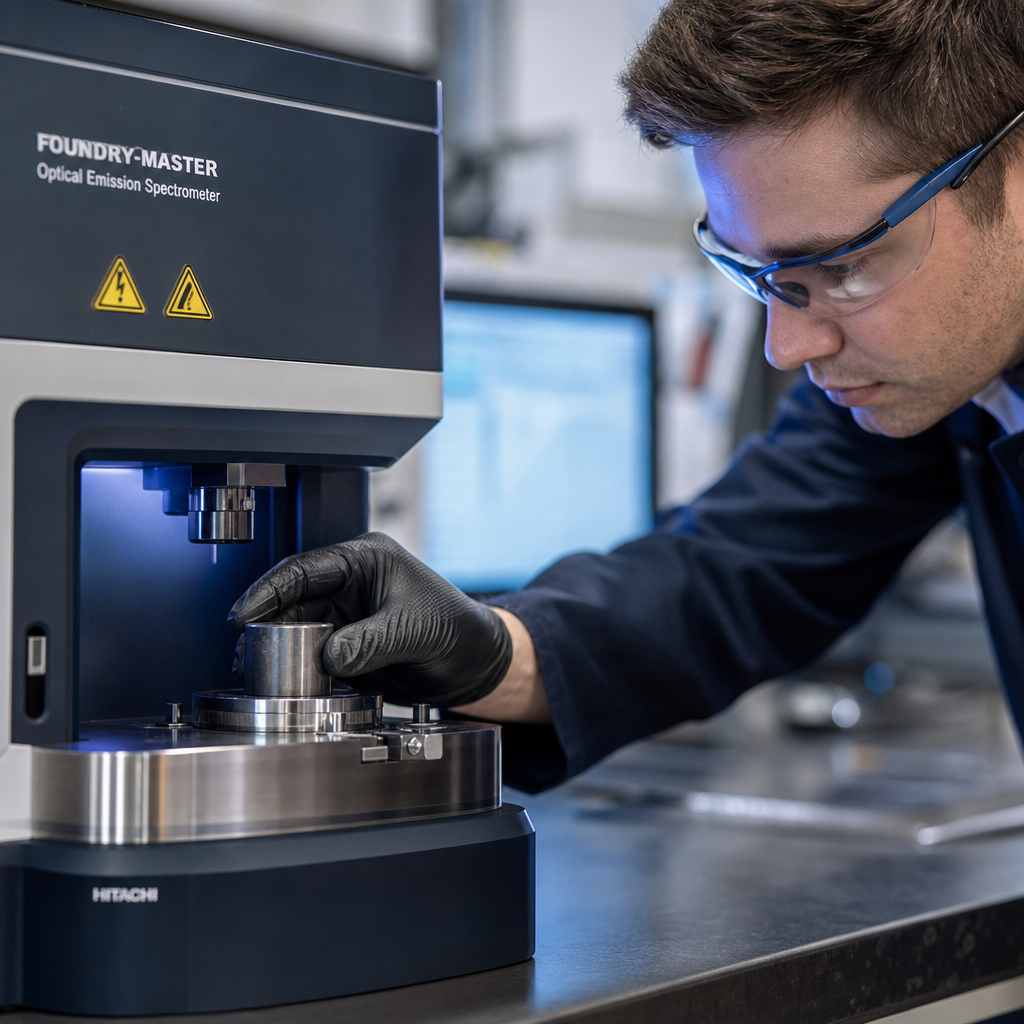
Ask for the raw instrument output. A genuine OES run produces a printout or a screen export carrying the spectrometer's own header — make and model, the analytical program used, the date, the operator ID, and the measured intensity values behind each element. A table retyped in a word processor has none of that. When the supplier can only send the clean PDF, ask them to photograph the spectrometer screen showing the same heat number with a timestamp. That takes two minutes inside a working lab and never once happens inside a sales office.
Then check who actually tested the material. A production foundry's in-house lab isn't accredited and doesn't need to be, but the report should name the testing body and the instrument. If the certificate claims a third-party lab, that lab should exist and hold CNAS accreditation in China — or UKAS/DAkkS for a European lab. Search the lab, not the certificate.
Finally, read the chemistry against the alloy, not against the certificate title. This is where ductile iron certificates fail most often. The header names the grade correctly — GGG-40, EN-GJS-400-15, ASTM A536 60-40-18 — and the actual figures that make the iron ductile are missing. Magnesium and cerium residuals, the elements that drive nodularity, are absent, out of range, or suspiciously identical across three heats with different dates. Nodularity is a chemistry-plus-treatment-plus-cooling question. A certificate showing only carbon, silicon, manganese, phosphorus and sulphur has told you nothing about whether the part in your hand is ductile or just grey iron wearing the right label.
Step 4 — Audit equipment and capacity against your part
Capacity isn't a number of tonnes. It's whether the specific kit needed for your casting exists, is running, and has the tolerance to repeat.
Ask for a written equipment list with quantities, ages, and tonnage, then verify the items that matter for your geometry:
- Melting. Induction furnace count and capacity per furnace. This sets the maximum pour weight and tells you whether your casting takes one furnace or five on a coordinated pour.
- Moulding. Green sand automatic line, no-bake resin sand, lost foam, investment, or high-pressure die casting — with the machine tonnage or flask size. A 1,600-tonne die casting machine and a 250-tonne machine produce entirely different parts, and the quote tells you nothing about which one they have.
- Testing lab. An optical emission spectrometer is non-negotiable for any alloy you care about the chemistry of. Without one, the foundry is controlling composition by eye and experience. Ask for the make and model — a portable handheld XRF is not a substitute for a stationary OES in a production lab.
- Metallography and mechanical testing. Microscope with image analysis, tensile tester, hardness tester.
- Non-destructive testing. X-ray, ultrasonic, magnetic particle, dye penetrant — in-house or subcontracted, and which one.
- Heat treatment. Furnace capacity, and whether temperature chart recorders are calibrated. Ask to see the calibration certificates, which have dates on them.
Request dated photographs of the key equipment, and cross-reference the dates with the video call. Equipment lists get copied between suppliers; a photo taken last Tuesday with your RFQ number written on a whiteboard next to the furnace doesn't.
Step 5 — Demand data that traces to a single heat
This is where most buyers get fooled. A sample arrives, it's beautiful, the dimensional report is clean, the material certificate says ASTM A536. It was also cast in a one-off pattern by the pattern shop supervisor, at full retort, with the foundry's best moulder standing over it.
Production is a different animal. So ask for documentation that traces to a heat number, not a product family.
A real traceability package for a single casting looks like this:
- Heat number stamped or cast on the part, matching the paperwork
- Chemical composition report from the OES, keyed to that heat number
- Pouring record with time, temperature, and furnace number
- Heat treatment chart for that specific load, not a generic cycle
- Mechanical test results — tensile, yield, elongation, hardness — from a test bar cast with the same heat
- Dimensional inspection report against your drawing, with actual measured values and the gauge used
- Non-destructive test report where your specification calls for it
For European pressure applications, that package should be wrapped in an EN 10204 3.1 inspection certificate, which is issued by the manufacturer's independent inspection representative and references the specific test results for your heat. A 3.2 certificate goes further — it's countersigned by a third-party inspector or a notified body. Ask which one your application requires before you ask for a price, because the difference in cost is real and the difference in liability is larger.
If the supplier can't produce a heat number trace, you're not buying a controlled process. You're buying a hope. And if the heat number trace exists on paper but the chemistry report is a retyped table rather than an instrument output, go back to the raw-output check in Step 3 — a trace that routes through a marketing document isn't a trace at all.
Step 6 — Inspect the plant, and inspect it unannounced
Announced audits show you the foundry's Saturday morning best behaviour: swept floors, everyone in clean overalls, the scrap bin emptied. You want the Tuesday night shift.
For a first order, an in-person audit is worth the flight if the annual spend justifies it. If it doesn't, a third-party technical audit from SGS, BV, TÜV, or Intertek costs roughly $600 to $1,200 per auditor-day, with a two-auditor process audit on castings usually landing between $1,200 and $2,500. That's less than a single scrapped production run, and their auditor knows what a cold shut looks like, which most generalist inspectors don't. If you'd rather walk the plant yourself, our foundry audit checklist covers the same ground the paid auditors do.
Whether you go yourself or send an auditor, insist on these five observations. They're the ones that correlate with real quality performance.
- The scrap pile. Look at it and ask what percentage it represents and over what period. Anybody can claim 2% scrap. A pile the size of a car with a two-week production volume tells a different story.
- The sand lab and the raw material yard. If the foundry is buying new sand, checking moisture and permeability, and keeping binder batches labelled, the process is under control. If the moulding sand is being recycled without testing, dimensional scatter is coming.
- The dust extraction system, running. Not installed. Running. Environmental enforcement in Hebei, Shandong and Jiangsu closes non-compliant foundries periodically, and a closed foundry cannot ship.
- Head count on the floor versus the office. A supplier claiming 400 employees with 60 people visible is either two shifts (ask) or misrepresenting size.
- The quality manager, face to face. Not the sales rep. Ask the quality manager how they handle a customer complaint. Then ask to see the log. A foundry with a boring, well-kept complaint log is a foundry you can work with.
Ask this question and watch the reaction: "What was your worst quality escape in the last twelve months, and what did you change?" A foundry that answers with specifics — a porosity problem on a thick section, a supplier's pig iron off-spec, a die that cracked at 40,000 shots — has an actual quality system. A foundry that says "we never have problems" has just told you that nobody in that building is measuring anything.
Step 7 — Run a trial order under a contract that protects you
No amount of paperwork replaces casting your actual part on their actual line. But the trial only tells you the truth if it's structured properly.
Scope the trial. Fifty to two hundred pieces, or one full shot of your die. Specify that it runs on the production moulding line with the production pattern, not a hand-made sand box. State in the PO that the trial samples are drawn randomly from the run, not selected by the supplier.
Fix the commercial terms. Thirty percent deposit against a confirmed tooling and production schedule, seventy percent against the bill of lading copy, is standard and fair. Full prepayment is a gift you don't need to give. For a first order above roughly $20,000, a letter of credit or an escrow arrangement is worth the banking fees.
Own the tooling, on paper. Add an explicit clause covering who owns the pattern, die, and gauges, where they're stored, and the process for transferring them to another supplier. Buyers have lost years of production to a pattern held hostage by a supplier they were trying to leave. The clause is four sentences long and costs nothing to include.
Write the quality terms in numbers. Acceptable quality level per defect category, what happens to a rejected batch (rework, replace, or credit — and on whose freight), who pays for the third-party inspection, and the sampling plan. "Good quality" in a contract means nothing in a dispute.
Include a pre-shipment inspection right. Your inspector, or your agent's inspector, at the plant before the goods are loaded. This is the single highest-return clause in the document, because a problem caught before the container is sealed costs a rework. The same problem caught at your dock costs a return, a delay, and a conversation you'd rather not have.
Set the dispute venue. CIETAC arbitration is standard for China-side disputes. Know whether your contract says CIETAC, the Singapore International Arbitration Centre, or the courts of the supplier's province — and understand what each one costs you if it's ever used.
Five mistakes buyers keep repeating
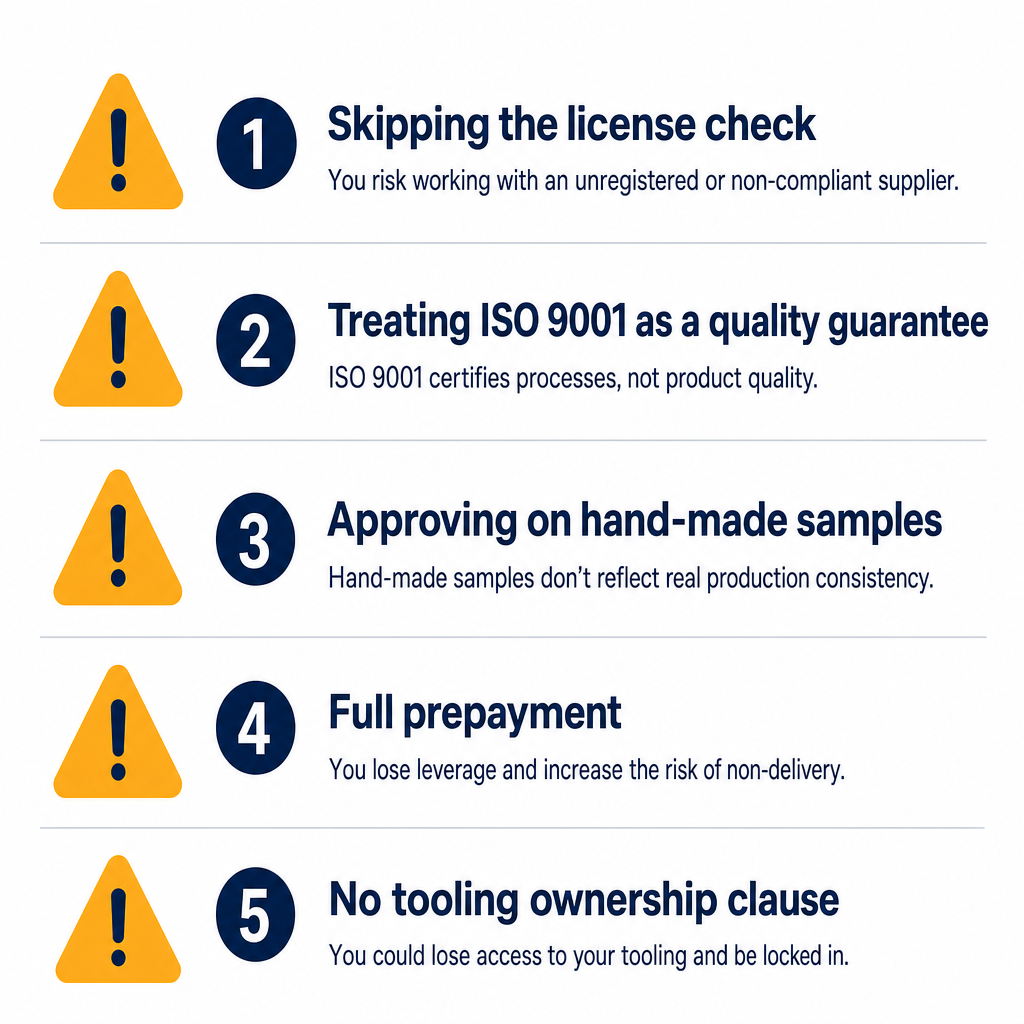
Checking the trader and never the factory. A trading company can be a perfectly good partner, and its factory still needs the full Step 1 through Step 4 treatment. Ask for the plant's license, not the trader's.
Treating ISO 9001 as a quality guarantee. ISO 9001 certifies that a documented process exists. It does not certify that the process produces good castings. A foundry can hold a valid certificate and a 9% internal reject rate at the same time.
Approving on hand-made samples. The pattern shop is not the production line. Approve on a sample that came off the automatic line, with the heat number recorded.
Paying 100% upfront for a discount. A 3% discount in exchange for paying the entire order before a single casting exists is not a discount. It's an unsecured loan to a company you haven't audited.
Leaving tooling ownership unspecified. Then discovering, eighteen months later, that the pattern belongs to a supplier whose quality has slipped and who knows exactly how much you need the part.
Red flags that warrant walking away
| Signal | What it usually means |
|---|---|
| Refuses a live unedited video walk of the plant | No plant, or a plant that isn't theirs |
| Cannot produce a polluting discharge permit | Trading company or non-compliant operation |
| Quotes ASTM or EN standards as "certifications" | Fundamental misunderstanding of the standards they're claiming |
| Sample arrives with no heat number | No traceability system in production |
| Material certificate is a retyped PDF with only a logo | Numbers may never have come off an instrument |
| Price 25%+ below the next three quotes | Unpriced substitution, wrong process, or a quote they can't honour |
| Payment demanded to a personal or third-party account | Immediate stop. Not negotiable. |
| Certificate validity date already expired | If they sent an expired document and hoped you wouldn't check, ask what else they hoped you wouldn't check |
FAQ
How do I verify a Chinese foundry's business license?
Request the 18-character Unified Social Credit Code and look it up on gsxt.gov.cn. Confirm the registered name matches your quotation, the operating status is active and not listed as abnormal, the business scope covers casting or metal manufacturing, and the registered address matches the plant. Compare paid-in capital to registered capital — a wide gap signals a shell operation.
How can I tell whether a Chinese supplier is a factory or a trading company?
The fastest reliable tell is the pollutant discharge permit, which only an operating foundry holds and which names the specific site. Follow it with a live, unedited video walk from melting bay to pattern shop. Trading companies will stall, show pre-recorded footage, or route you to a partner's facility.
What quality documents should I require with a casting shipment?
A heat number stamped on the part, a chemical composition report from an optical emission spectrometer for that heat, mechanical test results from a test bar cast with the same heat, a dimensional inspection report against your drawing, and an EN 10204 3.1 certificate for European pressure applications. Everything must trace to one heat number, and the chemistry report should be an instrument output rather than a retyped table.
How do I check whether a material test certificate is genuine?
Ask for the raw spectrometer output, not the retyped PDF — the printout carries the instrument's make, model, program, date and operator ID. Then verify any third-party lab named on the report actually exists and holds the accreditation it claims. Finally, read the chemistry against the alloy: a ductile iron certificate that omits magnesium and cerium residuals has not proven the iron is ductile.
What payment terms are normal for a first order from a Chinese foundry?
Thirty percent deposit against a confirmed production schedule and seventy percent against the bill of lading copy. For first orders above roughly $20,000, a letter of credit or escrow through a sourcing agent adds a few hundred dollars of paperwork and removes most of the counterparty risk.
Is a third-party factory audit worth the money?
At $1,200 to $2,500 for a two-auditor process audit, yes — assuming your order carries real value. A single rejected production run typically costs five to ten times that amount once you count rework, freight, and schedule recovery. The audit is the cheapest line item in the whole sourcing budget.
Next steps
Verification isn't a formality you complete before the real work starts. It's the work. Three weeks of diligence up front removes most of the reasons first orders go wrong — and the ones it doesn't remove are the reasons you wrote the contract clauses in Step 7.
Start with Step 1 this week. Pull the Unified Social Credit Code for every supplier currently quoting you, and check it on gsxt.gov.cn. It takes twenty minutes and it will change how you read at least one of those quotes. If you want the rest of the sequence in a form you can hand to a colleague, our sourcing guides walk through each casting process and material the same way.
If you'd rather not run the whole sequence solo, submit your RFQ and get quotes back from factories that have already been through it — license verified, export rights confirmed, process audit completed, certificates validated against the issuing registries.