Your ISO 9001 Foundry in China: The Certificate Isn't Enough — 5-Step Verification Guide
You've got the ISO 9001 certificate from a foundry in China. It's framed on their office wall, stamped, signed, and valid through next year. Looks legit.
But here's the question that keeps procurement pros up at night: Is the certificate real? And even if it is, does it actually mean the foundry delivers quality castings?
I've spent the last 12 years auditing foundries across Guangdong, Jiangsu, Shandong, and Zhejiang. I've seen certificates that were expired, out of scope, issued by unrecognized bodies, and — in a few cases — completely fabricated. I've also seen ISO 9001 certified foundries that couldn't pass a basic porosity test.
This guide is your 5-step verification playbook. By the time you finish, you'll know exactly how to validate any ISO 9001 certification from a Chinese foundry, what the certificate actually guarantees (spoiler: not what you think), and how to run a 6-point on-site audit that separates real systems from paper tigers.
No fluff. No sales pitch. Just the tools you need to source with confidence.
Why ISO 9001 Certification in China Needs a Second Look
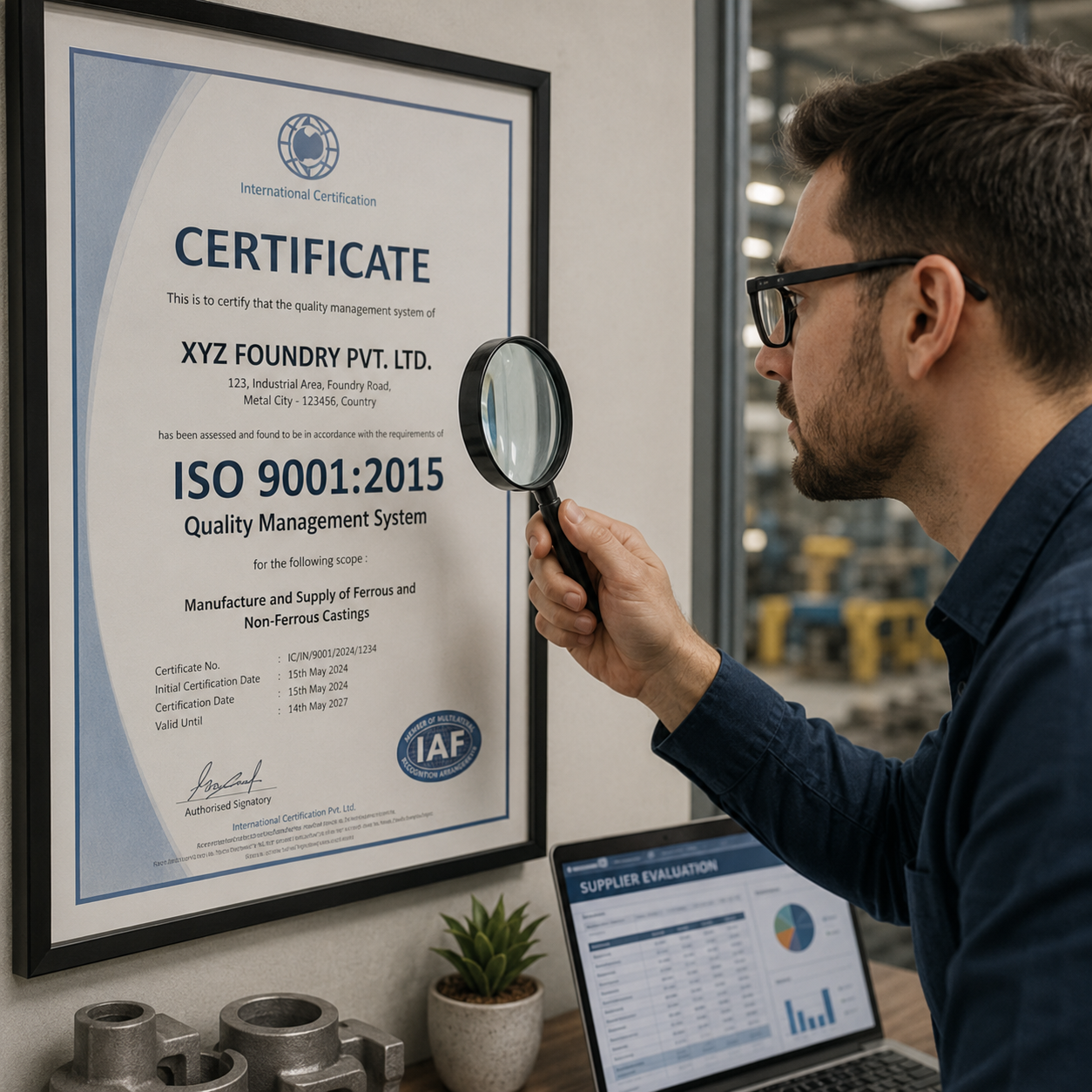
Let's start with a dose of reality. Of the 12,000+ foundries operating in China, roughly 4,000 claim ISO 9001 certification. That's about 33%. Sounds encouraging — until you dig deeper.
Based on audits conducted by Interstate China and our partners over the past 5 years, an estimated 30-40% of those certificates have one or more of these issues:
- Expired — The certificate expired but the foundry still lists it on their website and Alibaba page.
- Out of scope — The certificate covers machining or assembly, but the foundry uses it to sell castings.
- Issued by unrecognized body — The certification body isn't CNAS-accredited or IAF-recognized. In some cases, the "certification body" is a shell company.
- Fabricated — The certificate number doesn't exist in any official database. Yes, it happens.
- Not backed by a functioning QMS — The foundry passed the audit but never actually implemented the quality management system. They "bought the paper," as the saying goes.
This isn't about being cynical. It's about being smart. The vast majority of Chinese foundries are honest operators. But the ones that cut corners know that a framed ISO 9001 certificate can close a deal before anyone asks hard questions. Your job is to ask the hard questions.
5-Step ISO 9001 Verification for Chinese Foundries
Here's the process I use with every new foundry I evaluate. Follow it step by step — no shortcuts.
Step 1: Check the Certification Body
Not all ISO 9001 certificates are created equal. The first thing you need to verify is who issued it.
Legitimate certification bodies in China must be:
- CNAS-accredited — China National Accreditation Service (CNAS) is the national body. Check their directory at
cnas.org.cn. - IAF-recognized — The International Accreditation Forum (IAF) maintains a global database of recognized accreditation bodies. A certificate from an IAF-recognized body is accepted internationally.
Credible bodies operating in China include:
- SGS (Switzerland) — IAF-recognized, CNAS-accredited
- TÜV Rheinland (Germany) — IAF-recognized, CNAS-accredited
- Bureau Veritas (France) — IAF-recognized, CNAS-accredited
- DNV (Norway) — IAF-recognized, CNAS-accredited
- LRQA (UK) — IAF-recognized, CNAS-accredited
- China Quality Certification Centre (CQC) — CNAS-accredited
Red flags: If the certification body isn't listed on CNAS or IAF websites, that's a major warning sign. Some Chinese foundries use "certification bodies" that are actually consulting firms offering guaranteed certificates for a fee. Those aren't worth the paper they're printed on.
Step 2: Verify the Certificate Number
Once you have the certification body's name, go to their official website and look for a certificate verification portal. Most major bodies have one.
- SGS — SGS Certificate Verification Portal
- TÜV Rheinland — TÜV Certificate Check
- Bureau Veritas — BV Verify
Enter the certificate number exactly as it appears on the document. Check:
- Is the certificate number valid?
- Does the foundry name match?
- Is the scope of certification correct (e.g., "manufacturing of castings" not "assembly of parts")?
- Is the certificate status "active" or "valid"?
- What's the expiration date?
Pro tip: Request a screenshot of the verification page. A legitimate foundry will have no problem providing it. If they hesitate or make excuses, that's a red flag.
Step 3: Request the Latest External Audit Report
This is where most buyers stop — and where you should keep going. An ISO 9001 certificate is a snapshot. The audit report tells you the real story.
Ask for the most recent surveillance audit report (not the initial certification audit — that's usually the easiest). Look for:
- Non-conformities raised: How many? Minor or major? Were they closed out?
- Observations and opportunities for improvement: These reveal systemic weaknesses.
- Auditor's overall assessment: Did the auditor note any concerns about process control, quality records, or management commitment?
A foundry with a genuinely functioning QMS will have audit reports that show continuous improvement — not zero non-conformities (which is actually suspicious) but a pattern of identifying issues and fixing them.
Warning: If the foundry tells you the audit report is "confidential," explain that you're a potential buyer conducting due diligence. A transparent foundry will share it under NDA. One that has something to hide won't.
Step 4: Schedule a Video Walkthrough
Before you book a flight to China, do a video walkthrough. This is your chance to see the quality management system in action — or lack thereof.
Ask to see:
- The quality control office — Are inspection records organized? Do they have calibrated measuring equipment?
- The production floor — Is it clean? Are work instructions posted? Do operators follow them?
- The material storage area — Are raw materials segregated and labeled? Is there a traceability system?
- The calibration records — Are gauges and instruments calibrated with traceable standards?
Watch for these red flags during the walkthrough:
- The "quality manager" can't answer basic questions about the QMS.
- Documents are pristine — never been used, just sitting in binders.
- The production floor is chaotic, with no visible process controls.
- Calibration tags are expired or missing.
A video walkthrough done right will tell you more than any certificate ever will.
Step 5: On-Site Audit (6-Point Checklist)
If the foundry passes steps 1-4, it's time for an on-site audit. Here's the 6-point checklist I use:
- Management Review Records — Does top management actually review quality performance? Look for meeting minutes, action items, and follow-up.
- Internal Audit Records — Are internal audits conducted regularly? Are findings tracked to closure? If the internal audit reports look identical year after year, that's a red flag.
- Corrective & Preventive Action (CAPA) System — When a defect occurs, is there a documented process for root cause analysis and corrective action? Ask to see 3-4 recent CAPA records.
- Supplier Management — Does the foundry evaluate its own suppliers? Ask to see their approved supplier list and recent supplier audits.
- Process Control Documentation — Are work instructions, process parameters, and inspection criteria documented and followed on the production floor? Pick a random process and trace the documentation.
- Customer Feedback & Complaint Handling — How does the foundry handle customer complaints? Ask to see the complaint log and resolution records. A foundry with no complaints is either very good or very dishonest.
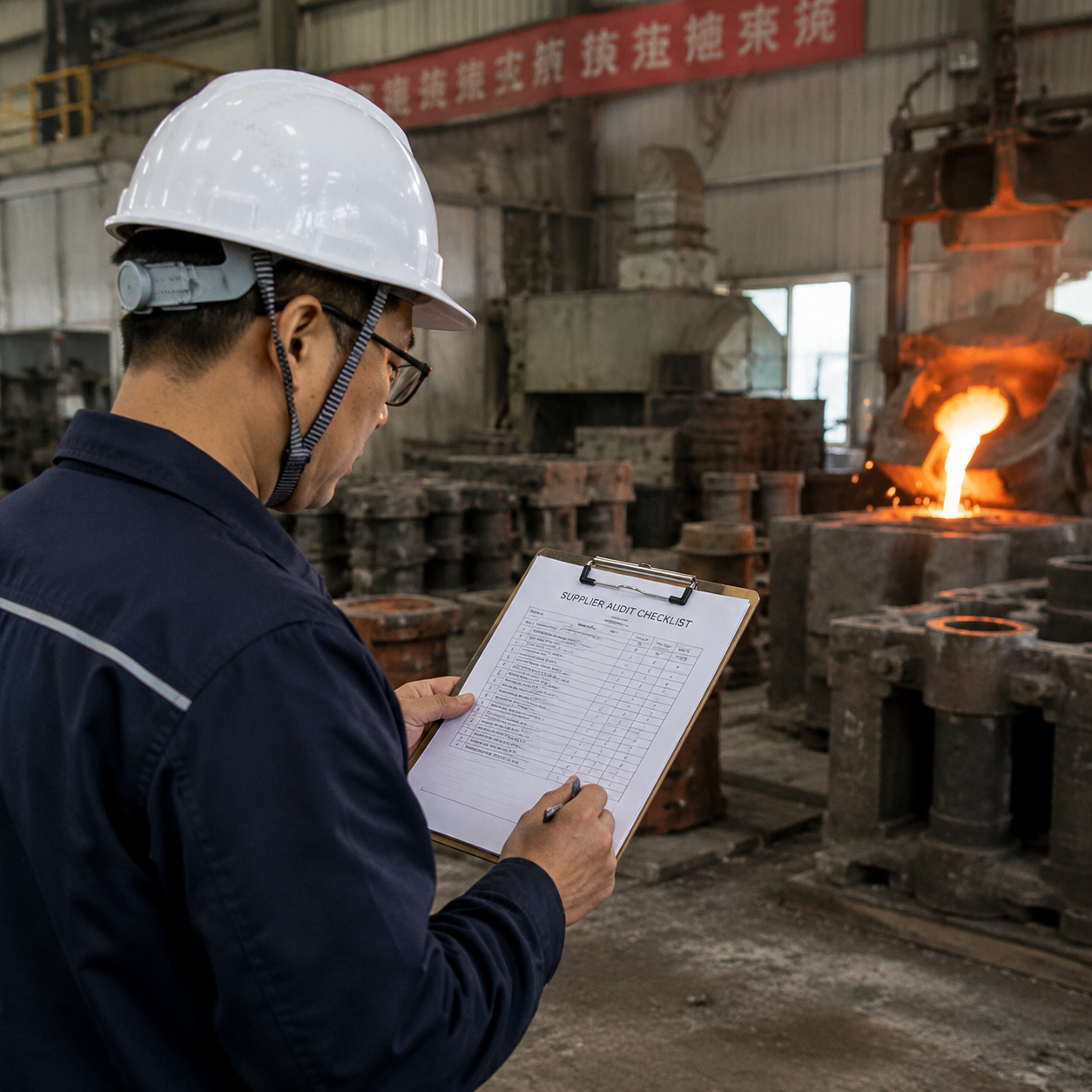
If the foundry passes all 6 points, you can be confident their ISO 9001 certification is real — and more importantly, that their quality management system actually works.
The Hard Truth: What ISO 9001 Does (and Doesn't) Guarantee
Let me be blunt: ISO 9001 certifies the system, not the product. A foundry can be ISO 9001 certified and still ship castings with porosity, dimensional errors, or wrong material grades.
Here's what ISO 9001 certification actually tells you:
- The foundry has a documented quality management system.
- They've been audited by an external body against ISO 9001 requirements.
- They have processes for corrective action, internal audits, and management review.
Here's what it does not guarantee:
- Product quality (dimensional accuracy, mechanical properties, surface finish).
- Process capability (Cpk, Ppk, control limits).
- On-time delivery.
- Consistency across different production runs.
- Ethical labor practices or environmental compliance.
That's not a flaw in ISO 9001. That's just what it's designed to do. Your job as a buyer is to use the certificate as a starting point, not an ending point. The certificate gets you in the door. The audit tells you if you should stay.
Here's a quick reference table to keep things straight:
| What You're Evaluating | ISO 9001 Tells You | What You Still Need to Verify |
|---|---|---|
| Product quality | ❌ Not directly | Sample inspection, PPAP, process capability study |
| Quality management system | ✅ Yes (if certificate is valid) | On-site audit to confirm implementation |
| Delivery reliability | ❌ Not covered | Supplier scorecard, past performance review |
| Technical capability | ❌ Not covered | Technical assessment, sample evaluation |
| Ethical compliance | ❌ Not covered | Social compliance audit (SMETA, BSCI, etc.) |
| Continuous improvement | ✅ Encouraged by standard | Review CAPA records and improvement trends |
Common Traps Buyers Fall Into
After watching hundreds of procurement professionals evaluate Chinese foundries, I've seen the same mistakes again and again. Here are the top ones to avoid:
Trap #1: "The certificate is valid, so the foundry must be good."
As we've covered, a valid certificate doesn't guarantee product quality. Always audit the system behind the certificate.
Trap #2: "I'll just check the Alibaba verified badge."
Alibaba's "Verified" badge is not an ISO 9001 verification. It's a basic company registration check. Some factories with fake certificates still have the Alibaba badge.
Trap #3: "The certificate says 'ISO 9001:2015' so it's up to date."
Check the issue date and expiration date. A certificate can say 2015 on the cover but be expired. Also verify that the scope matches your product category.
Trap #4: "I'll just send my QC guy to check."
Your QC guy knows how to inspect castings. But does he know how to audit a QMS? ISO 9001 verification requires trained auditors who understand the standard. If your in-house team isn't trained, consider hiring a third-party auditor or using a procurement agent with auditing expertise.
Trap #5: "I've worked with this foundry for 3 years, I don't need to verify."
Certificates expire. QMS systems degrade. Personnel change. I've seen long-term relationships go south because the foundry let their certification lapse and didn't tell the buyer. Annual re-verification is non-negotiable.
How Interstate China Helps You Verify ISO 9001 Foundries
You don't have to do this alone. Interstate China was built by procurement professionals who've been auditing Chinese foundries for decades. Here's how we help buyers like you:
- Factory verification — We verify ISO 9001 certificates against CNAS and IAF databases, review audit reports, and conduct on-site QMS audits.
- Pre-shipment inspection — Our QC team inspects castings against your specifications before shipment, so you don't discover defects after payment.
- Supplier development — Foundry not quite there yet? We work with them to improve their QMS and process control — or help you find one that's ready.
- Procurement representation — We act as your boots on the ground in China, from initial supplier qualification to final shipment release.
No matter where you are in the evaluation process, we can help you verify your ISO 9001 foundry in China. Contact us for a consultation.
Frequently Asked Questions
How do I verify an ISO 9001 certificate from a Chinese foundry?
Check the certification body is CNAS-accredited and IAF-recognized, verify the certificate number on the body's official website, request the latest external audit report, and schedule a video walkthrough or on-site audit.
What percentage of Chinese foundries have genuine ISO 9001 certification?
Approximately 4,000 out of 12,000+ foundries in China claim ISO 9001 certification, but an estimated 30-40% have certificates that are either expired, out of scope, or not backed by a functioning quality management system.
Can a foundry have ISO 9001 but still produce poor quality castings?
Yes. ISO 9001 certifies the quality management system, not the product. A foundry in China can be ISO 9001 certified and still produce defective castings if the system is poorly implemented or the certificate was obtained without genuine process adoption.
Which certification bodies are most credible for ISO 9001 in China?
Credible bodies include SGS, TÜV Rheinland, Bureau Veritas, DNV, and LRQA — all IAF-recognized and CNAS-accredited. Avoid certificates from obscure bodies not listed on the CNAS or IAF websites.
How much does a genuine ISO 9001 certification cost a Chinese foundry?
A legitimate ISO 9001 certification for a medium-sized foundry in China costs between ¥50,000 and ¥150,000 RMB (approximately $7,000 to $21,000 USD), including initial audit, certification fees, and annual surveillance audits.
What's the difference between ISO 9001:2015 and older versions in Chinese foundries?
ISO 9001:2015 requires risk-based thinking and context analysis, while older versions (like 2008) focused on documented procedures. Many Chinese foundries upgraded to 2015 by the 2018 deadline, but some still operate under legacy certificates. Always verify the version.
Don't Let a Piece of Paper Be Your Only Assurance
An ISO 9001 certificate from a Chinese foundry is a good start. But it's not enough. You need verification, audit, and ongoing oversight to ensure you're getting quality castings — consistently, shipment after shipment.
Let Interstate China be your eyes and ears on the ground. We'll verify the certificate, audit the foundry, inspect the castings, and give you the confidence to source from China without the guesswork.
No obligation. No sales pressure. Just expert advice on your specific sourcing situation.
Need Help with Your ISO 9001 Foundry in China: The Certificate Isn't Enough — 5-Step Verification Guide?
Get matched with 3 verified foundries in 24 hours. No markup, transparent pricing.
Request Quotes →