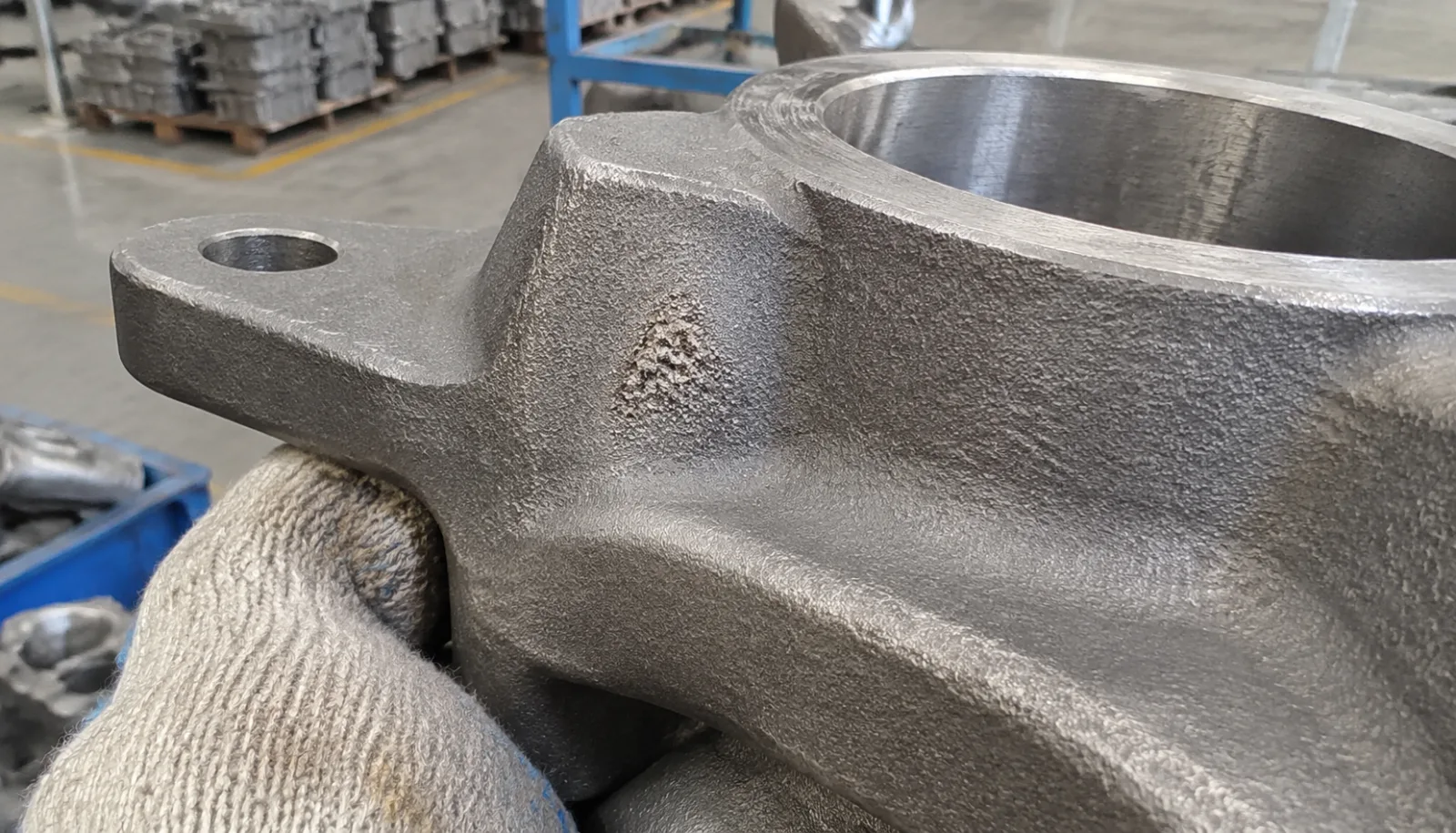
Surface quality is the most argued-about and least specified attribute on any casting order. The drawing says “smooth finish, free from defects”. The foundry ships what the process produces. The parts arrive with the surface a sand casting always has, and someone has to decide whether that is a rejection or a normal delivery.
The decision is almost always made on the spot, by whoever is holding the part, with no reference. It goes badly about a third of the time, and the cost is a replacement shipment, a credit note or a customer who stops ordering.
The vocabulary problem comes first
“Defect” and “normal surface” overlap. A casting surface carries three separate things that buyers lump together:
| Category | Examples | Normally acceptable? |
|---|---|---|
| Inherent surface | Sand grain texture, mould joint line flush, slight veining | Yes — it is the process |
| Cosmetic discontinuity | Small gas pore, minor scab, localised roughness | Depends on location and size |
| Structural discontinuity | Hot tear, penetration, cold shut, shrinkage exposed at surface | No — these are rejects regardless of appearance |
Most disputes happen in the middle row, and they happen because the drawing never said where on the part the middle row is tolerable. A 1 mm pore on a machined sealing face is fatal. The same pore on an as-cast non-functional web is irrelevant. The drawing has to make that distinction; the foundry cannot guess it.
Using MSS SP-55 and ISO 11971 as the backbone
Both standards do the same job: they name the discontinuity types and give severity levels, so acceptance becomes a table lookup instead of an opinion.
MSS SP-55
Widely used for valve, flange and pipeline castings in steel and nickel alloys. It lists twelve discontinuity types — including hot tears, shrinkage, gas porosity, sand inclusion, scabs, cold shuts and weld repairs — and grades severity from A (least severe) through to levels that constitute rejection. The practical value is that you can write “MSS SP-55, type VII (sand inclusion), severity 2 maximum on machined faces, severity 4 maximum on non-machined surfaces” and the sentence is enforceable.
ISO 11971
The European equivalent for visual assessment of surface quality, used with reference photographs. It suits iron and steel castings and pairs well with a boundary sample set, because the standard expects comparison against visual references rather than description.
Either standard is fine. What matters is naming one, because the moment you name one the conversation moves from aesthetics to a documented scale.
The single most effective thing you can do: a photographic boundary set
Standards still require interpretation. Photographs do not. A boundary set is three images per critical feature:
- Acceptable — typical good production, not the best part ever made.
- Marginal — the worst condition you will accept. This is the important one and the one everybody skips.
- Rejectable — just past the limit.
Shoot all three from the same distance, under the same lighting, with the same background, and label the feature. Attach them to the purchase order as an appendix. Then have the first article signed against them.
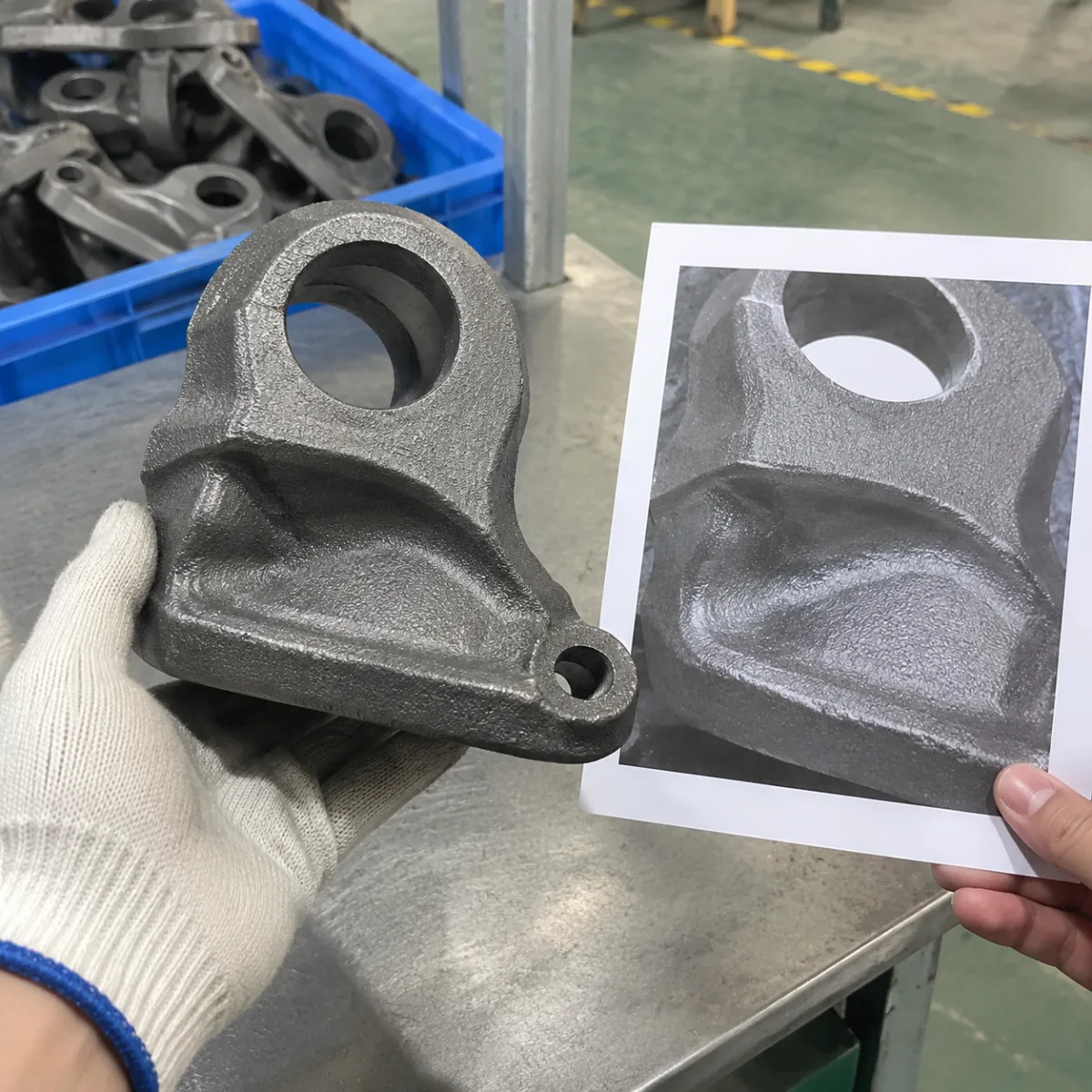
The marginal image is where the value is. Buyers who provide only a “good” example keep receiving arguments about the parts that fall between good and obviously bad. Buyers who provide a marginal example stop having those arguments, because the line has been drawn.
Where on the part matters more than how bad
Acceptance criteria should be zone-based, not uniform. A workable three-zone scheme:
- Zone A — functional and sealing surfaces, and any surface visible to the end user. Tightest limit. Consider requiring zero exposed porosity and no repair.
- Zone B — machined surfaces that are not sealing or visible. Moderate limit. Some porosity acceptable if it does not exceed the machining allowance.
- Zone C — as-cast non-functional surfaces. Loosest limit. Inherent texture accepted; structural discontinuities still rejected.
Mark the zones on the drawing. This one change resolves most of the volume of future disputes, because the vast majority of disagreements are about a Zone C surface being judged by Zone A standards.
The defects that are never acceptable regardless of size
Some discontinuities are not a matter of degree. Include this list explicitly so there is no room for negotiation:
- Hot tears and cracks. A crack is a stress riser and will propagate. No size is acceptable.
- Cold shuts on a pressure-retaining wall. The wall is not continuous, whatever it looks like from outside.
- Penetration. Metal has entered the mould surface; the local geometry is compromised even where it looks sound.
- Exposed shrinkage on a machined face. Indicates a feed path problem that will recur across the lot.
- Unapproved weld repair. Repair is legitimate for many castings and destructive when undocumented, because the heat-affected zone is not in your material certification.
The weld repair clause deserves its own sentence in the PO: repair permitted only with prior written approval, with the repair recorded on a chart and the area heat treated and inspected afterwards. Foundries that repair quietly are not being deceptive; they are responding to a specification that never said whether repair was allowed.
What to ask a new supplier before the first order
- Which surface standard do you work to by default, and at what severity level?
- Can you supply photographs of a typical production surface for this process, so we can set a boundary before we set a price?
- What is the local surface roughness in Ra on an as-cast face for this process?
- What is your policy on weld repair, and how is it recorded?
- For a visible cosmetic surface, what would you need to add in cost and time to reach the finish we are describing?
The last question is the commercially useful one. Cosmetic surfaces on castings are achievable and expensive, and buyers routinely ask for them without knowing they have asked. A supplier who quotes the cost of the finish separately has done you a favour, because now the surface requirement is a decision rather than an assumption embedded in a price you cannot decompose.
The realistic baseline for each process
| Process | As-cast Ra | Typical cosmetic acceptability |
|---|---|---|
| Investment casting | 3.2 – 6.3 µm | Good — often usable without cosmetic work |
| Resin sand | 6.3 – 12.5 µm | Fair — visible texture, acceptable for industrial parts |
| Green sand | 12.5 – 25 µm | Coarse — expects paint or machining on visible faces |
| Die casting | 1.6 – 3.2 µm | Very good, but with flow marks and flash to control |
If your product needs a fine visible finish and the process quoted is green sand, the mismatch will surface as a rejection cycle no matter how well the first article is negotiated. Better to learn that at quotation stage, when the choice is still open.
Related verification pages
Agree the standard before the first lot
Send the part, the process and the surface you are worried about. We return a set of photographs showing acceptable, marginal and rejectable conditions for that feature, which you can attach to the purchase order as the acceptance reference.
Prefer email? cfwc@163.com · WhatsApp +86 159 4126 7000