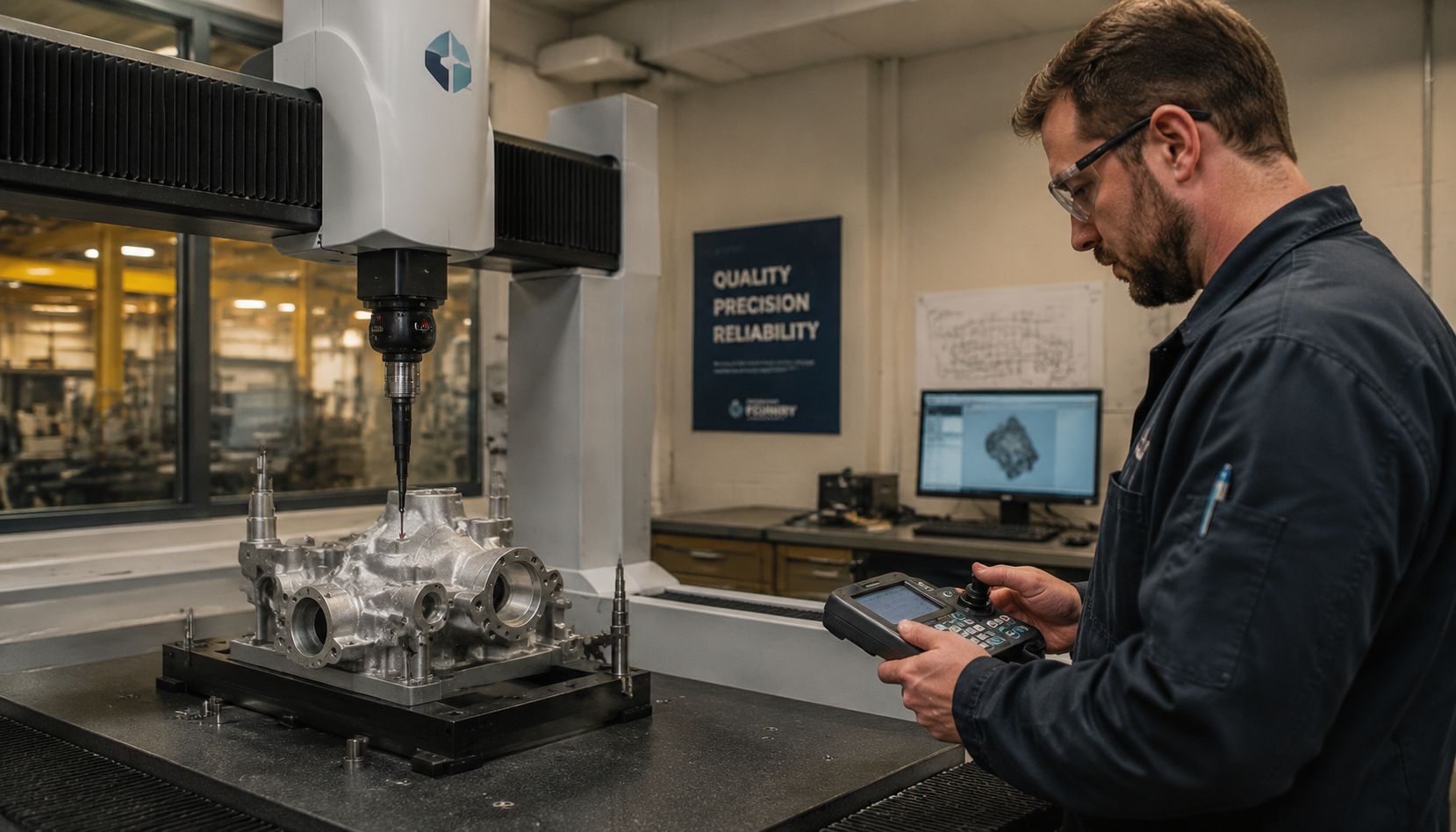
Picture this: You're in a conference room in Stuttgart. The production line at your Tier 1 supplier's plant has been down for six hours. 47,000 euros lost per hour. The root cause? A steering knuckle casting that's 0.3 mm out of spec on a single bore diameter. The supplier's inspection report said "pass." Your assembly line said "no."
Sound familiar? If you've been sourcing castings for more than a year, you've got your own version of this story. Maybe it was a valve body that didn't seal. Or a bracket that wouldn't align. Or a housing where the bolt holes were 0.5 mm too close together. And every time, the conversation goes the same way: "Our inspection shows it's within tolerance."
Here's the hard truth: most casting suppliers don't do dimensional inspection the way you think they do. They measure what's easy to measure, not what matters. They use tools that aren't calibrated. They inspect 1 piece out of 500 and call it a batch. And when you push back, they point to a report that looks official but tells you almost nothing about whether the casting will actually fit when it reaches your line.
This guide is built for one purpose: to give you the framework to verify dimensional inspection quality before you place the PO — not after the line goes down. You'll learn the six methods that matter, the standards that actually apply, and the five red flags that tell you a supplier's inspection is smoke and mirrors.
What Dimensional Inspection for Castings Actually Means

Let's get specific. Dimensional inspection for castings is the process of verifying that a cast part's physical geometry — its lengths, diameters, angles, flatness, concentricity, and surface profiles — falls within the tolerances specified on the engineering drawing. It's not a single measurement. It's a system of checks, each targeting a different category of potential deviation.
The casting process introduces variation at every stage: pattern wear, mold shift, core shift, shrinkage, distortion during heat treatment, and residual stress release during machining. A casting that passes visual inspection can still be dimensionally non-conforming in ways that make it unusable for assembly.
Consider this: a sand casting of a hydraulic valve body typically has a linear tolerance of ±0.5 mm in the as-cast condition. After machining, critical sealing surfaces might require ±0.05 mm. If the as-cast dimension is already at the limit, machining won't save it — you'll end up with a thin wall that fails under pressure. That's why dimensional inspection needs to happen at both stages: as-cast and after machining. And it's why you, as the buyer, need to verify both.
The key standards you'll encounter are ISO 2768 (general tolerances for linear and angular dimensions), ISO 8062 (tolerances for castings — replaced by ISO 8062-3 and -4), ASTM E29 (standard practice for using significant digits), and ASME Y14.5 (geometric dimensioning and tolerancing — GD&T). A supplier that can't reference these standards by name is a supplier you should question.
The 6 Dimensional Inspection Methods Every Casting Buyer Should Know
Not all dimensional inspection is created equal. Here's the hierarchy, from most to least capable, and exactly when each method is appropriate.
1. Coordinate Measuring Machine (CMM)
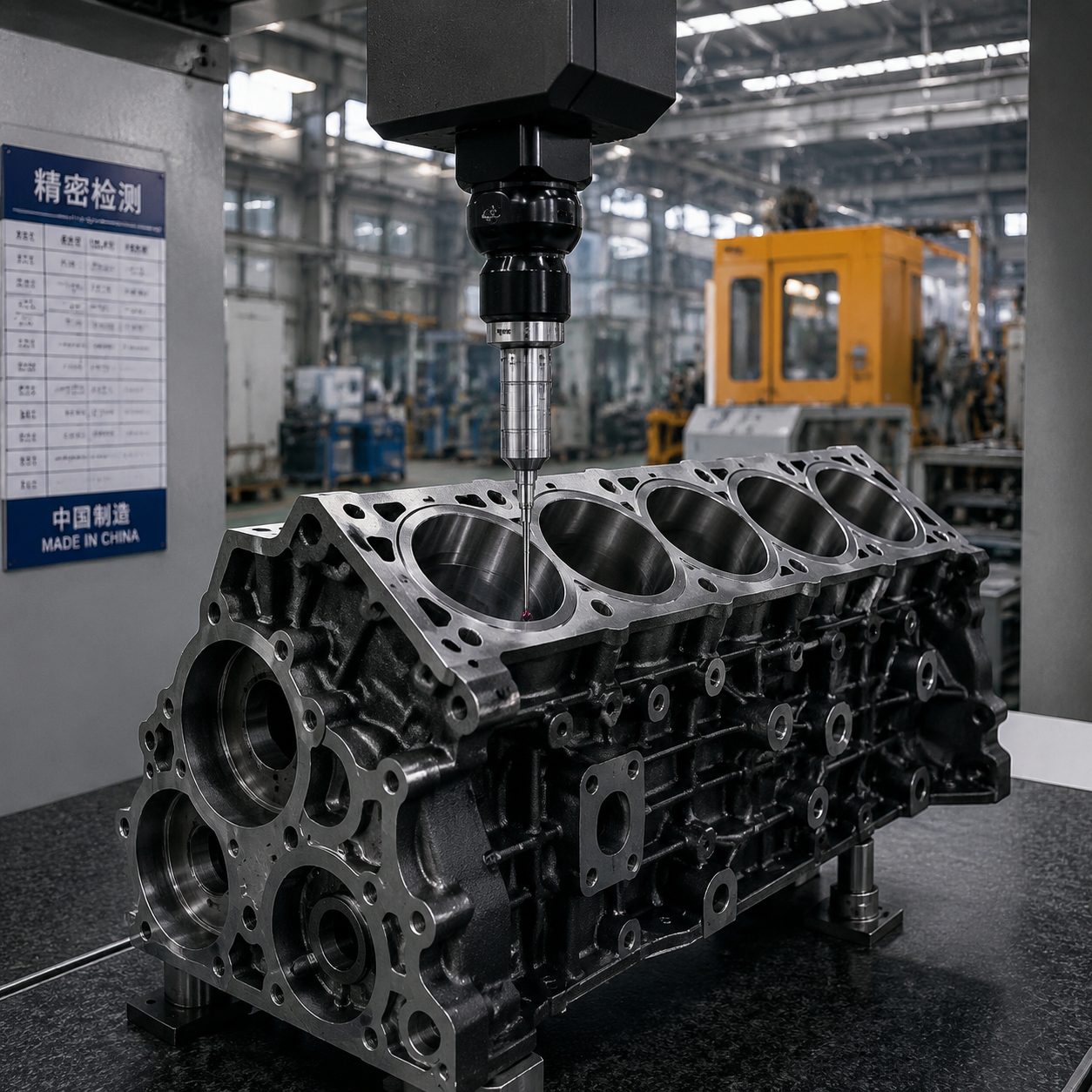
The gold standard. A CMM uses a touch probe or optical sensor to measure points on the casting surface and compare them to the CAD model. Accuracy ranges from 0.5 to 5 microns, depending on the machine and environment. Best for: complex geometries, tight tolerances, and first-article inspections.
What to ask your supplier: "What brand of CMM do you use? When was it last calibrated? Can you share the calibration certificate?" A legitimate supplier will answer immediately and provide the cert. A supplier using a CMM from 2005 that hasn't been calibrated in three years? You've got a problem.
CMM inspection is slow — a complex casting can take 30 to 90 minutes to measure. That's why it's used for first-article and sample inspections, not 100% production checks. But if a supplier tells you they do CMM on every part, they're either lying or they have a tiny production volume.
2. Optical 3D Scanning (Structured Light / Blue Light)
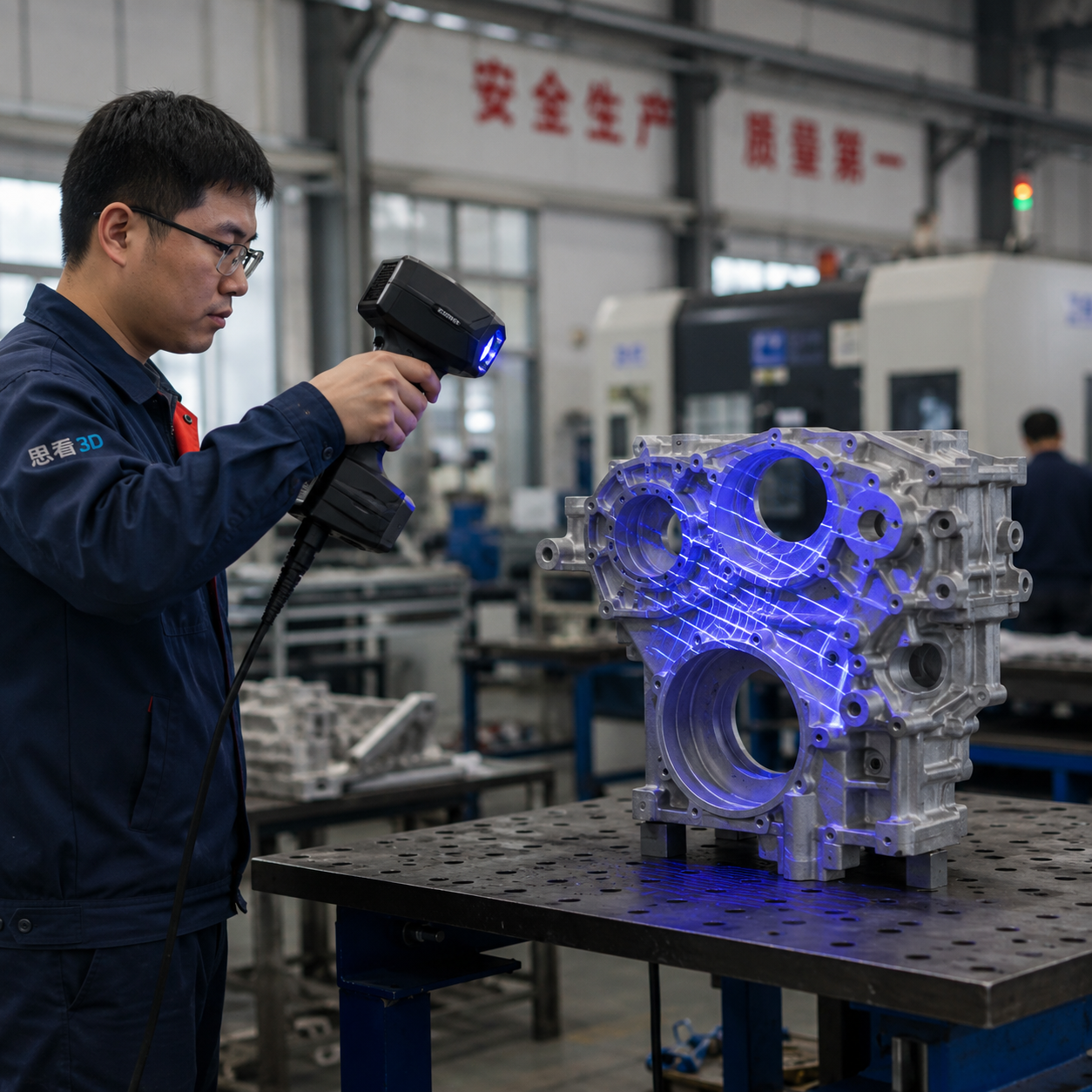
This is where things get interesting. Optical 3D scanning projects a pattern of light onto the casting and uses two cameras to triangulate surface geometry. The result is a point cloud (millions of points) that gets compared to the CAD model. Accuracy: 10 to 50 microns, depending on the system.
Optical scanning shines for complex freeform surfaces — think impeller blades, manifold runners, or ergonomic handles — where a CMM would take forever. It also generates a color map that shows exactly where the casting deviates from nominal. Red means "high," blue means "low," green means "within tolerance." You don't need to be a metrologist to read it.
The catch: optical scanning struggles with shiny surfaces (needs coating), deep cavities (line of sight), and very large parts. But for 80% of complex castings, it's faster and more informative than CMM. Ask your supplier: "Do you have structured light scanning? Can you share a deviation color map from the last first-article inspection?"
3. Laser Line Scanning
Laser scanning is the workhorse for large castings — engine blocks, transmission housings, structural components. A laser line is projected onto the surface and a camera captures the profile as the part or sensor moves. Accuracy: 20 to 100 microns.
It's less accurate than CMM or blue light, but for large parts where the tolerances are ±0.5 mm or wider, it's perfectly adequate. The main advantage is speed: a full engine block scan takes 10–15 minutes. The main disadvantage is lower resolution on sharp edges and internal features.
4. Hard Gages (Go / No-Go)
You'll see these everywhere in high-volume casting production. A hard gage is a physical fixture that simulates the mating part — if the casting fits, it passes. Think of a ring gage for an outer diameter, a plug gage for a bore, or a contour gage for a profile.
Hard gages are fast (2–5 seconds per check) and don't require expensive electronics. But they only tell you pass/fail, not how far out of spec the part is. They also wear over time — a plug gage used 10,000 times will eventually start passing parts that are actually out of tolerance. Calibration intervals for hard gages should be quarterly at minimum for high-volume production.
When a supplier says "we inspected every part," they usually mean hard gages. That's fine, as long as the gages are calibrated and the critical features are actually being checked. But if your critical tolerance is ±0.1 mm and the gage hasn't been certified in two years, the inspection is worthless.
5. Hand Tools (Calipers, Micrometers, Height Gages)
The baseline. Every foundry has calipers and micrometers. They're fine for rough checks and quick verification of non-critical features. Accuracy: 0.01 to 0.05 mm, heavily dependent on operator skill.
The problem: hand tools miss geometry errors that CMM or scanning would catch. A caliper can measure the outer width of a bracket, but it can't tell you if the mounting face is flat within 0.1 mm. A micrometer can measure a shaft diameter, but it can't detect ovality unless you measure multiple orientations.
If a supplier's entire dimensional inspection process is calipers and a height gage, they're not doing dimensional inspection. They're doing rough measurement. That's fine for a sand casting of a counterweight with ±2 mm tolerances. It's not fine for a precision investment casting with ±0.2 mm tolerances.
6. Industrial CT Scanning (X-Ray Computed Tomography)
This is the heavyweight. CT scanning creates a full 3D model of the casting's internal and external geometry using X-rays. It detects internal voids, porosity, and wall thickness variations that no other method can see without destructive testing. Accuracy: 5 to 50 microns, depending on part size and density.
CT scanning is expensive and slow — a single scan can cost $500–$2,000 and take 30–120 minutes. It's not practical for production inspection. But for first-article validation of complex castings (fuel injector bodies, turbine blades, medical implants), there's no substitute. Ask for CT scan results on the first article if your casting has internal passages or critical wall thickness requirements.
| Method | Accuracy | Speed | Cost / Part | Best For |
|---|---|---|---|---|
| CMM | 0.5–5 µm | Slow (30–90 min) | $50–$200 | First article, tight tolerances |
| Optical 3D Scan | 10–50 µm | Medium (10–30 min) | $30–$150 | Complex surfaces, color maps |
| Laser Scan | 20–100 µm | Fast (5–15 min) | $20–$80 | Large parts, moderate tolerances |
| Hard Gages | Depends on gage | Very fast (2–5 sec) | $1–$5 | High-volume pass/fail |
| Hand Tools | 10–50 µm | Medium (2–10 min) | $1–$10 | Rough checks, non-critical |
| CT Scan | 5–50 µm | Very slow (30–120 min) | $500–$2,000 | Internal geometry, first article |
What this means for you as a buyer: Don't ask "Do you do dimensional inspection?" That's like asking "Do you build cars?" — the answer will be yes, but you don't know if they're building a Toyota or a Yugo. Instead, ask: "What dimensional inspection methods do you use for critical features? Can you show me the last first-article inspection report with a deviation color map?"
ASTM and ISO Standards for Dimensional Inspection of Castings
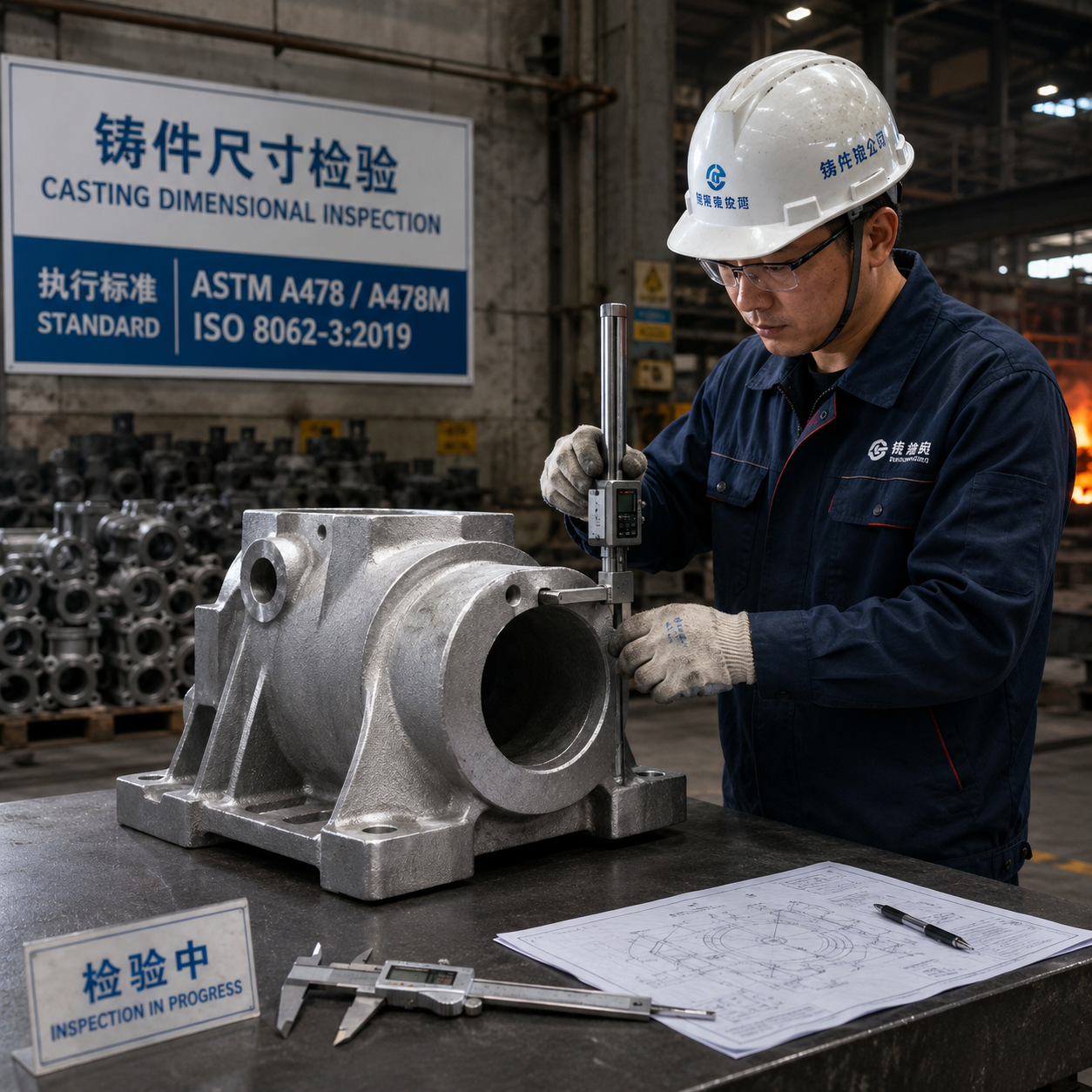
You don't need to memorize every standard. But you need to know which ones apply to your parts, and whether your supplier is referencing the correct ones. Here's the shortlist:
- ISO 8062-3:2023 — Dimensional tolerance system for castings. This replaced the old ISO 8062. It defines tolerance grades (D1 through D11) for linear dimensions, and additional grades for geometrical tolerances. Most commercial castings fall in the D4–D7 range. If your supplier says "we meet ISO 8062," ask which grade. D1 is extremely tight (0.05 mm for small dimensions), D11 is very loose (2.5 mm).
- ISO 8062-4:2023 — Geometrical tolerances for castings. Covers flatness, straightness, parallelism, perpendicularity, and concentricity. Critical for mating surfaces and assembly interfaces.
- ASTM E29 — Standard practice for using significant digits. This sounds trivial, but it's not. It defines how to round measurements and interpret tolerance limits. A supplier that doesn't follow E29 might report a measurement of 50.05 mm as "passing" a tolerance of ±0.05 mm, when it's actually at the limit.
- ASME Y14.5 — GD&T standard. If your drawing uses GD&T symbols (and it should, for critical features), the supplier's inspection must verify those GD&T requirements — not just the nominal dimensions. A position tolerance of Ø0.2 mm at MMC requires a different inspection approach than a simple linear tolerance.
- ASTM A370 — Mechanical testing, but often referenced alongside dimensional inspection for structural castings. Dimensional conformance without mechanical property conformance is incomplete.
A pro tip: when you send an RFQ, include a line that says: "All dimensional inspection must reference ISO 8062-3 tolerance grade [specify grade] and ASME Y14.5 for GD&T features. First-article inspection report must include a deviation color map or CMM point data." This separates suppliers who understand the standards from those who are just nodding along.
How to Verify Your Supplier's Dimensional Inspection Capability
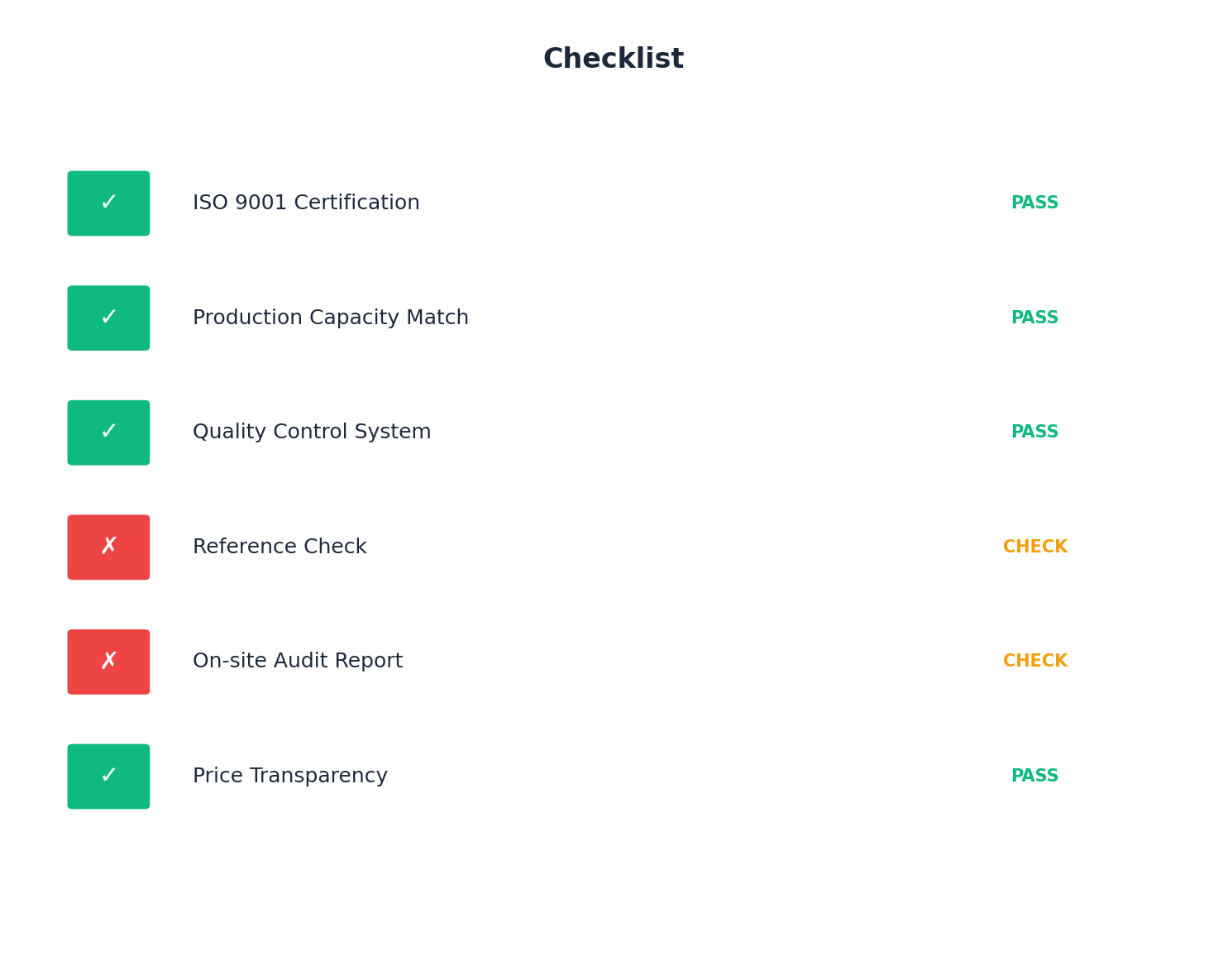
Talking to suppliers about dimensional inspection is one of the fastest ways to separate the serious from the superficial. Here's a 5-step verification process you can run over the phone or during a video call:
- Ask for the calibration certs. Not from last year. From the last 6 months. For every measurement device they use on your parts. If they hesitate, that's a red flag.
- Ask who writes the inspection plan. Is it the quality manager? The operator? The customer (you)? A supplier that says "we follow the drawing" without having a written inspection plan is flying blind.
- Ask for a sample FAIR. First-article inspection report. A real one, with actual numbers, not a template. Look for: part number, feature name, nominal dimension, actual measured value, tolerance range, pass/fail, and measurement method. If the report doesn't include the measurement method, it's incomplete.
- Ask about CMM programming. Who writes the CMM programs? Are they using offline programming from CAD, or teaching the CMM manually? Offline programming is faster and more repeatable. Manual teaching introduces operator error.
- Ask about frequency. How many pieces per batch are inspected dimensionally? For critical safety-related castings (steering knuckles, brake calipers, pressure housings), the automotive standard is 100% inspection of critical features. For non-critical commercial castings, AQL sampling (ANSI/ASQ Z1.4) is common. If they can't articulate their sampling plan, they don't have one.
I've used this checklist with over 40 casting suppliers in 12 countries. The ones that pass all five checks without deflection are rare — maybe 1 in 5. But those are the ones you want to work with.
5 Mistakes That Cost Casting Buyers Millions
These are the patterns I see repeat across industries. Avoid them and you'll save more than the cost of this article — you'll save your production schedule.
Mistake 1: Accepting a "Certificate of Conformance" Instead of Data
A CoC says "we certify this part meets specifications." It's a piece of paper. It has no measurement data. It tells you nothing about actual dimensions. Always require a First Article Inspection Report (FAIR) with actual measured values.
Mistake 2: Not Specifying the Tolerance Grade
ISO 8062-3 defines 11 tolerance grades. If you don't specify the grade, the supplier will use whatever grade is cheapest to produce. On a 100 mm dimension, D4 gives ±0.22 mm, D7 gives ±0.50 mm. That's a 2x difference. Specify the grade in your RFQ.
Mistake 3: Only Inspecting the First Article
Process drift is real. Mold wear, pattern shift, core consistency — these change over time. Require periodic dimensional inspection (every 50th piece, or every shift change) for critical features. A single FAIR at the start doesn't guarantee conformance six months later.
Mistake 4: Ignoring GD&T
A linear dimension of 50 ±0.1 mm doesn't capture the position of a hole relative to a datum. That requires a position tolerance with GD&T. If your drawing uses GD&T but your supplier is only checking linear dimensions, you're not getting the part you designed.
Mistake 5: Not Visiting the Inspection Lab
You can't verify dimensional inspection capability from a PDF. Schedule a video call or on-site visit to the inspection lab. Look at the equipment, the calibration stickers, the temperature control (CMMs require 20±1°C), and the operators. A lab that's messy and disorganized produces unreliable data.
Frequently Asked Questions About Dimensional Inspection for Castings
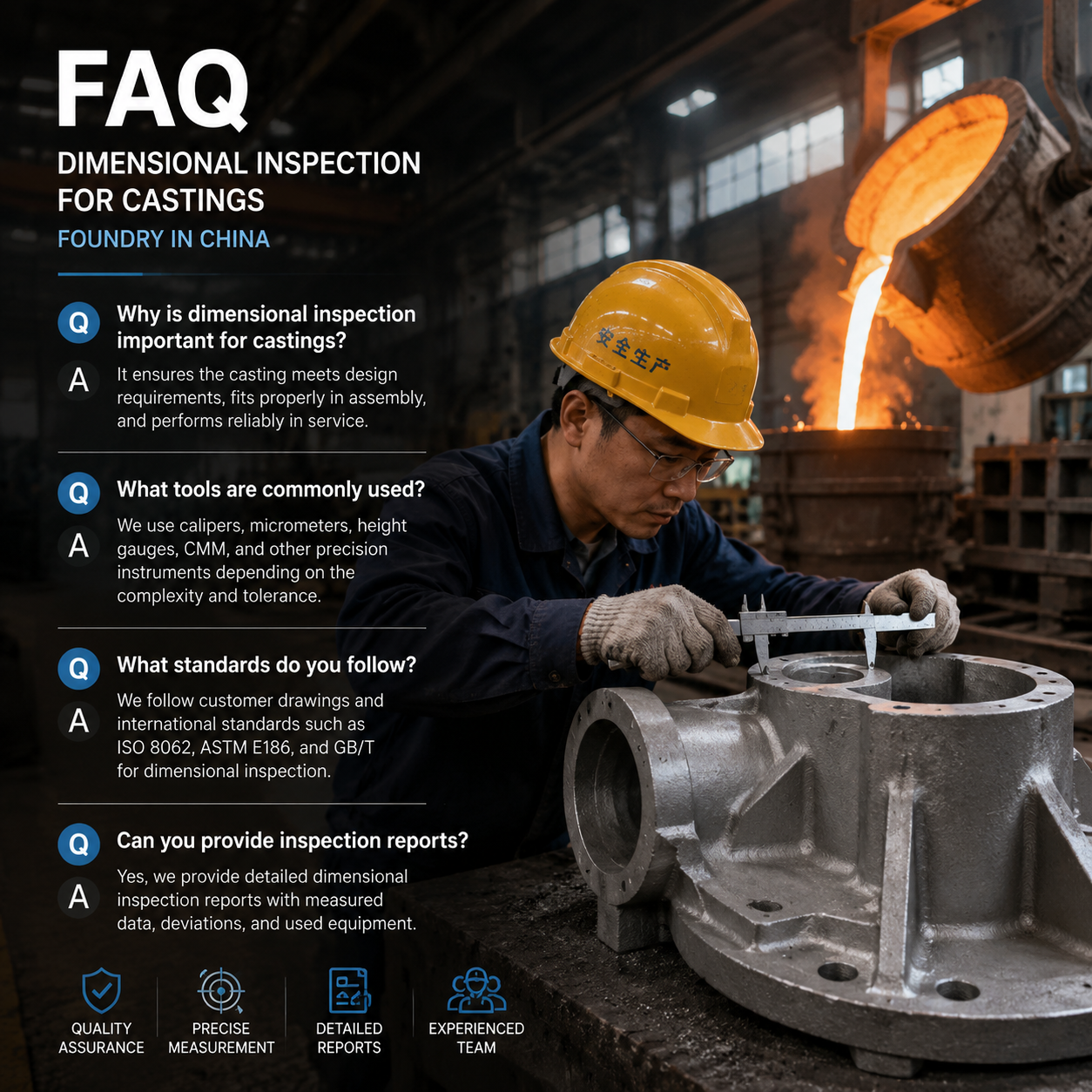
What is dimensional inspection for castings?
Dimensional inspection for castings is the process of measuring a cast part's physical geometry — lengths, diameters, angles, flatness, concentricity, and surface profiles — to verify it falls within the tolerances specified on the engineering drawing. Methods include CMM, optical 3D scanning, laser scanning, hard gages, hand tools, and CT scanning. Standards such as ISO 8062-3 and ASME Y14.5 define the tolerance systems and measurement practices.
What is the difference between CMM and optical scanning for casting inspection?
CMM (Coordinate Measuring Machine) uses a touch probe to measure individual points on the casting surface, achieving accuracy of 0.5–5 microns. It's slow (30–90 minutes per complex part) but extremely precise. Optical 3D scanning (structured light / blue light) projects a light pattern and captures millions of points in a single scan, achieving 10–50 micron accuracy. It's faster (10–30 minutes) and generates a color deviation map, but struggles with shiny surfaces and deep cavities. For first-article inspection of complex castings, optical scanning often provides more useful information than CMM.
What are the standard tolerances for castings per ISO 8062-3?
ISO 8062-3 defines 11 tolerance grades (D1 through D11) for linear dimensions of castings. D1 is the tightest (e.g., ±0.05 mm for dimensions up to 10 mm) and D11 is the loosest (e.g., ±2.5 mm for the same range). Most commercial castings fall in the D4–D7 range. The standard also covers geometrical tolerances for flatness, straightness, parallelism, and concentricity. Always specify the tolerance grade in your RFQ — otherwise the supplier will use the grade that's cheapest to produce.
How often should casting dimensional inspection equipment be calibrated?
Calibration frequency depends on the equipment type and usage. CMMs should be calibrated annually at minimum, with interim verification (using a reference sphere) daily or weekly. Hard gages (plug gages, ring gages, fixtures) used in high-volume production should be calibrated quarterly. Hand tools (calipers, micrometers) typically require annual calibration. Optical scanners and laser line scanners should be verified monthly using a certified reference artifact. Always ask for the calibration certificate and verify it's from an accredited lab (ISO 17025).
What should a first-article inspection report (FAIR) include for castings?
A complete FAIR for castings should include: part number and revision, feature name or identifier, nominal dimension per drawing, actual measured value, tolerance range (upper and lower limits), pass/fail indication, measurement method (CMM, optical scan, hard gage, etc.), and the date and signature of the inspector. For GD&T features, the report should show the calculated result (e.g., position tolerance used vs. allowed). For optical scans, a deviation color map should be attached. The report should reference the applicable standards (ISO 8062-3, ASME Y14.5, etc.).
How do I verify a casting supplier's dimensional inspection quality?
Use a 5-step verification process: (1) Request calibration certificates for all measurement equipment — current, within 6 months. (2) Ask to see their written inspection plan for your part — not just "we follow the drawing." (3) Request a sample FAIR with actual measured values, not a template. (4) Ask who programs their CMM and whether they use offline programming from CAD. (5) Confirm their sampling frequency — for critical features, 100% inspection is standard; for non-critical, ask their AQL level per ANSI/ASQ Z1.4. Schedule a video call or on-site visit to the inspection lab to verify conditions.
Your Next Step: Build Dimensional Inspection Into Your RFQ
Here's the bottom line. The difference between a casting that fits and one that shuts down your production line isn't luck. It's a dimensional inspection process that's specific, documented, and verified.
You don't need to become a metrologist. But you need to ask the right questions, specify the right standards, and verify the right data. The suppliers that can answer those questions confidently are the ones worth working with. The ones that can't — you now know how to spot them before they cost you 47,000 euros per hour.
Here's what to do next:
- Update your RFQ template to include a section on dimensional inspection requirements — specify ISO 8062-3 tolerance grade, ASME Y14.5 for GD&T, and FAIR requirements.
- Run the 5-step supplier verification on your current and potential casting suppliers.
- Download our free Casting Inspection Checklist — a one-page reference you can use during supplier audits and video calls.
Ready to source castings with confidence?
We help buyers verify supplier dimensional inspection capability across 20+ countries.
Submit Your RFQ →
— Hans Weber, Sourcing Engineer. I've spent 12 years on the shop floor of casting foundries across 30 countries. I write to help buyers avoid the mistakes I've seen cost companies millions.
Need Help with Dimensional Inspection for Castings: A Buyer's Guide to Avoiding Costly Fit Failures?
Get matched with 3 verified foundries in 24 hours. No markup, transparent pricing.
Request Quotes →