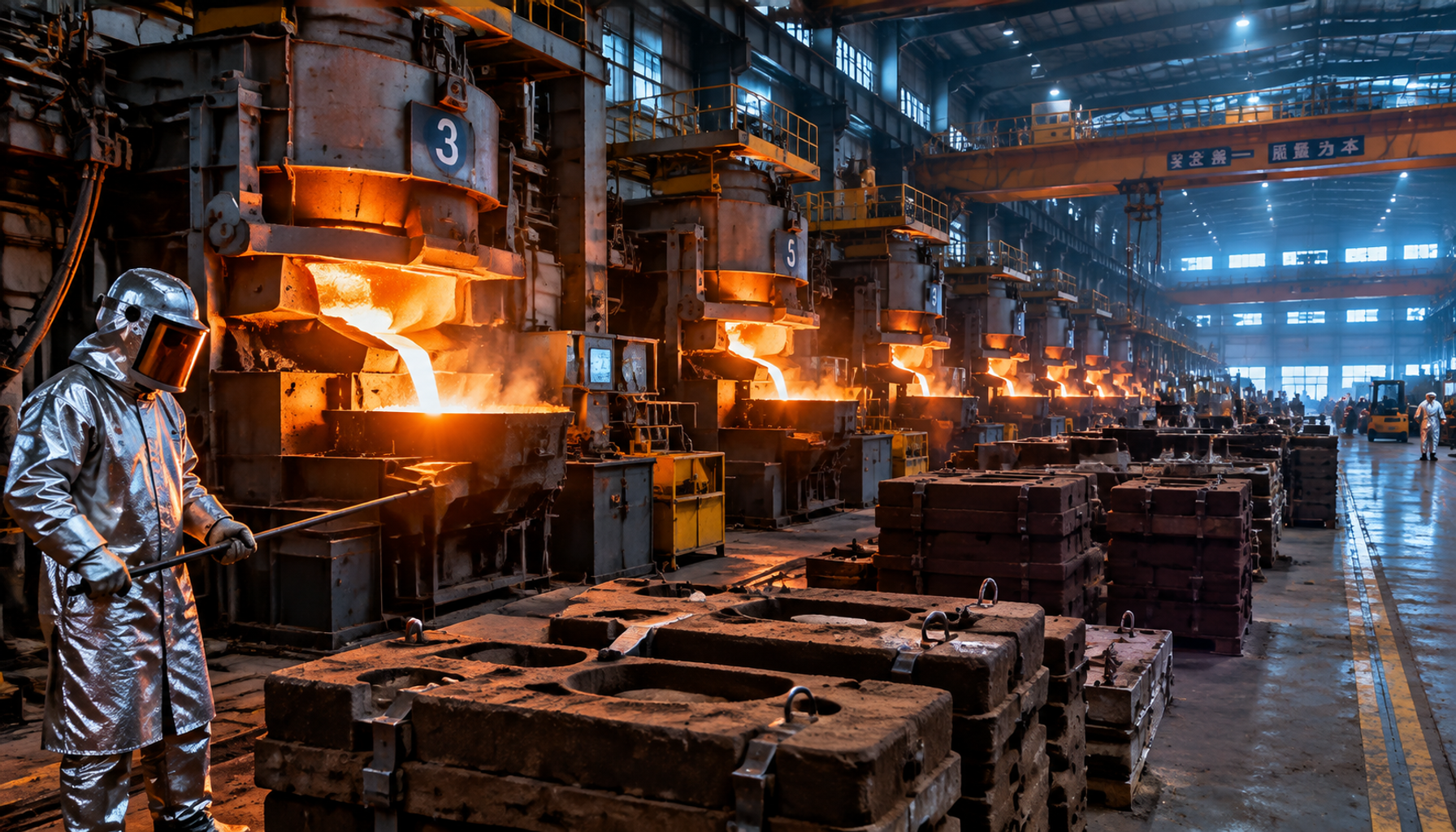
The wire cleared on a Tuesday. €46,300 — the 30% deposit on a €154,000 run of ductile iron pump housings.
The sales rep had answered WeChat in nine minutes flat. He sent a photo of the melting furnace with the date chalked on a board, and promised 75 days to Tianjin port.
By Friday he'd gone quiet. By the following Wednesday, the number was unregistered.
The company website stayed live for another six weeks. Same stock photo of a furnace. Same "18 years of casting experience." Same list of happy customers with no names attached.
Here's what stings: nothing about that supplier was hard to check. Every public record that would have flagged him was sitting online, free, in Mandarin, behind a form you fill in with a captcha. The whole set of checks takes about four hours and costs less than a rounding error on the deposit.
Nobody ran them. That's the whole story.
China Has No Dun & Bradstreet. It Has Something Better and Stranger.
Most Western buyers assume they can't verify a Chinese supplier because there's no D&B file, no Experian record, no credit score out of 850. That assumption costs people a lot of money.
What China actually has is a state-run disclosure regime that publishes more about a company than the US SEC publishes about most private firms. Registered capital. Paid-in capital. Every shareholder. Every legal representative change since incorporation. Every lawsuit the company lost. Every court enforcement action filed against it. Whether it holds an environmental permit. Whether it's registered to export.
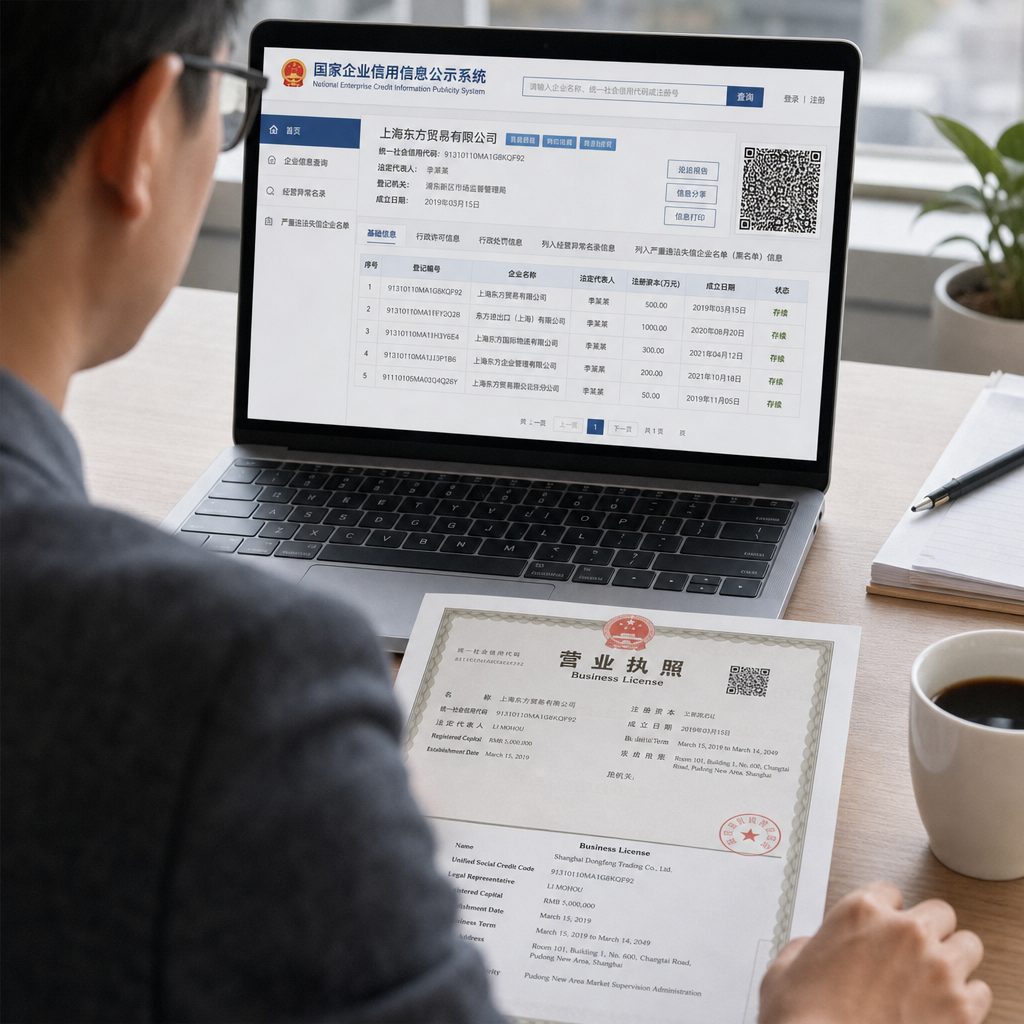
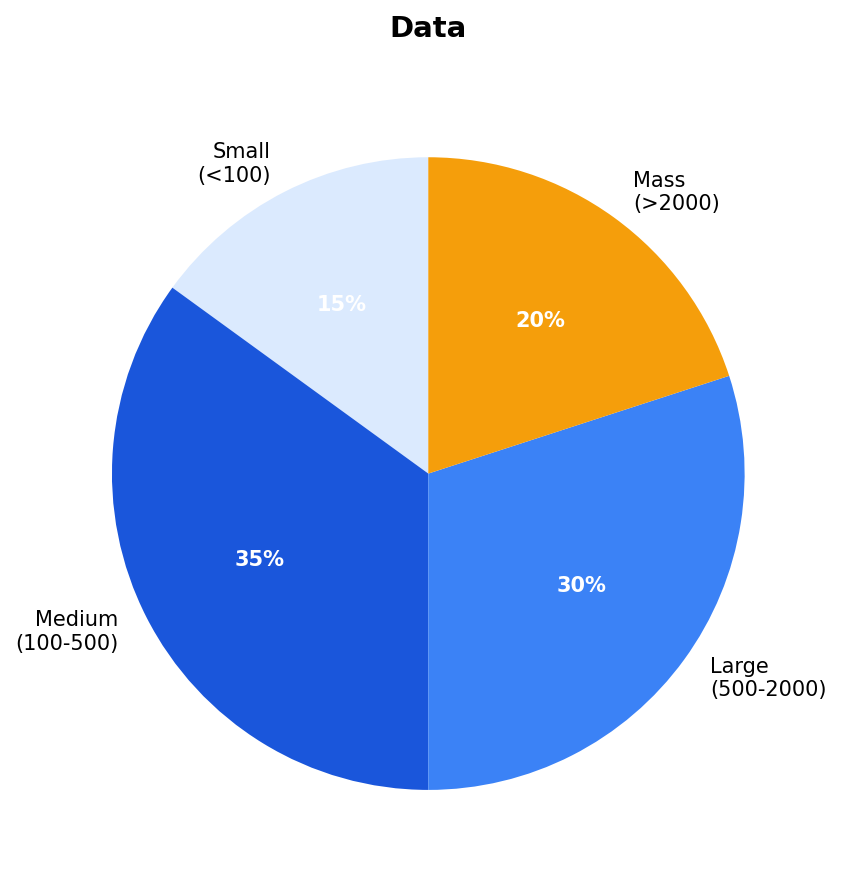
The catch: it's fragmented across six or seven portals, written in bureaucratic Chinese, and none of them explain what's normal versus what's fatal. A registered capital of RMB 5,000,000 means something very different for a foundry that pours 8,000 tons a year than for one that pours 400.
So let's go record by record.
The 7 Records That Actually Tell You Something
If you only want the short version — the page you can hand to a colleague or pin above your desk — here it is. Everything after this table explains how to read each row.
| # | Record | Where to look | Deal-breaker |
|---|---|---|---|
| 1 | Business license & scope | gsxt.gov.cn | Scope has no 铸造; legal name ≠ contract name |
| 2 | Paid-in vs. registered capital | gsxt.gov.cn | Paid-in under 10% of registered |
| 3 | Litigation history | wenshu.court.gov.cn | Repeated losses as defendant on quality or delivery |
| 4 | Enforcement / dishonest debtor list | zxgk.court.gov.cn | Any 失信被执行人 or 限制高消费 hit |
| 5 | Pollutant discharge permit | permit.mee.gov.cn | No permit, or an expired one |
| 6 | Customs registration & credit rating | credit.customs.gov.cn | Claims to export but isn't registered |
| 7 | Bank beneficiary name match | Proforma invoice vs. license | Any mismatch, or payment to a personal account |
1. The Business License — Read the Business Scope, Not the Name
Every Chinese company has an 18-digit Unified Social Credit Code (统一社会信用代码). Ask for it in your first email. It's the key that opens everything else, and any real manufacturer gives it up without blinking.
Paste it into the National Enterprise Credit Information Publicity System at gsxt.gov.cn — that's the government's own registry, not a commercial reseller. You'll get the license. Now read three fields and ignore the rest for a moment.
The legal name. "Ningbo Haoyu Casting Co., Ltd." is not the same legal person as "Ningbo Haoyu Trading Co., Ltd." or "Ningbo Haoyu Casting Technology Co., Ltd." Chinese suppliers swap suffixes freely in emails. If the name on the proforma invoice doesn't match the name in the registry character for character, you're paying someone who is not the entity you think you're paying.
The registered address (注册地址). Then open Baidu Maps or Google Earth and look at it. A foundry looks like a foundry from orbit: a long shed with a ridged roof, a raw-material yard, stacks of scrap and sand, trucks. A trading company registered at "Room 1408, Building 3, Xingye Business Plaza" is a trading company, no matter what the website says. I've seen buyers fly 14 hours to a "factory" that turned out to be a serviced office with a receptionist and a wall of framed certificates.
The business scope (经营范围). This is where it gets useful. A genuine casting manufacturer's scope contains terms like 铸造 (casting), 金属制品制造 (metal products manufacturing), 机械零部件加工 (machining of mechanical parts). A trader's scope says 批发 (wholesale), 零售 (retail), 进出口 (import/export). Those are legally different activities. A company with only wholesale in its scope cannot legally manufacture your parts — which means it's subcontracting them out, and you have no contract with the subcontractor.
One more field worth checking: 一般纳税人 (general VAT taxpayer) status. Small-scale taxpayers can't issue a 13% VAT invoice, which means you can't claim the export rebate properly and their invoicing ceiling is capped. It's also a decent proxy for turnover.
2. Paid-In Capital vs. Registered Capital — The Gap Is the Story
Here's the thing that trips up almost every first-time China buyer. Since 2014, China has used a subscription system for capital. The number on the license — 注册资本, registered capital — is a promise. Shareholders committed to putting that money in eventually. It is not money in the bank.
The number that matters is 实缴资本, paid-in capital. How much of that promise has actually been deposited.
You will regularly see foundries with RMB 10,000,000 registered and RMB 0 paid-in. That's a company with a ten-million-yuan business card and an empty account. It's completely legal, and it tells you that if things go sideways, there is nothing to chase.
Rule of thumb I'd apply: for an order of value X, the supplier's paid-in capital should be at least a few multiples of X. If you're placing a $180,000 order with a company showing RMB 500,000 paid-in, you are lending them your money with no collateral.
Note the 2024 change: under the revised Company Law effective July 2024, newly registered companies must pay in within five years, and older companies are on a transition path toward 2032. So paid-in figures are slowly getting more meaningful. As of late 2026, plenty of legacy foundries still show zero.
3. Litigation History — With a Big Caveat
Search the company name on China Judgments Online (wenshu.court.gov.cn). You want to see the pattern, not the count.
Zero lawsuits is unusual for a foundry that's been running 15 years and does serious volume. A handful of 买卖合同纠纷 (sales contract disputes) where the foundry is the plaintiff chasing a customer for unpaid goods? Fine. That's a factory that has been stiffed and went to court over it — borderline reassuring, honestly.
What you don't want: cases where the foundry is the defendant and repeatedly lost on quality claims, late delivery, or failure to return tooling. Three or more of those, and you've found your answer.
The caveat matters. Since 2021, the volume of judgments posted publicly on wenshu.court.gov.cn has dropped sharply. Whole categories of cases have been pulled from public view. So an empty result is inconclusive, not clean. Treat "no records found" as "we don't know," and if the order is large enough to hurt, pay for a commercial report that includes non-public case databases.
4. The Dishonest Debtor List — Instant Disqualification
This one is binary. Check zxgk.court.gov.cn, the Supreme People's Court enforcement portal, for two things:
- 失信被执行人 — "dishonest judgment debtor." The company lost a case, was ordered to pay, and refused.
- 限制高消费 — a consumption restriction order against the legal representative. They cannot take a plane, take a first-class or business-class train seat, stay in star-rated hotels, or send their kid to a fee-paying private school.
A hit on either is a hard stop. Not "negotiate harder." Not "ask for a bigger discount." Walk.
Why so absolute? Because the restriction only lands after a court has already ordered payment and the person has refused for an extended period, and because a legal rep on that list has had their ability to travel and operate curtailed. A factory whose boss can't board a plane is not a factory that's going to reliably deliver your container.
Search both the company name and the legal representative's name. Enforcement follows the person, and it's common to find the flag on an individual who then registers a fresh company under a spouse's name.
5. The Pollutant Discharge Permit — The Factory Test Nobody Talks About
This is my favorite check and almost nobody uses it.
Any Chinese foundry with a melting furnace — induction, cupola, whatever — needs a 排污许可证, a National Pollutant Discharge Permit, issued by the local bureau of ecology and environment under the Ministry of Ecology and Environment. For metal casting this falls under the fixed-source pollution permit regime. It's individually issued, numbered, and searchable on the national permit platform at permit.mee.gov.cn.
Ask your contact for the permit number. Then look it up.
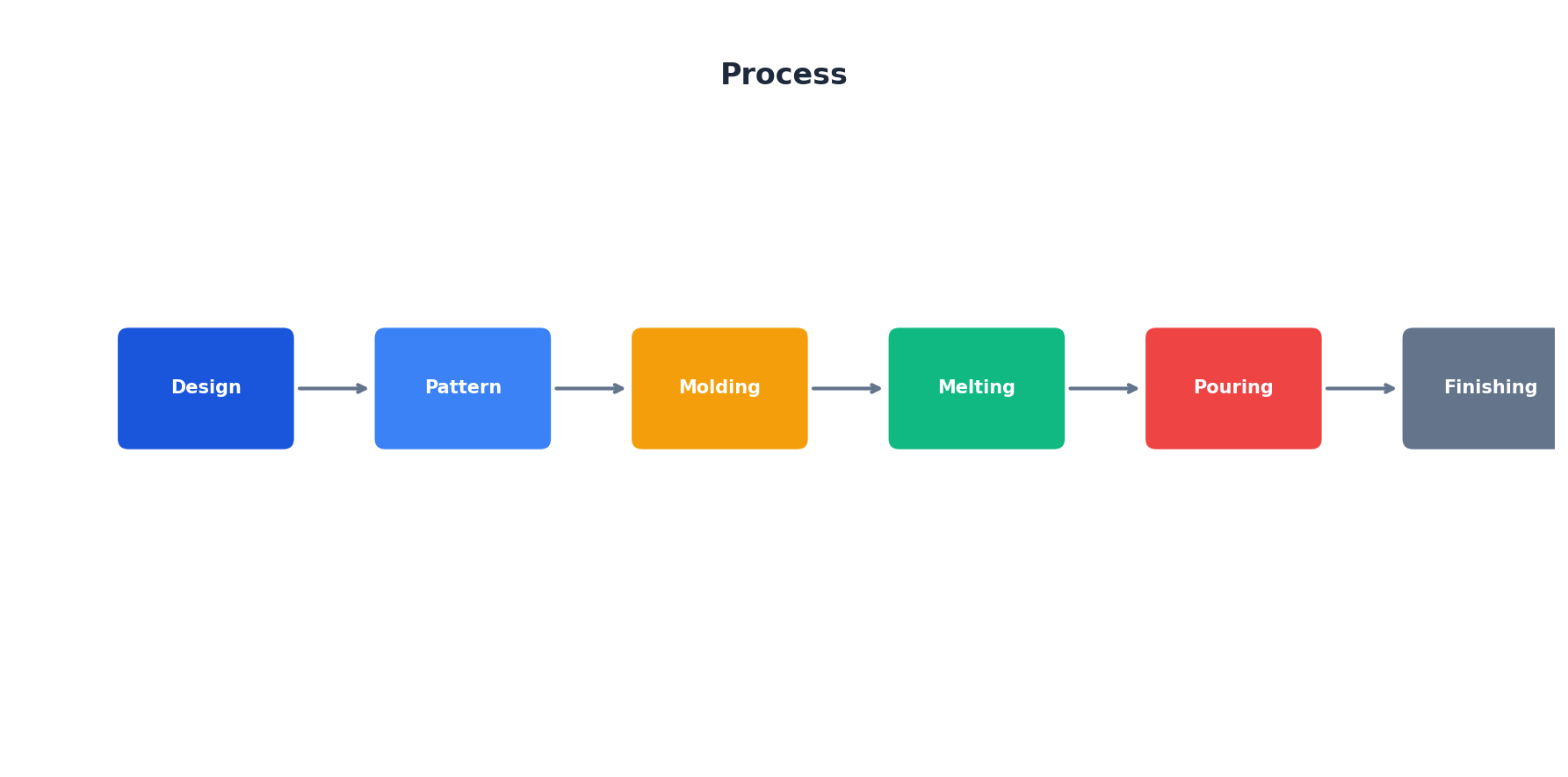
Three outcomes, three meanings:
- They have one, and it's current. You've just confirmed they physically melt metal on Chinese soil. That's a stronger proof of being a real factory than any photo.
- They say they don't need one. Either they're a trading company with no furnace, or they're operating outside the permit regime. In the second case, they can be shut down by a routine inspection in the middle of your production run — and it happens every winter.
- They have one but it's expired or suspended. Same as above, with paperwork.
While you're in the environmental records, also ask for the 环评批复 — the environmental impact assessment approval. Foundries sit in the "two high" (两高) category, meaning high energy consumption and high emissions. That designation matters operationally: across Hebei, Shandong, and Shanxi, foundries get throttled or halted outright during heavy-pollution alerts and winter heating season air-quality controls. If your delivery window lands in November through February and your supplier is in the Beijing-Tianjin-Hebei airshed, build that risk into the schedule — or into the penalty clause.
6. Customs Registration and Foreign Trade Operator Filing
If your supplier says they export, check that they legally export. Two filings exist:
- 对外贸易经营者备案登记 — foreign trade operator registration
- 海关注册登记 — customs registration, which gives a 10-digit customs code
The second is searchable on the China Customs credit publicity platform at credit.customs.gov.cn. It also shows the company's customs credit rating: AEO Advanced Certified Enterprise, General Certified, General Credit, or Dishonest. If you're dealing with an AEO Advanced firm, customs clearance is materially faster and inspection rates are lower. If the rating is 失信企业 (dishonest), you have a problem at the port.
The real value of this check, though, is what it reveals when it comes back empty. A supplier with no customs registration but a slick export-oriented website is shipping through a third-party export agent. That means:
- Your purchase order isn't with the entity that holds title to the goods.
- The name on the bill of lading won't be the name on your contract.
- If quality goes wrong, the agent points at the factory and the factory points at the agent.
Sometimes that's fine. Often it's how you end up with a $200,000 hole and two companies telling you it's not their problem.
7. The Bank Account Name Match — The Single Most Reliable Fraud Signal
Ignore everything else for a second. If you check one thing on this page, check this.
On the proforma invoice, look at the beneficiary name and account. Then look at the company name on the business license pulled from gsxt.gov.cn.
They must match. Exactly. Character for character, including 有限公司 vs. 股份有限公司.
If they don't — if the invoice says "Ningbo Haoyu Casting Co., Ltd." and the bank details say "Ningbo Haoyu Trading Co., Ltd.", or worse, an individual's name like "ZHANG WEI" or "LI QIANG" — you have your answer.
Payments to a personal account are the signature move in a large share of China sourcing frauds, and they're also the move that leaves you with no legal claim, because the money never entered the company you thought you were paying. No bank will reverse it. No court will treat it as a corporate debt. You sent money to a person.
There's a legitimate-looking excuse you'll hear: "It's our boss's personal account for faster processing," or "the corporate account takes three days to clear." Both are nonsense. Chinese corporate accounts handle international wires in a day like everywhere else.
One more layer for large orders: ask the supplier to send you a copy of a recent bank slip showing the corporate account name, or ask your bank to run a beneficiary name verification on the SWIFT transfer. The name on the receiving account is the last line of defense and the only one that can't be talked around.
Red Flags: The Table I'd Print and Tape to the Wall
| Signal | Why it matters | Verdict |
|---|---|---|
| Bank beneficiary ≠ license name | Money leaves the corporate legal entity | Walk away |
| Payment requested to a personal account | No recoverable claim exists | Walk away |
| On the 失信被执行人 list | Already refused a court payment order | Walk away |
| Paid-in capital under 10% of registered | No assets behind the promise | Reconsider or reduce exposure |
| Registered address is an office building | Likely a trader, not a manufacturer | Verify factory independently |
| No pollutant discharge permit | Not a legal melting operation, or not a melter | Investigate hard |
| No customs registration, claims to export | Shipping through an undisclosed third party | Get the entity chain in writing |
| Legal rep changed twice in 18 months | Classic pattern before an entity is abandoned | Investigate |
| Registered under 2 years, claims 20 years' experience | The trading front is new; the real maker is unknown | Investigate |
Free vs. Paid: What's Worth Paying For
The registry, litigation, enforcement, permit, and customs portals are free. Fill in a captcha, read a translated page. Two hours gets you five of the seven checks.
What you can't get for free, and what you pay for when you hire a due-diligence firm:
- Tax filing data. Nobody publishes revenue. A paid report can estimate annual turnover from VAT filings through a licensed intermediary.
- Bank references. A lender's view of the company's account behavior, obtained with the supplier's cooperation.
- Non-public litigation. The judgments that moved off public portals.
- Related-entity mapping. Shareholders, their other companies, and whether any of them are on enforcement lists. This is where a lot of the real signal hides — the clean company is often sitting next to a dirty one owned by the same family.
- Site verification. A person physically standing in the plant with a camera, counting furnaces and asking what the monthly tonnage is. If you're going to do this yourself, our foundry site visit guide covers what to photograph and what to ask.
Typical costs as of 2026: RMB 300–1,500 per year for an aggregator subscription like Tianyancha or Qichacha with monitoring alerts, and USD 300–800 for a commissioned report, delivered in three to seven working days. Against a five-figure deposit, that's not a cost. It's insurance priced at something like half a percent.
Payment Terms That Survive a Bad Supplier
A credit check reduces the odds. Payment structure is what limits the damage when the odds don't work out.
Never 100% T/T in advance. I shouldn't have to write that, and I'll write it anyway, because people still do it.
30/70 is the standard starting point. 30% deposit against a signed PO, 70% against a pre-shipment inspection certificate and copies of shipping documents. That's a normal ask in the Chinese casting industry and nobody serious will refuse it.
Push to 30/40/30 on anything complex. Deposit, then a progress payment after first-article approval, then the balance after pre-shipment inspection. On tooling-heavy jobs, pay for tooling in milestones tied to the tooling being built, not in a lump at the front.
Above roughly USD 50,000, use a letter of credit. Irrevocable, at sight, confirmed by a bank in your own jurisdiction. But understand what an LC does and doesn't do: it guarantees you get documents or your money back. It does not guarantee the documents describe good castings.
So add the clause that makes the LC actually useful: a pre-shipment inspection certificate from a named third party — SGS, Bureau Veritas, Intertek, TÜV — is a required document for payment. Without that clause, the supplier can present a clean bill of lading for a container full of porosity and get paid. With it, the money doesn't move until someone has measured wall thickness, checked dimensional conformance, and pulled a test bar.
Hold back 5–10% for 60 days after arrival. Call it a quality retention. It covers the parts that pass visual inspection at the port and fail in your machining cell three weeks later.
Set a per-supplier exposure ceiling and write it down. Something like: no single supplier gets more than 15% of annual casting spend, and no unsecured prepayment above USD 25,000 without a fresh credit check. The rule sounds bureaucratic until the week you're glad it exists.
Mistakes That Keep Showing Up
Trusting the badge. Alibaba Gold Supplier, Verified Supplier, trade assurance — these verify that a company exists and paid a subscription. They do not verify solvency, capacity, or whether the entity has a furnace. Do not treat a badge as a credit check. Do not treat it as half a credit check.
Checking the trading company instead of the factory. The contract is with a Hong Kong or mainland trading entity, the parts come from a factory in Cangzhou nobody has vetted. When quality fails, you have a claim against a company with a mailbox and no assets. Ask, in writing, who physically melts the metal. Then vet that entity too.
Accepting the reference list. The supplier picks the references. Of course they're happy ones. If you want a real signal, ask the factory for the contact details of a customer who stopped ordering, and see whether they'll tell you why.
Checking once, at the beginning. A clean report from two years ago describes a company that may no longer exist in any meaningful sense. Legal representative changes, shareholder exits, new enforcement filings, and expiring permits all happen quietly. Re-run the enforcement and permit checks before any order that matters.
Confusing an ISO certificate with a healthy company. ISO 9001 and IATF 16949 certificates are worth checking — but on the issuing body's website, not the PDF the supplier emails you, and read against the casting quality standards that actually apply to your part. Forged and expired certificates circulate freely. And a valid certificate says nothing about whether the company can pay its electricity bill.
Ignoring operational risk. A foundry can be financially healthy and still miss your date by eight weeks because of a power curtailment order or an air-quality shutdown. Financial credit checks don't capture this. Ask directly: how many days of production did you lose to environmental controls last winter? A supplier who answers "none" is either lying or not melting metal.
FAQ
Can you actually run a credit check on a Chinese casting factory?
Yes — more easily than in most countries. Registration, paid-in capital, litigation, enforcement, environmental permits, and customs registration are all published. Most of it is free. The skill is knowing which seven records matter and what normal looks like in each.
How much does it cost?
The public records cost nothing but time. Aggregator subscriptions with monitoring alerts run RMB 300–1,500 per year. A commissioned due-diligence report with tax and bank verification is typically USD 300–800 and takes three to seven working days.
What if the supplier won't give me their Unified Social Credit Code?
Walk. The 18-digit code is on the business license and is meant to be public. A refusal usually means the trading entity, the invoicing company, and the receiving bank account don't line up — which is exactly the situation you're trying to detect.
Does Alibaba Trade Assurance cover my deposit?
Partially, within a coverage cap and the platform's own dispute process. It won't cover downtime, lost orders, or separately purchased tooling. Treat it as an extra layer, not a substitute for a credit check.
How often should I re-check?
Every 12 months, plus a fresh enforcement-and-permit check before any order above your internal exposure threshold. Chinese corporate records change fast — a 2024 report tells you nothing about a September 2026 wire.
What to Do on Monday
Take your top three Chinese casting suppliers — the ones you'd lose sleep over if they vanished — and run the four free checks. Unified Social Credit Code into gsxt.gov.cn. Company name into the enforcement portal. Permit number into the environmental platform. Customs code into the customs credit site.
Four hours total. Then compare the bank beneficiary name on your most recent invoice against the license name you just pulled up.
If the two don't match, you don't need the rest of the checklist. You need a new supplier.
And if there's a deposit sitting with someone you haven't checked yet — that's the one to start with.
Get the 7-Record Verification Sheet
A one-page PDF with the exact portal URLs, the Chinese search terms to use, and the red-flag thresholds. Print it, give it to whoever handles your purchase orders, and run it before the next wire — not after.