
Ask ten buyers who've been burned by a casting supplier what went wrong, and you'll hear the same answer nine times: they skipped a step. Not a big step. Sometimes just one. A heat number that didn't match. An ISO certificate that expired six months before the PO. A sub-supplier running the machining on parts nobody approved. A material grade that quietly drifted from A356 to a scrap-fed blend with 0.4% iron that no mill certificate ever mentioned.
Now look at the supply side. The China Foundry Association's published count puts the country's foundry base at roughly 22,000 plants. Global casting output crossed 105 million metric tons in the most recent Modern Casting census, with China, India, the US, Japan and Germany carrying most of it. There is no shortage of suppliers. There is a shortage of suppliers who survive a serious qualification review.
So here's a working checklist. Forty-seven points, six sections, weighted, with hard-fail rules. Run it before you sign an LOI, not after. It takes about three days of document work and one day on site, and it will save you a recall.
Why a Written Checklist Beats a Factory Visit
Factory visits feel productive. You fly in, you drink tea, you walk the floor, you take photos of the new machining cell. Then you fly home and realize you never asked who calibrates the spectrometer.
Humans are terrible at unstructured inspection. We anchor on the first impressive thing we see and stop looking. A written list fixes that. It forces the boring questions in the same order, every time, whether you're standing in a plant in Ningbo or reviewing PDFs from a desk in Ohio.
Two more reasons it matters. First, a scored checklist is a record. When a casting cracks eighteen months from now, you can show exactly what you verified and what you waved through. Second, it makes comparison possible. Six suppliers, same 47 points, same weighting. Now you're making a decision instead of a guess.
And this is not just a China problem. Deloitte's most recent global supply chain survey found that roughly three in four manufacturers have experienced an unplanned supplier disruption in the last two years. The fix isn't fewer suppliers. It's better qualification on the ones you keep.

The 47-Point Casting Supplier Qualification Checklist
Six sections, A through F. Score each point 0 (fail), 1 (partial), or 2 (pass). Section totals get weighted differently — I'll show you the weighting further down. If you want to see how these points map against the standards they reference, the ISO 8062 tolerance grades page is a good reference for the technical side.
Section A — Legal and Commercial Identity (8 points)
- Legal name on the business license matches your PO exactly. Not the trade name, not the English translation the sales rep uses on WeChat. A mismatch here voids your warranty claim before it starts.
- Unified Social Credit Code verified against the National Enterprise Credit Information Publicity System. Ninety seconds of work. Cross-check the registered address while you're in there.
- Registered capital vs. paid-in capital. Registered capital is a number on paper. Paid-in capital is money that actually showed up. On a 50 million RMB registration, a paid-in figure of 3 million tells you something.
- Establishment date. Under three years means a young operation. Fine for simple, low-risk parts. Risky for anything that depends on process stability you can't observe yet.
- Scope of business includes casting or metal products manufacturing. Sounds pedantic. It isn't. A trading entity invoicing you for manufactured goods creates customs and liability problems you'll spend months untangling.
- Export license on file, current, and in the entity's own name. Borrowed licenses are common and they break the moment a shipment gets inspected.
- Beneficial owner identified. Who actually owns this company? If the answer is a Hong Kong shell that nobody will explain, stop here and don't spend more of your time.
- Customs registration number verified against actual export records. Ask for three recent customs declarations for castings.
Section B — Process and Capability (9 points)
- Primary process matches your part. Green sand, no-bake, investment, high-pressure die, gravity die, centrifugal. Getting this wrong is the single most expensive qualification error on the list. You cannot make a 3 mm-wall aluminum housing in green sand at a competitive cost, no matter how good the foundry is.
- Maximum part weight on the machines they actually run. Not the machines in the brochure. Not the machine their sister plant owns.
- Minimum wall thickness held in production — with a real part number to back it up. "We can do 2 mm" means nothing without a sample.
- Tolerance grade per ISO 8062-3 or whatever standard your drawing calls out — for aluminum sand castings that typically means grades DCTG 4 to DCTG 8, for die castings ADCTG 3 to ADCTG 6. Ask what they hold in routine production, not what they achieved once on a prototype. Our breakdown of casting tolerance grades has the full reference table with dimensional ranges.
- Machining capability. In-house or subcontracted? If subcontracted, you want to approve that machine shop before the first production lot ships. This is where most dimensional escapes originate.
- Heat treatment on site, with current furnace calibration records compliant with AMS 2750 (or CQI-9 for automotive). Outsourced heat treat adds a week and a second traceability gap.
- Surface finishing: powder coat, e-coat, anodize, plating, shot blast. In-house or outsourced, and to which specification — note the specification number, not just the process name.
- Tooling shop. In-house pattern and die making cuts lead time and gives you a clean answer on who owns the tool and where it physically sits.
- Solidification simulation software — MAGMA, ProCAST, AnyCasting. Not a dealbreaker on its own, but a shop that simulates finds porosity on a screen instead of in your first article.
Section C — Quality Management System (10 points)
- ISO 9001 certificate valid and issued by an IAF-accredited body. Check the certification body's name against the IAF member list. Certificates from unrecognized bodies are common, cheap, and worth exactly what you paid for them.
- IATF 16949 if you're automotive. No substitutes, no exceptions, no "we're in the process."
- AS9100 or NADCAP accreditation for aerospace and defense work. These have longer audit cycles and you can verify them in the public certification databases.
- Certificate scope covers your product family. A certificate scoped to "steel fabrications" does not cover aluminum die castings. Read the scope box, not the logo.
- Expiry date and last surveillance audit date. An expired certificate with a scheduled renewal is a manageable risk. A certificate nobody has checked since 2023 is not.
- In-house optical emission spectrometer. If they outsource chemistry checks, they cannot catch a bad melt before it becomes 500 finished parts. Ask what reference standards they use to calibrate it.
- X-ray or CT capability for internal defect detection, referencing ASTM E505 for radiography of aluminum castings (or ASTM E446 / E186 for steel, depending on wall thickness). On-site beats outsourced, because sending parts out for radiography adds days your schedule probably doesn't have.
- CMM for dimensional verification, with a current calibration sticker and a calibration certificate you can read. Ask for the uncertainty statement, not just the calibration date.
- Mechanical testing in-house: tensile, hardness, hardness after heat treat, impact where applicable. The test certificates should name the standard used — ASTM E8 for tension, ASTM E10 for Brinell, ASTM E18 for Rockwell.
- Documented PPAP or First Article Inspection process, with a sample report you can actually read. A real FAI report has dimensions, tolerances, measured values, and a signature. Our guide on casting porosity defects walks through the acceptance criteria that a decent FAI report should reference.

Section D — Material and Traceability (7 points)
- Incoming material certification for every heat of ingot, citing the correct material standard — ASTM B26 or B108 for aluminum, EN 1706 for EU aluminum grades, GB/T 1173 for Chinese cast aluminum alloys, ASTM A48 or A536 for iron, ISO 1083 for spheroidal graphite. Ask to see three random mill certificates from the last quarter and confirm the chemistry limits in each are actually within the standard's range.
- Heat number logged at melt and carried through to the shipping carton. Test it. Pick a random finished part, hand it to the quality manager, and ask them to walk it back to a heat number and a melt log. If it takes four hours and three people, the system isn't real.
- Melt chemistry records retained. Ask how long. Anything under three years is a problem if your product carries a field-life warranty.
- Scrap segregation and scrap rate. What's the number, and where does rejected material go? Contaminated returns are one of the most common causes of chemistry drift between lots — particularly iron pickup in recycled aluminum.
- Spectrometer calibration records, current and traceable to certified reference material (CRM). Ask which CRM supplier they use.
- Sample retention policy. Do they retain a first article, a last article, and a mid-run sample? For how long? Where? Retained samples are your only real forensic tool when a field failure shows up two years later.
- RoHS, REACH, and conflict minerals declarations if your market requires them. Get the signed versions, not the template.
Section E — Capacity and Delivery (7 points)
- Monthly tonnage capacity against your volume — and then the harder question: what share of their total order book would you represent? Above 30% and you have leverage plus concentration risk. Below 2% and you're a rounding error in their scheduling meeting.
- Machine list with tonnage and count, verified on the floor. Walk the floor with the list in hand and compare it to machine nameplates.
- Shifts per day, and whether night shift runs under the same supervision and the same inspection frequency. A lot of quality escapes happen between 11 pm and 6 am.
- On-time delivery rate for the last twelve months. Ask for the raw number. "About 98%" is not a number, it's a mood.
- Sub-supplier list and their approval process. Who else touches your part before it reaches a container? If the answer is "a few local shops," you need names.
- Packaging standard and transit testing. A casting that survives the press and dies in a container is still a defective casting.
- Lead time for tooling and for production, in writing, with a consequence attached. Lead times without consequences are estimates. Estimates are how schedules slip.
Section F — Commercial and Risk Terms (6 points)
- Payment terms and who funds the tooling before first shipment. Whoever pays for the tool should own the tool — make sure the paperwork agrees.
- Tooling ownership and access rights. The tool is yours. Write that down, with a physical location, a retrieval right, and a condition report.
- Warranty length and claim process. How do you file a claim, what's the response window, and who pays freight on a return?
- Liability cap and insurance coverage. Get the insurance certificate. A liability cap set at the value of one shipment is not meaningful protection on a 20,000-piece run.
- Exit terms: tooling transfer, NDA, and design non-compete. Decide before the relationship sours, not during.
- Currency, Incoterms, and dispute venue agreed in the contract, not in an email thread. Where do you sue if it goes wrong? That clause matters more than the price.
How to Score It
Score each point 0, 1, or 2. Maximum is 94. Don't weight all six sections equally — the failure modes aren't equally expensive.
| Section | Weight | Why |
|---|---|---|
| C — Quality Management | 30% | Directly controls defect escape |
| B — Process & Capability | 25% | Determines whether the job is even possible |
| D — Material & Traceability | 20% | Determines whether you can prove what happened |
| E — Capacity & Delivery | 12% | Determines whether promises hold |
| A — Legal Identity | 8% | Determines whether recourse exists |
| F — Commercial & Risk | 5% | Determines cost of failure, not chance of it |
Thresholds that hold up in practice: 85% and above, proceed. 70 to 84%, proceed with a written corrective action plan and a follow-up audit inside 90 days. Below 70%, walk. Below 60%, don't negotiate — just walk. Sellers who score low rarely improve under pressure; they improve under competition, and you don't have time to wait for that.
One rule overrides the total score. Any zero on points 18, 19, or 21 is an automatic fail regardless of how the rest looks. A fraudulent or out-of-scope certificate is not a partial-credit situation. It's evidence of how they think about documentation, and you're about to trust them with your part number.
The Five Checks That Kill Most Deals
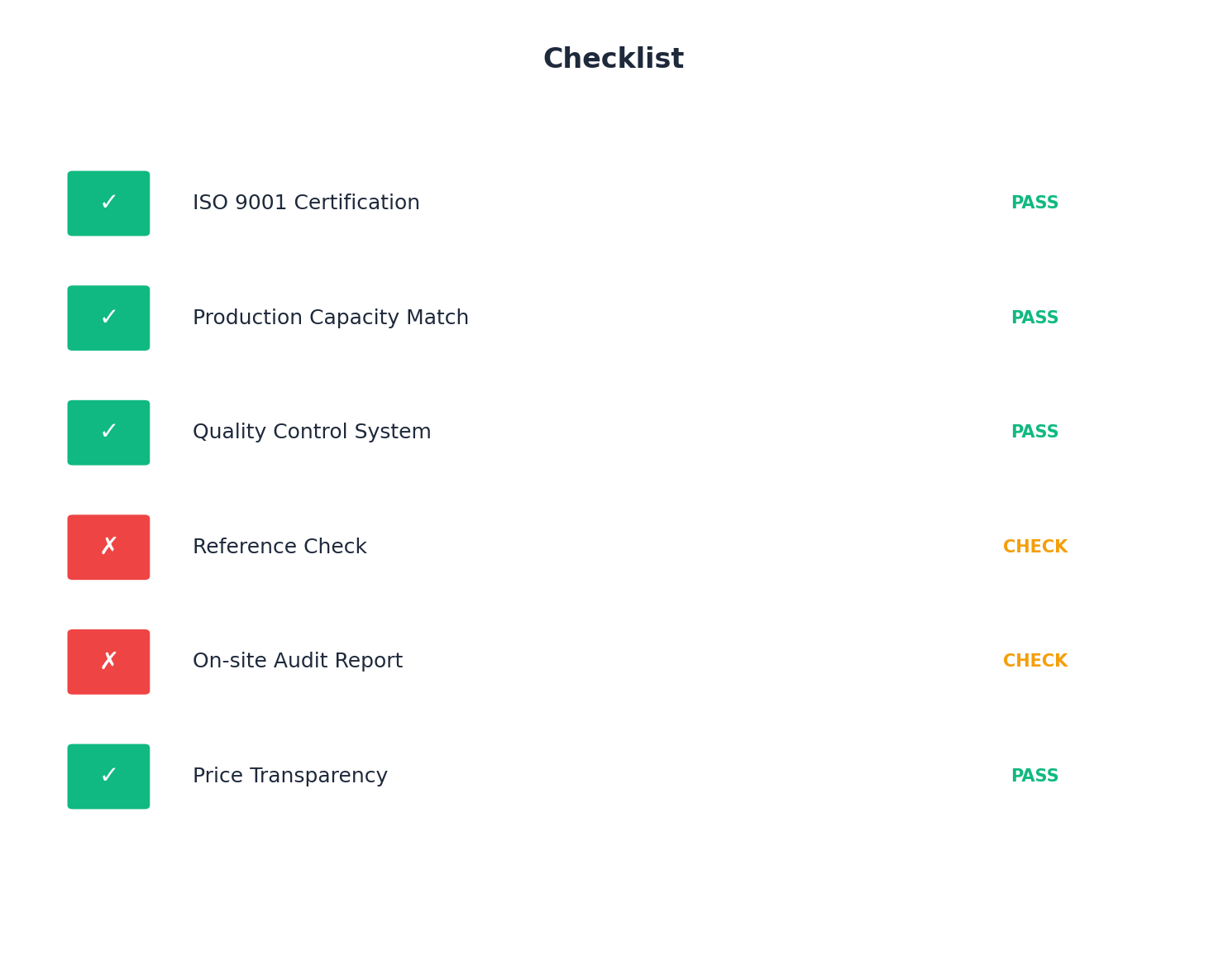
Out of 47 points, five do most of the work. If you're short on time, run these first — they'll eliminate the majority of bad candidates before you spend a day on a plane.
1. The Heat Number Walk-Back
Pick a finished casting at random from the warehouse. Hand it to the quality manager and ask for the melt chemistry, the furnace log, and the ingot supplier for that specific part. A shop with real traceability answers in fifteen minutes. A shop without it sends three people to look for a binder and comes back with a lot number that may or may not connect to anything.
2. The Certificate Scope Check
Pull the ISO 9001 or IATF certificate, find the certification body's name, and check it against the IAF member list. Then read the scope statement. Certificates appear on factory walls all over Asia, and a meaningful fraction of them are issued by bodies that don't belong to any international accreditation framework. Two minutes of checking eliminates them.
3. The Paid-In Capital Gap
A 100 million RMB registered capital with 4 million paid in is a company that exists on paper. It can't absorb a recall, it can't fund a tooling replacement, and it can't pay a liability claim. When the gap is that large, the company you're dealing with is a sales office, not a manufacturer. That's not automatically fatal, but it changes every risk calculation downstream.
4. The Capacity Math
Ask for monthly tonnage capacity. Ask for their current monthly output. Ask what your order would represent. Suppliers oversell capacity constantly, and the ones who oversell hardest are the ones who take on work they can't schedule. A shop already running at 90% utilization that promises to prioritize you is telling you something about how they handle promises.
5. The Night Shift Visit
If you visit once, visit during second shift. Day shift is a performance — clean floor, supervisor walking the line, everything in place. Night shift is reality. You want to see whether the same inspection frequency applies, whether the same technical staff is on site, and whether anyone actually knows the acceptance criteria on the drawing.

Common Mistakes to Avoid
Auditing the sales office instead of the plant. Sales offices are designed to be impressive. Plants are designed to make parts. If the audit happens in a conference room with a projector, you haven't qualified anything.
Accepting a photo of a certificate. Photos are edited. Ask for the certificate number, the issuing body, and the expiry date, then verify all three independently. It takes four minutes.
Skipping the sub-supplier question. Most dimensional and cosmetic escapes originate at a company you've never heard of, doing a process you never approved, on a purchase order that never mentioned your drawing. Ask for the list. Approve it.
Scoring everything as a pass because you liked the general manager. This is the most common failure mode in supplier qualification, and it's the one that costs the most. Rapport is not a control. Score the points, then decide.
Having no exit plan. Roughly a third of sourcing relationships end badly. Tooling ownership, retrieval rights, and design non-competes are cheap to negotiate at the start and nearly impossible to negotiate later. Put them in the contract.
Frequently Asked Questions
How long does a full casting supplier qualification take?
Document review runs two to three days if you're organized. The on-site audit takes one to two days for a single plant, plus travel. From first contact to signed PO, most buyers spend three to six weeks. Rushing that to ten days is possible, and it's how people end up with tooling they can't retrieve.
Do I have to visit the factory in person?
For a first order, yes. Video tours are edited by definition. If travel genuinely isn't possible, hire a third-party inspector to make an unannounced one-day visit before you release a deposit. The cost is trivial compared to a failed first article.
What if the supplier is a trading company rather than a foundry?
Trading companies have real value — they handle logistics, consolidate orders, and speak your language. But you're still responsible for qualifying the plant behind them. Ask for the production address, then run the same 47 points against that facility. If they won't disclose it, you've learned something important.
How often should I re-qualify an approved casting supplier?
Full re-qualification every 24 months. Light re-checks on certificates, capacity, and ownership every 12 months. And an immediate re-check after any of these: ownership change, plant relocation, a quality escape, or a new sub-supplier appearing on your part. Ownership changes are the most commonly missed trigger, and they're the one that most often precedes a quality decline.
What if they refuse to share their sub-supplier list?
Then treat it as a failed point on Section E and score accordingly. Confidentiality is a legitimate concern and can be handled with an NDA. Outright refusal usually means they don't have a controlled list, or they don't want you to see how much of your part is actually done elsewhere.
Which material standards should a qualified casting supplier be able to cite?
For aluminum castings, the reference stack is ASTM B26 (sand castings), ASTM B108 (die castings), EN 1706 in the EU, and GB/T 1173 plus GB/T 15115 in China. For iron, it's ASTM A48 or ASTM A536 depending on whether you need gray or ductile, and ISO 1083 for spheroidal graphite worldwide. Ask the supplier to name the standard on the mill certificate and to walk you through the chemistry limits in it. Any hesitation is a Section D failure — because a supplier who can't cite the standard almost certainly isn't verifying against it.
Next Steps
Download the checklist, run it on your current shortlist, and see where the scores land. Most buyers find that two of their three "finalists" drop below 70% once the points are actually scored — and that the supplier they were about to write off turns out to be the strongest on traceability.
If you'd rather not staff a three-week audit cycle, an independent casting supplier audit covers all 47 points on site, with photo evidence and a scored report you can compare across candidates. Pair it with our guide to finding a casting foundry in China and you'll have enough to make a decision you can defend six months from now.
The order you place is not the expensive part. The order you place with the wrong plant is.