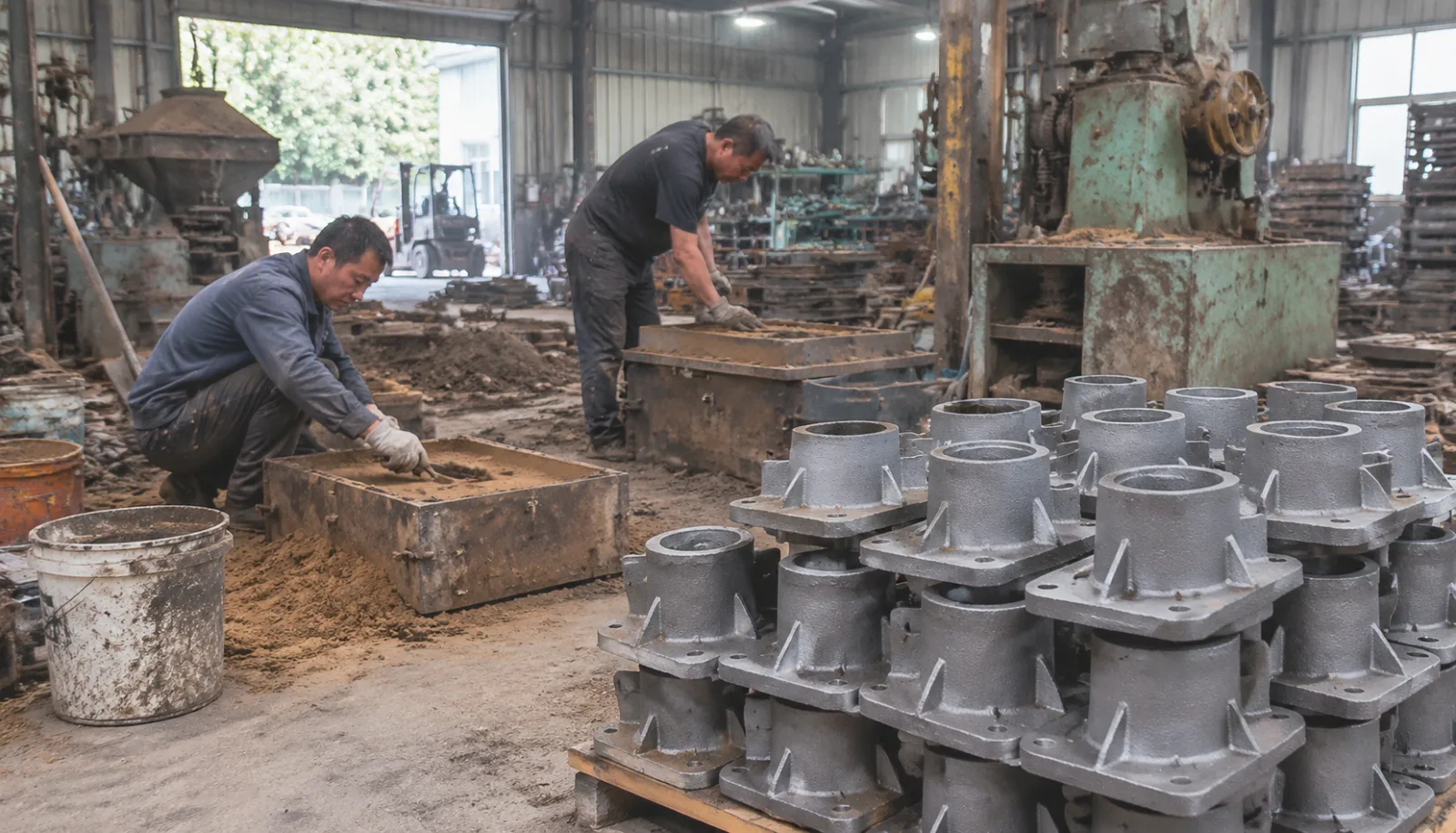
Ask a Chinese foundry whether they subcontract and most will say no, or almost no. Ask which company performs their normalising and the answer is a name in another town. Both answers are given honestly by the same person, because the first is about casting and the second is about everything the casting needs to become a part.
This gap matters because the process route on paper is the basis of your quality plan, your certification and your traceability, and every operation that leaves the building takes all three with it.
What actually leaves the building
| Operation | Typically subcontracted | Why it matters |
|---|---|---|
| Pattern and tooling making | Almost always | Sets dimensional variation for the life of the tool |
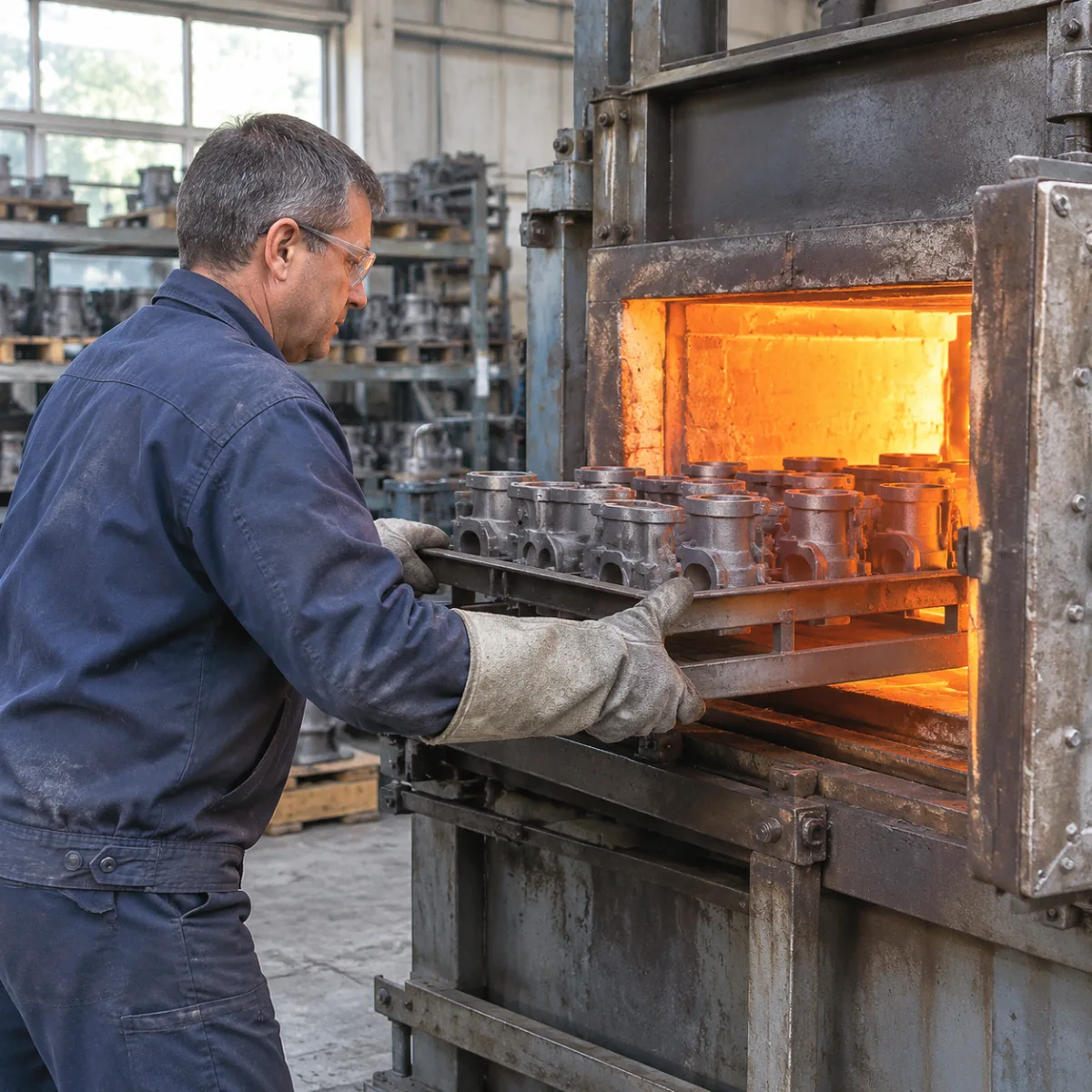
| Heat treatment | Very commonly | Cannot be verified from the finished part; sets mechanical properties |
| Machining | Commonly | Critical dimensions and surface finish live here |
| Radiography, UT, MPI | Usually, for accreditation reasons | Your NDT report comes from a third party, not the foundry |
| Coating, painting, plating | Commonly | Corrosion performance and appearance |
| Moulding or pouring overflow | Sometimes, at peak load | Your casting may be made by a different plant entirely |
The last row is the one that causes real disputes. When a foundry is at capacity, overflow work goes to a partner plant, and the parts arrive with the ordering foundry’s name on the certificate. The dimensional and material evidence may still be valid, but the plant you audited is not the plant that made the part, and in automotive or pressure work that is a qualification failure regardless of part quality.
Why the gap is usually not deception
It helps to understand the mechanism, because it changes how you ask.
- Sales presents the plant, not the supply chain. The quotation describes capability the foundry controls, and heat treatment is not part of that picture in the salesperson’s mind.
- Nobody keeps a single list. Subcontracting is managed operationally — the planner calls the heat treater — and no one maintains a document that says these five operations are external for these part families.
- Disclosure feels like a competitive weakness. A buyer comparing two quotations may read “we subcontract all heat treatment” as a reason to choose the other supplier, even when the other supplier does exactly the same thing.
So the productive request is not “do you subcontract” but “walk me through the route for this part, operation by operation, and tell me which steps happen on this site”. That question is answerable, and it produces a document.
The clause that makes disclosure real
A disclosure clause works when it is short enough to be read and specific enough to be enforced. Four elements:
- A written process route before order acceptance, listing every operation and marking which are performed off-site.
- Named subcontractors with certification references for each external operation, particularly special processes.
- Prior written approval for any change to the route or the subcontractor, with the same notification obligation applying to overflow production at another plant.
- A consequence — undisclosed subcontracting is a nonconformity, and the buyer may reject at the supplier’s cost.
The third element is the one buyers omit and the one that matters most, because the initial route is usually honest. What changes later is the subcontractor, at a busy moment, without anyone thinking to tell you.
How to detect what was not disclosed
You will not catch it from the parts. You catch it from documents and from small inconsistencies.
The certificate header
If your material certificate or heat treatment record is issued by a different company from the one you contracted, there is an external operation in the chain. Read the header of every certificate, not just the values.
The NDT report
NDT reports almost always carry the laboratory’s name and accreditation number. That is expected. What is worth checking is whether the laboratory is the one named in the approved route, and whether it is accredited for the method used.
Hardness and microstructure as a tell
If the heat treatment was not performed to the specified cycle, hardness will often be right while microstructure is wrong, or the scatter across a batch will be wider than a controlled furnace produces. A metallographic report on a sample from two different lots is a cheap way to see whether the process is consistent.
Tooling and pattern marks
Overflow production at a partner plant means a second set of patterns, or your pattern travelling. Marks, plate identification and dimensional drift between lots are the visible traces. This is one more argument for owning and marking your tooling.
Packing and shipping documents
Occasionally the shipping documents name a different shipper or a different factory address from the one on the contract. That is worth a question, asked calmly, before payment.
What to require for each external operation
| Operation | Minimum evidence |
|---|---|
| Heat treatment | Furnace chart or cycle record per batch, with the batch identification linking to your heat numbers |
| NDT | Report naming the method, acceptance level, coverage, operator certification level and the laboratory accreditation |
| Machining | Dimensional report with measured values, and the identity of the machine shop if it is not the supplier |
| Coating | Coating thickness measurements and, where specified, a salt spray report |
| Overflow casting | The name of the plant, and its qualification status for your part |
For special processes, the requirement is not the certificate alone. It is the record that ties the specific batch to your specific parts. A heat treater with a good quality system still needs to show you which cycle ran on your heat.
Five questions that surface the real route
- Walk me through this part from pattern to packing, and tell me at each step whether it happens on this site.
- Who performs the heat treatment, and can I see their certificate and their cycle record for my batch?
- Where is the NDT done, and is that laboratory accredited for the method?
- If your plant is at capacity, will this part be poured elsewhere? Which plant, and is it qualified for this part?
- If any of those answers changes during my order, how and when will I be told?
The fifth question is the one that changes behaviour, because it asks the supplier to commit to a notification process rather than to a fact. Suppliers who answer it in detail have usually been asked before, by a customer with a serious quality system.
Why this is worth the friction
Subcontracting disclosure is not about distrust. It is about the fact that your quality plan, your certification and your traceability are only as complete as the least documented step in your process route. Every external operation without a name, a certificate and a record attached is a place where your evidence chain has a hole.
Buyers who obtain the route in writing get three things: they know which certificates to ask for, they know which operations could change without notice, and they have a contractual basis for the conversation when something does. That is a small amount of paperwork for a large amount of certainty.
Related verification pages
Ask for the route, operation by operation
Send the drawing and we will return the process route with every external operation named, the subcontractor identified, and their certification referenced. If an operation cannot be brought in-house for your part, you will know before you place the order.
Prefer email? cfwc@163.com · WhatsApp +86 159 4126 7000