A salt spray report arrives with a number on it — 500 hours, 720 hours, 1000 hours — and the number gets copied into a specification and treated as a durability guarantee. It is not one. The test is a quality control method for comparing coated specimens under fixed conditions, and its output is only meaningful when read with four other pieces of information that are often missing.
This page is about reading the report properly, and about what to ask for when a supplier sends one page with a headline number and no method.
What the test actually does
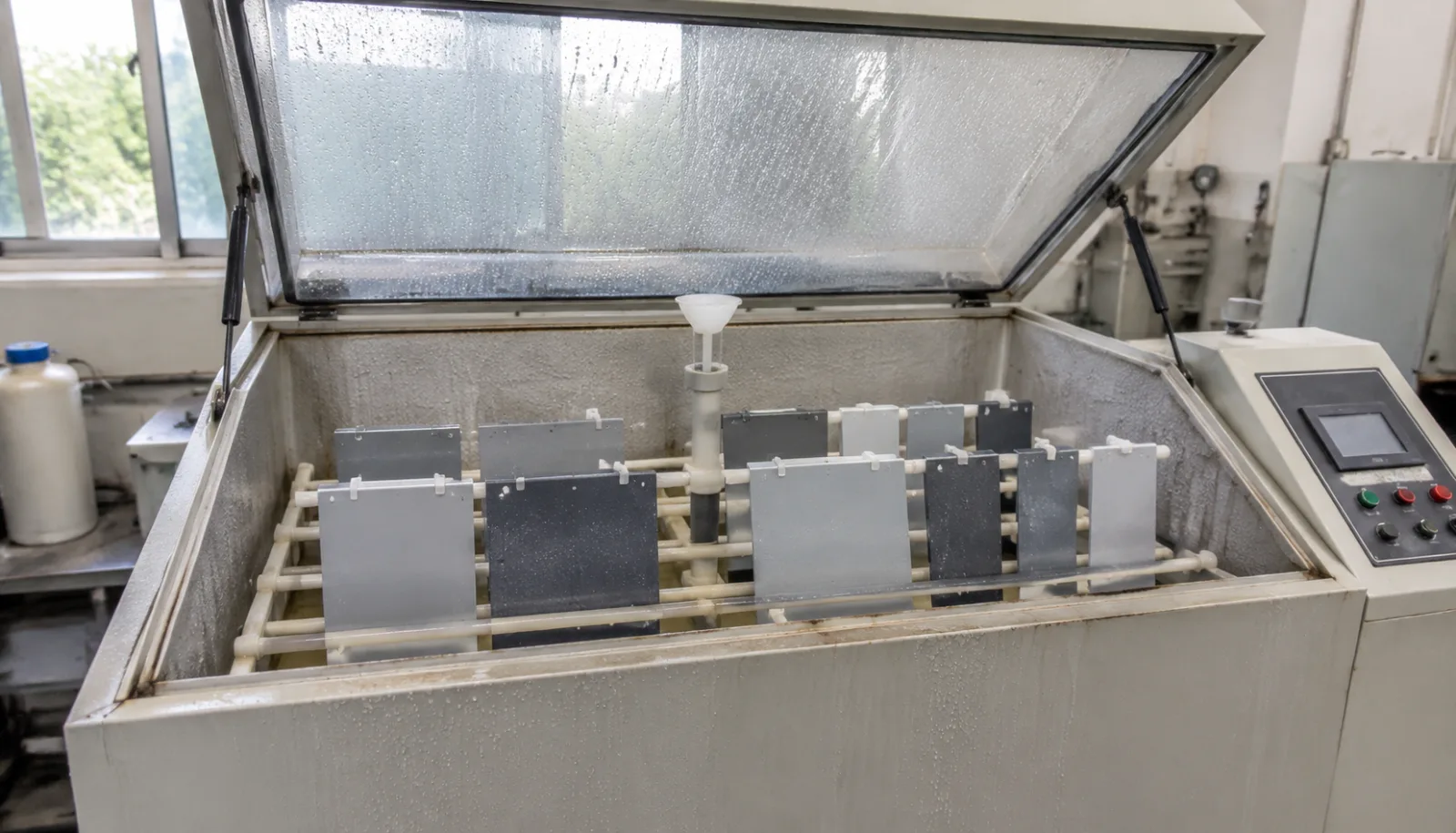
Neutral salt spray testing puts coated specimens in a closed chamber and atomises a salt solution continuously. The standard conditions are broadly similar across the main standards:
| Parameter | Typical requirement |
|---|---|
| Solution | 5% ± 1% sodium chloride |
| pH of collected solution | 6.5 – 7.2 |
| Chamber temperature | 35 ± 2 °C |
| Fog deposition rate | 1 – 2 ml per 80 cm² per hour |
| Panel angle | 15 – 30° from vertical |
| Test duration | As specified, commonly 240 to 1000 hours |
The mechanism is straightforward: chloride attacks the coating, the coating fails at a weak point, and the substrate corrodes. Where it fails first — a scribe, a pinhole, an edge, a porosity site — tells you more about the coating than the headline hour count does.
The four things that make or break the number
1. Coating thickness actually achieved
Salt spray life scales roughly with coating thickness for barrier coatings up to a point, so a 500-hour result on 60 microns and a 500-hour result on 120 microns are not the same claim. The report should state measured thickness on the tested specimens, not the specification range. If it does not, the hour count cannot be compared to anything.
2. Substrate and surface preparation
The same coating performs differently on a blasted surface and a as-cast skin. Casting skin carries scale, sand residue and sometimes graphite exposure on iron, all of which affect adhesion. The report should name the substrate, the surface preparation method and the cleanliness grade achieved.
3. Whether the panel was scribed
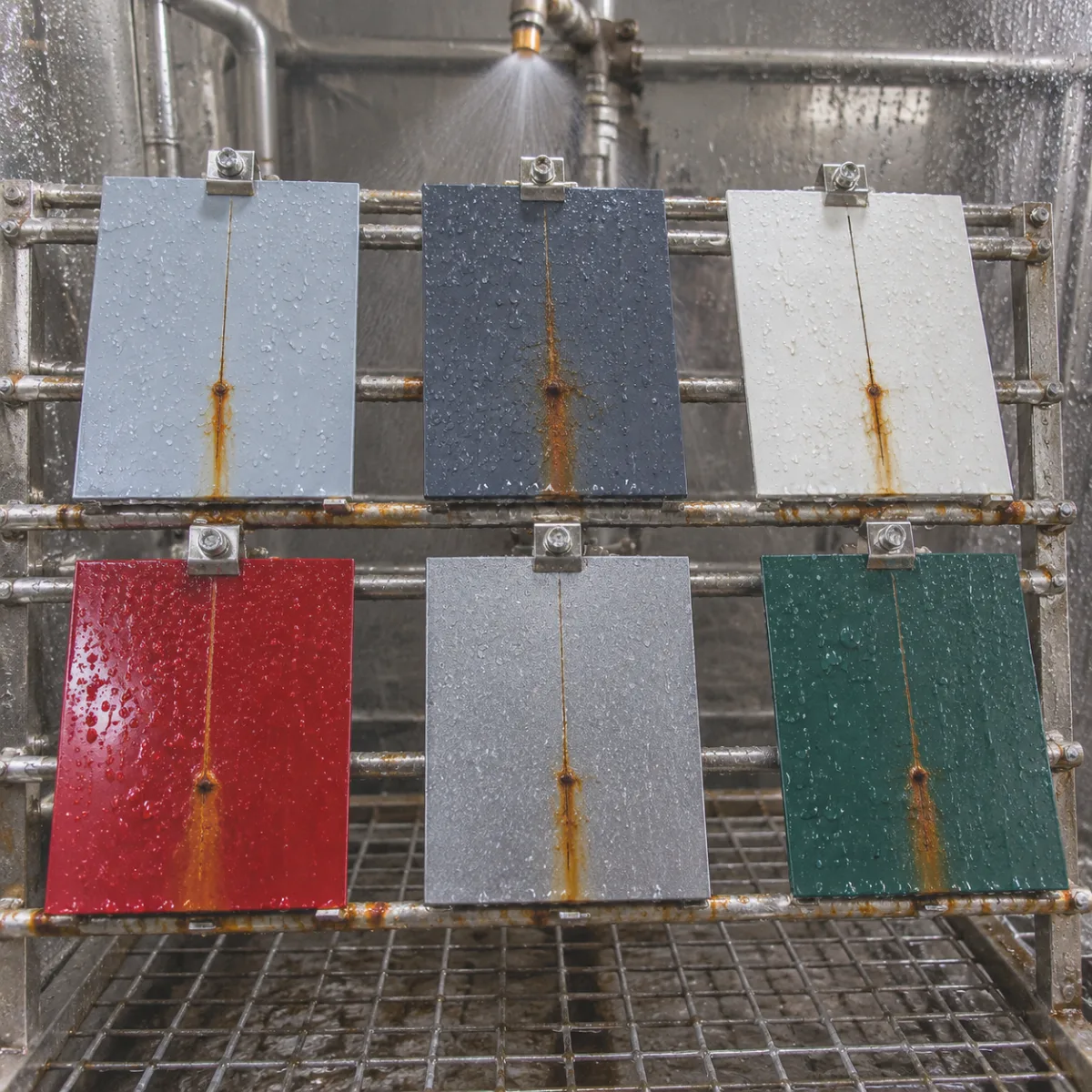
An unscribed panel tests the barrier. A scribed panel tests the barrier plus the coating’s ability to resist undercutting from a damaged edge, which is far closer to what happens to a real part. Scribed results are much harder to pass and much more informative. Ask which one was tested — a supplier quoting a high hour count that turns out to be unscribed has told you less than you thought.
4. The failure criterion
This is the field most often missing and the one that decides everything. “Failed at 720 hours” without a definition of failure is not a result. Useful criteria name the defect, the area and the reference standard:
- Red rust — percentage of area, or millimetres of creep from a scribe.
- Blistering — density and size per ISO 4628-2.
- White rust on zinc coatings — often permitted in defined areas for defined durations.
- Adhesion loss — measured by a cross-cut or pull-off test after exposure.
A report that says “no red rust at 480 hours, less than 2 mm scribe creep at 720 hours, 5 panels tested” is a report you can put in a specification. One that says “passed 720 hours” is a marketing line.
Why you cannot compare hours across labs
Buyers routinely treat salt spray hours as a single scale. In practice two accredited labs testing nominally the same coating can differ by a factor of two, for reasons that are all within the standards:
- Different achieved thickness on the specimen, even when both nominally meet the same range.
- Different edge treatment — masked, coated or bare — which changes where failure initiates.
- Different chamber loading, which changes fog distribution.
- Different interpretation of the same failure criterion by different operators.
- Different standards — ASTM B117 versus ISO 9227 — with small but real differences in apparatus and calibration.
The practical rule: compare results only from the same lab, the same standard and the same reported conditions. When you change labs, treat the numbers as a new baseline, not a continuation. Foundries that switch labs between orders and keep quoting “our coating does 1000 hours” are usually not being clever; they are not tracking the change either.
The six fields a usable report must carry
- Standard and edition — ASTM B117-19, ISO 9227:2022, or equivalent.
- Substrate and surface preparation — material, blast media, cleanliness grade.
- Coating system and measured thickness — each layer, with actual measured values and the method used.
- Specimen configuration — scribed or unscribed, number of panels, edge treatment.
- Test conditions as run — solution concentration, pH, temperature, deposition rate, actual duration.
- Result against a named criterion — defect type, area or creep measurement, reference standard for grading.
If a report is missing three or more of these, treat the number as indicative and ask for a re-test on a defined specimen. A lab that cannot produce these fields is not accredited for the work, whatever the letterhead says.
What salt spray does not tell you
Three limitations worth stating plainly, because they cause expensive misreadings:
It is not a service life predictor. A 1000-hour result does not mean ten years outdoors. The acceleration factor between continuous salt fog and a real environment varies with coating chemistry, temperature cycling, UV exposure and mechanical damage. Salt spray tells you the coating is what it claims to be; it does not tell you when your part will rust.
It ignores UV and cycling. Real exposure involves wet-dry cycles, temperature swings and sunlight. For outdoor coated parts, a cyclic test such as a prohesion or a combined UV/salt cycle says more about real performance than a continuous fog test, at greater cost.
It does not cover internal surfaces. The inside of a casting cavity, a bore or a hollow section is not uniformly fogged. If your corrosion concern is internal — a water jacket, a fluid passage — salt spray on an external panel answers a different question.
What to specify instead of an hour count
A specification that survives contact with reality names the environment and the evidence, not a single number:
- The environment — coastal industrial, road salt exposure, indoor condensing, or chemical.
- The coating system — layers, chemistry, nominal thickness with a measured minimum.
- The test — standard, duration, scribed or unscribed, number of panels.
- The acceptance criterion — the defect and the limit, with the grading standard named.
- The verification frequency — per lot, per quarter, or on change of coating subcontractor.
That last item is the one buyers forget. Coating is almost always subcontracted, and a change of coating shop is a change of process. Requiring a fresh salt spray report whenever the coater changes catches the substitution that a dimensional and visual inspection will never see.
Related verification pages
Specify the environment, not the hours
Describe where the part will live: coastal, road salt, indoor humid, or chemical exposure. We will propose a coating system and the test that supports it, with the standard, the thickness and the acceptance criterion written out rather than a single hour count.
Prefer email? cfwc@163.com · WhatsApp +86 159 4126 7000