Traceability is the difference between a supplier who can answer a question about a specific casting and one who can only answer questions about a shipment. That difference is invisible until something goes wrong, at which point it decides whether a recall covers one carton or six months of production.
This page covers what a heat number actually identifies, where the chain usually breaks, and how to test it in half an hour.
What a heat number identifies — and what it does not
A heat is one furnace charge: one chemistry, one set of test bars, poured into a sequence of molds. The heat number is the thread that ties a physical casting back to that charge and to the results measured on it.
What it does not identify is the individual casting. Two hundred castings from the same heat share a heat number and nothing else. If you need to distinguish them — for a serialised or safety-critical part — you need mold numbers, cavity numbers or serial marking on top of the heat number, and that is a separate requirement to write into the purchase order.
The second thing buyers conflate is heat treatment. A heat number identifies the metal; a heat-treatment lot identifies a furnace cycle. Castings from three heats routinely go through one treatment cycle, and castings from one heat are often split across two. Both numbers belong on the certificate when the part is heat treated.
The chain, link by link
| Link | Record | Where it breaks |
|---|---|---|
| Melt | Pour log: heat number, chemistry, furnace, time | Log written after the fact, or not at all |
| Pour | Which mold numbers were poured from which heat | Missing entirely at small foundries |
| Casting | Heat number marked on the part or tag | Tag swapped when parts are re-palletised |
| Heat treatment | Treatment lot number, cycle, chart | Lot number not linked back to heat |
| Finishing | Heat number carried through shot blast and machining | Lost when parts are dumped into a bin |
| Packing | Heat number per carton on the packing list | Packing list shows only part and quantity |
| Documents | Certificate, invoice, customs papers quoting the heat | Certificate quotes a heat not in the shipment |
Most foundries can do the first link. Far fewer can do the second, which is the mold-to-heat map, and that is the link that decides how precisely a problem can be bounded. Without it, a defect found in one casting implicates the whole heat: potentially hundreds of parts, and every customer who received them.
Physical marking: choose the method deliberately
Traceability lives or dies on whether the number is still on the part when it reaches you. Four methods, in descending order of durability:
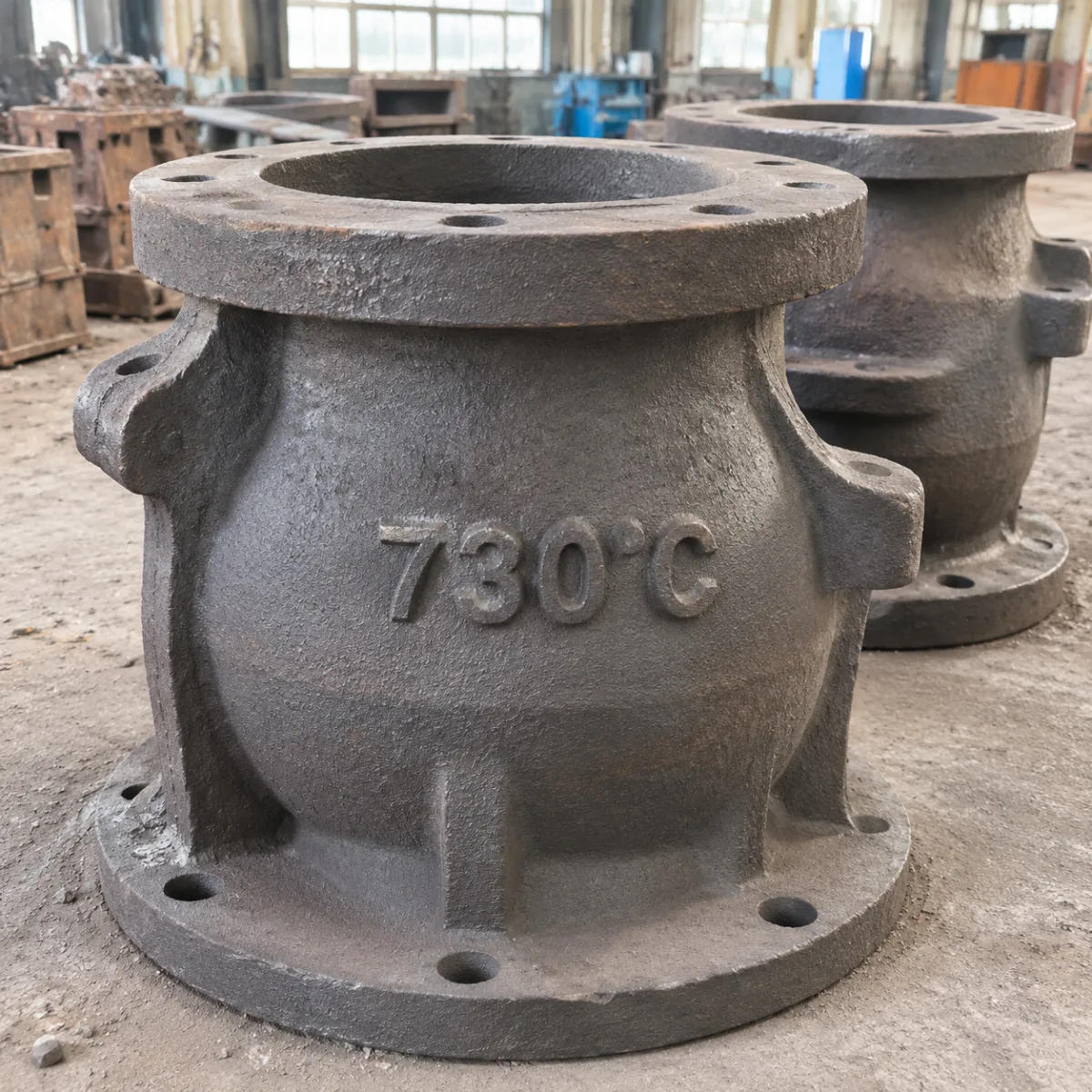
- Cast-on characters — machined into the pattern, reproduced in every casting. Permanent, impossible to swap, and it costs a one-off pattern modification. This is the right choice for anything repeatedly ordered.
- Laser marking — applied to a machined surface. Durable and legible, but only after machining, so it cannot carry through the casting stage.
- Stencil or ink — cheap, visible, and removed by shot blasting or handling. Adequate only if reapplied after finishing.
- Wired or adhesive tags — the default at many foundries and the weakest option, because a tag identifies a bundle rather than a part and moves when the bundle is broken up.
If your drawing does not specify a marking method, you will get the fourth one. Specify cast-on marking in the purchase order and accept the one-off pattern cost; over three years it is cheaper than a single containment exercise.
Where the chain actually breaks
In practice, three failure points account for most traceability problems:
- Re-palletising. Parts are poured into one bin per heat, then consolidated onto shipping pallets by order. If the consolidation is not recorded, the heat-to-carton link is lost at the last step, which is the step your customer will ask about.
- Short-shipment substitution. An order for 500 pieces falls short by 60, and 60 castings from an earlier heat are added to make the quantity. This is common, usually well-intentioned, and it is how a certificate ends up quoting a heat that covers only part of the shipment.
- Subcontracted heat treatment. The treatment lot number is issued by a third party and never merged back into the foundry’s records, so the chain has a hole exactly where the mechanical properties are decided.
A thirty-minute traceability audit
Do this during a factory visit, unannounced if you can. It is more informative than an afternoon of presentations.
- Pick one casting at random from a finished, packed pallet. Note the marking.
- Ask which heat it came from. Time the answer.
- Ask for the pour log for that heat. Check the chemistry is the grade you ordered and the date is before the shipment.
- Ask which mold numbers were poured from that heat, and which molds produced the part number in front of you.
- Ask for the test bar results for that heat. Confirm they are for the same heat, not a neighbouring one.
- Ask for the heat-treatment lot and its furnace chart, if the part is heat treated.
- Ask for the packing list covering that carton. The heat number should be printed on it.
- Repeat steps 1 to 3 with a second casting from a different pallet.
The signal you are listening for is not whether the records exist. It is how they are retrieved. Records fetched from a system in a minute are real. Records that require three phone calls and forty minutes are being assembled for you, and the difference will be far more expensive to discover during a customer complaint than during a visit.
What traceability buys you: bounding a problem
The value of the chain only becomes visible when something goes wrong, so it is worth working through a concrete case.
A customer reports a crack in a pump housing after three months in service. Two hundred housings were shipped. The question your own customer will ask within a day is: how many others are affected?
With a heat number only. You know the cracked part came from heat 240815. That heat produced 1,400 castings across four part numbers, of which 620 went to three customers. You now have to treat all 620 as suspect, notify two other customers, and either replace or inspect them. Cost: a containment exercise measured in weeks.
With heat plus mold-to-heat mapping. The cracked part was mold 37 from that heat. Mold 37 sits in a block poured late in the sequence, when the pouring temperature had dropped and the riser was already freezing. The pour log shows molds 30 to 42 had the lowest temperatures of the heat, and the packing list shows those molds went into two cartons, 48 castings in total. You contain 48 parts, not 620, and you have a process cause you can fix: pour temperature control at the end of a heat.
That is the whole argument for the second link in the chain. It does not prevent the defect. It decides whether discovering the defect costs you a phone call or a recall, and it decides whether you learn the cause or merely the symptom.
Ask any foundry you are evaluating to talk you through a real containment they have run in the last two years. The ones with a working system describe it in specifics — numbers of molds, cartons, hours. The ones without one describe a process instead of an event.
Writing it into the purchase order
Traceability requirements that are not in the contract do not survive the first busy month. Four lines that do most of the work:
- The heat number shall be cast on or permanently marked on every casting, and shall appear on the packing list per carton.
- No substitution of heats after the order quantity is confirmed. Any shortfall shall be shipped as a shortfall.
- The certificate shall list every heat in the shipment; a single heat number covering a multi-heat shipment is not acceptable.
- The supplier shall retain pour logs, mold-to-heat records and treatment charts for a minimum of seven years, and make them available on request within two working days.
None of that is onerous for a foundry that already works this way, and all of it is uncomfortable for one that does not. Which is precisely why it is worth writing down before the first order rather than after the first complaint.
Related verification pages
Ask for a traceability sample
Tell us the part and the annual volume. We send back a redacted traceability pack for a comparable casting — pour log, mold-to-heat map, test bar results and the packing list with heat numbers on it — so you can see the chain before you order.
Prefer email? cfwc@163.com · WhatsApp +86 159 4126 7000