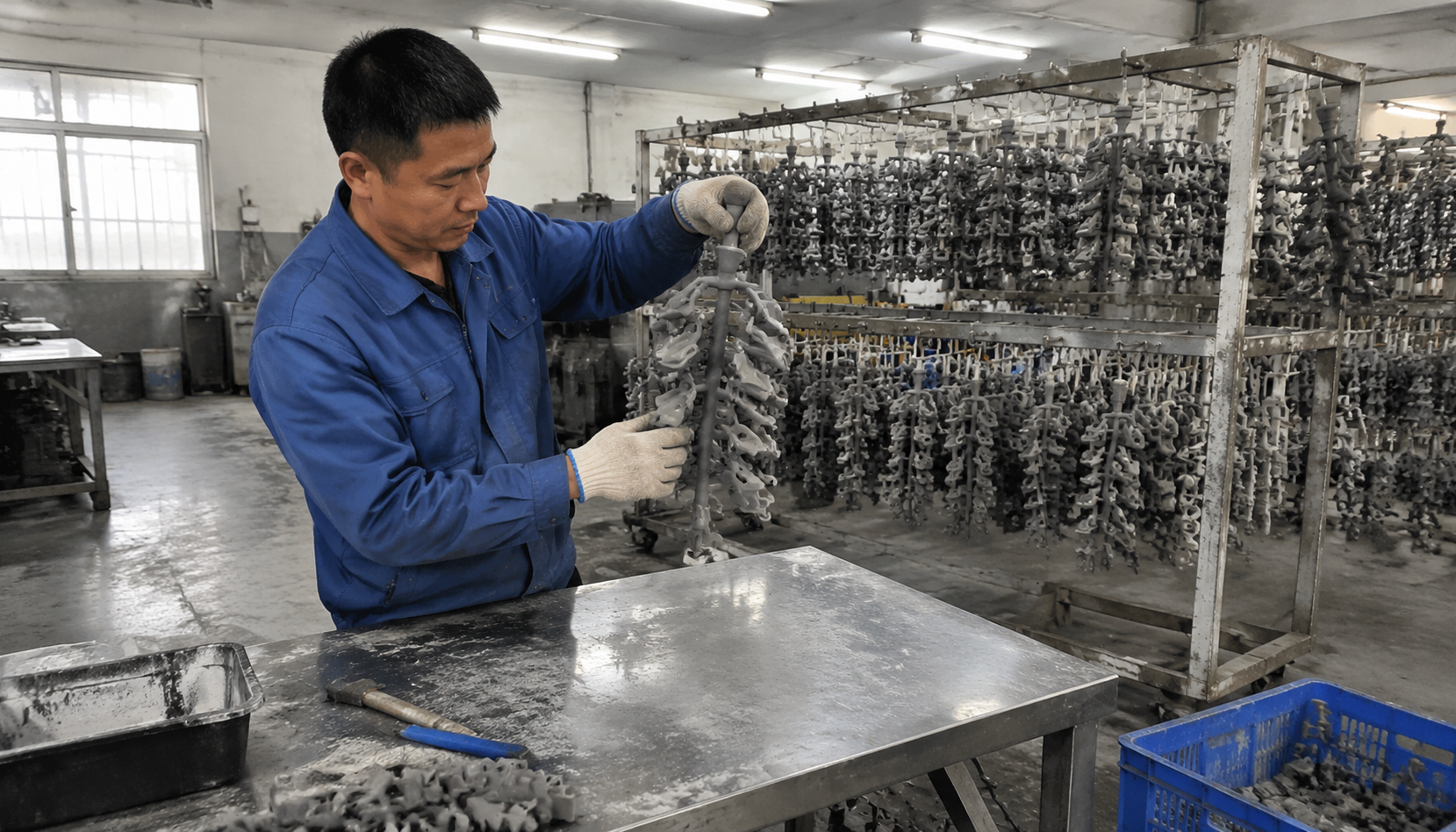
Two years ago a pump manufacturer in Ohio wired a 40% deposit — $18,400 — to a "foundry" in Ningbo for 2,000 aluminium investment cast impellers. The samples had been flawless. Bright, clean, dimensions dead on. Then the production lot landed, and 380 of the 2,000 had sponge-textured porosity right where the hub meets the vane. Machining opened up cavities that looked like worm tracks. The buyer sent photos. The reply came back in eleven words: "This is normal for casting. We can offer 5% discount."
Then the emails started bouncing.
It took six weeks and a local inspector to work out what had happened. The "foundry" was a two-person export office on the fourth floor of a trading building. The samples had come from one workshop. The production run — cheaper, faster, no X-ray, no heat treat — came from another. Nobody had lied outright. Nobody had to.
That story is not unusual, and it is not really a story about China's casting capability. Chinese foundries pour some of the best aluminium investment castings in the world. It's a story about what the word "supplier" hides, and how little most overseas buyers know about what sits behind the quotation they accept.
This guide is the checklist that buyer didn't have. Work through it before the deposit leaves your account, not after.
Why "aluminium investment casting supplier" means three different businesses in China
Search that phrase and you'll get websites that look identical. Same stock photos of glowing furnaces. Same ISO 9001 badge. Same "20 years experience, 15,000 m² workshop." Roughly half of them don't own a wax injection machine.
There are three types, and they behave very differently when a problem shows up.
| Type | What they actually own | Behaviour when defects appear |
|---|---|---|
| Real foundry | Wax presses, shell line, melting furnace, spectrometer, heat treat furnace, sometimes in-house machining | Can trace the heat number, re-pour, adjust the process. Slower to admit fault, faster to fix it. |
| Trading company with a partner foundry | An office and a long-term relationship with one or two workshops | Depends entirely on how much leverage they have. Good ones are excellent. Bad ones disappear behind "the factory says." |
| Export desk / broker | Nothing. They quote from whoever answers the phone. | Vanishes. This is who you're usually talking to when the price is 30% under everyone else. |
Trading companies aren't automatically bad. A competent one that has used the same foundry for nine years can save you a lot of pain on communication, consolidation and export paperwork. But you need to know which one you're dealing with, because the checks you run are different. With a real foundry you audit the plant. With a trading company you audit the plant and the relationship.
Five failures that actually cost aluminium casting buyers money
You can read a hundred articles about casting defects. In practice, the money leaks out through five specific holes.
1. Porosity that only appears after machining
Investment casting gives you a good surface. It does not guarantee an internally sound section. Shrinkage porosity forms at the last point to solidify — usually a thick hub, a boss, or a junction where two sections meet. It hides under 2 mm of clean skin. The moment your machinist bores into it, the part is scrap and the argument starts.
Fix it in the PO, not in the argument. Specify radiography to ASTM E505 severity levels (level 1 for critical sections, level 2–3 for general), state which zones are critical, and require the film or digital images with each lot. A foundry that can't produce X-ray images in-house will always be guessing.
2. Alloy substitution
A356.0-T6 and whatever came out of the scrap bin can look identical on a polished casting. The difference shows up as iron content above 0.20%, gas porosity from poor degassing, and mechanical properties that quietly miss the mark. It also shows up eight months later as corrosion pitting on a part that was supposed to be in a marine environment.
Ask for the spectrometer printout per heat — not a generic mill certificate for "aluminium alloy." If the answer is "our material supplier provides the certificate," you're buying someone else's ingot with no idea what happened between the ingot and the mould.
3. Heat treatment quietly skipped
T6 means solution treatment around 540 °C, a quench fast enough to hold the alloying elements in solution, then artificial ageing at roughly 155–175 °C. Skip the quench speed or the ageing time and you get a part that machines beautifully and cracks in service. On a small order, skipping a furnace cycle is a very tempting shortcut.
Demand the furnace chart with the lot. A real foundry has a chart recorder or a digital log per load. A broker has a shrug.
4. Samples from workshop A, production from workshop B
The most expensive failure of all, because the sample told you everything was fine. Watch for a first article that arrives fast and cheap, a tooling invoice that never quite materialises, or a reluctance to let an inspector film the pour. Ask directly: "Will my production run come off the same line as the samples?" Get it in writing. Then verify with a mid-production visit or a third-party inspection during the run, not after.
5. Dimensional drift across the lot
Wax shrinks. Aluminium shrinks about 1.3% linearly. Ceramic shell expands. Get the tooling compensation slightly wrong, or let the slurry temperature wander, and the first fifty pieces pass while pieces 400 to 600 sit outside tolerance. By the time your incoming inspection catches it, the container is already on the water.
The answer is a dimensional report with actual measured values on the first article, and a documented SPC check every 50–100 pieces during the run. Not a "yes, we check dimensions" email.
Seven checks that separate a real aluminium investment caster from a reseller
None of these require you to fly to China. All of them require the supplier to answer a specific question with a specific answer. Vagueness is the tell.
1. How many wax injection machines, and what tonnage?
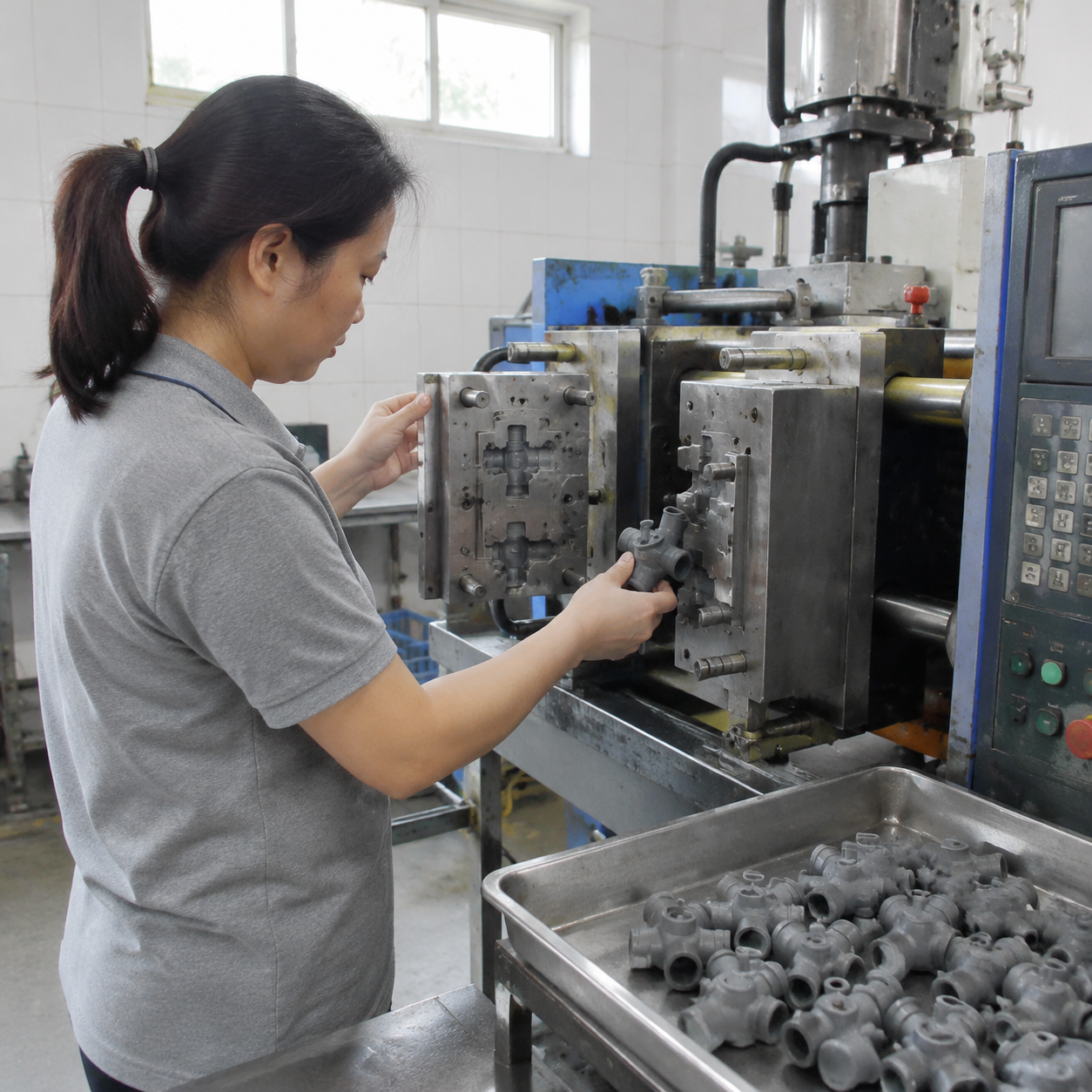
A working investment casting shop has multiple wax presses because the wax die sets run in parallel. A shop with one machine and a smooth sales pitch is either very small or not casting your parts at all. Ask for a photo of the machine bay with the machines visible — not a rendered 3D floor plan.
2. Walk me through your shell line
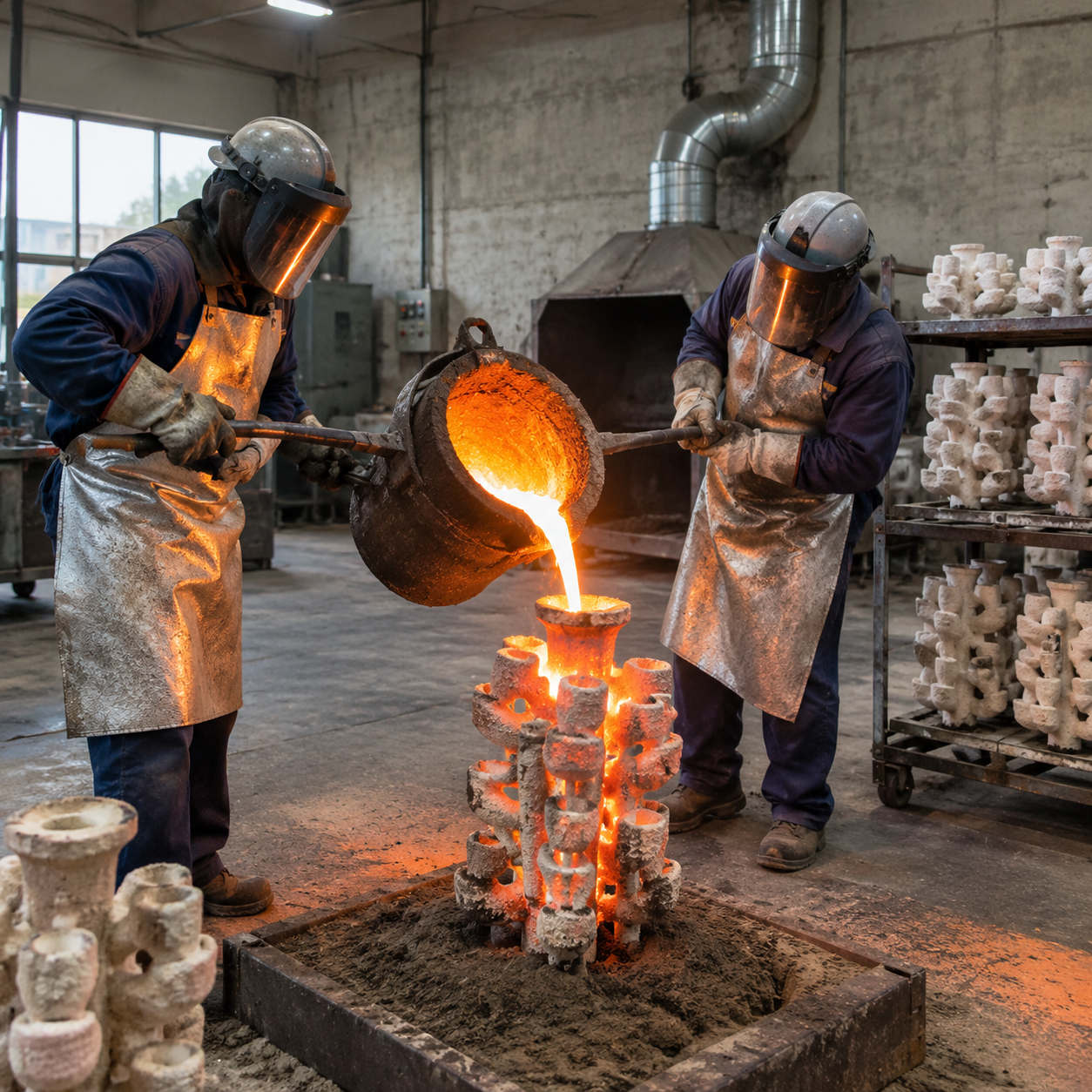
Investment casting builds a ceramic shell in coats: typically 5 to 7, alternating slurry dips and stucco applications of increasing grit size, each dried under controlled humidity. Ask how many slurry tanks they run, what binder system (colloidal silica is standard for aluminium), and how they control drying humidity. Someone who actually runs the line will answer in thirty seconds. Someone reading from a brochure will say "advanced equipment."
3. What kind of melting furnace?
For aluminium, a crucible or induction furnace with a covered melt and argon or nitrogen degassing is normal. Gas-fired open crucibles with no degassing table produce exactly the gas porosity that ruins machined parts. Ask what degassing they use. If the answer is "we use good material," move on.
4. Is there a spectrometer on site, and can I see a raw readout?
Optical emission spectrometry is the only way to confirm chemistry before the pour. It's a $25,000–$40,000 instrument, which is exactly why brokers don't own one. Ask for a photo of the machine and a recent printout with the heat number visible.
5. Do you have an in-house X-ray room?
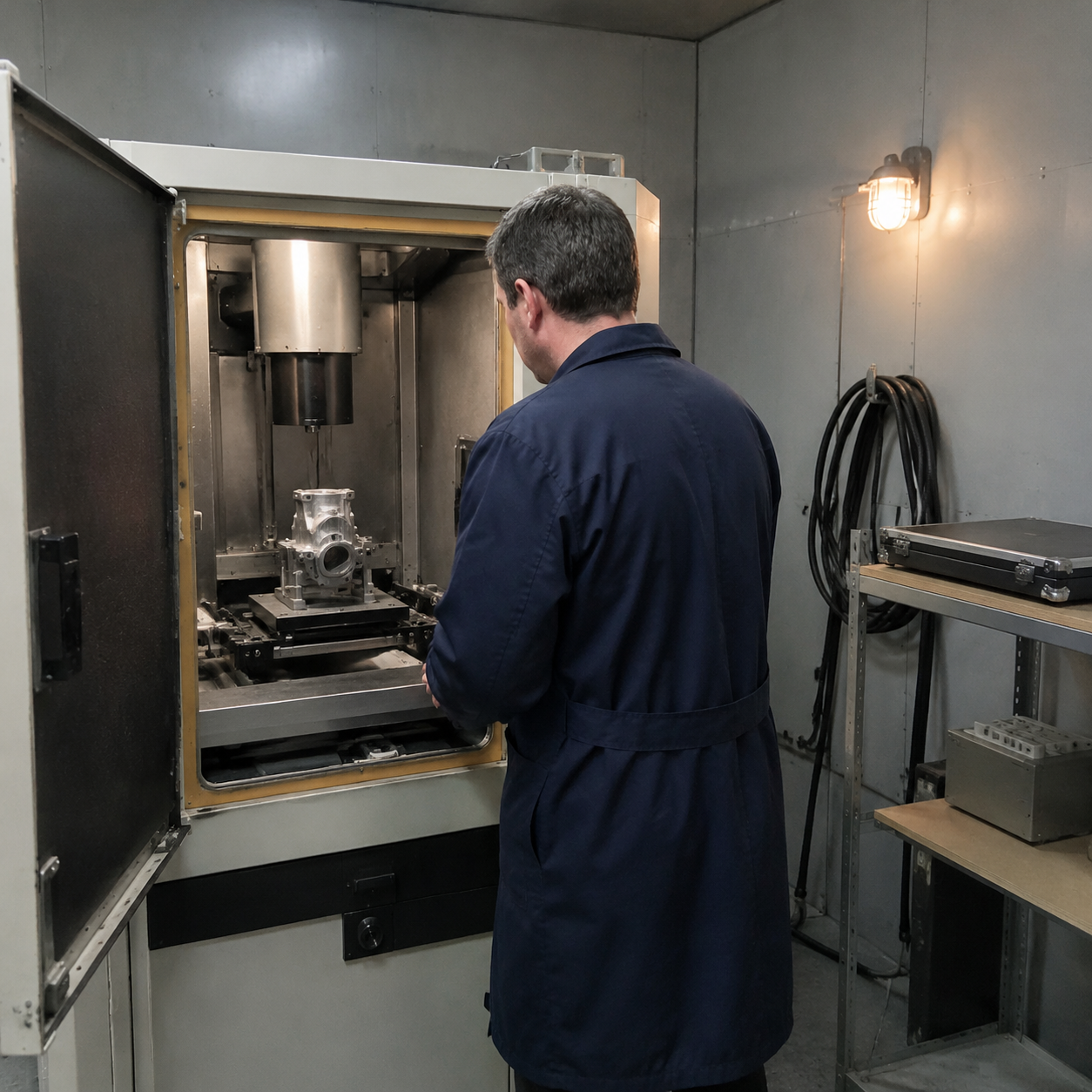
Not "we cooperate with a testing lab." An actual shielded room with a film or digital radiography unit. For aluminium castings, ASTM E505 is the reference standard for porosity severity. If they send everything out, turnaround becomes a week, which means they'll skip it on small orders.
6. Show me a heat treatment chart from last month
Any chart. From any job. You're not checking the numbers, you're checking whether the document exists at all. A foundry that does T6 in-house has stacks of them.
7. Which three customers did you ship this product category to in the last year?
Not customer names — they won't give you those, and shouldn't. Ask for product descriptions and shipping marks (photos of cartons with the marks blacked out). A shop that genuinely exports pump housings or marine fittings will have photos on someone's phone. A broker will change the subject to price.
If a supplier can't answer five of these seven in one email, the price they quoted you is not a price for the part you designed.
The ten-minute check most buyers skip: the business licence
Any Chinese company can hand you a business licence scan. What matters is whether the licence matches the story you were told.
Every mainland company carries an 18-character unified social credit code, and the record behind it is public on the National Enterprise Credit Information Publicity System at gsxt.gov.cn. Three fields are worth reading before anything else:
- Business scope. Does it include casting, metal products manufacturing or mould making? A pure trading or import-export scope is not fraud in itself, but it means the "foundry" is a trader, and your audit just changed shape.
- Registered capital and address. Neither proves quality. But ¥500,000 of registered capital and a claimed 15,000 m² plant don't belong in the same sentence, and an address in a city-centre office tower usually isn't where the furnaces are.
- Company name on the contract, invoice and bank account. All three should match. A payment instruction pointing at a personal account or an unrelated third company is the single most common fraud marker in Chinese sourcing.
Documents that should arrive with every lot
This is the part most buyers get wrong, and it's the cheapest insurance you'll ever buy. Add these to the purchase order as a delivery condition, not a favour:
- EN 10204 Type 3.1 inspection certificate — specific to your heat number, not a generic material cert.
- Chemical composition report from the foundry's own spectrometer, listing all elements including iron and silicon.
- Mechanical properties from test bars cast with the same lot: ultimate tensile strength, yield at 0.2%, elongation, hardness. For A356.0-T6 expect roughly 250–280 MPa UTS, 200–230 MPa yield, 5–8% elongation and 70–100 HB — if the numbers come in low, the heat treat is suspect.
- Radiographic images per ASTM E505 with the severity level stated and the acceptance criteria written on the report.
- Dimensional report with measured values against the drawing, not a tick box saying "OK."
- Heat treatment chart for the load your parts were in.
- Dye penetrant report if the part has surface-critical areas.
- First article inspection report on the first production lot, ballooned to the drawing.
One more thing: make sure the heat number stamped or tagged on the parts matches the certificate. Mixed heats are how a good foundry turns into a bad supplier without anyone deciding to be dishonest.
Which aluminium alloys Chinese foundries cast — and what to put on the drawing
Most aluminium investment casting in China runs through a small family of alloys. Being specific on the drawing removes the room for "equivalent material" improvisation.
| Alloy | Equivalent / where you'll see it | Typical use |
|---|---|---|
| A356.0 | AlSi7Mg0.3, EN AC-42100 | General engineering parts, pump bodies, housings, T6 standard |
| A357.0 | AlSi7Mg0.6 | Higher strength, pressure-tight parts, aerospace-adjacent work |
| C355.0 | — | Elevated temperature service, cylinder heads |
| AlSi12 | LM6, EN AC-44100 | Thin walls, corrosion resistance, marine |
| LM25 | UK BS 1490, near A356 | Common on UK/EU legacy drawings |
Three lines on the drawing will save you months:
- "Primary ingot only. No secondary/recycled ingot without written approval." Secondary ingot is cheaper and legal, but iron and gas content drift. If the part matters, say so.
- "Heat treat to T6, solution 540 °C ± 10, polymer or water quench, age 165 °C ± 5 for 6–8 h. Chart required." Vague "T6" invites a vague furnace cycle.
- "Radiographic acceptance per ASTM E505, severity level 2 in zones A and B, level 3 elsewhere. Critical zones marked on drawing." Undefined acceptance criteria means the argument is decided by whoever is more stubborn.
Tolerances: what aluminium investment casting can actually hold
Buyers regularly send drawings asking for ±0.05 mm on a cast surface. That's a machining tolerance, and no foundry anywhere in the world will hold it on a raw casting. Here's the realistic envelope for aluminium lost-wax:
- Tolerances: ISO 8062-3 DCTG 4–6. Roughly ±0.10 mm on features under 25 mm, ±0.15 mm at 50 mm, ±0.25 mm at 100 mm, growing with size.
- Minimum wall: 1.5 mm on small parts under 100 g, 2.0–2.5 mm on larger castings. Thinner is possible but yield falls and price climbs.
- Surface finish: typically Ra 3.2–6.3 µm as-cast, better on the die side of the wax pattern.
- Draft: not required. This is the main reason to pick investment casting over sand for complex geometry.
- Machining stock: leave 1.0–2.0 mm on faces you'll machine. It absorbs cast variation and removes surface defects in one pass.
If a supplier promises ±0.05 mm as-cast without blinking, they either didn't read the drawing or they plan to sort parts and charge you later.
Aluminium investment casting prices in China: where the money actually goes
Price per kilogram is a bad way to buy investment castings, and Chinese suppliers know it. For aluminium lost-wax work, labour and shell material dominate — a 200 g part with a complex internal core can cost more than a 2 kg blocky bracket.
Rough numbers to sanity-check quotes against, based on 2026 quoting patterns for 500–5,000 piece runs:
| Part type | Typical unit price (FOB) | Notes |
|---|---|---|
| Simple bracket, 0.1–0.5 kg, no machining | $1.20 – $3.00 | High volume, low defect risk |
| Pump impeller, 0.3–1 kg, balanced | $4.00 – $12.00 | Balancing and X-ray add cost |
| Valve body, pressure-tight, 1–3 kg | $12.00 – $35.00 | Pressure test + radiography mandatory |
| Marine fitting, corrosion grade, 0.5–2 kg | $6.00 – $18.00 | Alloy discipline and passivation matter |
| Machined + anodised assembly | $25.00 – $80.00 | Machining often exceeds casting cost |
Tooling is separate: aluminium wax dies typically run $1,500–$6,000 depending on cavity count and complexity. Multi-cavity dies cut piece price at volume but raise the upfront number and the risk if the design changes.
When a quote comes in 30–40% below everyone else, one of four things is true: no X-ray, no heat treat, secondary ingot, or it's not their factory. Ask which one. The answer is usually silence.
For a deeper breakdown of how the line items stack up, see our casting cost breakdown.
The factory audit you can run from your desk
You don't need to book a flight for the first round. You need a supplier who doesn't flinch at these four requests.
- A live video walk-through. Not a pre-recorded video. Ask them to start at the wax room and walk to shipping, in one continuous call. Ask them to open the heat treatment furnace door. Ask them to point the camera at the spectrometer's last printout.
- Photos of your specific part in process. Wax pattern, shell before dewax, casting after knockout. Any real foundry photographs its own work. This also tells you whether your job exists yet.
- A third-party pre-shipment inspection. SGS, BV, TÜV or a local engineering firm, scoped to dimensional check plus document review. Budget $300–$600. A supplier who resists third-party inspection has told you everything.
- Two reference buyers outside China. Ask for buyers in a different region from you — they're more likely to talk honestly.
Our factory audit checklist has the full 40-point version if you're going deeper, and the printable one-page version lives in the checklist library.
Payment terms and the deposit trap
Standard terms are 30% deposit with order, 70% before shipment. That's normal and generally acceptable — but the details around it are where buyers get hurt.
- Never 100% in advance, no matter how good the discount sounds. The discount is priced against the risk you're carrying.
- Tie the balance to inspection release, in writing: "Balance payable after buyer's or third-party inspection report confirms conformity." Suppliers who refuse this are telling you the inspection will find something.
- Pay the tooling separately and get the die ownership in writing. "Wax die remains buyer's property and will be shipped or transferred on request." Without that line, changing suppliers later means paying for the tooling twice.
- Above about $50,000, consider a letter of credit or an escrow arrangement. The bank fee is cheaper than a bad lot.
- Check the bank account name against the company name on the contract. Payments to a personal account or an unrelated third-party company are one of the most common fraud patterns in Chinese sourcing.
Lead times from China, and what the delays actually mean
A realistic schedule from PO to delivery at your dock:
| Stage | Duration | What a delay signals |
|---|---|---|
| Wax die tooling | 20–30 days | Tooling "delayed" often means it was subcontracted and the shop is queuing |
| First article samples | 5–10 days | Samples arriving in 3 days from a complex part = they didn't cast it |
| Sample approval loop | 7–14 days | Plan for at least one correction round |
| Production | 25–40 days | "Waiting on material" usually means they order ingot per job, not per stock |
| Sea freight to US East Coast | 25–35 days | Add 7–10 days for port congestion in peak season |
| Sea freight to Northern Europe | 30–40 days | — |
Build 20% buffer into your first order. Nobody's first aluminium investment casting order from a new Chinese supplier arrives on the originally promised date, and the ones that do are usually the ones that skipped a step.
Common mistakes to avoid
Choosing on unit price alone
A $0.40 difference on a $4.00 part across 2,000 pieces is $800. One rejected lot costs more than that in freight, inspection and schedule.
Skipping the drawing review
Send the drawing and ask three questions: what's your minimum wall on this geometry, which features will you machine, and what tolerance can you actually hold on the bore? The quality of the answers tells you more than the audit.
Not specifying acceptance criteria
"No visible defects" is not a specification. It's an invitation to a negotiation you'll lose.
Approving samples without a report
A sample with no dimensional report is a pretty object, not an approval. Ask for the measured values before you sign.
Treating the first shipment as the relationship
The test of a supplier isn't the first lot. It's the third lot, when everyone's comfortable and the rush is on.
Frequently asked questions
How much does aluminium investment casting cost in China?
Most parts land between $3.50 and $7.50 per kilogram, but per-piece pricing is driven by shell volume, core complexity and finishing labour, not weight. Simple brackets at 500+ pieces run $1.20–$3.00 each; pressure-tight valve bodies with X-ray and machining run $12–$35 each. Tooling is separate at $1,500–$6,000.
What's a realistic MOQ?
100–500 pieces per part number. Below 100, wax die cost and setup dominate and most foundries won't quote. If a broker offers you 50 pieces, ask whose wax tree your parts are sharing — mixed heats are the usual result.
Can I get a Chinese foundry to hold ±0.05 mm?
Not on a raw casting. ISO 8062-3 DCTG 4–6 is the realistic band, roughly ±0.10 mm under 25 mm and ±0.25 mm at 100 mm. Anything tighter needs a machining operation, and you should budget 1.0–2.0 mm of stock for it.
How do I verify the alloy is actually A356 and not scrap?
Demand a spectrometer printout per heat with the heat number visible, cross-checked against the stamp on the parts. Add "primary ingot only" to the drawing. If the foundry can't show you a raw readout from their own machine, you're buying on trust, not verification.
Is a trading company ever the better choice?
Sometimes, yes. A good one handles consolidation across multiple processes, export documentation and English-language project management better than a 200-person workshop will. The condition is simple: they tell you which foundry is casting your parts, and they let you or a third party inspect it. If either of those is a problem, walk.
What about tariffs?
US importers should verify the current classification on the HTS database (aluminium castings generally fall under 7616.99) and the Section 301 status before you price the job — the rates have moved more than once and the schedule is worth confirming with your customs broker rather than a supplier's sales email.
Next step: the one-page version
If you take nothing else from this, take the sequence. Before the deposit: confirm whether they own a wax press, a spectrometer, an X-ray room and a heat treat furnace — with photos, not adjectives. Before the tooling payment: get die ownership in writing. Before the balance payment: get the inspection report in your hand.
That's it. Three gates, and the Ohio impeller story stops being your story.
If you want a second opinion on a quotation or a drawing before you commit, send the part drawing and the quote you've received. We'll tell you what's missing from the specification, what the price should look like, and which questions to send back — no obligation, no sales call. More on alloy specs and drawing conventions sits in our buyer guides.
Need Help with Aluminium Investment Casting Suppliers in China (2026 Guide)?
Get matched with 3 verified foundries in 24 hours. No markup, transparent pricing.
Request Quotes →Related: verified foundry capability — the operating envelope and the verified foundries we shortlist against.
Send one drawing, get a costed quote
Attach the 3D file or the 2D drawing. Include the alloy, the tolerance class you actually need and the annual quantity. You get a quotation with tooling, unit cost, lead time and inspection scope separated, within 24 hours.
Prefer email? cfwc@163.com · WhatsApp +86 159 4126 7000