Two years ago I signed a PO for 316 stainless valve bodies at $16.80 a kilogram. Then a shop I'd never heard of quoted $8.40 for the identical drawing. Same alloy. Same tolerance callouts. Same annual volume, same Incoterm.
I took the $8.40.
Eleven months later I was air-freighting replacement bodies to two distributors and eating a $47,000 chargeback. The parts passed dimensional inspection on arrival. They failed a salt-spray test in my customer's hands, because the "316" was 304 with a certificate that had been photocopied so many times the mill heat number had gone soft and grey at the edges.
That's not a story about being robbed. That's a story about not knowing what's inside a per-kilo number. And once you know what's inside it, you can read a quote in about ninety seconds and spot the ones that are lying to you.
One note on where the numbers in this article come from. Everything below is drawn from roughly 140 quotes I've collected since 2023 — as-cast and machined, seven countries, parts from 40 grams to 11 kilos — plus published alloy pricing for the same months. Where you see a range, it's the middle 80% of what actually landed in my inbox, not a best case. Where a line is a judgment call rather than an observation, I say so.
What's Actually Inside an Investment Casting Price Per Kg
Here's the part most buyers never see. A per-kilo price on a lost-wax casting is a bundle of at least nine separate cost centers, and the supplier decides how to allocate them. That's why the same part can come back at $6.20 and $11.80 from two shops with the same electricity bill.
Let me walk through a real one. I'll use a 1.2 kg 316 stainless valve body, 2,000 pieces a year, as-cast with light fettling, no machining.
1. Metal — and the two weights nobody explains
316 stainless raw stock sits roughly $2.80–$3.60 per kg depending on the month and where nickel is. So naive math says metal is about $3 a kilo.
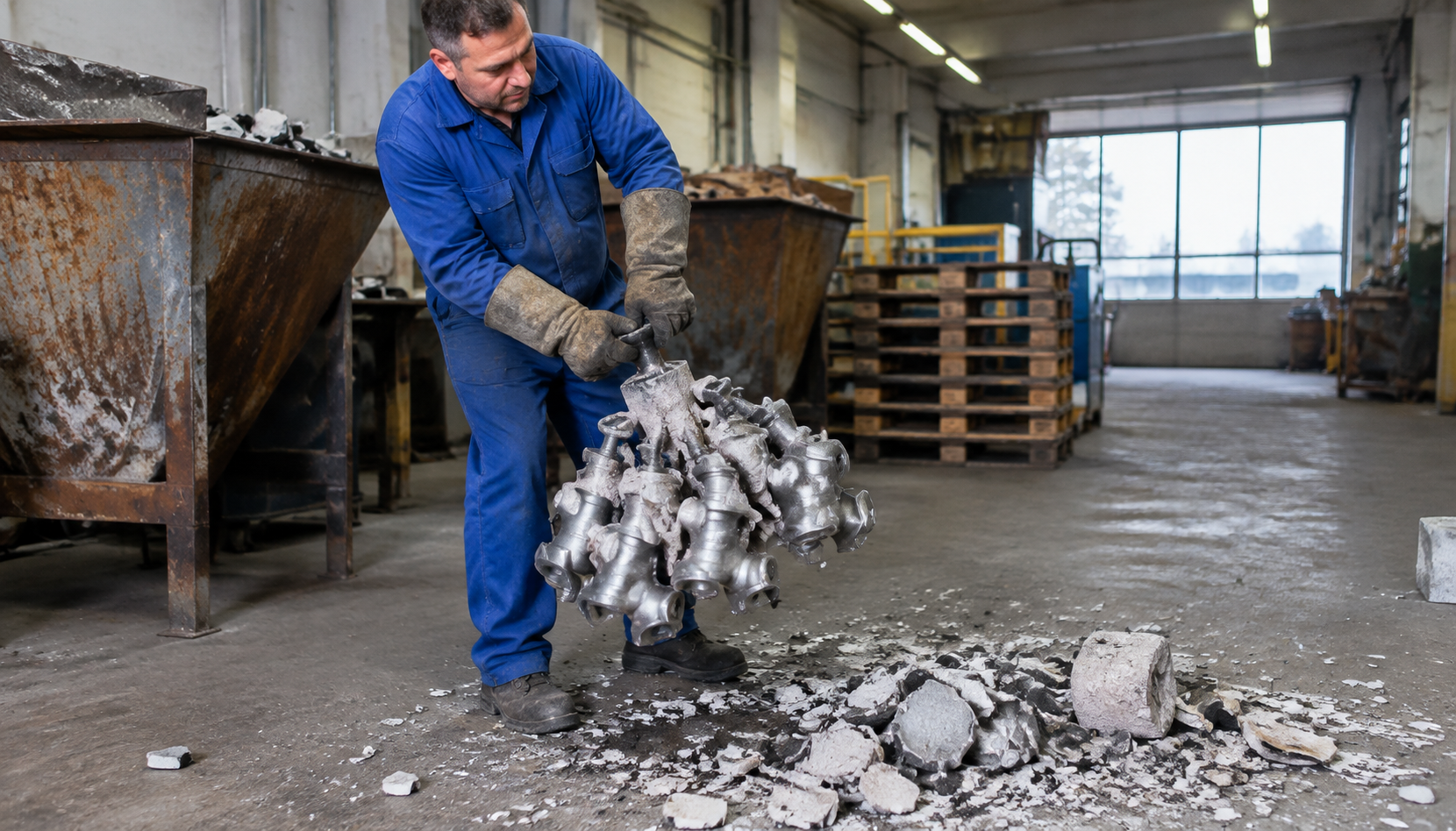
Wrong, but not in the direction most people think. On a 1.2 kg casting you pour more than you keep. The running yield on a small-to-mid wax tree is typically 1.6:1 to 2.2:1 — for every kilo of good casting you melt 1.6 to 2.2 kilos of metal. The gating and sprue don't vanish, though. They come back as your own returns, and they get re-melted next heat.
So you don't buy the gating twice. You do melt it twice, you lose 2–4% of it to oxidation and slag every cycle, and most shops apply a 10–15% haircut on the return credit because they aren't a scrap dealer. Net it out and metal lands at $3.60–$4.80 per kilo of finished casting — not the $5.50 the crude yield multiplication suggests. I've seen buyers argue themselves into a bad decision by doing that multiplication the wrong way.
Now the trap. Suppliers quote two different weights and don't always tell you which one the rate applies to. Poured weight is what leaves the furnace, gating included. Casting weight is what's left after cut-off. On a 1.8:1 tree, a rate quoted per poured kilo looks about 45% cheaper than the same money quoted per casting kilo. Two quotes that "differ by 45%" may be identical. Ask which weight the number is attached to before you compare anything else.
And ask what yield they assumed. If they can't answer, they either guessed or they're planning to make it up in scrap charges later.
2. Shell and refractory
Investment casting isn't cheap on consumables. A proper silica-sol shell with a zircon face coat and back-up layers of mullite or chamotte runs roughly $0.70–$1.80 per kilo of finished casting for parts in this weight band. Small parts are brutal here — a 60-gram fitting burns almost the same shell material as a 600-gram one.
3. Wax and tooling amortization
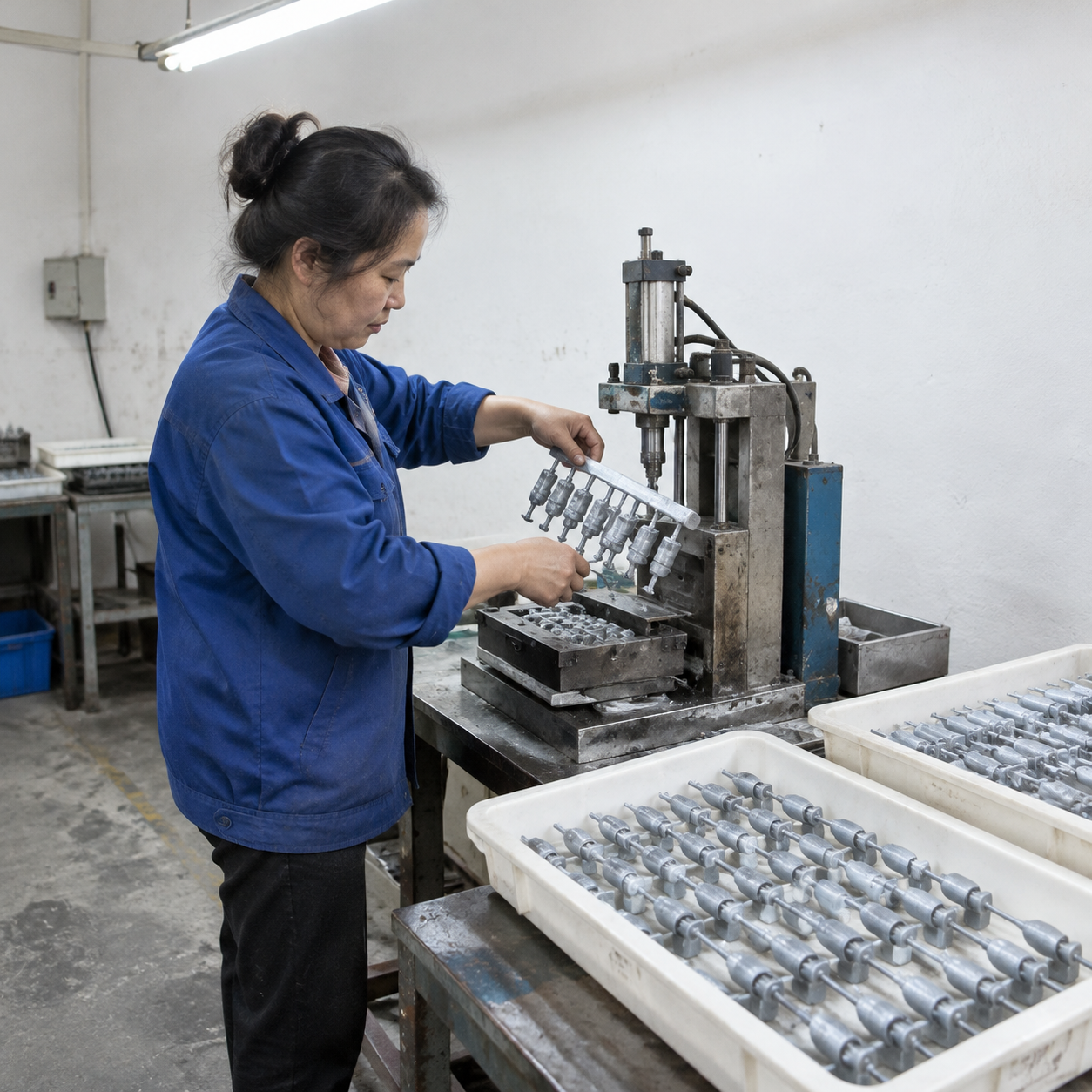
Wax pattern material, injection labor, and the aluminum wax die. The die is a one-time cost (more on NRE below), but wax itself still runs $0.30–$0.70/kg of casting, plus the man-hours to assemble and clean the tree.
4. Melting energy
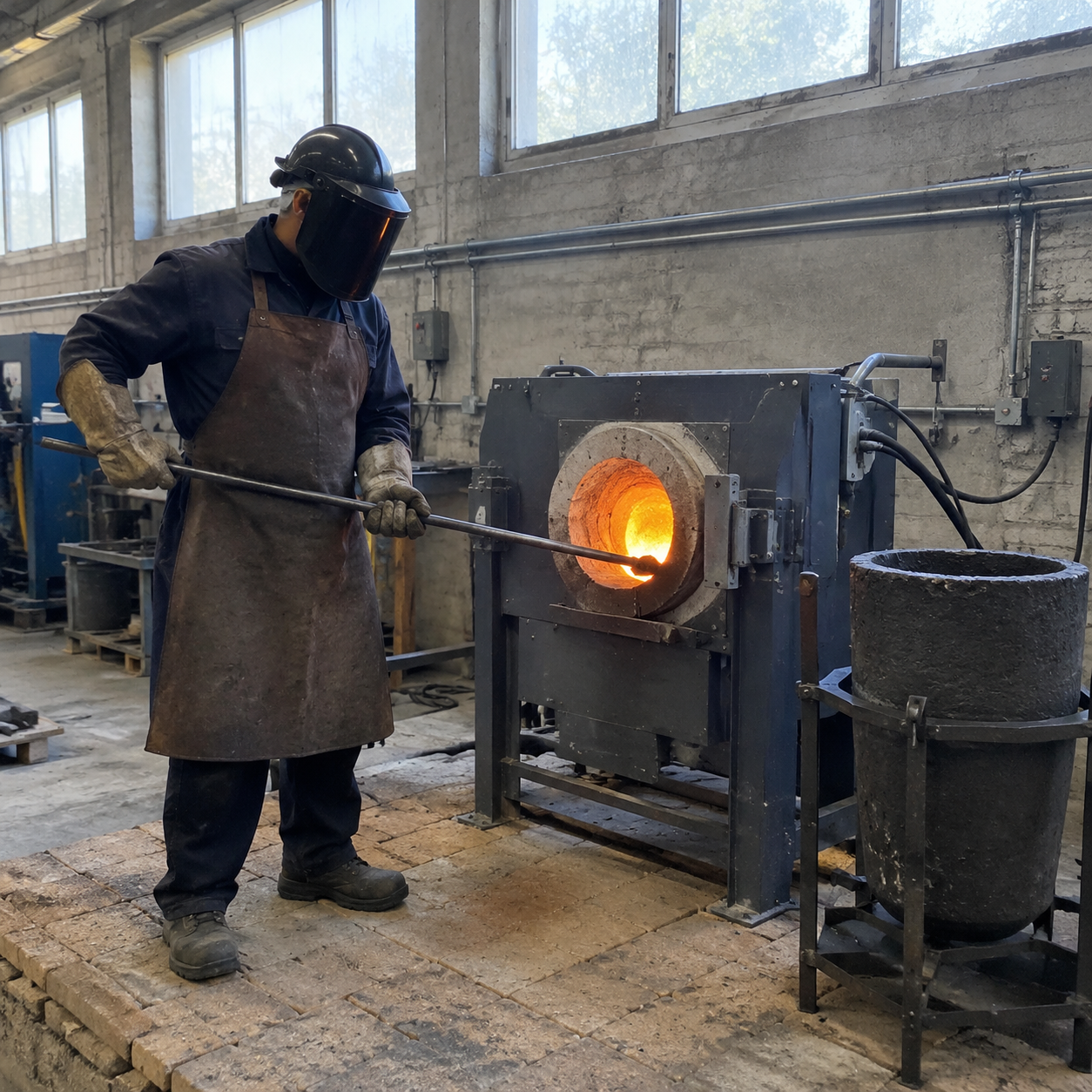
Induction melting for stainless is roughly 550–650 kWh per ton in the textbook. Small shops running a 500 kg furnace with a tired power supply are closer to 900–1,300 kWh per ton, and that's the number that shows up in their price. At Chinese power rates this line stays small; at European rates it doesn't. This is one of the few genuinely regional cost lines on the list.
5. Knockout, cut-off, grinding, shot blast
Labor-heavy and usually underestimated. Cutting a tree apart, grinding gates flush, and blasting clean is worth $0.80–$2.00 per kilo on most parts, and a lot more on castings with awkward geometry or thin sections that a grinder can wreck.
6. Heat treatment
Solution annealing for 316 runs maybe $0.30–$0.80/kg in China, more if you need a certified furnace chart per lot. If your spec calls for 17-4PH H1150, add more — the cycle is longer and the furnace paperwork heavier.
7. Inspection
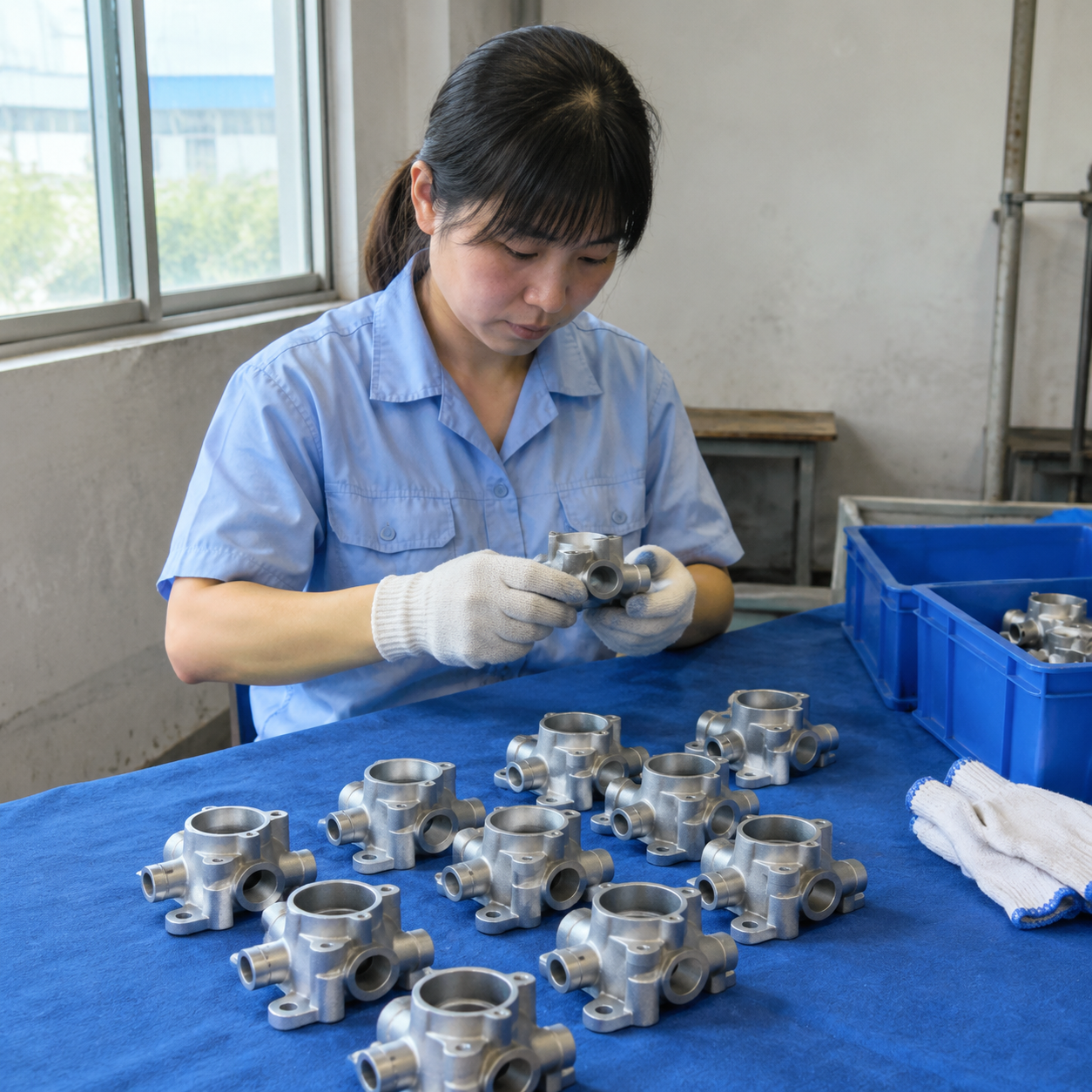
Dimensional check, visual, PMI on the first article, radiography on a sampling basis, and a material cert package. A basic inspection bundle adds $0.20–$0.60/kg. Full dimensional layout plus X-ray sampling plus third-party witness can triple that.
8. Scrap allowance
Nobody casts at zero defect. A realistic internal scrap rate is 3–8% on a mature part, and 10–15% during the first two production runs. Good shops bury this in the price honestly. Bad shops quote you the perfect-world number and then send a scrap surcharge invoice in month three.
9. Margin, packing, freight
A healthy export-oriented foundry works on 12–25% gross margin for investment castings. Below 10% they're either cutting something or buying the order to fill capacity — and either one means your second PO gets repriced.
Stack it up honestly and it looks like this for that 1.2 kg 316 body, as-cast, no machining, quoted FOB Ningbo:
| Cost line | $/kg of finished casting | Share of price |
|---|---|---|
| Metal, net of return credit and melt loss | $3.70 | 41% |
| Shell and refractory | $1.10 | 12% |
| Wax, pattern and tree assembly | $0.45 | 5% |
| Melting energy | $0.20 | 2% |
| Knockout, cut-off, grind, shot blast | $1.15 | 13% |
| Heat treatment | $0.45 | 5% |
| Inspection and certification | $0.35 | 4% |
| Scrap allowance (4%) | $0.35 | 4% |
| Margin, packing, inland freight | $1.25 | 14% |
| Total | $9.00 | 100% |
A 1.2 kg 316 body with no machining should land around $7.50–$9.50/kg FOB. If someone quotes $5.40, one of those nine lines is missing. Your job is to find out which one before you wire a deposit.
Real Investment Casting Price Per Kg by Material
Here's the range I see across quotes in 2025–2026 for parts between 0.5 and 3 kg, annual volume 500–5,000 pieces, as-cast plus light fettling, FOB Chinese port. The third column is the same part fully machined from the same drawing, because that's the comparison most buyers actually need and most quotes don't give them.
Treat these as planning numbers, not gospel. Nickel and copper move, and a 4 kg part breaks every one of them.
| Material | As-cast, $/kg | Fully machined, $/kg | What moves it |
|---|---|---|---|
| Carbon steel (1020, 1045, WCB) | $3.20 – $6.00 | $7.00 – $14.00 | Low metal cost, so labor and shell dominate |
| Low alloy (4140, 8620) | $4.00 – $7.00 | $8.50 – $16.00 | Heat treat spec, hardness verification |
| 304 stainless | $5.00 – $8.50 | $10.00 – $18.00 | Nickel content, yield ratio |
| 316 / 316L stainless | $5.80 – $9.50 | $14.00 – $19.00 | Moly content, PMI testing, cert traceability |
| 17-4PH | $8.50 – $14.00 | $16.00 – $26.00 | Solution + aging cycle, hardness sampling |
| Duplex 2205 | $9.00 – $15.00 | $18.00 – $30.00 | Narrow process window, ferrite content checks |
| Aluminum A356 | $6.50 – $12.00 | $11.00 – $22.00 | Per-kilo looks high because density is low |
| Brass / bronze | $11.00 – $20.00 | $19.00 – $34.00 | Copper price, heavy gating returns |
| Inconel 625 / 718 | $38.00 – $85.00 | $52.00 – $120.00 | Raw stock is $25–$45/kg before you melt it |
| Cobalt-based (Stellite) | $45.00 – $95.00 | $60.00 – $135.00 | Raw material, specialty melting practice |
A 316 body that's $8.50/kg as-cast becomes $14–$19/kg fully machined, because you're now paying for a CNC spindle, a fixture, and a second round of inspection. That gap — 60% to 150% on the same kilogram — is why "per kg, machining included" is a sentence you should never accept without a breakdown.
The stainless rows move more than the carbon rows, and not because foundries get greedier. 316 is roughly 10–14% nickel and 2–3% molybdenum by weight. When nickel runs up 20%, a 316 quote moves 8–12% within a quarter, purely on arithmetic. Carbon steel rows barely twitch. If a supplier won't put a metal-index clause in the contract, they're planning to absorb the swing quietly — and then recover it somewhere you can't see.
Why a 40-Gram Bracket Costs More Per Kilo Than a 3-Kilo Flange
This is the single most misread thing about investment casting price per kg. The unit is kilos, but the cost driver is how many times a human being has to touch the part.
I put this question to Li Wei, a process engineer at a shell-casting plant outside Ningbo that runs about 900 tons a year.
"The metal is not the job," he told me. "The mold is the job. A 40-gram part and a 3-kilo part take the same wax injection, the same one shell, the same one cut-off. You pay for touches, not for weight. That is why small parts look expensive per kilo and big parts look cheap. Buyers hate hearing it, but it is arithmetic."
He's right, and it has a practical consequence: when you're benchmarking quotes, only compare per-kilo numbers within roughly the same weight band. Comparing a $28/kg dental fitting against a $4.80/kg pump housing tells you nothing except that you don't understand the process.
Rough rule of thumb from the quotes I've collected: per-kilo price tends to fall about 35–50% as you move from a 100-gram part to a 2-kilo part in the same alloy and finish, then flatten out. Above 8 kilos it barely moves at all.
The Regional Gap, Honestly Stated
For a 1.2 kg 316 stainless body, as-cast, 2,000 pieces a year, here's roughly where landed quotes sit in 2026:
| Origin | As-cast price per kg | What you're really paying for |
|---|---|---|
| Ningbo / Wuxi, China | $6.50 – $9.50 | Mature shell shops, deep alloy coverage, English-speaking sales |
| Shandong, China | $5.80 – $8.80 | More capacity, thinner margins, wider quality spread |
| India (Rajkot, Coimbatore) | $7.00 – $10.50 | Good carbon steel, weaker on duplex and superalloys |
| Vietnam | $7.50 – $11.00 | Smaller shop count, less alloy depth, growing fast |
| Mexico (Monterrey) | $9.00 – $14.00 | Freight and tariff advantage for US buyers |
| United States (PA, WI) | $13.00 – $24.00 | No ocean freight, no 60-day lead time, DLA/spec pedigree |
| Germany / Czechia | $16.00 – $28.00 | Automotive-grade PPAP documentation, tight process control |
The gap between Shandong and Wisconsin is real, usually 40–55%. What it buys you on the US side isn't better castings — a good Ningbo shop casts as well as anyone — it's reaction time. When a line goes down, four days of freight matters more than $4 a kilo.
How Volume Actually Moves the Number
Buyers tend to assume a big order discounts everything. It doesn't. Volume attacks three specific cost lines and leaves the rest alone.
- Tooling amortization — a $6,000 wax die across 500 pieces is $12/piece; across 5,000 it's $1.20. On a 1.2 kg part, that alone is a $9/kg swing.
- Setup and first-article — melting a new alloy, proving a tree layout, running the dimensional layout. Roughly 20–40 hours of shop time, one time.
- Process learning — scrap drops from maybe 12% on run one to 4% by run three. That scrap allowance is inside your price, and it shrinks.
What volume does not fix: metal cost, shell cost, melting energy, or grinding labor. Those are per-kilo for life. So when a supplier says "we'll drop 30% at 20,000 pieces," what they're actually telling you is that 30% was tooling and scrap all along — and you were overpaying at 500.
One more distinction that trips people up: annual volume and release batch are different levers. A 20,000-piece annual blanket order released in twelve monthly lots of 1,600 does not get the 20,000-piece price, because the shop still sets up twelve times and still runs twelve first-articles. If you want the volume price, negotiate minimum release quantity, not just annual commitment. Most buyers leave that on the table.
Mold Cost and NRE: The Line Buyers Forget to Negotiate
A wax injection die for a mid-size investment casting typically runs $2,500–$12,000 depending on cavity count, parting complexity, and whether there are slides. Fixtures for machining are separate, often $1,500–$8,000 more.
Two things worth doing here. First, get the die priced as a standalone line item, not folded into the per-kilo rate — you want to know what you paid and who owns it. Second, put die ownership in writing. If the relationship ends, that tooling is your property and it should ship. Plenty of buyers have discovered mid-dispute that "their" die legally belonged to the supplier because nobody wrote it down.
While you're at it, ask how many cavities the die has and what the shop's die life expectation is. A single-cavity die on a 5,000-piece order means five thousand wax injections on one tool. That's fine if the die was built for it and a quiet problem if it wasn't.
What a Quote Should Show You
If a supplier sends a single number and a lead time, you can't evaluate it, and that's usually the point. Here's the structure I now require before I take any quote seriously.
- Metal grade and mill source — not "stainless," but 316L with a named mill or at least a country of origin.
- Yield ratio assumed — the melt-to-casting ratio. This alone explains most price gaps.
- As-cast price, per kg, per piece — both units, so you can sanity-check.
- Machining quoted separately — with cycle time or a per-feature breakdown.
- Heat treatment — in-house or subcontracted, and whether charts come per lot.
- Scrap allowance — stated as a percentage. The refusal to state it is the answer.
- Inspection scope — what's tested, at what frequency, and who signs the cert.
- Tooling cost and ownership — a separate line, with a clause.
- Validity and metal clause — how long the price holds and what happens when nickel moves 15%.
Nine lines. A competent export shop can produce them in a day. A shop that pushes back on line 2 or line 6 is telling you something useful, free of charge.
If you're holding a quote right now and want to know which of the nine is missing, send it over — you'll get the breakdown back inside three business days.
Common Mistakes That Cost Real Money
Comparing per-kilo across different part weights
Covered above, but it keeps happening. Two quotes are only comparable when the part weight, alloy, finish, and inspection scope match. Anything else is noise.
Mixing up poured weight and casting weight
A rate quoted per poured kilo can look half the price of a rate quoted per casting kilo on the same job. Before you celebrate a 45% saving, ask the supplier to write down which weight the number applies to. If they can't, that's your answer.
Assuming "per kg" includes machining
On rough castings it usually doesn't. I've seen buyers budget $9/kg and receive a $21/kg reality because the drawing had six tapped holes and a ground bore.
Letting the material cert be a photocopy
This is exactly how I lost $47,000. Ask for the mill test certificate with a heat number that traces to the heat, and run a PMI check on the first article yourself or through a third party. A $180 XRF test on arrival is the cheapest insurance in this business.
Accepting an unstated scrap allowance
If scrap isn't in the price, it appears later as a surcharge, a short shipment, or a part that quietly gets made to the loose end of the tolerance.
Ignoring the currency and metal clause
An 18-month blanket PO at a fixed per-kilo rate with no metal adjustment is a fantasy. Either the supplier eats the loss and degrades, or they walk. Build a quarterly nickel-index review into the contract and everyone stays honest.
Choosing on price alone at first article
First article is where the real price reveals itself. A shop at $7.20/kg that takes three rounds to pass dimensional layout has cost you more than the $8.90/kg shop that passed round one.
Seven Checks Before You Commit to a Per-Kg Price
- Ask for the yield ratio in writing. Compare it against the 1.6–2.2:1 range. Anything outside it needs an explanation.
- Request three past certs from their files — same alloy, different customers. Check the heat numbers are distinct and legible.
- Get the scrap percentage stated. Then ask what happens if actual scrap exceeds it.
- Confirm the inspection scope in the quote, not in a separate quality agreement that contradicts it.
- Price the die separately and put ownership plus a ship-on-request clause in the PO.
- Run a paid first article before the volume PO. 30–60 pieces, your dime. Cheapest due diligence you'll ever buy.
- Check whether the quote assumes "as-cast per drawing" or "as-cast per their standard." Those are different parts.
If you want a structured version of the same exercise, the seven-point supplier audit covers the shop-floor side of these questions — furnace records, shell room discipline, calibration status — rather than the commercial side.
Frequently Asked Questions
Why do two suppliers quote wildly different investment casting prices per kg for the same drawing?
Almost always one of four things: a different yield assumption, machining inside versus outside the number, a scrap rate baked in or left out, or material substitution hidden behind a soft certificate. A 40–50% gap is never generosity — it's a missing cost line, and you'll pay for it somewhere.
Does the price per kg include machining?
Frequently not. Rough cast and finished machined can differ by 60–150% on the same kilogram. Always ask for as-cast, heat-treated, and finished-machined as three separate columns.
What's the difference between poured weight and casting weight?
Poured weight is what leaves the furnace, gating and sprue included. Casting weight is what's left after cut-off. On a small-to-mid wax tree the ratio runs about 1.6:1 to 2.2:1, so a rate quoted per poured kilo looks roughly 45% cheaper than the same money quoted per casting kilo. Ask which weight the rate is attached to.
What's a normal investment casting price per kg out of China?
For 0.5–3 kg parts, carbon steel lands around $3.20–$6.00/kg and 316 stainless around $5.80–$9.50/kg, as-cast, FOB. Nickel alloys start near $38/kg because the raw stock alone is $25–$45/kg.
How much does volume drop the per-kilo price?
Going from 500 to 5,000 pieces on a 1 kg stainless part typically cuts 20–35%, mostly from tooling amortization and scrap settling down. Past 10,000 pieces the curve flattens — metal and shell don't care how many you ordered.
How fast can I get a real number instead of a guess?
A credible shop can quote a fully specified drawing in 3–5 business days, including the yield assumption. Anything faster than 24 hours on a complex part is a number someone made up to keep you on the hook.
Next Step
The number on a quote is the end of a conversation, not the start of one. Before you compare another two per-kilo figures, get the yield ratio, the scrap allowance, and the machining scope in writing. If a supplier won't put those three on paper, you already have your answer.
If you want a second read on a quote you're holding right now — send the drawing and the number, and you'll get an independent cost breakdown back: metal, shell, labor, heat treat, inspection, tooling, margin. No obligation, no sales call. Just the arithmetic, so you can tell whether the $8.40 is a bargain or a warning.
Need Help with Investment Casting Price Per Kg: What You'll Actually Pay?
Get matched with 3 verified foundries in 24 hours. No markup, transparent pricing.
Request Quotes →