Maybe you're staring at a batch of steel castings that showed up with porosity defects your QC team didn't catch until the third week of production. Or maybe your current supplier just pushed your lead time from 10 weeks to 16 with no explanation. Or maybe you're starting from scratch, trying to figure out which Chinese steel casting manufacturers are worth your RFQ and which ones will waste your time.
Whatever brought you here, you need the same thing: a clear, honest picture of how China's steel casting industry actually works in 2026 — not the version you get from supplier brochures or B2B marketplaces. After auditing over 80 Chinese steel casting foundries and helping buyers place orders worth $50K to $2M, here's the real picture.
1. China's Steel Casting Industry by the Numbers
China produced approximately 18.5 million metric tons of steel castings in 2025, accounting for roughly 42% of global output. The industry is concentrated in four provinces:
| Province | Est. Foundries | Specialization | Avg. Factory Size |
|---|---|---|---|
| Hebei | 650+ | Heavy castings, mining, construction | Medium-large (200+ workers) |
| Shanxi | 500+ | Railway, heavy machinery, valves | Medium (100-300 workers) |
| Jiangsu | 450+ | Automotive, pump/valve, precision | Medium (150-400 workers) |
| Zhejiang | 300+ | Small-medium castings, hardware | Small-medium (50-200 workers) |
Key trend: Hebei's share of steel casting output has grown from 28% in 2020 to an estimated 34% in 2025. The province invested heavily in foundry park consolidation — closing illegal workshops and concentrating production in regulated industrial zones with shared environmental treatment facilities.
Here's the uncomfortable truth the brochures won't tell you: in 2018, China had over 3,800 steel casting foundries. Today it's roughly 2,100. Nearly 45% have shut down. The survivors invested in emissions compliance, upgraded their melting equipment, and hired metallurgists who know their ASTM standards. They're also more expensive than the ones that closed.
2. Quality Tiers: A Market Divided
This is the single most useful framework for understanding Chinese steel casting suppliers:
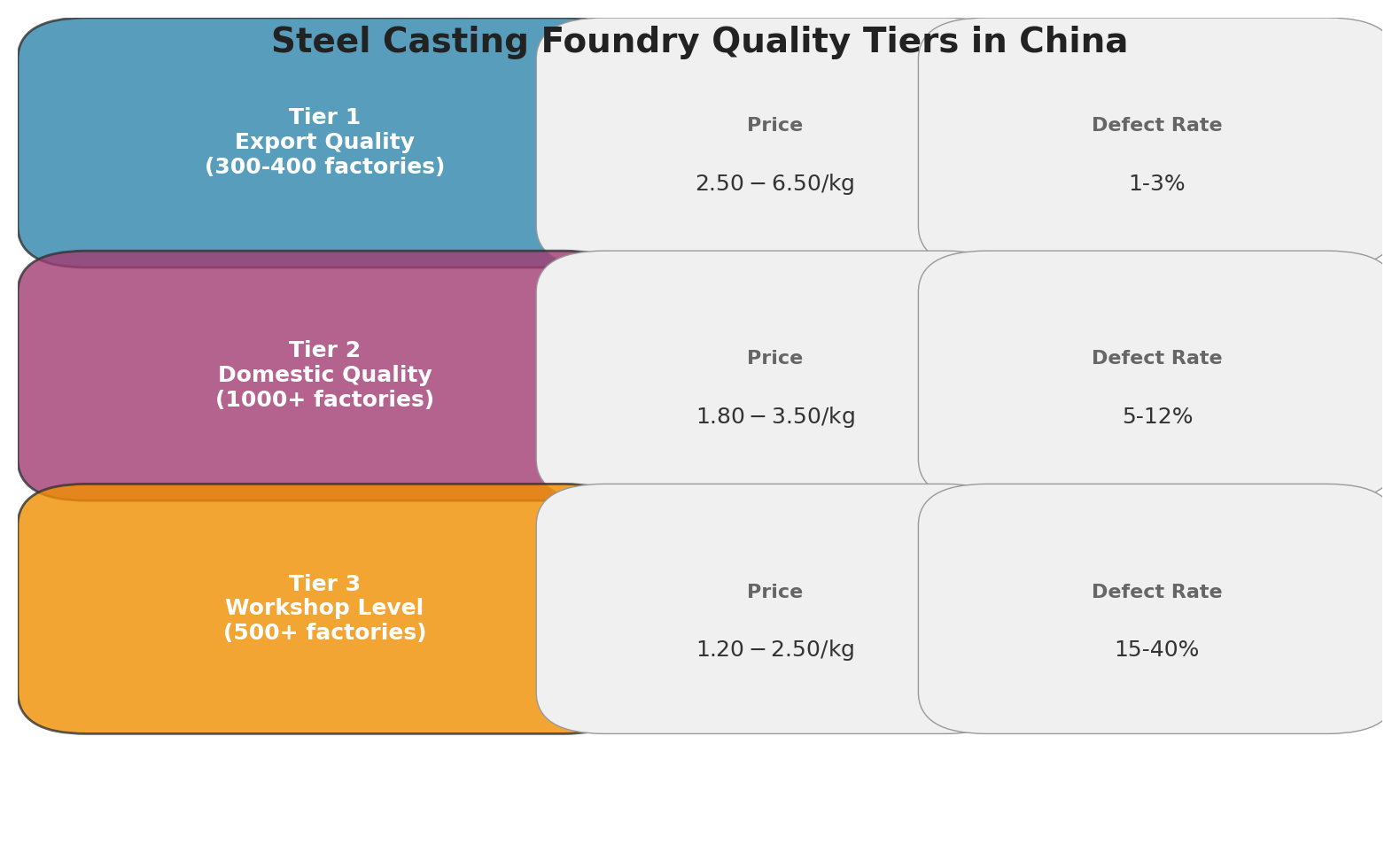
Tier 1: Export-Quality Foundries (~300-400 factories)
- ISO 9001:2015 or equivalent (PED, ASME, AD 2000)
- In-house spectrometer on every heat
- Programmable heat treatment furnaces with chart recorders
- In-house NDT (RT, UT, MPI)
- Rejection rate: 1-3%
- Price: $2.50-$6.50/kg
Tier 2: Domestic-Quality Foundries (~1,000+ factories)
- May have ISO; may not
- Spectrometer available but not always used every heat
- Basic heat treatment, sometimes outsourced
- NDT outsourced if available
- Rejection rate: 5-12%
- Price: $1.80-$3.50/kg
Tier 3: Workshop-Level (~500+ factories)
- No certification, no spectrometer, no documented process
- Rejection rate: 15-40%
- Price: $1.20-$2.50/kg
- You may get parts. You may get excuses.
Ask any Tier 2 foundry for a bill of lading from the last six months. The ones that actually export will have them. The ones that don't will change the subject.
3. What You'll Actually Pay: Cost Breakdown
When a Chinese foundry quotes you $3.00/kg for a steel casting, here's roughly where that money goes:
| Cost Component | % of Total | Notes |
|---|---|---|
| Raw materials (steel scrap + alloys) | 35-40% | Fluctuates with scrap market; budget 15% buffer |
| Melting & pouring | 15-20% | Electricity for EAF/induction furnaces |
| Molding & core making | 10-15% | Sand, resin, mold assembly labor |
| Heat treatment | 5-10% | Longer Q&T cycles = higher cost |
| Finishing & inspection | 8-12% | Grinding, shot blasting, NDT, dimensional check |
| Overhead & margin | 10-15% | Management, facility, QMS maintenance |
If a quote comes in more than 20% below the market average, something's being cut. Most often: inspection frequency, heat treatment quality, or material integrity.
Three specific things that inflate per-kg pricing:
Material grade. ASTM A216 WCB (standard carbon steel) is baseline. Switch to A148 grade 80-50 (higher strength low alloy), add 15-20%. Stainless CF8M? 30-40% premium.
Machining. As-cast at $3.00/kg becomes $6.50-$8.00/kg after CNC machining critical surfaces. Smart buyers design for as-cast surfaces wherever possible.
Heat treatment. Normalizing is often baked into the price. Quench and tempering, or solution annealing for stainless — those add $0.50-$1.50/kg per cycle.
4. How to Source Steel Castings: A Repeatable 4-Phase System
Refined over three years working with buyers sourcing everything from 2kg valve parts to 2-ton crusher components:
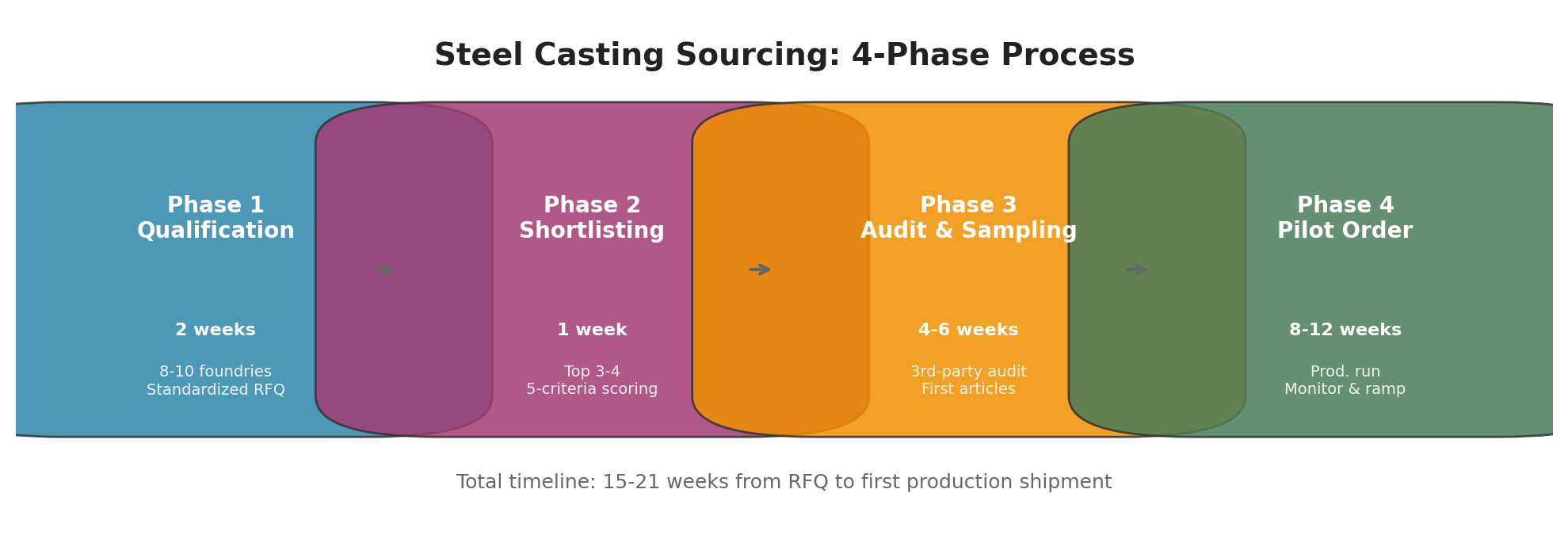
Phase 1: Qualification (2 weeks)
Identify 8-10 Tier 1 foundries in the relevant cluster (Hebei for heavy, Jiangsu for precision, Shanxi for rail/valve). Send each a standardized RFQ with: material grade + ASTM reference, dimensional drawing with critical tolerances marked, testing requirements (chemical, mechanical, NDT), and delivery terms.
Phase 2: Shortlisting (1 week)
Score responses on: technical capability (30%), price (25%), communication quality (20%), lead time (15%), payment terms (10%). Shortlist the top 3-4.
Phase 3: Third-Party Audit & Sampling (4-6 weeks)
This is the step most buyers skip — and the step that separates smooth projects from train wrecks. Budget $1,500-$3,000 for a professional foundry audit. Here's a detailed audit checklist we use for our own supplier evaluations. Test first articles against your spec before committing to production.
Phase 4: Pilot Order (8-12 weeks)
Start with one production order, not a blanket PO. Monitor first-article inspection, in-process QC reports, and on-time delivery. If the first run meets spec, negotiate a frame agreement.
5. Seven Red Flags That Scream "Run"
- Won't share a machine list. No machine list = the equipment either doesn't exist or is too old to mention. Either way, no quote.
- Promises everything. "Zero defects," "100% on-time," "best price." Nobody delivers all three. Someone who says they do hasn't been in business long enough to know better.
- English is too polished. AI-generated or outsourced communication means the technical person you need isn't the one answering your emails.
- Can't name raw material sources. "We buy from the market" means zero traceability. A proper foundry knows which steel mill and which alloy supplier they use.
- Heat treatment is "standard" with no details. Ask for the specific cycle: austenitizing temperature, soak time, quench medium, tempering temp. No details = no control.
- Demands 100% T/T upfront. Standard is 30% deposit, 70% against shipping docs. Stricter terms suggest cash flow issues or a history of chargebacks.
- Never been audited by a foreign buyer. For a foundry claiming to export, "never audited" is the loudest red flag of all.
6. FAQ
Which Chinese province has the best steel casting foundries?
Hebei for heavy castings, Jiangsu for precision, Shanxi for valve and railway. Match the cluster to your part, not the other way around.
How do I verify a Chinese foundry's ASTM compliance?
Request their last three material test reports (MTRs) from production — not the sample they prepared for you. Cross-reference chemistry and mechanicals against the ASTM spec. Then check spectrometer calibration records.
What's the typical payment term for first-time buyers?
30% with PO, 70% against shipping documents. Some Tier 1 foundries will do 20/80 for large orders. Never pay 100% upfront on a first order.
How long does steel casting production take?
Tooling 3-6 weeks, samples 4-8 weeks after tooling approval, production 4-8 weeks. Budget 12-16 weeks minimum from drawing to first shipment. Here's what actually drives lead times.
What certifications should a steel casting foundry have?
Minimum: ISO 9001:2015. For specialized needs: PED (pressure equipment), AD 2000 (German), ASME, or marine ABS/DNV. ISO 3834 for welding is a strong indicator of quality culture.
7. Bottom Line
China's steel casting industry isn't the same market it was five years ago. 45% of foundries have shut down. The ones that remain are better equipped, more compliant, and more expensive. Your job isn't to find the cheapest quote — it's to find a Tier 1 foundry whose capabilities match your requirements, then build a relationship that survives the inevitable problems.
Because problems will happen. The question is how the foundry handles them. We've seen the difference between a supplier that owns their mistake and fixes it overnight, and one that blames the drawing and disappears for three weeks. The first one is worth a premium. The second one isn't worth any price.
Brian Miller, an oil equipment distributor in Houston spending $2M annually on Chinese castings, told us: "I've been burned by three suppliers in 15 years. The one that made it right is still my supplier. The other two aren't in business anymore."
Need help vetting steel casting manufacturers? We maintain a database of pre-audited Tier 1 foundries across Hebei, Jiangsu, and Shanxi. Send us your RFQ, and we'll match you with vetted suppliers that fit your requirements.
Need Help with Steel Casting Manufacturers in China 2026: Data, Costs & How to Pick the Right One?
Get matched with 3 verified foundries in 24 hours. No markup, transparent pricing.
Request Quotes →