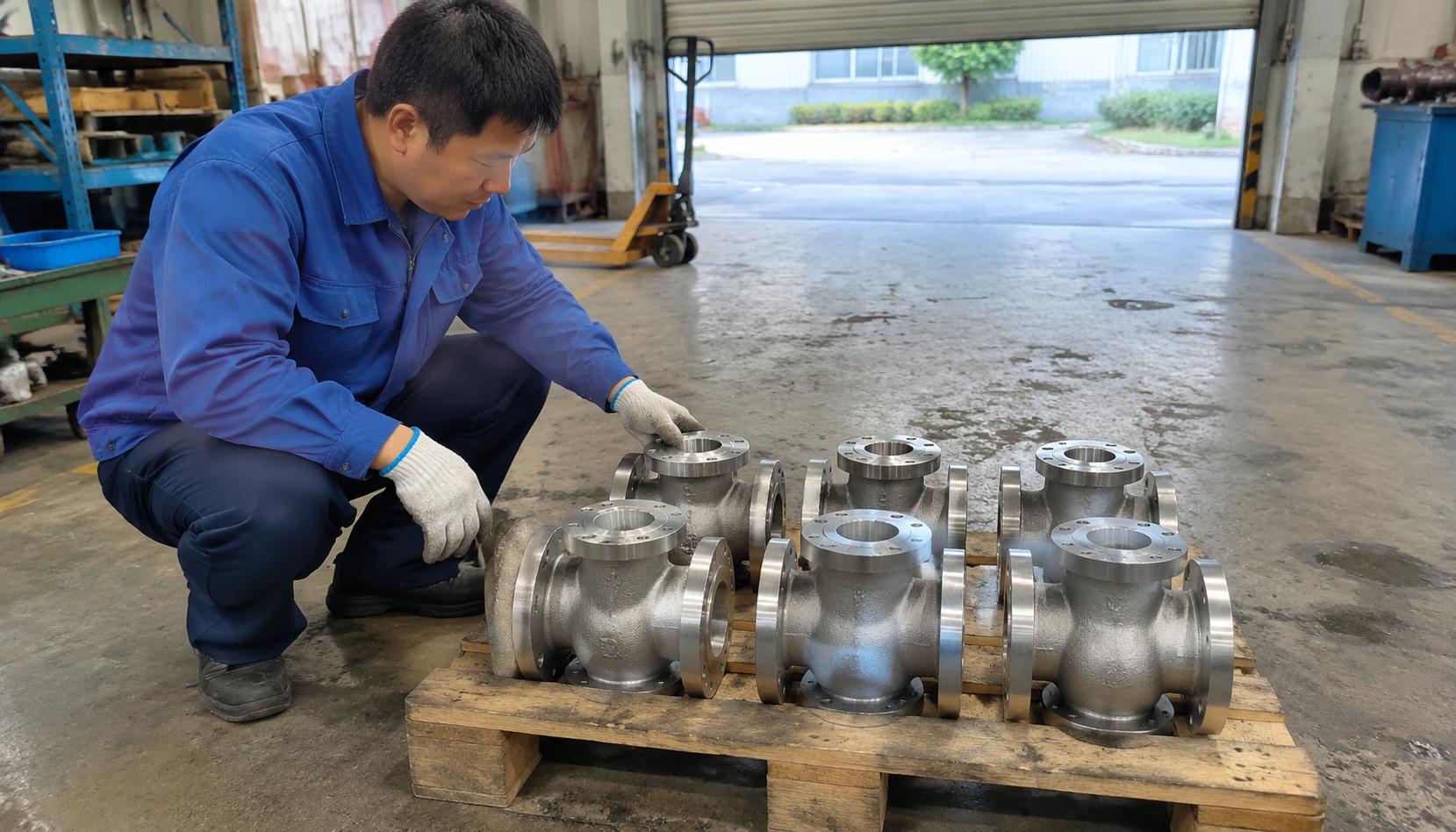
The same CF8M valve body drawing, sent to eight Chinese suppliers, came back with quotes between $38 and $140 per piece. Same weight. Same material callout. Same wall thickness on the print.
That was a 6-inch ball valve body, drawing unchanged, RFQ sent to eight shortlisted shops in the same week. Four of those quotes weren't for the same product. One supplier was shooting a silica sol face coat and a water glass backing — a hybrid, not a true investment casting. Another was quoting a sand-cast pattern with extra machining stock, which is why the price was low and the flange thickness was going to need 7 mm of cleanup instead of 2 mm. A third was quoting off a mold they'd already built for a different customer, changing one dimension and hoping nobody checked.
If you're sourcing a valve body, the price difference isn't a negotiation gap. It's usually a process gap. Here's how to separate them.
First, put the three processes side by side
Almost every "silica sol casting supplier" you'll find on a B2B platform is actually running one of three processes. The price gaps don't make sense until you see what each one can and can't hold.
| Property | Silica sol investment | Water glass investment | Sand casting |
|---|---|---|---|
| Surface roughness | Ra 3.2–6.3 µm typical | Ra 12.5–25 µm | Ra 12.5–50 µm |
| ISO 8062 tolerance grade | DCTG5–DCTG6 | DCTG7–DCTG8 | DCTG8–DCTG10 |
| Minimum wall | 2.5–4 mm | 4–6 mm | 6–8 mm |
| Practical max piece weight | ~100–150 kg | ~200 kg | No hard limit |
| Tooling cost (typical valve body) | $3,000–$15,000 | $1,500–$6,000 | $800–$5,000 |
| Machining stock on a 150 mm bore | 1.5–2.5 mm | 3–4 mm | 5–8 mm |
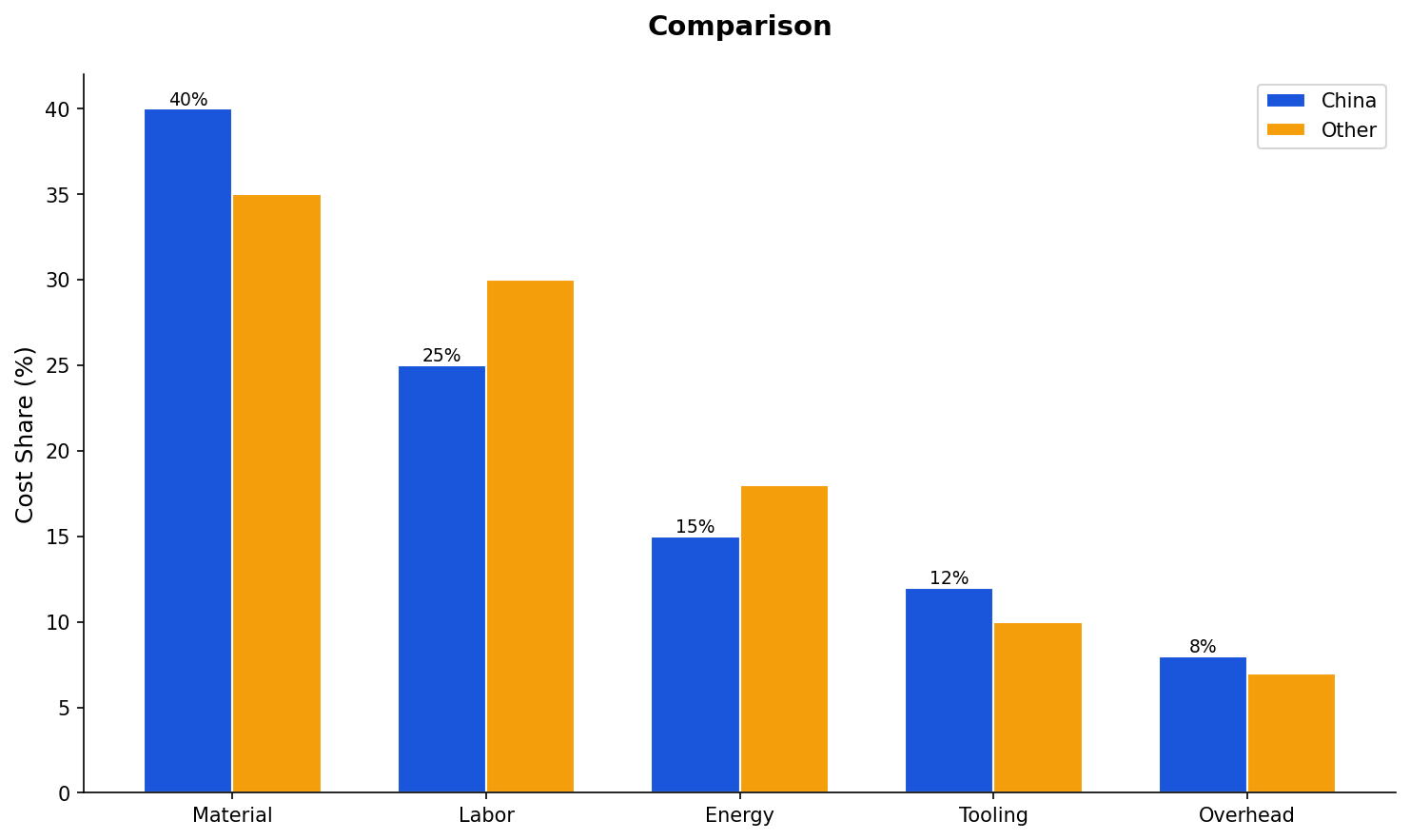
The minimum wall line deserves a caveat. Those figures assume a body under roughly 50 kg with a reasonably simple section and a working pressure in the ordinary PN16–PN40 band. Push to a 12-inch body with heavy flanges and thick section transitions, and the practical floor rises. If a drawing calls for 2 mm on a pressure boundary, that's an RFQ question for the foundry's process engineer, not a number to assume because a supplier said "no problem."
Read the rest of the table against your drawing. A 6-inch ball valve body with a 152 mm bore and a 25 mm flange thickness: at DCTG6 you're machining 2 mm off the face and holding flatness with one setup. At DCTG9 you're machining 6 mm and fighting distortion because you've cut through the chill zone. Same casting, different machining hours — and if you want to see how these grades turn into machine-shop hours, we broke it down in this guide to ISO 8062 tolerance grades.
So when a quote looks 40% cheap, ask which column it came from. That's not a negotiation tactic — it's a specification question.
A note on where these numbers come from: the tolerance and roughness ranges follow ISO 8062-3 and normal published foundry capability for each process. The tooling and machining-stock ranges come from quotes we've collected on 2" to 8" stainless valve bodies over the past several years. Treat them as indicative bands for budgeting, not as a guaranteed price for your part. Your drawing governs, and a supplier who can't explain why their number sits outside the band has some explaining to do.
Check 1: Is the shell actually silica sol, all the way through?
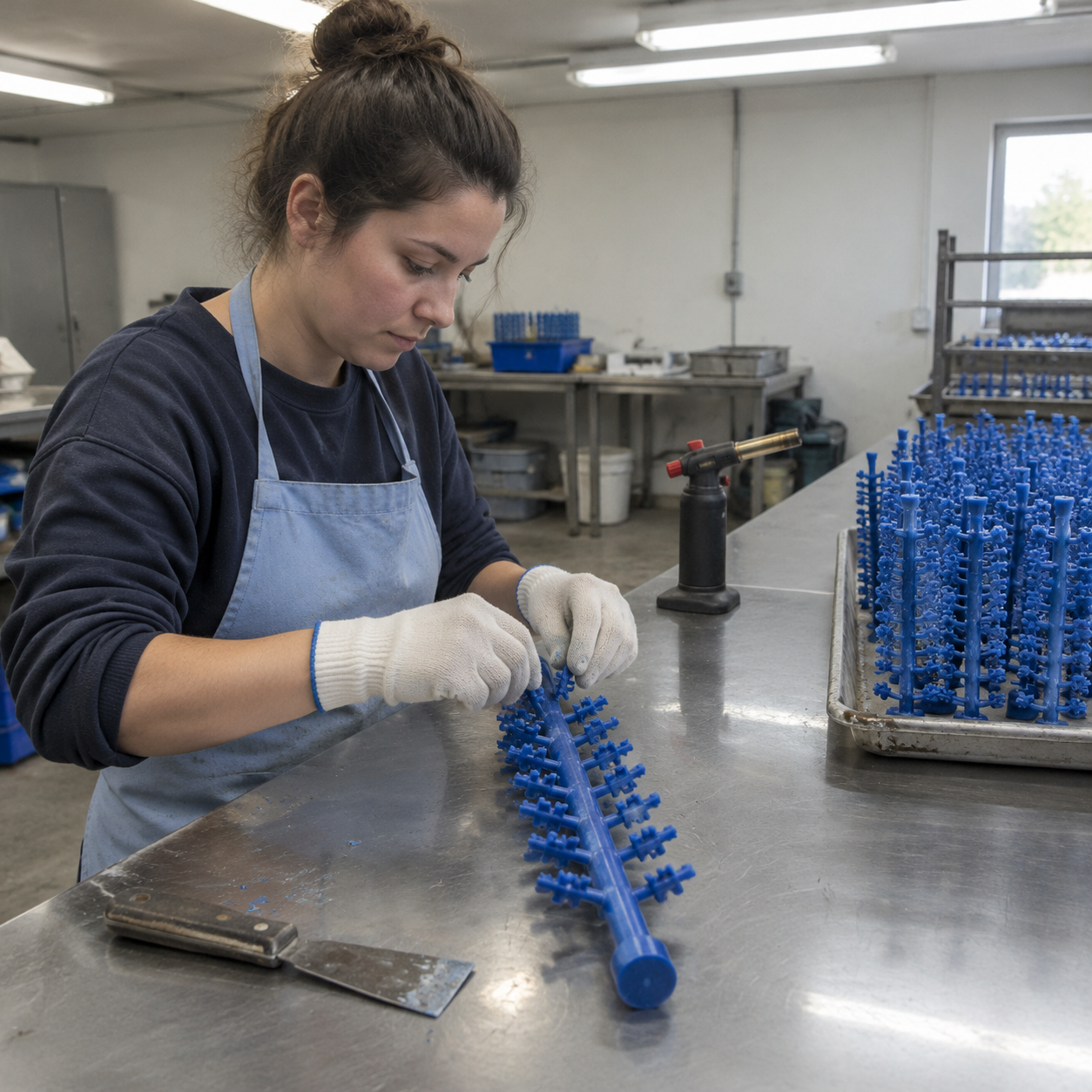
"Silica sol casting" gets used loosely. Plenty of shops run a silica sol face coat — one or two layers — then switch to water glass for the backing layers to save binder cost. You get most of the surface finish benefit and none of the dimensional stability, because the water glass backing shrinks differently during firing and the mold distorts.
That hybrid pattern is something we've run into on supplier audits, not a published statistic. Take it as a question worth asking, not a claim about how many shops do it.
Ask three specific questions, in this order:
- How many layers, and what binder in each? A true silica sol shell for a valve body runs 5–7 layers, all silica sol, with stucco grading from fine zircon on the face coat to coarser mullite or chamotte on the back.
- Do you buy slurry or make it? Both are legitimate. What matters is whether they control the silica content and viscosity daily. Ask to see the viscosity log — a working shop has one, dated, with a notation of who measured it.
- What's your firing temperature and dwell? Expect 950–1,150 °C with a real dwell curve. If the answer is vague or the kiln has no chart recorder, the shell isn't fully sintered and you'll see it as surface porosity and hot tears.
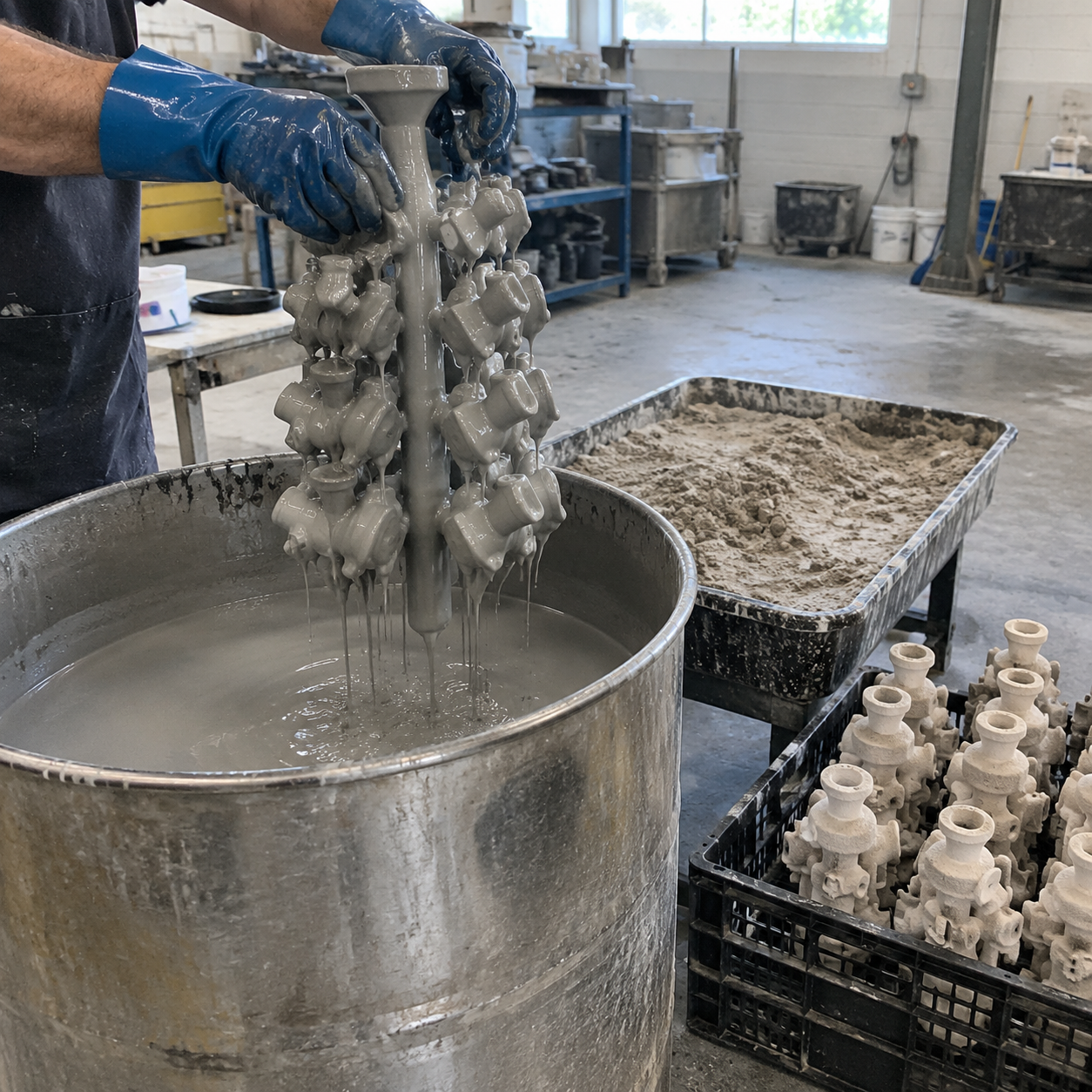
Here's the tell most buyers miss: ask them to walk you through a failed shell. A shop that genuinely runs silica sol will describe a shell crack from a bad ramp rate or a wax tree that was too dense for the autoclave. A shop that mostly runs water glass will describe something generic. The answer tells you what they actually live with every day.
Check 2: Chemistry, heat traceability, and PMI on every heat
For a valve body, the material is the easy part to specify and the easy part to fake. ASTM A351 Grade CF8M calls for:
| Element | CF8M | CF3M |
|---|---|---|
| Carbon | 0.08 max | 0.03 max |
| Silicon | 1.50 max | 1.50 max |
| Manganese | 1.50 max | 1.50 max |
| Phosphorus | 0.040 max | 0.040 max |
| Sulfur | 0.040 max | 0.040 max |
| Chromium | 18.0–21.0 | 17.0–21.0 |
| Nickel | 9.0–12.0 | 9.0–13.0 |
| Molybdenum | 2.00–3.00 | 2.00–3.00 |
Nothing exotic. The problem is never the spec — it's whether the heat they poured is the heat on the certificate, and whether the certificate is a real EN 10204 3.1 or a 2.2 dressed up to look like one.
Three things to insist on:
- Heat number stamped or vibro-etched on the casting itself. Not on the tag, not on the carton. On the part. If a claim ever comes up two years later, the tag is long gone.
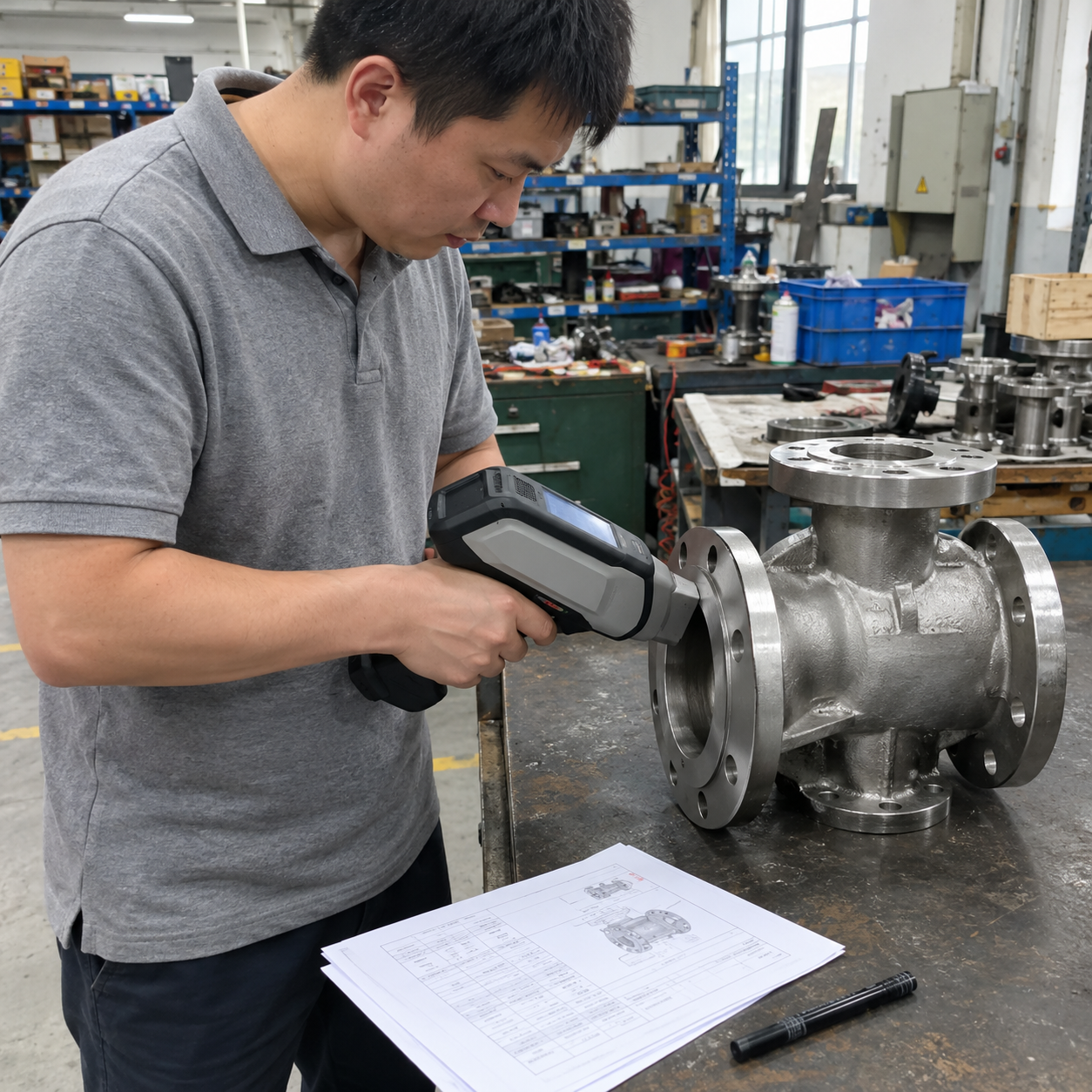
- PMI at 100% or at least per heat, not per shipment. A positive material identification check on the finished casting catches the mixer-up when two wax trees of different grades go through the same pour line. Optical emission spectrometry on the furnace is good; XRF on the finished part is the second gate.
- A 3.1 certificate signed by a named, titled representative of the manufacturer. EN 10204 3.1 means the inspection rep is independent of the manufacturing department. Ask who signs. If the answer is "the sales manager," it's not 3.1 in spirit.
For duplex and super duplex bodies — 4A, 5A, 6A in ASTM A995 — add the ferrite/austenite balance to the check. A 50/50 phase balance target, with a working window of roughly 35–65% ferrite, is the usual ask, and a shop that can't tell you how they measure it is a shop that hasn't poured much duplex. We go deeper into those grades in the duplex and super duplex casting guide.
Check 3: What NDT actually gets done, and to what acceptance level
Every supplier will tell you they do "radiographic testing." The question is what they radiograph, at what coverage, against which acceptance criteria, and who reads the film.
For a pressure-retaining valve body, here's the baseline we ask for. It isn't a standard in itself — your end-user spec or the applicable valve design standard overrides it — but it's a fair floor to argue from:
| Test | Where | Coverage | Acceptance |
|---|---|---|---|
| Visual + dimensional | 100% of parts | 100% | Drawing + ISO 8062 |
| Penetrant (PT) | Machined sealing faces, weld repairs | 100% | ASTM E165, no linear indications |
| Radiography (RT) | Body wall, bore transition, neck | Per heat or 10–20% sampling | ASTM E446 / E186 severity level agreed in writing |
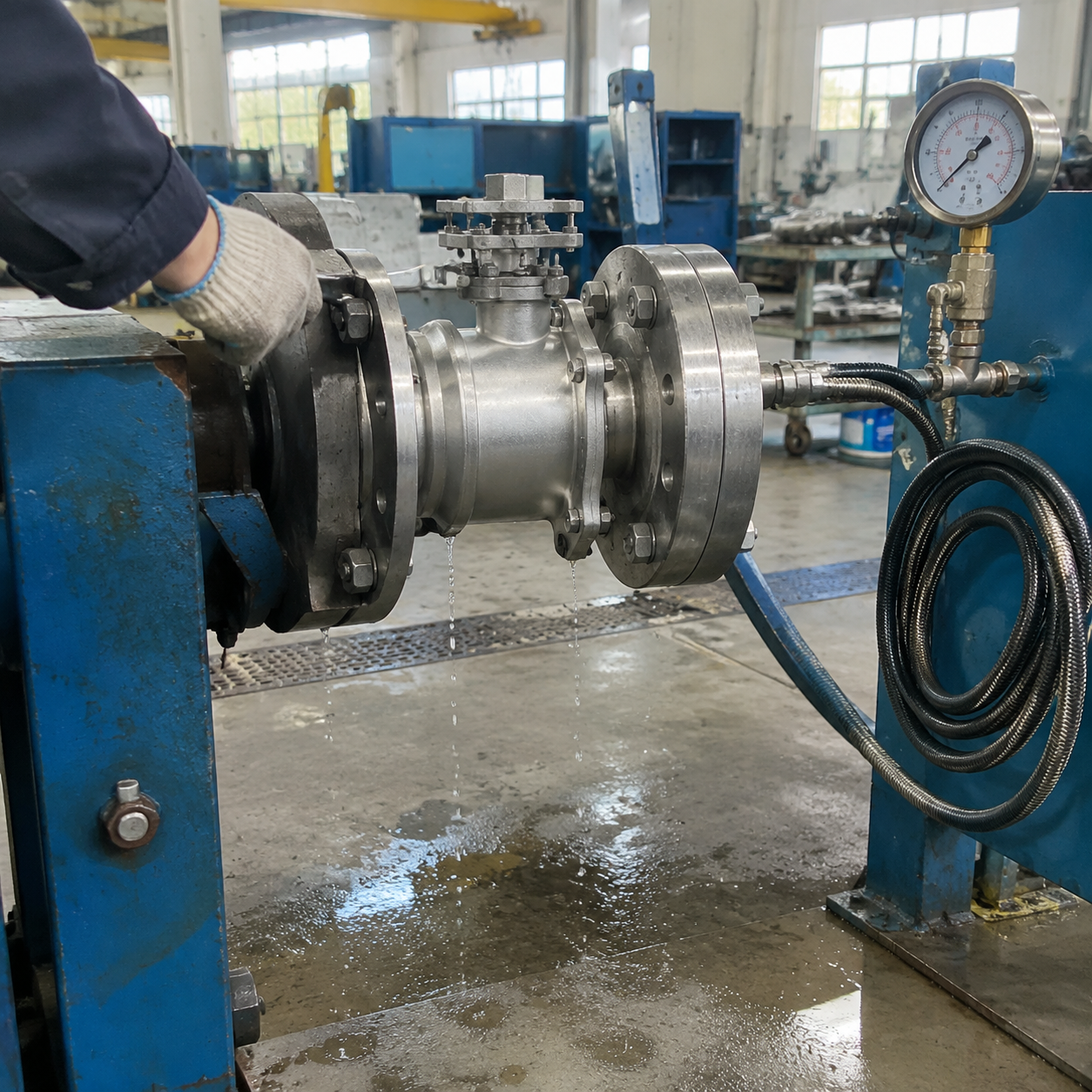
| Hydrostatic shell test | Assembled or blind-flanged body | 100% | 1.5 × rated CWP, hold per applicable standard |
| Ultrasonic (UT) | Heavy section bodies, 4" and up | 100% | ASTM A609 |
Two failure points in that table. First, RT severity level: "we do RT" means nothing if the acceptance is a loose severity level your drawing never specified. Put the level in the PO. Second, who reads the film — a Level II or III certified interpreter with a name on the report, or a technician who's been shown once. Ask for the certification. It's a legitimate ask and the answer is either a card or an excuse.
If the service is sour, NACE MR0175 / ISO 15156 is a separate gate on top of all of this — hardness limits, specific heat treatment condition, and documentation that says so explicitly. A CF8M body that's fine for water service can fail a sour specification on hardness alone.
Check 4: Machining stock — the line item nobody quotes
This is where the cheap quote turns expensive, and it's the thing most buyers don't model before they order.
If your casting comes in at DCTG8 instead of DCTG5, on a 150 mm dimension that's several millimetres of extra stock. Your machine shop bills hours, not millimetres, but the hours follow the stock. On a batch of 500 bodies, extra roughing and an added semi-finish pass can easily add 15–25% to the machining cost — which usually wipes out the entire saving on the casting price.
Robert Davis, a Georgia hardware wholesaler who spends around $1.5M a year on castings, put it plainly when we spoke:
"I stopped chasing casting price after the second year. We had a supplier whose quote was 22% under everybody else. Turned out we were paying our machine shop an extra $9 a part in setup and roughing because the castings were all over the place. Nobody ever added those two numbers together until I did."
Ask for a first-article dimensional report on the actual production tooling — not a sample from the tool room. Ten parts, full CMM report, all critical characteristics listed. If the spread on a 150 mm bore is wider than the tolerance grade they claimed, you know what you're buying before you commit to 500 pieces.
Check 5: Who owns the tooling, and can you take it with you?
You pay a tooling charge of $3,000 to $15,000 for a valve body mold. Then the relationship goes sideways two years later and you discover the mold is "theirs" because the invoice said "tooling fee" and not "tooling purchase."
Three clauses belong in the PO, every time:
- The tooling is your property, paid in full on the tooling invoice, and identified by a tool number you assign.
- The supplier will release the tooling — physically, along with wax injection dies, core boxes, gauges, and any fixtures built for your part — on request, at your cost, within a stated number of days.
- The supplier will not use the tooling, or any modification of it, to produce parts for anyone else.
Robert again, on the same call:
"I've got a mold sitting in a building in Ningbo I'll probably never see again. Four thousand dollars. The paperwork said tooling fee and I signed it. So now every new supplier I use, the first email is about who owns the tool — before we even talk price."
Also ask how the shop stores tooling between orders. Wax dies left on a shelf in a humid building rust, and rust shows up as a dimension drift on your second order. A shop that has a die maintenance schedule will tell you about it without prompting.
Check 6: Verify capacity from records, not from a plant tour
A plant tour shows you the best-lit bay and the newest machine. It doesn't show you whether they can hold your delivery date in March.
Ask for these instead — they're harder to stage:
- Furnace log for the last 30 days. Heat number, time, alloy, weight poured, and the pour temperature. This tells you real throughput, not stated capacity, and whether they pour the grade you need more than once a month.
- Shell build and kiln schedule. If the kiln runs once a week at low load, your four-week lead time is fiction.
- Current open order board, anonymized. Customer codes instead of names is fine. What you want to see is how much of their capacity is already committed over your delivery window.
- Their scrap rate, by defect type, for the last quarter. A shop that quotes 3% and can't show the data is guessing. A shop that says "8%, mostly shrinkage on the heavier sizes, we're changing the riser on that pattern" is telling you the truth.
One more that costs you nothing: ask what happens when a pour goes wrong. Not "do you have a quality system" — ask them to describe the last non-conformance and what changed afterwards. Good shops answer in specifics and take thirty seconds to get there. If you want the longer version of this, we wrote up what a foundry audit should actually cover.
Check 7: Read the quote structure, not just the number
A proper valve body quote has more lines than most buyers expect. If you get a single unit price, keep asking.
- Price per piece is usually a sliding scale by quantity. Typical breaks at 50 / 100 / 500 / 1,000. If there is one price for 20 pieces and 2,000 pieces, the tooling is probably being amortized into the unit price and you're paying for it twice on repeat orders.
- Single weight basis, not per casting. Ask what weight the price is calculated on and whether the trim weight, gating return, and riser are included in the charge. Casting weight minus gating return is the number you should be paying on.
- Machining as a separate line. If it's bundled in, you can't tell whether you're paying for a good casting or a bad one plus a lot of hours.
- Material surcharge clause. Nickel and molybdenum move. Ask for the formula and the reference date. A quote with no surcharge mechanism is a quote that gets renegotiated the moment the LME moves.
- What's excluded. Heat treatment, NDT, third-party inspection, packaging, and freight to port are the usual omissions. A quote that leaves out third-party witness inspection looks cheap until you need it.
Put the two quotes side by side on a per-piece landed basis, including machining, inspection, and packaging. That's the only comparison that means anything.
The seven checks on one page
If you're about to get on a call, this is the short version. Copy it, print it, send it to the supplier ahead of time and ask for written answers.
| # | Ask this | What a good answer looks like |
|---|---|---|
| 1 | How many shell layers, and what binder in each? | 5–7 layers, all silica sol, with stucco grading named |
| 2 | Is the heat number on the casting, and who signs the 3.1? | Etched on the part; a named inspection rep, not sales |
| 3 | Which RT severity level, and who interprets the film? | A stated ASTM E446 level and a certified Level II/III reader |
| 4 | Show me a 10-part CMM report from production tooling | A tight cluster, matching the grade they claimed |
| 5 | Who owns the tooling, and how fast do you release it? | Your property, your tool number, stated release days |
| 6 | Furnace log, kiln schedule, and last quarter's scrap by defect | Actual dated records, with a defect breakdown |
| 7 | Show me the quote broken out line by line | Quantity breaks, weight basis, machining separate, surcharge formula |
Seven questions. Any of them can be answered in two minutes by a shop that knows its own process. The ones that can't are the ones that will cost you a shipment.
Common mistakes that cost real money
Comparing across process routes. A sand casting quote against a silica sol quote is not a price comparison, it's two different products. Decide the process from the drawing's tolerance and surface requirement first, then source within that process.
Accepting a 2.2 certificate where 3.1 is specified. These are not interchangeable. A 2.2 is a declaration by the manufacturer that the material conforms. A 3.1 is independent inspection with specific results. For a pressure boundary on a valve body going into a PED-governed installation, the 3.1 isn't optional and the notified body will ask.
Not putting the RT acceptance level in the PO. "Radiographed per ASTM E446" without a severity level means the foundry picks the level. They'll pick one their scrap rate can live with, not one your application needs.
Skipping the first-article inspection to save two weeks. Two weeks at the start versus a rejected shipment of 500 bodies and a disputed claim six months later. Look at those two outcomes and tell me which one is cheaper.
Assuming the trading company is the factory. Plenty of legitimate sourcing happens through trading companies, and some of them are very good. But if you're paying factory-direct prices, verify you're getting factory-direct process control. Ask to see a pouring log with the date and the heat number. A trader will have to go back to the foundry for it, and how fast they come back tells you something.
Never asking about repair welding. Most specs allow limited weld repair on non-critical areas. Ask what their repair rate is, who does it, and whether repairs are recorded on the inspection sheet. An unrecorded weld on a pressure-retaining wall is the kind of thing that finds you at commissioning.
Frequently asked questions
What's the typical lead time for a silica sol cast valve body from a Chinese foundry?
Tooling takes 3–5 weeks for a new valve body pattern and wax die. First article follows 2–3 weeks later. Production runs 4–6 weeks for the first order and 3–4 weeks on repeat orders, plus 1–2 weeks for machining and NDT if you're buying finished bodies. Anything quoted under four weeks for a first order either has existing tooling or is not telling you something.
Should I specify CF8M or CF3M?
CF3M (the low-carbon 316L equivalent) reduces the risk of sensitization if you're welding the body or using it in a service where carbide precipitation matters. CF8M is the default for most water, oil, and general process valve bodies and is easier to source. Duplex and super duplex come into play for chloride stress-corrosion service — that's a different conversation and a different supplier shortlist.
How do I verify a silica sol foundry can actually hold DCTG5 on a valve body?
Ask for a CMM dimensional report on ten production parts from the same heat, not a single sample. Look at the spread on the bore diameter and flange thickness across those ten. A shop holding DCTG5 will show you a tight cluster. A shop claiming DCTG5 that isn't will show you a scatter that matches DCTG8 — and that scatter is your machining cost.
Is a hydrostatic test enough without radiography?
No. A hydrostatic test proves the body holds pressure at the test moment. It does not tell you about internal shrinkage that's close to breaking through the wall, and it won't catch wall thinning that fails after two years of thermal cycling. For a pressure-retaining body, the hydro test and RT cover different failure modes and you want both.
How much should I expect to pay for valve body tooling?
For a silica sol-cast valve body in the 2" to 8" range, tooling typically lands between $3,000 and $15,000, driven mostly by cavity count, the number of core boxes, and whether the wax die needs a slider. A single-cavity aluminum wax die for a simple 3" body sits near the bottom of that range. A multi-cavity die with complex cores for an 8" trunnion body sits at the top.
What to do next
You don't need a perfect supplier. You need to know which risks you're carrying and what each one costs if it goes wrong.
Start with the two questions that filter fastest: how many layers in the shell, and can you show me the PMI report for the last heat of CF8M you poured. A shop that answers both without hesitating is worth the next hour of your time. A shop that gets vague on either one has just saved you three months.
Then put the tooling ownership clause and the RT acceptance level in writing before anyone invoices anything. Everything else can be negotiated after the first article comes back.
If you'd rather not build the shortlist from scratch, our valve body sourcing programme starts with the audit records in Check 6 — the furnace log, the kiln schedule, the scrap breakdown — before a single price gets discussed.
Get the supplier vetting checklist
We put the seven checks in this article into a one-page PDF you can send to a supplier before the first call — including the exact questions on shell construction, heat traceability, NDT acceptance levels, and tooling ownership, with a column for their written answer. No sign-up wall for the checklist itself.
Request the valve body supplier checklist
Email cfwc@163.com · WhatsApp +86 159 4126 7000 · or Request a Quote from verified foundries →