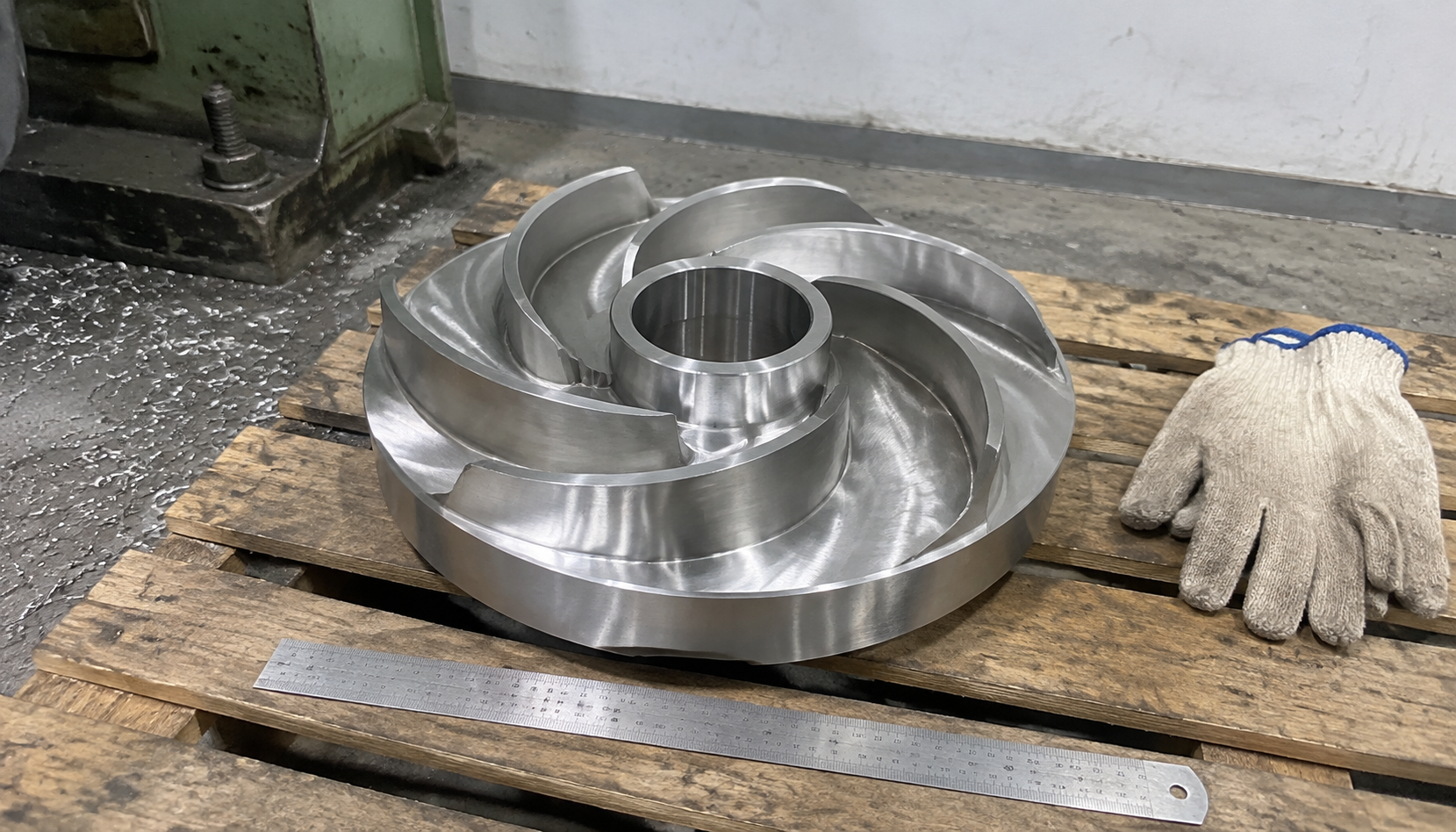
Somewhere between 15% and 30% of centrifugal pump failures get traced back to the impeller. Not the mechanical seal. Not the bearing. Not the motor. The one part that has to be hydraulically clean, dynamically balanced, and metallurgically sound all at the same time — and the one part where a defect hides inside a wall you cannot see with your eyes.
Now the second number. China has roughly 1,800 investment casting foundries. Of that pool, somewhere around 300 have the shell-room discipline, the spectrometer habits, and the radiography access to hold a closed impeller to a spec you'd actually accept on a rotating assembly. The other 1,500 will send you a quote in 48 hours. A few of them will come in lower than everybody else.
That gap — between who can do it and who will happily try — is where silica sol casting pump impeller sourcing goes sideways. Not in the price column. In the fourth shipment.
I'm Sarah Chen. I buy castings for a pump builder in Ontario, about $1.2M a year, a big chunk of it impellers in CF8M and duplex. I've moved two impeller part numbers between foundries in eight years, and both moves were expensive enough that I now run the same process every time. This is that process.
What silica sol casting actually buys you
Silica sol is a binder — colloidal silica particles, 10 to 20 nanometers, suspended in water. You build a ceramic shell around a wax pattern by dipping it in slurry, sprinkling refractory sand on it, and letting it dry. Then you repeat. Five to eight layers for a pump impeller, sometimes more on the heavy sections. Face coat is usually zircon; backup coats are mullite or chamotte. Each layer needs 8 to 12 hours in a climate-controlled room.
That's the whole game, right there. Unlike water glass, silica sol doesn't harden through a CO2 gassing pass. It dries. And because it dries slowly and evenly, the shell doesn't distort, and the casting that comes out lands closer to nominal. That is the core of every investment casting process worth paying for.
What that translates to on an impeller:
- Dimensional tolerance around ISO 8062-3 CT4 to CT6, versus CT7 to CT9 on water glass.
- As-cast surface on flow passages in the Ra 3.2 to 6.3 range. Water glass sits at Ra 12.5 to 25, which is roughly the difference between a pump that hits its curve and one that doesn't.
- Thin walls. 1.5 mm on small parts, 3 mm on the heavy ones. You need that for closed impeller shrouds.
- Closed impellers as one piece. This is the real reason pump builders pay the premium. A silica sol shell can form the internal flow channel with a soluble or ceramic core, so the vanes and both shrouds come out as a single casting. No welded vanes. No weld prep, no post-weld heat treat, no penetrant inspection on a joint that sits right where your highest stress lives.
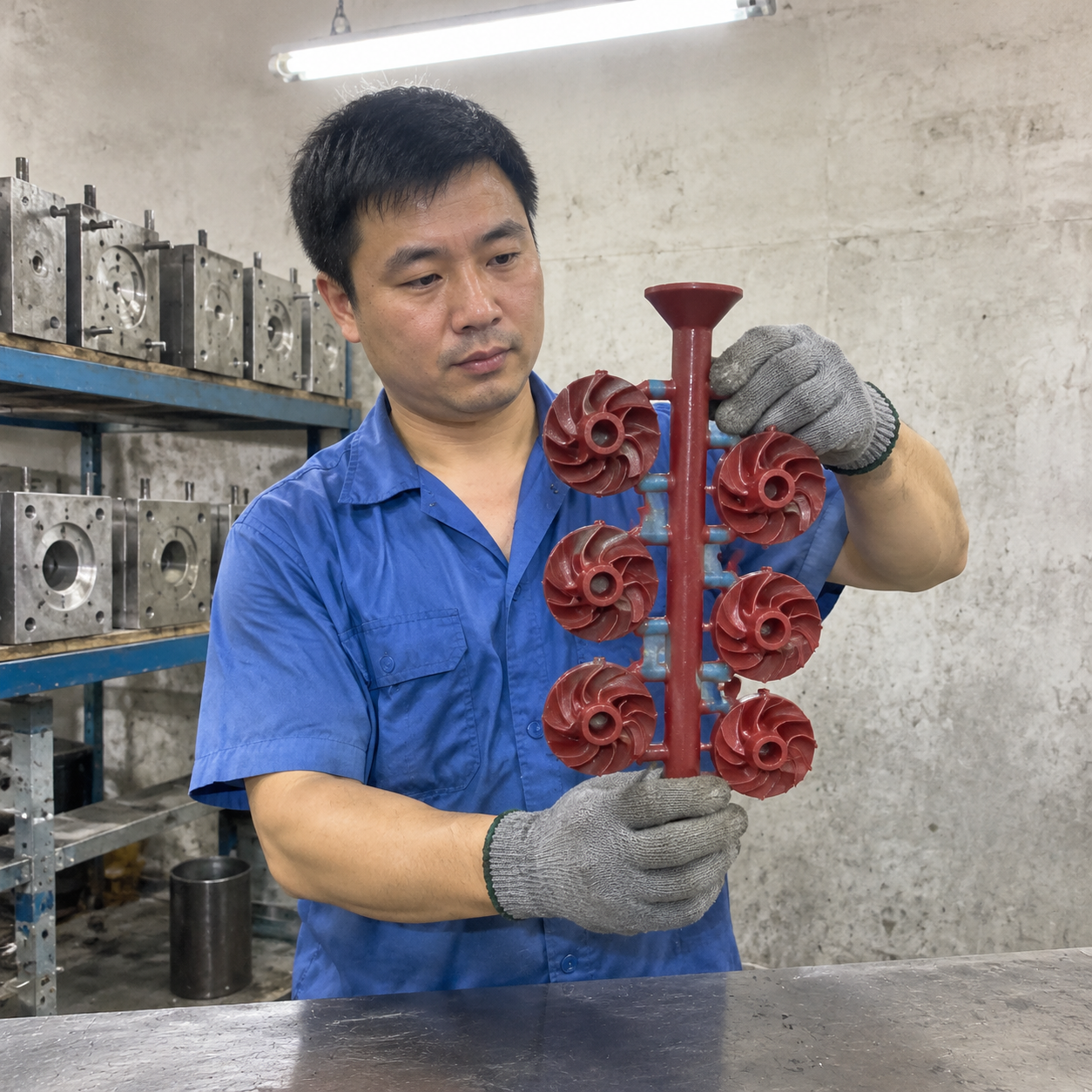
What it doesn't buy you: speed or cheapness. Shell building alone runs five to seven days, versus two or three on water glass. Total lead time on a new impeller part number is usually 6 to 10 weeks after tooling, and tooling is another 4 to 6 weeks. Cost per kilo runs 20% to 40% above water glass, and that gap widens fast once you go past about 150 kg finished weight.
My rule: if it's a closed impeller under 600 mm diameter running at any real efficiency target, silica sol is the default and you should stop shopping. If it's an open or semi-open impeller with a loose curve, sand casting with a machined bore is still the cheapest correct answer. Don't let anyone sell you silica sol for a part that doesn't need it — that's a supplier optimizing for their capacity, not your total cost.
Where impellers actually fail
The failures I've dealt with cluster into four buckets, and three of them are invisible from the loading dock.
Shrinkage at the hub-to-shroud junction. That's a hot spot. Thick section, surrounded by thin sections, cooling at a different rate than everything around it. If the riser design and the pour temperature aren't right, you get a sponge of micro-porosity sitting exactly where the bending moment peaks. It passes a visual. It passes a dimensional check. It fails at month fourteen.
Non-metallic inclusions. Furnace lining, ladle refractory, loose sand from a sloppy shell. They show up as stringers after machining, or as fatigue initiation sites that never show up at all until the impeller throws a vane.
Gas porosity from shell venting. Silica sol shells are dense. If the shell room didn't dry a layer fully, or the pattern didn't vent, you trap gas against the wax surface and it becomes porosity on the flow passage. That one you can sometimes see. Sometimes.
Surface roughness drift. Nobody specs it, so nobody measures it, so the slurry density quietly walks out of range over six months and your flow passages come in at Ra 12 instead of Ra 6. Your efficiency curve drops two points and nobody can tell you why.
A 2 mm shrinkage cavity at the hub-to-shroud junction of a closed impeller has essentially zero chance of being caught by a visual inspection. If your inspection plan for that zone is "look at it," you don't have an inspection plan.
This is the part where the cheap quote stops being cheap. A casting defect that survives incoming inspection tends to announce itself between month 8 and month 18 — right around the time the warranty conversation gets uncomfortable, and right around the time the end user is asking why the pump is vibrating.
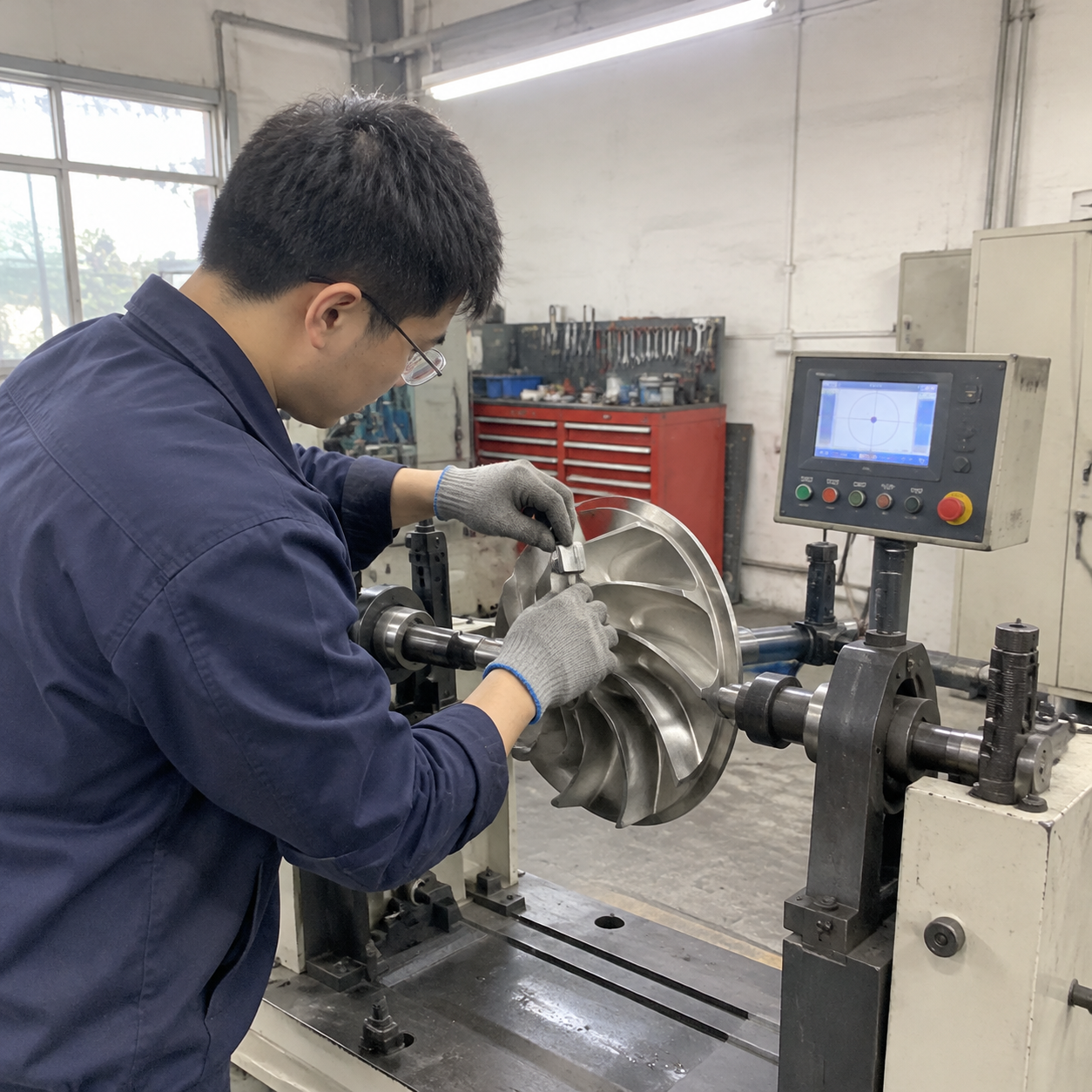
Dynamic balance is the other half. Most pump specs call out ISO 1940-1 G6.3 at the impeller. High-speed or multistage duty often wants G2.5. Both are achievable on a silica sol casting, but only if the casting was dimensionally consistent to begin with and the machinist had enough stock to correct the imbalance without taking the shroud too thin. A casting that comes in 1.5 mm off-center eats your machining allowance and your balance grade at the same time.
The spec numbers that decide whether it works
Most impeller RFQs I see from smaller pump builders are three pages of drawing plus one line that says "material: stainless steel, no defects." That's not a spec. That's a wish. Here's what I actually write, and what a competent silica sol shop can hold.
| Item | What to write on the RFQ | Realistic silica sol capability |
|---|---|---|
| Dimensional tolerance | ISO 8062-3, CT5 for impellers under Ø300 mm | CT4 to CT6 |
| Minimum wall | 2.0 mm nominal on shrouds, state it explicitly | 1.5 mm small parts, 3 mm above ~50 kg |
| Flow passage surface | Ra 6.3 max as-cast on wetted passages; Ra 3.2 by agreement | Ra 3.2 to 6.3 with controlled slurry density |
| Chemistry | ASTM A743 CF8M, or ASTM A890 CD4MCuN / A995 CD3MN; heat analysis per lot | Verified by spark emission on every heat |
| Ferrite content (CF8M) | 5% to 12%, measured per ASTM A799 | Needs a calibrated ferrite scope, not a guess |
| Radiography | ASTM E446 / E505, severity level and zone map on the drawing | In-house RT or accredited subcontract |
| Penetrant | ASTM E165 on all machined and as-cast wetted surfaces | Routine |
| Dynamic balance | ISO 1940-1, G6.3 standard; G2.5 for high-speed duty | Done after machining, report per impeller |
| Heat treatment | Solution anneal per ASTM A743, furnace chart traceable to heat number | Chart must be issued, not just claimed |
| Material cert | EN 10204 3.1 minimum; 3.2 if the end user is in nuclear or offshore | 3.1 routine, 3.2 costs extra and takes longer |
| Weld repair | Written policy: prohibited in the flow channel, permitted elsewhere only with PT and record | Ask before you buy, not after |
Two things about that table. First, "no porosity" is not a spec. Radiography acceptance has to reference a severity level and a zone — otherwise the foundry will interpret it as "the film looks fine to the guy holding it." Second, if you specify Ra 3.2 across the whole casting, you've just written a spec nobody can meet at a price you'd pay. Put the roughness requirement on the wetted passages only, and leave the outside as-cast.
Silica sol versus water glass versus sand: the honest comparison
You'll get pitched all three. Here's how they actually behave on an impeller.
| Silica sol | Water glass | Sand casting | |
|---|---|---|---|
| Tolerance | CT4–CT6 | CT7–CT9 | CT10–CT12 |
| As-cast surface | Ra 3.2–6.3 | Ra 12.5–25 | Ra 25+ |
| Min wall | 1.5–3 mm | 3–5 mm | 6 mm+ |
| Closed impeller, one piece | Yes | Yes, with more cleanup | No — open/semi-open or welded vanes |
| Tooling cost | Moderate | Moderate | Low |
| Piece price | Highest | Mid | Lowest |
| Lead time | 6–10 weeks | 4–7 weeks | 3–5 weeks |
| Sensible up to | ~200 kg | ~300 kg | No real ceiling |
The one place water glass still wins on impellers is large, low-speed, dirty-service pumps where efficiency isn't the selling point and the buyer cares about price per kilo. If that's your product, fine — but budget for machining the flow passages, because you will not want to run that surface finish.
And sand casting simply cannot make a closed impeller as one piece. You either go open impeller or you weld the shroud on. Welded shrouds work. They also add a heat treat step, a PT step, and a fatigue-sensitive joint in a part that flexes every revolution. Don't let a foundry talk you into that geometry switch to save 20% — you'll spend the difference back on the machining and the warranty reserve.
How to read a silica sol impeller quote
An impeller quote has about eight cost buckets in it. You don't need to rebuild the foundry's cost model. You do need to know which bucket they left out.
Tooling. Wax injection die plus core die plus any gauges. Typically $600 to $2,500 per pattern for an impeller in this size range. Ask two questions: is it a one-time charge, and do you own the pattern after the second order? If the answer to the second one is vague, get it in writing. Patterns walk.
Material. Roughly $3 to $6 per kg for CF8M, $8 to $14 for duplex, bought at melt weight, not finished weight. A 40 kg impeller might start as 70 kg of melt. Casting yield of 45% to 60% is normal on closed impellers because of the risering.
Shell building. Layers times drying time times floor space. This is the biggest structural cost difference between silica sol and water glass, and it's also where a foundry under price pressure will quietly cut a backup coat.
Post-processing. Cutoff, grinding, heat treat, and any machining you're having them do.
Inspection. Dimensional, RT, PT, chemistry, balance. Where RT is subcontracted, this line gets real.
Scrap allowance. And here's the one that decides everything.
Ask one question on every impeller quote: "What yield rate is baked into this price?" If they say 95%, they either didn't calculate it or they're planning to argue with you later. Good silica sol shops run 85% to 92% on a mature impeller. New tooling, first two lots — 75% to 85%, and they should say so.
A 12% yield gap between two quotes is worth roughly 15% to 20% on the piece price. Which means the cheapest quote on your spreadsheet is very often the one that assumed 95% yield and will recover the difference through reschedules, "material price increases," and slow-walking your third shipment.
Other questions worth putting in the same email:
- Price at 50, 200 and 500 pieces — and does the tooling amortize or stay a line item?
- Is heat treatment in this price, and do I get the furnace chart with the cert?
- What's your RT coverage on the hub section — sampling plan or 100%, and which severity level?
- What's the price if we use your consolidation container versus shipping on ours?
- What's the scrap rate on this part number over the last twelve months, by lot?
That last one separates the shops that track yield from the shops that track invoices. The ones that can answer it are, in my experience, also the ones that answer technical questions in one round instead of three.
The 7-point check before you place a PO
This is the part of the guide where I hand over to someone who's done more of these audits than I have. Dale Hoffman spent 14 years as a supplier quality engineer for a US pump OEM before going independent, and he's walked shell rooms from Ningbo to Coimbatore. I asked him what he actually looks at in the first two hours of a foundry visit.
"Paperwork is the last thing I check," he told me. "Anybody can print a certificate. I want to see whether the room is running the way the certificate says it's running. There are seven things, and I can usually get through them before lunch."
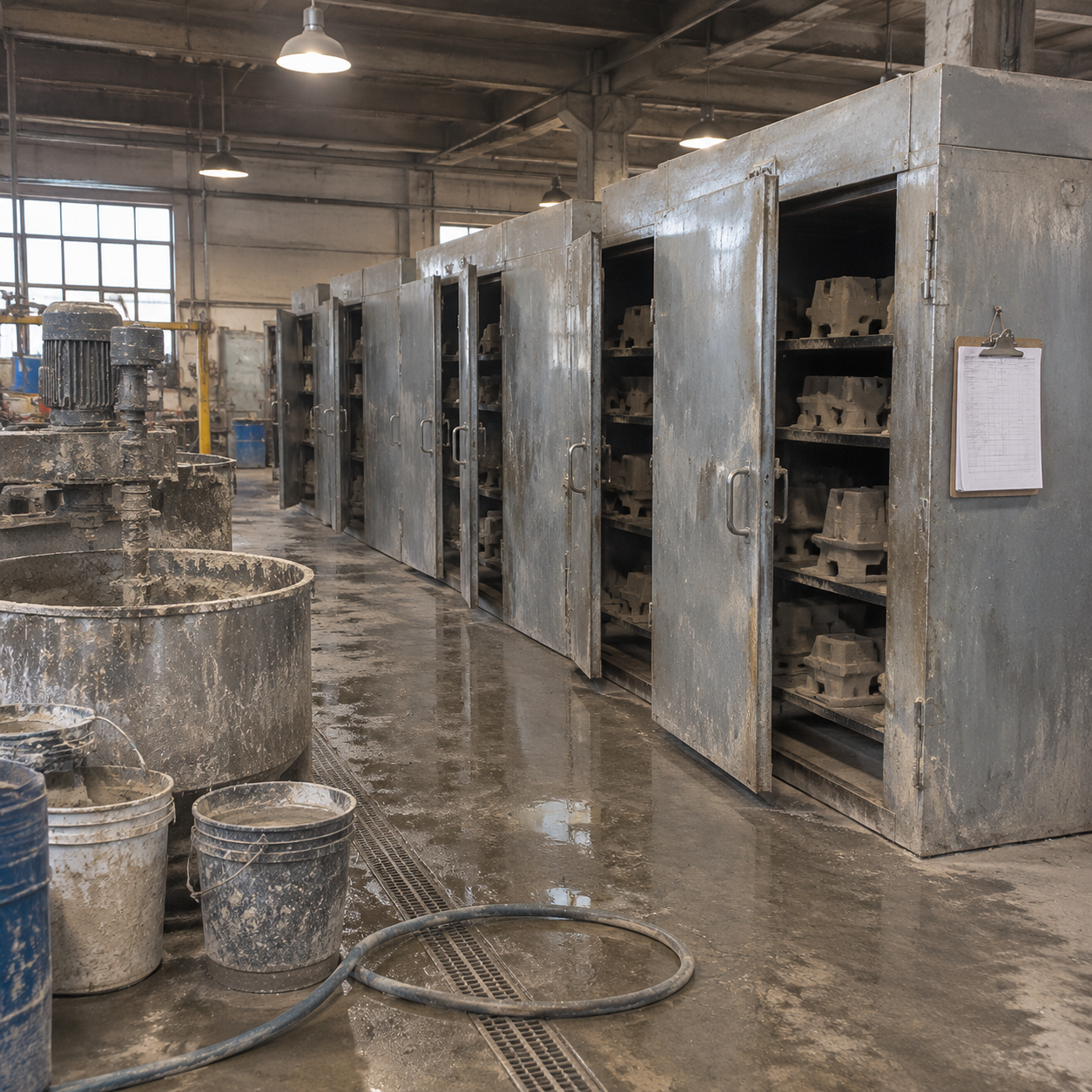
- The slurry tank. Is there a viscosity cup and a density record sheet hanging next to it, and is today's entry filled in? "Nine times out of ten the sheet is there and the last entry is from three months ago. That tells me the density control is theater."
- The drying room. Temperature and humidity logged, or just "we control it"? Silica sol shells fail on humidity drift, and humidity drift shows up as gas porosity six weeks later at your incoming inspection.
- Wax injection. Machine tonnage, die maintenance log, and the percentage of reclaimed wax going back in. High reclaim ratios change the shrinkage and nobody adjusts the die.
- The spectrometer. Where's the reference standard, and when was it last checked? "I've seen beautiful spectrometers with a calibration sticker that expired two years ago and a standard block covered in dust. That's a decoration, not a QC instrument."
- Radiography. In-house or subcontracted? If subcontracted, can a film be traced back to a specific heat number and a specific casting? If they can't answer that in under a minute, your RT requirement is going to be satisfied with a piece of paper.
- The scrap bin. Physically separated, red-tagged, no path back into production? "An impeller with a known shrinkage indication does not belong in the same room as your shipping crate. I want to see a locked or fenced area."
- Traceability. Pick a finished casting off the rack at random and ask them to walk it back to the melt record and the heat treat chart. "This is the whole audit in one question. If they can do it in ten minutes, you're probably fine. If there's a lot of walking and phone calls, you're going to spend the next two years chasing paperwork."
His point about the shell room stuck with me, because it's the opposite of how most buyers approach supplier selection. We spend our time on the quote and the sample. The sample is always good. The sample is made by the best people on the best day. What you're actually buying is the hundredth impeller, made on a Friday, while the supervisor is on a call.
Metallurgy traps that are specific to impellers
Two alloys cover most of what you'll buy, and both have a trap.
CF8M (ASTM A743). The trap is ferrite. You want 5% to 12% — enough for weldability and resistance to stress corrosion cracking, not so much that you lose ductility and corrosion resistance. It has to be measured with a calibrated ferrite scope per ASTM A799, not estimated from the chemistry. If a foundry tells you "the chemistry guarantees the ferrite," they're doing arithmetic on a diagram instead of measuring the part.
Duplex, CD4MCuN (ASTM A890) or CD3MN (ASTM A995). Two traps here. First, sigma phase. Hold duplex in the 320–525°C window too long and it embrittles; the solution anneal has to be followed by a fast enough cool — water quench, usually — and that cool is only as good as the quench tank. Second, pitting resistance. Offshore and seawater duty frequently calls out ASTM G48 Method A, and if the PREN doesn't come in where the spec says, you find out after the impeller is machined and balanced. Ask for the G48 result on the heat, not on a generic certificate from last year. This is the same set of checks we run on every duplex stainless job.
Weld repair. This is the one I'd put at the top of the list if I could only ask one thing. Most casting standards permit weld repair under controlled conditions. That's fine on a bracket. On a closed impeller, a weld inside the flow channel is nearly impossible to blend properly and effectively impossible to inspect afterwards. Decide your policy before you get a nonconformance — either prohibit repair on wetted passages entirely, or require PT after repair plus a record of every repair location tied to the serial number. Ambiguity here is how you end up with a flow channel full of blended weld and a supplier who says, correctly, that nothing in the spec forbade it.
One more: MTC type. EN 10204 3.1 is a certificate signed by the manufacturer's own authorized inspector. 3.2 is signed off by an independent third party. If your end customer is in offshore, nuclear, or anything with a class society attached, you probably need 3.2, and the price difference and lead time difference are both real. Figure that out at the RFQ stage, not three weeks before shipment.
Making the communication actually work
I'm bilingual, and I still get drawings wrong. That should tell you something about how much a non-Chinese-speaking buyer is missing.
The specific problems are predictable:
- ASME versus ISO drawing convention. ASME Y14.5 true position callouts get misread by inspection departments working in GB/ISO habit. It's not a language problem, it's a convention problem, and it produces parts that are "in tolerance" against the wrong reading.
- Gauge mismatch. Your position tolerance was designed for a CMM. Their inspection report was generated with a fixture. Those two things do not measure the same feature.
- Vocabulary. Flow passage, not "channel." Riser, not "feeder." Chill, not "cold iron." Furnace chart, not "heat treatment record." Spectro analysis. Shell room. Gating system. Getting these right saves you a week per round of questions.
- Time zone. China is 12 to 13 hours ahead of Ontario depending on daylight saving. Every question you send at 4 pm your time gets answered tomorrow afternoon at best. Three rounds of questions is six working days. Three rounds is also roughly what you'll get from a supplier who hasn't really read the drawing.
What's worked for me: stop sending 40-page specs. Send one page, with a photo of a good part and a photo of a bad part, and a short list of the five things you will actually reject on. Then run a fixed 15-minute video call once a week during production — and ask them to walk the phone through the shell room and the finishing area, not sit in the meeting room. The camera doesn't lie about whether the floor is wet.
Communication cost is real cost. It doesn't show up in the quote, but it shows up in your calendar, in your engineer's time, and in the two weeks of schedule you burn when a question goes unanswered.
Common mistakes to avoid
- Buying on unit price alone. The yield rate assumption inside the price is worth 15–20%. Compare on landed cost at the yield they've quoted, then compare the yield numbers.
- Not specifying surface roughness on the flow passage. It's the one characteristic that directly moves your efficiency curve, and it's the one most RFQs leave out.
- Writing "no porosity" instead of a severity level. Unmeasurable specs get interpreted in the supplier's favor, every time.
- Leaving weld repair undefined. Silence is permission.
- Not settling pattern ownership. Get it in the contract or expect to pay for tooling twice.
- Approving on first article only. First articles are made by the A-team. Watch lot three.
- Assuming ISO 9001 covers your part. It covers the system. It doesn't tell you whether the spectrometer is calibrated or whether the drying room was logged last Tuesday.
- Skipping the factory visit because the sample was good. The sample is a marketing document.
FAQ
How much does a silica sol cast pump impeller cost?
For a closed impeller in CF8M, roughly 30 to 120 kg finished, expect piece prices in the range of $8 to $22 per kg at quantities of 100 or more, plus tooling. Duplex roughly doubles the material component. The range is wide because it depends on weight, wall thickness, risering complexity, RT coverage, and whether machining is included. Anyone quoting you a single number without asking about those five things is guessing.
Can silica sol casting make a closed impeller without welding the shroud?
Yes, using a soluble or ceramic core for the internal passage. This is the main technical reason pump builders choose the process. Confirm that your supplier actually has core-making capability in-house rather than assembling the impeller from two castings and welding — the difference shows up in the PT results and in the fatigue life.
What's a realistic minimum order quantity?
Most silica sol shops will run 50 to 100 pieces on an existing pattern. Below that, you're paying a setup premium and you'll likely be quoted at a small-lot rate. If you need 20 pieces, expect to pay for the tooling anyway and consider whether a machined-from-solid or sand cast alternative is cheaper for the first run.
What lead time should I plan for?
New part number: 4 to 6 weeks for tooling, then 6 to 10 weeks for first article and approval. Repeat orders on an existing pattern: 6 to 9 weeks door to door, including ocean freight. Radiography and third-party witness testing add one to three weeks. If a supplier promises four weeks on a silica sol impeller with RT, ask where the shell room is.
Can I get duplex stainless impellers?
Yes, CD4MCuN and CD3MN are both commonly available in silica sol. Ask for the heat analysis, the ferrite or austenite-ferrite balance, and the ASTM G48 Method A result if your service is seawater or high-chloride. And specifically ask how they quench after solution anneal — that answer tells you more than the certificate does.
Do I have to pay for tooling twice?
Only if you didn't settle ownership. Standard practice is a one-time tooling charge with the pattern becoming your property after a defined period or order volume. Put it in the purchase order. If you switch suppliers in year three, you want to be able to ask for your die back.
What to do next
If you take one thing from this, take the yield question. Everything else in the sourcing process — the spec, the audit, the balance grade, the ferrite check — assumes you're comparing two quotes that mean the same thing. They usually don't.
The short version of the process I run:
- Write the spec with five rejectable characteristics, not forty aspirational ones.
- Ask every supplier for their yield rate on the part number, in writing.
- Get the weld repair policy in writing before the PO.
- Visit, or have someone visit, and go through the seven-point shell room check.
- Approve on lot three, not lot one.
None of that is complicated. It's just slower than sending a drawing to eight foundries and picking the cheapest reply — which is exactly why so many buyers skip it, and exactly why the impeller failures keep happening.
Get the impeller sourcing checklist
A one-page PDF you can send with your RFQ: the spec table, the seven shell-room checks, and the ten questions that separate a foundry from a quote generator.
Or if you're mid-decision on a part number, talk to a sourcing engineer who has bought closed impellers out of Ningbo, Qingdao and Chennai.