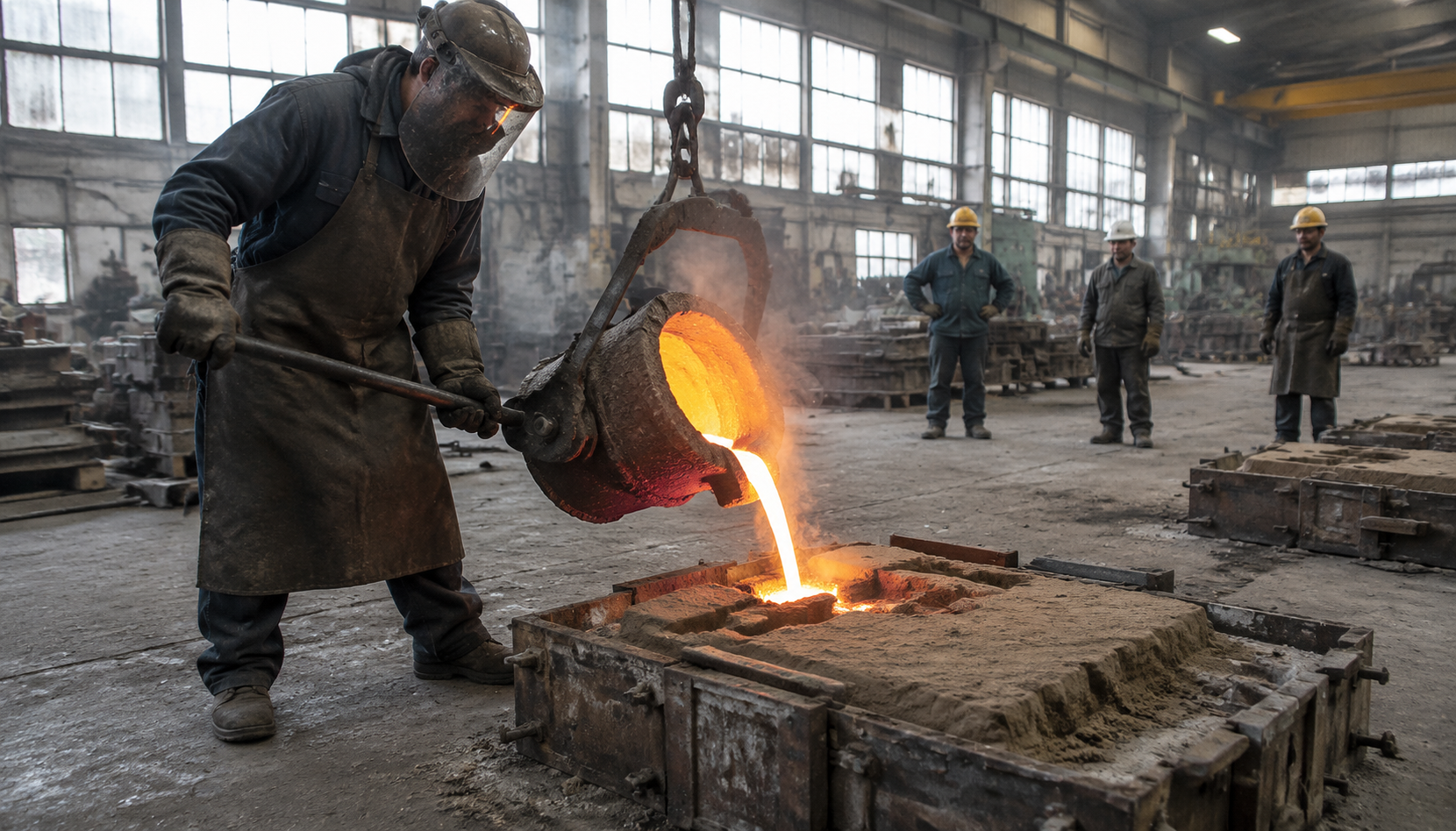
China runs somewhere north of 60,000 foundries. Fewer than 2,400 hold a valid IATF 16949 certificate. Of that 2,400, a smaller number again hold one whose scope actually covers melting and pouring — not just machining castings that somebody else poured.
That gap is where most OEM sourcing projects quietly die. Not at the price negotiation. Not at the sample stage. At the moment a Tier-1 quality engineer opens the supplier's certificate PDF and reads the scope line.
I've spent twelve years on the buying side in Stuttgart, and the pattern repeats: a foundry looks perfect on the website, quotes a competitive FOB number, sends beautiful samples, and then falls apart in PPAP review because the paperwork doesn't match the part, or the IATF scope turns out to be a trading company's certificate borrowed from a sister plant.
So treat this as a working guide to screening an OEM automotive iron casting supplier. Not the brochure. The evidence. Everything below is something you can request this week and check yourself, before anyone flies anywhere.
One note on perspective. I buy for a German Tier-1, so my instincts run to paperwork and process. If you buy for a North American Tier-1, your weighting is different — landed cost and delivery carry more of the score — but the same documents decide whether your programme launches on time. Both sets of weights appear below, because the audit question and the money question are the same question asked in two languages.
Why "OEM" Changes the Entire Screening Logic
Aftermarket is forgiving. If a batch of brake drums is off by half a millimetre of wall thickness, somebody eats the margin and the parts still ship. OEM is not forgiving. Your name is on the drawing, your customer's vehicle carries the part, and a field failure starts a paper trail that ends at your desk.
So the question shifts. It is no longer "can this foundry make this casting?" Plenty of foundries can make one good casting. The question is: can this foundry make the same casting, to the same specification, at the same rate, in month thirty-seven, when the operator on the line has changed twice and the sand system has been running on the same reclaim for three years?
That's a system question, not a capability question. And systems are only visible through audits and documents. Which is why the next four sections are about paper, not about tonnage.
The IATF 16949 Scope Trap
Here's the first thing I check, and it takes ninety seconds.
Pull the supplier's IATF 16949 certificate and read the scope statement line by line. Not the logo. The scope.
I have seen certificates where the scope reads something like "machining of ferrous castings." That foundry does not have a certified melting process. They buy raw castings from an unverified yard foundry down the road, machine them, and ship them to you under an automotive certificate. Your PPAP package will be built on top of an undocumented supply chain.
Cross-check the certificate number against the IATF database. Confirm three things:
- The certificate is currently valid, not suspended.
- The certification body is one of the recognised IATF oversight offices, not a small local registrar with a similar-sounding name.
- The scope names casting or foundry processes, and it names the actual site address you're buying from — not a head office in another province.
Then diarise the expiry date. I have watched a supplier lose certification eleven weeks into a series programme because nobody in my own team tracked the renewal. The audit you ran last year does not survive the certificate lapsing.
VDA 6.3 process audit: what the report tells you that the certificate doesn't
A certificate says a system exists. A VDA 6.3 process audit says whether it works on a specific product line.
Ask for the last process audit report, not a summary. You want the element scores. VDA 6.3 grades six elements — incoming materials, process flow, personnel, resources, effectiveness, and customer care — each on a 0–10 scale, with downgrading rules. A supplier scoring 92% overall but 4/10 on incoming material control is telling you their scrap steel and pig iron verification is a formality.
For a casting operation, I care most about two elements: whether incoming charge materials are verified (chemistry, not just delivery notes), and whether process parameters are monitored in real time or recorded retrospectively. Retrospective records are fiction written after the shift.
PPAP: Where Iron Casting Suppliers Actually Fail
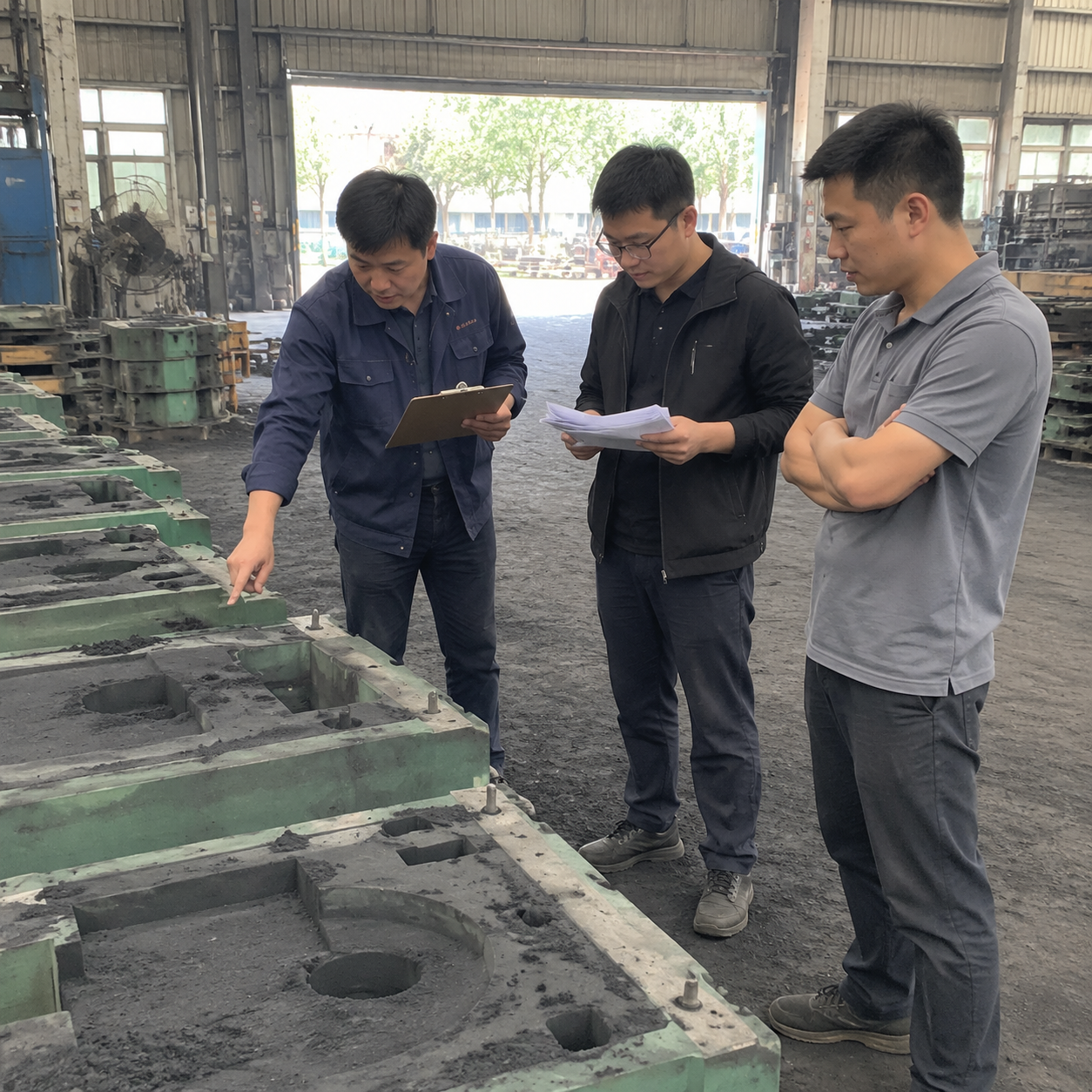
Level 3 is the default for OEM automotive. Eighteen elements. Most suppliers will tell you they do PPAP without blinking. Ask for the last three full packages they submitted to other customers and watch the room get quiet.
For iron castings specifically, four elements cause the most rejections.
1. Material certification without heat traceability
A certificate of analysis showing GJL-250 chemistry is worthless if it cannot be tied to the specific castings in the box. You need the heat number — the melt batch — on the test certificate, on the pouring record, on the casting box label, and on the shipping document. A continuous chain.
Ask the supplier to walk you through one heat number from furnace to pallet. If it takes more than five minutes to find the paperwork, the traceability is reconstructed, not recorded.
2. Process capability on the wrong characteristics
Ppk of 1.67 minimum during trial production, Cpk of 1.33 in series, on designated special characteristics. That's the requirement. What you get instead is capability studies done on a machined bore that runs on a CNC, where hitting the tolerance is trivial, while nobody studies the as-cast wall thickness that actually varies.
Specify the special characteristics on the drawing yourself, and make sure the supplier studies the cast features — not just the machined ones. A full breakdown of the evidence pack is worth reading before you write your own PPAP requirement into the contract.
3. Dimensional reports on the wrong drawing revision
This one is embarrassingly common. The dimensional results report ten points. The drawing has fourteen. Or the report references revision C and the current revision is D. Either way, the package is rejected and you lose three weeks.
Build the check into your own review process: before you accept any PPAP, compare the drawing revision on the dimensional report to the revision on your purchase order, character by character.
4. IMDS submission missing or stale
International Material Data System entry, submitted at the supplier's cost, referencing the actual material specification. Not "cast iron." Not "grey iron." The exact grade with the alloying elements declared. If a supplier has never heard of IMDS, they have never supplied a European OEM directly, and you should recalibrate your expectations accordingly.
Casting Tolerances: Stop Specifying Machined Numbers on Raw Surfaces
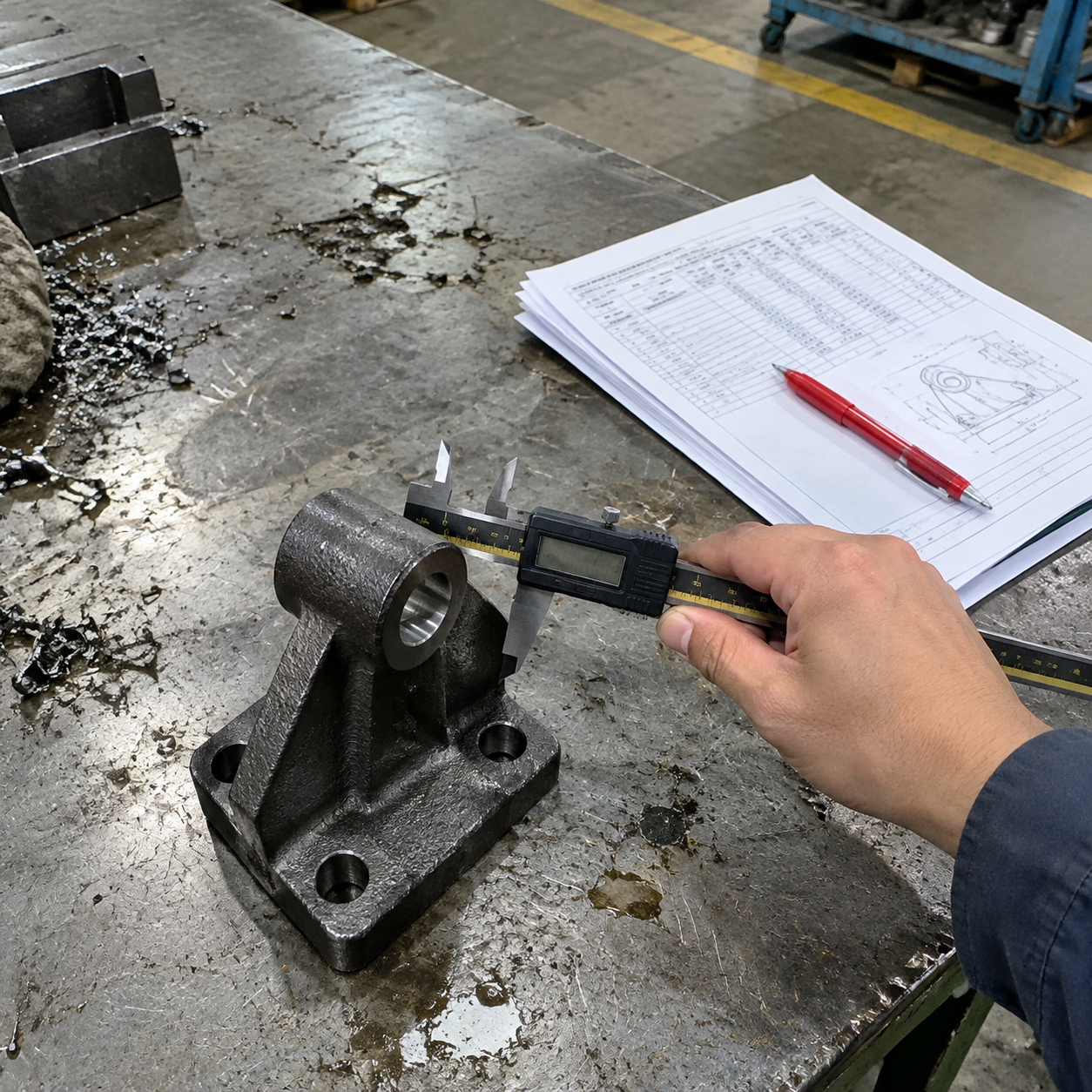
Half the RFQs I see coming from junior buyers have a raw cast surface toleranced at ±0.3 mm. That is not achievable in sand casting and never will be. The supplier will either quote it and fail, or quote it and quietly add a machining operation you didn't budget for.
Sand castings follow ISO 8062-3, with dimensional casting tolerance grades. A realistic grade for a medium-complexity automotive bracket runs DCTG 5 to DCTG 7 on as-cast features. Machined datums and bores can hold much tighter — that's what the machining allowance is for.
| Feature | Realistic as-cast tolerance | Note |
|---|---|---|
| Overall length, 150 mm nominal | ±0.8 to ±1.2 mm (DCTG 5–6) | Varies with mold size |
| Wall thickness, 8 mm nominal | ±1.0 mm minimum | Never specify ±0.3 |
| Draft angle | 1.0° to 2.0° | Not a tolerance — a design requirement |
| Machining allowance | 2.0 to 4.0 mm per surface | Depends on part size and distortion |
| Flatness over 200 mm | 0.5 to 1.5 mm as-cast | Correctable only by machining |
Get the material grade right too. GJL-250 (EN-GJL-250, formerly GG25) grey iron for housings and brackets where vibration damping matters more than tensile strength. GJS-500-7 (EN-GJS-500-7, formerly GGG50) ductile iron for anything load-bearing, because grey iron has almost no elongation and will crack, not bend, when overloaded. The ASTM equivalents — A48 Class 35B for grey, A536 65-45-12 for ductile — are what you'll see on North American drawings, and a competent supplier should be able to map between the systems without a phone call.
| Application | European grade | US equivalent | Why this one |
|---|---|---|---|
| Gearbox housings, covers, brackets | GJL-250 | ASTM A48 Class 35B | Damping, machinability, compressive load |
| Load-bearing arms, hubs, yokes | GJS-500-7 | ASTM A536 65-45-12 | Tensile strength with usable elongation |
| Safety-critical suspension parts | GJS-450-10 / GJS-600-3 | ASTM A536 60-40-18 / 80-55-06 | Impact and fatigue with a ductility margin |
If the supplier can't tell you the difference between GJL and GJS without looking it up, that's a useful signal about their engineering depth.
RFQ Comparison: Kill the Price-Per-Kilo Habit
Here's the trap. You send the same drawing to six foundries and compare the FOB price per kilogram. The cheapest number wins. Six months later the parts arrive with a machining allowance 0.5 mm too thin, and every single one gets reworked at your cost.
Price per kilo is not comparable across suppliers, because it doesn't capture what's bundled in. One supplier quotes a heat-treated, shot-blasted, machined part. Another quotes a raw casting with flash still on. The kilos are the same; the work isn't.
Force a cost breakdown instead. Ask for separate lines on material, melting, moulding, fettling and cleaning, machining, inspection, coating, packaging, and tooling amortisation. A supplier who can't produce that breakdown either doesn't understand their own cost structure or is hiding a margin cushion inside a single blended number.
I asked James Parker, a Michigan aftermarket parts importer who has been buying ductile iron castings in China for nine years, how he handles this.
"The first quote is always a number. The second conversation is where you learn something. I tell them: send me the breakdown, and I'll tell you which line I think is wrong. Half of them never send it. The ones who do — that's my shortlist, right there, before I've even looked at the total."
He has a point I didn't expect to agree with. The breakdown itself is a capability test. A foundry that can break its own price into eight lines knows where its cost sits, which means they know where a design change will save money and where it won't. That's a supplier you can engineer with.
Tooling Ownership and Payment Terms: The Clauses That Save You Later
Pattern equipment for a medium-complexity iron casting runs anywhere from €3,000 to €15,000 depending on the number of cores and boxes. It's often the single largest line item after the castings themselves, and it is the one most frequently left ambiguous.
Who owns the pattern after you've paid for it? In writing, in the purchase order, with a tooling inventory that lists each pattern by a unique stamped identifier. Not a description. An identifier.
Why it matters: if the relationship ends in year four, and the tooling isn't documented as yours, you are re-cutting patterns and re-running PPAP from zero. That's six to ten weeks and a full re-validation, and it happens more often than anyone admits.
Payment structure is the second clause. Standard for tooling is a split — something like 30% at PO, 40% at pattern trial, 30% after first-off sample approval. Never 100% up front for tooling, no matter how good the relationship feels.
James Parker again, on the terms side:
"I used to accept 100% tooling upfront because it sped things up. Then a supplier went dark in month seven with my patterns in their yard. Now it's staged payments and a written tooling agreement, every time, even for a €4,000 pattern. It's not about trust. It's about not having that argument."
Same for production payments. A 30/70 split against shipping documents is normal. Full payment before shipment, on a first order, with no performance guarantee, is not something to accept.
Capacity Claims vs Capacity Evidence
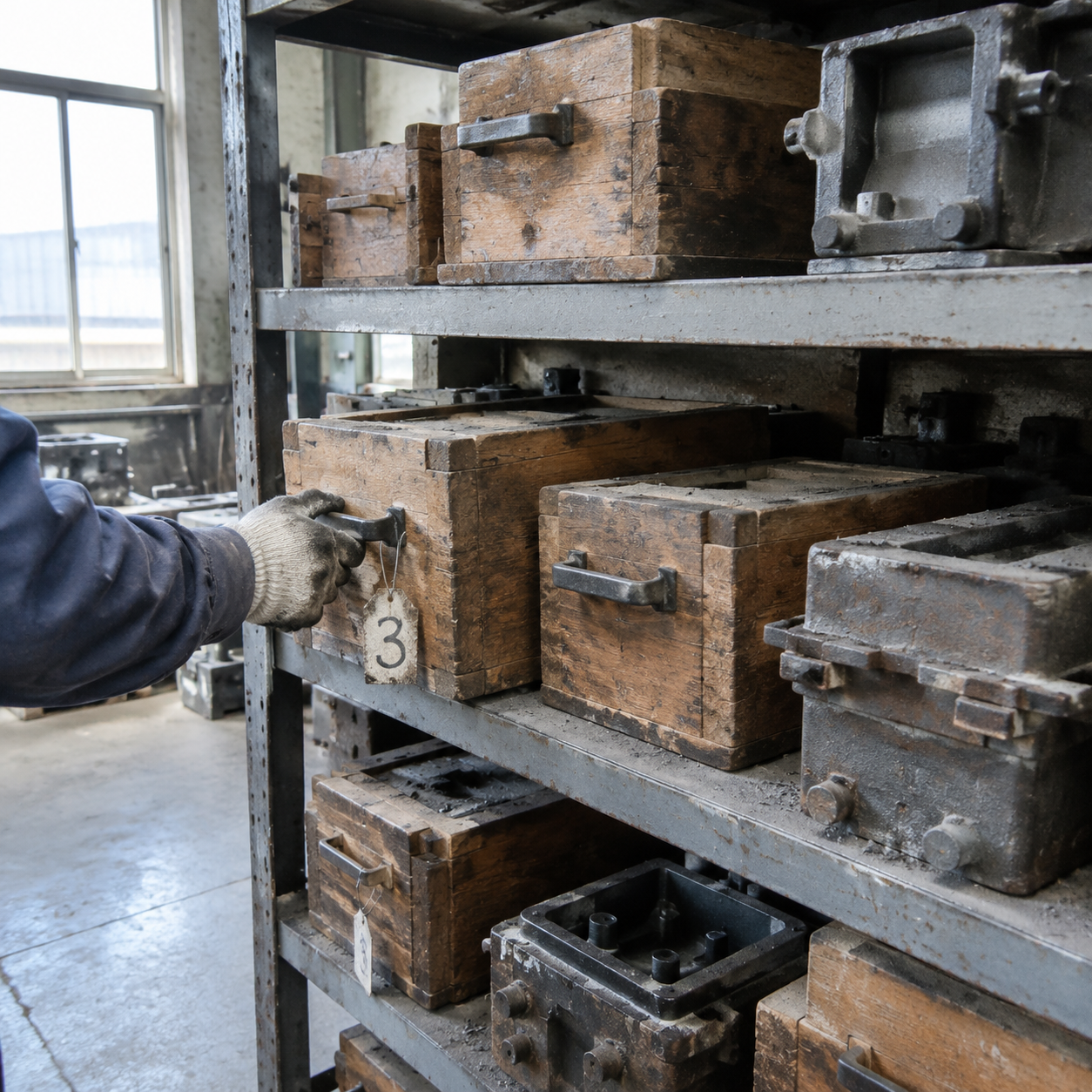
Every foundry brochure claims a monthly capacity. Almost none of them can support the number with a production schedule.
Ask for the last six months of actual pouring tonnage, by month, by shift. Then ask how many moulding lines are running and what the current utilisation is. A foundry quoting 800 tonnes per month capacity while running at 40% utilisation has room — but it also has a cost problem, and cost problems show up as deferred maintenance.
The utilisation number that matters for you isn't the monthly total. It's the free capacity on the specific moulding line your part will run on. A plant at 95% overall utilisation might have a small flask line sitting at 40%, which is exactly where your 2 kg bracket fits.
Also ask directly: what happens to my schedule in the Chinese New Year window, and what is your committed lead time in weeks, not days? A fifty-day lead time that becomes seventy in February is a fifty-day lead time that's wrong.
Landed Cost, Lead Time, and the Questions a US Buyer Asks First
If you buy for a North American Tier-1, the audit answer gets you onto the shortlist and the landed-cost number decides the award. Three things sit between an FOB quote and the figure your controller sees.
Duty and tariff exposure. Iron castings clear under HTS 7325 and 7326 headings, and a large share of Chinese-origin goods in those headings have carried additional Section 301 duties for years. The list status moves, and it moves without much warning. Before you build a business case on a 12% saving, give your customs broker the HTS code and the country of origin and ask for the total duty rate in writing. A foundry that quotes you FOB and stays quiet on duty isn't lying to you — it just isn't their job. It's yours.
Transit versus lead time. Ningbo or Shanghai to a US Midwest door runs roughly 30 to 40 days port to port plus inland, and that's the good case. Add booking pressure in the fortnight before Chinese New Year. Add a week if the port is congested. Ask the supplier for the last six shipments with actual on-board dates and actual arrival dates. Not the quoted transit time. The actual dates, with the vessel names on them.
The inventory you have to carry. A 70-day supply chain forces safety stock in a way a 14-day domestic supply chain does not. That stock has a carrying cost, and it belongs in the comparison even though no foundry will ever put it in a quote.
A Tier-1 commodity buyer in Ohio, who spends around $8M a year on iron and aluminium castings, put the arithmetic to me plainly last spring:
"The FOB number is the least interesting number on my spreadsheet. I want to know what the part costs sitting in my rack in week thirty, after duty, after freight, after the safety stock I'm carrying because the boat is late. Two suppliers can quote twenty cents apart and land eighty cents apart."
That reframing is worth stealing. Build the comparison in landed cost per good part — not per kilo, not per FOB unit, and with scrap and rework inside the number. The cheap quote stops looking cheap remarkably fast.
One European item that now belongs in the same conversation: iron and steel goods entering the EU sit inside CBAM reporting obligations. Your supplier will eventually need to hand you emissions data per tonne. Ask now whether they track it. The ones who answer without hesitating are the ones still shipping to you in 2029.
Common Mistakes to Avoid
- Accepting an IATF certificate without reading the scope. Machining-only scopes are common and they leave your melting process uncertified.
- Auditing the plant but not its sub-suppliers. Charge materials, resin, sand, and coatings all move final properties. Ask who supplies them and how incoming chemistry is verified.
- Specifying machined tolerances on cast surfaces. ISO 8062 DCTG 5–7 is realistic for sand. ±0.3 mm is not.
- Skipping the IMDS entry. It's a European OEM gate, and retrofitting material data after the part is in series is painful.
- No written tooling ownership clause. If it isn't in the PO with a stamped identifier, it isn't yours.
- Comparing price per kilo across quotes with different process scopes. Force the eight-line breakdown.
- Trusting a capacity figure without seeing six months of tonnage. Utilisation on your specific line matters more than the plant total.
- Approving a PPAP built on a different line from the one that will run your part. Same plant, same certificate, different sand system, different result.
- Leaving duty and HTS classification until after the business case is signed. By then the saving is already committed and the tariff is somebody else's line item.
Frequently Asked Questions
What certification does an OEM automotive iron casting supplier actually need?
IATF 16949, with a scope that explicitly covers the casting and melting processes at the site you're buying from. ISO 9001 alone is not sufficient for an OEM programme. For German OEM supply chains, expect VDA 6.3 process audit capability and often VDA 6.5 product audit as well. Verify the certificate against the IATF database, not against a PDF in the supplier's presentation deck.
What does PPAP Level 3 require for an iron casting?
All eighteen elements, with samples and supporting data submitted to the customer. The elements that most often cause rejection on castings are material test reports that can't be traced to individual heat numbers, process capability studies performed on machined features instead of as-cast features, dimensional reports tied to the wrong drawing revision, and missing IMDS declarations.
Should I specify grey iron or ductile iron?
Grey iron (GJL-250 / ASTM A48 Class 35B) for housings, brackets, and covers where vibration damping and machinability matter and loads are compressive. Ductile iron (GJS-500-7 / ASTM A536 65-45-12) for anything that sees tensile load, fatigue cycling, or impact, because grey iron has negligible elongation and fails without warning. If a drawing specifies grey iron on a safety-critical load path, question the design before you question the supplier.
How long does it take from RFQ to series production?
Realistically twelve to eighteen weeks for a new casting with new tooling. Pattern manufacture is four to six weeks, first-off samples and dimensional check another three to four, PPAP preparation and customer review four to six, plus shipping. If a supplier promises eight weeks for a new pattern and a full Level 3 PPAP, they are either reusing existing tooling or planning to send an incomplete package and negotiate later.
Foundry or trading company — does it matter?
It matters the day something goes wrong. A trading company can be a perfectly competent partner on price, consolidation, and logistics, and plenty of buyers use one deliberately. But it cannot sign off a PPAP for a melting process it doesn't own. If the IATF certificate belongs to a mill down the road, your corrective action path runs through a third party with no authority over the furnace. Know which one you're buying from, in writing, before the first PO.
Is a Chinese iron casting foundry still competitive after duty and freight?
Often yes, but the answer now depends on part weight and value density. Heavy, low-value castings lose most of their advantage to ocean freight. Smaller, machined, higher-value parts usually still work. Build the comparison in landed cost per good part: duty rate in writing from your broker, six months of actual shipment dates from the supplier, and the safety stock your lead time forces you to carry.
Next Steps
Before you sign the letter of intent, run the scope check on the certificate — that one step eliminates most of the problems that come later. Then request the last three PPAP packages, the most recent VDA 6.3 report with element scores, and six months of pouring tonnage for the specific line your part will run on.
If any of those three requests gets deflected, that's your answer. A supplier with a working system produces those documents in a day. A supplier without one produces excuses for a week.
The rest — the price, the lead time, the tooling terms, the duty — becomes a much shorter conversation once you know the system holds. If you want to see how these checks translate into an actual part enquiry, the casting pages on this site show the drawings and process routes we work from. And if your programme is on a clock, send the drawing over early; the audit takes longer than the quote.
Get the supplier verification checklist
Twenty-three checkpoints covering IATF scope verification, PPAP evidence, casting tolerance review, tooling terms and landed-cost maths. Written for Tier-1 buyers, not for marketing departments.
Related: automotive castings — the operating envelope and the verified foundries we shortlist against.
Send your RFQ package
Drawing, annual volume, PPAP level, material spec and target price. We return a quotation with tooling amortisation, PPAP timing and the inspection plan spelled out — no placeholder numbers.
Prefer email? cfwc@163.com · WhatsApp +86 159 4126 7000