Let's start with a story you probably recognize
Last year, a plant manager I know in Texas ordered 600 impeller castings from a Chinese supplier he found through a trade show brochure. The price was irresistible—about 38% below his previous source in Mexico. The castings arrived on schedule, the paperwork looked clean, and for about two weeks, everyone was happy.
Then the first pump housing went on the test stand, and the vibration readings came back two times above the API limit. The impeller's vane geometry was off by just 1.6 mm at the trailing edge. On paper, that's within the foundry's stated tolerance. On a 3,600 rpm pump, it turned a $4,800 part into a scrapped casing and a missed delivery penalty.
Here's the thing: he didn't pick a fly-by-night shop. The foundry had a real website, an ISO certificate number that checked out, and a sales engineer who answered emails within hours. What it lacked was experience with your kind of impeller—tight hydraulics, critical dynamic balance, and a buyer who actually tests what he buys. That's a specific gap that's common across China's 7,000+ commercial foundries.
So before you send another RFQ to a shortlist of names from an internet search, spend 15 minutes running your candidates through this framework. I've been evaluating Chinese casting suppliers for industrial pump buyers for over a decade, and these are exactly the checks I run before recommending anyone.
Why impeller castings fail—and what it costs you
An impeller is one of the least forgiving castings you can source. It's a thin-walled hydrofoil that spins at high speed, directs fluid flow, and carries the entire performance of your pump on its geometry. The foundry isn't just casting a piece of metal. It's casting a hydraulic profile.
Get these four things wrong, and no amount of post-machining will save you:
- Vane geometry and core shift. If the core shifts more than 1 mm, the hydraulic passage narrows on one side, creating cavitation, vibration, and efficiency loss well below your pump curve.
- Internal porosity. Thin sections cool faster than thick hubs, which creates shrink porosity in exactly the worst places. Porosity near a machined bore can open up during final machining and reject the whole casting.
- Material integrity. CF8M (SS316) sound fine on the certificate, but if the chemistry or heat treatment is off, you get sensitized grain boundaries and chloride stress corrosion within months of service.
- Dynamic balance. A casting that's perfectly dimensional on the bench can still be massively out of balance because of hidden internal voids. That means your final impeller needs balancing—and if the foundry didn't build in enough machining allowance, you can't correct it.
One US pump OEM I work with scraped 22% of a batch of investment-cast impellers from a new Chinese source because of porosity discovered only after final machining. The per-part cost looked great at the start. By the time they counted machining hours, scrap, re-inspection, and delayed shipments, the true cost per good part was higher than their premium European supplier.
That's the trap. And it's why the cheapest quote is rarely the least expensive choice.
Five non-negotiables for any impeller casting supplier in China
Use this as a pass/fail filter. If a candidate fails any of these five checks, drop them. There are enough foundries in the market that you don't need to rehab a weak one.
1. Metallurgy and material traceability
Your impeller is defined by its material as much as its shape. The foundry must be able to provide a material test certificate (MTC) with actual chemical analysis and mechanical test results per heat—not a certificate generated from "standard values."
Ask specifically:
- Which melting furnace do they use, and is there a spectrograph on site or off site?
- Can they produce a 3.1 certificate per EN 10204, or only a 2.2?
- What's their heat treatment capacity and its certified temperature uniformity?
For pump impellers, you'll be working with a range of materials, and each one demands different foundry experience:
- Stainless steel (CF8, CF8M, CF3M): Must-have for water, chemical, and general process pumps. Foundry must practice proper melting control, because carbon pickup ruins corrosion resistance.
- Duplex and super duplex (CD4MCu, 2205): High strength, high corrosion. Requires controlled ferrite-to-austenite ratio and much stricter foundry discipline.
- Bronze (C95800, C95400): Standard for marine and seawater service. Watch for the right aluminum-iron-nickel balance.
- High-temperature alloys (e.g., CA15, HK30): For boiler feed and power plant pumps. Requires experience with high-alloy melting and proper mold filling to avoid hot tears.
If the foundry's sales engineer hesitates for one second when you ask what CT (casting tolerance) class they can hold per ISO 8062, that's your answer. They don't work with pump-critical castings regularly.
2. Process capability matched to your geometry
Not all foundries are equal—far from it. Three processes dominate impeller production in China, and each fits a different set of applications:
Sand casting is the default for mid-to-large impellers over 200 mm diameter, especially in ductile iron and steel. It gives you design freedom, relatively low tooling cost (typically $2,000–$8,000), and a rough surface finish. For any impeller that requires precise hydraulics, sand casting is almost always followed by CNC machining of the wetted surfaces. Choose sand casting when volume is low-to-medium and your impeller is too large for investment casting.
Investment casting is the answer for complex, multi-vane impellers under about 200 mm diameter. You get excellent surface finish (Ra 1.6–3.2), tighter tolerance (CT5–CT7), and thin sections down to 2 mm—which means the hydraulic profile comes closer to your design as-cast. Tooling is more expensive ($5,000–$20,000+), but per-part cost is very competitive at higher volumes.
Centrifugal casting is used mainly for cylindrical parts like pump casings, sleeves, and some special impeller hubs. It produces a dense, sound structure and is excellent for materials that are difficult to cast statically, like certain bronze alloys.
Here's my advice: don't ask a foundry "can you do investment casting?"—ask them what percentage of their revenue comes from it. A foundry that does 80% sand casting and maintains a token investment line as a sideline will not give you the dimensional consistency you need. On the other hand, a foundry with dedicated investment casting lines, where the operator's monthly bonus depends on casting yield, is the one that will fight to get your thin vanes right.
3. Real quality system, not just a certificate
Every Chinese foundry with export ambitions has ISO 9001. That tells you almost nothing. The question is whether the quality system is actually exercised on the shop floor.
Brian Miller, the head of sourcing at a US pump manufacturer that buys around 900 tons of stainless steel castings a year, puts it bluntly:
"The first thing I check is not the brochure. It's the certificate list in the QC manual. If they can't show me in-process inspection records from last month with actual measured values on 10 castings per batch, I don't care what their audit score says."
That's a smart focus. In-process records are hard to fake consistently across months of production. A foundry that measures, records, and files every heat's chemistry, every batch's hardness, and every dimensional check—and can pull those records from a drawer in under five minutes—has a real quality culture.
Here's what to dig into:
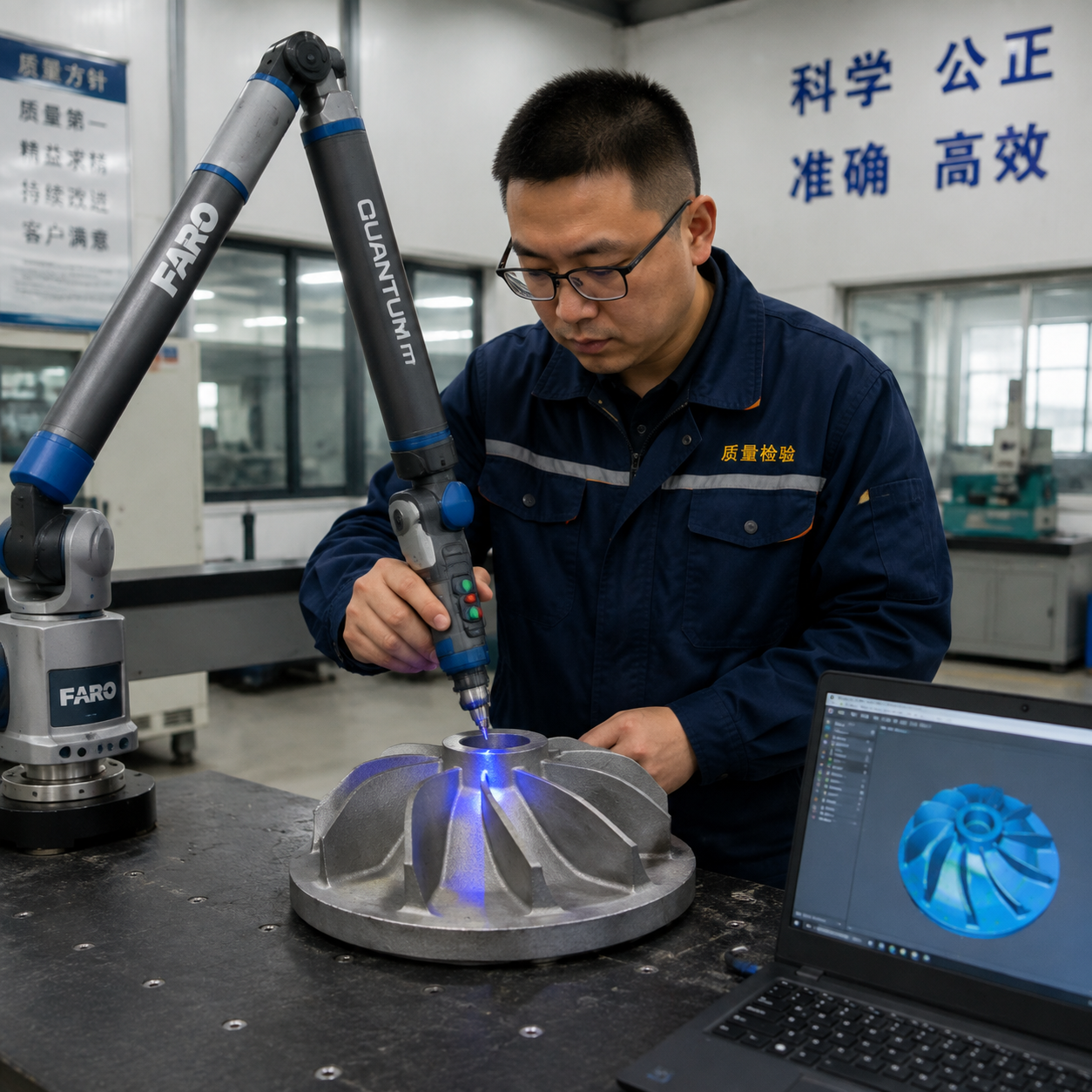
- Inspection equipment. Do they have a coordinate measuring machine (CMM), a portable 3D scanner, or at minimum calibrated gauges and fixtures? How often are they calibrated?
- NDT capability. For pressure-containing parts, you'll want radiographic testing (RT), ultrasonic testing (UT), or dye penetrant testing (PT). Does the foundry have certified NDT operators, or do they outsource it to a third-party lab?
- Positive material identification (PMI). A hand-held XRF gun used on every heat before pouring is a simple, powerful check against mix-ups. You'd be surprised how many foundries don't do this.
- Process documentation. Ask to see a control plan for a casting similar to yours. If they can't produce one, they're not process-managed, they're artisan-managed.
And one more thing: ask about their internal rejection rate. Most foundries track castings rework and scrap as a percentage. A reputable foundry will answer openly—say, 3–6% internal scrap for sand casting, 5–10% for investment casting. A vague "not too high" answer is a red flag.
4. Cost understanding and quote transparency
Let's talk money. You need a realistic baseline before you compare quotes, and I don't want you to get played by the classic lowball games.
As a planning range in 2026—and these are market estimates from ongoing sourcing projects, not official quotes—expect roughly:
- Sand-cast stainless steel impeller: $4–$8 per kg, plus machining and tooling amortization.
- Investment-cast stainless steel impeller: $12–$25 per kg, depending heavily on geometry complexity and vane count.
- Bronze impeller (C95800): $15–$30 per kg, driven by copper prices.
- Duplex and super duplex: significantly higher, call it 1.5–2.5× the CF8M price.
These numbers sound low compared to what you'd pay in the US or Western Europe, and that's the whole point. But you have to be honest about what the low number doesn't include.
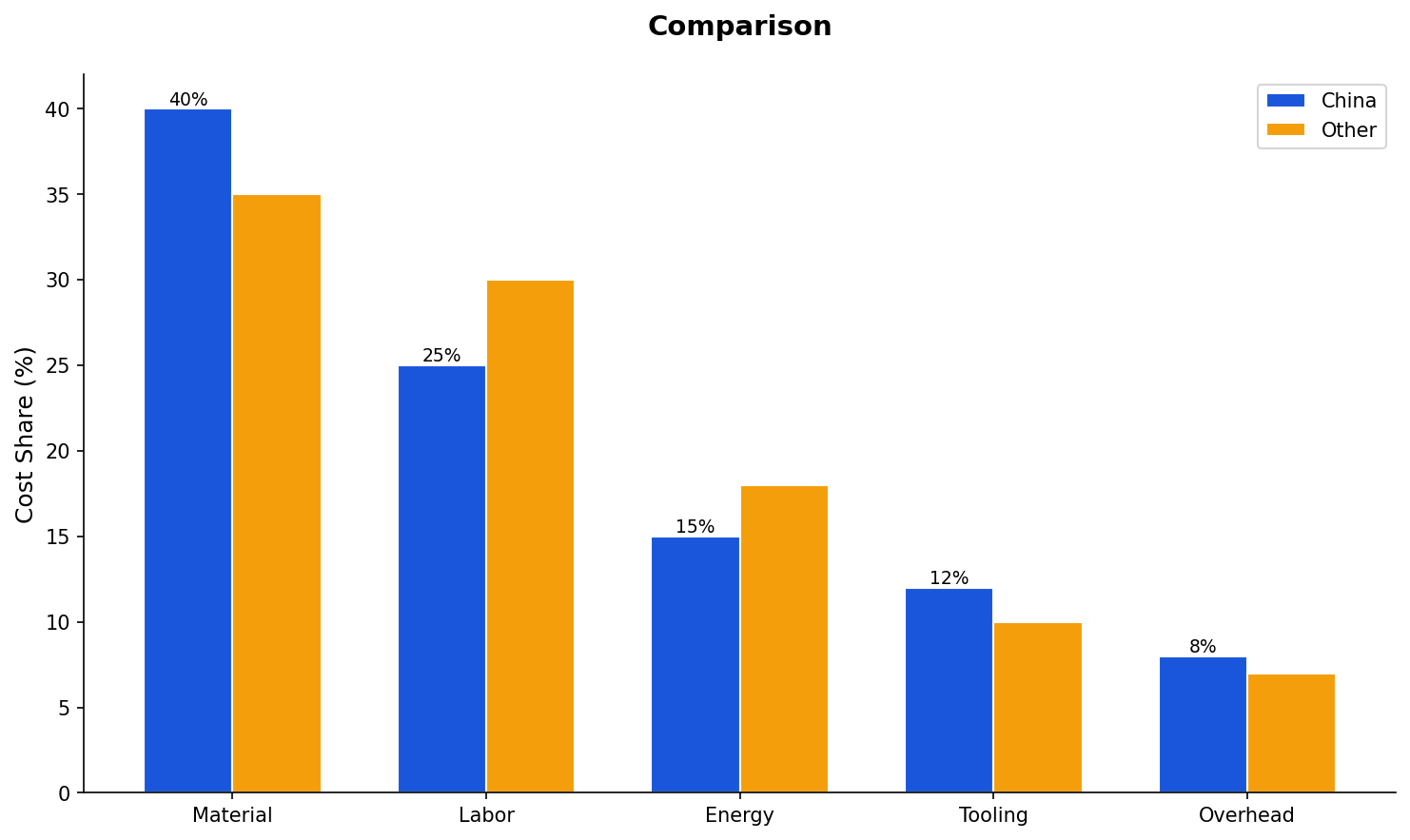
A disciplined buyer asks for a cost breakdown with five lines:
- Raw material cost (based on which alloy price index and date)
- Casting cost (per kg or per piece, including their yield factor)
- Heat treatment cost
- Machining cost, if they offer finish machining
- Inspection, packaging, and logistics
If a foundry gives you a single "all-in price" and refuses to itemize, you'll struggle to negotiate and you'll have no basis for cost-reduction conversations later. A supplier who carefully explains that bronze alloy prices move with the London Metal Exchange (LME) and shows you how the quote adjusts month-to-month is a supplier who protects both of you.
Now, the one thing I always repeat to buyers: price per kg is the wrong KPI for impellers. A $6/kg impeller that requires 4 kg of casting and 3 hours of machining to meet dimensions is more expensive than an $8/kg impeller that's consistently near-net. Compare final machined cost per pump, not raw casting weight. And if the quote is 35% below the next competitor, your first question should be "what's missing?"—not "great, let's sign."
5. Communication and delivery—the hidden failure points
This is the dimension I've seen sink more projects than any metallurgical issue. You can fix a porosity defect. You can't easily fix a supplier who doesn't tell you about a two-week furnace breakdown until the shipment is already late.
When I evaluate a Chinese foundry for a client, I specifically test communication in three phases:
- Response quality. Does the sales engineer answer technical questions with specifics, or do you get pleasant but evasive "will check with production" replies three times in a row?
- Structured updates. Does the supplier proactively send production schedule updates, photos of first articles, and inspection progress reports? Or do you have to chase every time?
- Problem transparency. Here's my litmus test: send an email saying "We may need to pull the delivery date forward by two weeks—is that feasible?" The good supplier will reply with a realistic assessment, including what it would cost. The weak supplier will say "no problem" to everything, then quietly miss the date.
Language matters too. Many Chinese foundry sales teams speak functional English, but the shop floor workers and QC managers often don't. So your technical documents need to be super clear to survive translation. Send your specification with a drawing that has unambiguous dimensional tolerances (not just a note "per pump standard"), a clear material designation, and a defined inspection plan. Ambiguity is the parent of a hundred problems.
"I used to assume 'we understand your drawing' meant the shop floor knew what mattered. Now I send a list of the top five characteristics I will inspect on the first article, in writing, every single time. Suppliers that don't ask a single clarifying question scare me," Miller says.
The factory audit: what to check when you visit
Nothing beats walking the floor in person. But don't waste your visit. When Brian Miller audits a foundry, he spends his first hour in the QC lab, not the shop floor:
"If the lab is disorganized—calibration stickers expired, traceability paperwork in piles, samples sitting around unidentified—the castings will be too. I've never found a great foundry with a sloppy lab."
Here's a practical 7-point audit checklist. Take this with you:
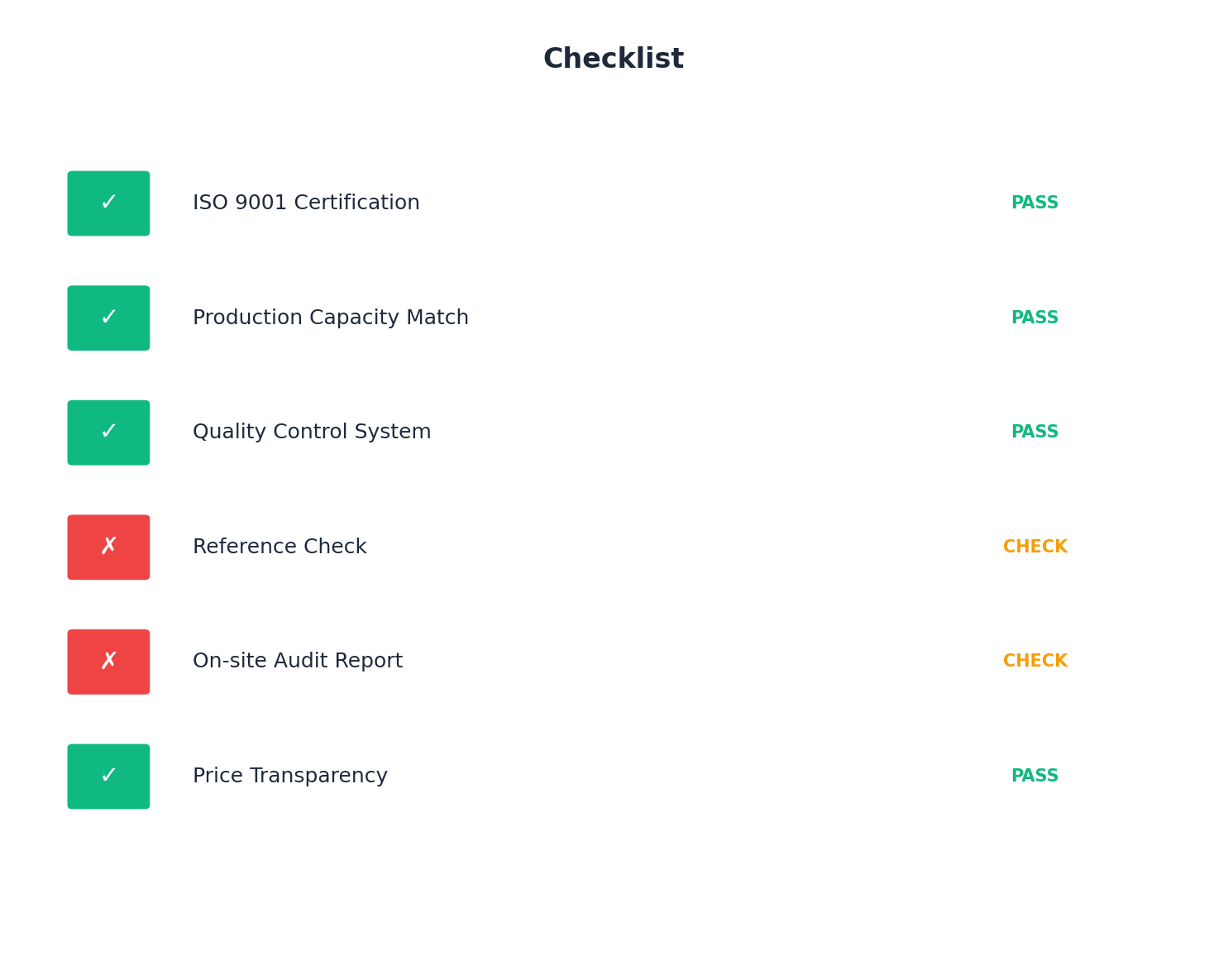
- Spectrograph calibration records. Ask to see the calibration certificate and the log book. A quality foundry runs a reference sample at the start of every shift.
- Heat treatment records. Pull records for a typical stainless steel batch. Check the chart recorder trace—does the cycle match the specification? How long is the thermal soak, and how is the furnace temperature verified?
- Core setting fixtures. For impellers, core shift is the enemy. Is the foundry using a dedicated core setting fixture or verifying core position after assembling the mold? If they just "eye it up," walk away.
- NDT operators. Look for a certificate of competence. If they outsource NDT, ask to see the last batch's non-destructive test report and the subcontractor's accreditation.
- Rework segregation. Is reworked material marked, logged, and re-inspected through the same process as the original? Uncontrolled weld repair is how impellers find their way into service with sub-surface defects.
- PMI practice. Do they verify alloy chemistry on every heat before pouring? A simple XRF check could be the difference between a pipe that lasts 20 years and one that fails in 6 months.
- Packing and preservation. Impeller castings arrive by ocean freight. Rust on a machined surface means rework at your cost. Look at how finished castings are oiled, wrapped, and boxed. It tells you how the foundry thinks about the product beyond its own gate.
Three traps that eat buyers alive
Run through what I've covered and you'll be ahead of most. But these three specific traps deserve a special mention because I see them over and over.
Trap 1: The "too good to be true" low price. If a quote comes in dramatically lower than the market range I listed above, someone is cutting a corner. It could be a tungsten-content cheat on the alloy, a heater skipped during heat treatment, or an inspection skipped to save schedule. Get a complete material test report and a first-article inspection from an accredited third party before you commit to volume.
Trap 2: The agent or trading company pretending to be a foundry. I'd guess about a third of the "foundry" websites you'll find in a Google search are trading companies with office space near a foundry. That's not necessarily a problem—a good agent adds real value, especially with communication. But if the invoice is from a company with no furnace and no casting line, you bear the risk of miscommunication, markups, and zero process accountability. Ask for a geography-specific visit, or have a local inspector verify their production address against the business license.
Trap 3: Tooling "free" but actually amortized into a higher part price. There's no such thing as a free mold. Some foundries quote "tooling included" so the buyer doesn't notice the write-off is buried in the first-year piece price. That makes your part cost look competitive in year one and uncompetitive by year two. Ask for tooling cost and piece price quoted separately. That way you can evaluate who owns what and how to move tooling if you ever change suppliers.
First-article inspection: your last line of defense
Even after a supplier passes every vetting check, you never jump straight to mass production. The first article inspection (FAI) is the moment of truth.
Send the foundry a written inspection plan that matches your drawing's critical characteristics. I recommend you specify which dimensions matter most, which material tests you require, and what NDT applies. Most serious foundries will counter with their own suggestions because they want to avoid disputes later.
Here's the part people skip: inspect the FAI castings independently. Send samples to a third-party lab—there are many in Shanghai, Shenzhen, and other ports—or ask for the foundry to include an independent inspection report from an accredited company. The foundry's own CMM results are a starting point, not a guarantee.
And when you sign off on the FAI, put your requirements into production with a clear boundary. Define the production inspection frequency: chemistry per heat, hardness per batch, dimensional check per batch. Ask for photographs of the critical dimensional checks. You want a trail that proves conformity with each batch, not just a pretty certificate.
FAQ
What is the minimum order quantity for impeller castings from Chinese foundries?
Most foundries prefer annual volumes of 300 to 1,000 pieces for investment castings. Sand casting is more flexible—some foundries accept prototype orders of just 5 to 10 pieces, but the per-piece price will be higher until the volume stabilizes. If your volume is below a few hundred pieces per year, a foundry that specializes in quick-turn precast prototypes might be a better fit.
How long does it take to get impeller castings from China?
From tooling approval to first articles: typically 2 to 4 weeks for sand-casting tooling, 4 to 8 weeks for investment-casting tooling. Add 2 to 3 weeks for first articles and sample approval, then 4 to 6 weeks for production and inspection. Plan 10 to 16 weeks total if you want to be safe. If a foundry promises 4 weeks from scratch to volume delivery, be very skeptical.
What casting process is best for pump impellers?
For precision and surface integrity on complex vane geometries, investment casting is the priority. For larger impellers or higher volumes with manageable complexity, sand casting plus CNC machining of critical surfaces is often the most cost-effective route. Centrifugal casting is ideal for cylindrical shapes and certain alloys that are prone to porosity in static pours.
How much do impeller castings cost from China?
Use $4–$8 per kg for sand-cast stainless steel, $12–$25 per kg for investment casting, and $15–$30 per kg for bronze. Duplex and super duplex alloys cost considerably more. The final quote depends on the foundry's yield, your tolerance requirements, machining scope, and order volume. Always compare final machined cost per pump, not raw casting price per kg.
What certifications should an impeller casting supplier have?
ISO 9001:2015 is the baseline, but it's not a quality guarantee. Look for a foundry that can produce material test certificates with actual values, follow ASTM A351 or A48 equivalents, and support third-party inspections. If your customer requires API or ATEX certification, make sure the foundry has export experience to that industry—it makes a big difference in documentation discipline.
Your next move
You now have the full vetting framework. If you're short on time, start with the five non-negotiables, then use them to shortlist your candidates before sending an RFQ. The goal is never to find the absolute cheapest quote—it's to find the supplier who can deliver conforming castings, on time, at a price you can explain to your CFO.
Before you send your next inquiry, here's a quick pre-flight checklist:
- Make a list of your top 5 critical characteristics for the FAI, so the foundry knows what matters before production starts.
- Ask for a cost breakdown with five quoted lines (material, casting, heat treatment, machining, inspection & logistics). No single-line quotes.
- Check their in-process records from last month—not a sample they prepared for your visit.
- Insist on third-party first-article verification, at least once in the first purchase order.
And if you want someone who's already walked 200+ Chinese foundries to help you shortcut the search—without charging you a markup on the casting itself—that's exactly what a sourcing platform like ours is for. Set up a quick call, tell us your pump type and annual volume, and we'll shortlist three foundries that fit your spec. No obligation, just a roadmap.
Need Help with How to Vet Impeller Casting Suppliers in China (2026 Guide)?
Get matched with 3 verified foundries in 24 hours. No markup, transparent pricing.
Request Quotes →- ✓ 1,700+ vetted foundries
- ✓ 40+ QA engineers
- ✓ Serving buyers in 22 countries
- ✓ ISO 9001 / IATF 16949 capable