
15 versus 7. That's the entire conversation.
EN-GJS-400-15 — the grade your drawing probably calls GGG-40 — has to hit 15% elongation at break. EN-GJS-500-7, the one stamped GGG-50, has to hit 7%. Everything else in the comparison table — the 400 versus 500 MPa, the 250 versus 320 MPa yield — is downstream of that one number.
You get 25% more tensile strength. You pay for it with roughly half the ductility. Whether that trade is smart depends entirely on what your part does under load, and almost nothing else.
Here's the scale you're working at: according to the Bundesverband der Deutschen Gießerei-Industrie, German foundries pour north of 3 million tonnes of iron castings a year, and ductile iron accounts for roughly a third of that. Of the ductile iron orders that leave those foundries, EN-GJS-400-15 and EN-GJS-500-7 together take about 60%. Two grades. Most of the tonnage. And the difference between them gets misread on spec sheets every single week.
So let's walk through it the way you'd actually need to — as the person signing the purchase order, not the person writing the metallurgy textbook. If you buy to ASTM rather than DIN, there's a cross-reference section below that most grade comparisons skip entirely.
What GGG-40 and GGG-50 Actually Mean on Your Drawing
GGG stands for Gusseisen mit Kugelgraphit — cast iron with spheroidal graphite. It's the German naming system from DIN 1693, and the trailing number is the minimum tensile strength in kg/mm². Multiply by ten and you get MPa. GGG-40 becomes 400 MPa. GGG-50 becomes 500 MPa.
DIN EN 1563 replaced that system. Now the grade names carry both numbers explicitly:
- GGG-40 → EN-GJS-400-15 — 400 MPa minimum tensile, 15% minimum elongation
- GGG-50 → EN-GJS-500-7 — 500 MPa minimum tensile, 7% minimum elongation
Plenty of European drawings still show the old GGG designations, and plenty of Asian suppliers quote against them without ever asking which standard governs inspection. That gap matters. If a Pakistani or Indian foundry quotes you "GGG-50" but certifies against a local equivalent that allows 5% elongation instead of 7%, you've bought a different material than your drawing specifies, and the paperwork will look perfectly fine.
First action item: put both the old and the new designation on your RFQ, and state the inspection standard explicitly. Something like "EN-GJS-500-7 per DIN EN 1563, or equivalent — supplier must declare the governing standard and the test bar configuration." It takes one line and removes a whole category of argument later.
GGG-40 vs GGG-50 in ASTM A536 and ISO 1083
Not every buyer reading this works in DIN EN 1563. US procurement teams usually quote against ASTM A536. Indian, Korean and many other Asian foundries certify to ISO 1083 or a national standard derived from it. The grade names change, and the elongation minimums — the number that actually separates these two materials — don't always line up.
Three systems, roughly the same two materials:
| EN 1563 (DIN) | ASTM A536 | ISO 1083 | Tensile (min) | Yield (min) | Elongation (min) |
|---|---|---|---|---|---|
| EN-GJS-400-15 (GGG-40) | 60-40-18 | 400-15 | 400 MPa | 250 MPa | 15% (EN) / 18% (ASTM) |
| EN-GJS-500-7 (GGG-50) | 65-45-12 | 500-7 | 500 MPa | 320 MPa | 7% (EN) / 12% (ASTM) |
What matters is the word "roughly." ASTM 60-40-18 and EN-GJS-400-15 share a tensile target but not an elongation floor: 18% versus 15%. ASTM 65-45-12 is the nearest US equivalent to GGG-50, but it runs at 448 MPa tensile, not 500 — a 10% gap that shows up if your FEA margin was thin. The cross-reference is close enough for a first-pass review and not close enough to sign a PO.
So the safest instruction on any cross-region quote is: name the standard, not the nickname. "GGG-40" is an invitation to ambiguity. "EN-GJS-400-15 per DIN EN 1563" or "60-40-18 per ASTM A536" is not. If you're dual-sourcing a European foundry and an Asian one, put both quotes on the same reference standard, because the difference between a 15% and an 18% elongation floor will not show up until a part cracks in the field.
The Comparison Table — and Which Numbers Actually Govern Your Design
| Property | GGG-40 (EN-GJS-400-15) | GGG-50 (EN-GJS-500-7) |
|---|---|---|
| Tensile strength Rm (min) | 400 MPa | 500 MPa |
| 0.2% yield strength Rp0.2 (min) | 250 MPa | 320 MPa |
| Elongation at break A (min) | 15% | 7% |
| Brinell hardness (typical) | 135–185 HBW | 170–230 HBW |
| Typical matrix | Ferritic | Ferritic–pearlitic |
| Impact resistance | High | Moderate |
| Fatigue strength | Lower | Higher |
| Weldability | Good with procedure | Difficult |
| Machinability index | Baseline | 25–40% lower tool life |
Two things about that table that get skipped in most published comparisons.
One: those are minimum values from separately cast test bars. DIN EN 1563 allows different values when the test bar is cast onto the part rather than poured separately into a mold. For thick-wall castings, the attached-bar values can be well below the numbers in the table, and that's legal. If your design margin is thin, you need to specify which test bar configuration governs acceptance, because your supplier will pick whichever one makes their life easier unless you tell them otherwise.
Two: the yield strength gap is where your actual design margin lives. Nobody designs a part against ultimate tensile strength. You design against yield, and 250 versus 320 MPa is a 28% increase in usable design stress. If your part is failing at FEA because the yield margin is too thin on a bracket or a mounting lug, moving from GGG-40 to GGG-50 often solves the problem in one revision — whereas going the other direction, from GGG-50 back to GGG-40, means you just lost 28% of your margin and no amount of re-meshing will get it back.
Chemistry and Microstructure — Where the Trade Is Actually Made
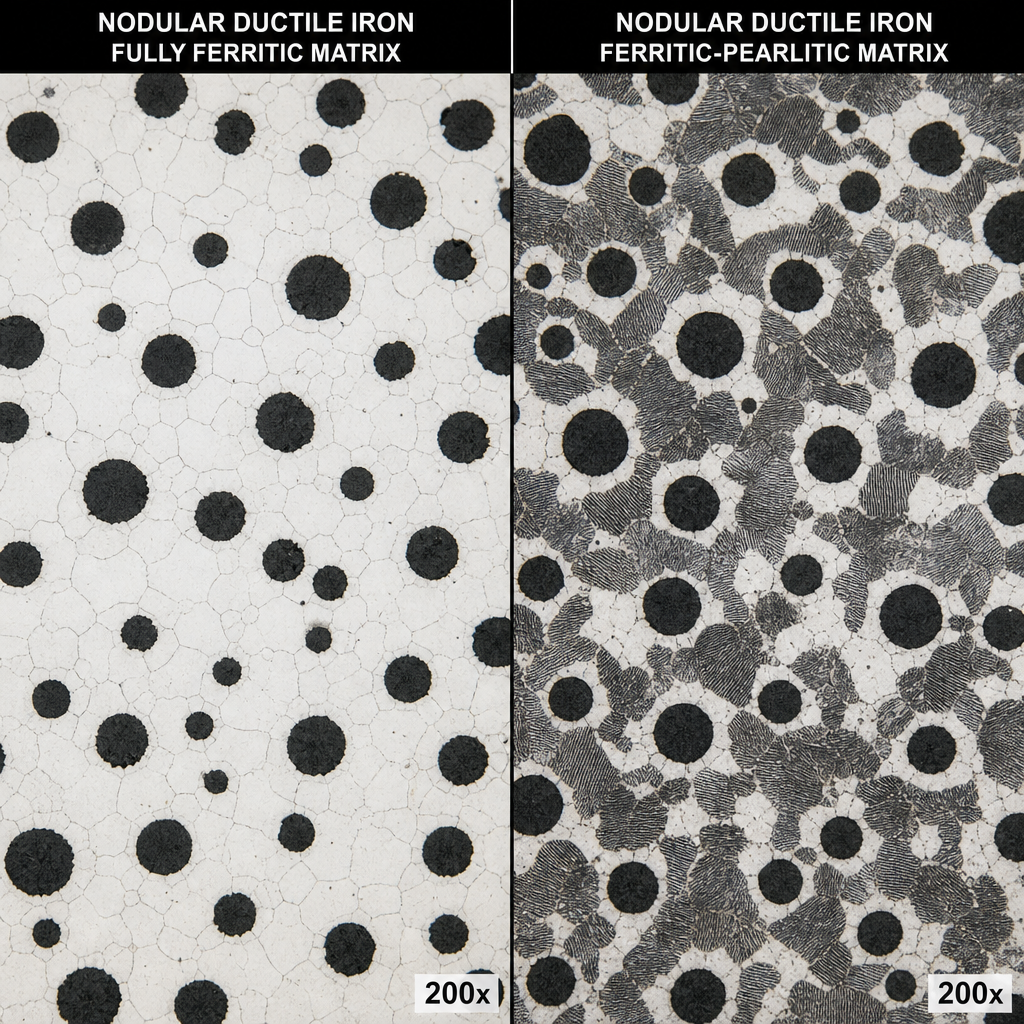
Both grades get their ductility from the same trick: magnesium treatment that turns free graphite from flakes into nodules. That's the whole point of ductile iron — the spheroidal shape stops graphite from acting as a crack initiator the way flakes do in grey iron.
The difference between GGG-40 and GGG-50 is what surrounds those nodules.
GGG-40 runs a ferritic matrix. Silicon sits high, typically 2.2–2.8%. The microstructure is soft, ductile, machines cleanly, and absorbs impact energy well. It's the default for anything that has to take abuse without shattering.
GGG-50 runs a mixed ferritic–pearlitic matrix, usually with 30–60% pearlite. To get there, the foundry drops silicon toward 2.0–2.4% and adds pearlite stabilizers — copper up to about 0.5%, or tin up to about 0.1%. Those additions harden the matrix and raise tensile strength, and they also raise hardness and cut thermal conductivity.
Here's what nobody tells you at the quotation stage: pearlite fraction is the number that floats between heats. Two furnaces of "GGG-50" from the same foundry in the same month can land at 35% and 60% pearlite, and both will pass a tensile test. But a 60% pearlite heat will machine like a different material — edges chip, inserts wear faster, surface finish drifts out of tolerance. If your drawing specifies GGG-50 but doesn't specify a pearlite range or a hardness ceiling, you've handed the variability to your machining cell.
Practical fix: put a hardness window on the drawing, not just the grade. Something like 170–220 HBW gives the foundry room to work but stops the outliers that ruin your tool life.
Choosing Between Them: Start With the Failure Mode, Not the Grade
Stop reading the property table and ask a different question: how is this part supposed to fail?
If your answer is "it shouldn't fail, but if it does it needs to deform rather than shatter," you want GGG-40. That's pump housings, valve bodies, pipe fittings, differential carriers, anything that sees impact, thermal cycling, or field overload from a tired maintenance tech with a hammer.
If your answer is "it needs to hold a static load without yielding, and weight matters," you want GGG-50. That's brackets, mounting plates, gear blanks, crankshafts, steering knuckles — parts where higher yield strength lets you take out wall thickness, and where fatigue life under cyclic load is the governing design case.
There are parts that sit in between, and that's where the judgment calls get real. Industrial pump and valve work is exactly this territory, which is why I asked Sarah Chen — who buys castings for a US-based industrial pump manufacturer — how she draws the line.
"For pump housings we don't need 500 MPa. We need wall sections that seal at 40 bar and don't crack when a service tech drops the cover plate in a cold plant in January. GGG-40 does that. When we trialed GGG-50 on a housing, the pressure test was fine — the problem showed up 6 weeks later when the machined flange started chipping at the seal groove. That's a ductility problem, not a strength problem, and no test certificate was going to warn us."
That's the failure mode first, grade second. Her trial passed every strength check and still got rejected, because the governing failure mode on a pump housing isn't tensile rupture — it's brittle fracture and edge chipping during handling and service.
Cost, Machinability, and Supply Reality
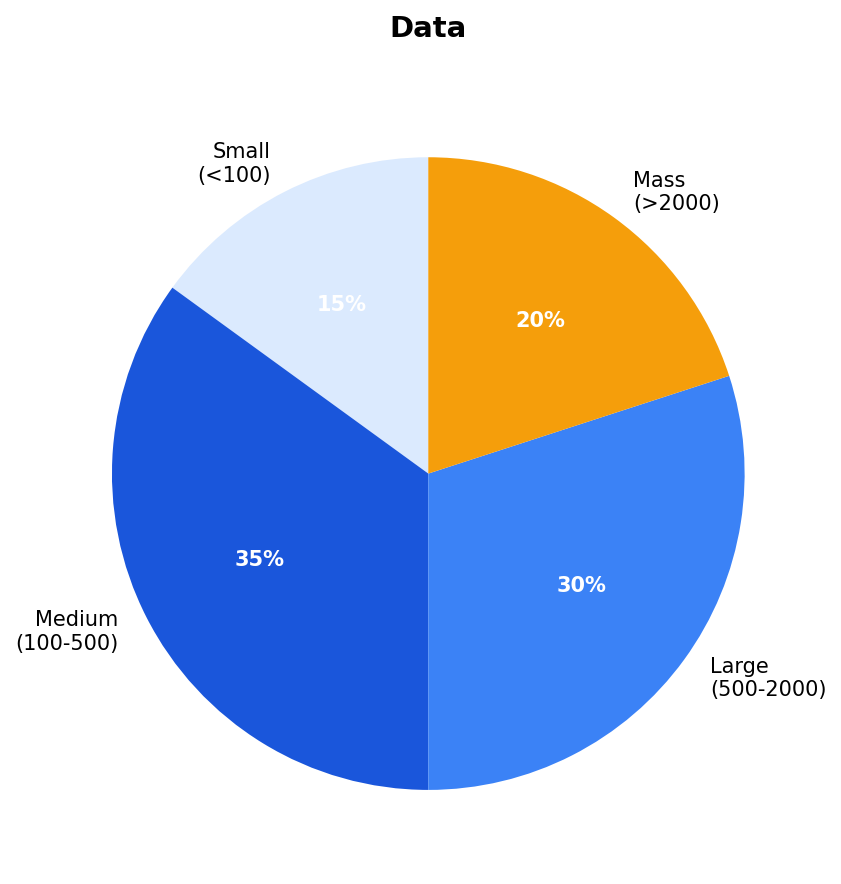
On the quote sheet, GGG-50 usually lands 8–15% higher per kilogram than GGG-40. That's the alloying premium — copper, tin, tighter process windows, higher rejection rates at the foundry on nodularity and pearlite control.
That's not the number that should make your decision, though. The number that should is cost per finished, conforming part, and that one is usually worse than 15%.
Machining is where it shows up. The hardness jump from around 160 HBW to around 200 HBW cuts tool life by 25–40% on turning and drilling operations. Cycle times creep. Insert consumption climbs. And when hardness varies between heats — which it does, unless you've specified a window — you get intermittent scrap that's expensive to trace because the material cert looks fine every time.
Chen put the arithmetic plainly:
"We don't buy kilograms, we buy finished parts. If a supplier saves us 6% on the casting and it costs us an extra four minutes of machining per piece across a 30,000-unit run, that's not a saving. We started scoring quotes on cost per conforming machined part, and the ranking flipped on three of our part numbers overnight."
Supply availability is the other axis. GGG-40 is the industry default — most ductile iron foundries anywhere in the world can pour it to spec on a normal day. GGG-50 requires tighter process control, and the pool of foundries that can hold a consistent pearlite fraction heat-to-heat is smaller. If you're dual-sourcing, be careful about assuming the second source can match the first on GGG-50. Ask for three heats of metallographic data before you commit a production run.
What to Put on the Drawing Before You Send the RFQ
Everything above is diagnostic. This part is prescriptive. Six lines on your drawing prevent almost every grade-related dispute that shows up at incoming inspection.
- Old and new designation together. "GGG-50 / EN-GJS-500-7" kills the naming ambiguity in one line.
- The governing standard, named outright. "Per DIN EN 1563" or "per ASTM A536" — not "equivalent." The word "equivalent" is what starts arguments three months after the PO.
- Test bar configuration. "Separately cast test bar per EN 1563." Without this, the foundry defaults to whichever bar is easier to pour, which on thick-wall castings can quietly be a 20% reduction in the numbers you designed to.
- Elongation minimum, as a number. Not just the grade. "Minimum elongation 7%." Elongation is the acceptance criterion that separates GGG-40 from GGG-50 in the first place — leaving it implicit defeats the point of naming the grade.
- Hardness window. "170–220 HBW, minimum five readings across the section." A single hardness value is a data point. A window is a specification.
- Microstructure, on GGG-50. "Nodularity ≥ 85%, pearlite fraction 30–60%." This is the line that predicts whether your machining cell runs or fights you, and it is the one most often left off.
Add certification level — EN 10204 3.1 at minimum, 3.2 if the part is safety-related — and you have a specification no reasonable supplier can misread. That single-page RFQ addendum does more to protect your margin than the material selection itself.
Red Flags When You're Reviewing Supplier Quotations
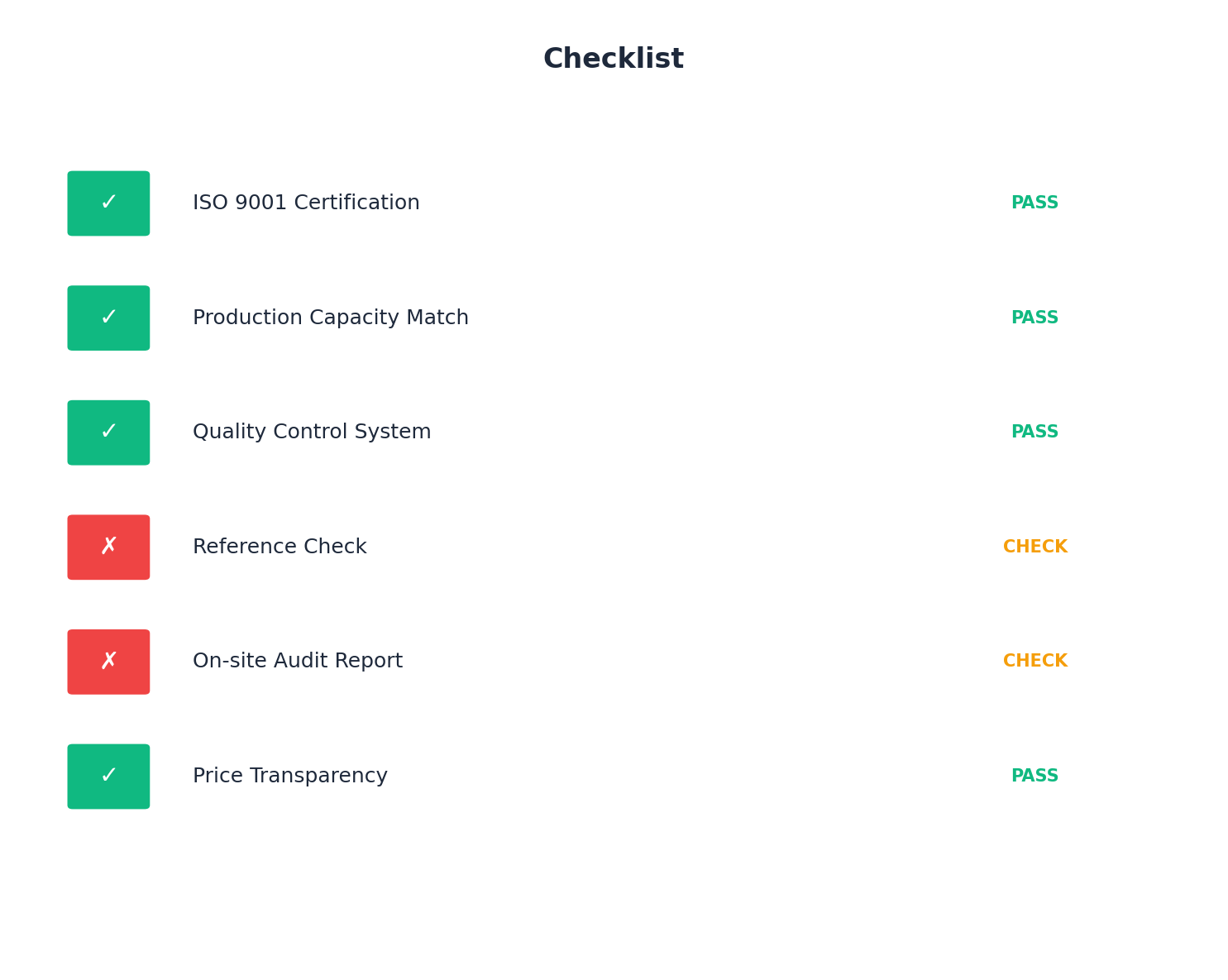
These show up on a meaningful share of the quotes that cross a buyer's desk, and each one is worth a follow-up question.
- "GGG-50, same price as GGG-40." Either they're not actually alloying for pearlite, or they're quoting you GGG-40 and hoping the cert passes. Ask for the copper and tin content on the heat analysis.
- No test bar configuration stated. "Meets EN-GJS-500-7" is incomplete without knowing whether that's a separately cast bar or an attached bar. It can be a 20% difference in the numbers you're designing against.
- Tensile and yield reported, elongation omitted. Elongation is the acceptance criterion that distinguishes the two grades in the first place. A cert without it tells you nothing about which material you actually received.
- Hardness given as a single value, not a range. A single reading from one location on one casting is a data point, not a material property. Ask for a minimum of five readings across the section.
- No metallographic report offered. On GGG-50 this is the document that predicts whether your machining cell will run smoothly. Nodularity percentage and pearlite fraction should both be on the report.
Common Mistakes Buyers Make With These Two Grades
Treating GGG-50 as "GGG-40 with a bump." It isn't an upgraded version of the same material. It's a different microstructure with a different set of failure characteristics. The failure modes it's good at and the ones it's bad at are almost opposite.
Ignoring the attached-bar allowance in EN 1563. Reviewers who only read the headline table often design to 400/500 MPa without realizing the standard permits lower values for attached bars on heavy sections. If your casting has a wall over about 60 mm, check the applicable table before you finalize the design margin.
Specifying GGG-50 for a part that needs weld repair. Pearlite content raises carbon equivalent and hardens the heat-affected zone. Weld repair on GGG-50 without a qualified procedure and controlled preheat will crack, usually after the part has been finish-machined.
Changing foundries without re-qualifying the grade. A new source can hit the same tensile numbers with a completely different pearlite fraction, and the machining process that was dialed in on the old source will start producing scrap on the new one. Requalify the grade, not just the supplier.
Choosing the grade after the drawing is frozen. This happens more than anyone admits. A design gets released with GGG-50 because someone assumed higher is better, then the cost analysis comes back and the team wants to switch to GGG-40 without re-running the FEA. Don't. The yield margin changed by 28%.
Forgetting that elongation is the acceptance criterion, not the spec-sheet line item. Buyers who treat 15% and 7% as "nice to have" numbers routinely have to explain to their QA team why a shipment cracked during handling. One number, two different materials.
FAQ
Are GGG-40 and GGG-50 interchangeable?
No. They differ in tensile strength, yield strength, elongation, hardness, matrix structure, weldability and machining behavior. A substitution in either direction requires re-verifying the finished part, not just re-reading the material certificate.
Which grade is cheaper, GGG-40 or GGG-50?
Per kilogram, GGG-40, typically by 8–15%. Per finished part, the gap is often wider because GGG-50's higher hardness drives tool wear and machining scrap. Score quotes on cost per conforming machined part, not cost per kilo.
Can GGG-50 be welded?
It can, but it's a different job than welding GGG-40. Higher pearlite means higher carbon equivalent, a harder heat-affected zone, and a real cracking risk without qualified procedures. If weld repair is in your process plan, GGG-40 is the safer choice.
Do GGG-40 and GGG-50 have the same density?
Effectively yes — both sit around 7.1 g/cm³. Small chemistry differences shift it within measurement noise. Density is not a reason to choose between them.
Is GGG-50 the same as ASTM A536 65-45-12?
Close, but not identical. GGG-50 / EN-GJS-500-7 targets 500 MPa tensile and 7% elongation. ASTM A536 Grade 65-45-12 targets roughly 448 MPa tensile (65 ksi) and 12% elongation. The tensile gap is about 10% and the elongation floor differs by five points, so they are nearest-neighbour grades rather than direct drop-in equivalents. State the governing standard on the drawing, not just the grade nickname.
What documentation should I require on a GGG-50 order?
A material certificate to EN 10204 3.1, tensile and yield results with the test bar configuration declared, elongation values, at least five Brinell hardness readings across the section, and a metallographic report covering nodularity percentage and pearlite fraction. The metallographic data is the one most often missing and the one most likely to predict machining problems.
Next Steps
Before your next PO goes out, do three things.
First, pull the drawing and check whether the grade designation includes the elongation number and the governing standard. If it just says "GGG-50," you have an ambiguity that will cost you at incoming inspection. Fix it in the next revision — and until then, put the clarification in writing on the RFQ.
Second, run the cost comparison on a per-finished-part basis for whichever parts you're considering switching. Include machining time, tool consumption and expected scrap rate, not just the per-kilo delta. Most grade decisions look different once you do.
Third, if you're specifying GGG-50, ask your candidate foundries for three consecutive heats of metallographic data before you commit. Pearlite fraction consistency is the single best predictor of whether the material will behave the same next month as it does today — and it's the one thing a tensile certificate will never tell you.
If you're still narrowing down sources, it's worth understanding how supplier qualification for ductile iron differs from grey iron before you start shortlisting, and how EN 1563 test bar requirements affect the numbers you'll see on the certificates.