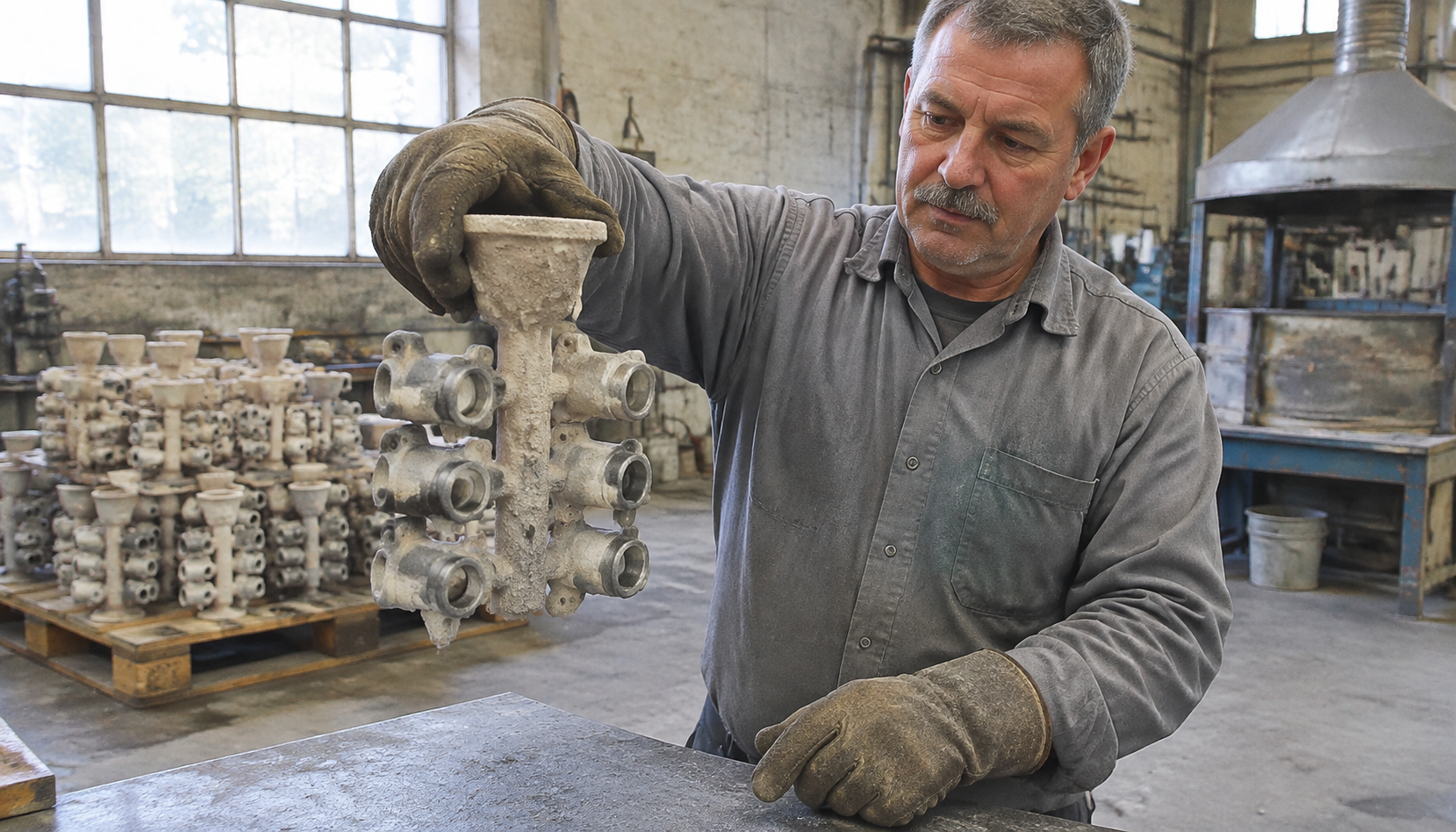
17-4PH spans roughly 1,310 MPa down to 795 MPa ultimate tensile strength across the full range of aging treatments. Same alloy. Same drawing. The only variable is which aging treatment somebody wrote into the heat treatment note — and that single line swings hardness by around 145 HB, which is the difference between a shaft you machine in one pass and a shaft you machine with three carbide inserts a shift.
That is the first number in this article. There are about a dozen more, and every one of them sits on the boundary between a good casting and an expensive lesson. The shell system is one. Porosity acceptance criteria is another. Delta ferrite is a third, and almost nobody puts it on the drawing.
Work through them in this order and you will spot a bad quote before it becomes a bad shipment.
Start with the alloy numbers — they are on the cert, so read them
17-4PH is a martensitic precipitation-hardening stainless steel. Martensitic means it is hardenable by quenching from austenite. Precipitation hardening means you then hold it at an intermediate temperature and let fine copper-rich precipitates form inside the martensite. Two mechanisms, two chances for a supplier to cut a corner.
For castings the governing specification is normally ASTM A747 (CB7Cu-1 and CB7Cu-2), with AMS 5344 covering aerospace investment castings. Wrought mill limits for AISI 630 are looser than the casting grades, so always check which specification the certificate actually cites. If you source across multiple stainless grades, our buyer guides cover the spec differences by material.
| Element | Range or max | Why you care |
|---|---|---|
| C | 0.07 max | Carbon above spec pushes hardness up and toughness and corrosion resistance down |
| Cr | 15.0 – 17.5 | Passive layer formation; low end plus high delta ferrite is a corrosion risk |
| Ni | 3.0 – 5.0 | Balances ferrite; the single biggest lever on delta ferrite content |
| Cu | 3.0 – 5.0 | Forms the strengthening precipitates; drives the whole aging response |
| Nb + Ta | 0.15 – 0.45 | Forms NbC, pins grain size, controls toughness |
| Mn | 1.00 max | Retained austenite if pushed high |
| Si | 1.00 max | Above spec, casting fluidity improves and toughness drops |
| Mo | 0.50 max | Residual from scrap; watch for scrap-based melts |
| P / S | 0.04 / 0.03 max | Segregation and hot tearing, both common in investment castings |
Two practical checks beyond the chemistry table.
Delta ferrite. Wrought 17-4PH typically carries under 1% delta ferrite. Cast 17-4PH often runs 5% to 25%, because the chemistry has to be balanced for fluidity and for resistance to micro-fissures in heavy sections. Delta ferrite is not automatically a defect — a small amount keeps heavy sections sound — but the amount should be agreed, measured by point count to ASTM E562 or by a calibrated ferrite scope, and recorded per heat. Above roughly 25% to 30%, toughness and corrosion resistance start falling off. If your drawing is silent on delta ferrite, you have no rejection ground later.
Magnets. 17-4PH is ferromagnetic in every condition. A buyer once rejected a batch because a magnet stuck to it, assuming the foundry had shipped carbon steel rather than stainless. The opposite test is the useful one: if a magnet does not stick, you have the wrong alloy. Verify with X-ray fluorescence PMI on every lot, and ask for the readings rather than a "yes, checked" email.
Why "silica sol" is not a marketing word
Investment casting shells are built by dipping a wax pattern into a ceramic slurry, stuccoing it with refractory sand, and drying it. Repeat five to seven times and you have a shell. The binder in that slurry is the whole ballgame, and there are two you will meet.
Sodium silicate (water glass) is cheap, sets fast, and can be chemically hardened with carbon dioxide or an ammonium chloride bath. Four or five coats in a day or two and the shell is ready. It is also full of sodium.
Colloidal silica is a suspension of nano-scale silica particles, typically 20% to 30% solids, pH around 9 to 10.5, particle size in the 8 to 20 nanometre range. It gels by losing water, which means it dries slowly and needs a controlled room: roughly 22°C to 26°C and 40% to 60% relative humidity. Get the room too dry and the shell cracks. Too humid and a six-coat build takes a week.
That sodium content is the part buyers underestimate. At pouring temperatures around 1,570°C to 1,600°C, sodium oxide in the shell reacts with the refractory and with the steel surface. The result is burn-on, pitting, an "orange peel" skin, and a higher inclusion count right where you least want it — on a stainless part whose whole selling point is a passive surface.
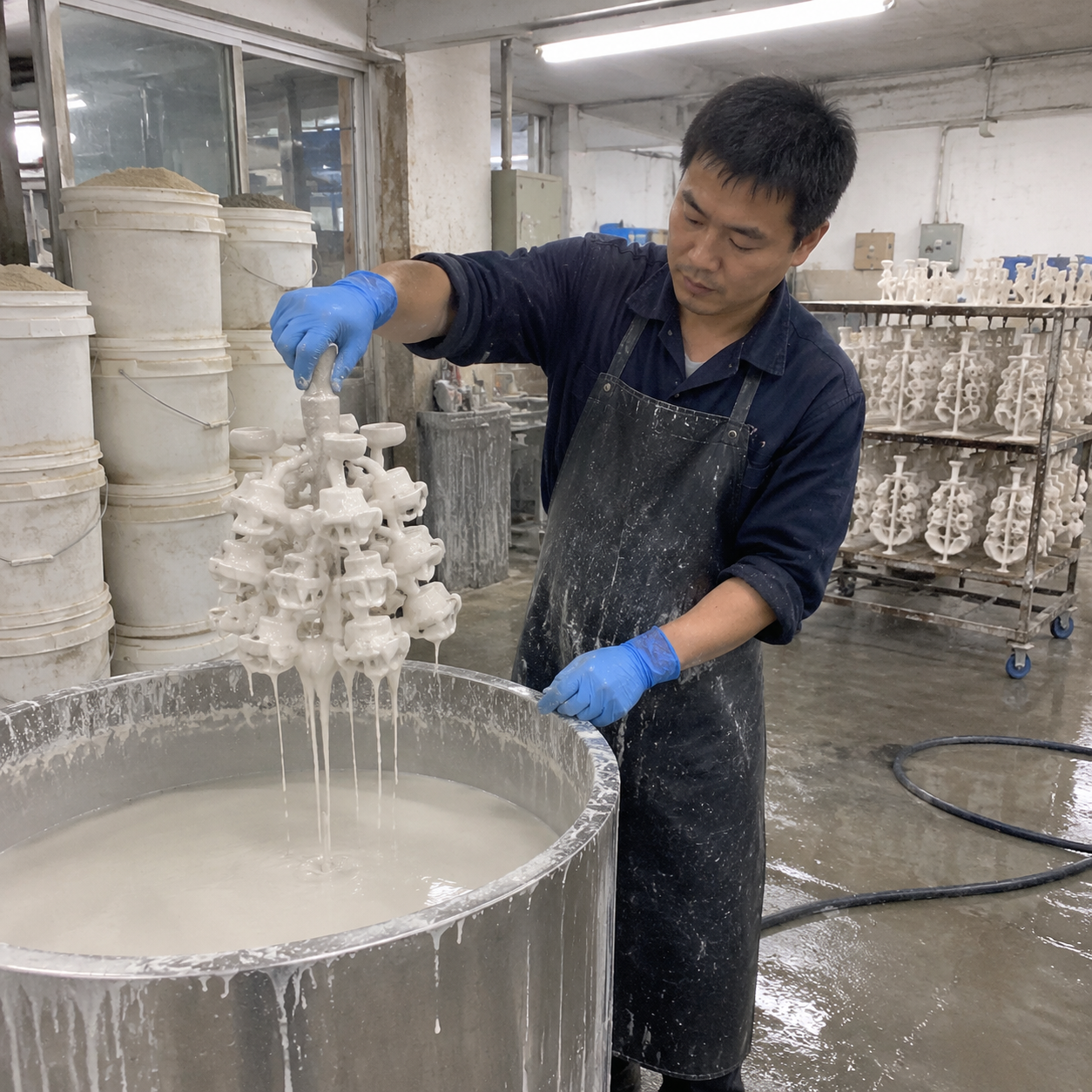
Here is what the two systems actually deliver, side by side.
| Metric | Silica sol | Water glass |
|---|---|---|
| Shell build time | 3 – 5 days (5 – 7 coats) | 1 – 2 days (4 – 5 coats) |
| As-cast surface roughness | Ra 3.2 – 6.3 µm typical; 1.6 – 3.2 µm achievable | Ra 6.3 – 12.5 µm |
| Dimensional tolerance | Often CT4 – CT6 to ISO 8062 | Usually CT6 – CT8 |
| Sodium in the shell | Negligible | Several percent Na₂O |
| Surface defects on stainless | Low burn-on, fewer inclusions | Burn-on, pitting, orange peel more common |
| Shell cost premium | Base + 15% to 30% | Baseline |
| Typical finished part premium | +8% to 15% | Baseline |
Now the honest part. On a 3 kg bracket with a 2 mm machining allowance and no cosmetic requirement, water glass is a perfectly rational choice and nobody should be ashamed of it. Silica sol earns its premium on thin walls, tight tolerances, sealing faces, polished or passivated surfaces, and any part where a 0.15 mm wall shift means rework. If a supplier quotes you the same price for both, they are either not building silica sol shells, or they are absorbing the difference somewhere you will find later — usually in the inspection budget.
Ask one question to settle it: "What is your prime coat refractory, how many backup coats, and what is the drying room temperature and humidity?" A foundry building silica sol shells answers in seconds. A foundry buying shells from a trader hesitates.
Heat treatment: five numbers, and you have to pick one
17-4PH only behaves if it is first solution annealed — roughly 1,040°C, hold, then cool fast enough to get martensite — and then aged. The condition is named after the aging temperature in Fahrenheit.
| Condition | Age | UTS | 0.2% YS | Elong. | Hardness |
|---|---|---|---|---|---|
| Condition A | Solution annealed only | ~1,035 MPa | ~760 MPa | 12 – 16% | ~190 – 250 HB |
| H900 | 480°C, 1 h, air cool | ~1,310 MPa | ~1,170 MPa | ~10% | ~388 – 410 HB |
| H1025 | 550°C, 4 h | ~1,070 MPa | ~1,000 MPa | ~12% | ~331 HB |
| H1075 | 580°C, 4 h | ~1,000 MPa | ~930 MPa | ~13% | ~302 HB |
| H1100 | 595°C, 4 h | ~965 MPa | ~880 MPa | ~14% | ~285 HB |
| H1150 | 620°C, 4 h | ~930 MPa | ~795 MPa | ~16% | ~277 HB |
| H1150M | 760°C 2 h + 620°C 4 h | ~795 MPa | ~585 MPa | ~18% | ~255 HB |
Three things go wrong here more than anything else.
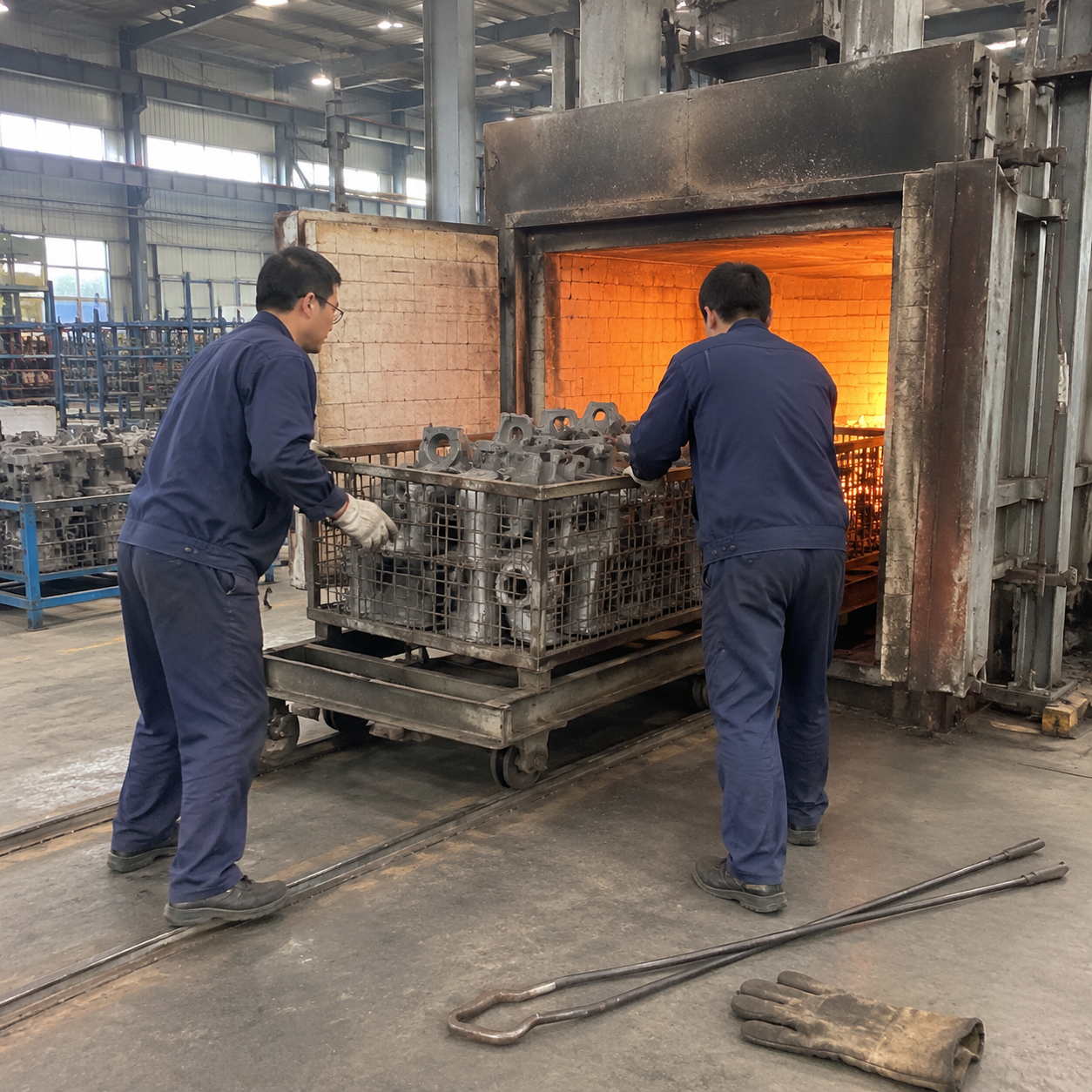
Nobody solution anneals. A foundry casts the part, throws it straight into the aging furnace at 480°C, and ships. Without the solution anneal the precipitates never form correctly, the microstructure is a mess of segregation from casting, and you get a hardness reading that looks plausible and properties that are not. Require the solution anneal as a separate, recorded step with its own furnace chart.
The machining sequence is backwards. At H900 the part is around 400 HB. That is not a machining problem, that is a "we need to source ceramic inserts and double the cycle time" problem. Cast it, solution anneal it, rough machine it in Condition A at 190 to 250 HB, then age to the final condition, then finish machine. Get this into the purchase order, because the default is to age everything at the foundry and hand you a hard part with a 1 mm stock allowance.
H900 gets specified by default. H900 is the highest strength and the easiest to quote, so it shows up on drawings whether or not anyone needed it. It is also the worst condition for stress-corrosion cracking and the least tough. For anything seeing chlorides, seawater splash, or sustained tensile stress, H1150 or H1150M is the sane choice. You are giving up about 380 MPa of tensile strength to buy a part that does not crack in service. Take that trade unless weight is genuinely critical.
Porosity, radiography, and the acceptance criteria nobody writes
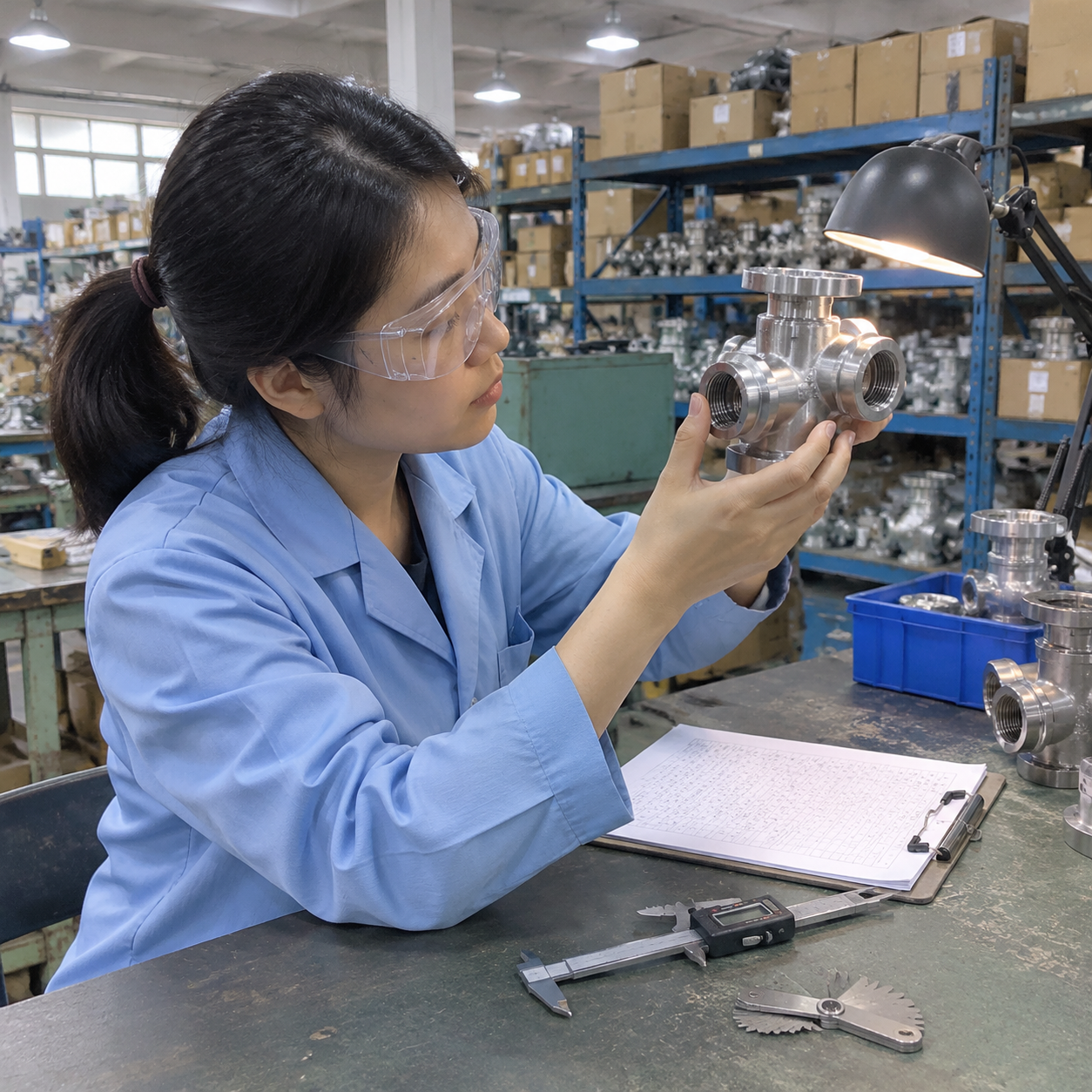
Here is a pattern worth naming. A buyer orders 17-4PH silica sol investment castings, receives beautiful parts, machines them, and finds porosity at the sealing face on part number nine of fifty. The foundry says the porosity is within commercial practice. The buyer has no acceptance criteria on the drawing. The argument is unwinnable.
Porosity in an investment casting is usually one of three things: shrinkage at a heavy section the gating did not feed, gas from a shell that was not fully dried, or entrained air during a turbulent pour. All three are predictable and all three are fixable by the foundry before the first article. None of them are fixable by you after the container ships.
What to put in writing:
- A reference radiograph standard and a severity level. ASTM E192 is the reference set for investment steel castings; ASTM E505 covers radiography of steel castings generally. "No harmful porosity" is not a criterion. "ASTM E192, Grade C, 3/16 inch maximum, in zones A and B only" is.
- Defined zones. Mark on the drawing which areas are critical (sealing faces, fatigue sections, bearing surfaces) and which are non-critical. You will pay for film on all of it if you do not say otherwise.
- Penetrant inspection to ASTM E165 or E1417 on machined surfaces where you have already been burned.
- First article inspection with a full dimensional report plus a destructive or CT cross-section on one part per tool, before production release.
For a pump shaft or impeller, a CT scan on the first article costs a few hundred dollars and maps every internal void. It is the cheapest insurance in this whole article, and it gives you a baseline to compare against when a later batch is suspect.
What a 17-4PH silica sol quote actually contains
Quotes for 17-4PH investment castings land roughly in these bands for 50 to 500 piece runs out of Asia, and materially higher in Europe or North America:
- Simple, symmetric, loose-tolerance parts: around $6 to $9 per kg
- Valve bodies, impellers, mid-complexity housings: around $10 to $16 per kg
- Thin-wall, tight-tolerance, cosmetic or pressure-tight parts: around $18 to $25 per kg
Those numbers are meaningless until you know what is inside them. A per-kilo price that excludes heat treatment, machining, NDT, passivation and third-party inspection is not a price, it is a headline. Ask for the quote broken into five lines: casting, heat treatment, machining, NDT and certification, and tooling. A supplier who cannot produce that breakdown is quoting from a spreadsheet template.
Four cost drivers are worth pushing on directly.
Tooling ownership. Wax injection dies for 17-4PH parts commonly run $800 to $4,000 depending on cavity count and complexity. You should own them outright, with a written clause that they are returned or transferred on request. Anything else and you are renegotiating from a weak position in year three.
Machining allowance. Every millimetre of stock you leave costs money in metal, in cycle time and in tool wear. Work out the minimum that removes shell scale and casting tolerance, and specify it. Foundries default to generous allowances because they are safe for the foundry.
Batch heat treatment. Aging is usually priced per batch, not per part. If your part is small, ask whether you can piggyback on a combined load — the furnace does not care how many parts are on the tray, only what fills it.
Certification level. EN 10204 3.1 mill certificates, XRF PMI on every heat, hardness on every batch, dimensional report per shipment. All of it is a cost line, and all of it is worth more than the discount you would get for dropping it.
Seven mistakes that show up again and again
- Specifying the alloy but not the condition. "17-4PH" on a drawing with no aging temperature is an invitation for the foundry to pick one for you. It will be the one that suits them.
- No delta ferrite limit. Two heat-treated parts, both on chemistry, one with 8% ferrite and one with 30%. Different toughness, different corrosion behaviour, identical certificate.
- Aging before machining. Then paying a machine shop to fight 400 HB and complaining about the price of the part.
- Accepting "silica sol" without asking about the drying room. A shell built in an uncontrolled shed cracks, and the cracks become inclusions you find at final inspection.
- No porosity acceptance criteria. The single most common cause of a rejected container that should have been a rejected first article.
- Missing the weld repair clause. Uncontrolled weld repair on a 17-4PH casting leaves a hard, brittle zone that will find a way to embarrass you in service. Require notification, a qualified WPS, and re-solution anneal plus re-age for any repair on a critical part.
- Quoting per kilo across dissimilar parts. A 200 g part and a 4 kg part do not share a price per kilo, because the shell cost per kilo is wildly different.
The pre-PO checklist
Seven questions. Send them as an email, not a phone call, and keep the answers on file. These are the same seven we print on the one-page buyer checklist.
- Which edition of ASTM A747 or AMS 5344 will the certificate cite, and can you send a sample certificate with the heat number visible?
- Is the shell built in-house, and what is the prime coat refractory, the backup refractory, the coat count and the drying room setpoint?
- Will the parts be solution annealed at 1,040°C after casting, as a separately recorded step, before aging?
- What delta ferrite range do you expect for this chemistry, and how do you measure it?
- Can you quote with rough machining in Condition A and finish machining after aging?
- What radiography standard and severity level will you work to on the zones I have marked?
- Do I own the wax dies, and what is the written transfer clause?
Any foundry that genuinely builds 17-4PH silica sol investment castings will answer all seven within a working day. The ones that answer three and ask you to send the drawing again are telling you something useful.
FAQ
Is 17-4PH stainless steel magnetic?
Yes, in every condition. It is martensitic, so a magnet sticks to it whether it is solution annealed or aged to H900. If a magnet does not stick to a part delivered as 17-4PH, you have the wrong alloy — probably a 300-series stainless substituted somewhere in the chain. Confirm with XRF PMI, not a magnet, but the magnet is a five-second sanity check.
Can 17-4PH investment castings be weld repaired?
Yes, under a qualified WPS, and the part should be re-solution annealed and re-aged afterwards. The trap is that weld repair is often treated as a routine shop-floor fix. On a casting that will see fatigue or corrosion, an undocumented repair is a defect in its own right. Put a repair-notification clause in the PO.
Should I specify H900 or H1150 for seawater exposure?
H1150, or H1150M if there is significant residual stress. H900 gives you the highest strength and the poorest stress-corrosion resistance of the useful conditions. You are trading roughly 380 MPa of tensile strength for a part that survives chloride service. Unless weight is the binding constraint, that is a good trade.
How much more does a silica sol shell cost than a water glass shell?
Roughly 15% to 30% on the shell, which usually lands at 8% to 15% on the finished part. On cosmetic, thin-wall or tight-tolerance 17-4PH parts the reduced machining stock and lower scrap rate repay that premium several times over. On a heavy, loose-tolerance bracket, water glass is fine and you should not be embarrassed to say so.
What as-cast surface finish can I expect?
Ra 3.2 to 6.3 microns on the prime coat side is normal for a good silica sol shop, with Ra 1.6 to 3.2 achievable on critical faces. Sodium silicate shells typically sit at Ra 6.3 to 12.5 microns. If a supplier promises Ra 1.6 on a general casting without a proof sample, ask to see the surface profile report from a part they actually shipped.
What to do next
Take the seven checklist questions and send them to whoever quoted you last. Compare the answers, not the prices, because the prices are downstream of the answers.
If you want the short version: pick the aging condition deliberately, insist on the solution anneal as a recorded step, machine before aging, put a radiation standard and severity level on the drawing, and make somebody describe their drying room out loud. Do those five things and the rest of the 17-4PH silica sol conversation becomes engineering instead of gambling.