Truck Casting Suppliers in China: How to Vet One Before You Wire a Single Yuan
Last March, a fleet maintenance director from Texas wired a 30% deposit to a "manufacturer" in Hebei for 400 brake drums and 200 spring hangers. The quote was 22% under every other bid. The broker sent photos of a real foundry floor. The company registration looked clean.
Six weeks later, the container arrived with drums machined 1.8mm under the drawing tolerance and hangers cast in gray iron instead of the specified ductile iron. The parts failed visual incoming inspection. The "manufacturer" turned out to be a three-person trading office that had outsourced the job to a job-shop with no heat-treatment capability and no TÜV witness. The deposit was gone. The replacement order cost him 41% more than the original budget, and he had trucks sitting idle for nine weeks.
That story is not rare. It's a Tuesday.
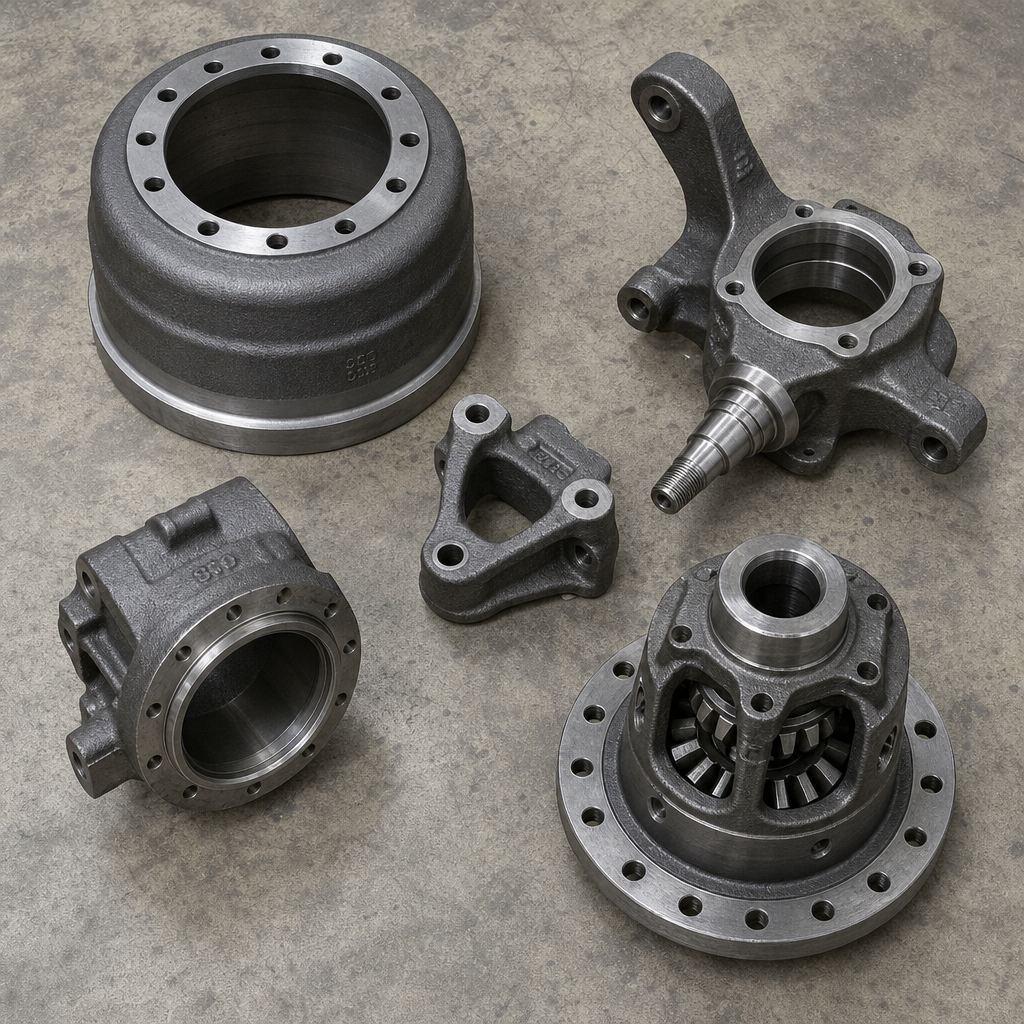
If you're sourcing truck castings from China — axle housings, brake drums, hubs, spring hangers, steering knuckles, differential carriers, suspension brackets — the supplier you pick is not the price on the quote. It's the melting furnace, the spectrometer, the heat-treat line, the NDT bench, and the person who signs the certificate of conformance. Everything else is decoration.
This guide covers what to verify, what to ask, what to pay, and where the traps sit. No fluff. You can run every checklist here in a single factory visit or a two-hour video audit.
Why Truck Castings Are a Higher-Risk Category Than Most Castings
General castings — pump housings, valve bodies, manhole covers — are forgiving. If one is 3% off spec, you send it back. Painful, not existential.
Truck castings are different in four ways that make supplier selection matter more:
- Safety-critical classification. Brake drums, steering knuckles, and suspension components are typically classed as safety-critical or IATF special-characteristic parts. A defect does not just cost you money — it can cost you liability in a courtroom.
- Heavy wall sections and long solidification times. A 45kg axle housing cools unevenly. Shrinkage porosity, hot tears, and cold shuts are far more likely than in a 2kg bracket. You need a foundry that knows its risering and chill placement, not one that "does castings."
- Ductile iron microstructure requirements. Many truck castings call for nodularity above 80%, ferrite/pearlite ratios in narrow windows, and specified impact values at −20°C or −40°C. A foundry without a working spectrometer, nodularity image analyzer, and proper magnesium treatment is guessing.
- Certification traceability. Fleet operators, OEM tier-1s, and insurance underwriters increasingly demand mill certs, heat numbers, and NDT reports tied to the specific serial on the part. If the supplier cannot match a part back to a heat number, you have no chain of custody.
So "truck casting supplier china" is not a keyword to shop by price. It is a keyword to shop by capability. The same logic applies when you source any heavy industrial castings from overseas — the capstone is always verifiable capability, not the lowest number.
Where China's Truck Casting Supply Actually Sits
"China" is not one supplier base. It's at least four, and they do not compete on the same job.
Shandong and Hebei — the heavy sand-casting heartland
Shandong alone hosts an estimated 1,200+ foundries, and the province produces a large share of China's gray and ductile iron tonnage. Hebei runs slightly behind but is strong in brake components and axle parts. This is where you go for parts in the 5kg–500kg range, green sand or resin sand, medium to high volume.
Strength: deep casting know-how, integrated machining, competitive on ductile iron.
Weakness: enormous quality spread. A tier-A shop and a tier-D shop can sit 40km apart and quote within 15% of each other.
Henan and Shanxi — cost leaders, thinner capability
Lower labor and land cost, but fewer of these shops carry IATF 16949 and fewer still have in-house heat treatment. Use them if you have your own QC presence. Do not use them on a first order.
Jiangsu and Zhejiang — precision and machining strength
Higher cost, better CNC capacity, stronger on small to mid-size castings that need heavy machining — differential side gears, hubs, brackets. Also the most likely region to find suppliers set up for export documentation and OEM production-part approval processes.
Liaoning and the Northeast — legacy automotive tier-2s
State-influenced heavy industry with some very capable shops, but responsiveness and MOQ flexibility can be inflexible. Worth a look if you need a specific grade or a very large casting.
Here is the part most sourcing guides skip: the "supplier" you contact is often not the foundry. A large share of "China casting manufacturers" advertising on Alibaba, Made-in-China, and Google are trading companies. Some are honest and add real value — sourcing, QC, consolidation, export paperwork. Others are arbitrage. You need to know which one you are dealing with before you sign.
The 5-Step Vetting Process That Filters Out 80% of Bad Suppliers
You do not need a 40-page audit to weed out the chaff. Five checks do most of the work. Run them in order.
Step 1: Verify legal identity and factory address — separately
Ask for the business license (营业执照) and confirm the registered address. Then ask for the physical plant address. If they are different, ask why. Acceptable reasons: office in city, plant in industrial zone. Unacceptable: vague answers or a P.O. box style address.
Cross-check the unified social credit code on the National Enterprise Credit Information Publicity System (国家企业信用信息公示系统). Look for:
- Registration year — under 3 years is a yellow flag for a truck casting supplier
- Registered capital — RMB 5M+ suggests a real plant, RMB 100K nearly always means a trading shell
- Business scope — must include casting production, not just 进出口贸易 (import/export trading)
- Judicial records — lawsuit history, especially contract disputes and quality claims
Cost of this step: 20 minutes and zero dollars. Percentage of bad suppliers it eliminates: roughly 30%.
Step 2: Request an unedited video walkthrough of the melting and molding floor
Not a photo album. Not a promotional video. A live, unedited walkthrough with audible commentary, ideally on WeChat video call so you can direct where the camera points.
What you are looking for on camera:
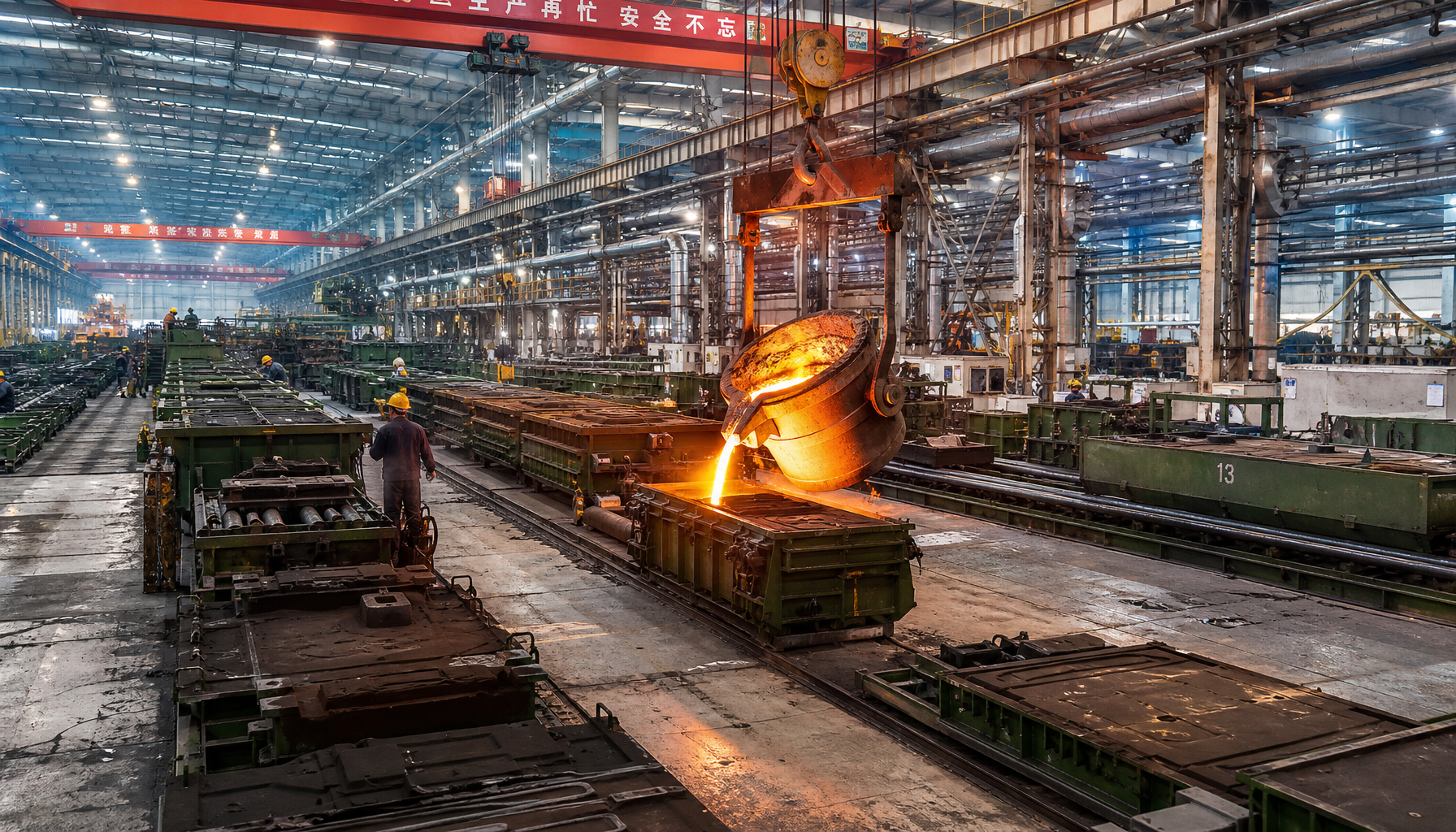
- An induction furnace in operation, with molten iron visible
- Molding line running — green sand, resin sand, or lost foam, whatever they claim
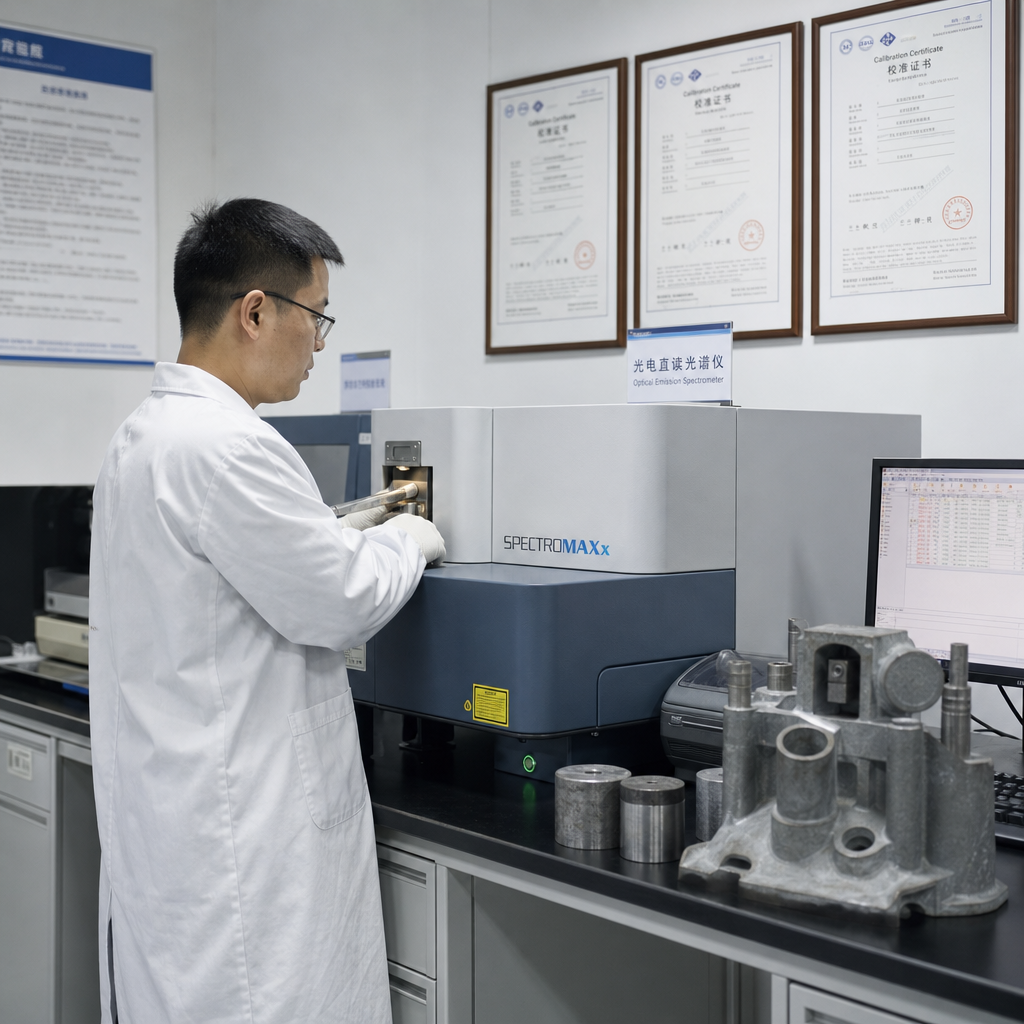
- A spectrometer next to the furnace, not locked in an office
- Heat treatment furnaces with temperature recorders
- Ample WIP and finished goods, not a staged "showroom" floor
- Workers wearing proper PPE — foundries that skip PPE skip process discipline too
Fifteen minutes of live video tells you more than 40 pages of PDF. If they refuse, "our plant policy doesn't allow video calls," you have your answer. Some legitimate large plants do restrict filming, but they will typically offer a site visit alternative. A trading company with no plant will stall.
Step 3: Ask for the last three months of production records — for one specific part
Pick a casting you need. Ask for:
- Monthly output quantity of that part over the last 3 months
- Chemical composition records for the last 5 heats
- Mechanical property test reports (tensile, yield, elongation, hardness)
- Microstructure reports with nodularity percentage
- Any NDT reports — ultrasonic, magnetic particle, dye penetrant
A real foundry has these in a filing cabinet. A trading company will either refuse, send a "sample report" from 2021, or send a report with blacked-out customer names — which is fine, but the heat numbers and dates should be recent and internally consistent.
Consistency check: the heat number on the chemical report must match the heat number on the mechanical report. If they don't, the reports are not from the same production run. That is a hard stop.
Step 4: Validate the certificate — do not accept the PDF
IATF 16949 and ISO 9001 certificates are the two you care about. Both have online validation portals:
- IATF 16949: validate through the IATF database or the issuing certification body
- ISO 9001: validate via IAF CertSearch or the issuing body
- For European OEM work: also check TÜV, SGS, or Bureau Veritas audits if claimed
Enter the certificate number and the certificate holder's exact legal name. Watch for these common tricks:
- Certificate belongs to a parent or affiliated company, not the entity quoting you
- Certificate scope covers "trading of castings" rather than "manufacture of castings"
- Certificate expired and quietly renewed — check the original issue date
- Certificate is real but the site address is different from the plant you are buying from
Roughly 1 in 5 "IATF certified" suppliers I've seen quoted in broker decks had at least one of these problems.
Step 5: Speak to two reference customers outside China
Ask for two non-Chinese customers who bought similar truck castings in the last 18 months. Not the biggest names on their website. Actuals.
If they refuse for confidentiality, that's normally fine — but then ask for the reference to confirm directly to you, without the supplier as intermediary. If they can't produce even one outside customer who will take a 10-minute call, they are almost certainly not exporting at scale.
Ask the reference:
- What was the actual defect rate, not the claimed one?
- How did the supplier handle the last quality claim?
- Were quoted lead times met?
- Would you place another order?
The last question is the only one that matters.
Price Reality: What Truck Castings in China Actually Cost
Below are indicative FOB price ranges for common heavy truck castings in 2026, based on quotes seen across dozens of sourcing projects. These are bands, not fixed prices — grade, geometry, machining scope, and volume move them.
| Part | Material | Weight | Price Band (USD/unit, FOB) |
|---|---|---|---|
| Brake drum, 16.5" | Gray iron HT250 | 38–45 kg | $42–$68 |
| Brake drum, 16.5" | Ductile iron GGG50 | 38–45 kg | $62–$94 |
| Spring hanger / bracket | Ductile iron GGG40 | 3–8 kg | $5.50–$14 |
| Steering knuckle | Ductile iron GGG60 | 18–28 kg | $58–$110 |
| Axle housing end (per side) | Ductile iron GGG45 | 22–35 kg | $70–$130 |
| Differential carrier | Ductile iron GGG50 | 12–20 kg | $48–$95 |
If your quote lands 25%+ below the bottom of these bands, you are not getting a deal. You are getting one of these:
- Gray iron instead of ductile iron (density drop, cheaper charge materials)
- Off-spec chemistry — too little magnesium, too much phosphorus
- Insufficient machining allowance, or machining skipped on non-critical surfaces
- No heat treatment where heat treatment is required
- Fake or mismatched certification
- A sourcing intermediary taking you for a ride
What drives the price up (and why you should pay it)
Three lines you should never negotiate to zero:
- Heat treatment. For ductile iron safety-critical parts, this is typically 8–15% of piece cost. Cutting it means unpredictable mechanical properties.
- NDT and dimensional inspection. Roughly 3–6% of piece cost. Cutting it means you accept the defect rate.
- Machining tolerance. Going from ±0.5mm to ±0.1mm on bearing surfaces doubles machining time. If the quote is tight, the manufacturer has quietly loosened the tolerance.
Quality Control: What to Demand and What It Costs
The QC plan should be agreed in writing before the PO. Not after. Here is a workable structure for truck castings. If you want the full template, our quality control sourcing framework breaks each inspection stage down to AQL and sampling plan.
Pre-production
- First article inspection (FAI). Full dimensional report against your drawing, CMM-checked. Cost: usually free or $150–$400, depending on complexity.
- PPAP Level 3 for automotive-tier supply chains. Includes process flow, PFMEA, control plan, MSA, capability studies, and full dimensional and material results. Expect $500–$2,000 setup.
- Sample approval before mass production. Physically ship 2–5 pieces to you for fitment check. Air freight. Do not start the mass run until you have signed off.
During production
- Spectrometer check on every heat. Chemistry must be within ASTM A536 or your grade's spec. Do not accept "typical" values. Ask for actuals.
- Nodularity and microstructure on every heat for ductile iron. Typical target is 80%+ nodularity, with service-condition-specific ferrite/pearlite ratio.
- Mechanical testing per heat. Tensile, yield, elongation. Impact testing for low-temperature applications.
- Radiographic or ultrasonic testing for safety-critical castings or thick sections. Sampling plan: typically 1 in 50 or 1 in 100.
- Magnetic particle inspection post-machining for surface cracks on knuckles, spindles, and hubs.
Pre-shipment
- Dimensional check on stratified random sample. Typically 5–10% AQL depending on class.
- Visual and marking check. Traceability, heat number, part number, casting marks.
- Third-party inspection. SGS, BV, TÜV, or Intertek. Cost: $300–$900 per man-day depending on region and scope. For a first order, budget 1–2 man-days. Never skip it on order #1.
A well-run foundry will already be doing most of this. Your third-party inspection is not there to fix the process — it is there to prove the process.
Eight Red Flags You Should Never Override
If you see any one of these, slow down. If you see two, walk away.
- Quote arrives in under 4 hours for a complex part. Real quoting requires a manufacturing engineer to review the drawing. Fast quotes are usually copy-paste.
- No questions about your application. A real foundry wants to know load cases, ambient temperature, mating parts, tolerance stack. Silent quoting means silent engineering.
- "We can produce any standard you need." Anyone. Any standard. No pushback. That is a trading company or a broker.
- Casting drawings do not match the quoted price. Pay attention to machining allowances and post-processing steps, which are often quietly trimmed after the PO.
- Suspiciously low tooling fees. A proper pattern for a 40kg casting is not $300. Expect $1,500–$6,000 for a wooden or aluminum pattern depending on complexity and cavities.
- Payment terms pushing cash forward. "100% T/T before production" is a pass. 30/70 with 70% against B/L copy is standard. 20/70/10 with a post-delivery retention is stronger.
- No English-language documentation. If the supplier cannot send a clean mechanical test report in English, they have not exported to your market.
- Response time collapses after deposit. Quiet suppliers are usually overwhelmed suppliers. Track response times weekly during the first order.
Payment, Contract, and Warranty Terms That Actually Protect You
You do not need an American or European contract to enforce rights — but you do need specific clauses in the PO and a written contract in English and Chinese.
Payment structure
- First order: 20–30% deposit, 60–70% against B/L copy, 10% retention released 30 days after arrival and inspection.
- Repeat orders: once trust is established, up to 30/70 is common.
- Avoid: full prepayment, cash-only deals, and any payment to a personal account rather than the company corporate account.
Key contract clauses
- Exact grade and standard (e.g., ASTM A536 65-45-12, not just "ductile iron")
- Acceptance criteria with measurable defects — porosity size, dimensional tolerance, hardness range
- Sampling plan and AQL
- Documentation package that must ship with each lot
- Notification window for latent defects — 90 days after arrival is normal, 180 days for safety-critical
- Remedy hierarchy: replace, repair, credit, or refund
- Governing law and arbitration. CIETAC (China) or HKIAC (Hong Kong) are typical. Avoid litigation in the supplier's local court.
Logistics and Customs: The Boring Section That Costs People Money
A few realities worth internalizing before your first shipment:
- Castings are heavy. Most truck castings ship FCL, not LCL. A 20ft container holds roughly 22–26 tonnes of castings depending on packaging. Plan shipments around cubic AND weight limits.
- Fumigation and packing. Export casting is typically packed on wooden pallets or in crates. Confirm ISPM-15 compliance or expect customs headaches.
- HS codes. Most truck castings fall under 7325.10, 7325.99, or 8708.xx depending on whether they are articles of iron or parts of motor vehicles. Misclassification can cost you 5–10% of landed cost.
- Anti-dumping considerations. Certain cast articles attract trade duties in some markets. Check your import country's current rules before the supplier ships.
- Landed cost. Castings are heavy and low-value-density — freight and duty are often 15–30% of the FOB price. Factor this into your comparison against domestic suppliers.
Should You Start With a Sample Order?
Yes. Always.
The first order should be small enough that a failure does not sink your project, but large enough that a supplier takes it seriously. A workable starting point for truck castings:
- 50–150 pieces per part number
- One or two part numbers maximum
- Full PPAP or at minimum FAI plus material certs
- Third-party pre-shipment inspection
- Air freight the samples, sea freight the production lot
Budget the first order as a validation cost, not a profit center. A 90-day, one-part-number trial reveals more about a supplier than six months of email correspondence.
Metrics to hold the supplier to on the trial order:
| Metric | Acceptable | Walk Away |
|---|---|---|
| Dimensional conformance | ≥ 98% | < 95% |
| Visual defect rate | < 2% | > 5% |
| Certificate accuracy | 100% matched to heats | Any mismatch |
| On-time shipment | Within 7 days of committed date | > 14 days late |
| Claim response time | Under 5 working days | > 10 working days |
Frequently Asked Questions
How much does a truck casting cost per kg from China?
For ductile iron heavy truck castings in 2026, typical FOB pricing sits between $2.80 and $4.50 per kg depending on grade, complexity, machining scope, and volume. Gray iron runs lower, $2.20–$3.20 per kg. Precision-machined safety-critical parts with heat treatment and NDT can push $5.00+ per kg. Anything quoted below $2.00/kg for ductile iron should trigger a material verification.
How long does a first order take from China?
Realistic timeline from PO to arrival on the US East Coast: pattern and tooling 25–40 days, first article approval 7–14 days, production 30–45 days, sea freight 30–40 days, customs 3–7 days. Total: 12–18 weeks. Suppliers promising 6 weeks are either quoting air freight (expensive on heavy castings) or skipping steps.
How do I confirm whether a supplier is a factory or a trading company?
Three fast checks: (1) cross-check the business scope on the National Enterprise Credit Information Publicity System — casting production must appear; (2) request a live video walkthrough of the melting floor and molding line; (3) ask for a recent electricity bill or environmental permit (排污许可证), both of which only factories hold. Trading companies usually fail at least one of the three.
Which standards apply to truck castings?
Common ones you will see on drawings: ASTM A536 (ductile iron), ASTM A48 (gray iron), EN 1563 (European ductile iron), ISO 1083 (international ductile iron), and GB/T 1348 (China ductile iron). Automotive programs also reference IATF 16949 for the quality system and often SAE J431 for gray iron brake components. Always specify the exact grade, not just the standard family.
Can I get truck castings with my own branding and part numbers?
Yes. Cast-in logos, part numbers, and heat codes are standard. Expect a one-time pattern modification cost of $200–$800 per part number for adding marks. Confirm the requirement before pattern approval — modifying a completed pattern costs 3–5× more and delays the schedule.
What to Do Next
If you are sourcing truck castings from China for the first time, resist the temptation to run an open quote comparison across 20 suppliers. It wastes weeks and attracts exactly the wrong kind of seller. Instead:
- Shortlist 3–5 suppliers that pass the five-step vetting process in this guide.
- Send the same detailed RFQ package to each: drawing, standard, grade, quantity, tolerance requirements, documentation package, delivery Incoterm and port.
- Compare quotes line by line, not on total only. The "cheapest" quote is often missing machining, NDT, or heat treatment.
- Place a trial order with your preferred supplier. Budget 12–18 weeks. Inspect hard.
- Scale only after the trial order meets your metrics table.
China is still the world's most capable source for heavy truck castings at scale. The problem has never been capability. The problem is that the good foundries and the bad ones advertise identically. The difference is in the furnace, the spectrometer, the documents, and the discipline — every one of which is verifiable, if you know where to look.
If you are about to place a truck casting order and want a second set of eyes on your supplier shortlist, or if you need an RFQ package built around ASTM or EN specs, reach out. We help buyers verify suppliers, run trial orders, and keep quality problems out of their containers — not out of their lawyers' offices.
Get Your Truck Casting RFQ Reviewed — Free
Send your drawing, grade, and target quantity. We will return a supplier shortlist, price benchmark, and QC plan within 48 hours. No obligation, no sales pitch.
Request a Free RFQ Review