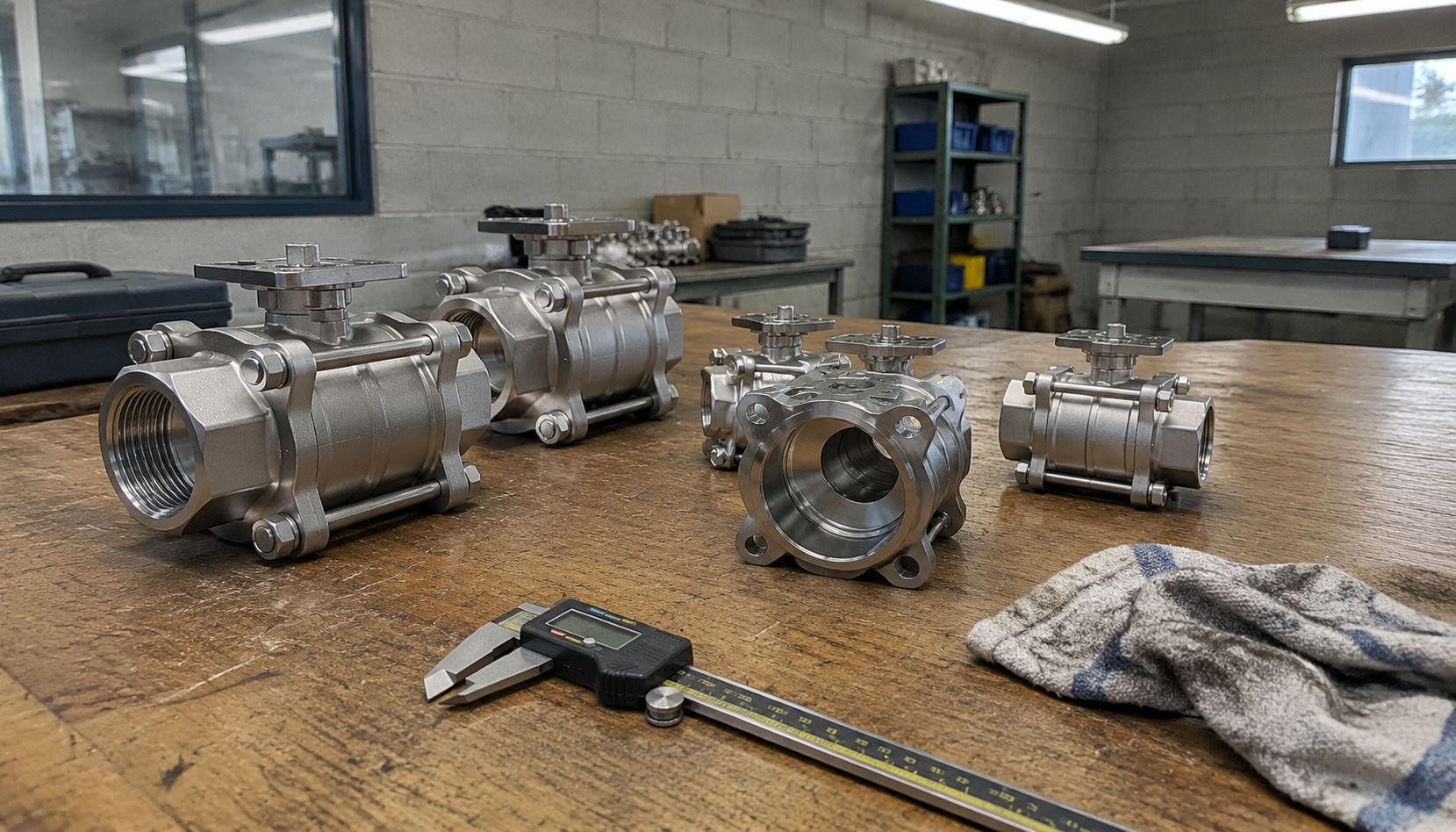
The email landed on a Tuesday morning. A pallet of DN50 two-piece ball valve bodies had failed the shell test at the buyer's own bench, in his own plant, in front of his own customer. Six out of forty leaked at the body joint. The foundry's paperwork said everything passed. The paperwork was signed. The paperwork meant nothing.
When the buyer pulled the purchase file, the first thing that didn't add up was the process. The PO said silica sol investment casting. The foundry's process sheet, which nobody had asked to see, was sodium silicate. Same shape, same CF8M stamp, half the shell cost, and a surface finish rough enough that the machining shop had to take three passes instead of one to clean up the flange face. That extra stock is where the porosity showed up.
This happens more than the catalogs suggest. Silica sol investment casting is the right process for a two-piece ball valve body — tight wall sections, a smooth bore path, a flange face that has to seal — but "silica sol" on a quotation is a claim, not a fact. This guide is about turning that claim into something you can check before the container leaves.
Why the process choice decides half your quality risk
A two-piece ball valve body is not a hard shape. It's a body with an end flange, an opposite end for the union or weld, a spherical cavity for the ball, and two sealing faces. What makes it awkward is the combination: thin wall around the cavity, a thick flange, and a bore that has to stay concentric across both halves so the ball seats properly when the two pieces are bolted together.
That combination punishes the wrong process. Here is what the four routes actually deliver on a body of this shape, measured against ISO 8062-3 casting tolerance grades:
| Process | ISO 8062-3 CT grade | Typical wall tolerance | Surface finish (as-cast) | Where it fits a ball valve body |
|---|---|---|---|---|
| Silica sol investment casting | CT4–CT6 | ±0.1–0.3 mm on 25 mm | Ra 3.2–6.3 µm | DN15–DN150 bodies, thin sections, sealing faces that need minimal stock |
| Sodium silicate (water glass) investment | CT6–CT8 | ±0.3–0.6 mm | Ra 6.3–12.5 µm | Larger, simpler bodies where machining stock is cheap |
| Sand casting | CT7–CT9 | ±1.0–2.0 mm | Ra 12.5–25 µm | DN150+ bodies, low pressure classes, generous machining allowance |
| Closed-die forging | n/a (forging tolerance standard) | ±0.5 mm | N/A (machined all over) | High-pressure small bodies, but the cavity has to be machined out entirely |
The reason silica sol wins on valve bodies isn't the surface finish, even though that's what the brochures push. It's the shell strength at thin sections.
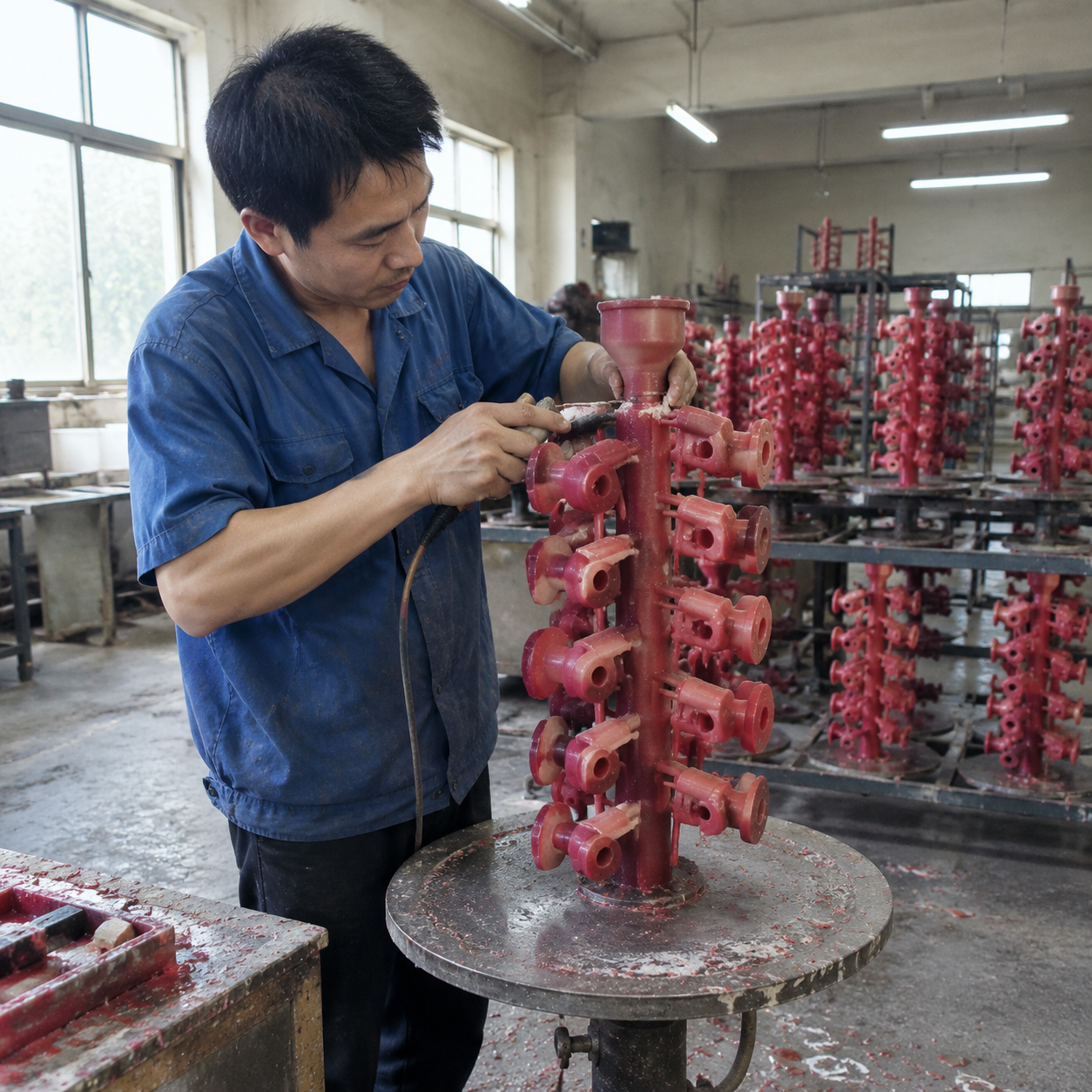
A silica sol shell is built from colloidal silica binder and refractory flour in five to seven coats. Each coat is dried in a controlled humidity chamber before the next goes on. The result is a shell that holds its shape when 1,550°C steel hits it — including in the 4 mm wall between the ball cavity and the outside diameter, which is the thinnest, most failure-prone section on the whole part.
A sodium silicate shell is cheaper and faster because it's chemically set. You dunk it in a hardening bath and move on. But it's brittle, it's rougher, and at thin sections it can move. When it moves, you get a wall that's 3.1 mm on one side and 4.6 mm on the other. The machinist either scraps the part or cuts through to the cavity. If your PO says silica sol and the foundry runs water glass, you've paid for tolerance you didn't get. The two routes are compared in more detail in silica sol versus sodium silicate investment casting.
Where the process stops making sense: past roughly DN150, or on Class 300 and above where the wall section thickens considerably, resin-bonded sand casting becomes the more economical route and the tolerance penalty stops mattering because you're machining the sealing faces anyway. If a supplier quotes you silica sol for a DN250 Class 300 body at a price that looks competitive, ask what they're actually running.
What to ask for, and what the answer should look like
You can't audit a shell process from a quotation. But you can force the question in a way that's hard to fake, and you can verify it in twenty minutes on a plant visit.
Ask for the process control sheet for your specific part number, not the general company brochure. It should list the number of shell coats, the binder type and supplier, the slurry viscosity range with the actual daily readings, and the drying room temperature and humidity setpoints.
A real silica sol shop has this document because they need it to reproduce results. A foundry that runs water glass and writes "silica sol" on quotes will hand you a generic one-pager with no readings on it.
Then look at three things on site:
- The drying room. Silica sol shells need controlled humidity, typically 50–70% RH, and air movement. If there's no enclosed drying area with a hygrometer on the wall, the process is not silica sol.
- The hardening bath. If you see a row of tanks with a liquid that shells get dunked into right after stuccoing, that's the sodium silicate or ethyl silicate route, not colloidal silica.
- The shell scrap pile. Silica sol shells crack. A shop with zero cracked shells either has a tiny volume or isn't telling you the truth. What you want to see is cracked shells segregated and counted, because that means somebody is tracking it.
One more check that costs nothing: ask what the wax injection die costs for your body size. Silica sol shops typically quote $900 to $3,000 for a two-piece body die depending on cavity count. If the tooling number in the quote is $200, the part is being made from a sand pattern or a water glass tool, or the die is being amortised in a way you'll pay for later in piece price.
The material spec is where most purchase orders go wrong
Ninety percent of two-piece ball valve bodies in general service are CF8M to ASTM A351 — the cast equivalent of 316 stainless. It's a good default. It also gets written on POs without the clauses that decide whether the casting actually performs.
Here's what belongs on your specification, and what happens when it's missing:
| Spec item | What to write | What goes wrong without it |
|---|---|---|
| Base standard | ASTM A351 Gr. CF8M, heat treated per A351 | Supplier substitutes a "316 equivalent" from a non-A351 shop with different chemistry limits |
| Chemistry | Full ladle analysis + product analysis, C ≤ 0.08%, ferrite 5–20% | Ferrite outside range gives you either hot cracking or poor weldability |
| Certification | EN 10204 3.1, heat number stamped on each body | You get a 2.2 or a generic certificate with no traceability to your parts |
| NDE | PT on 100% of bodies per ASTM E165, acceptance per ASME B16.34 | Surface porosity passes because nobody looked |
| Radiography | RT per ASTM E446 on first article and 5% sampling, severity level stated | Internal shrinkage in the ball cavity wall reaches you undetected |
| Corrosion / sour service | NACE MR0175 / ISO 15156 if applicable, hardness limits stated | You get standard CF8M into a sour line and inherit the failure |
Notice that "ASTM A351 CF8M" alone is not a specification. It's a grade name. The clauses after it do the work. ASME B16.34 sets the minimum wall for the pressure class, and it's the number your ultrasonic readings get compared against — not the drawing nominal.
The ferrite range is the one buyers skip most often and regret most often. CF8M with ferrite below 5% is prone to solidification cracking during welding of the end connection. Above 20%, you lose corrosion resistance in the heat-affected zone and start seeing sigma phase if the part sees elevated temperature.
A foundry that reports ferrite as "within spec" without a number is telling you they didn't measure it. Ask for the reading on the first article report. It takes them thirty seconds with a ferritescope, and it tells you whether they own one.
Pressure testing: the part everyone certifies and nobody documents
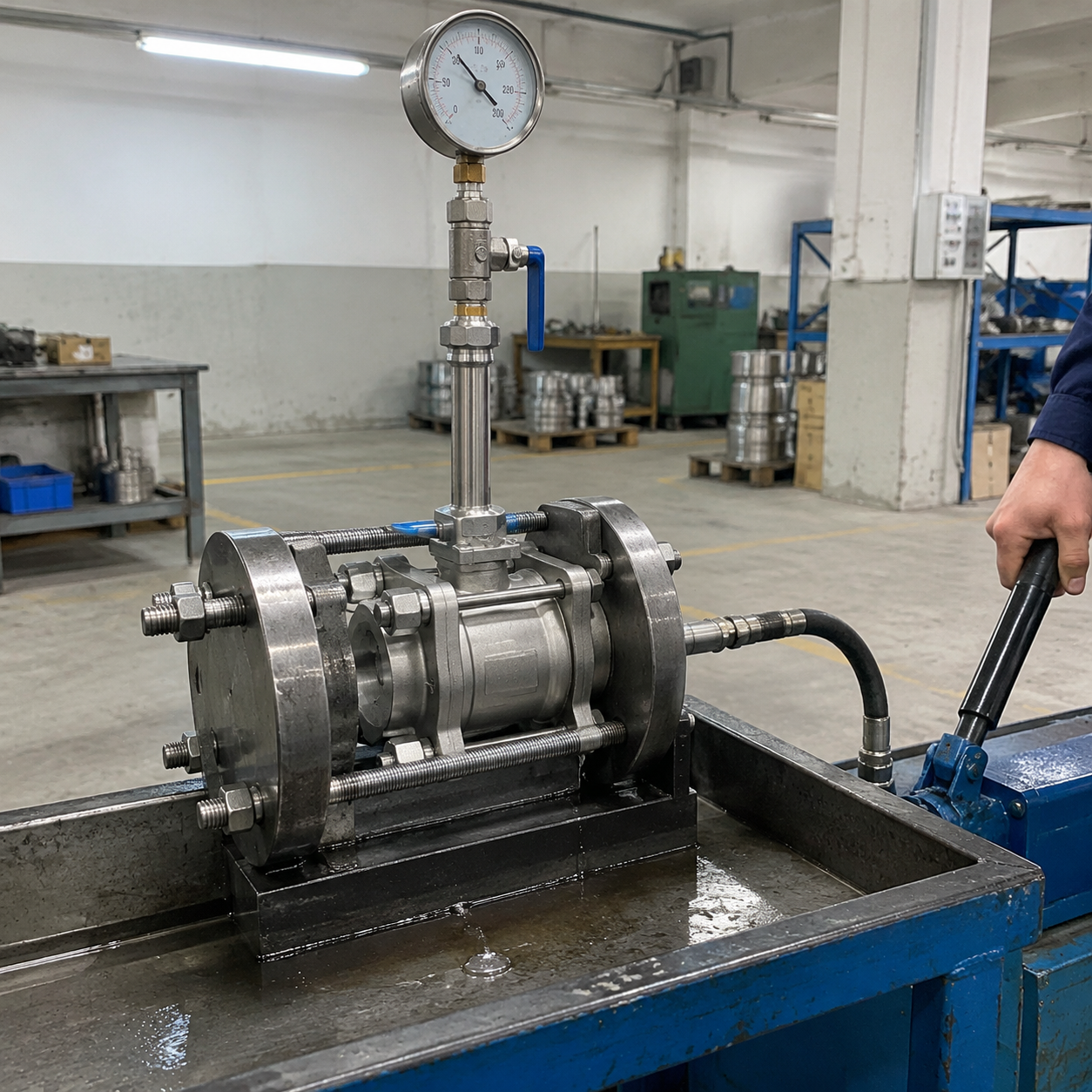
API 598 covers valve inspection and testing. EN 12266-1 covers the European equivalent. Both require a shell test at 1.5 times rated pressure and a seat test at 1.1 times, held for a specified duration based on valve size.
What arrives with most shipments is a certificate that says "shell test: passed, seat test: passed" on company letterhead. That document is worth roughly the paper it's printed on, because it doesn't tell you which valve, at what pressure, for how long, with what result.
What you should require instead:
- Test pressure actually applied, in bar, recorded per serial or per lot
- Hold time in seconds or minutes, not "per standard"
- Test medium — water for shell, air or water for seat, stated
- Acceptance criterion — zero leakage, or the allowable drip rate if you're buying to a leakage class
- The test bench calibration date
If the foundry casts and machines, the pressure test happens at the machining facility after assembly. That's a different building, sometimes a different company. Make sure your PO names which legal entity signs the test report, because when a leak shows up at your plant, "that was the assembly vendor" is a conversation you don't want to have.
Where the price actually comes from
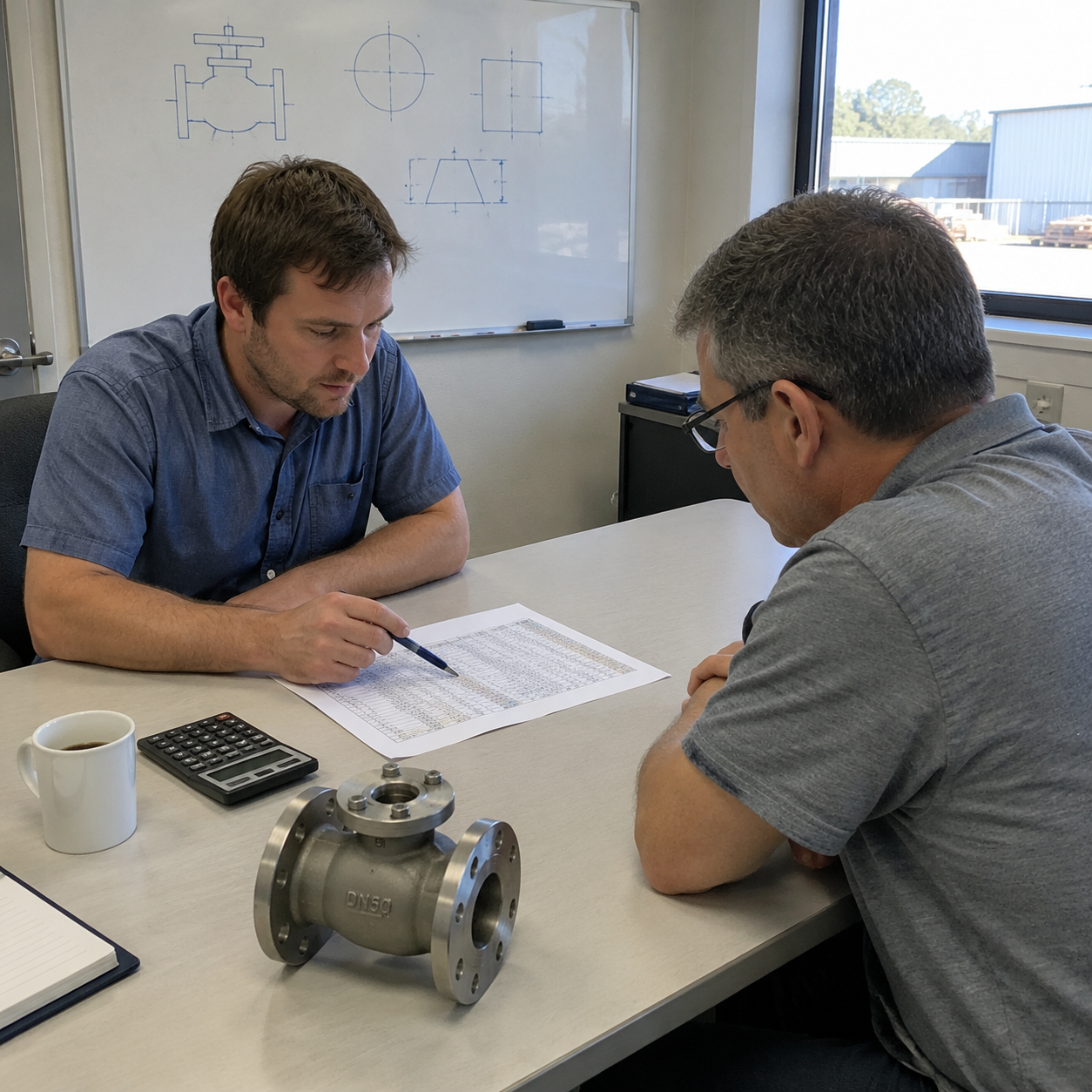
Most buyers get three quotes for the same drawing and see a spread of 40%. Then they pick the middle one and hope. That's not a strategy. The spread exists because the three quotes are not quoting the same thing, and until you break the number apart you can't tell which one is real.
Robert Davis runs a hardware wholesale operation out of Georgia and spends about $1.5 million a year on castings, a good chunk of it valve bodies. He's been doing this for nineteen years and he's blunt about how he handles quotes.
"I don't accept a single line item any more. Not ever. I want to see the casting, the machining, the test, the coating, the packing and the tooling amortisation as separate lines. When a supplier won't break it out, it's because one of those lines is doing something they don't want me to see — usually the casting is being bought from a second shop and marked up, or the tooling is being charged twice."
That's the first filter. Here's what a broken-out quote for a DN50 CF8M two-piece body typically looks like from a Chinese silica sol shop in 2026, at 500 pieces:
| Cost line | Share of piece price | What moves it |
|---|---|---|
| Casting (silica sol, CF8M) | 30–38% | Shell coats, wax die cavity count, scrap rate, melt yield |
| Machining | 28–35% | How much stock the casting leaves; a rough casting costs more to machine than it saves |
| Ball, stem, seats, seals | 15–20% | Seat material (PTFE vs RPTFE vs PEEK), ball finish, stem grade |
| Assembly and pressure test | 6–10% | Test time per unit, leak rework rate |
| Certification and NDE | 3–6% | PT, RT sampling, 3.1 certificate, third-party witness |
| Packing and inland freight | 4–7% | Export crate standard, whether you asked for seaworthy packing |
| Tooling amortisation | 2–8% at 500 pcs | Spread over quantity — the same die at 5,000 pcs nearly disappears |
The number that surprises buyers is machining sitting at nearly a third of the piece price. This is why a cheap casting is often an expensive valve. If the foundry shaves 8% off the casting cost by moving to water glass, the machining shop has to take deeper passes and the scrap rate climbs. You've moved cost from a line you can see to a line buried in rework, and the total goes up.
"The other thing I do is ask what happens at 2,000 pieces instead of 500. If the answer is a 4% drop, the tooling is already paid and they're just being polite. If it's 18%, that's a real quote and I know where my volume break is. I've walked away from suppliers who couldn't answer that question at all."
Use that. Ask for pricing at 500, 2,000 and 5,000 pieces. Ask separately what the tooling costs if you pay for it up front versus amortised. A supplier who wants your tooling paid up front is fine — it means they're not hiding margin in the piece price, and you own the die if you ever move.
The five-step foundry check for valve body castings
This is the sequence I run before a first order, and it hasn't failed me yet. It takes one day on site if the foundry is organised, and the printable version lives in the foundry audit checklist.
Step 1 — Confirm the shell process is what the quote says
Walk to the shell building. Look for the drying room, the slurry tanks with agitators, and the stucco station. Ask to see the viscosity log for the last thirty days. A silica sol shop will have it on a clipboard or in a spreadsheet on a terminal nearby. If the answer is "the manager has that at headquarters," you're being managed.
Step 2 — Trace one heat from furnace to finished body
Pick a body from the finished goods area. Read the heat number stamped on it. Ask them to pull the heat's ladle analysis, the spectro printout, the heat treat chart and the EN 10204 3.1 certificate.
All four should match within the same working day. A foundry that can do this in twenty minutes is a foundry with a real traceability system. One that asks you to come back tomorrow has a filing problem, and a filing problem becomes a recall problem.
Step 3 — Watch a pressure test, don't read about one
Stand at the bench for three valves. Time the hold. Watch whether the operator actually waits or releases early. Check the gauge calibration sticker. This tells you more about your leak risk than any quality manual.
Step 4 — Look at the first article inspection report format before you order
Ask to see a FAI report from a previous valve body job, with the customer name redacted. What you want on it: every drawing dimension with nominal, tolerance, actual and pass/fail; material chemistry against the A351 limits; ferrite percentage; hardness; PT results; RT film reference. A one-page report with "dimensions OK" is not an FAI.
Step 5 — Check the machining source
If the foundry machines in-house, walk the line and look at how they fixture the body for the flange face and the ball bore. Those two features decide whether the valve seals. If they outsource machining, find out who — and check whether that shop also machines for a competitor who gets priority when schedules slip.
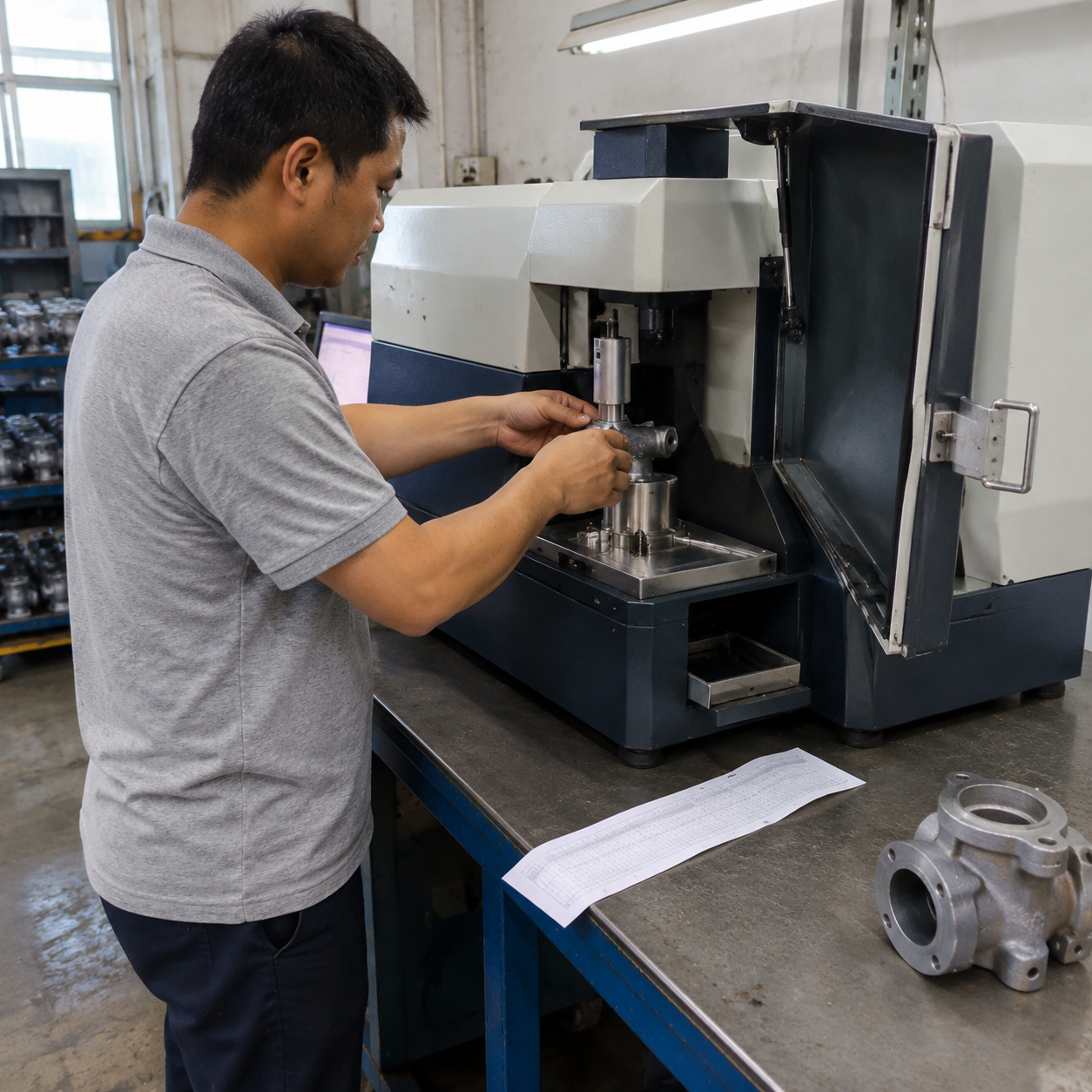
First article inspection: what to put on the report
The FAI is where you either catch a problem at zero cost or catch it at container cost. Here's the minimum content for a two-piece ball valve body.
- Dimensional: every dimension on the drawing, including the ones marked reference, with actual values. Pay particular attention to flange face to flange face, the ball cavity diameter, the distance from the flange face to the seat pocket, and the bolt hole pattern position.
- Concentricity: the bore of one half against the bore of the other, measured assembled. This is the number that decides whether the ball floats true or binds.
- Wall thickness: ultrasonic readings at eight points around the cavity. Minimum wall should be at least the drawing nominal minus the ISO 8062-3 DCTG allowance, and never below the ASME B16.34 minimum for the pressure class.
- Chemistry: product analysis from the actual part, not the ladle. They should drill a sample from the body itself, or use the spectro on a sacrificed part.
- Ferrite: percentage, with method stated.
- Hardness: on the body and, if the stem is cast, on the stem.
- NDE: PT report with the acceptance criterion cited, RT films if specified with the severity level and the reader's name.
- Pressure: shell and seat, with actual pressure, hold time and result.
One thing buyers forget: ask for the FAI to be signed by the person who measured, not just the QA stamp. When something goes wrong at your incoming inspection, you want a name attached to the numbers.
Common mistakes to avoid
Writing "silica sol" without a process control requirement. It's an unenforceable claim. Attach the shell coat count and drying parameters to the PO, or accept that you're buying whatever the foundry finds cheapest that month.
Buying on piece price alone. As the cost breakdown shows, machining is nearly a third of the price. A casting that's $0.80 cheaper and 0.5 mm rougher can cost you $1.20 more at the machining stage. Compare landed, machined, tested cost — not the casting line.
Accepting a 3.1 certificate without the heat number on the part. The certificate proves a heat existed. The stamp proves your parts came from it. No stamp, no traceability, no matter what the paper says.
Skipping the ferrite number. It's the single cheapest check on the FAI and the one most likely to be missing. Ask for it in the PO.
Letting the foundry choose the seat material. PTFE is standard, RPTFE is common in Chinese production, PEEK shows up in high-temperature service. They behave differently at 180°C. Name the material and the temperature range on the drawing.
Not defining who tests. Casting shop or assembly shop — the pressure test report should name the legal entity. Otherwise a failure becomes a three-way conversation between you, the caster and the assembler, and nobody owns it.
Ordering 500 pieces before running 5. A first article from a pilot batch of five bodies costs almost nothing and catches the wax die problems, the shell cracking, and the machining fixturing issues before they scale. Every experienced buyer does this. Every buyer who skips it learns why.
Frequently asked questions
Can silica sol investment casting hold the tolerances on a two-piece ball valve body?
For a DN15 to DN100 body, a competent silica sol shop holds ISO 8062-3 DCTG4 to DCTG5 on critical dimensions, which works out to roughly ±0.1 to 0.3 mm on a 25 mm span. The ball bore and the flange face parallelism aren't left to the casting — they're machined. What the casting has to guarantee is wall thickness and enough clean stock to machine true.
What pressure test should a two-piece ball valve body pass before shipment?
A shell test at 1.5 times rated pressure, held for the duration specified in API 598 or EN 12266-1, followed by a seat test at 1.1 times. Ask for the actual recorded hold time and result per serial or per lot. A one-line "passed" certificate tells you nothing about whether the test happened.
Is CF8M the right material for a silica sol cast ball valve body?
For water, mild chemicals and general service, yes — CF8M to ASTM A351 is the workhorse and it casts well in silica sol. It's the wrong answer for sour service, chloride-heavy seawater, or high-temperature steam. Those need a different grade, often with NACE MR0175 compliance, and most casting quotes don't include that unless you ask.
What does an EN 10204 3.1 certificate actually prove?
It proves the foundry issued a test certificate traceable to a specific heat, with results from the actual product rather than a generic type test. It does not prove the parts in your crate came from that heat. That's what the heat number stamp on the body and the spectro check at incoming inspection are for.
How long should a first order take?
Realistically, 25 to 35 days for the wax die and first article, then 30 to 45 days for the production run at 500 pieces, plus 20 to 30 days sea freight. Anyone promising a first article in ten days is either using an existing die that isn't yours or planning to skip the FAI.
Next steps
Before your next PO goes out, do three things. Add the shell process control requirement to the specification so "silica sol" means something. Require the ferrite number and the heat number stamp on every body. And ask for a broken-out quote at three quantity levels so you can see what you're actually paying for.
If you want a second set of eyes on a drawing before you send it out, or you need the verification checklist in a form you can hand to a supplier, that's a conversation worth having early rather than after the container ships. Send the drawing and the service conditions — pressure class, medium, temperature, and the standard you're buying to — and you'll get a process recommendation and a cost structure back, not a single number.
For the process comparison behind this article, see silica sol versus sodium silicate investment casting. For the wider category, valve body castings covers gate, globe and check bodies on the same verification logic. And the foundry audit checklist has the on-site sequence in a printable form.