SASO Saber Certificate for Casting Export to Saudi: The 2026 Playbook
Saudi Arabia’s Vision 2030 has roughly $550 billion tied up in giga-projects—NEOM, Red Sea resorts, Qiddiya, and sprawling logistics hubs. To give you an idea of the scale, those projects alone demand an estimated 2.1 million metric tons of iron, steel, and aluminum castings for valves, pumps, pipeline fittings, transmission housings, and construction components. Incredible numbers.
But here’s the kicker. In the first quarter of 2026, port data from Jeddah and Dammam shows that 1 in 10 casting containers was held at customs for more than 72 hours due to a missing or invalid SASO Saber certificate.
If you’re exporting ductile iron pipe fittings or steel casting housings to Saudi Arabia right now, you’re staring at one of the most lucrative industrial buying booms in a generation. But the Saudi Standards, Metrology and Quality Organization (SASO) built a digital gate specifically designed to stop non-compliant goods before they clear the harbor.
This gate is called Saber. And if you don’t have the right certificates wired into the system, your shipment—and your payment—gets stuck at sea.
Let’s decode exactly how the SASO Saber certification process works for castings, what it costs you in time and money, and how you can avoid the rookie mistakes that cost companies anywhere from $7,500 to $40,000 in penalties and detention fees per failed shipment.
What Is the SASO Saber Certificate?
Let's be blunt about what all these acronyms actually mean. You'll see SASO and Saber used interchangeably, but they aren't the same thing.
SASO is the government body. It sets the technical regulations, monitoring which types of products are allowed into the Kingdom. Saber is SASO's electronic database and certification platform. Think of Saber as the post office and SASO as the law.
When people talk about getting a "SASO certificate," they're really talking about applying for it through the Saber portal. For every single shipment of regulated products, an importer or certified exporter has to handle two separate certificates on Saber:
- PCoC (Product Certificate of Conformity): a product-level approval linked to your foundry and your product grade.
- SCoC (Shipment Certificate of Conformity): a one-time document attached to the specific consignment, invoice, and Bill of Lading.
You can’t skip ahead. A valid PCoC is mandatory before you can even initiate an SCoC application. And a PCoC isn’t given away for free or rubber-stamped. The Saber system cross-checks the manufacturer's details, the HS code, and the relevant standards. If you're exporting castings under the HS code 7325 (other iron/steel castings) or 8483 (transmission shafts, gears, and housings), the scrutiny is specific and technical.
Here’s the part your local freight forwarder may not tell you: the SCoC is not your certificate. In most cases, the Saudi importer, or an authorized service provider, holds the SCoC. If your importer isn't registered in Saber, your goods are not moving out of the port. You don't have a plan B unless you or your buyer are both aligned from day one.
The 4-Step Process to Get Your Castings Certified
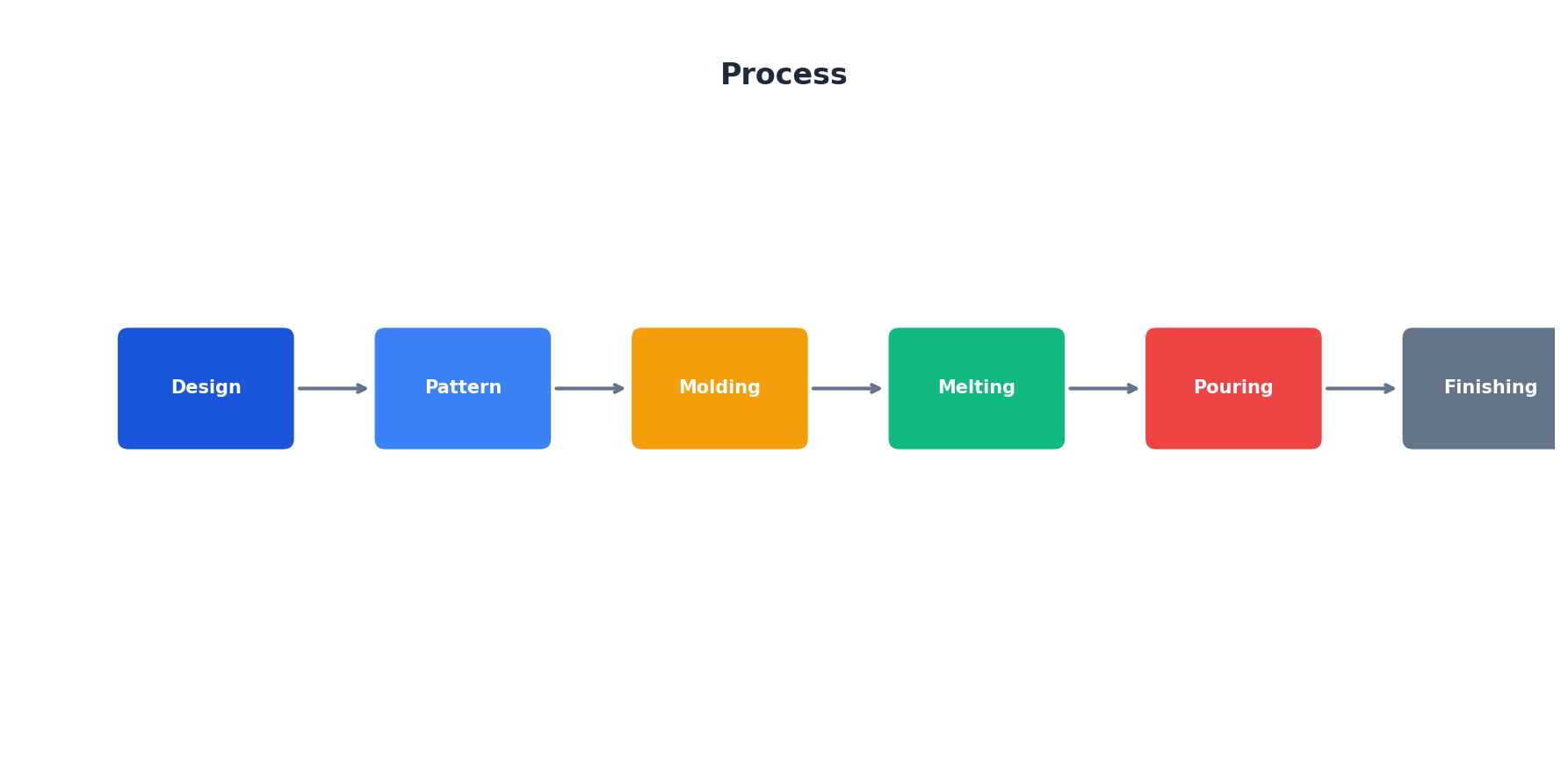
For iron, steel, and aluminum foundries, the PCoC/SCoC loop looks deceptively simple. But the practical details decide whether your cargo clears Saudi customs on time or lands you in a financial dispute with your buyer. Stick to this sequence:
Step 1: Register Your Product in Saber (Importer or Your Authorized Rep)
The registration for Product (i.e., each specific casting grade) is opened on Saber by the importer or their technical representative. You need to ensure the following data matches your mill certs exactly:
- The exact HS code. A wrong HS code (e.g., classifying a ductile iron pipe fitting under cast iron general covers) is one of the leading causes of 48-hour customs detention holds in Saudi.
- The product model/brand name.
- Trade name and manufacturer's name and address.
- Country of origin.
Step 2: Apply for the PCoC Through a SASO-Approved Certification Body
Once the product is saved in Saber, you choose an approved Certification Body (CB) like Bureau Veritas, Intertek, SGS, or TÜV Rheinland. They review the product's test reports and may perform a factory audit in China, India, or Turkey to ensure the manufacturing process is stable.
Because casting is a process-sensitive industry, a CB will ask for proof of chemical composition and mechanical properties. They want to see your:
- Mill Test Certificates (to EN 10204 or ASTM A536/A360 standards).
- Quality assurance documentation (ISO 9001 often satisfies audit requirements).
- Nominal wall thickness and tolerance data.
Review times on a PCoC typically take 5 to 15 working days. This is not something you do when the ship is already sailing.
Step 3: Generate the SCoC for the Specific Shipment
After a PCoC is valid (it lasts for one year), the importer or CB applies for the SCoC. This links the product code to the shipment's invoice, packing list, and Bill of Lading number.
The SCoC application to Saber cross-checks the quantity, weight, and country of export. The fee is minimal—we'll break it down in a moment—but if the HS code or product code is changed at the last minute, SCoC automatically blocks it.
Step 4: Saudi Customs Clearance
Your SCoC applicant receives a PDF certificate that carries a QR code. This QR is scanned by Saudi customs officials (ZATCA). Once it validates, your container is release-stamped and you're through. The entire process, on paper, is digital. Nothing needs a physical stamp.
Casting-Specific Standards That Matter
Generic advice won't cut it here. SASO follows the regional GSO (Gulf Standardization Organization) framework, but in practice, for casting products, customs and CBs heavily reference industry standards:
- ASTM A536: Ductile Iron Castings—standard spec for heavy-duty industrial castings, valves, and pump housings.
- ASTM A48: Gray Iron Castings—common for counterweights and general engineering castings, but the specs are strict.
- EN 1563: Founding - Spheroidal graphite cast iron (equivalent to ASTM A536). Often required for European-design pumps and pipe fittings.
- ISO 9001: for the factory's quality management system, which bolsters your PCoC approval significantly.
If you're exporting a machined casting, expect the technical file in Saber to ask for the machining tolerances, surface finish, and a declaration of the casting method (e.g., shell molding, investment casting, or sand casting). If you source from a foundry that has limited QA systems, the certification process becomes dramatically more painful.
One thing you should absolutely do: test your products in a laboratory accredited by ILAC-MRA. If you're in China's casting hub (Hebei, Shandong, Shanxi, or Ningbo), labs like SGS and Bureau Veritas have local setups that submit data directly accepted in Saber. This cuts off the chance of a lengthy back-and-forth over test report authenticity.
The Real Cost of SASO Saber Certification (Data-Driven Look)
Here’s a realistic financial snapshot. Costing can vary based on the Certification Body and the casting type, but the ballpark for typical iron/steel casting exports (containers weighing 20-25 tons) is as follows:
| Cost Item | Typical Range (USD) | Notes |
|---|---|---|
| PCoC (Product Certificate) | $850 – $2,500 per product family | Covers the entire year. Includes CB review + factory audit (if needed). |
| Lab Testing (Per Material/Heat) | $400 – $1,500 | Chemistry and tensile testing. Mandatory for the technical file. |
| SCoC (Shipment Certificate) | $30 – $100 | Per shipment. Surprisingly cheap, but it blocks everything if PCoC is wrong. |
| Port Rejection Penalty (If no cert) | $10,000 – $40,000+ | Demurrage, reverse logistics, and buyer penalties. This is the real price. |
For a regular exporter shipping two containers per month, you end up allocating just $650 to $1,400 per year to SASO compliance if you have a valid PCoC. Compare that to one failed shipment spent in a hot situation—it's a fraction of what you'd lose in demurrage fees alone. Jeddah Port detention rates are $2,500 to $5,000 per day for out-of-quota cargo, and those days add up faster than your payment schedule can handle.
3 Costly Mistakes That Trigger SASO Saber Rejections
Data from Saudi ports shows a spike in failed casting shipments to the Kingdom. Usually, it's not random. It's these exact mistakes.
Mistake 1: Changing the Casting Process Without Updating the PCoC
Say you have an approved PCoC based on green sand casting. Six months later, your foundry decides to switch to shell molding to improve surface finish. Did you notify the CB? No. But the Saber portal checks technical consistency. If a photo from the factory audit or the product technical file shows sand casting and the shipment arrives with a visibly different finish, customs may suspend the SCoC for further verification.
In 2025, an estimated 20-25% of casting-related SCoC blocks were on account of undocumented manufacturer changes. You need to update the PCoC before, not after, the production switch.
Mistake 2: Mixing Non-Certified Materials in a Container
Let's say you're shipping a 20-foot container of ductile iron fittings. To fill the volume, you decide to add some gray iron covers that aren't included in the Saber PCoC. The problem? Saber doesn't just connect the container—it validates against weight and risk profiles.
Customs can perform a physical inspection, and the moment they see a material grade that's not on the PCoC, the shipment is flagged as a violation. Your SCoC doesn't cover it, your doc is void, and you're now looking at a huge fine.
Mistake 3: Thinking the SCoC Is Optional Before Loading
The process says SCoC is requested after you have the BL draft. But you need to get that done while the cargo is still at the origin port. It takes 24-48 hours to issue an SCoC. Many foundries assume the buyer will handle the SCoC "on their side" and the goods will clear with just a PO and an invoice.
Not true. Saudi buyers often require the foundry to provide full compliance. If you wait for the ship to arrive in Jeddah and then scramble to get an SCoC, you're already in the red zone for demurrage.
Your 7-Step Pre-Shipment Checklist for Saudi Castings
Let's make this operational. Print this checklist. Share it with your production and QC team:
- Verify your importer or agent is registered on Saber. Nothing moves without their "Importer of Record" status.
- Check the HS code specific to your casting type. Confirm with the Saudi importer to avoid a mismatch.
- Ensure the PCoC is active and has at least 11 months of validity remaining. If your PCoC expires in the same month as the shipment arrival—it's game over.
- Carry out or review the laboratory test reports. Ensure they're issued within 3 years for materials compliance.
- Have the commercial invoice and packing list values match the declared SCoC exactly. Even a $100 discrepancy can trigger a red flag in ZATCA.
- Apply for the SCoC after the Bill of Lading is issued, but while cargo is still loading. If the PCoC is already valid, the SCoC is a simple formality.
- Print the QR code labels if required by your CB. Attach them to the shipping marks and packing list.
Follow those 7 points, and you're not just shipping iron. You're shipping compliance, which is the real product Saudi buyers pay a premium for.
Frequently Asked Questions
Do all castings require a SASO Saber certificate?
Yes, most iron and steel castings entering Saudi Arabia fall under regulated product categories, including parts for valves, pumps, scaffolding, and general machinery. The only way to know for sure is to search your product type on the Saber platform or ask your chosen Certification Body for a classification check.
Can I get the PCoC if my foundry doesn't have ISO 9001 certification?
You can, but it's significantly harder. The certification body will likely require a full factory inspection and rigorous batch testing. Having ISO 9001 is not strictly a legal requirement for Saber, but it makes the PCoC approval process measurably smoother.
How long is the SASO Saber PCoC valid?
The PCoC is generally valid for exactly one solar year from the date of issuance. After that, you need to submit updated test reports and re-evaluate the factory to renew it. Note that if your foundry undergoes significant changes, the PCoC can be cancelled earlier.
Why did my SCoC get rejected if the PCoC is valid?
This typically comes down to a data mismatch. A tiny difference between the HS code on your invoice and the HS code registered under the PCoC is enough to block it. It also happens when the quantity or total value exceeds the SCoC’s declared quantity by more than 10%. Check every digit, every zero.
Final Word: Treat Saber as a Gate, Not a Barrier
Regardless of whether you’re a foundry in Hebei or a sourcing office in Mumbai, Saudi Arabia’s casting demand is a massive revenue opportunity. The SASO Saber certificate doesn't have to be an obstacle. It’s a system with a predictable, data-driven compliance path. Those who internalize the PCoC’s validity, the SCoC’s matching criteria, and strict adherence to casting standards will unlock the Saudi market.
Those who don't? Their containers are already drifting toward the demurrage list.
Get your product registered early. Test your material. Make sure every document matches the invoice. Do it before you book the freight, and you'll dump the risk before it ever reaches the Red Sea.
Need a clear cost estimate for obtaining your SASO Saber PCoC for castings?
Tell us your product type, HS code, and monthly shipment volume. Get a detailed certification roadmap and liability-free cost plan.
Get My Certification Plan