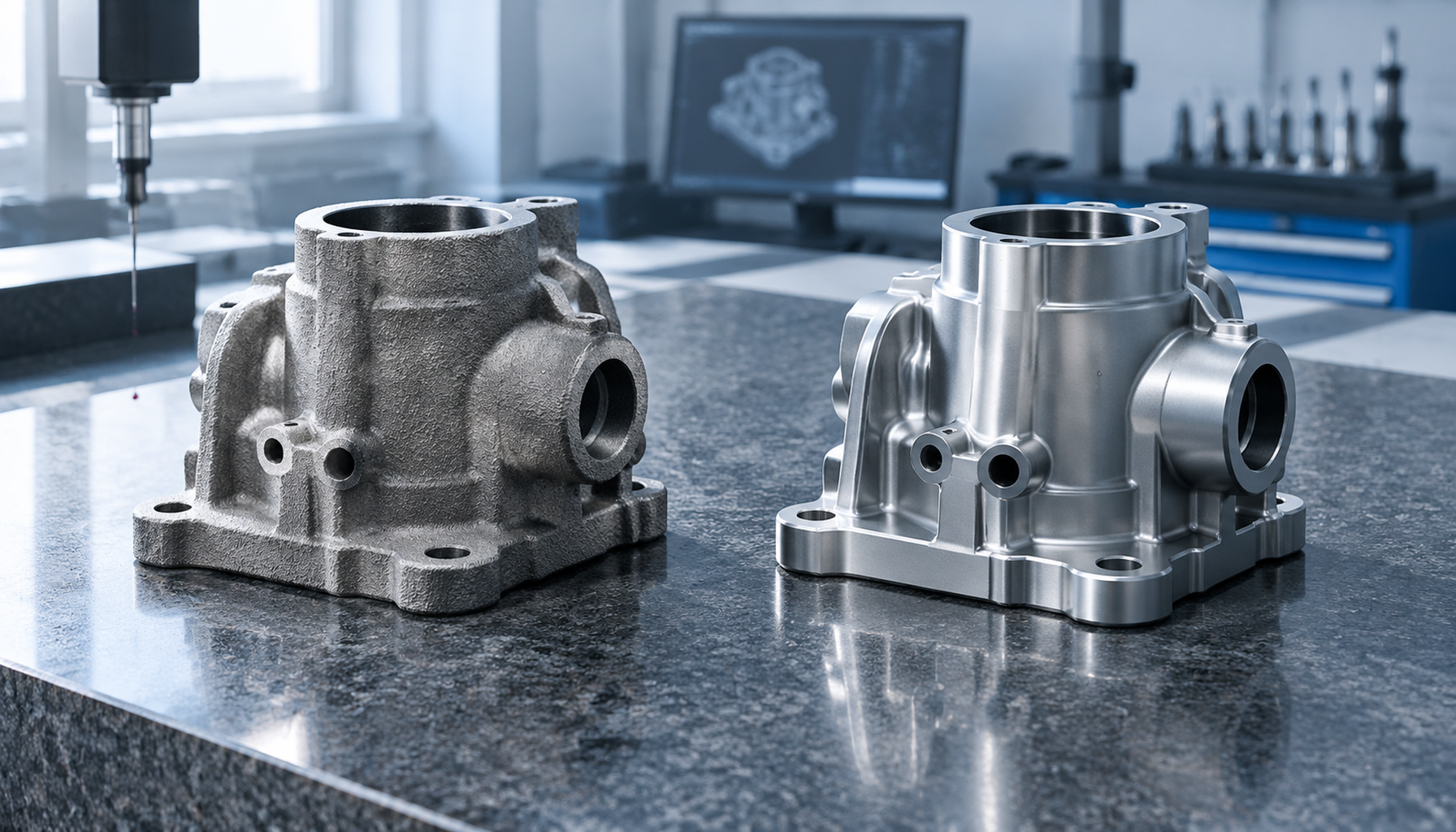
A purchasing manager in Ohio sent a drawing to a Chinese foundry last spring. Stainless valve body, 316L, 500 pieces. On the sealing face, the drawing said Ra 3.2 max. The foundry quoted sand casting. The quote came back 22% under everyone else. She took it.
Eleven weeks later, the first article arrived. The sealing face measured 8.4 µm Ra. The foundry's QA guy sent a photo of a comparator plate and wrote: "as-cast is as-cast."
She paid twice. Once for the castings, once for a machine shop to face 500 flanges down to spec — plus a five-week schedule slip and a very awkward call to her VP of operations.
This article exists so you don't make that call. Surface finish is the single most misunderstood line item in casting procurement, and it's the one that quietly blows up budgets. Here's how sand casting and investment casting actually compare on finish, what the gap costs you downstream, and how to write a drawing that holds up in a dispute.
The Numbers First, Opinions Later
Forget the marketing pages that say "excellent surface finish." Here's what the processes deliver as-cast, measured in Ra (arithmetic mean roughness), which is what your drawing almost certainly uses.
| Process | Typical as-cast Ra | In µin RMS (shop shorthand) | Realistic tolerance class |
|---|---|---|---|
| Green sand casting | 12.5–25 µm | 500–1000 | ISO 8062-3 DCTG 10–12 |
| Resin-bonded no-bake sand | 6.3–12.5 µm | 250–500 | ISO 8062-3 DCTG 9–11 |
| Shell molding (sand-based) | 3.2–6.3 µm | 125–250 | ISO 8062-3 DCTG 8–10 |
| Investment casting (standard) | 1.6–3.2 µm | 63–125 | ISO 8062-3 DCTG 5–7 |
| Investment casting (fine slurry) | 0.8–1.6 µm | 32–63 | ISO 8062-3 DCTG 4–6 |
| Die casting (for reference) | 0.8–3.2 µm | 32–125 | NADCA SPC standards |
Read that table again and notice the size of the gap. Green sand is roughly 6 to 10 times rougher than standard investment casting. That's not a rounding difference. That's the difference between a part that goes straight to assembly and a part that goes to a machine shop first.
One caveat before you take these numbers into a negotiation: they're production-realistic ranges, not best-case lab samples. A foundry that claims 6.3 µm Ra from green sand on a 40 kg part is either measuring on a polished test bar or talking about a different process. Ask for the measurement setup before you believe the number.
The units are where the fights start
Four different numbering systems get used on the same drawing stack, and they don't agree with one another. Before you argue with a supplier about whether the part passed, make sure you're both reading the same column.
| Ra (µm) | Ra (µin) | RMS (µin, shop) | N-grade (ISO 1302) | What it looks like |
|---|---|---|---|---|
| 0.4 | 16 | 18 | N5 | Mirror-ish, lapped |
| 0.8 | 32 | 36 | N6 | Ground, near-reflective |
| 1.6 | 63 | 71 | N7 | Fine machined, soft sheen |
| 3.2 | 125 | 142 | N8 | Standard machined |
| 6.3 | 250 | 283 | N9 | Rough machined, visible tool marks |
| 12.5 | 500 | 566 | N10 | Shell-molded as-cast |
| 25 | 1000 | 1132 | N11 | Green sand as-cast |
If your drawing says "125" with no unit, you don't know if it's Ra µin, RMS µin, Ra µm, or a typo. Every one of those readings has been used to reject a real shipment somewhere. Write the unit.
Why Sand Casting Comes Out Rough
The mechanism is simple and it's worth understanding, because it tells you exactly where the ceiling is.
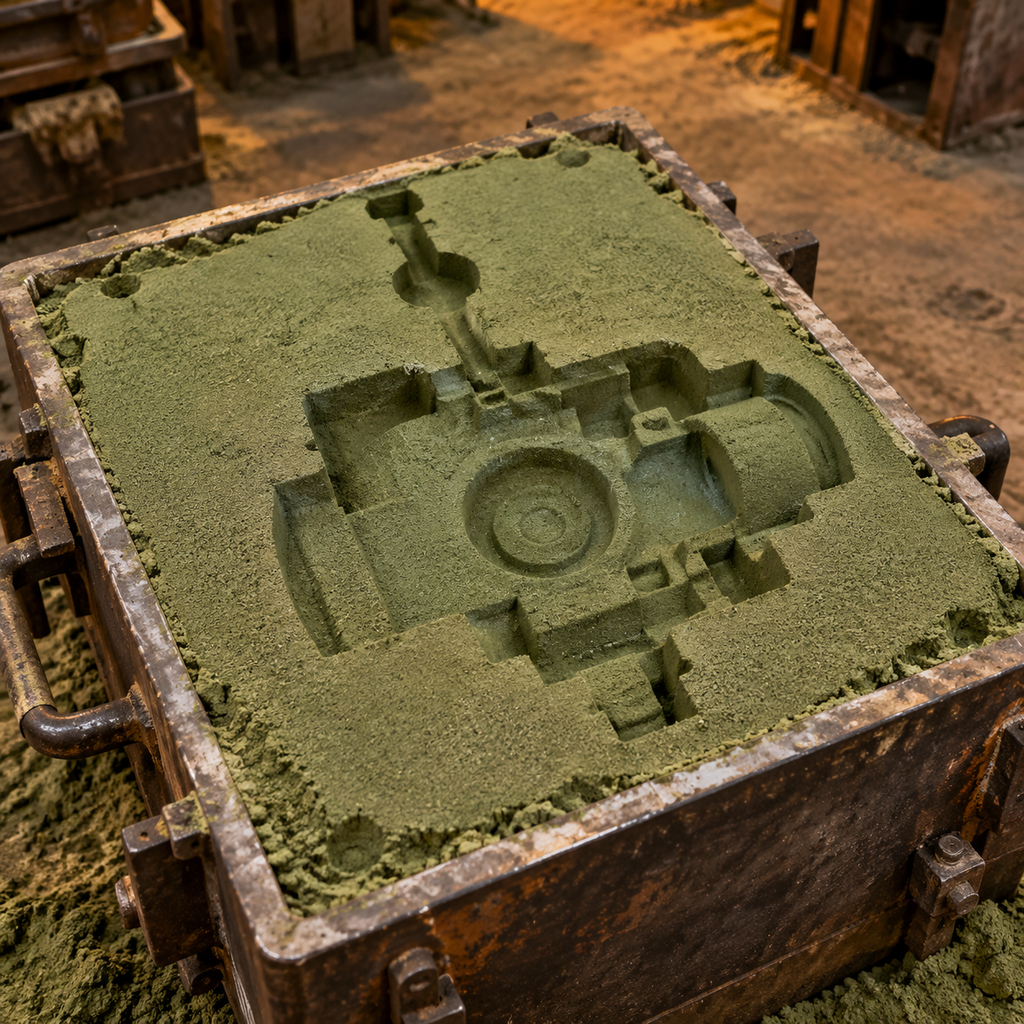
In sand casting, you pack bonded sand around a pattern. That sand is a mix of silica grains — typically AFS grain fineness number 45 to 70 for general iron and steel work, finer if you're chasing finish — held together with bentonite clay (green sand) or a resin binder (no-bake). The mold cavity surface is, physically, a wall of sand grains glued together.
Pour 1,450°C molten steel against that wall and the metal replicates the texture of the grains. It also replicates every loose grain, every binder-rich spot, and every imperfection the pattern left behind.
What determines the finish in sand
- Grain fineness. Finer sand, smoother surface — but finer sand needs more binder and vents worse, which raises defect risk. There's a real tradeoff, not a free dial.
- Binder and coating. A refractory wash or coating on the mold face can knock 1–2 µm off the Ra. Zircon-based coatings are common on steel; they also reduce burn-on.
- Pattern surface. If the pattern is polished, the mold is smoother. If it's been sitting in a rack for eight years with nicks and paint ridges, that transfers too.
- Pouring temperature. Hotter metal attacks the mold surface more aggressively. Superheat is necessary for filling thin sections, and it costs you finish.
- Metal type. Aluminum reproduces mold texture more faithfully than steel does. Ductile iron sits somewhere in the middle. Titanium is a nightmare on sand and most shops won't quote it green.
The practical floor for sand is around 3.2 µm Ra, and that's shell molding — where a thin resin-bonded sand shell is formed over a heated metal pattern, giving a much finer mold face than a rammed green sand mold. Green sand, no matter how carefully run, is not getting below about 6.3 µm Ra in production.
Why Investment Casting Gets Smooth
Investment casting — lost wax — sidesteps the sand problem entirely. There is no sand touching your part at the point where finish matters.
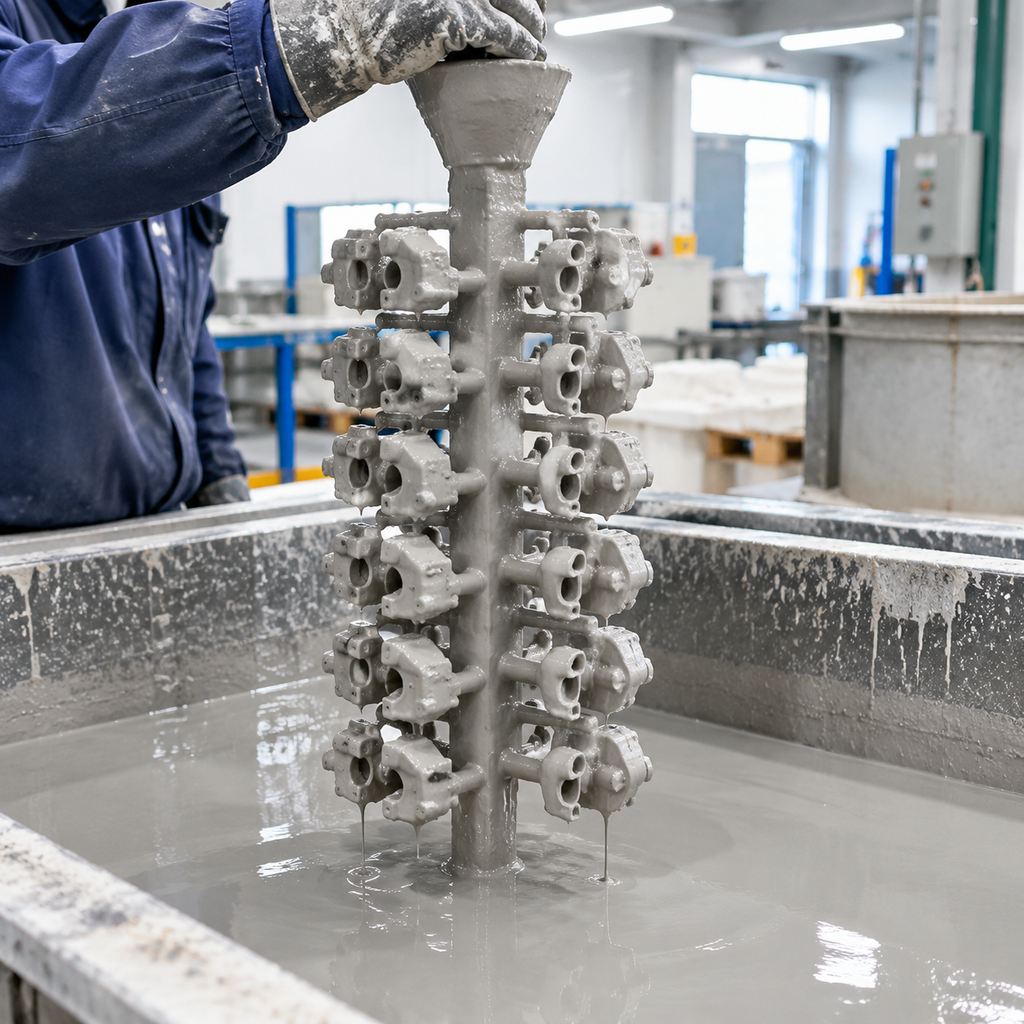
The sequence: a wax pattern is injection-molded in a metal die. That die can be machined and polished to a mirror finish, so the wax comes out smooth. The wax is then dipped repeatedly in ceramic slurry — typically five to nine coats, with progressively coarser stucco on the outer coats and a very fine primary coat against the wax. The shell dries, the wax is melted out in an autoclave, and the shell is fired.
Molten metal now contacts a ceramic face that was formed against a polished wax surface. The result is a dramatically smoother surface.
Where the finish comes from
- Primary slurry particle size. The first coat is typically zircon or fused silica with particle sizes in the 5–15 µm range for fine work. This is the single biggest lever on finish.
- Wax pattern quality. Die surface finish, wax injection pressure, and die temperature all show up in the final part. A scratched wax is a scratched casting.
- Number of coats and stucco grading. Coarse stucco on the backup coats is fine as long as the primary coat is intact. A breach in the primary coat shows up as a rough patch.
- Shell removal. Knockout and blast media matter. Aggressive grit blasting can add 1–2 µm Ra to an otherwise good surface.
Standard investment casting lands at 1.6–3.2 µm Ra. Push it with fine primary slurry, tight wax control, and gentle shell removal and you can hold 0.8–1.6 µm Ra on critical surfaces. That's a surface that often needs no machining at all.
The Cost You Don't See: Machining the Difference Away
Here's where the decision actually gets made. A process comparison on finish is easy. The real question is what it costs you to get from as-cast to your drawing spec.
Say your drawing calls for Ra 3.2 on a sealing face. Two paths:
Path A — Investment cast, as-cast. The part comes out at 2.4 µm Ra. No machining. You inspect and ship.
Path B — Sand cast, then machine. The part comes out at 14 µm Ra. You need a facing operation to remove 0.5–1.0 mm of skin — which also removes the casting skin's porosity, inclusion risk, and any decarburized layer on steel. Fixturing, setup, cycle time, inspection.
Path B isn't automatically wrong. Sometimes it's cheaper overall, especially on large heavy parts where investment casting dies would run six figures. But you need to price it honestly.
What machining actually adds
| Cost element | Typical range | Notes |
|---|---|---|
| Fixture design and build | $150–$400 per unique setup | One-time, amortized over order |
| Facing, 3-axis mill, simple face | $8–$25 per part at 500 pcs | Assumes 0.5–1.0 mm stock removal |
| Multi-axis or sealing-face work | $40–$120 per part | Datum control becomes the cost driver |
| Lapping or superfinishing | $60–$200 per part | For Ra below 0.8 µm |
| Scrap from exposed porosity | 2–8% of lot, sometimes worse | Machining into a gas pocket kills the part |
Run the math on your own order
Take that same 500-piece valve body. Investment cast as-cast at 2.4 µm Ra: no secondary op. Sand cast then face: fixture at $250 one-time, 500 × $15/part for the simplest 3-axis op, plus a 4% scrap rate after machining that exposes subsurface porosity. That's $7,500 in machining, $250 in fixture, plus roughly 20 lost parts at whatever your unit cost is — call it $1,500 at $75/part. Total: over $9,000 in cost the investment quote would have absorbed, plus a six-week delay in the schedule.
On the flip side, run the same numbers on a 25 kg pump housing with a 12.5 µm Ra requirement. Investment dies alone could run $30,000. Sand tooling is $2,500. The house doesn't need machining because the surface spec is loose enough. Sand wins by a mile.
The crossover point
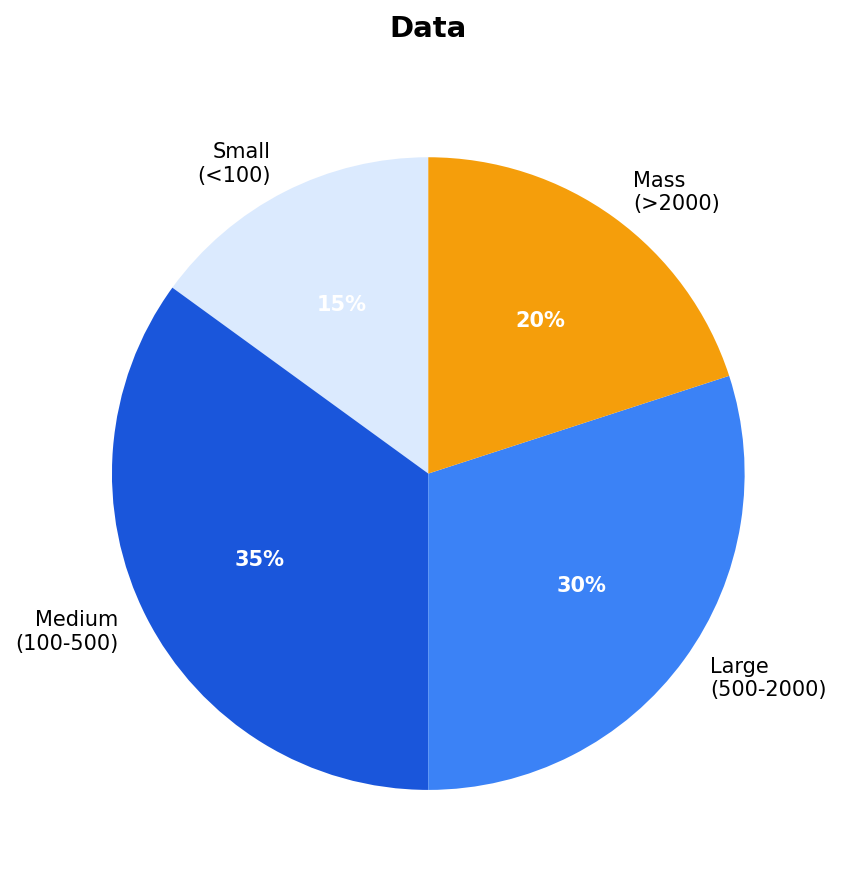
Broadly: below 3.2 µm Ra, investment casting usually wins on total landed cost. Above 6.3 µm Ra, sand casting almost always wins — and it wins big on large parts, because investment casting die costs and shell handling costs scale badly with part size.
Between 3.2 and 6.3 µm Ra it's genuinely close, and the deciding factors aren't finish at all. They're part size, wall thickness, quantity, alloy, and how much dimensional tolerance you need alongside the finish.
Rule of thumb: if your part is under 5 kg, has walls under 6 mm, needs tolerances tighter than ±0.5 mm, and needs finish better than 3.2 µm Ra — go investment and don't look back. If it's over 15 kg with thick walls and a 6.3 µm Ra or looser finish callout — sand is almost always the answer.
Post-Casting Finishing: What Cheaper Than Machining Can Fix
Not every roughness problem needs a cutting tool. There's a middle tier of finishing operations that sit between "as-cast" and "machined," and using the right one can save real money — or quietly ruin a surface if you use it wrong.
| Finishing operation | Typical effect on Ra | Best for | Watch out for |
|---|---|---|---|
| Shot blasting (steel grit) | Removes scale, adds 0.5–2 µm Ra | Cleaning, cosmetic uniformity | Rounds corners, can induce compressive stress but also embeds media |
| Vibratory finishing (ceramic media) | 6.3 → 2.4–3.2 µm Ra on sand castings | Deburring, edge break, blend-out | Rounds edges 0.2–0.5 mm; not for critical sealing edges |
| Bead blasting (glass bead) | Cosmetic uniform matte, may raise Ra slightly | Pre-paint prep, cosmetic parts | Not a finish improvement — it's a finish uniformizer |
| Chemical etching / passivation | Does not lower Ra materially | Stainless corrosion resistance | Will not fix a rough surface and can widen porosity |
| Electropolishing | Cuts 30–50% off Ra on stainless and some alloys | Pharma, food, semiconductor parts | Only works on conductive metals; hard to do selectively |
| Powder coating / e-coat | Adds 25–75 µm of thickness | Cosmetic or corrosion-protective outer skin | Changes dimensions; unsuitable for sealing faces |
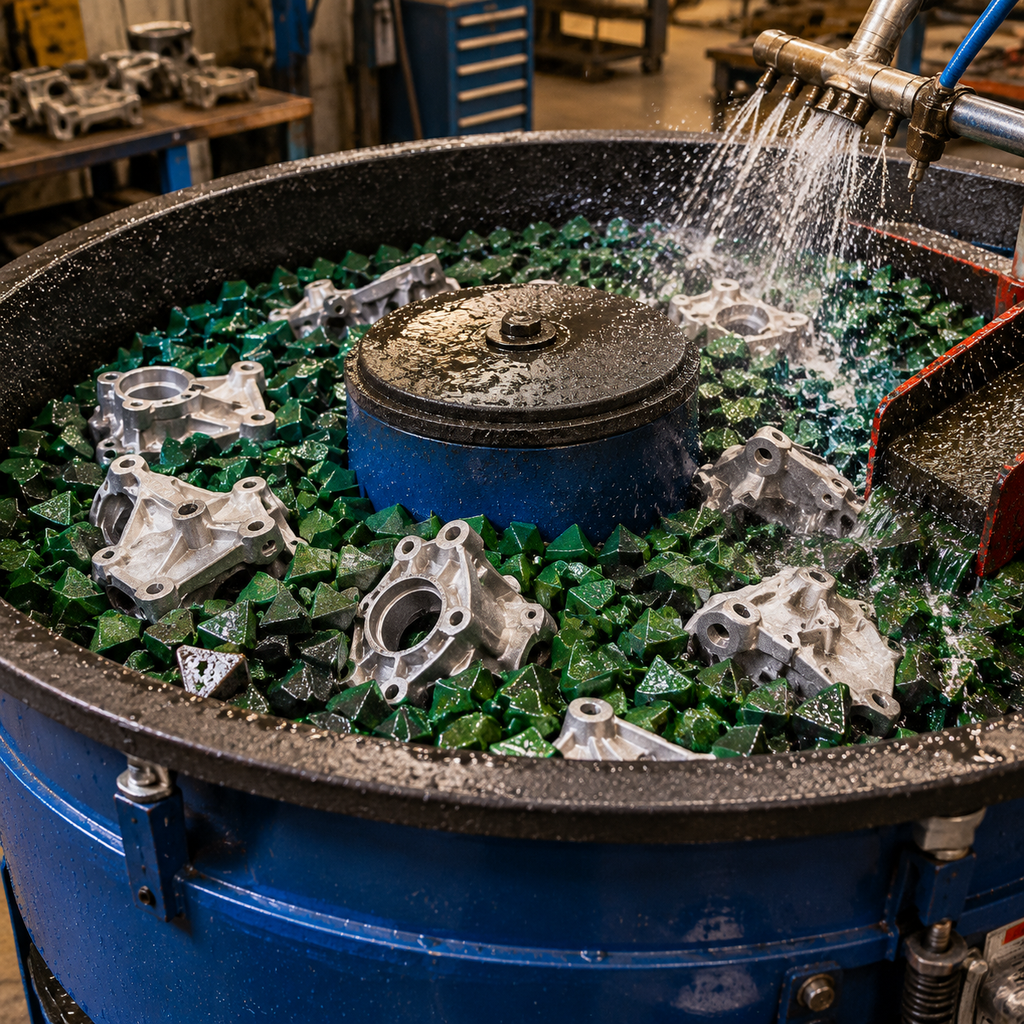
The takeaway: shot blasting and vibratory finishing are great for cleaning up loose surfaces and evening out cosmetic parts. They are not a path to a sealing face at Ra 1.6. If you need tighter than the as-cast range, the answer is either the other casting process or a machining operation — not a bowl of rocks.
What Else Changes With the Process
Finish doesn't travel alone. The same physics that makes sand molds rough also makes them dimensionally loose, and the same wax die that gives you a smooth surface also gives you tight tolerances, thin walls, and zero draft.
| Attribute | Sand casting | Investment casting |
|---|---|---|
| As-cast Ra | 6.3–25 µm | 0.8–3.2 µm |
| Tolerance on 100 mm dim (ISO 8062-3) | ±0.5 to ±1.2 mm (DCTG 9–12) | ±0.13 to ±0.30 mm (DCTG 4–6) |
| Minimum wall | 3 mm aluminum, 4–5 mm steel/iron | 0.8–1.5 mm |
| Draft angle required | 1.5–3° | 0–1° |
| Parting line visibility | Prominent, needs finishing | Minimal, often invisible |
| Typical part weight sweet spot | 1 kg to several tonnes | 1 g to ~50 kg |
| Tooling cost | $800–$12,000 | $3,500–$40,000+ |
| Sample lead time | 10–20 days | 20–35 days |
| Production lead time | 25–45 days | 30–50 days |
Notice the draft angle line. In sand casting, you need 1.5–3° of draft because you're physically pulling a pattern out of a packed sand mold. In investment casting, the wax is melted out — there's nothing to pull. You can have zero draft and even internal undercuts. If your part geometry needs that, the decision is already made for you and finish is just a bonus.
How to Specify Finish So It Actually Holds Up
Most disputes aren't about what the foundry can do. They're about what the drawing actually said. Here's what to put on the drawing and in the PO.
1. Name the standard and the unit
Write Ra 3.2 µm per ISO 21920-2, or Ra 125 µin per ASME B46.1. Not "smooth." Not "125 RMS" with no unit. Not "Ra 3.2" with no unit at all — that one has caused real arguments, because 3.2 µm and 3.2 µin are different worlds.
If you must use RMS, convert properly. RMS is roughly 1.11 × Ra for a sinusoidal profile. So "125 RMS" and "3.2 µm Ra" — the pairing the whole industry treats as interchangeable — are off by about 11% mathematically. Most shops ignore this. Some don't. Don't leave it to chance.
2. Specify the cutoff length
This is the mistake almost nobody catches. Ra is a filtered measurement. ISO 21920-2 sets the cutoff: 0.8 mm for Ra 0.1–2 µm, 2.5 mm for Ra 2–10 µm, 8 mm for Ra 10–80 µm.
Measure a 14 µm Ra sand casting with a 0.8 mm cutoff instead of 2.5 mm and you'll get a materially different number. If the foundry and your incoming inspection use different cutoffs, you'll have a fight that neither side can win — because both readings are correct for the setup used.
Write the cutoff on the drawing. It takes ten seconds.
3. Mark which surfaces actually matter
Don't apply a global finish callout to the whole part. A sand casting with a global "Ra 3.2" note means every surface gets machined, and you've just doubled your cost for no reason. Use surface finish symbols on the specific faces that need them and leave the rest as-cast.
Ask yourself per surface: does anything touch it, seal against it, slide on it, or get inspected visually? If no, leave it rough.
4. Agree the measurement method before you cut the PO
- Instrument: stylus profilometer (contact) or optical? They disagree on textured surfaces.
- Traverse direction: roughness is anisotropic on machined faces. Specify the direction relative to the lay.
- Number of traces: one trace on one part is not a lot acceptance test. Agree a sampling plan — typically 3 traces on 3 parts per lot.
- Who measures: foundry, third-party lab, or your incoming inspection? If it's a third party, budget for it upfront.
5. Put the process on the PO
The quote should name the process explicitly — "green sand," "shell mold," "lost wax investment" — and state the as-cast Ra range the foundry is committing to. If the quote just says "casting," you're one change order away from a surprise. This is the single cheapest insurance policy in the whole transaction.
Common Mistakes to Avoid
Taking the low quote without checking the process. A sand casting quote against an investment casting drawing isn't a better price. It's a different product. Always ask which process the quote assumes, and put it in writing.
Believing "we can polish it." Hand polishing to 1.6 µm Ra across 500 parts is a labor estimate nobody honors. If your spec requires hand work, get a per-part price and a sample before volume.
Ignoring what machining exposes. Cutting 1 mm off a sand casting opens up subsurface porosity. Parts that passed visual inspection as-cast fail after machining. Your scrap rate on machined castings is always higher than your scrap rate on as-cast parts, and the quote should reflect that.
Assuming investment casting means no machining ever. It doesn't. Threads, bores, and sealing faces still get machined. Investment casting reduces the machining envelope — it doesn't eliminate it.
Comparing RMS to Ra without converting. Covered above, but it deserves repeating. Write the unit.
Treating shot blasting or vibratory finishing as a shortcut to a tighter spec. They clean up surfaces and even out cosmetics. They do not create sealing faces. If your callout is 1.6 µm Ra, these operations won't get you there — they'll just cost you a week and hand you a rounder edge.
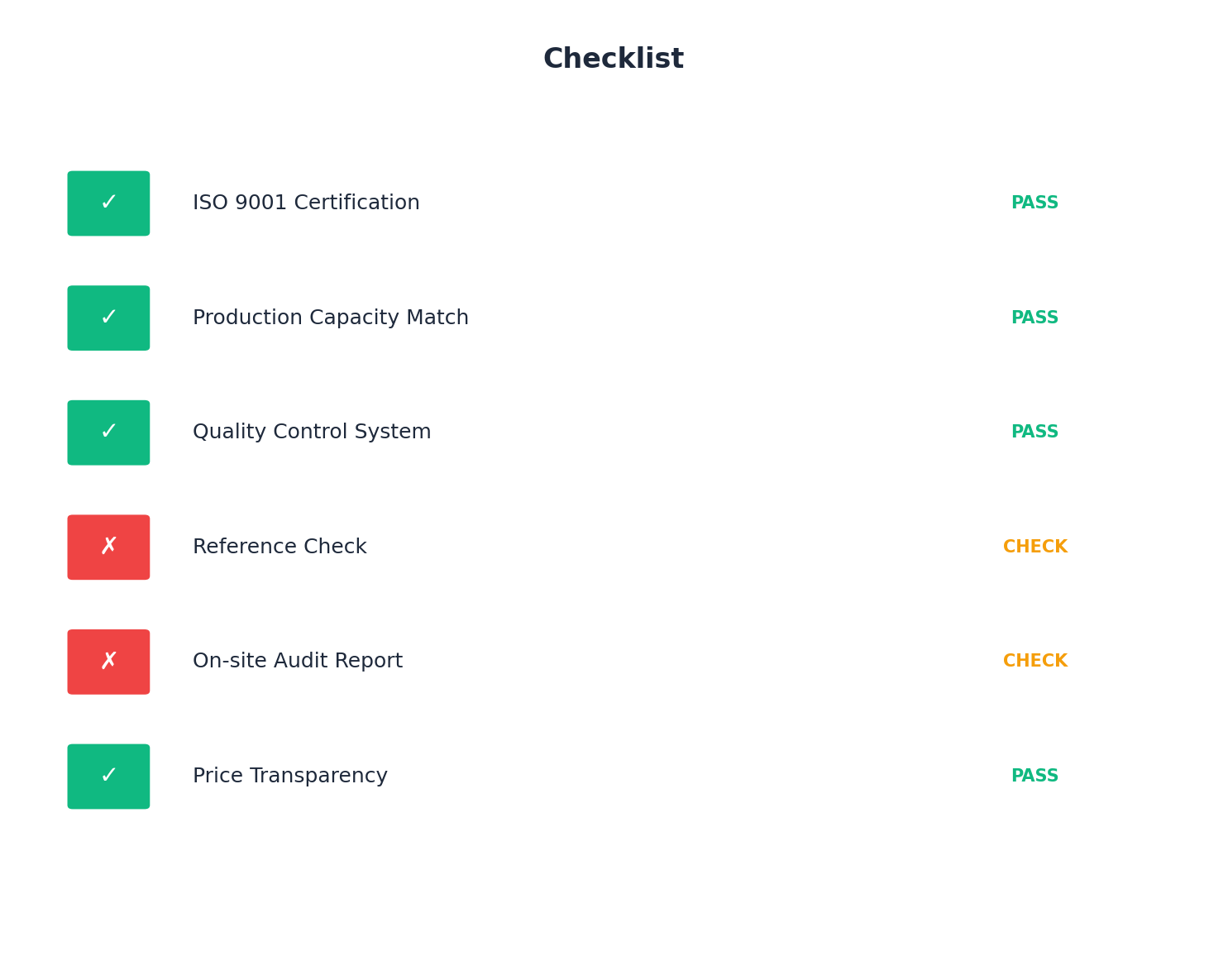
Skipping the first article on finish. Get a first article with actual Ra traces from the foundry's own measurement, before you approve volume. Not a comparator photo. Traces, with the cutoff noted.
FAQ
What is the typical surface finish of sand casting?
Green sand produces 12.5–25 µm Ra. Resin-bonded no-bake improves to 6.3–12.5 µm Ra. Shell molding — still a sand-based process — reaches 3.2–6.3 µm Ra. Below 3.2 µm Ra, you're machining.
What surface finish does investment casting achieve as-cast?
Standard lost-wax investment casting delivers 1.6–3.2 µm Ra. With fine primary slurry, tight wax control, and gentle shell removal, 0.8–1.6 µm Ra is realistic on critical surfaces.
Can I get Ra 1.6 from a sand casting without machining?
No. The mold wall is bonded sand grains, and that texture transfers to the metal. Even shell molding bottoms out around 3.2 µm Ra in production. Plan for secondary operations if you need better.
Can shot blasting or vibratory finishing replace machining for surface finish?
No. Shot blasting removes scale but can add 0.5–2 µm Ra when run aggressively. Vibratory finishing with the right media can take a shell-molded sand casting from 6.3 down to roughly 3.2 µm Ra, but it won't hold tighter than that on cast surfaces and it rounds edges 0.2–0.5 mm. Use them to clean up and uniformize — not to hit a critical sealing spec.
Why do suppliers argue about RMS versus Ra?
They're different statistics — RMS is roughly 1.11 × Ra for a sinusoidal profile. The industry shorthand treating 125 RMS and 3.2 µm Ra as identical is off by about 11%. Specify the unit and the standard and the argument goes away.
How much does machining a rough casting to 3.2 µm Ra cost?
Budget $8–$25 per part for simple faces at 500-piece volume, and $40–$120 per part once you add multi-axis setups or sealing faces. Fixtures add $150–$400 per unique setup. On 500 parts, the swing is often $15,000–$50,000.
Next Steps
Before you send that RFQ, do three things.
First, mark your drawing with per-surface finish callouts, the standard reference, and the cutoff length. If you only fix one thing from this article, fix that.
Second, decide the process based on finish plus weight plus tolerance — not price alone. Under 5 kg with a tight finish and tight tolerances points to investment. Over 15 kg with a 6.3 µm Ra callout points to sand.
Third, get the first article with real Ra traces before you approve volume production. A comparator photo isn't a measurement.
Get your drawing reviewed before you cut the PO
Upload your drawing and target finish callout. Get matched with vetted foundries that run the process your part actually needs — sand, shell, or investment — and receive quotes that state the process, the as-cast Ra, and the machining scope in writing.
Surface finish values in this article are production-realistic ranges for general commercial work. Actual results vary by alloy, part geometry, wall thickness, foundry equipment, and mold material. Always confirm capability with a first article before committing to volume.