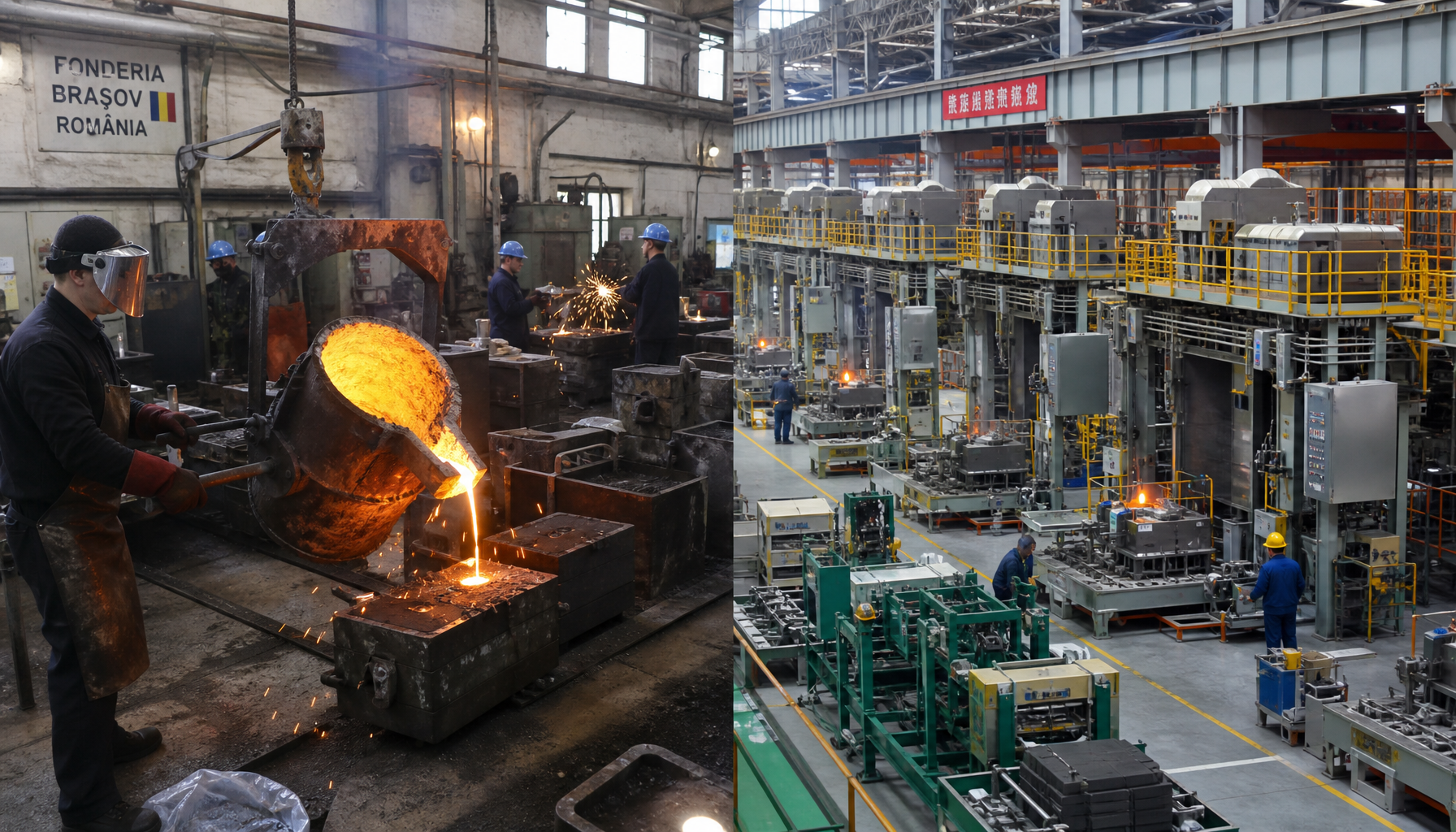
Short answer: a Chinese foundry's ex-works piece price for mid-volume iron and aluminium castings runs 25–55% below a Romanian shop's. On landed cost that gap narrows to roughly 10–30% — and it flips the other way below about 150–400 pieces a year, depending on how heavy the part is. The number that decides the award is never the headline price. It is the nine-line equation underneath it.
You signed the PO with a Romanian foundry in early 2025. The pitch was clean: EU member, no import duty, 6-day truck instead of 6-week boat, EUR invoicing, and a sales engineer who answered emails in four hours. The quote came in at €3.10/kg for a 22 kg grey iron housing.
Your old Chinese supplier had been at $1.52/kg FOB Ningbo.
Eighteen months later the spreadsheet looks different. Tooling came in 40% above the verbal estimate. Two pattern changes ran to €6,400 because nobody quoted them upfront. The "6-day delivery" turned out to be 6 days once the castings left the yard — after a 9-week production slot. And the second batch arrived with 6% porosity that nobody caught until the machining line stalled.
None of this means Romania was the wrong call. It means you were comparing the wrong numbers. A foundry quote is not a price. It is one line of a nine-line landed cost equation, and the two countries put their weight on completely different lines.
What actually changed between 2023 and 2026
Three shifts moved the goalposts, and most buyers are still working off 2022 assumptions.
Freight normalised, then didn't. The 2021 container madness is over, but rates are volatile in a way they weren't a decade ago. Red Sea routing alone added 10–14 days and roughly 30–60% to Asia–Europe container rates in 2024. It has settled somewhat since, but you should plan with a range, not a point estimate.
European energy costs restructured. Romania's industrial electricity sits in the region of €0.15–0.20/kWh in 2026 planning scenarios — well above Chinese industrial rates of roughly €0.075–0.10/kWh. Melting is the single largest energy input in a ferrous foundry. That gap shows up directly in the euro-per-kilo number, and it is not going away.
CBAM went live. The EU's Carbon Border Adjustment Mechanism moved into its definitive regime on 1 January 2026. Iron, steel and aluminium products — including most castings — now carry an embedded-carbon cost at the EU border. In 2026 the charge is small. By 2034 it isn't. More on that below.
Why the euro-per-kilo number is a lie
When a Romanian foundry quotes €3.10/kg and a Chinese foundry quotes $1.52/kg, you are not comparing the same thing. You are comparing one ex-works conversion price against another ex-works conversion price, and then importing an entire supply chain around both of them.
Here's what sits outside both numbers:
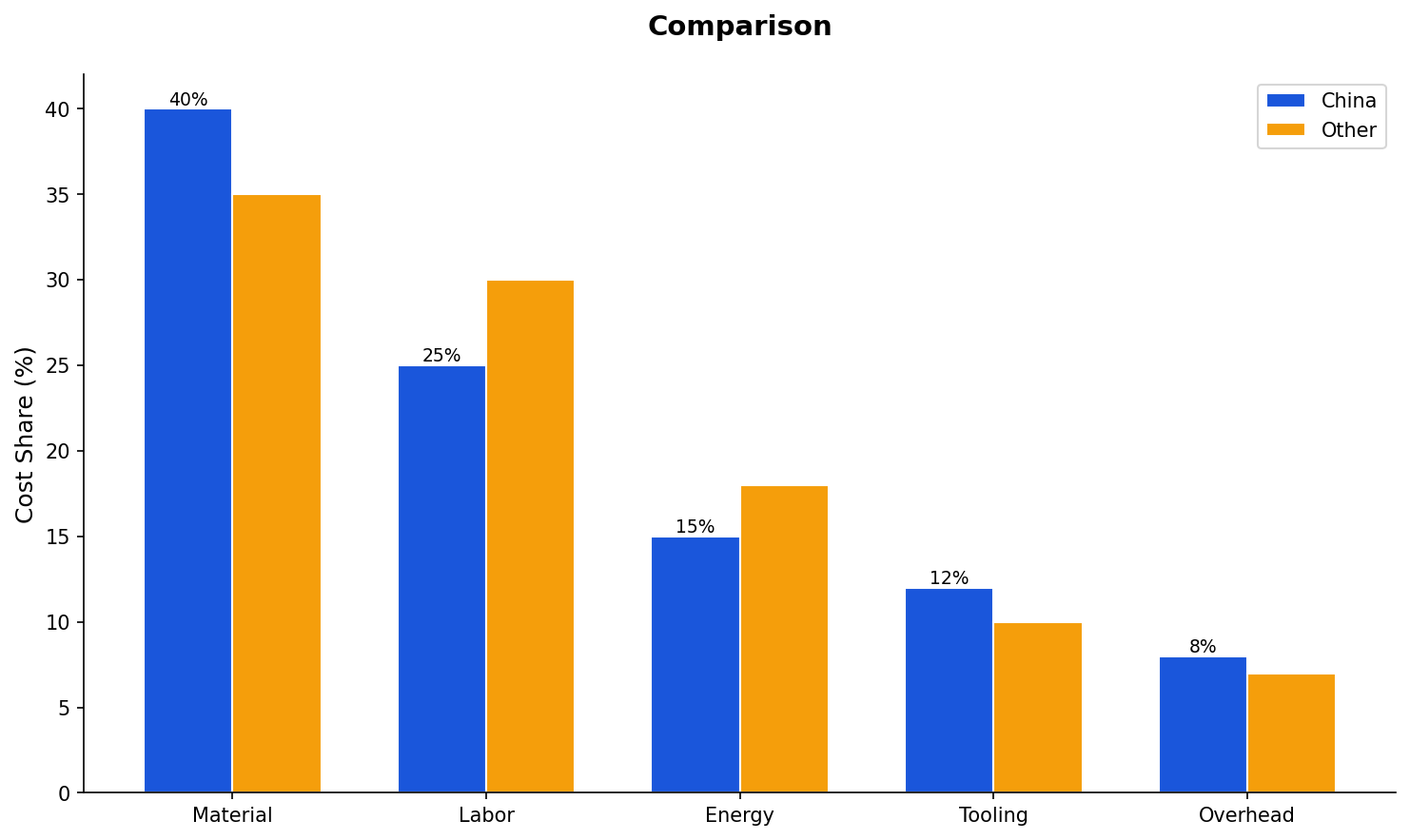
- Tooling and patterns — a one-off, amortised over a program life nobody has defined
- Packaging — returnable steel stillages for a Romanian truck, one-way export crates for a Chinese container
- Inland logistics both ends — the foundry-to-port leg is often not in the FOB number
- Main freight — road from Timișoara, sea from Ningbo
- Duty and trade measures — MFN rates plus whatever anti-dumping measures are active for your HS code
- CBAM certificates — new in 2026, scaling through 2034
- Capital in transit — 40–55 days of your cash sitting on a ship
- Quality escape cost — the rework, sort, and line-down cost of a bad batch
- Engineering change cost — multiplied by how far away the pattern shop is
If your comparison stops at line one, you will draw the wrong conclusion roughly half the time. Usually in favour of China on price — and occasionally in favour of Romania on process, when the real numbers say the opposite.
Piece price head-to-head, 2026
These are planning ranges drawn from typical quotes for European buyers across 2025–2026. Treat them as ballparks for building a model, not as a quotation. Actual prices swing hard on geometry, core complexity, tolerance and volume — expect ±15% on any single line.
| Material / part type | Romania | China | Gap |
|---|---|---|---|
| Grey iron, 10–50 kg, 200 pcs/yr | 2.40 – 3.60 | 1.30 – 1.90 | 35 – 48% |
| Ductile iron, 5–30 kg, 500 pcs/yr | 2.60 – 3.90 | 1.40 – 2.00 | 33 – 46% |
| Aluminium gravity die, 2–10 kg, 1,000 pcs/yr | 4.20 – 6.00 | 2.60 – 3.60 | 35 – 42% |
| Aluminium high-pressure die casting, 1–5 kg, 5,000+ pcs/yr | 3.80 – 5.40 | 2.10 – 3.00 | 40 – 48% |
| Small jobbing part, under 3 kg, 50 pcs/yr | 6.50 – 11.00 | Not economical | — |
Two things jump out. First, the piece price gap is enormous and consistent — 35–48% across every category. Second, that gap is the only line where China wins as decisively as this. Everything after it narrows the picture.
Also note the last row. Under roughly 3 kg and under 100 pieces a year, a Chinese foundry will either decline, quote a silly minimum, or accept the order and lose money on it while your tooling sits idle for eleven months. Small jobbing work is a Romanian and Turkish speciality, and no amount of cost modelling changes that.
Landed cost: where the gap collapses
Now add the things that sit between the foundry gate and your receiving dock.
Freight
Castings are heavy and dense, which is actually good news for sea freight. A 20ft container will hold 20–25 tonnes of iron castings — you will hit the weight limit long before you run out of space. Filled properly, sea freight from a Chinese port to Constanța, Hamburg or Rotterdam adds roughly €0.08–0.18/kg in 2026 conditions.
The catch is that you rarely fill a container with one part number. A 200-piece order of a 22 kg housing is 4.4 tonnes. That's LCL territory, and LCL rates for dense cargo run €0.30–0.60/kg effective once you add terminal handling and consolidation. Suddenly your 4.4 tonne shipment carries €1,300–2,600 of freight instead of €400.
Romanian road freight to Germany, Austria or Northern Italy runs roughly €1,200–1,800 for a full 24-tonne truck. Fully loaded, that is €0.05–0.075/kg. Half-loaded, it doubles — but you're still at half a day's transit, not six weeks.
Duty and trade measures
MFN duty on iron and aluminium castings into the EU typically falls in the 0–6% band depending on the exact HS code and whether the part is classified as a casting or a finished article. That is manageable.
What is not manageable is ignoring anti-dumping and countervailing measures. The EU has had duties on certain Chinese iron and steel articles — including some cast iron products — for years, and the list changes. Check TARIC against your exact ten-digit code before you model anything. A 30% anti-dumping duty turns a good quote into a disaster.
CBAM — small in 2026, structural by 2034
This is the line most buyers get wrong, in both directions.
CBAM's definitive regime started 1 January 2026. Importers of covered goods — iron, steel, aluminium and others — must surrender CBAM certificates for embedded emissions. The CBAM factor, which determines what share of embedded emissions you actually pay for, ramps like this:
| Year | 2026 | 2028 | 2030 | 2032 | 2034 |
|---|---|---|---|---|---|
| CBAM factor | 2.5% | 10% | 48.5% | 73.5% | 100% |
Run the math on a 1 tonne casting with roughly 2 tCO₂ of embedded emissions, at an ETS price around €80/tonne. In 2026 you pay 2 × 80 × 2.5% = €4 per tonne. That's €0.004/kg. A rounding error. Anyone telling you CBAM kills Chinese castings in 2026 is selling something.
By 2030 the same casting carries 2 × 80 × 48.5% = €78 per tonne, or €0.078/kg. By 2034 it's €160 per tonne — €0.16/kg. On a €1.60/kg part, that is a 10% permanent cost increase, and it will keep climbing because Chinese foundry emissions intensity is higher than a gas-fired European shop's.
The honest read: model CBAM as a slowly compounding tariff, not a cliff. If you are signing a five-year program in 2026, you need to know what your landed cost looks like in 2031, not just this year. Also check the 50-tonne annual importer de minimis threshold — if your total CBAM-covered imports sit under it, you're out of scope entirely.
Run the actual numbers
Take a 22 kg grey iron housing, 200 pieces a year — 4.4 tonnes. Not a hypothetical; this is the exact profile where buyers get it wrong most often.
| Line | Romania | China |
|---|---|---|
| Piece price | €3.00/kg → €13,200 | €1.60/kg → €7,040 |
| Tooling (one-off, year 1) | €14,000 | €5,500 |
| Packaging | €600 (returnable) | €900 (export crates) |
| Freight to your dock | €700 (part truck) | €1,700 (LCL) |
| Duty (assume 2%) | €0 | €141 |
| CBAM 2026 | €0 | €18 |
| Year 1 total | €28,500 | €15,299 |
| Year 2+ total | €14,500 | €9,799 |
China wins. It wins on year one by 46%, and on steady-state years by 32%. That is the reality, and no amount of nearshoring enthusiasm changes it.
But now add the lines that never make it onto a comparison sheet:
- Capital in transit. €9,799 of goods averaging 45 days at sea plus 30 days safety stock, at 7% cost of capital: roughly €145/year. Small.
- Quality escape. If your Chinese supplier ships a 5% porosity rate on one batch in five years, and the sort plus line interruption costs €9,000, that's €1,800/year amortised. A Romanian foundry 8 hours away sends a technician.
- Engineering change. Two pattern modifications a year at €1,200 each, plus a 4-week airfreight sample cycle versus a 10-day truck cycle. The Chinese route typically costs 2–3× per change once you count travel, samples and programme delay.
- Working capital and flexibility. A Romanian foundry will often run 30-day terms and take a 60-piece call-off against a blanket order. A Chinese foundry wants 30% deposit and a defined MOQ.
Realistically, the fully-loaded gap narrows to something in the 15–28% range once the programme matures. Still a China win on this part — but half the size the piece price suggested, and with a different risk profile attached.
Tooling and the amortisation trap
Tooling is where the Romania-vs-China comparison most often breaks, because buyers amortise it over a program life they invent on the spot.
A pattern plate and core boxes for a 22 kg jobbing iron part: roughly €8,000–20,000 in Romania, €3,000–9,000 in China. For an aluminium HPDC die on a mid-size part: €25,000–60,000 in Romania, €10,000–25,000 in China. The tooling gap is often bigger, in percentage terms, than the piece price gap itself.
Two rules that save real money:
Amortise over realistic volume, not optimistic volume. If the program might run 3 years at 200 pieces, amortise over 500 pieces total, not over 2,000 because someone hoped for a ramp. And if the program dies at year one, that tooling cost is gone either way — treat it as a sunk risk in your NPV, not a per-piece number that vanishes when the program does.
Tooling does not transfer cleanly between countries. A pattern built for a Romanian hand-moulding line with a particular flask size will need modification — sometimes full replacement — to run on an automated Chinese line with a different moulding box and core-setting setup. If your plan is "start in Romania, move to China when volumes rise," budget 40–70% of the original tooling cost for the transition. If your plan is the reverse, the same applies.
Where the break-even actually sits
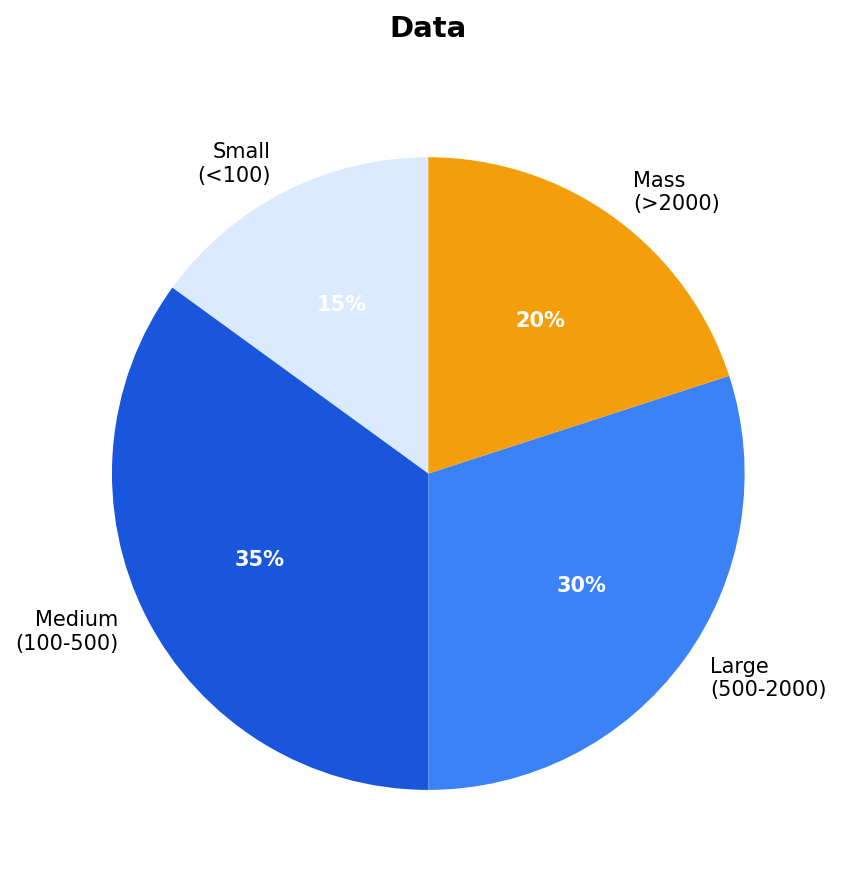
For general engineering castings in the 5–30 kg range, the crossover usually falls in the 150–400 pieces per year band, once tooling is amortised over a realistic three-year life and freight is priced honestly. Below that, Romania generally wins on total cost. Above it, China usually wins and keeps winning as volume climbs.
But the crossover moves dramatically with part weight:
- Heavy parts (30 kg+): crossover drops to 80–150 pcs/yr because a container fills fast and freight per kilo collapses. China wins earlier.
- Light parts (under 5 kg): crossover climbs above 1,000 pcs/yr because you're shipping air and cardboard as much as metal. Romania holds the advantage much longer.
- High scrap-rate parts: crossover climbs. Chinese foundries typically quote yield assumptions; if the actual scrap rate on a complex cored part runs 8% instead of 3%, the effective price rises 5% and the freight on rework shipments eats more.
Where Romania genuinely wins
Not as a consolation prize. These are structural advantages that no Chinese cost structure erases.
Lead time and the feedback loop. A Romanian foundry 900 km away can ship a sample in a week and have an engineer on your shop floor in two days. That matters enormously for first-article approvals, design iterations and any part where your customer keeps moving the goalposts. A 6-week sea transit plus 2 weeks of production means every change costs you two months of program time.
Low volumes and jobbing work. Hand-moulded and small-batch production is a real Romanian strength. Under 100 pieces a year, or for service and spare parts with unpredictable demand, a Romanian shop will take the order and hold the pattern indefinitely. A Chinese foundry will not.
Cash flow and payment terms. EU-to-EU transactions run on 30–60 day terms with clean VAT treatment. Chinese sourcing usually means 30% deposit, balance against B/L, plus the working capital locked in 45 days of transit and 30 days of safety stock. On a €100,000 annual spend that's €15,000–20,000 sitting in the pipeline.
Documentation and origin. If your customer needs an EU-origin declaration, a Romanian casting melted and poured in Romania gets it. Chinese castings cannot, no matter what the invoice says. Check where the melt actually happens — some Romanian-sounding suppliers broker work to Moldova, Serbia or Turkey, and origin follows the melt.
Electricity price exposure cuts both ways. Romanian foundries are exposed to European energy prices, which is a headwind. But so are their competitors, and EU ETS free allocation phase-out hits European producers too. Expect Romanian piece prices to drift upward 3–6% a year through 2030.
Where China genuinely wins
Scale and melting efficiency. A Chinese foundry running three shifts on an automated line spreads furnace and overhead costs across ten times the tonnage. That's where a large part of the 35–48% gap comes from, and it's structural.
Tooling cost and speed. Chinese pattern shops and die makers are simply cheaper and often faster. For aluminium HPDC especially, the die cost difference alone can fund a year of freight.
Complexity at volume. Thin walls, complex cores, tight dimensional tolerances, extensive secondary machining — Chinese foundries with vertical integration handle these better and cheaper once volume justifies the setup.
Secondary operations. Machining, heat treatment, shot blasting, coating, assembly and kitting under one roof. A Romanian jobbing shop will almost always sub out the machining, which adds a margin, a truck leg and a coordination risk.
The 9-line landed cost model
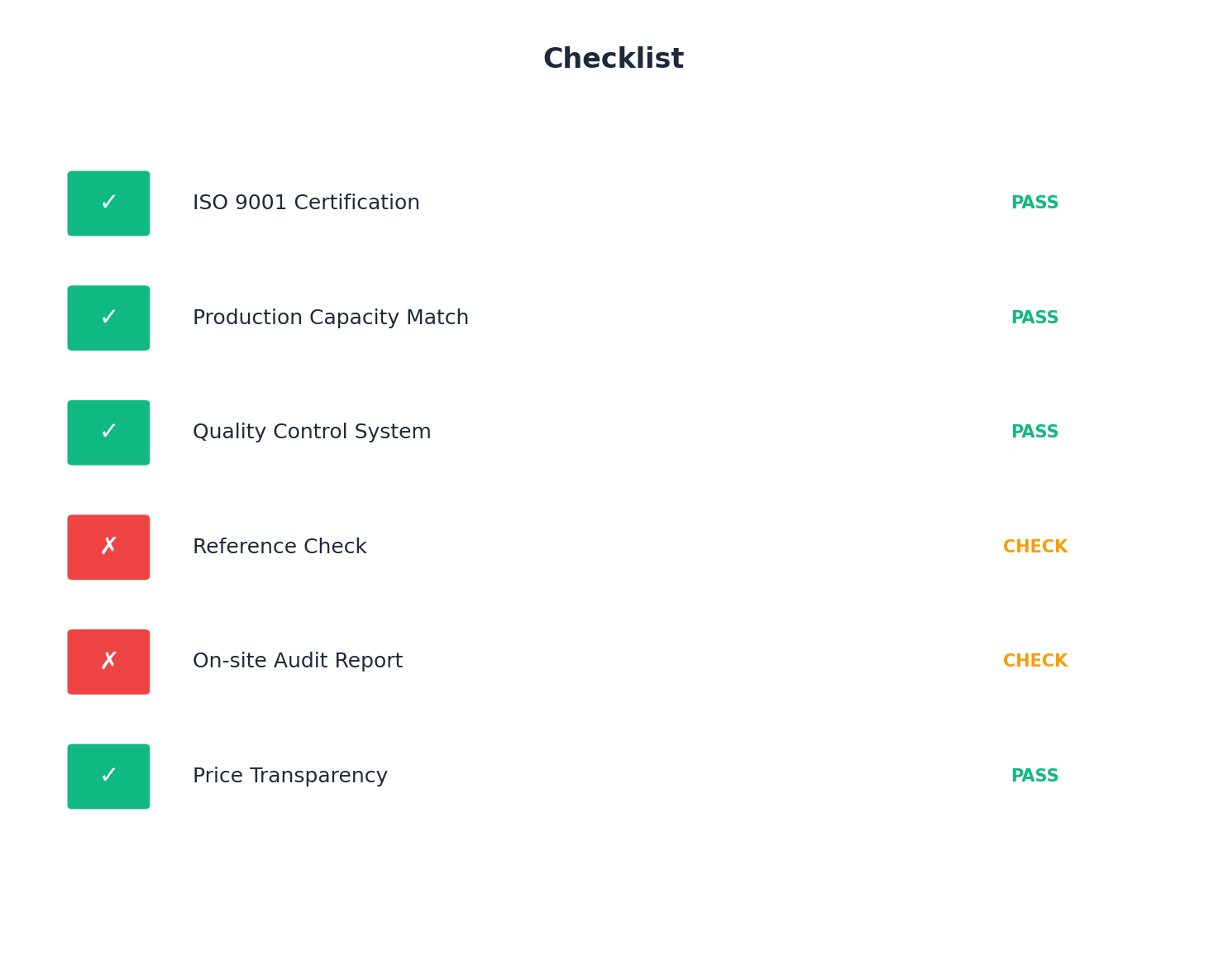
Build this in a spreadsheet and stop arguing about the headline price. One column per supplier, one row per line, same period, same volume assumption. If you want a starting structure rather than a blank sheet, our landed cost templates use exactly these nine lines.
- Piece price ex-works — in the same currency, converted at a rate you'll lock or hedge, not at today's spot.
- Tooling amortisation — total tooling divided by realistic lifetime volume, plus a 40–70% transition cost if you might move countries.
- Packaging — returnable stillages are cheaper per cycle but need a return loop; export crates are one-way and go in the bin.
- Inland freight both ends — foundry to port, port to your dock. Ask specifically whether the FOB price includes the inland leg to the port. It usually doesn't.
- Main freight — per kilo of actual shipment weight, at the fill rate you'll actually achieve, not full-container rates you'll never hit.
- Duty and trade measures — your ten-digit code, checked in TARIC, including any anti-dumping or countervailing measures currently in force.
- CBAM — embedded emissions × the CBAM factor for each year of the program, not just year one. This is a five-year line.
- Capital in transit and safety stock — days of pipeline × your cost of capital. Add 20 days of buffer stock you'd never hold with a domestic supplier.
- Quality escape and engineering change — historical defect rate × cost per escape, plus expected changes per year × cost per change (including travel, samples and programme delay).
Fill that in honestly and you'll find the same thing almost every buyer finds: China wins on a number, Romania sometimes wins on a total, and which one wins depends on volume, weight, and how much your business can tolerate a six-week feedback loop.
Five mistakes that cost real money
1. Comparing ex-works to delivered
Every year, buyers put a Romanian ex-works price next to a Chinese FOB price and call it a comparison. Those are two different points in the supply chain. Get both to DAP-your-dock before you put them in the same column.
2. Ignoring anti-dumping measures on your exact HS code
MFN duty of 2% is a nuisance. A 35% anti-dumping duty is a program-killer. The measures on Chinese iron and steel articles have been revised repeatedly, and whether they apply depends on the exact product and code. Verify in TARIC — the EU's own database — before you sign anything, and put the duty responsibility clause in the contract explicitly.
3. Assuming "Romania" means "EU origin"
Some suppliers quoting from Romania are brokers. The casting is melted in Moldova, Serbia or Turkey and finished in Romania. Origin follows where the melt and pour happen, not where the invoice is issued.
Ask for the melt location in writing, get it into the supply agreement, and run the supplier through a foundry verification checklist before you commit tooling money. Two questions do most of the work: which plant melts and pours the metal, and can you visit it. A supplier who can't answer the first one in a sentence is a trading company.
4. Model CBAM as a 2026 problem
In 2026 the CBAM factor is 2.5% and the charge is negligible. By 2030 it's 48.5%, and by 2034 it's 100%. If you're signing a multi-year program, the number that matters is the one in the middle of the program, not the first shipment. Build the ramp into your model and your negotiation.
5. Forgetting that the pattern belongs to you
Whatever you decide, make sure the contract states that tooling, patterns, core boxes and CAD data are your property, are marked as yours, and can be retrieved on request. Buyers who skip this clause have lost €20,000 of tooling to a supplier dispute more often than anyone admits. It applies in Romania and China equally.
How to run this in one afternoon
You don't need a consulting project. You need two quotes on identical terms and ninety minutes with a spreadsheet.
- Send both foundries the same drawing, the same annual volume, the same Incoterm target (DAP your dock) and the same payment terms you actually want. Not FOB this and ex-works that.
- Ask each for tooling as a separate line item, with a breakdown of pattern, core boxes, gauges and first-article inspection.
- Ask each for the melt location, in writing.
- Look up your ten-digit HS code in TARIC. Note the MFN rate and any trade measures.
- Get one real freight quote for your actual shipment weight — LCL if you're under 15 tonnes, FCL if you're above it. Don't use last year's number.
- Fill in the nine lines. Convert everything to one currency at a rate you'd actually accept.
- Decide on total, then sanity-check the decision against lead time and change frequency. Sometimes the cheaper total is still the wrong supplier.
FAQ
Is casting cheaper in China than Romania in 2026?
On piece price, yes — typically 25–55% lower for mid-volume iron and aluminium castings, and the gap is widest on aluminium high-pressure die casting. On fully landed cost the gap narrows to roughly 10–30%, and it disappears entirely below about 150 pieces a year for general engineering parts.
Does CBAM apply to castings imported from China?
Yes. Iron, steel and aluminium products are covered, and most castings fall inside those categories. In 2026 the CBAM factor is only 2.5%, so the charge is small — a few euros per tonne. The reason to model it is the ramp: 48.5% by 2030 and 100% by 2034. Check the 50-tonne annual importer de minimis threshold too; if your total covered imports sit below it, you're exempt.
What is the minimum order at a Romanian foundry?
Hand-moulded jobbing shops will strike a pattern plate for 20–50 pieces, and will often hold the pattern for years. Automated moulding lines typically want 500 pieces or a full shift of production. If you need 60 pieces a year of a 15 kg part, you are a jobbing customer, not an automated-line customer, and you should be talking to Romanian or Turkish shops, not Chinese ones.
How much does freight add per kilo from China?
Castings are dense, so a fully loaded 20ft container holding 20–25 tonnes adds roughly €0.08–0.18/kg at 2026 rate levels. Part-loads and LCL shipments run €0.30–0.60/kg effective. Road freight from Romania to Central Europe adds only €0.05–0.075/kg on a full truck, which is why Romania's advantage grows for heavy, low-volume parts.
Can I split the sourcing — prototype in Romania, production in China?
You can, and it's often the right answer. Budget 40–70% of the original tooling cost for the transition, keep the CAD and pattern ownership airtight in both contracts, and plan for a first-article approval cycle at the new supplier. Buyers who plan the transition upfront spend far less than those who discover mid-program that the pattern doesn't fit the new moulding box.
Next steps
Before your next RFQ goes out, do two things. Run the nine-line model on the quotes you already have — you'll probably find the gap is narrower or wider than you assumed, in a direction you didn't expect. If you're still building the sourcing shortlist itself, start with our casting sourcing guides before you send drawings anywhere.
Then send the same drawing to both a Romanian and a Chinese foundry on identical Incoterms and identical volume assumptions, and see what a real comparison looks like.
If you want a second pair of eyes on the maths, submit both quotes — Romanian and Chinese, with Incoterms and annual volume stated — and get a line-by-line landed cost comparison back, covering freight, duty, CBAM, tooling amortisation and quality risk, side by side.
Need Help with Romania Foundry vs China Casting Cost: 2026 Buyer Numbers?
Get matched with 3 verified foundries in 24 hours. No markup, transparent pricing.
Request Quotes →