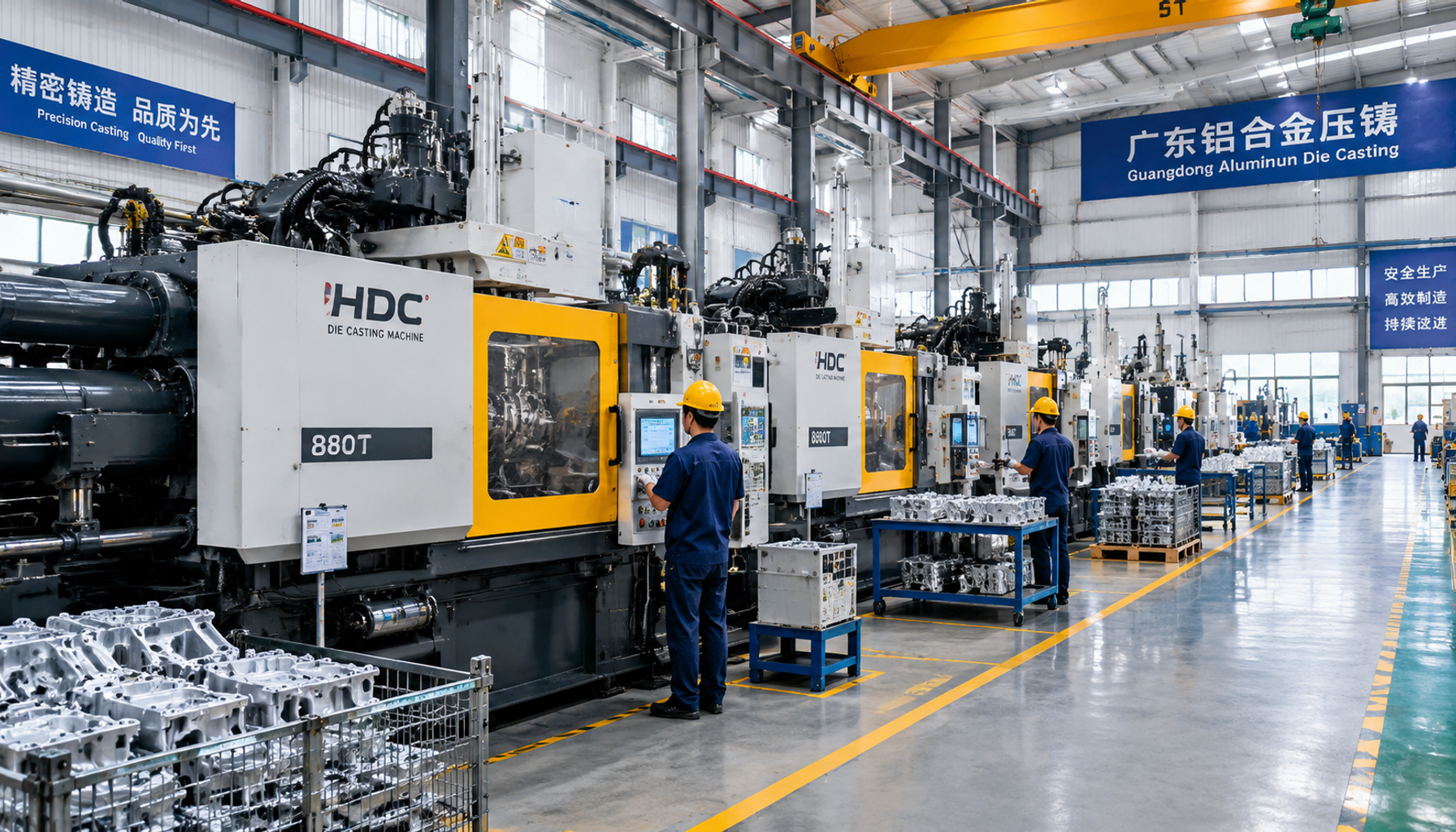
China pours more than 50 million tonnes of castings a year. Shandong province alone has over 1,200 ISO-certified foundries, and if you send a request for quotation on Monday, you'll have a dozen replies by Tuesday afternoon—often with prices that differ by 300%.
That spread isn't competition. It's information asymmetry. Someone is quoting a real number, and someone else is quoting a number they plan to renegotiate after you've paid the tooling deposit.
You can't inspect your way out of every bad decision, but you can catch the obvious traps before money leaves your account. Here are seven red flags that show up again and again in Chinese casting sourcing—what each one actually looks like on the ground, and how to verify it in under a week.
Red flag #1: The alloy changes between quote and delivery
Your drawing says A356-T6. The quote says A356-T6. The invoice says A356-T6. The part in the crate is something else—usually a cheaper secondary alloy with higher iron content, poured because scrap was cheap that week.
This is the single most common substitution in Chinese casting sourcing, and it's also the hardest to catch after the fact. A356 and its cheaper cousins look identical coming out of the shakeout. The difference shows up three months later when your machined part starts developing porosity under load, or when the anodized finish comes out blotchy because the silicon ratio drifted.
For reference, when your drawing specifies A356-T6, you're invoking ASTM B26/B26M (sand casting) or ASTM B108/B108M (permanent mold), with the chemistry limits locked in EN 1706 or the equivalent GB/T 1173 grade ZL101A. The T6 condition itself is defined by heat-treatment parameters in ASTM B917 or AMS 2771. Any quote that doesn't acknowledge these standards at spec time is a quote that will treat them as optional at pour time.
Watch for these signals in the quotation stage:
- The quote lists "aluminum alloy" or "ADC12 equivalent" without a designation. A supplier who won't name the grade before the order isn't committing to one. Note that "ADC12 equivalent" is often a cover term for whatever they poured last week.
- They ask if you'll accept "similar material" if the specified grade is out of stock. Translation: they plan to substitute and want cover in writing.
- The material cert arrives as a PDF with a generic letterhead. Real mill certs carry heat numbers that trace back to a specific melt batch.
- They can't tell you what spectrometer model stands behind the cert. A real production foundry runs spark-OES by ASTM E1251 or XRF, and the operator knows the machine.
Verify by sending your own material spec sheet with the RFQ, and requiring the supplier to confirm receipt in writing against a specific alloy designation. Then ask for a spectro test report on the first production batch—not the sample. If they push back on a $40 lab test, that tells you something about the margin they're protecting. If they can't quote ASTM E1251 back to you, they're likely outsourcing the analysis to a trading partner.
Red flag #2: The certifications look perfect until you check them
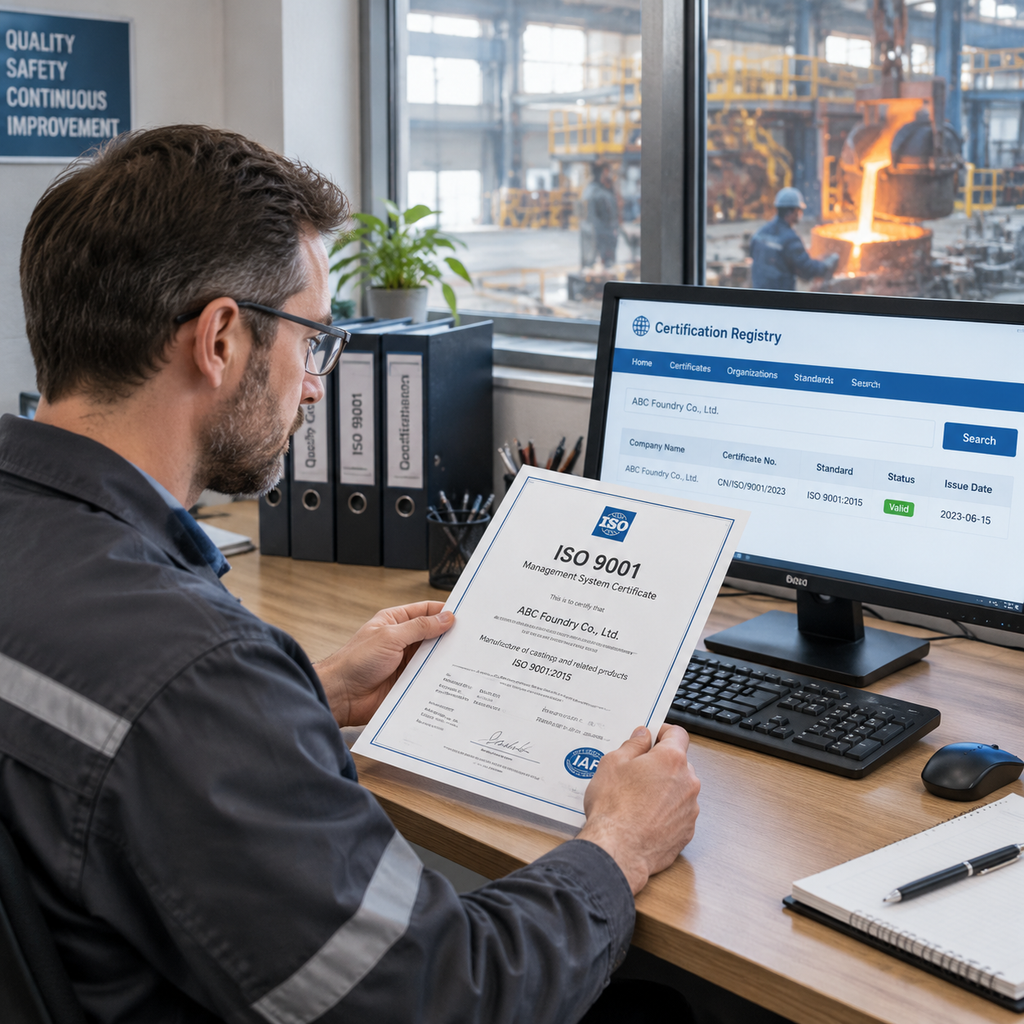
ISO 9001. IATF 16949. API Q1. PED 2014/68/EU. AD2000-Merkblatt. The letterhead is impressive. The PDF is signed. And roughly one in four times, the certificate doesn't belong to the factory quoting you.
This happens in three ways. The certificate belongs to a trading company, and the actual foundry has never been audited. The certificate was real but got suspended or withdrawn after a failed surveillance audit—and the factory is still circulating the old scan. Or the certificate covers a scope that has nothing to do with your part, like a company certified for sand casting that's quoting you investment castings.
"I've seen suppliers holding ISO 9001 certificates who couldn't tell you the address of the factory those certificates cover," says Robert Davis, a Georgia hardware wholesaler who spends about $1.5 million a year on castings. "The paper is real. The factory on the paper is real. They're just not the same factory you're talking to."
Verification takes about 20 minutes per supplier:
- Get the certificate number and issuing body. Then check the issuing body itself against the IAF CertSearch database or the accreditation body registry—ANAB for the US, UKAS for the UK, CNAS for China.
- Look up the body's public registry—most international accreditation bodies maintain searchable databases.
- Match the legal entity name, factory address, and scope against the company you're actually dealing with. If the scope field says "sand casting of ferrous alloys," it doesn't cover your A356 aluminum part.
- Check the certificate's expiry date and, if possible, call or email the issuing auditor to confirm the certificate is still active.
If the company can't produce a certificate number you can look up independently, you're not buying from a certified foundry. You're buying from someone who knows how to borrow a PDF. For pressure-equipment buyers, that distinction gets expensive the moment a PED 2014/68/EU Annex I audit falls on your desk.
Red flag #3: The price is 15% below everyone else
If you collect ten quotes for the same casting drawing, the spread will tell you more than any individual number. Typically you'll see a cluster of quotes within 8-12% of each other, then one or two outliers sitting 20-30% below that cluster.
Sometimes the low quote is real. A foundry with idle capacity, a good scrap contract, and efficient tooling can genuinely undercut a competitor. But more often, the cheap quote is a hedge against three costs you haven't been shown yet:
- Machining and finishing quoted separately. The casting price looks great. The "optional" CNC machining line item at the bottom triples the total.
- Tooling amortized differently. A supplier quoting $8,000 for tooling versus $2,000 for tooling usually means the $2,000 version only lasts 3,000 shots. That's a problem when your H13 die insert is supposed to survive 100,000 cycles.
- Yield assumptions that don't hold. If the quote assumes 92% good-part yield and the actual production line runs at 78%, the price per shipped part just went up 18%. At that point you're paying for the scrap of a process they never intended to run efficiently.
Ask for a cost breakdown before you sign anything. Not because you need to audit their books, but because the way a supplier responds tells you whether they understand their own process.
"I always request a line-by-line breakdown before signing," Davis told us. "Material, mold amortization, labor, secondary ops, packaging, freight. If a supplier won't break it out, they either don't know their own costs or they're hiding something. Either way, I walk."
A good supplier will send a breakdown within a day. A bad one sends a paragraph explaining why breakdowns are "not standard practice in our industry." Neither is the answer you want, but the second one is a clear no.
Red flag #4: The "factory tour" is actually a showroom tour
You fly to China. The supplier picks you up, drives you to a facility with a polished entrance, hands you a hard hat and a safety vest, and walks you through three clean production lines that were suspiciously idle at 10 a.m. on a Tuesday.
This is the classic trading-company tour. The facility you're standing in belongs to a partner factory that the trading company uses for the largest orders. The actual production of your part might happen somewhere else entirely—at a smaller shop two provinces away, with a fraction of the equipment quality.
Signals that you're on a showroom tour and not a working factory tour:
- No production running while you're there. Real factories don't stop for customer visits unless they were told to.
- Workers wearing identical new uniforms, standing in evenly spaced rows.
- No scrap, no dust, no half-empty bins. Real foundries are messy.
- The tour never includes the pattern shop or the heat-treat area—those are the places that tell the truth about capability. A working investment casting foundry will show you the wax injection room and the shell-building line, not just the pouring floor.
- Nobody mentions any other customer during the whole visit. Real factories have backlogs, and backlogs have names.
- The calibration stickers on gauges are either missing or expired. Anything measuring your part needs traceability to NIST or an equivalent national standard.
Ask for the factory's business license in advance—the one with the foundry's name and registered address. Then ask if the tour will be at that same address. A supplier who hedges on this answer is telling you the address on the license isn't the address you're visiting.
Red flag #5: First articles pass, third shipment falls apart
You approve the FAI. The second batch ships and matches. The third batch arrives and something is subtly wrong—a dimension 0.3 mm out, a surface finish that requires an extra polishing step, a hardness reading 12 HB low on a sample of ten.
This is quality drift, and it's different from an outright defect. The foundry didn't lose control; they just changed something. A new sand supplier. A different pour temperature. A worn die insert. A shift that runs on weekends when quality personnel are off.
The problem is that most suppliers don't tell you. They adjust to hit the delivery date, and the change stays hidden until it shows up in your incoming inspection or, worse, in your customer's assembly line.
"My first shipment was a work of art," Davis said. "By the third shipment, we started finding wall thickness off by four-tenths of a millimeter. The factory never sent a process change notice, because from their side, they hadn't changed anything—they'd just solved a problem."
Protect against drift with a written change-management clause in your purchase order. Any material, process, or tooling change—including a new subcontractor for heat treatment or coating—requires written notification and your approval before the change takes effect. Tie the clause to ASTM E8/E8M mechanical test requirements and ASTM E165 liquid penetrant acceptance criteria so "the part still meets spec" has a definition both sides can point to. Put a specific email address in the contract for that notification. Then track it. If a supplier never sends you one over 18 months, they're either not changing anything (unlikely) or not telling you (very likely).
When a batch does drift, the paper trail matters. Ask for the heat numbers on the parts in your third shipment and compare them to the heat numbers on your first article certificate. If the heat number moved and no notice arrived, you have written proof the change-management clause was breached.
Red flag #6: The lead time is exactly what you want to hear
Ask three suppliers for a lead time on a moderately complex part. One says 45 days, one says 50, one says 30. The 30-day quote isn't a faster factory—it's a promise that will get renegotiated the moment your deposit clears.
Realistic casting lead times depend on the process. Investment casting runs 35-50 days for a first article and 25-35 days for repeat orders. Die casting is closer to 25-40 days plus tooling. Sand casting can be 30-45 days depending on pattern-making. Anyone quoting significantly below these ranges is either quoting from stock or planning to miss the date.
Watch for the specific ways lead time gets inflated after the fact:
- Chinese New Year—the two-week holiday becomes a five-week gap in practice, and the backlogs stretch into March.
- National Day and Labor Day—another two multi-day shutdowns that suppliers often "forget" when quoting in January.
- Tooling delays—the tooling timeline is quoted separately, and the foundry clock doesn't start until tooling is approved. That's often 10-15 days after you thought the clock started.
- Heat-treat and surface-finish bottlenecks—many foundries outsource these steps, and the subcontractor's schedule isn't the foundry's schedule. If your heat treat is AMS 2750 compliant and the subcontractor isn't, you find that out when the cert is due.
Ask the supplier to give you a written production schedule with milestone dates: tooling completion, first article, customer approval, production start, final inspection, ship date. Then ask what happens to the schedule if tooling runs late. A supplier with a real plan will have an answer. A supplier with a hopeful quote will not.
Red flag #7: Documentation is always "in progress"
You ask for the material cert. Two days later it arrives, but it doesn't match the heat number on the parts. You ask for the dimension report. It arrives as a photo of a clipboard with handwritten numbers. You ask for the heat-treat certificate and get "we'll send it next week."
Weak documentation is a symptom, not the disease. The disease is that the supplier doesn't have a quality system that produces documentation as a byproduct of normal production. When records are reconstructed after the fact, they're unreliable—and in regulated industries (pressure equipment, automotive, aerospace), unreliable documentation is a liability that follows the parts for their entire service life.
Under EN 10204, the certificate type tells you who's standing behind the numbers. A 3.1 certificate is issued by the manufacturer's own QA department—still a factory document. A 3.2 certificate is countersigned by an independent inspector or a notified body. If your spec requires 3.2 and you receive a 3.1, the paperwork looks compliant on the ship date and fails the moment a downstream auditor reads the header.
Before you place an order, request three things and see how they arrive:
- A sample material certificate with a real heat number. If the sample is a sanitized version for marketing purposes, the production certs will be too. Ask the supplier to name the heat number trace—mill, pour date, batch chemistry—and follow that trail once it arrives.
- A sample dimensional inspection report from a recent production run. The format should show the drawing dimension, the tolerance, the actual reading, and the pass/fail status. Not just a final "OK." A real report uses calibration-traceable gauges and cites the inspection-equipment IDs.
- The name and role of the person who will sign the final inspection reports. If that person isn't identified before the order, they don't exist.
Common mistakes buyers make when they spot a red flag
Recognizing a red flag is only half the job. Here's where most first-time China buyers go wrong once they've spotted one.
Assuming the supplier will fix it
A supplier who has been substituting alloy for two years is not going to stop because you asked nicely. If the flag is structural to how they operate, the fix is to change suppliers, not to send a sternly worded email.
Looking for one perfect supplier instead of two good ones
Dual-sourcing is the cheapest insurance you can buy in Chinese casting. Two suppliers at 80% of your volume cost slightly more per part but eliminate the single-point failure that ruins delivery schedules. It also gives you a benchmark for pricing and quality that a single supplier can't match.
Trusting the fix without verifying it
If a supplier says they've "improved the process," "upgraded the tooling," or "added a new inspection step," ask for documentation. A new inspection step that isn't written into the control plan doesn't exist. A tooling upgrade that isn't reflected in the first article report didn't happen. If they claim to have added spectro checks, ask which ASTM standard the new lab method follows. If they can't answer in one sentence, they added a paragraph to a policy document, not a step to their process.
Skipping the pre-shipment inspection because the samples looked good
Samples are curated. Production is not. A third-party pre-shipment inspection costs $200-400 and catches the drift between approved sample and shipped batch. It's the cheapest part of the entire sourcing process. For parts that will see pressure, structural load, or a regulated end-use, it's not optional.
Frequently asked questions
How many suppliers should I contact before choosing one?
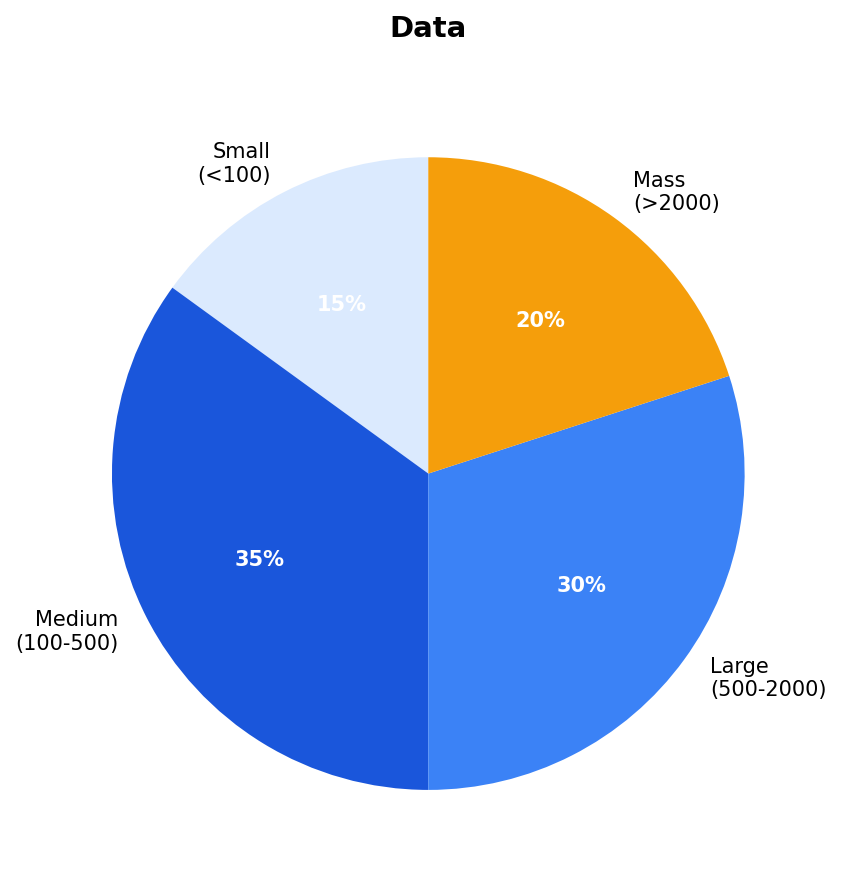
At least five, ideally eight to ten. Fewer than five and you don't have enough data to identify outliers—both the too-cheap and the too-expensive. The goal isn't to find the cheapest quote; it's to find the cluster, then understand why everyone outside it is outside it.
Is a trading company always a red flag?
No. Good trading companies add real value in casting sourcing—they handle quality control, consolidate shipments, manage tooling, and take on part of the risk. The red flag is a trading company pretending to be a factory. If they're honest about their role and can document their quality process, they're a legitimate option, especially for smaller orders.
How much does a factory audit cost, and is it worth it?
A third-party factory audit in China typically runs $300-600 for a one-day visit, plus travel if the factory is remote. For a first order under $20,000, it's often more cost-effective to do a pre-shipment inspection ($200-400) instead of a full factory audit. For orders above $50,000 or any order in a regulated industry, the audit pays for itself the first time it catches a problem.
What's the fastest way to verify an ISO certificate is real?
Get the certificate number and the issuing body's name, then look it up on the issuing body's public registry. Most Accreditation Board members maintain searchable online databases. Match three things: legal entity name, factory address, and certification scope. If any of the three doesn't match, the certificate doesn't apply to the factory you're talking to.
Can I spot red flags without visiting China?
Most of them, yes. Alloy substitution, fake certifications, unrealistic pricing, and weak documentation can be caught remotely with the right questions. Showroom tours and quality drift are harder to catch without physical presence—which is exactly why a pre-shipment inspection is standard practice for experienced buyers.
When does a red flag become a walk-away?
When the supplier can't explain it in writing. Every red flag above has a legitimate explanation—outliers happen, capacity gets tight, subcontractors change. What separates a manageable problem from a fatal one is whether the supplier puts the story on paper with dates, names, and standards attached. Vague verbal reassurance is the single strongest signal to take your drawing somewhere else.
What to do next
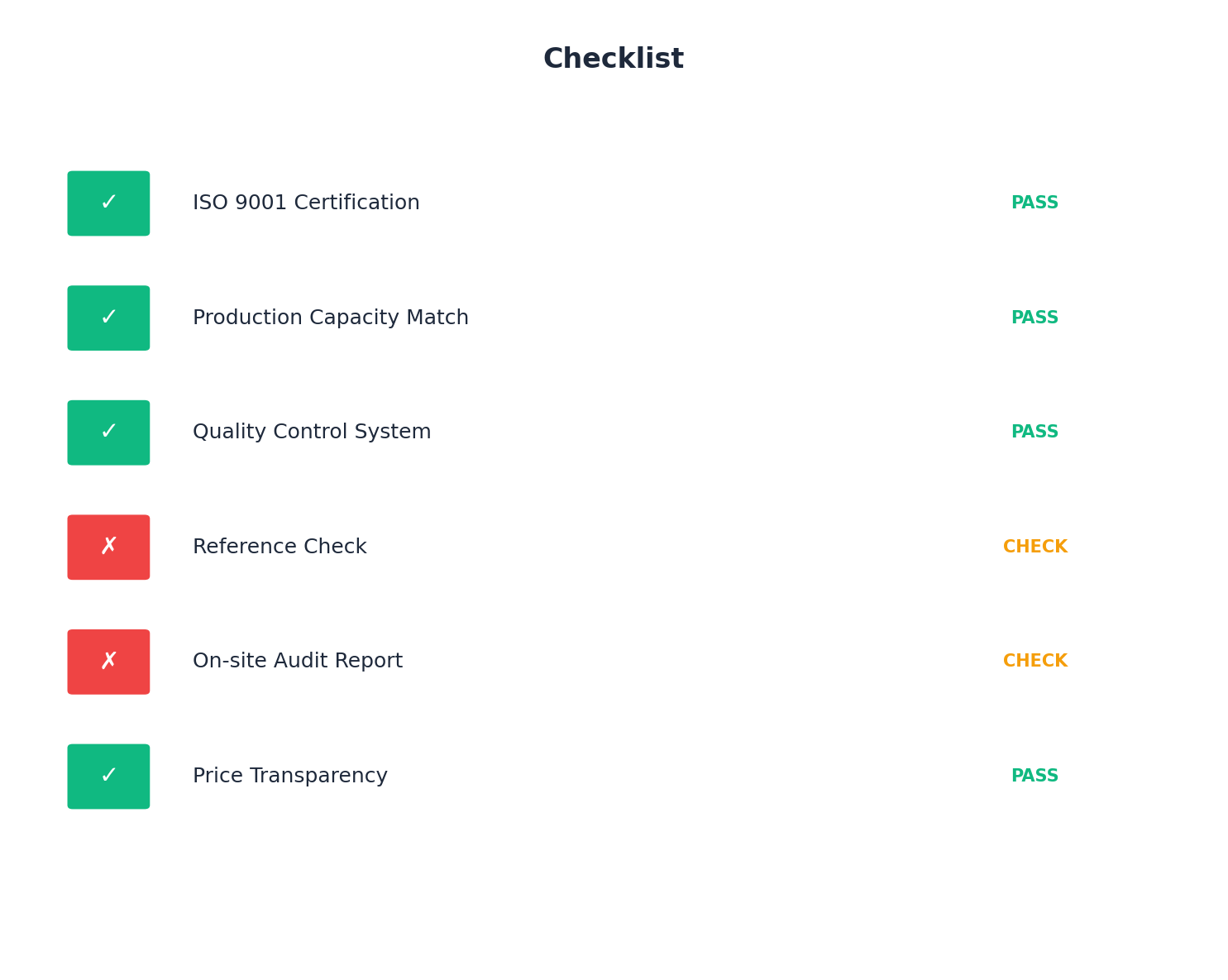
You don't need to catch every red flag to be a successful buyer. You need to catch the ones that apply to your order, your industry, and your risk tolerance. For most castings buyers, that means verifying certifications before you engage, requiring a cost breakdown before you sign, and inspecting before you pay.
If you want to see how your current quotes stack up against a broader supplier pool, submit a casting RFQ and get matched with verified foundries that have been audited on certification scope, production capability, and documentation practices. No charge to you, and no obligation to buy.
The best time to catch a red flag is before the deposit. The second-best time is before the shipment. After that, you're negotiating from the wrong side of the table.
Ready to source castings without the guesswork?
Submit your drawing and specs. Get matched with vetted Chinese foundries, review their audit reports, and compare quotes side by side in under 48 hours.
Get Matched With Audited Foundries →