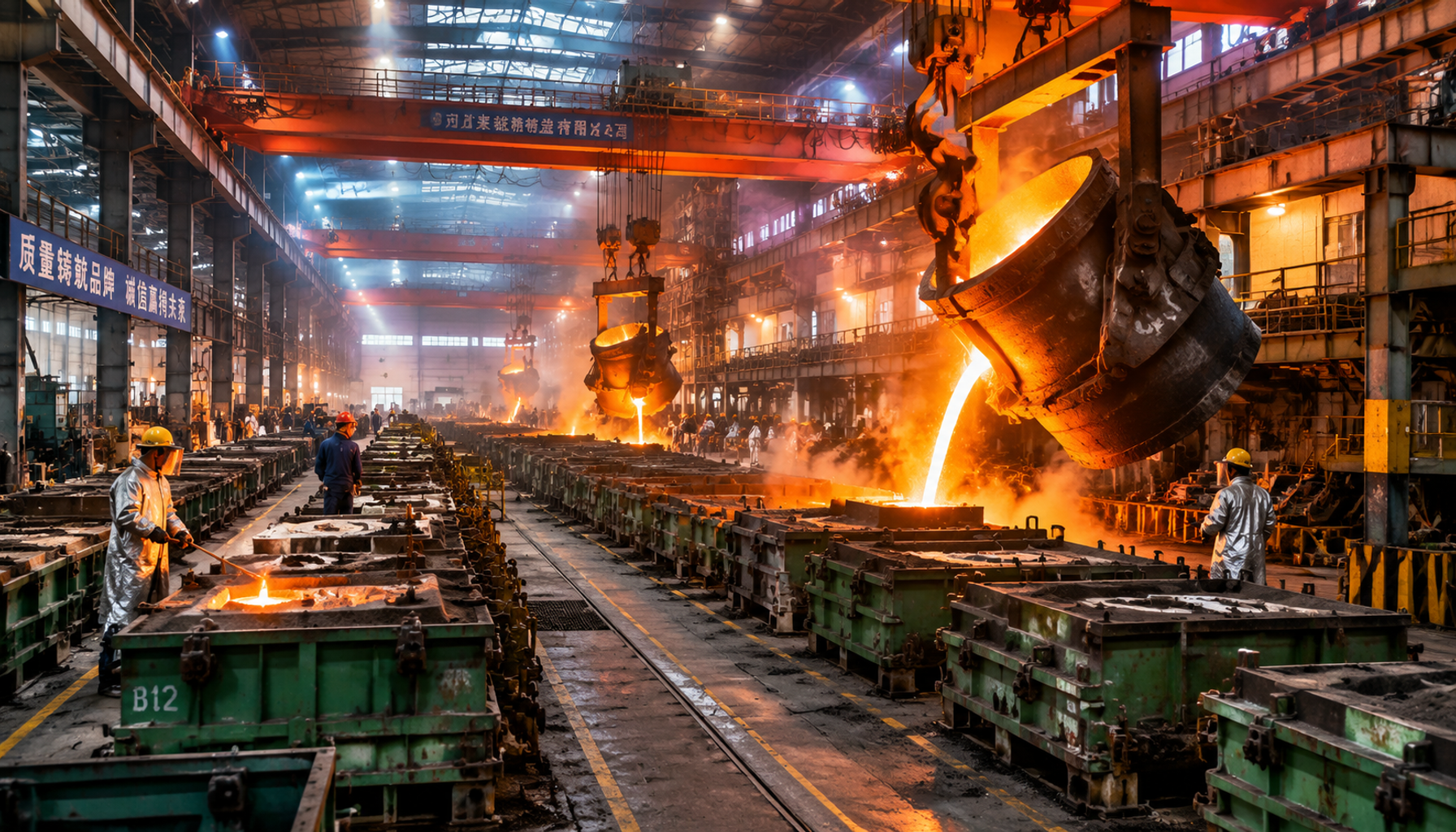
Here's a number that should change how you read the next supplier email in your inbox: China produced roughly 5.2 million tonnes of castings for the rail sector in 2025 — about 38% of global railway casting output by volume. That's not a sales pitch. That's the reason you're getting quotes from nine different factories, all claiming to be "AAR approved," all quoting within 15% of each other, and all sending you the same three photos of a rail yard in Qingdao.
Now the number that actually matters to your project: fewer than 220 of those Chinese foundries hold a valid CRCC certificate for rail components, and fewer still — somewhere between 60 and 90, depending on the product category — can pass an AAR M-1003 audit without corrective actions. The gap between "we supply railway parts" and "we are qualified to supply railway parts" is where most buyer mistakes live.
This guide walks you through the data: what Chinese railway casting output actually looks like in 2026, which categories have real supplier depth, what certification acronyms mean and don't mean, and the audit steps that separate a factory from a fax machine with a WeChat account.
The short version, if you only have 90 seconds: (1) Verify CRCC and AAR M-1003 certificates against the issuing body's public database — never trust a PDF alone. (2) Match the supplier's factory province to your component category. (3) Normalize every quote to the same grade, NDT level, packing, and Incoterm before you compare. Everything below is how you actually do those three things.
China's Railway Casting Market in 2026: The Real Numbers
Start with the demand side. China's national rail network passed 163,000 km of operating track in early 2026, with high-speed lines accounting for roughly 48,000 km. Annual fixed-asset investment in rail hovered between RMB 700–850 billion for the past five years, and that pace isn't slowing — the 2026 national plan calls for another 4,000+ km of new track, mostly in western provinces.
But domestic demand isn't why you're reading this. You're reading this because the export side is where the volume is.
Chinese rail casting exports grew from roughly USD 1.9 billion in 2019 to an estimated USD 3.1 billion in 2025. The growth is not uniform. It's concentrated in a few specific component categories where Chinese foundries have both capacity and cost advantage:
| Component Category | Est. Export Value (2025) | Supplier Depth | Typical Lead Time |
|---|---|---|---|
| Fishplates & joint bars | USD 420M | Deep (100+ foundries) | 25–40 days |
| Rail clips & fastening systems | USD 680M | Deep (150+ suppliers) | 30–45 days |
| Brake discs & pads | USD 510M | Moderate (40–60) | 45–65 days |
| Couplers & draw gear | USD 290M | Moderate (25–40) | 50–70 days |
| Bogies & side frames | USD 350M | Shallow (12–20) | 70–110 days |
| Wheels & axles (cast) | USD 340M | Shallow (8–15) | 80–120 days |
Read that table again with one thing in mind: supplier depth is your negotiating leverage. A category with 150 suppliers competing for your order behaves very differently from one with 12. If your RFQ is for rail clips, you're in a buyer's market and should push hard on price. If it's for cast bogie side frames, you're in a seller's market and should be pushing on capacity reservation and schedule certainty instead.
A quick word on data confidence. Export values above are estimates compiled from Chinese customs classifications (HS 8607 and related), cross-referenced against industry association reports. Expect ±15% variance — the customs codes don't separate railway castings cleanly from general steel castings, and a chunk of volume ships through trading companies that list the origin as a third country. Treat these as directional, not exact.
Where the Factories Actually Are
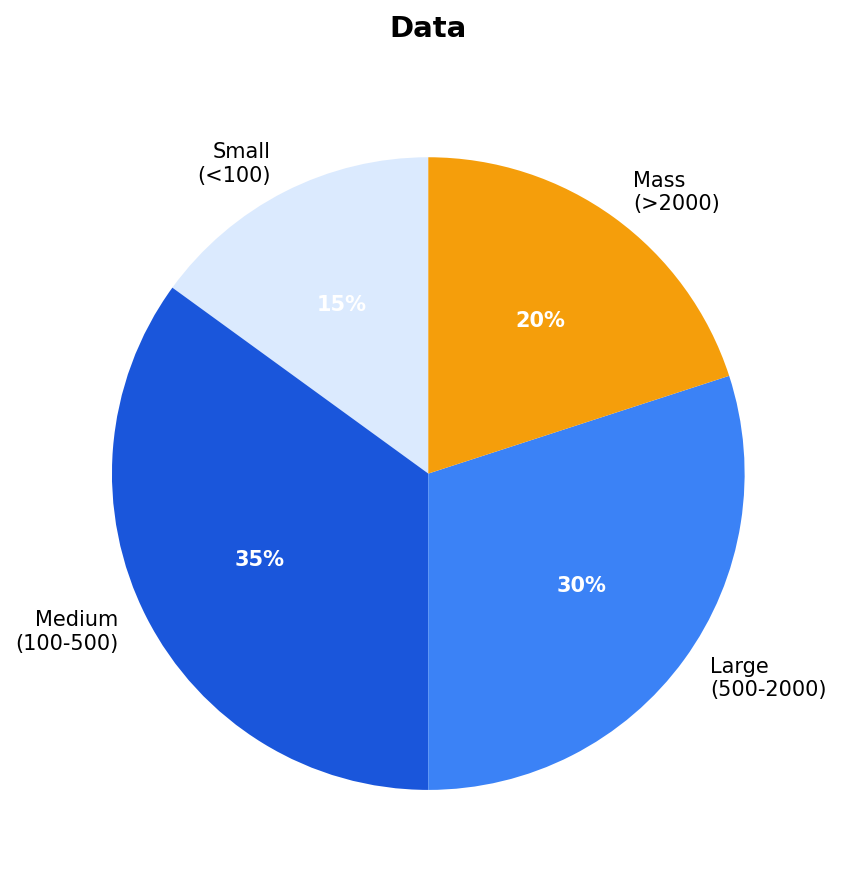
Chinese railway casting production clusters in four regions. Knowing where your supplier sits tells you a lot about their capability before you ever visit — and it's the fastest way to tell a real foundry from an office that fronts one.
Hebei Province (Botou, Cangzhou, Tangshan). The largest cluster by far. Botou alone hosts over 1,800 registered casting enterprises, though the vast majority are small sand-casting shops making municipal hardware, not rail components. The rail-qualified subset here is maybe 40–60 factories. Strength: cast steel fishplates, joint bars, and general rail fastening hardware. Weakness: environmental compliance pressure has closed or idled dozens of small furnaces since 2021, so lead-time volatility is real.
Shanxi Province (Taiyuan, Linfen). Historically tied to state-owned heavy industry. Fewer factories, but the ones that survived tend to be larger and better capitalized. Good for forged and cast wheels, axles, and bogie components. Many have legacy CRCC certification dating back to domestic Chinese rail contracts.
Jiangsu and Zhejiang (Changzhou, Wuxi, Ningbo). Higher-tech, more export-oriented. A lot of investment casting shops here doing brake components, couplers, and precision fasteners. More likely to hold multiple international certifications (AAR, EN, IRIS) simultaneously. Cost is 8–15% higher than Hebei, but documentation quality is noticeably better.
Shandong and Henan. Mixed. Some strong rail casting factories serving Chinese state rail projects, plus a growing number chasing export orders. Quality varies widely — this is the region where you most need to actually audit rather than trust certificates.
The single most useful question you can ask on an introductory call: "Which province is your foundry in, and how many rail-specific customers do you ship to annually?" If they answer with a trading company address in Shanghai and can't name the foundry town, you're talking to a middleman.
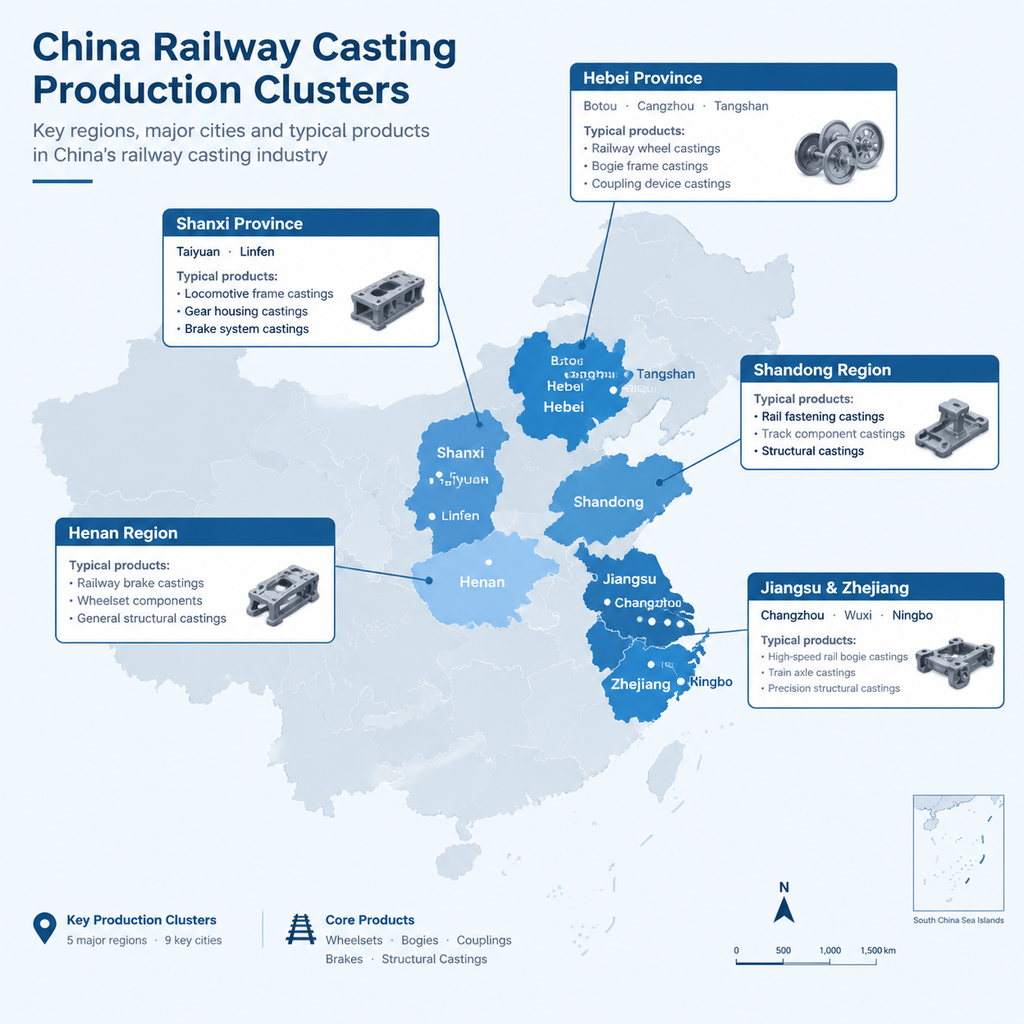
The Certification Alphabet: CRCC, AAR, IRIS, EN 15085
Certification is where buyers get complacent. A PDF certificate in your inbox proves one thing: someone paid for an audit at some point. It does not prove the factory currently operates to that standard. Here's what each one actually covers — and how to verify it yourself.
CRCC (China Railway Product Certification Center). This is the domestic Chinese rail approval. It's mandatory for components used in Chinese national rail projects. If your supplier holds CRCC for the exact product category you're buying, that's meaningful — it means they passed a Chinese government witness test on that product line. But CRCC is product-specific, not factory-wide. A factory can hold CRCC for fishplates and have zero qualification for couplers.
AAR M-1003. The Association of American Railroads quality assurance certification. This is the one most North American buyers ask for, and the one most often faked or expired. M-1003 is a factory-level quality system certification — it means the facility has documented process control, traceability, and calibration procedures that AAR auditors accepted. Note the nuance: M-1003 certifies your system, while M-201/M-210/M-211 certify specific products. You need both. If you want the full breakdown of what each M-1003 clause actually demands, we walk through it in AAR M-1003 Explained for Procurement Teams.
ISO/TS 22163 (formerly IRIS). The international railway industry standard. Common among European-facing Chinese suppliers. It's a strong signal, but it's a management system standard — it doesn't validate your specific casting metallurgy or NDT procedures.
EN 15085. Welding certification for railway vehicles. Relevant if your castings get welded into assemblies. Not relevant for a plain fishplate.
Here's the practical filter: ask for certificates with issue dates and expiry dates, then verify independently. AAR maintains a public list of certified M-1003 facilities. CRCC results are searchable through the certification center's public query system. If a supplier hesitates to give you the certificate number so you can check it yourself, that's your answer.
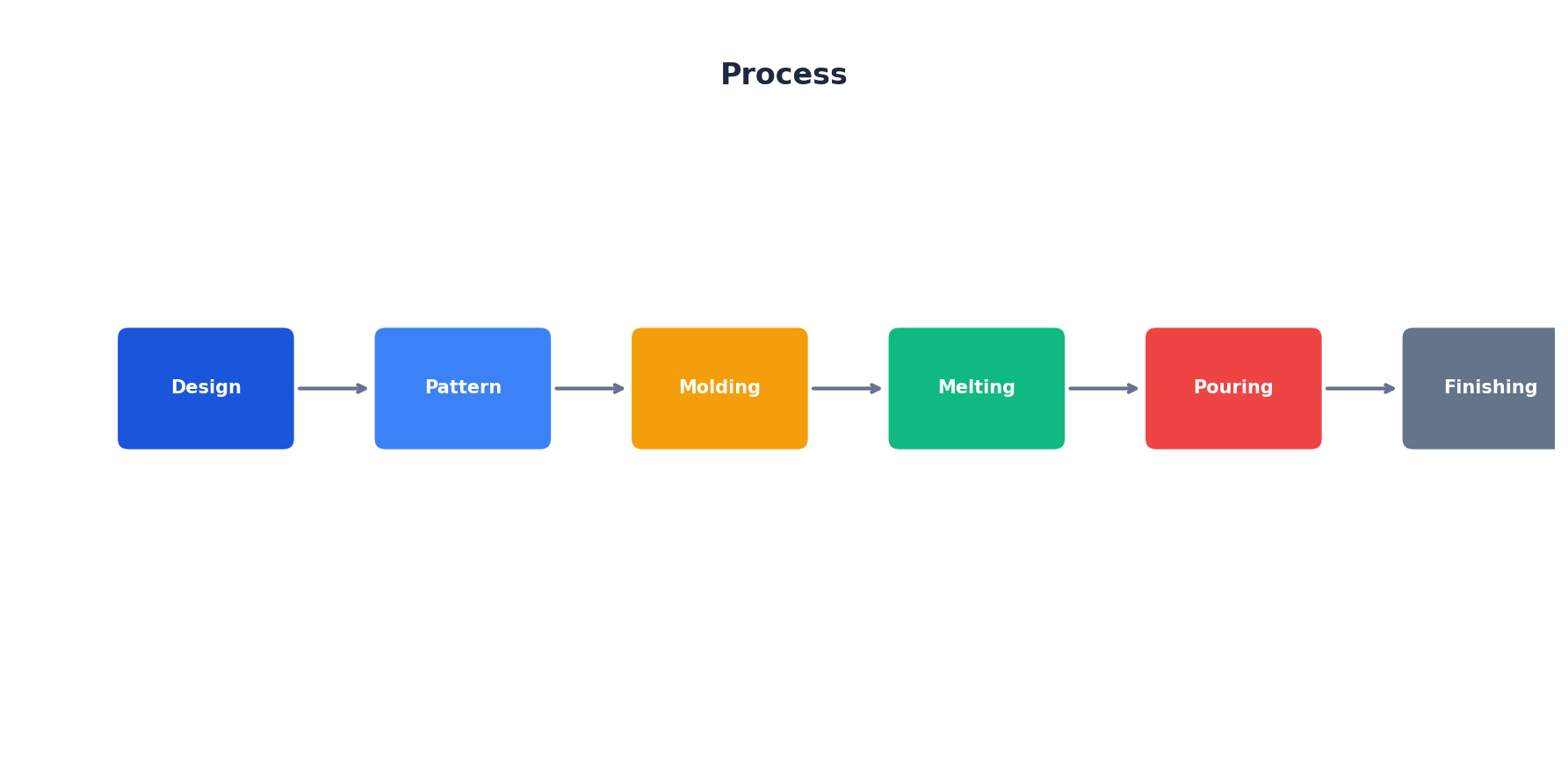
What Actually Drives Your Landed Cost
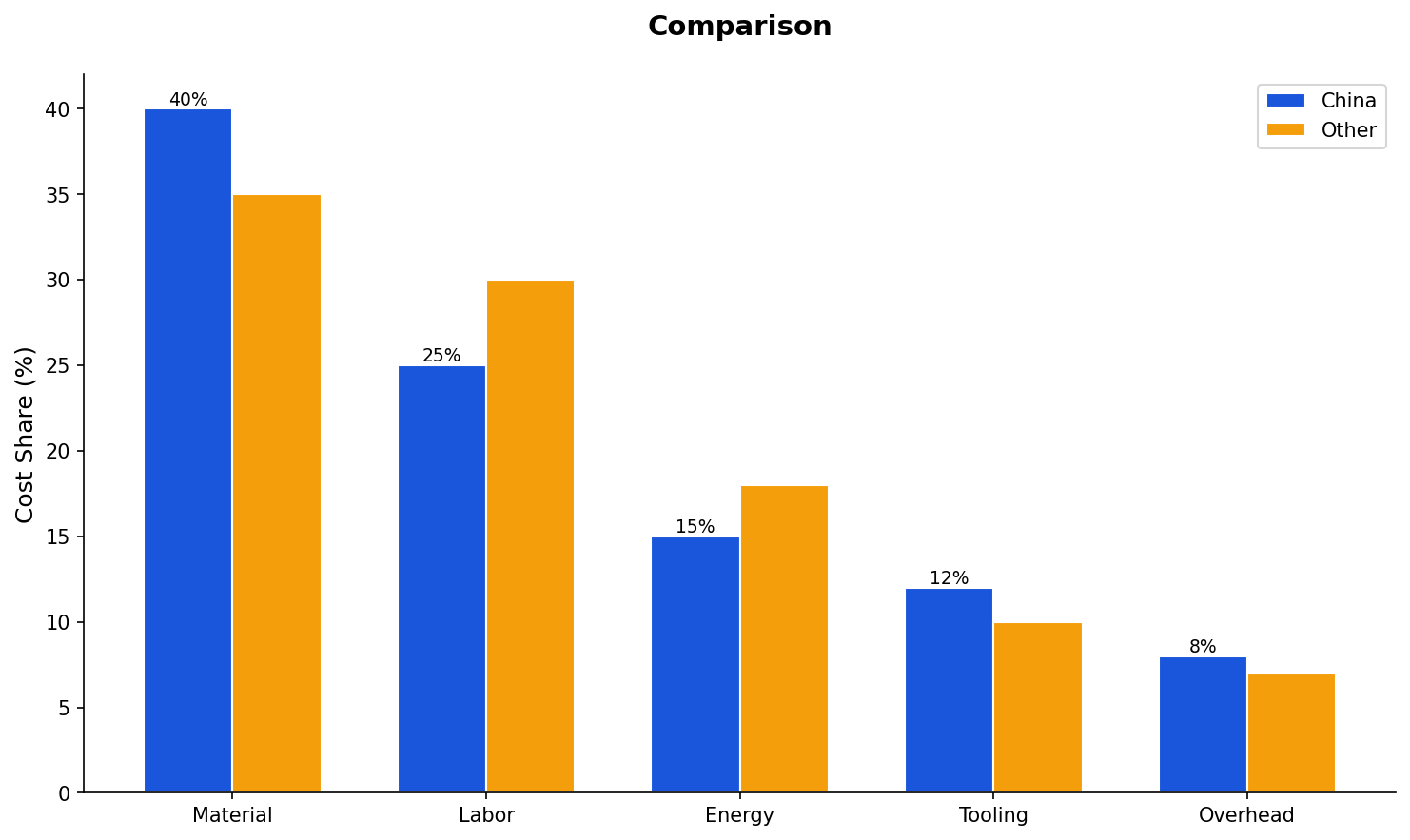
Buyers fixate on the per-tonne price in the quote. That number is maybe 60% of your real landed cost. Here's where the rest hides.
Mould and pattern cost. Sand casting patterns for a rail fishplate run USD 800–2,500 depending on complexity and whether you need a matchplate. For a bogie side frame, expect USD 15,000–45,000. Is it amortized into unit price or billed separately? If separately, how many pieces before it's paid off? Get this in writing — disputes here are common when order volumes come in under forecast.
Heat treatment and machining. Many rail castings need normalizing or quenching-and-tempering, plus machining of bolt holes, contact faces, or bearing surfaces. Chinese foundries vary enormously on whether they do this in-house. In-house is cheaper and easier to control; outsourced means one more traceability gap in your supply chain.
NDT and testing. Magnetic particle inspection (MPI) for surface defects, ultrasonic testing (UT) for internal soundness, and tensile/impact testing per heat. Budget USD 40–120 per piece for full NDT on a medium rail casting. Some suppliers quietly skip this on "sample" orders. Specify it in the PO and require the test reports by heat number.
Packing and shipping. Rail castings are heavy and awkward. Fishplates ship well in bundles on pallets. Bogies need custom steel cradles that add USD 200–600 per unit and eat container space. Get the packing spec and the container loading plan before you agree to Incoterms — FOB pricing on a badly packed shipment is a false economy.
Certification documentation. Mill certificates, heat treatment charts, NDT reports, dimensional inspection reports, and a certificate of conformance. On a serious rail order this is a 20–40 page document package per shipment. If a supplier treats this as optional, they've never actually shipped to a rail OEM.
| Cost Element | Typical Range (Fishplate) | Typical Range (Bogie Frame) |
|---|---|---|
| Unit casting price (FOB) | USD 6–14/pc | USD 1,100–2,400/pc |
| Pattern/mould amortization | USD 0.15–0.60/pc | USD 25–90/pc |
| Heat treatment | Included or USD 0.40/pc | USD 80–160/pc |
| NDT and mechanical testing | USD 0.30–0.80/pc | USD 60–140/pc |
| Machining | USD 0.50–1.20/pc | USD 120–350/pc |
| Packing | USD 0.20–0.50/pc | USD 200–600/pc |
Notice the shape of it. On low-value, high-volume parts, casting price dominates and everything else is noise. On high-value, low-volume parts, the "extras" can add 30–45% on top of the quoted unit price. If you're comparing a bogie frame quote at USD 1,400 from Supplier A and USD 1,650 from Supplier B, and only A's quote excludes NDT and machining, B isn't more expensive. B is just honest about the scope.
Seven Things to Check Before You Place a PO
This is the practical part. Work through it in order. If a supplier fails at step 2, you don't need to spend money on step 6. For a deeper version of this sequence, see our 12-point framework for auditing a Chinese casting factory.
1. Legal entity and factory address match
Get the business license (营业执照) and the export license. Check that the registered address matches the factory address the supplier gave you. Trading companies will often list a registered office in a Shanghai office tower and a "factory" somewhere in Hebei they don't own. That's not automatically disqualifying — good trading companies add real value on logistics and QC — but you need to know which one you're dealing with, because the risk profile is different.
2. Certification validity, verified independently
Pull the certificate number and check it against the issuing body's public database. For AAR M-1003, the AAR maintains a searchable list. For CRCC, use the certification center's query portal. Confirm the scope covers your product category, not just the factory in general. And check the expiry date — a certificate that lapsed eight months ago is a red flag about the supplier's attention to detail.
3. Melt shop capability and raw material source
What's the furnace capacity? Induction furnace, electric arc, or cupola? What scrap or pig iron do they charge? Rail castings are typically cast steel (AAR M-201 Grades B, C, or E, or equivalent EN/ASTM grades), and the melt chemistry controls everything downstream. Ask for the last three heats' chemical analysis reports. If they can't produce them within a day, they're not tracking heat chemistry properly. For a comparison of the common grades and their equivalents, see Cast Steel Grades Compared.
4. Heat treatment furnace and records
You need a furnace with a calibrated thermocouple and chart recorder. Ask to see the last month's heat treatment charts for a rail product. If they only have handwritten notes on a clipboard, your mechanical properties are a lottery.
5. NDT personnel certification
Magnetic particle and ultrasonic inspectors should hold certifications — in China, typically Level II per GB/T 9444 or equivalent. Ask for the personnel certificates by name. Factories that take this seriously will have them on file and be proud to show you.
6. Traceability and marking
Every casting needs a heat number, and in many rail applications a manufacturer's mark. Ask how they mark — cast-in, stamped, or laser-etched — and whether it survives heat treatment and coating. If their traceability stops at the shipping carton, you have no way to investigate a field failure.
7. Reference customers and audit history
Who have they shipped rail castings to in the last 24 months, and in which countries? Ask for two references you can contact. Then call those references and ask one specific question: "What went wrong, and how did they handle it?" Every supplier has a problem eventually. The answer tells you more than any certificate.
Common Mistakes That Cost Buyers Real Money
Trusting a trading company to be your quality gate. Some trading companies are excellent — they have engineers on staff, they do in-line inspection, they own the relationship with two or three factories. Others are one person with an Alibaba account and a warehouse. You can't tell which without visiting. If you're not going to China, at minimum insist on third-party pre-shipment inspection by a firm you choose and pay for directly.
Accepting "AAR approved" without a scope. AAR approves specific products at specific facilities. A general statement that a factory is "AAR approved" tells you almost nothing. Ask for the product approval letters, not the system certificate.
Not specifying the standard in the PO. "Cast steel fishplate, 60 kg rail" is not a specification. It's a description. Your PO needs the exact grade (e.g., AAR M-201 Grade B, or EN 15688 Grade E), the dimensional standard, the heat treatment condition, the NDT acceptance criteria, and the marking requirement. Vague POs are how buyers end up with castings that "meet the drawing" but fail in service.
Ignoring the environmental compliance angle. Chinese environmental regulation has tightened significantly. Factories that operate outside compliance occasionally get shut down for weeks during inspection campaigns. Ask directly about their environmental permits and whether they've had production interruptions in the last 18 months. Build schedule buffer into your plan if the answer is vague.
Comparing quotes without normalized scope. The cheapest quote is usually the cheapest because it excludes something. Build a scope matrix before you compare numbers — same material grade, same NDT level, same packing, same documentation package, same Incoterms. Then compare.
Frequently Asked Questions
How long does it take to qualify a new Chinese railway castings supplier?
Realistically, 10–16 weeks from first contact to first production shipment for an existing, certified product. That includes RFQ and quotation (1–2 weeks), sample production and testing (3–5 weeks), sample approval (1–2 weeks), and first production run plus inspection (4–6 weeks). If a supplier promises a container in three weeks on a new rail component, they're either quoting stock or they don't understand what qualification means.
What's a fair MOQ for railway castings from China?
For sand-cast parts, MOQ is usually driven by minimum heat size, not commercial policy. A one-tonne induction furnace means 1–2 tonnes minimum per heat, so MOQs of 500–2,000 pieces for small parts, or 20–50 pieces for large bogie components. If a supplier quotes MOQ 50 pieces on a small fishplate, they're likely batching your order with other customers' — which is fine, but ask how they segregate heat traceability.
Can I get samples before committing to production?
Yes, and you should. Expect to pay for sample castings plus tooling — typically 30–60% of the full pattern cost for the first sample, sometimes non-refundable. Budget USD 1,500–6,000 for a first article sample on a medium rail casting including testing. Anyone offering "free samples" on custom rail castings is either misunderstanding the request or planning to recover the cost elsewhere.
Is Chinese rail casting quality lower than European or Indian supply?
Not inherently. It's bimodal. The top 20% of Chinese rail casting factories — the ones with CRCC plus AAR plus IRIS, and a real customer list — produce to European standards or better, at 25–40% lower cost. The bottom 50% are general casting shops with a rail-shaped product and no rail discipline. Your job is to sort one from the other, and certifications plus audit are the sorting mechanism.
What payment terms are normal?
First order: 30% deposit, 70% against bill of lading copy is standard. Some factories will push for higher deposits on custom tooling. Established relationships commonly move to 30/70 against pre-shipment inspection report, or occasionally 100% L/C at sight. Be cautious with any supplier demanding 100% T/T before production on a first order.
Next Steps
The gap between a good outcome and an expensive lesson in Chinese railway casting sourcing isn't luck. It's the audit list above, worked through in order, without shortcuts.
Start with three suppliers in the category you need. Verify their certificates independently. Send the same normalized RFQ to all three with a fully specified standard. Then — before you commit to production — pick the one that answers your technical questions with specifics rather than reassurances, and put an inspection clause in the contract.
That's the whole playbook. It's not glamorous, but it's the difference between 5.2 million tonnes of output working for you and working against you.
Get the Railway Castings Sourcing Checklist
A single-page audit sheet: the seven verification steps, the certification query links, and the scope matrix template for comparing quotes. No fluff, no sales call required.
Download the checklistRelated Reading
- How to Audit a Chinese Casting Factory: A 12-Point Framework
- AAR M-1003 Explained for Procurement Teams
- Sourcing Rail Fastening Systems from Asia: Cost and Lead Time Benchmarks
- Cast Steel Grades Compared: AAR M-201 vs EN 15688 vs ASTM A27
Data in this guide is compiled from Chinese customs classifications (HS 8607), industry association publications, and certification body databases. Export volume figures are estimates with a ±15% margin. Certification requirements vary by destination market — always confirm the applicable standard with your end customer's engineering team before specifying.