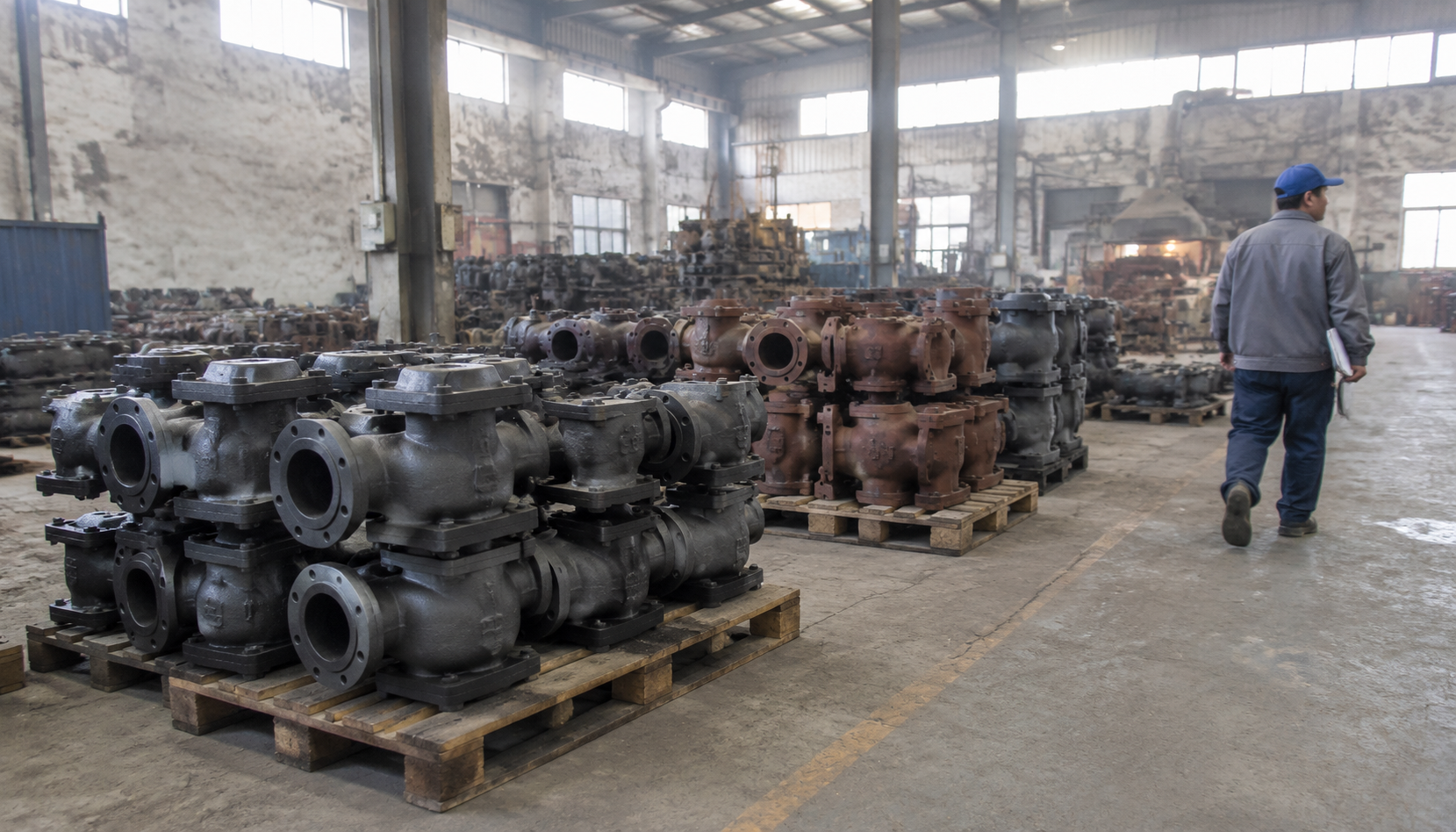
The crate lands on your dock on a Tuesday. You cut the banding, pull the first valve body out of the VCI bag, and it looks fine. Then your QC guy puts a straightedge across the flange face and finds 0.4 mm of warp. The hydrostatic rig comes out. Three of the first ten bodies weep at the body–bonnet joint before the needle even settles.
By Friday you've got 38% rejects, an EN 10204 certificate listing a heat number that appears nowhere on the castings, and a supplier who has stopped answering WhatsApp but is still posting factory videos on LinkedIn.
This is not an unusual story. It's the default outcome when a buyer treats "pump and valve casting OEM China" as a price question instead of a process question. The good news: every failure in that story is detectable in advance, for less than the cost of one rejected pallet.
What Actually Goes Wrong, in Order of Frequency
After enough of these shipments, the failure modes stop being varied. They cluster into five buckets.
1. Subsurface porosity that only shows up under pressure
Shrinkage porosity near a heavy section change. Gas porosity from wet sand or degassing that never happened. Either one passes a visual inspection and dies on the test bench at 1.5× the rating. The nasty part is timing — the defect is inside the metal, so it survives your incoming inspection and blows up at your customer's site six months later.
Cause is usually one of three things: gating and risering designed by eye rather than by simulation, sand moisture out of spec, or a pour temperature the furnace operator guessed because the pyrometer was broken. You can't fix any of those with a stern email. You fix them with a specification that requires a test result per heat, and with a foundry that owns a solidification simulation license.
2. Material substitution inside the same grade name
Nobody ships you plastic instead of steel. What happens is subtler. You order ASTM A351/A351M CF8M. You get CF8 — close enough to pass a magnet test, different enough to fail a chloride service application, because the 2–3% molybdenum that makes CF8M what it is simply isn't there. Or you order A216 WCB and the carbon sits at 0.32% instead of the 0.30% ceiling, which is fine until someone welds a repair and gets cracking.
Or the big one: you order duplex A995 Grade 4A (CD3MN, the 2205 grade) and receive material that has been solution annealed outside the 1,020–1,100 °C window, so the ferrite–austenite balance is off and the impact toughness is a rumour.
3. Dimensional drift you didn't define
Face-to-face dimension, bolt circle, flange thickness, bore concentricity. If your drawing says "±1 mm general tolerance" and you don't cite ISO 8062-3 or a table of your own, you'll get whatever the pattern gave them. Castings warp during cooling and during heat treatment. A pattern that was right for the first 200 shots is not right for shot 2,000.
4. The trading company in foundry clothing
Search results are dominated by companies whose website says "our factory" and whose business license says "trade and consulting". They will quote you, take 10–20% on top, and forward the order to a foundry they don't control. When the porosity shows up, they can't fix it, because they don't own the furnace, the pattern, or the QC decision.
5. Packing that destroys good parts
Twenty tonnes of castings in a container, loaded loose, no dunnage between layers. Cast iron flanges chip. Machined faces rust because nobody put VCI in the bag. You spend $8,000 fixing damage on parts that left the foundry in perfect condition.
Know Which Tier of Supplier You're Actually Talking To
There are three tiers, and the price difference between them is smaller than the risk difference.
Tier 1 — the trading company. No furnace. Sometimes no warehouse. Their value is English, responsiveness, and logistics. Some are genuinely good at that and honest about it. Most pretend to be a factory, which is where the trouble starts.
Tier 2 — the foundry that outsources everything downstream. They melt and pour well. Machining goes to a shop across town, pressure testing happens at whoever has a rig free, and the certificate is assembled from three different sources. Quality is only as good as their weakest vendor, and you have no visibility into that vendor.
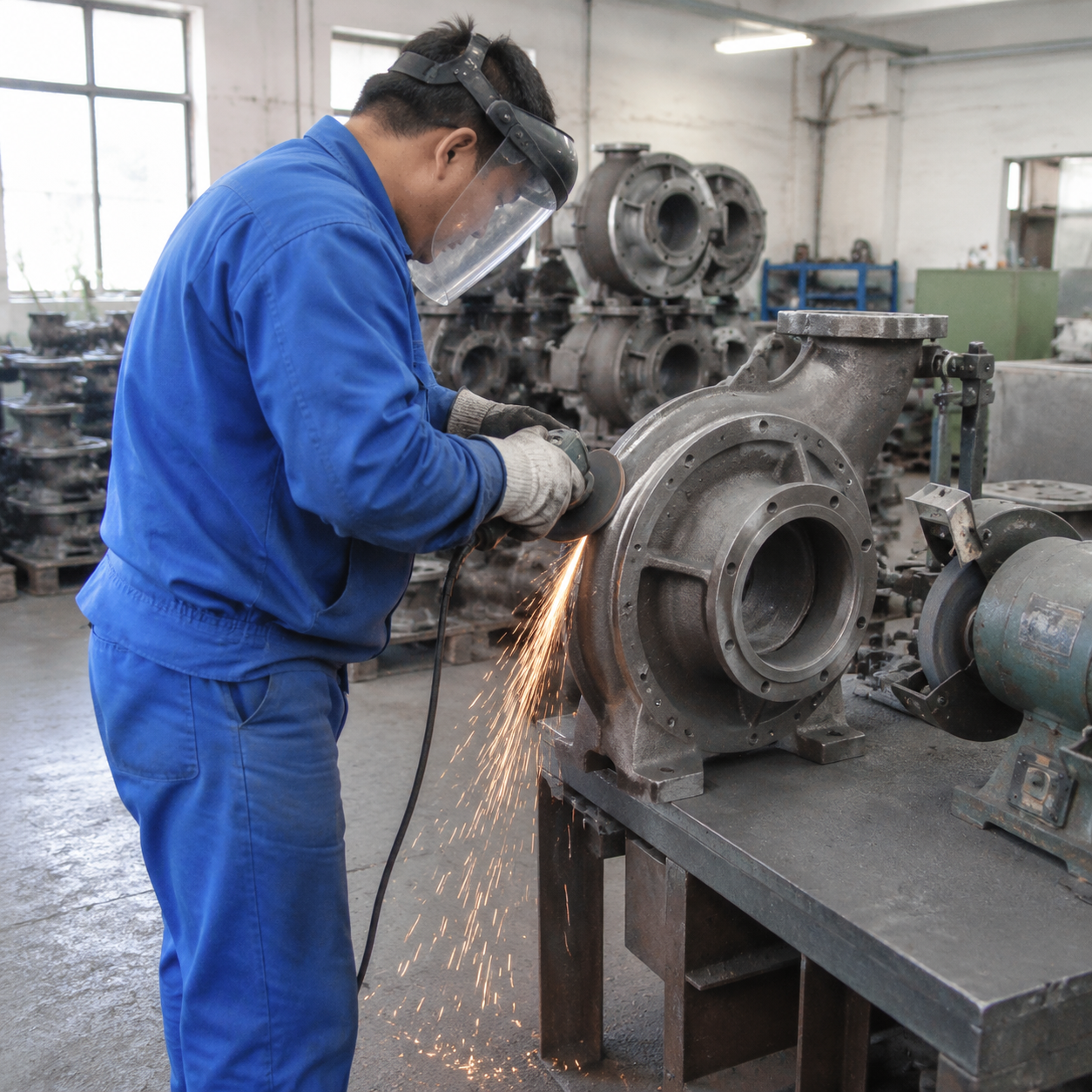
Tier 3 — foundry with in-house fettling, heat treat, machining, and a test bay. Fewer of these than the internet suggests, especially for stainless and duplex. This is where you want to be for anything pressure-retaining.
How to tell them apart in twenty minutes, without a flight:
- Business license scope. Ask for the 营业执照 and the 排污许可证 (pollutant discharge permit). A real foundry has an environmental permit with a production capacity figure on it. Trading companies don't. The address on the permit should match the address you're shipping from.
- Ask them to walk the shop live on video. Not a highlight reel. A live call where you say "go to the melting area" and they either walk there or start explaining why they can't.
- Ask for a furnace log from last week. Heat numbers, tap temperature, chemistry. Real foundries have this within arm's reach. Traders ask their supplier for it and get back to you in three days.
- Ask for three bills of lading from the last six months, not customer references. A B/L shows a real shipment of a real product to a real consignee.
If you want the longer form of that process — including the documents to ask for in order and what a bad answer looks like — see our walkthrough on auditing a Chinese foundry before you schedule the call.
Write the Spec Sheet, or Someone Else Will Write It for You
Most bad castings are traceable to a two-paragraph RFQ. If you send "200 pcs valve body, CF8M, per drawing", you have handed every decision that matters to the supplier. Here's the minimum that belongs in the RFQ for pump and valve castings.
| Field | What to specify | Why it matters |
|---|---|---|
| Material grade | Full ASTM/EN designation + edition year, e.g. ASTM A351/A351M-18 CF8M, or ASTM A995/A995M-19 Grade 4A for duplex | "Stainless 316" is not a grade. CF8 vs CF8M is a molybdenum difference that decides chloride service. |
| Casting process | Sand (green sand or no-bake), shell, or investment — your call, not theirs | Changes surface finish, minimum wall, tooling cost and unit price by 2–3× |
| Dimensional tolerance | ISO 8062-3, DCTG grade per feature, plus your own critical dims | Stops the "general tolerance ±1 mm" argument after the fact |
| Surface acceptance | MSS SP-55, visual acceptance criteria class | Gives you a written basis to reject sand inclusion and cold shuts |
| NDT | Which method, which areas, which acceptance level (e.g. RT per ASTM E94 on 100% of body-bonnet weld prep) | Retrofitting NDT after casting means scrapping the part |
| Pressure test | API 598 or EN 12266-1, shell and seat, hold time, per-piece record | A summary sheet saying "all passed" is not a record |
| Material cert | EN 10204 3.1, heat number cast or stamped on the part | Without traceability the cert is decoration |
| Marking | Heat number, size, rating, your logo or part number, cast-on vs stamped | Cast-on marking has to be in the pattern — decide before tooling |
| Machining scope | Which faces, which datums, surface roughness Ra, whether you machine or they do | Most "casting" quotes exclude machining and you find out at PO stage |
| Packing | VCI, desiccant, ISPM 15 plywood, flange face protection, max crate weight | Cheap to specify, expensive to fix |
Ten rows. It takes an hour to write and saves whole quarters.
The Certificate Trap
An EN 10204 3.1 certificate is only worth something if three things line up: the chemistry and mechanical values, the heat number, and a physical mark on the casting you can actually see.
Ask yourself, holding the paper next to the part:
- Does the heat number on the cert appear on the casting? If the marking is buried under primer or ground off during fettling, the cert proves a heat existed. It doesn't prove this part came from it.
- Does the cert include both chemistry and mechanical properties from the same heat? Many Chinese certs are assembled from two different test lots.
- Is there a ferrite count for the CF8M? Austenitic stainless valve bodies in the 5–20% ferrite range behave very differently from fully austenitic ones under thermal cycling. ASTM A800/A800M is the reference for how to measure it. A supplier who has never been asked won't have the number.
- For duplex, is there a documented solution anneal with the actual furnace chart, not just "heat treated"?
Then spend the money on PMI. Positive material identification on 10–20% of a shipment, or 100% for duplex and super duplex, costs a few dollars per part and catches substitution cold. If your supplier resists PMI, you've learned everything you need to know.
If certificates are the part of sourcing from China that has burned you before, this primer on reading EN 10204 3.1 from Chinese suppliers goes further into what each line should and shouldn't contain.
Where the Price Actually Sits
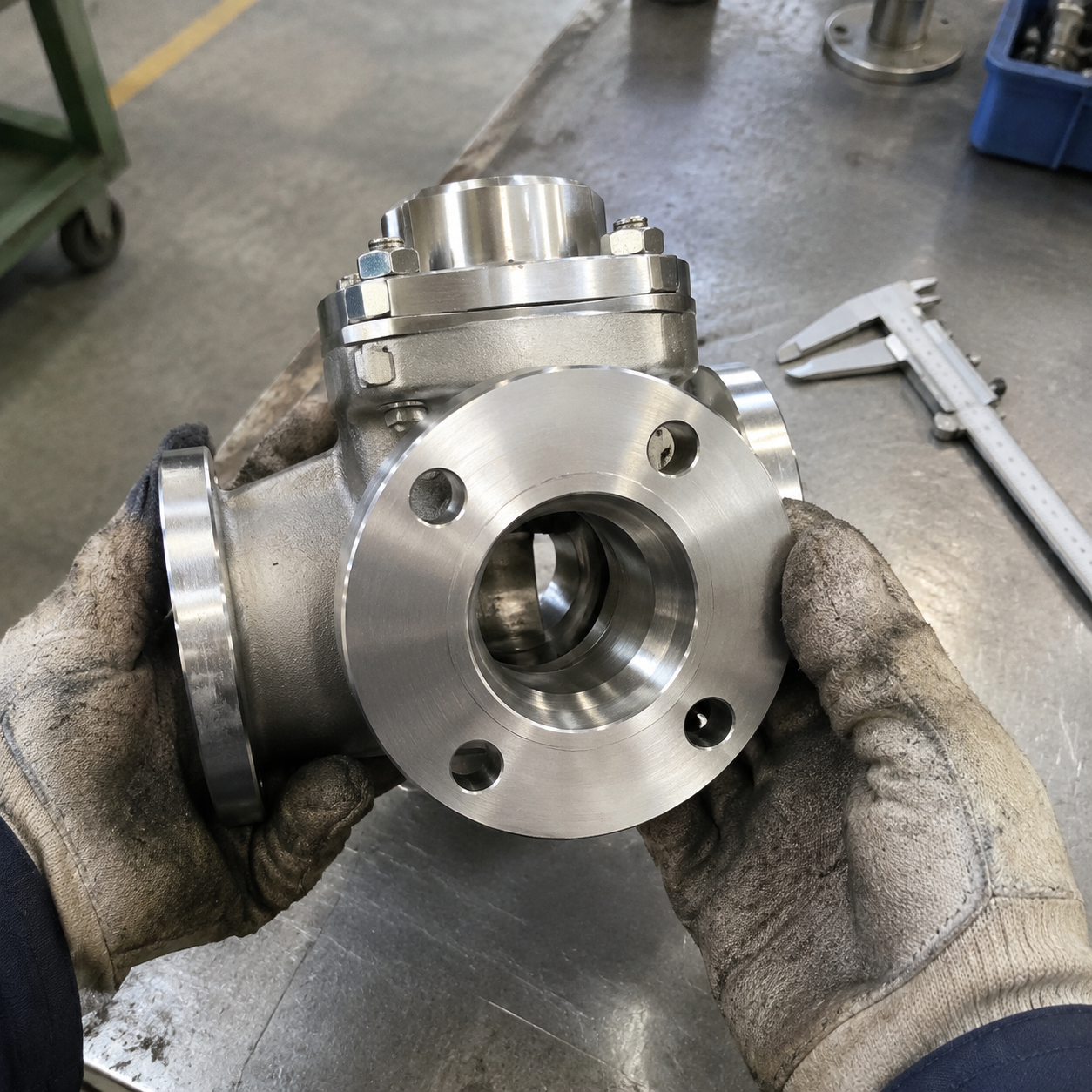
The single most common quoting mistake is comparing a per-kilogram number with a per-piece number. They are not the same animal. A finished machined valve body weighs 20–30% less than the raw casting, because that's what goes into the chip bin. Always ask for the gross casting weight, the finished weight, and the machining allowance separately.
Rough order of magnitude for 2026, FOB Ningbo, mid-volume (200–2,000 pcs), and treat these as ballpark, not quotes:
| Type | Typical unit price | Tooling | Lead time (first order) |
|---|---|---|---|
| Carbon steel sand casting, WCB, 5–50 kg, unmachined | $1.8–3.0/kg | $400–1,200 (wood or foam pattern) | 35–50 days |
| Carbon steel sand casting, machined + hydro tested | $3.5–6.0/kg | $800–2,500 (metal pattern + core box) | 55–75 days |
| Stainless CF8M sand casting, machined | $5.5–9.0/kg | $1,000–3,000 | 60–85 days |
| Investment cast stainless trim (disc, ball, stem) | $9–16/kg | $1,500–6,000 (wax die, multi-cavity) | 50–70 days |
| Ductile iron pump housing, A536 65-45-12 | $1.5–2.6/kg | $600–2,000 | 40–60 days |
| Duplex 4A valve body, investment cast | $14–22/kg | $3,000–8,000 | 70–100 days |
If someone quotes you 40% under the middle of these ranges, one of four things is happening: they're a trader adding nothing but a margin, the material is not what you asked for, the machining and testing are excluded, or they're buying the order to fill a furnace and will cut every corner to survive it.
Also decide upfront who pays for what. Standard Chinese practice is 30% T/T deposit and 70% before shipment, with the balance released against a copy of the B/L. On orders above roughly $100,000, negotiate an L/C at sight — it costs about 0.1–0.15% and forces the shipping documents to be consistent with the contract.
The Seven-Point Check Before You Send the PO
This is the part that separates buyers who sleep from buyers who don't. Run all seven on any new supplier of pressure-retaining castings. Skip one and you're gambling on the outcome.
1. License, permit, address, all matching. Business license scope includes casting production. Environmental permit exists with a capacity figure. The shipping address on the proforma invoice matches both. Photograph the factory gate sign on your audit — if the sign has a different company name than the invoice, ask why in writing.
2. A live, unscripted video walk. Melting, molding line, pouring, shakeout, fettling, heat treat, machining, test bay, warehouse. Twenty minutes. Watch whether the floor is organised — clutter predicts dimensional escapes better than any quality manual.
3. One recent 3.1 certificate, with the heat number on the casting. Pick a random part from their ready-to-ship rack. Have them show you the cert and point to the marking. Two minutes, and it tells you whether traceability is real or decorative.
4. Calibration status of the pressure test rig. Ask for the calibration certificate on the gauge and, ideally, the chart recorder. A rig with an uncalibrated gauge is theatre.
5. One independent lab test on a sample. SGS, BV, TÜV or a Chinese CMA-accredited lab. Chemistry, mechanicals, and PMI on the same part. Budget $200–400 for a single sample test and don't let the supplier choose the lab.
6. A third-party pre-shipment inspection on the first order. A man-day in Zhejiang or Shandong runs roughly $280–400 plus travel. On a $60,000 order that's 0.7% for a second set of eyes on dimensions, marking, and packing. On the first order, always. On the fifth, maybe not.
7. Tooling agreement, signed, before the first chip flies. More on that below, because it's the one that bites years later.
Print it. Tape it to the front of every new supplier file. The one-page version is in our checklist library if you want it in a form you can paste into an email.
Pressure Testing: Insist on the Paper Trail
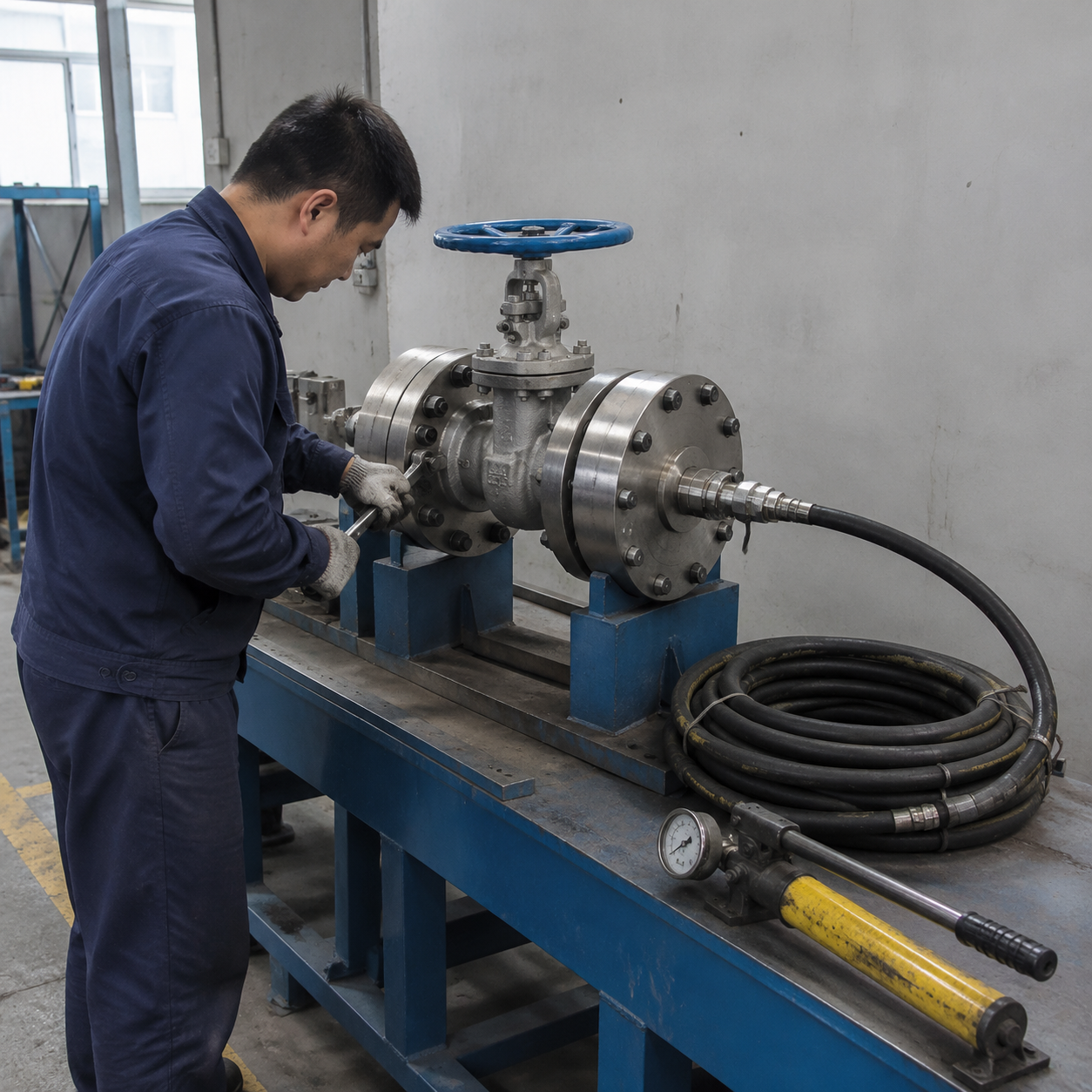
Under API 598, the shell test runs at 1.5× the pressure rating at 38°C, with a minimum hold time that scales with size — 15 seconds minimum for the smallest valves, up to 60 seconds and beyond for larger ones — and the seat test at 1.1×. If your supplier can't tell you the test pressure and hold time they used without looking it up, they're not testing to a standard, they're just pumping water.
What to require, in writing:
- Per-piece test record, not a batch summary. Serial or heat number, test pressure, hold time, result, operator, date.
- Testing at the actual end connections with proper blind flanges — not a blanking plate and a hose clamp.
- Video of the first five pieces on the first order. You'll spot a weeping gasket in ten seconds.
- For anything with a weld prep or a repair, NDT before the pressure test, not after. A repaired casting that passes a hydro test today can crack in service next year.
One more thing buyers forget: define what happens to rejects. Who pays the freight back? Who decides whether it's a rework or a scrap? Put a number on it — for example, "any lot exceeding 5% dimensional rejects is replaced at supplier's cost including freight". Suppliers who argue hard about that clause are telling you something.
Tooling Ownership: The Trap With the Long Fuse
You pay $2,200 for a pattern and core box. Nobody discusses who owns it. Two years later you move to a cheaper supplier, and your old foundry starts selling your part number — from your pattern — to your competitor in the same market. This happens more than people admit.
Prevent it with four sentences in the PO:
- The tooling is your property, paid in full, and is held by the supplier only for the purpose of fulfilling your orders.
- The tooling carries a permanent tooling ID stamped into the pattern plate, plus photographs attached to the PO.
- On request, the tooling is returned or transferred to another supplier at your cost, within 30 days.
- The supplier will not use the tooling, or any casting derived from it, to produce parts for any other customer.
That last clause is worth almost nothing legally across borders and almost everything practically, because it removes the ambiguity. Foundries that plan to honour it will sign. The ones that won't are telling you their business model. If you haven't written this clause before, use the template rather than drafting it in a hurry at the bottom of a PO.
The Timeline Nobody Quotes You
Suppliers quote the production time. The order takes longer than that.
Realistic first-order timeline from PO to FOB: 90 to 110 days. Tooling 15–25 days. First samples 15–20 days after tooling. Your own first-article approval 5–10 days (don't rush this — it's the cheapest place to catch a mistake). Production 30–45 days for sand castings at 200–1,000 pieces. Add 10–15 days if machining is in scope and queued behind other customers. Third-party inspection 3–5 days. Space booking 7–10 days in a normal market, longer in Q4.
Then add the calendar risks that are specific to China:
- Chinese New Year. Not one week. Three to five weeks of effective shutdown, with a slow ramp on the far side and a wave of resignations among experienced moulders and grinders. If your order is due in March, the PO needs to be placed in November.
- National Day, first week of October. A week gone, plus shipping congestion either side.
- Typhoon season, July to September in Zhejiang and Fujian. Port closures in Ningbo and Xiamen cascade for two weeks.
- Power rationing. Still happens in some provinces during peak summer. Foundries are first in line to be asked to reduce load, because they're the biggest consumers.
Any supplier who quotes 30 days on a new machined valve body with testing is quoting the production run and silently excluding everything else. Ask them to break the timeline out. The good ones will, without irritation.
Packing, Rust, and the Last 500 Miles
Castings fail in transit in ways that have nothing to do with casting. Machined flange faces rust. Cast iron corners chip. Crate feet punch through a container floor. And none of it is covered because your PO said "standard export packing".
Write it out instead:
- Machined surfaces in VCI bags with desiccant, not bare in a crate.
- Flange faces protected with plastic caps or plywood discs, taped, not just placed.
- ISPM 15 stamped plywood, not solid wood — an unstamped pallet can get your container held at destination and the fumigation bill is yours.
- One part number per crate, labelled with part number, quantity, heat number, and your PO reference. Mixed crates are where inventory accuracy goes to die.
- Maximum crate weight around 1,000 kg so a standard forklift can handle it.
- Photos of the packed crates before the container doors close. Every time.
Freight itself is the variable you can't control. Container rates from Ningbo to Northern Europe have swung between roughly $1,800 and $4,500 per 40ft over the last two years depending on season and disruption. Budget a range, not a number, and never lock a landed cost on a rate you saw a quarter ago.
FAQ
What is a realistic MOQ for pump and valve castings from China?
Most sand casting foundries will quote from 50 to 200 pieces per part number. Investment casting shops usually want 100–500 pieces because the wax die has to be amortised. Under 50 pieces you're almost certainly paying a trader's premium — or talking to a foundry that will run your job in the gaps, which is exactly when the process control slips.
Sand casting or investment casting for valve parts?
Sand for bodies and bonnets above roughly 2 kg, especially anything with a complex internal waterway. Investment casting for trim — discs, balls, stems, seat rings — and for small stainless bodies where surface finish and as-cast tolerance matter. Duplex and super duplex trim is almost always investment cast, and if a supplier offers you sand cast duplex trim, ask to see their previous castings in that grade.
Can I get samples before placing a production order?
Yes, and you should, but understand what you're paying for. Sample cost is normally tooling plus 2–5 pieces at a premium of 1.5–2× unit price. Many foundries will credit the tooling against a first production order above a certain volume. Get the sample tested by an independent lab — a sample the supplier selects and pre-inspects is a marketing document, not evidence.
What certifications should a Chinese valve casting foundry hold?
ISO 9001:2015 is the floor and proves very little on its own. For EU pressure equipment you want PED 2014/68/EU coverage, EN 10204 3.1 certificates, and AD 2000 W0 where the application requires it. For potable water, NSF/ANSI 61 or WRAS. For sour service, NACE MR0175 / ISO 15156 compliance on the material selection. None of these replace your own audit — plenty of certified factories ship porous castings with perfect paperwork.
How do I handle a quality dispute after the container arrives?
Fast, with evidence, and before you've scrapped anything. Photograph and video the rejects with the heat number visible. Get an independent inspection report rather than a written opinion. Then claim against the balance, not against goodwill — this is why holding 70% until shipment documents are presented matters less than holding a retention against the next order. Realistically, your leverage ends when the money does.
What to Do This Week
If you're sourcing pump or valve castings from China for the first time, or replacing a supplier who burned you, don't start with price. Start with the spec sheet. Ten rows, one hour, and it eliminates about 70% of the arguments you'd otherwise have in month four.
Then run the seven-point check on two suppliers instead of one. Not because you'll split the order, but because the comparison is the information. A foundry that answers the awkward questions directly — the calibration cert, the furnace log, the tooling clause — is a different animal from one that gets defensive and offers a discount instead.
Send over your drawing and application and you'll get a written process recommendation, the tolerance grade you actually need, and an honest lead time with the tooling broken out separately. No obligation, and no 30-day fairy tale. Our sourcing desk reads every brief — if we can't help with your part, we'll say so on the first email, not the third.