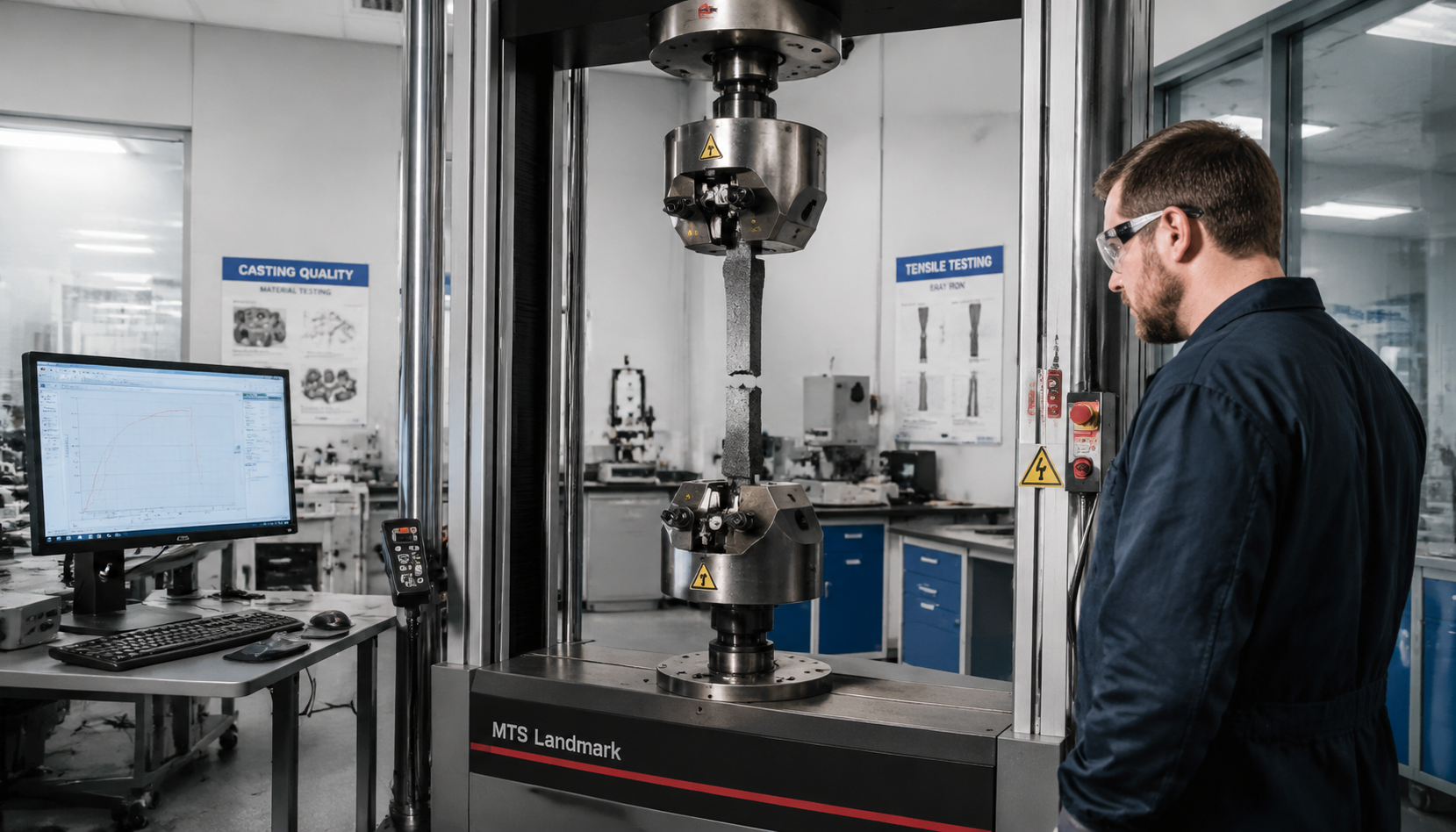
Mechanical Properties Casting: 5-Step QA Checklist for Buyers
You've done the hard part. You found a casting supplier, negotiated the price, and signed the PO. Now the real question: will the parts actually meet the mechanical properties you specified?
Every month, buyers across North America and Europe receive shipments of gray iron and ductile iron castings that look right but perform wrong. Tensile strength comes in 15% below spec. Yield strength is inconsistent from batch to batch. Elongation — the one property that tells you if the part will bend or snap — is either missing from the cert or clearly fabricated.
You don't need a metallurgy degree to catch these problems. You need a system. Here's a 5-step checklist used by Tier-1 automotive and industrial equipment buyers to verify mechanical properties on every casting order. No guesswork. No trust falls. Just verifiable data.
Step 1: Match Your Spec to the Right Grade — Don't Assume "Equivalent"
The single most common mistake buyers make is assuming that a supplier's "equivalent" grade matches their specified ASTM class. It happens constantly: you order ASTM A48 Class 40, and the supplier ships castings made to a Chinese GB/T 9439-2018 HT250, claiming it's "the same."
It's not always the same. The chemistry, test bar size, and heat treatment protocols differ. You need to verify grade equivalence with hard data, not supplier assurances.
The Grades That Actually Matter for Buyers
If you're sourcing gray iron castings for machinery bases, valve bodies, or pump housings, you'll most often deal with these ASTM A48 classes:
| ASTM Class | Min Tensile Strength (ksi) | Min Tensile Strength (MPa) | Typical Applications |
|---|---|---|---|
| Class 20 | 20 | 138 | Light-duty housings, covers, decorative |
| Class 25 | 25 | 172 | General machinery, small valve bodies |
| Class 30 | 30 | 207 | Medium-duty pumps, compressor parts |
| Class 35 | 35 | 241 | Gear blanks, heavy machine bases |
| Class 40 | 40 | 276 | High-strength gears, cylinder liners |
| Class 45+ | 45–60 | 310–414 | Specialty wear-resistant castings |
For ductile iron (ASTM A536), the grade designation tells you three numbers: tensile strength, yield strength, and elongation percentage. For example, 80-55-06 means 80 ksi tensile, 55 ksi yield, and 6% elongation minimum.
Buyer's rule: Never accept a grade change without a written cross-reference from an independent metallurgist. If the supplier says "HT250 is the same as Class 40," ask for the test data — then run your own verification.
Step 2: Don't Let Them Use Scrap Test Bars — Verify the Traceability
Test bars are supposed to represent the mechanical properties of the actual castings in your shipment. But here's the dirty secret: some foundries cast separate test bars from a different ladle, or worse, from a different melt entirely. A foundry running two shifts might pour your castings on the night shift and cast the test bars the next morning with a different chemistry.
The result? Your test report looks good, but your castings are soft.
What the Standards Actually Say
ASTM A48 requires that test bars be cast from the same melt as the castings they represent. The bars must be cast in a separate mold (not integrally attached to the casting), using the same pouring temperature and cooling conditions. For ductile iron, ASTM A536 requires test bars that are cast to specific dimensions (Y-block or keel-block) and heat-treated alongside the castings if heat treatment is specified.
But here's what the standard doesn't say: it doesn't require the foundry to tell you which test bar goes with which casting lot. That's where your purchasing terms come in.
A Real-World Example
A buyer in Ohio ordered 5,000 gray iron valve bodies per ASTM A48 Class 35. The supplier's cert showed 37 ksi tensile — comfortably above the spec. But the buyer had a clause in his PO requiring test bars to be poured from the same ladle as the castings, with a witness from an independent inspection agency present. The supplier balked. Turns out their standard practice was to pour one test bar per shift, not per melt. The buyer walked away.
You need to specify this in your contract. Don't rely on the foundry's standard procedures. Write it into the PO.
Step 3: Read the Certs — But Read Them Right
A certified material test report (CMTR) from an accredited lab is your best evidence that the castings meet spec. But only if you know what to look for. Most buyers scan the tensile number, see it's above the minimum, and move on. That's not enough.
The Trio You Can't Ignore
For any casting that will bear load, you need three numbers:
- Tensile strength (UTS): The maximum stress before fracture. Always above the ASTM class minimum.
- Yield strength (0.2% offset): Especially critical for ductile iron. A high tensile with a low yield means the part will deform permanently under moderate load.
- Elongation (%): The most commonly faked number. If the cert says 18% elongation on a 80-55-06 ductile iron, either the material is wildly off-grade or the test was done wrong. 6% is the minimum for that grade; 8-10% is typical. 18% would be a red flag.
A Red Flag to Watch For
If the elongation percentage on the cert is significantly higher than the ASTM minimum for that grade, ask questions. A ductile iron casting that shows 18% elongation is either ferritic (which has lower strength) or the test was performed on a non-standard specimen. Real production ductile iron in the 80-55-06 grade typically tests between 6% and 12% elongation. Anything above that suggests the chemistry has drifted toward a lower-strength, higher-ductility mix — which might not meet your design requirements.
Buyer's shortcut: Compare the cert number to the heat number on the castings themselves. If they don't match, you have a traceability gap. Reject the shipment until the supplier provides a correct cert.
Step 4: Run Your Own Tension Test — It's Cheaper Than You Think
You don't need to test every shipment. But you should test a random sample from every new supplier, and periodically from existing suppliers. The cost is minimal compared to the cost of field failure.
The Cost Math
A third-party tensile test on a cast specimen typically costs $45–$85 per sample, depending on the lab and turnaround time. For a shipment of 1,000 castings, testing three random samples costs you about $200. If you catch one bad batch before it goes into your production line, you save thousands in rework, downtime, and warranty claims.
Compare that to the cost of a field failure: a valve body that cracks at 80% of rated pressure, a gear hub that deforms after 500 hours of service, a pump casing that leaks because the material lacked the specified elongation. Those failures cost 10x to 100x more than a tension test.
When to Test
- First order from a new supplier: Always test. No exceptions.
- After any process change: New raw material source, new heat treatment line, new pattern maker — test.
- Quarterly random audit: For existing suppliers with a good track record, test one random sample per quarter.
- When the cert looks "too perfect": If every test result is exactly 2% above the minimum, something is being manipulated. Real production data has natural variation.
Step 5: Build a Supplier Scorecard That Rewards Consistency
The best suppliers aren't the ones who hit the spec once. They're the ones who hit it every time. A supplier scorecard tracks the consistency of mechanical properties across shipments, so you can see which foundries are reliable and which are gambling.
The Scorecard
Track these metrics for every shipment:
| Metric | What to Track | Target |
|---|---|---|
| Tensile strength consistency | Standard deviation across 5+ shipments | < 3% of class minimum |
| Yield strength margin | Average yield vs. minimum spec | > 10% above minimum |
| Elongation reliability | % of shipments meeting elongation min | 100% |
| Cert accuracy | Independent test results vs. supplier cert | Within ±5% |
| Traceability compliance | % of shipments with traceable test bars | 100% |
Score each supplier quarterly. Suppliers scoring 90% or above get priority on new orders. Suppliers scoring below 70% get a corrective action plan — or get replaced.
What Happens When You Don't Track
A buyer for a construction equipment manufacturer sourced ductile iron brackets from a foundry that looked good on paper. The first three shipments passed. The fourth shipment — produced during a Chinese New Year rush when experienced staff were off — had castings made with higher sulfur content that dropped the elongation from 8% to 2.5%. The brackets were installed on 200 excavators. Within six months, 14 brackets had cracked. The recall cost $340,000. A simple quarterly tension test ($200) would have caught it.
3 Common Mistakes Buyers Make With Mechanical Properties
Even experienced buyers fall into these traps. Here's what to watch for.
Mistake #1: Trusting the Supplier's In-House Lab
Most foundries have their own tensile testing machines. Many are properly calibrated. But some aren't. If the supplier's cert comes from their own lab, you have no independent verification. Always request that the cert be issued by a third-party accredited lab (e.g., SGS, Bureau Veritas, Intertek) or that samples be sent to an independent lab for cross-checking.
Mistake #2: Specifying Only Tensile Strength
For gray iron, tensile strength is the primary spec, and it's usually sufficient. But for ductile iron, you need the full trio: tensile, yield, and elongation. A ductile iron casting with good tensile but poor elongation will fail in fatigue. A casting with good tensile and good elongation but poor yield will deform under load. You need all three.
Mistake #3: Not Tracking Trends Over Time
A single passing test is not a system. Suppliers' processes drift — new raw material sources, operator turnover, mold coating changes. If you don't track mechanical properties across shipments, you won't see the drift until you have a failure. A simple spreadsheet or scorecard keeps you ahead of the curve.
Frequently Asked Questions
Your Next Move: Build the System Before You Need It
You don't need a full-time metallurgist to ensure your castings meet spec. You need a system — a repeatable process for specifying grades, verifying test bars, reading certs, running independent tests, and tracking supplier performance.
The 5-step checklist in this article is the same framework used by Tier-1 automotive buyers who source millions of castings per year. It works because it replaces trust with verification. And in the casting business, verification is the only thing that protects your production line, your reputation, and your bottom line.
Start with Step 1 today. Review your current casting specs. Do you have the right ASTM grade specified? Do your POs include test bar traceability requirements? If not, that's your first fix.
Need Help Setting Up Your Casting QA Process?
We help buyers develop supplier scorecards, review CMTRs, and coordinate independent testing worldwide. No long-term contracts — just procurement support when you need it.
Talk to Our Casting TeamNeed a Verified Casting Supplier?
We've audited 200+ foundries across China. Tell us your requirements — material, quantity, tolerances — and we'll match you with 3 qualified suppliers that have already passed our technical vetting. Each comes with a full audit report.
Get Matched with Suppliers →