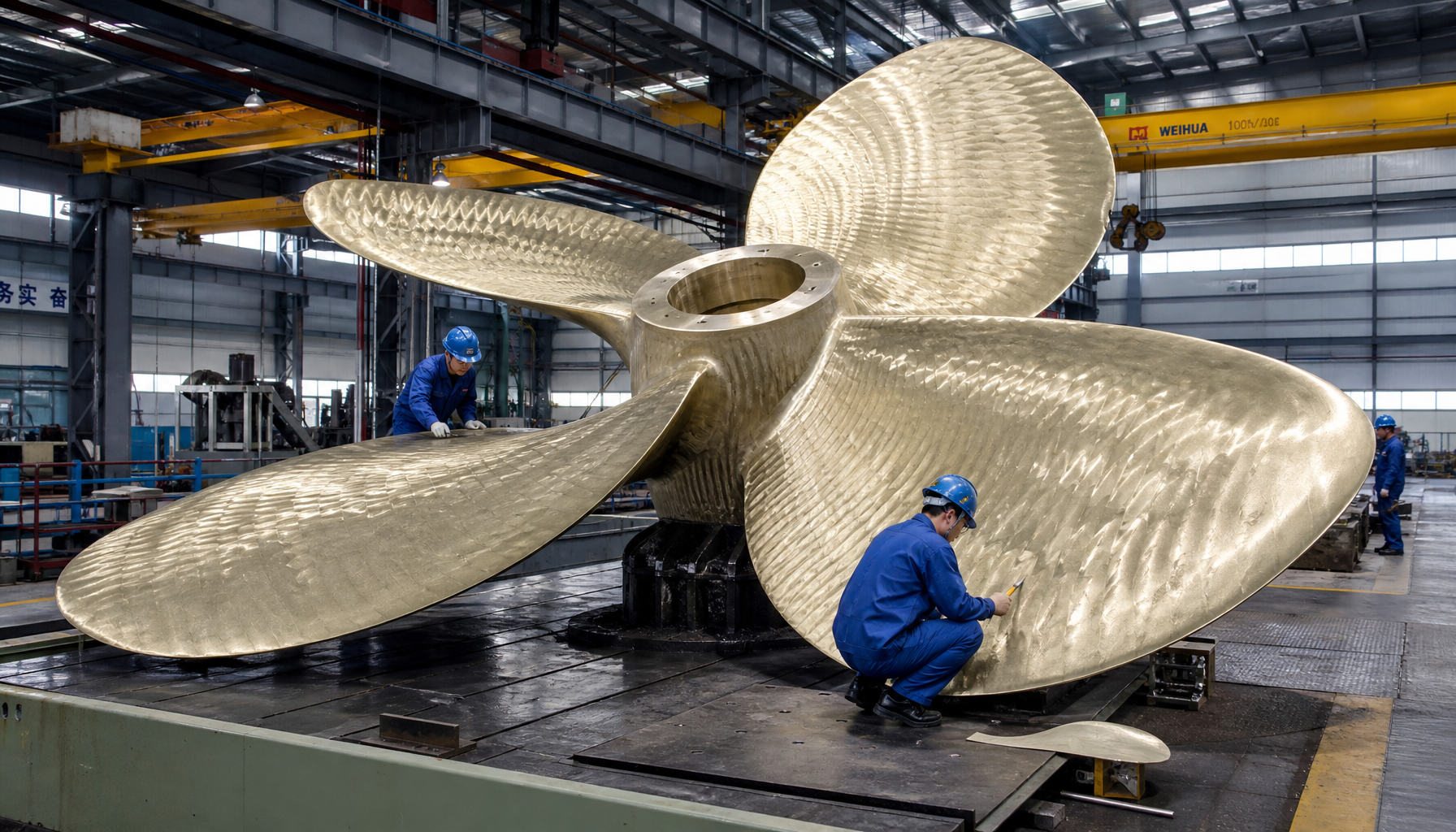
The call usually comes about seven months after installation.
A 32-metre purse seiner out of Sharjah, working the Gulf. Two new propellers fitted during a drydocking that the owner had been putting off for two years. Everything ran fine for the first month. Then the crew started noticing a hum at 780 rpm — a beat frequency that came and went with helm changes. By month six the port shaft bearing was running 14°C hotter than starboard, and the yard pulled the boat out again.
The starboard blade had a cavitation pit the size of a thumbnail on the leading edge, 60 mm inboard of the tip. The port propeller had an internal shrinkage cavity that only showed up when the surveyor sent a section for radiography.
Total damage: two replacement propellers, two shaft bearings, one lifted drydocking, and eleven days of lost fishing. Somewhere north of $40,000, on a set that cost $9,800 delivered.
The foundry had a certificate. The certificate had a heat number. The heat number matched a spectro report that showed C95800 nickel aluminum bronze. Except the propeller the boat actually received wasn't C95800. It was manganese bronze with enough nickel added to nudge the spectro readout into a grey zone — until the surveyor ran a density check.
This is not a rare story. Ask any fleet superintendent who sources from Asia and you'll get a version of it. Marine propeller casting in China can be genuinely excellent — there are foundries in Zhejiang and Jiangsu producing propellers for DNV-classed offshore vessels right now. But the distance between the good ones and the ones that will cost you a drydocking is not visible on a quotation sheet.
Here's how to tell them apart before you wire anything.
Why China Dominates Marine Propeller Casting (And What That Means For You)
China supplies a large share of the world's bronze propeller castings under about 4 metres diameter — many estimates put it above half. That's not a marketing claim, it's a procurement reality. Walk the propeller shops of Ningbo, Zhoushan, Qingdao and Dalian and you'll see the same thing: dedicated propeller foundries running sand-cast manganese bronze and NAB at volumes no European shop can match on price.
The reason is straightforward. Propeller casting is heavy, labour-intensive and pattern-dependent. A 1.2 m four-blade NAB propeller weighs around 180–260 kg depending on blade area ratio. Casting it means a wooden or foam pattern, a sand mould, a melt of maybe 400 kg, a 12-hour cooling cycle, then days of grinding, template checking and pitch measurement. Labour content is enormous. Material is a minority of cost.
That's why Chinese shops can quote $22–38 per kg finished for NAB small-craft propellers while a European foundry quotes $65–110 per kg for the same alloy and class. (These are typical 2026 quote ranges observed across trade inquiries, not a published index — treat as a ±20% indication.)
But the same economics that make Chinese propellers cheap also create the incentive to cut corners. If material is only 25–30% of your cost, substituting a cheaper alloy saves the foundry real money and is almost invisible to a buyer who only reads certificates.
So the question isn't "should I buy from China." It's "how do I make sure I get what I ordered."
The Five Failure Modes That Actually Bite Buyers
Forget the long tail. In practice, propeller problems from Chinese foundries fall into five buckets, and four of them are detectable before shipment.
1. Alloy substitution
The classic. You specify ASTM B148 C95800 nickel aluminum bronze. You receive something in the manganese bronze family — C86500, C86300 or an unclassified Mn-Cu alloy, which sit under ASTM B584 — with nickel content pushed up to fool a handheld XRF or a lazy spectro reading.
Why it matters: NAB has roughly double the cavitation resistance of manganese bronze in seawater at equivalent velocity. A blade that should last 12–15 years between dressings might pit noticeably in three.
How to catch it: optical emission spectrometry (OES) on a drilled sample, not handheld XRF. Plus a density check. NAB C95800 (ASTM B148) runs about 7.64 g/cm³. Manganese bronze C86500 (ASTM B584) runs about 8.3 g/cm³. That 8% gap is impossible to hide — weigh the propeller, compute volume from the CAD model, and the numbers either agree or they don't.
2. Internal porosity
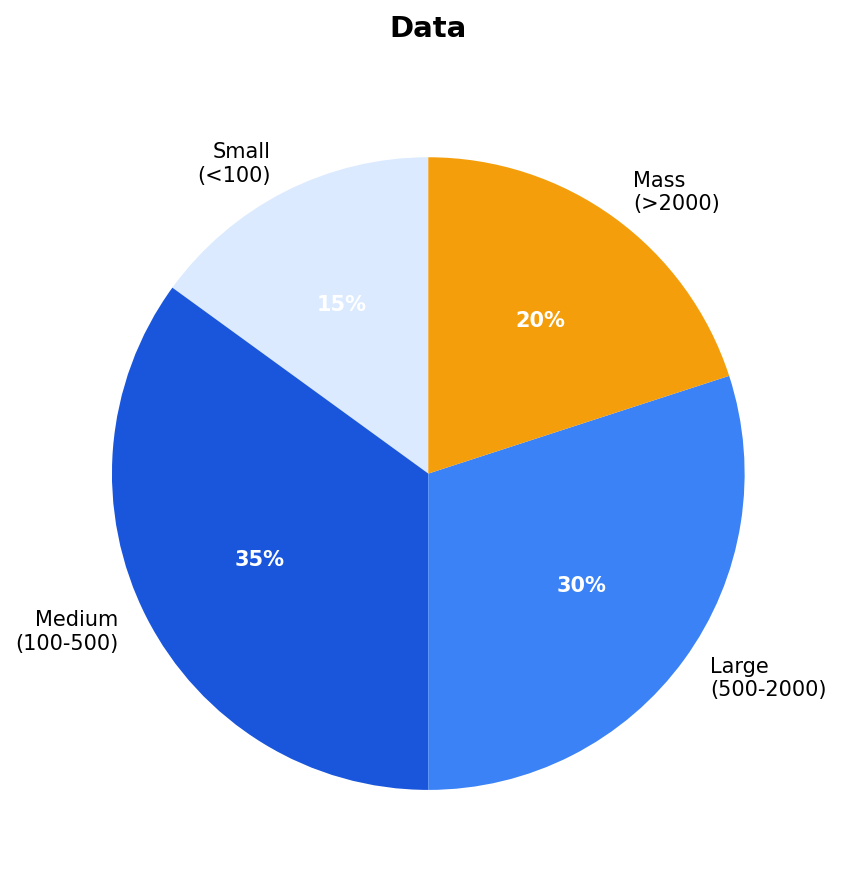
Shrinkage porosity in the hub is endemic to badly-run bronze casting. Copper alloys have a wide freezing range and a high solidification shrinkage — 4–6% by volume. If the foundry doesn't use adequate feeders, chills and a proper pouring temperature, you get sponge in the thickest section. Which is exactly where the blade root fillet is.
The nasty part: shrinkage porosity doesn't show on the surface. It shows up eight months later as a crack propagating out of the root fillet, usually right after a heavy weather passage.
How to catch it: radiography per ASTM E272 (reference radiographs for copper-base alloy castings) on the hub and blade roots. Note that ultrasonic testing is unreliable on bronze — the coarse grain structure attenuates the beam badly. Any foundry offering "UT on bronze propeller" as their primary NDT is either confused or hoping you are.
3. Pitch and blade geometry errors
Blade pitch is what turns engine power into thrust. Get it wrong by 2% and you either lose speed or overload the engine. Get two blades wrong in opposite directions and you get a vibration that no amount of shaft alignment will fix.
The tolerance framework here is ISO 484, which defines manufacturing tolerance classes S, I, II and III. Most Chinese foundries will cheerfully quote "ISO 484" without naming a class, because Class III is dramatically cheaper to hit than Class S.
4. Balance and blade weight scatter
Static balance is the minimum. Dynamic balance matters above roughly 500 rpm shaft speed. A propeller can be statically balanced and still vibrate if blade weights scatter by 1.5% — which happens constantly on hand-ground blades where nobody re-weighed after grinding.
5. Certification theatre
This is the one that catches experienced buyers. The paperwork looks perfect: mill certificate, heat number, spectro report, dimensional report, class society stamp. The problem is that the paperwork describes a different propeller, or a different heat, or a sample that was cast separately as a "witness coupon" and never went into your casting.
The tell is usually chronological. A spectro report dated eleven days before the pour. A radiography report referencing a film density that doesn't match the section thickness you specified. A certificate issued by a "surveyor" whose name doesn't appear on the class society's published surveyor list.
Verify every name and every date against the class society directly. It takes twenty minutes and it's the highest-return twenty minutes in the whole purchase.
What You Should Actually Specify in the RFQ
Vague inquiries get vague propellers. Here's what needs to be on the drawing or the specification sheet you send out.
| Parameter | What to write | Why it matters |
|---|---|---|
| Alloy standard | ASTM B148 C95800 (NAB) or ASTM B584 C86500 (Mn bronze) | A standard name plus UNS number removes interpretation room |
| Chemistry limits | Full table: Cu, Ni, Al, Fe, Mn, Si, Pb max 0.03% | Lead is added for machinability and destroys cavitation resistance |
| Mechanical props | Tensile, yield, elongation per ASTM E8; hardness per ASTM E10 — minimum values | Ensures proper heat treat / cooling, not just chemistry |
| Diameter & pitch | Exact values plus ISO 484 class | Class is the price driver; unspecified class = Class III |
| NDT | RT on hub and blade roots per ASTM E272, Level 2 acceptance | Catches internal porosity before shipment, not after |
| Balance | Static balance, max allowable residual, ISO 1940-1 G6.3 or better | G6.3 is fine under 500 rpm; G2.5 for high-speed craft |
| Taper & keyway | ISO 4566 or SAE J755 taper, keyway per drawing | Bad taper fit destroys the shaft, not just the propeller |
| Class approval | Named society: ABS, DNV, LR, BV, ClassNK, CCS | Approval is per-society and per-material — check both |
One more line worth adding to every RFQ: "Witness testing and third-party inspection at buyer's nominated agency, cost to buyer." Foundries that object to this are telling you something.
ISO 484 Tolerance Classes, Decoded
ISO 484-1 covers propellers over 2.50 m diameter. ISO 484-2 covers 0.80 m to 2.50 m. Both define four classes. Here's the practical version.
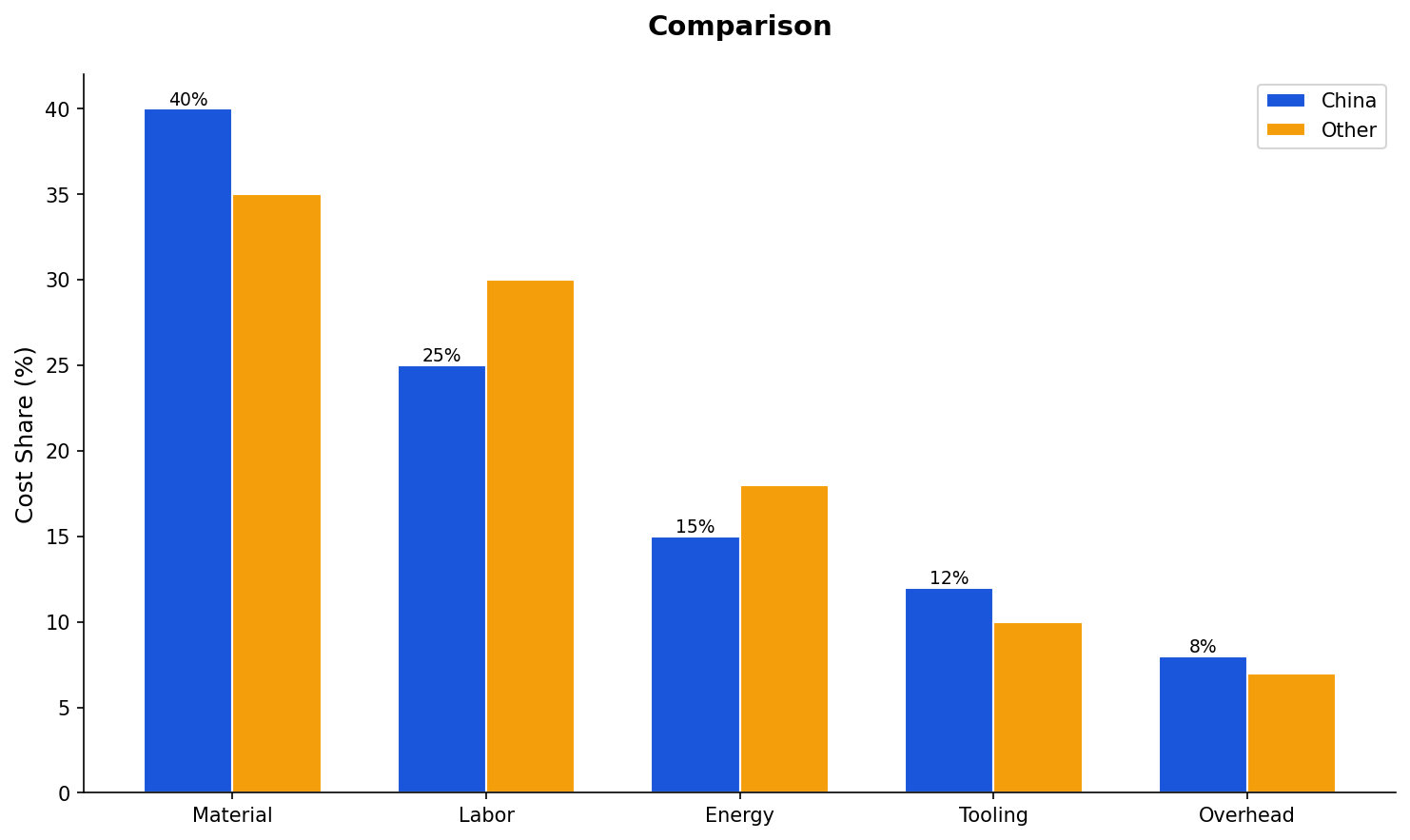
Rough working figures for pitch accuracy, which is the number that drives vibration:
- Class S — pitch tolerance around ±0.5%. Superyachts, fast ferries, patrol craft, anything above 25 knots.
- Class I — around ±0.75%. Commercial workboats, tugs, fishing vessels, pilot boats.
- Class II — around ±1.0%. General cargo, displacement hulls under 15 knots.
- Class III — around ±1.5% or looser. Slow-speed barges. Rarely appropriate for anything else.
Expect Class S to carry a 25–45% price premium over Class II on the same casting, mostly because of the additional template work, hand finishing and measurement labour. That premium is usually worth paying. A Class II propeller on a 22-knot ferry will vibrate, and the shaft bearing replacement alone will exceed the difference.
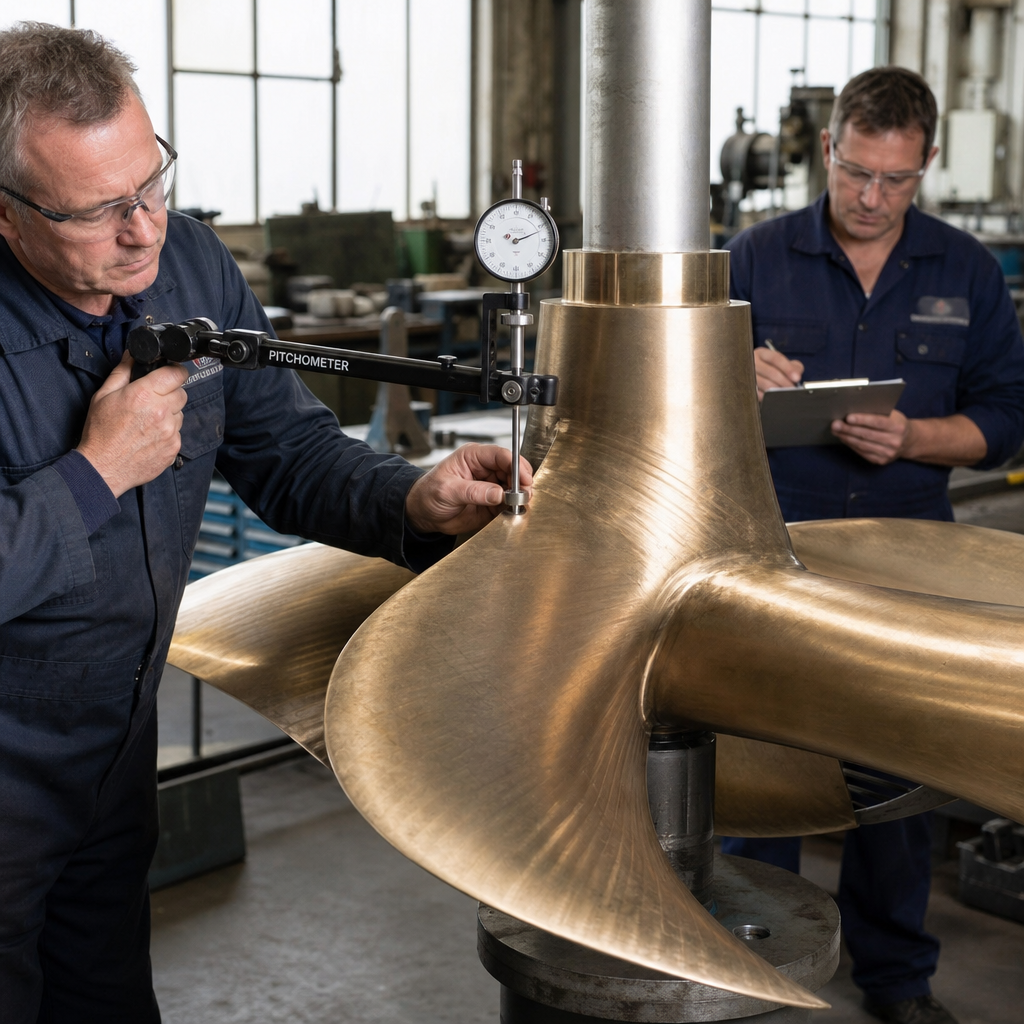
Ask for the pitch measurement report with the actual measurement grid — blade angle at defined radii (typically 0.3R, 0.4R, 0.5R, 0.6R, 0.7R, 0.8R, 0.9R, 0.95R) for each blade. A report that says "pitch within tolerance" without numbers is not a report.
Sand Casting vs Investment Casting: Which Shop Do You Need
The two processes serve different size ranges, and picking the wrong supplier type wastes weeks.
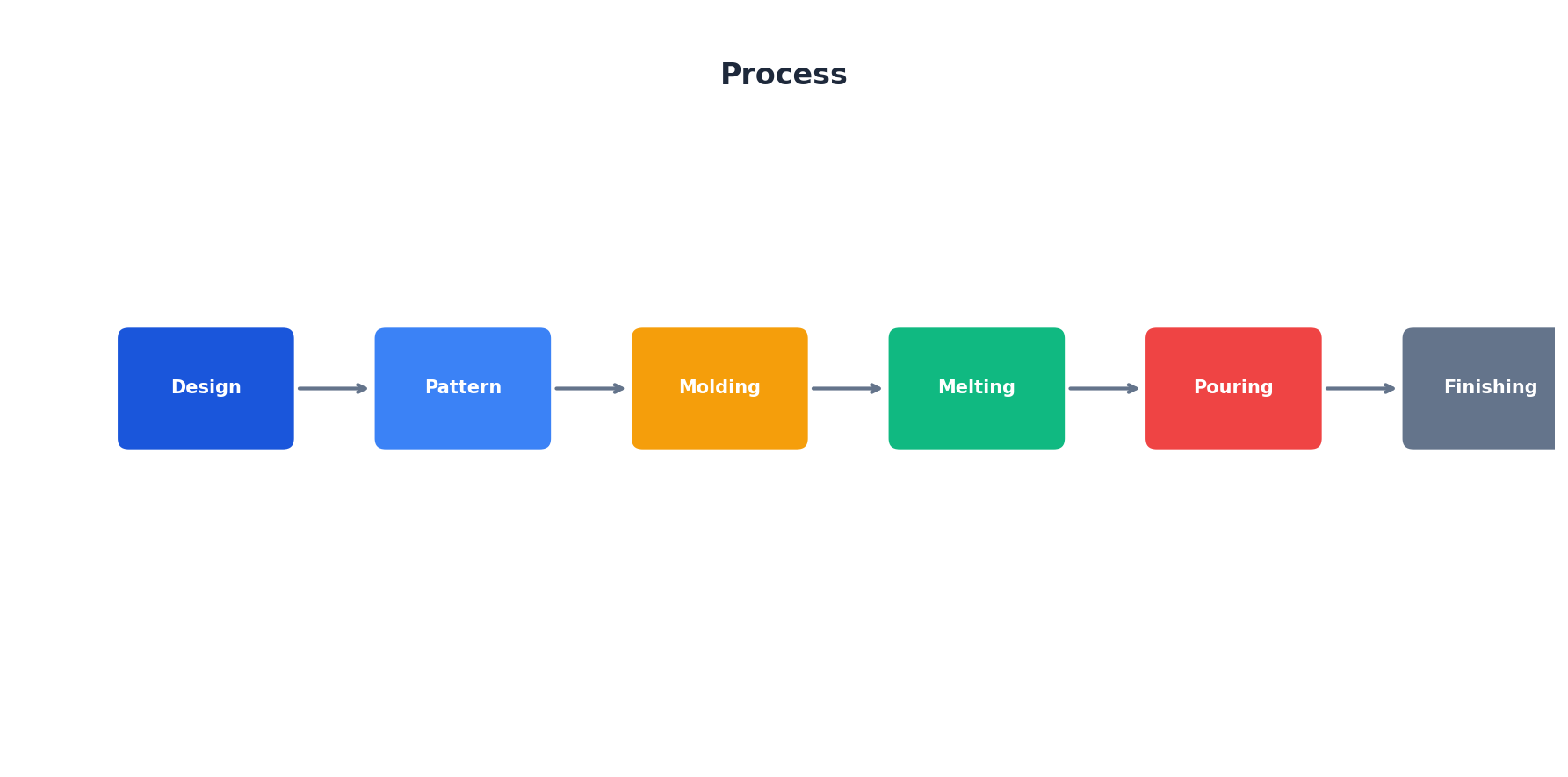
Sand casting handles propellers from about 300 mm up to 4 m and beyond. Pattern cost is low relative to part value, tooling lasts for many parts, and it's the standard route for anything commercial. Surface finish is rougher, dimensional consistency is looser, and you'll rely on machining and hand finishing to hit Class S or Class I geometry.
Investment casting (lost wax) is used for smaller propellers, typically under 600 mm, and for high-volume series like outboard and sterndrive propellers. Better surface finish and tighter as-cast tolerances, but the ceramic shell cost per unit punishes low volumes. For a one-off 400 mm NAB propeller, sand casting is usually cheaper and faster.
What you actually want to check is whether the foundry owns its own finishing and machining capability. A shop that casts and then subcontracts pitch measurement to a third party is a shop that cannot control its own quality. Ask which operations happen under their roof: moulding, melting, heat treat, grinding, template check, pitch measurement, dynamic balancing, final machining. Anything outsourced is a handoff where documentation gets creative.
The Inspection Stack: What to Demand at Which Stage
Third-party inspection on propellers isn't expensive relative to the risk. A typical pre-shipment inspection by SGS, Bureau Veritas or TUV on a mid-size propeller runs $700–1,800 depending on scope and travel, and takes one to three days on site. Compare that to the cost of a drydocking.
Here's a sensible sequence:
- Before pouring — witness the charge make-up. Confirm the ingot or scrap composition and the alloy being charged matches the spec. This is where substitution actually happens, and it's over in an hour.
- At pour — record pour temperature and mould temperature. NAB wants a controlled, relatively low superheat to avoid gas porosity. If someone is pouring at 1,300°C with a wet mould, you'll find out later.
- After shakeout — visual and dimensional. Check for surface porosity, cold shuts, misruns. Check the hub bore and keyway before any machining.
- Chemical analysis — OES on a sample drilled from the hub, plus the density check described above. Do not accept a spectro from a separately-cast coupon.
- Mechanical testing — one test bar per heat, machined from a separately cast ASTM test coupon poured from the same ladle as your propeller. Tensile, yield and elongation per ASTM E8, hardness per ASTM E10.
- Radiography — hubs and blade roots. ASTM E272 reference radiographs, Level 2 acceptance unless your class society specifies otherwise.
- Dimensional and pitch — full pitch grid, blade thickness at defined radii, diameter, hub bore, keyway dimensions, taper fit check with a mating gauge where possible.
- Balance — static balance with the correction weight recorded, or dynamic balance if you're above 500 rpm shaft speed.
- Final — surface finish check, marking (heat number, alloy, class, weight stamped into the hub), documentation package review.
That's the full stack. For a $3,000 propeller it's overkill. For a $60,000 set going onto a classed vessel, it's table stakes.
Class Society Approvals: Read the Scope, Not the Logo
ABS, DNV, Lloyd's Register, Bureau Veritas, ClassNK and CCS all maintain approved manufacturer lists for propeller castings. Chinese foundries hold many of these approvals, and holding one is a genuinely meaningful signal.
But there are two traps.
Trap one: the approval doesn't cover your material. A foundry may be approved for steel castings but not for copper alloys, or approved for Mn bronze but not NAB. Approvals are material-specific. Ask for the certificate and read the scope paragraph.
Trap two: the approval doesn't cover your size or product form. Some approvals are limited to propellers under 2.5 m, or to a specific pouring weight range. Your 3.2 m five-blade doesn't qualify if their approval tops out at 2.5 m.
There's also a third scenario worth naming: the foundry isn't on the approved list at all and offers to "get the propeller surveyed" by the class society on a one-off basis. That's a legitimate route — it's called unit certification — but it's a different process. It means a surveyor attends the pour and the tests, and it adds cost and lead time. Get that quoted in writing upfront rather than discovering it at the dock.
Marine Propeller Casting Cost in China: What to Expect in 2026
Price ranges are useful only if they're attached to a specification. The same nominal dimensions can swing 40–60% depending on alloy, ISO 484 class, NDT scope and whether class survey is included. Here's a rough cut for the 2026 Chinese foundry market, all for sand-cast propellers delivered FOB.
| Propeller size / alloy | Typical China FOB (finished) | Typical Europe ex-works | Notes |
|---|---|---|---|
| Under 1 m, Mn bronze C86500 | $18–28/kg | $55–90/kg | Class II or unclassified; river and displacement use |
| Under 1 m, NAB C95800 | $28–42/kg | $75–130/kg | Class I typical; add 25–45% for Class S |
| 1–2.5 m, NAB C95800 | $24–36/kg | $65–110/kg | Pattern amortization favours repeat sizes |
| Over 2.5 m, NAB C95800 | $22–34/kg | $60–105/kg | Class survey and RT drive the variance |
| 17-4PH stainless | $55–95/kg | $140–240/kg | Roughly 1.8–2.5× NAB equivalent |
These are observed trade-inquiry ranges, not a published index. Treat them as ±20%. The important number is not the per-kg price — it's the total landed cost including inspection, freight, duty and the probability of a re-do. A $24/kg quote on an as-cast Class III propeller without RT is not a bargain; it's a different product.
Lead Times: What's Realistic From a Chinese Foundry
Anyone promising a classed 3 m NAB propeller in four weeks is either quoting from stock or planning to skip a step. Realistic timelines, from PO to FOB:
- Pattern making (new design): 2–4 weeks. Non-negotiable — rushing this is where geometry errors enter.
- Under 1 m, Class I, no class survey: 4–7 weeks total including machining and balance.
- 1–2.5 m, Class I, NAB: 6–10 weeks total.
- Over 2.5 m with class survey: 10–16 weeks, plus surveyor scheduling, which in a busy yard can add 1–2 weeks on its own.
Two practical notes. First, book the surveyor's slot at the same time you place the PO — waiting until the casting is ready to arrange survey is the most common cause of a two-week slip. Second, leave buffer for radiography re-shoots. A single RT finding on a hub is normal; a re-shoot and re-inspection cycle adds 5–10 days and shouldn't be a surprise.
What Drives the Price (So You Can Spot a Lowball)
When a quote comes in 40% under everything else, it's coming out of somewhere. Here are the levers a foundry can pull.
| Cost driver | Typical share of price | What a lowball quote compromises |
|---|---|---|
| Alloy and charge material | 25–35% | Substitutes Mn bronze, or dilutes NAB with scrap |
| Pattern and tooling | 5–15% one-off | Reuses worn patterns, off by 1–2% on geometry |
| Melting and pour labour | 10–15% | Skips temperature control, under-feeds the hub |
| Grinding and finishing | 15–25% | Leaves as-cast surface, ignores leading edge profile |
| Pitch and template work | 8–15% | Drops from Class I to unclassified, hand-eyeballs it |
| NDT and testing | 3–8% | Cuts RT entirely, reuses another job's certificates |
| Balance and machining | 8–15% | Static balance only, sometimes not even that |
| Class survey and admin | 3–7% | Quotes unit certification as if it were covered by approval |
Note that finishing is the single biggest labour line. A foundry that quotes rock-bottom is almost certainly delivering an as-cast propeller with a rough grind. That's not necessarily fraudulent — it's just a different product than what you thought you were buying. Which is why the specification sheet matters so much.
The 7-Point Verification Before You Send the Deposit
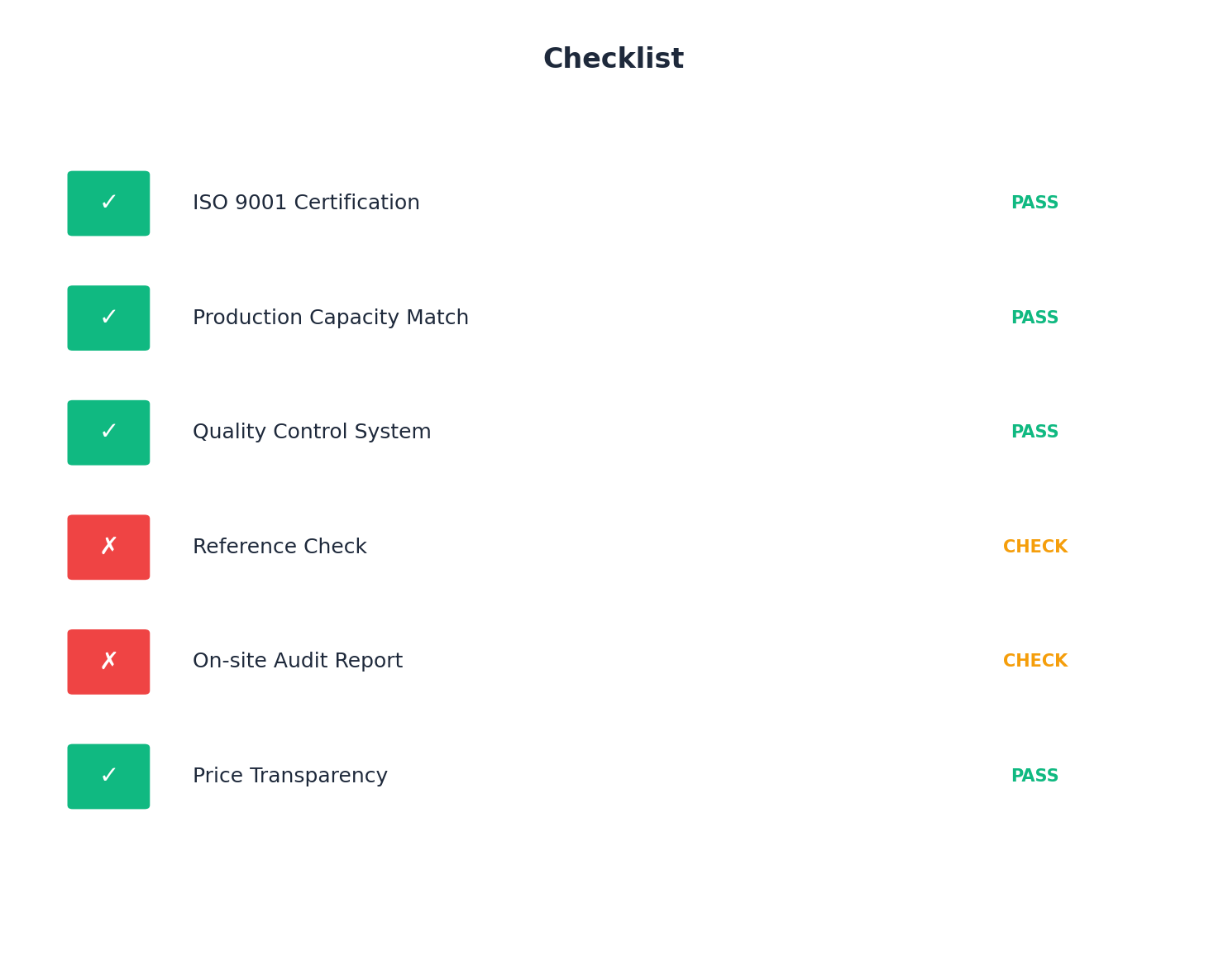
Run this in order. Any "no" is a reason to keep shopping.
- Pull the class society approval certificate and read the scope paragraph. Confirm it names your alloy and covers your diameter. Verify the certificate number on the society's own website — not a PDF the foundry sent you.
- Get the test plan in writing. Which lab, which method, which acceptance criteria. OES plus density check. No exceptions, no substitutions with handheld XRF.
- Name the ISO 484 class explicitly in the PO. "ISO 484 Class I" — not "ISO 484." If they push back on the class, they're telling you what they can actually hold.
- Require radiography on hub and blade roots. ASTM E272 acceptance, Level 2 or tighter. Ask for the film or digital images, not just a summary report.
- Nominate your own third-party inspector. Not the foundry's. Budget for a pre-pour witness and a pre-shipment inspection. The pre-pour visit is the one that matters most and the one most buyers skip.
- Demand the pitch measurement grid with actual numbers. Every blade, every radius. Cross-check against your design values. A report without numbers is not a report.
- Video call the shop floor during your job. Ask to see the mould, the pattern, the melt, the finished casting on the bed. Foundries with nothing to hide say yes immediately. Foundries that stall or route you to a sales office for two weeks have answered the question already.
Common Mistakes That Cost Buyers Real Money
Buying on per-kilogram price alone. A quote at $24/kg on a Class III as-cast propeller is not comparable to $34/kg on a Class I with full RT and balancing. Normalize the spec before you compare numbers.
Accepting a spectro report from a separately cast coupon. That coupon came from a small, carefully controlled melt. Your propeller came from a 600 kg ladle. They are different objects.
Skipping the pre-pour inspection to save $900. This is the single highest-leverage spend in the entire purchase. Once the metal is solid, your ability to influence the outcome drops to near zero.
Ordering only one propeller for a twin-shaft vessel. If you replace one prop and not the other, you'll never know whether the vibration is the new blade or the old one. Order both, or accept the diagnostic blind spot.
Assuming the pattern is right because the casting fits it. Patterns wear. A pattern that's 1.5% oversized produces a propeller that's 1.5% wrong everywhere, and it will pass every fit check because the whole thing is proportionally wrong. This is why dimensional reports must reference absolute design values, not pattern-derived ones.
Not specifying the leading edge. The leading edge profile of a propeller blade is where cavitation begins. If your drawing says "sharp leading edge" and the foundry interprets that as "grind until it looks thin," you get an edge that's too sharp, which erodes faster than a properly radiused one. Specify the radius.
Frequently Asked Questions
Is NAB better than manganese bronze for my application?
For anything running above about 12 knots, or operating in abrasive or high-silt water, yes — and the gap is large. NAB C95800 (ASTM B148) has roughly double the cavitation erosion resistance of Mn bronze C86500 (ASTM B584). It costs 40–70% more in material. For a river barge doing 8 knots in calm water, manganese bronze is fine and saves real money. For a ferry, a tug, or anything that sees rough water at speed, the material premium pays back inside one drydocking cycle.
Can I use 17-4PH stainless instead?
Yes, and it's common on high-speed craft and superyachts where thin blade sections are needed or where the propeller operates at very high tip speeds. 17-4PH (UNS S17400) gives roughly 1.6× the cavitation resistance of NAB and much higher yield strength. Expect 1.8–2.5× the cost of an equivalent NAB casting, plus heat treatment tolerance requirements (H900 or H1025 condition, specified on the PO). It's more sensitive to casting quality than NAB — porosity in a stainless propeller is more dangerous because of the higher loads the thinner sections carry.
What ISO 484 class should I specify?
Class S for fast ferries, patrol craft, superyachts, anything above 25 knots or with strict vibration limits. Class I for commercial workboats, tugs, fishing vessels, pilot boats — this is where most buyers should land. Class II for slow displacement hulls under 15 knots. Never accept unclassified pitch, and never accept Class III on anything that planes or runs above 12 knots.
How do I verify the alloy before shipment?
Two things together: OES chemical analysis on a sample drilled from the hub of your actual casting, and a density check. Weigh the finished propeller on a calibrated scale, calculate volume from the CAD model, and divide. NAB C95800 lands around 7.64 g/cm³, manganese bronze C86500 around 8.3. An 8% deviation is unmissable and no amount of certificate work can cover it.
How long should a custom propeller take?
Under 1 m: 4–7 weeks including pattern, casting, machining and balance. 1–2.5 m: 6–10 weeks. Over 2.5 m with class survey: 10–16 weeks. Add 2–4 weeks if the pattern doesn't exist yet. Anyone promising a classed 3 m NAB propeller in four weeks is either quoting from stock (ask which) or planning to skip something.
What should I budget for third-party inspection?
Pre-pour witness visit: $600–1,200 including travel, one day. Full pre-shipment inspection with dimensional and pitch verification: $700–1,800. Combined package with radiography review: $1,500–3,000. On a propeller set worth $20,000+ going onto a classed vessel, that's 8–12% of the purchase and it catches the failure modes that cost ten times that amount.
Do I need a Chinese trading agent, or can I buy direct?
Direct works if you have someone on the ground for inspection and can handle the documentation, export paperwork and payment mechanics. Direct fails badly when the only eyes on the product are the foundry's own QC staff. The middle path most buyers take: buy direct from the foundry but nominate an independent inspection agency and a separate payment escrow. You keep the foundry margin and you keep the verification.
Next Steps
Marine propeller casting in China is a good deal when you control four variables: alloy, tolerance class, internal soundness, and documented verification. The foundries that can deliver all four exist — plenty of them, in Zhejiang, Jiangsu and Shandong. The ones that can't will still quote you, and their quote will look attractive.
The difference between the two is not visible on a price sheet. It's visible in whether they let you witness the pour, whether they name an ISO 484 class in the PO without arguing, and whether they hand over the pitch measurement grid with real numbers.
Start with the seven-point list above. Run it against two or three foundries. The one that clears all seven without friction is your supplier.
Get the Propeller Sourcing Pack
A ready-to-send RFQ template with the full ASTM B148 chemistry table, the ISO 484 pitch acceptance grid, the RT acceptance criteria and the seven-point verification checklist. Built so you can drop it into an inquiry today.
Download the RFQ Template Arrange Pre-Pour Inspection
No cost, no signup wall. Sent as a PDF and an editable spreadsheet.