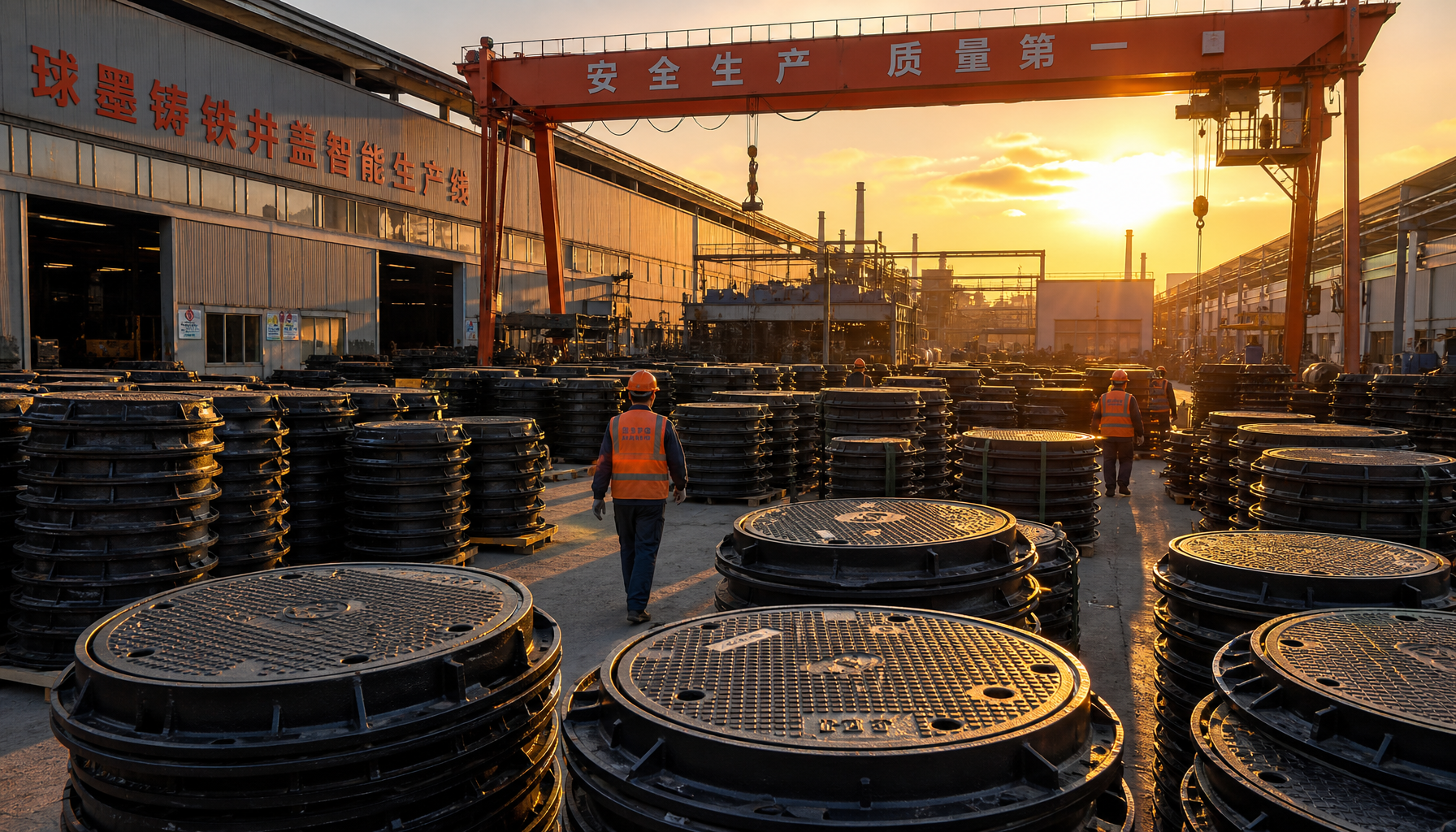
Twelve months ago, a municipal contractor in Rotterdam wired a 30% deposit on 40 tons of D400 ductile iron covers. The quote came in $180 a ton below everyone else's. The samples looked right. The catalog was glossy.
Four months later, the container landed. The covers weighed 68 kg each instead of the 85 kg on the drawing. A scrap test on three of them snapped like a biscuit — gray iron, not ductile. No spheroidization report, no tensile certificate, no heat numbers. The supplier's "factory" turned out to be a two-desk office in a commercial building, and the actual foundry had already disowned the order.
That buyer paid $32,000 for 40 tons of iron that will never see a road, another $9,000 on return freight, and three weeks explaining to a city council why the intersection on Prins Hendrikkade was still open.
The details are anonymized. The pattern isn't unusual — it surfaces on buyer forums every quarter, and it always starts the same way: a quote that looks too good, and a buyer who didn't know which questions to ask.
This guide is what those questions look like. Below is what actually goes wrong when you source manhole covers from China, how to spot a fake factory in ten minutes, the tests you should never skip, and a five-point audit you can run on your next video call.
The Seven Ways a Manhole Cover Order Goes Wrong
After enough orders, the failure patterns stop being random. They cluster. Here's what you're actually defending against.
1. Underweight castings
The single most common scam. A D400 cover specified at 85 kg arrives at 70 kg. It's cheaper to make, cheaper to ship, and it passes a visual inspection. It also fails load testing somewhere around 300 kN instead of the 400 kN it's supposed to hold. This is the number one reason covers crack in service within 18 months.
2. Wrong iron grade
Gray iron (EN-GJL-200) costs roughly 15-20% less per ton than ductile iron (EN-GJS-500-7). They look identical from the outside. They behave completely differently when a 40-ton truck rolls over them. Gray iron shatters; ductile iron deforms. On a European or North American road, using gray iron where ductile is specified is a liability event waiting to happen.
3. Coating that isn't what the certificate says
You specify 250 μm epoxy. You receive 60 μm of bitumen paint with a fake coating thickness certificate. It'll survive the sea freight and fail within two years on a salted road.
4. Gap and seating tolerances that don't close
EN 124 puts hard limits on the gap between cover and frame, and on the difference in level between them. If you don't measure it, nobody will. A cover that rocks will rattle itself loose within a season.
5. Missing or fabricated test certificates
A tensile report with a logo on it is not a tensile report. If the heat number on the certificate doesn't trace back to a furnace batch, it's decoration.
6. Breakage in transit
Improper stacking, no dunnage between layers, covers loaded flat instead of on edge. You pay for 250 sets, you receive 244 usable ones and a pile of chips.
7. The delivery date that moves three times
Usually caused by the supplier being a trader who is negotiating with a factory that has already filled its furnace schedule. Your order gets bumped.
First, Be Precise About What You're Ordering
Half of all disputes trace back to a vague purchase specification. Before you talk to a single supplier, lock down four things: load class, material grade, dimensions, and coating system.
Load classes, and why they matter more than the price
EN 124 defines six classes based on test load. Here's the practical mapping:
| Class | Test Load | Where it's used | Typical 600×600 cover + frame weight |
|---|---|---|---|
| A15 | 15 kN | Pedestrian zones, gardens, green areas | 35-45 kg |
| B125 | 125 kN | Footpaths, car parks, driveways | 50-60 kg |
| C250 | 250 kN | Kerb-side channels, hard shoulders | 65-75 kg |
| D400 | 400 kN | Roadways, carriageways, motorway hard shoulders | 80-95 kg |
| E600 | 600 kN | Docks, aircraft pavements, heavy traffic | 110-135 kg |
| F900 | 900 kN | Airport runways, high-load areas | 150 kg+ |
That weight column is not trivia. It's your first filter. If a supplier quotes you a D400 cover at 70 kg and says it's "the same thing," you've just learned something about them.
Material: gray iron or ductile iron?
Get this in writing on the PO, with the exact standard designation:
- Ductile iron: EN-GJS-500-7 under EN 1563, or QT500-7 under GB/T 1348. Tensile strength ≥ 500 MPa, yield ≥ 320 MPa, elongation ≥ 7%. This is what you want for D400 and above.
- Gray iron: EN-GJL-200 under EN 1561, or HT200 under GB/T 9439. Tensile strength around 200 MPa, essentially zero elongation. Fine for A15 and B125 in light service. Not fine for roads.
- US market: ASTM A536 for ductile iron (Grade 60-40-18 or 65-45-12), ASTM A48 Class 35/40 for gray iron.
Specify the mechanical properties, not just the material name. "Ductile iron" means nothing in a dispute. "EN-GJS-500-7, elongation ≥ 7%, tensile ≥ 500 MPa, verified by tensile test per batch" means everything. If you're still weighing which grade your project actually needs, this breakdown of ductile versus gray iron covers the failure modes side by side.
Dimensions and tolerances
Quote the standard, not just the drawing. EN 124 specifies maximum clearance between cover and frame, and maximum difference in level. For D400, the gap limit is tight enough that a sloppy molding line will fail it. Ask the supplier to state their achieved tolerances in writing before you order.
Coating system
Three common options:
- Bitumen paint: 50-100 μm. Cheapest. Acceptable for dry, low-traffic markets. Fails fast in coastal or salted-road conditions.
- Epoxy coating: 200-300 μm. Standard for European municipal specifications. Demand the coating thickness test report per batch.
- Hot-dip galvanizing: 70-85 μm zinc. Used where corrosion resistance matters more than cost, common in Middle East and marine projects.
Whatever you pick, put the micron thickness on the PO. Vague coating specs are where money quietly leaks.
The Weight Trap: Why the Cheapest Quote Is Never Cheap
Here's the math that should reframe your entire supplier comparison.
Say you need 2,000 D400 covers. The correct weight is 85 kg. A lowball quote assumes 70 kg.
Correct weight: 2,000 × 85 kg = 170,000 kg = 170 tons
Lowball weight: 2,000 × 70 kg = 140,000 kg = 140 tons
Difference: 30 tons of iron that you paid for and never received
At a genuine FOB price of roughly $850-1,050 per ton for finished ductile iron covers in 2026, that's $25,500 to $31,500 of missing material — hidden inside a quote that looked $40,000 cheaper.
And that's before the liability. An underweight cover on a D400 road fails load testing. When it cracks, the repair bill and the insurance claim land on you, not the foundry.
So the first question you ask a manhole cover casting supplier in China is not "what's your price." It's:
"Send me the calculated weight per drawing, broken down by cover and frame, and confirm it on the proforma invoice."
A real foundry will send it within a day, because they calculated it before quoting. A trader will send a rounded number and hope you don't check.
Trading Company or Real Foundry? Ten Minutes to Tell
You don't need to fly to China for this. You need four questions and the willingness to ask them on a video call.
Question 1: What's on the business license?
Ask for a photo of the business license (营业执照) and look at the registered business scope. If it lists "casting production" or "metal casting," you're dealing with a manufacturer or an affiliated sales entity. If it lists "trade," "import and export," or "wholesale," you're dealing with a middleman. Middlemen aren't automatically bad — but the price and the accountability are different, and you deserve to know which one you're buying from.
Question 2: Show me the melting shop.
Ask for a live, unscheduled video walkthrough. Not a pre-recorded factory tour video — anyone can license footage. Ask them to walk past the furnace, the molding line, and the pouring station while you're on the call. Ask them to pan to the sand reclamation system or the shot blasting machine.
If the answer is "our factory is in another province, the sales office is here," that's a trader. Which is fine — as long as you then ask who the factory is, and get a name.
Question 3: Where's the lab?
A foundry producing D400 ductile iron needs a spectrometer for chemistry, a tensile testing machine, and a metallographic microscope for nodularity. If the answer to "can I see the lab" is vague, that's your answer.
Question 4: How many heats per day?
This is a good trap question. A real foundry production manager knows: "six heats a day, about 8 tons each." A trader will say "we have strong production capacity" and change the subject.
The Five-Point Factory Audit for a Manhole Cover Casting Supplier in China
Once you're past the sniff test, run this. It takes about 40 minutes on a video call and it has caught more bad suppliers than any sample order.
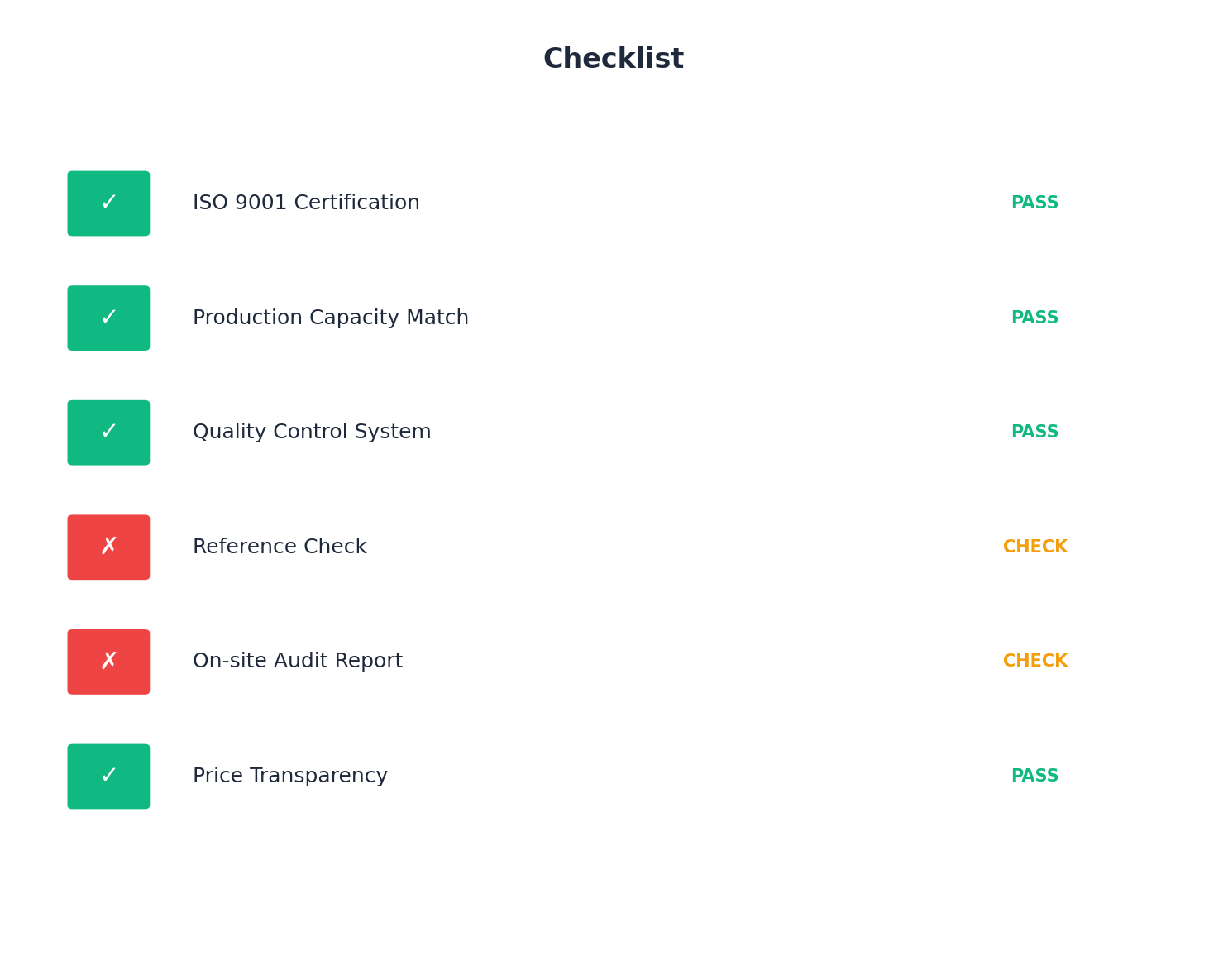
Point 1 — Legal identity and casting scope
Business license, registered capital, years in operation, and the registered address — that last one matters most. Then cross-check that address against the address on their export documents. If they don't match, ask why.
Point 2 — Production floor walkthrough
You want to see, live: the melting furnace, chemical analysis happening, the molding line, the pouring line, the cooling area, the shot blasting booth, and the coating line. Six stages. If any of them is "at our partner factory," you've found the gap.
Point 3 — Testing capability
Ask them to run a live tensile test while you watch, or at minimum, show you a recent tensile curve with the heat number. Ask to see the metallographic photo of a nodularity sample. A ductile iron foundry that can't produce a nodularity photo on demand is a ductile iron foundry in name only.
Point 4 — Recent export documentation
Ask for three bills of lading from the last six months, with the buyer names redacted. This tells you whether they genuinely export, and to which markets. A supplier claiming strong European experience who can only show one shipment to a neighboring country is telling you something.
Point 5 — A reference customer you can actually call
Ask for two references in markets similar to yours, and actually call them. Not email — call. Fifteen minutes on the phone with a buyer who has ordered three times will tell you more than any catalog. Ask specifically: "Did the weights match the drawing? Did anything arrive cracked? How did they handle it?"
Tests You Should Demand Before the Container Leaves
Don't wait for arrival. Every one of these can happen at the factory, in front of a third-party inspector, before the container is sealed.
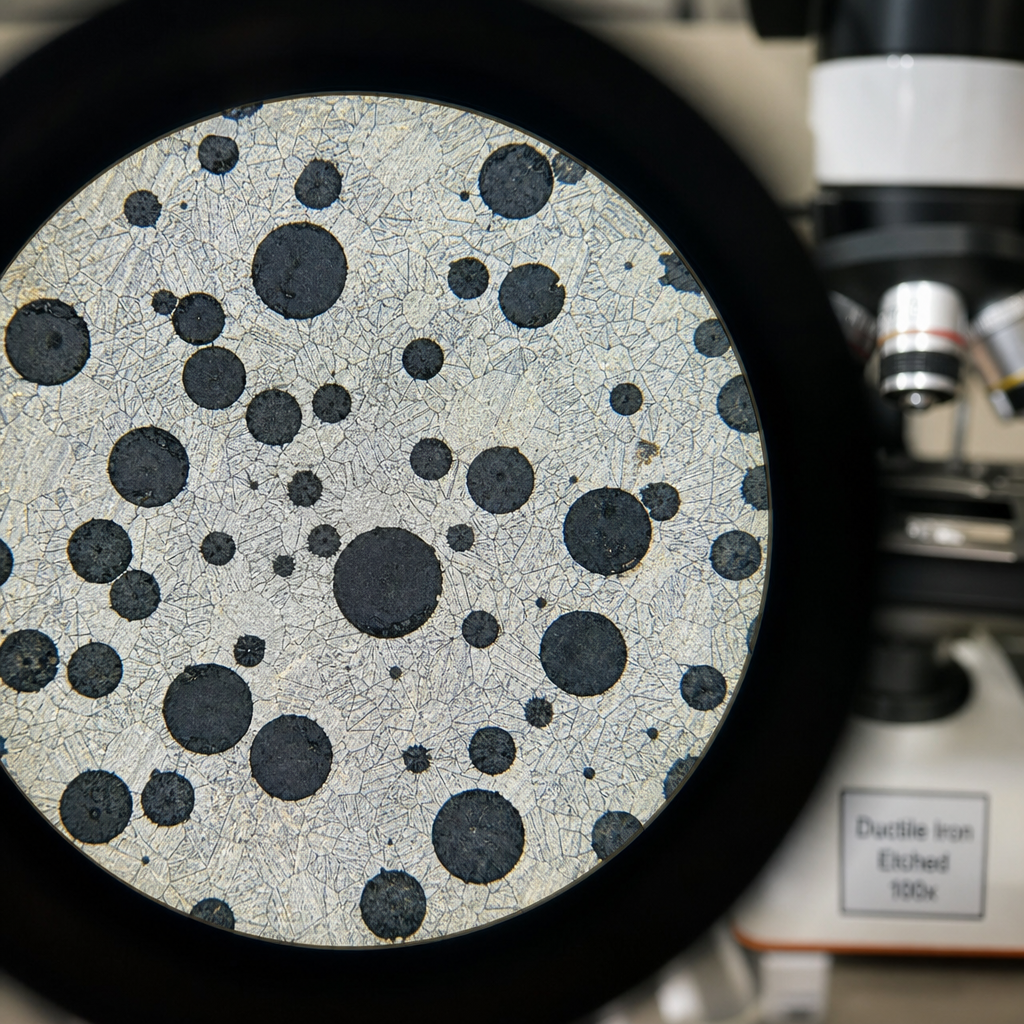
- Chemical analysis: Spectrometer report per heat, showing carbon, silicon, manganese, phosphorus, sulfur, and magnesium. Magnesium in the 0.03-0.06% range is a decent indicator that nodularization actually happened.
- Tensile test: Minimum one test per heat, or per agreed batch. You want the raw curve, not just a pass/fail line.
- Nodularity check: Metallographic examination, graphite nodularity ≥ 85% and nodule count per mm². This is the test that catches "gray iron painted to look like ductile iron."
- Hardness: Brinell, typically 170-230 HB for EN-GJS-500-7. Out-of-range hardness signals a heat treatment or cooling problem.
- Load test: If your volume justifies it, arrange a full EN 124 load test at a certified lab. Costs $400-800 per class test. Worth it once per order for a new supplier, or per production run if the stakes are high.
- Dimensional check: Cover diameter, frame opening, verticality, and the cover-to-frame gap. Measure ten random pieces, not the ones the factory picked.
- Coating thickness: Magnetic gauge, ten readings across the face and sidewall, per batch.
- Weight check: Weigh ten random covers. If the average is more than 3% below drawing, stop the shipment.
Third-party inspection from SGS, BV, TÜV, or Intertek runs roughly $300-600 per man-day in China, plus travel. Budget two days for a full batch of covers. Compare that to a failed container and it's the cheapest insurance you'll ever buy — and it only works if you brief the inspector properly instead of letting them tick their own generic checklist.
Coating, Hinges, and the Details Buyers Forget
The casting is the easy part. It's the finishing that decides whether the cover survives five years or fifteen.
Anti-slip surface
EN 124 sets slip-resistance requirements for covers used in pedestrian areas. Ask what pattern is being used — the classic raised diamond, the hexagonal stud pattern, or a milled groove. Also ask for the measured slip resistance value, because a shallow, worn mold produces a pattern that looks right and performs badly. This matters most on pedestrian-heavy sites and in wet climates.
Hinge and locking system
Three options you'll see:
- Simple hinge: cover pivots into the frame. Cheap, common on C250 and below.
- Hinge with locking screw: the standard on D400 for road traffic, prevents the cover lifting under wheel load.
- Three-point locking or captive hinge: required where theft or vibration is a serious risk.
Ask for the mechanism's load rating. A hinge is a cast-in feature — if it fails, you're replacing the whole cover.
Anti-theft features
In markets where cover theft is common, buyers specify locking bolts, captive hinges, or composite covers. If theft is a real cost for you, raise it early, because it changes the mold design and the price.
Marking and identification
Specify what gets cast into the surface: the standard number (EN 124), the load class (D400), the manufacturer's mark, and any municipal serial number. Cast-in marking is permanent. Painted or stickered marking is not.
Packaging, Loading, and the 2% Breakage Problem
Covers and frames are heavy, dense, and unforgiving in transit. Poor loading causes chipped edges, cracked hinges, and — occasionally — structural cracks that only show up after installation.
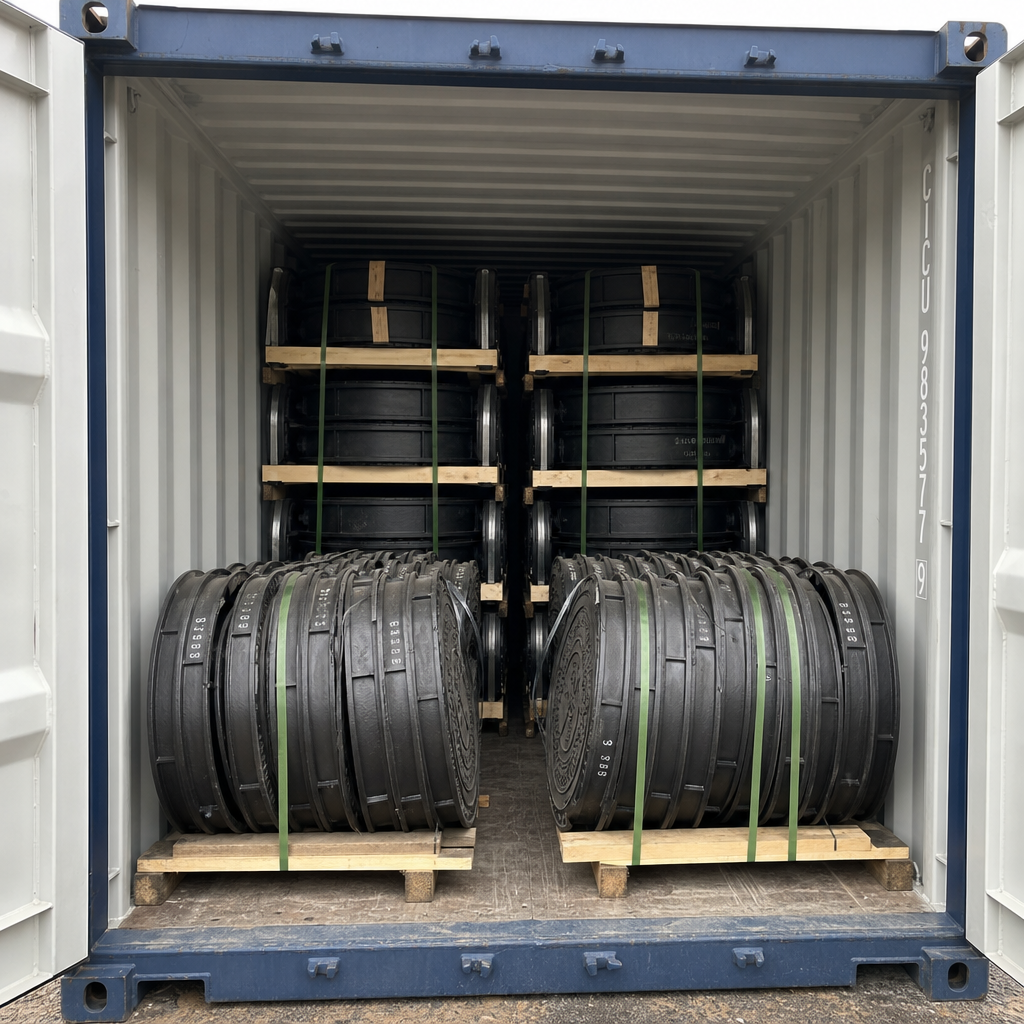
What good practice looks like:
- Covers stacked on edge, not flat, in a dedicated steel or heavy timber rack.
- Dunnage between every layer, with edge protection on the outermost pieces.
- Frames bundled separately, banded with steel strapping, not plastic.
- A loading diagram issued before the container is booked, showing piece count, weight, and the floor plan.
- Photographs of the loaded container, with the door open, before sealing.
On container math: for a 20ft container, a typical D400 600×600 cover and frame at 85 kg means weight is rarely the binding constraint — it's volume and stacking efficiency. Most suppliers achieve 220-250 sets per 20ft. If a supplier claims 300 sets in a 20ft, ask for the loading diagram and check the arithmetic yourself.
Also confirm who pays for the fumigation certificate, the wooden dunnage ISPM 15 stamping, and the container weighing (VGM). These show up on invoices late and always in your direction.
Payment Terms and Third-Party Inspection Clauses
This is where you control risk more than anywhere else in the order.
A reasonable structure for a first order:
- 30% deposit against a signed proforma invoice with the full spec attached.
- 70% against a passed inspection report — not against a copy of the bill of lading, and not "before shipment."
- Inspection clause: you, or a nominated third party, hold the right to inspect before the container is sealed, and to reject non-conforming pieces at the supplier's cost.
- Penalty clause: for weight shortfall of more than 3% and for late shipment beyond the agreed date.
- Certificate package: mill certificate, tensile report, chemical analysis, coating thickness report, and dimensional report, all with matching heat numbers. Withheld payment is your only real leverage after the container sails.
For larger repeat orders, letter of credit at sight is common and protects both sides. For orders above $30,000, it's usually worth the bank fees.
One more thing: never pay a deposit to an account that doesn't match the company name on the contract. Under-invoiced or third-party accounts are a classic sign of a deal that's being brokered by someone who isn't the factory.
Common Mistakes to Avoid
Seven things buyers do over and over, and what to do instead:
- Comparing quotes on price per set only. Compare on price per kilogram of finished, correctly-weighted product. It's the only apples-to-apples number.
- Accepting "ductile iron" without a grade. Write EN-GJS-500-7 or ASTM A536 65-45-12 on the PO, with elongation in the spec.
- Skipping the live video walkthrough. It costs 40 minutes and a time-zone headache. It has killed more bad deals than any contract clause.
- Ordering samples from a trader and production from a factory. Whoever makes the sample should make the order. Otherwise the sample proves nothing.
- Waiting for arrival to inspect. Once the container is on the water, your leverage is gone. Inspect at the factory, before sealing.
- Ignoring the coating specification on the PO. "Painted as standard" is not a specification. Microns, product type, and test method are.
- Not weighing the product yourself on arrival. A $40 industrial scale and twenty minutes will catch the single most common scam in this trade.
Frequently Asked Questions
How do I know if a Chinese manhole cover supplier is a real factory?
Ask for the business license and check whether the registered scope includes casting production. Then request an unscheduled live video walkthrough of the melting shop, molding line, and testing lab. A real foundry will show you a furnace and a spectrometer without hesitation. A trading company will stall, or show you a warehouse instead.
What should a D400 manhole cover weigh?
A 600×600 mm circular D400 ductile iron cover with frame typically weighs 80-95 kg. Square or rectangular designs in the same class run slightly heavier. Anything below 75 kg for that size should trigger questions, because load capacity comes directly from section thickness and mass.
How many covers fit in a 20ft container?
For 600×600 D400 sets at roughly 85 kg each, expect 220-250 sets in a 20ft container once stacking and volume are accounted for. Always request a loading diagram with piece count and total weight before you book freight, and check the arithmetic against your own weight spec.
Is Chinese ductile iron manhole cover quality reliable?
Yes — from the right foundries. China produces ductile iron to EN 1563 and ASTM A536 standards every day, and there are foundries with in-house spectrometers, tensile machines, and decades of export history to Europe and North America. The variable isn't the country. It's whether you vetted the supplier and specified the product precisely enough to hold them to it.
What's a reasonable price for D400 ductile iron covers from China?
As of late 2026, FOB China pricing for finished D400 ductile iron covers generally sits in the $850-1,050 per ton range, depending on size, coating system, locking features, and order volume. Anything materially below that should be checked for weight shortfall or grade substitution before you celebrate the savings.
Do I need a third-party inspection?
For a first order with a new supplier, yes — budget it in from the start. For established suppliers with a track record across three or more shipments, batch-level self-inspection with documentation is often enough, with periodic spot checks. The rule is simple: the newer the relationship, the more inspection you buy.
Next Steps
If you're about to place an order, do three things this week.
First, rewrite your specification. Add the iron grade with mechanical properties, the cover and frame weights per drawing, the coating type with a micron range, and the tolerance limits. That document is your entire protection.
Second, run the five-point audit on your shortlisted suppliers. Live video, business license, lab, shipping documents, reference call. It takes an afternoon.
Third, put the inspection clause and payment-linked-to-inspection into your PO before you send the deposit.
Do those three things and the Rotterdam story stays someone else's story.