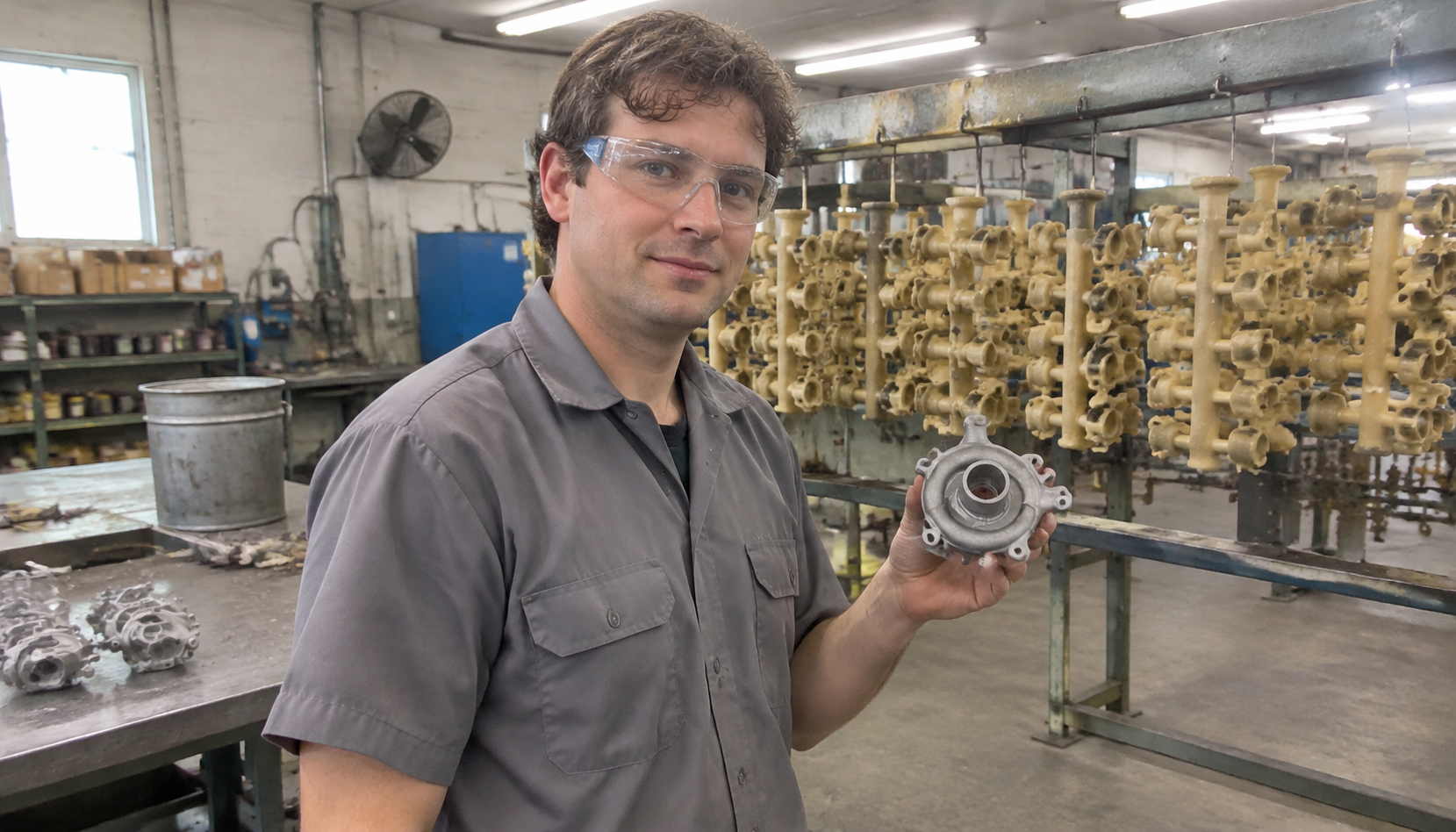
Here's a number that took me three years to trust: across 41 RFQs I ran for aluminum investment castings, the spread between the cheapest and the most expensive quote on the identical drawing averaged 2.6x.
Not 10% apart. Two and a half times apart.
I buy cast components for a pump manufacturer in Ontario — about $1.2M a year across aluminum and stainless. The same model number, the same PDF, the same tolerance block, sent to eight foundries. The replies land in my inbox over four days and they look like they're describing eight different parts.
That gap is not a pricing trick. It's information asymmetry. The foundry knows what your drawing actually requires. You're guessing. And the gap between those two things is where your margin goes to die.
This is what I've learned about aluminum investment casting from the buying side — the process, the alloy traps, the cost lines worth arguing over, and the five checks that separate a foundry you can grow with from one that ships you a container of porosity.
The spread first, because it tells you what to do
Roughly 70% of the quotes I've collected came back within 15% of each other. That cluster is the real market price. It's the signal.
The other 30% split into two groups, and both are trouble.
About one in five came in 30–45% below the cluster. In eight years, I've had exactly one of those low outliers actually deliver parts that passed incoming inspection on the first lot. The others failed on dimensional repeatability, on X-ray, or on heat treat hardness. There is no secret efficient process. The low bid is usually a foundry that priced your part as if the tolerance block didn't exist, and will find out it's wrong after you've paid the tooling invoice.
The rest came in 60–120% above cluster. Those are shops that either don't want the job, or quoted the part as though it were a turbine blade.
So the practical rule: get five quotes minimum, throw out the top and bottom, and study the middle three. If all five are clustered tight, you've got a well-defined part and a fair market. If they're everywhere, the problem is your drawing, not the suppliers.
What aluminum investment casting actually does to metal
Worth understanding properly, because a lot of buyers treat this process as a black box and end up specifying things it can't deliver.
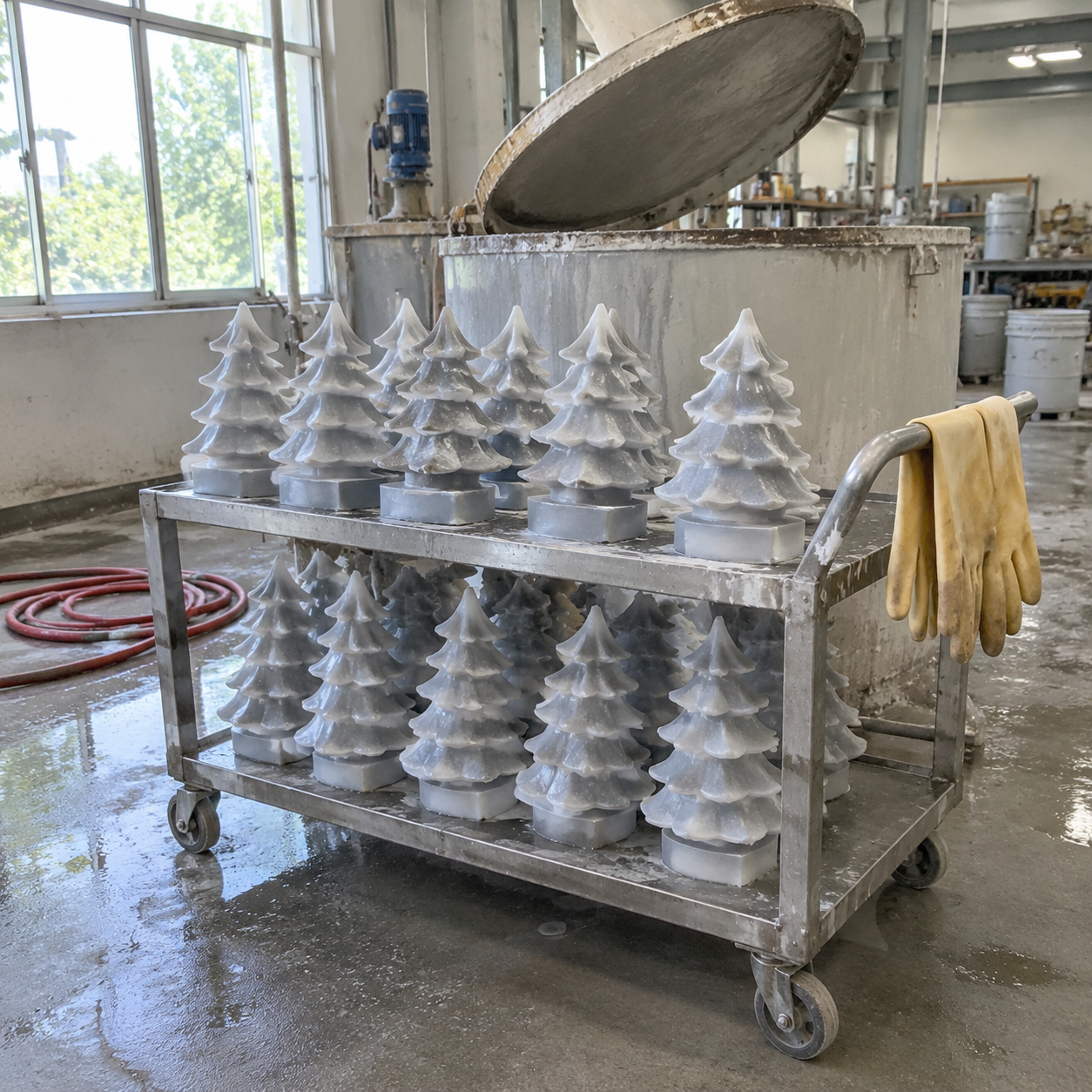
The sequence starts with a wax pattern — injection-molded into a metal die, one pattern per part. Patterns get assembled onto a central wax runner, forming a "tree." That tree gets dipped repeatedly into ceramic slurry and stucco, building up five to seven layers. Each layer dries before the next. On aluminum that's usually five layers, since pour temperature is around 700–750°C rather than the 1,500°C you'd see for steel.
Then the whole assembly goes into an autoclave or a flash-fire furnace. The wax melts out — that's the "lost wax." What's left is a hollow ceramic shell with your part's internal geometry baked into it.
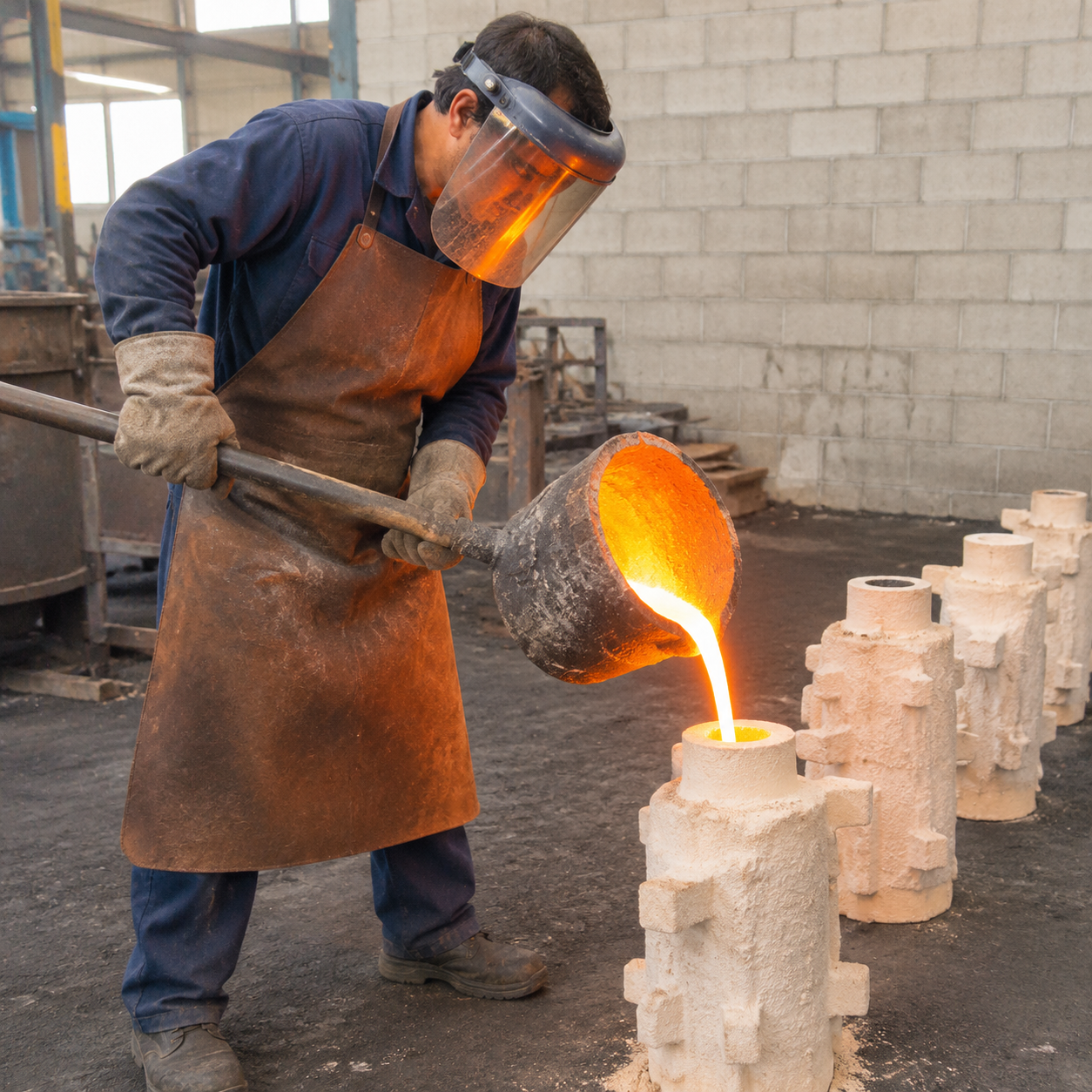
The shell gets fired at 900–1,000°C to burn off residue and give it strength. Then molten aluminum is poured in at roughly 700–750°C, gravity-fed, and the metal fills every cavity the wax once occupied. After cooling, the shell is broken away — literally smashed — and the parts are cut off the tree, ground, shot-blasted, heat treated if specified, and inspected.
The key thing about this process, from your side of the table: the mold is destroyed every cycle. There's no reusable die. That means tooling is cheap, quantities are flexible, and every part is a one-off in a way that die casting isn't. It also means your internal passages exist as physical ceramic that either works or breaks during pour — there's no halfway.
Where it beats die casting
Die casting needs a hardened steel die that can cost $60,000 to $250,000. Investment casting tooling on a mid-size aluminum part runs $2,000 to $15,000. That's the whole argument in one sentence. If your annual volume sits between 100 and 10,000 pieces, investment casting is usually the only math that works.
And volume isn't the only trigger. If your drawing carries an undercut, an internal gallery, or a tolerance tighter than ±0.15 mm, you're already in investment casting territory — a steel die cannot open around those features at any volume.
Second advantage: heat treat. Die cast aluminum is porous and gassy by nature — the metal is injected at high velocity and traps air. You can't reliably T6 a die casting. Investment castings are gravity-poured into a permeable ceramic shell, so the metal is dense enough to solution-treat and age. If your drawing says A356.0-T6 and you're holding a die casting, you have a problem.
Third: weldability. Repair welds on a die casting create porosity clusters and are usually rejected. Investment castings weld cleanly, which matters on a pump housing where you might need to rework a boss.
Where it loses
Cycle time. A die casting drops in 60 seconds. An investment casting takes days per shell cycle, and the tree sits in a furnace for hours.
Dimensional repeatability. Die casting holds ±0.05 mm on a well-designed part. Investment casting typically runs ISO 8062 grade CT5–CT6, or about ±0.13 mm per 25 mm with accumulation across larger dimensions. If your print calls for ±0.05 mm on a 120 mm bore, nobody is hitting that as-cast. You're machining it.
Surface finish. As-cast investment aluminum lands around Ra 3.2–6.3 μm. Good for most pump bodies, not good enough for a sealing face.
The alloy line is where buyers quietly lose money
I've seen more quality disputes start here than anywhere else, and most of them trace back to a two-line note on a drawing that everybody read differently.
You write "A356-T6" on the print. The foundry reads "A356." You assumed the Fe limit, the Mg range, and the heat treat cycle were all locked in by that one word. They weren't.
A356.0 is the casting alloy; A356.2 is the ingot. If your drawing says A356 without the .0, you've left room for interpretation. Specify UNS A13560 and a temper, or accept that you'll be arguing about it at incoming inspection. The full family of aluminum casting alloys is worth bookmarking if you specify more than one part type.
The composition items that actually bite:
Iron. A356 allows up to 0.20% Fe. Push past that and you form needle-shaped beta-phase platelets that cut ductility — elongation can drop from 7% to 3% while tensile strength still looks fine on the cert. If your part sees fatigue loading or impact, hold Fe at 0.15% max and mean it. Ask to see the spectrometer print, not just the mill cert.
Magnesium. The Mg range for A356 is 0.20–0.45% and it does the heavy lifting on the T6 response. Foundries that skimp on Mg to save a few cents per kilogram give you a part that won't reach hardness after aging. Your heat treat supplier will blame the alloy supplier, and you'll be in the middle.
Modification. Sodium or strontium additions refine the silicon structure. Strontium is more forgiving and most foundries use it, but it fades with melt hold time. If nobody at the shop can tell you how they control fade, they probably don't.
And then choose the right base alloy in the first place:
| Alloy | Typical use | Why buyers pick it | Watch out for |
|---|---|---|---|
| A356.0 | General pump housings, brackets, manifolds | Best balance of castability, strength, cost | Elongation collapses if Fe is high |
| C355.0 | Higher-pressure bodies | ~10–15% stronger than A356 in T6 | Harder to cast thin sections |
| 535.0 | Seawater, food processing, marine | Excellent corrosion resistance | Not heat treatable; lower strength |
| 771.0 | Elevated temperature service | Better creep resistance above 150°C | Limited foundry experience, higher price |
One more thing that catches people: A356 is a hypoeutectic Al-Si alloy and it machines with a gummy, built-up-edge tendency. If you're specifying machined features, factor in that the shop's tooling cost is real, and their machining quote for aluminum investment castings will reflect it.
Breaking the quote down, line by line
This is the part nobody sends you unless you ask, and it's the part that tells you whether you're being priced fairly or just priced. If you want the general framework before you sit down with a supplier, our guide to casting cost structure covers the same six lines.
A proper aluminum investment casting quote has six separable lines. If your supplier sends two lines — "casting" and "machining" — they're hiding something, possibly from themselves.
1. Metal. A356 ingot ran roughly $2.50–3.20/kg in recent years, and it tracks LME plus an alloying premium. With 3–5% melt loss, your net metal cost is usually 25–35% of the casting price on a simple part. Ask what ingot price they quoted against, and when it was quoted. Aluminum moves. A quote built on a six-month-old metal price is not a quote.
2. Wax injection and tree assembly. Labor-heavy, scales with the number of patterns and how many go on a tree. Not much room to negotiate, but it's a real cost and it explains why very small parts carry a high price per kilogram.
3. Shell building. Slurry, stucco, drying time, and floor space. Every layer is labor plus hours of climate-controlled drying. This line is where a shop's capacity shows up. A foundry running near full might quote you 40% high here simply because they don't want the work.
4. Pour and knock-off. Melting energy, pour labor at 700–750°C, shell breaking, cut-off, grind, blast. On thick-section parts this line grows because cooling time grows.
5. Heat treat. If you specified T6, this is solution treatment at around 540°C, a quench, then aging at 155°C for four to six hours. It's a batch process and it's not cheap. That line should stand on its own, not hide inside "finishing."
6. Inspection and scrap. This is the line to interrogate hardest.
"I always ask for the scrap rate in writing. If a shop won't put their fall-off percentage on the quote, they're pricing your parts to cover someone else's mistakes."
— Robert Davis, hardware wholesaler in Georgia, roughly $1.5M a year in cast components
He's right, and it's the single most useful habit I picked up from him. A good aluminum investment casting foundry runs 3–8% internal scrap on a mature part. A weak one runs 12–18% and quietly spreads it across every customer. When you see a scrap allowance above 10% on the quote, you're not looking at a risk provision — you're looking at a capability statement.
Where I'd push back on cost: heat treat and X-ray, kept together under a vague "finishing" heading. Robert put it well — split those out and the cheapest quote usually stops being the cheapest. I've watched a $4.80/kg bid become $7.10/kg once heat treat, level-2 radiography, and a real dimensional report were pulled into the open.
The five checks I actually run before placing an order
I'm in year eight of buying castings and I've been burned by two suppliers. Both passed my early screening. Both failed on things that a proper audit would have caught. Here's what I do now, and what I'd tell you to steal.
Check 1 — Ask for last quarter's actual X-ray rejects
Not a certificate. Not a "we comply with ASTM E155 level 2." Ask for the last three months of internal radiograph reject data on a part that's roughly similar to yours, and ask what the top defect mode is.
A foundry that does this routinely will send you a table within a day. A foundry that doesn't will send you a certificate. That difference tells you whether quality data exists as a working system or as a document for customers.
Check 2 — Find out who makes the wax patterns
Smaller shops outsource wax injection. That's not automatically disqualifying, but it means your lead time is now someone else's lead time, and your dimensional repeatability depends on a die you've never seen. Ask directly: in-house or subcontracted? Then ask to see the wax press area on a video call and count the machines.
The traps here are real. If they say in-house but can't show you a wax injection machine, you've learned something useful before spending $8,000 on tooling.
Check 3 — Confirm aluminum and steel don't share a pour floor
Cross-contamination destroys aluminum castings. A stray steel spill, a shared ladle, dust from a steel knock-off drifting into the aluminum area — any of these introduce iron into your melt in a way no spectrometer check at the ingot stage will catch.
This is where a 15-minute walk-through video is worth more than a certificate folder. Ask them to pan the camera across the pour floor and tell you where the aluminum stations are. The answer should be immediate and specific.
Check 4 — Look at the spectrometer and ask when it was last verified
Every foundry has an optical emission spectrometer. The question is whether it's calibrated and whether anyone acts on the results. Ask for the most recent third-party verification of the instrument, and ask who reviews the chemistry readouts.
If the answer involves a name and a schedule, good. If the answer is "the lab handles it," ask who the lab is. Small things. But you're not buying a part — you're buying the system that produces it consistently for five years.
Check 5 — Send them a part they've never made
My most reliable predictor of a good supplier relationship: give them a drawing for a part outside their normal range and see how they respond.
A strong foundry replies with three to five specific questions — draft angle, where the parting line can go, whether that thin section is a boss or a wall, whether the 0.8 mm rib is structural. A weak one replies with a price and a lead time.
The questions tell you whether engineering is involved in quoting. If nobody with process knowledge touches your RFQ, nobody with process knowledge will touch your part when something goes wrong on the floor.
The spec sheet items that catch problems before they ship
You can't inspect quality into a part. But you can specify the checks that make a bad part visible before it costs you a warranty claim.
Reference the right standards. ASTM B26/B26M governs the casting — chemistry, tensile properties, and acceptance criteria. ASTM B557/B557M is your tension test method. ASTM E155 gives the reference radiographs for internal discontinuities. ASTM B917/B917M covers heat treatment practice. Put all four on the drawing and you remove ambiguity. If you want a quick reference, we keep a running list of the ASTM standards that matter for castings.
Set the radiography level by zone, not by part. "Level 2" across the whole casting is both expensive and lazy. A pump housing has a pressure boundary and a mounting foot. Those don't need the same acceptance criteria. Zone the drawing: critical sections at ASTM E155 level 2, non-critical at level 3 or visual only. This single change cut roughly 18% off one of my part costs without touching anything that mattered.
Specify fluorescent penetrant on machined sealing surfaces. ASTM E1417. It finds surface-breaking defects that radiography misses entirely, and it's cheap. Do it after machining, not before.
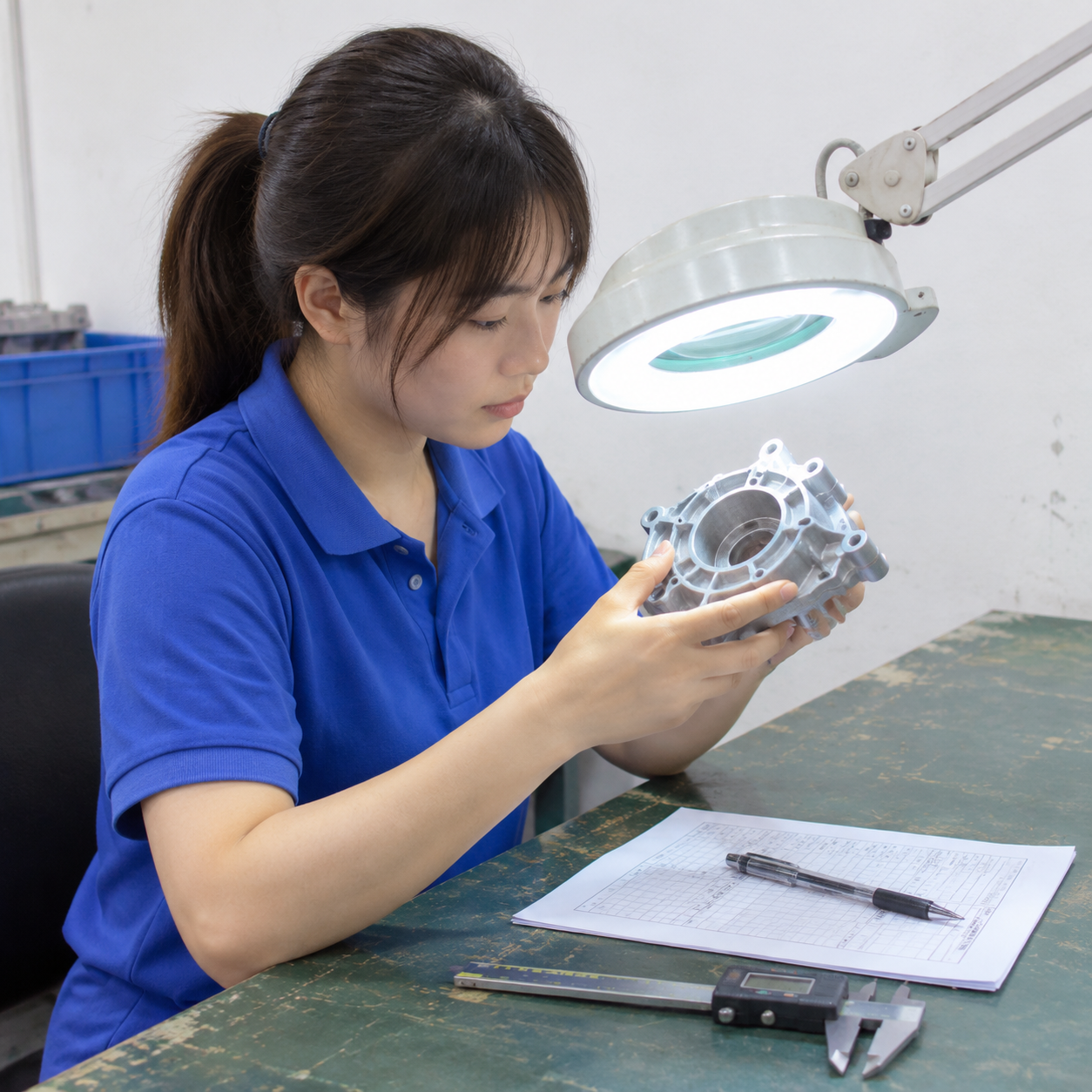
Demand first-article dimensional reports with the actual numbers. Not pass/fail. Actual measurements on every dimension, on the first three pieces, with the CMM or the measuring tool identified. This is how you find out whether a 1.5 mm wall came in at 1.2 mm on the low side of a tolerance you didn't think was a problem.
Pin down which test bars you're getting. Cast separably-cast test bars versus test bars cut from the part give you different numbers, and the standard allows both. Separable bars are more common and generally read higher. If your design calculation assumed a minimum tensile of 262 MPa on A356.0-T6, know which bar gave you that number.
Tooling, MOQ, and the lead time nobody quotes you
There's no true minimum order quantity for aluminum investment casting. The metal doesn't care if you run 20 pieces. What sets the floor is the wax die.
Tooling on a mid-size aluminum part runs $2,000–15,000 depending on size, cavity count, and complexity. Most foundries will accept a 100–300 piece first order if the tooling is paid up front or on a partial amortization schedule. Some will run a single prototype off a printed or hand-built pattern, at a premium.
If a supplier tells you the minimum is 2,000 pieces, ask why. In my experience the answer is usually that they're subcontracting the wax, or that they don't want small runs in their scheduling. Both are legitimate answers, but you should know which one you're dealing with.
On timing, real numbers from my last three programs:
| Stage | Typical duration | What slips it |
|---|---|---|
| Tooling | 3–5 weeks | Design changes after die cut; buyer spec changes |
| First samples | 4–6 weeks | Heat treat queue; X-ray lab backlog |
| Sample approval | 1–3 weeks | Your own engineering review |
| Production run | 6–10 weeks | Machining capacity; Chinese New Year; foundry order book |
| Ocean freight to N. America | 30–40 days | Port congestion; consolidation waits |
The last row isn't the supplier's problem, but it's on your critical path. Buyers routinely forget it and then blame the foundry for a shipment that arrived when it was supposed to.
One timing item worth mentioning because it catches everyone: Chinese New Year. If your production run should finish in the four weeks around the holiday, assume a two-to-three-week slip and plan a buffer stock. Foundries can't staff around it, and the ones that promise they can are usually the ones that fail.
Common mistakes I've made, so you don't have to
Quoting the drawing instead of the function. My first big mistake. I sent out a drawing with a ±0.05 mm tolerance on a bore that was going to be machined anyway. Four foundries quoted it as-cast at absurd prices, one quoted it cheap and then failed inspection. Read your own tolerances and ask whether each one is doing a job.
Treating heat treat as a checkbox. A356.0-T6 isn't a status, it's a process with a recipe. Solution temperature, quench rate, and aging time all matter. Ask for the actual cycle parameters and the hardness results, not the word "T6."
Not specifying the Fe limit. I mentioned it above but it deserves repeating. If you don't write the iron ceiling on the drawing, you'll get whatever the melt happens to land at, and you'll find out when a part cracks in fatigue test.
Approving a sample without approving the process. A sample from a hand-built prototype tells you the geometry is possible. It tells you nothing about what the production shell will do on the fifth hundred pieces. Ask for samples from a production-intent shell, at production-intent process parameters.
Letting the machining quote hide the casting price. If your supplier quotes a single lump sum for casting plus machining, you have no way to compare bids. Split them. Always.
"The die amortization is the only line item you can actually negotiate with real bargaining power. Everything else is arithmetic."
— Robert Davis
That one took me a while to accept, but it's true. Metal, labor, energy, and freight are what they are — you can shop them, but you can't argue them down. Tooling amortization and volume tiering are where a real conversation is possible.
Questions I get from other buyers
How much does aluminum investment casting cost per kilogram?
For A356.0-T6 parts between 0.2 and 3 kg, budget roughly US$5–9 per kilogram at 500-piece volumes and US$3.50–6 per kilogram above 5,000 pieces, before machining. Tooling adds $2,000–15,000. Treat those as planning figures, not quotes — small parts and thin walls price per piece, not per kilogram, and the per-kilo number becomes meaningless.
Investment casting or die casting for my part?
Count your annual volume. Below about 10,000 pieces, die casting tooling doesn't amortize and investment casting wins. Above it, die casting wins on piece price and cycle time. There's a hard exception: if you need T6 heat treatment, weldability, or internal passages, die casting can't do it at any volume. Go investment.
What's the realistic minimum order?
100–300 pieces on a new tool. Many foundries will do one prototype. If someone demands 2,000 as a floor, find out whether they're subcontracting your wax patterns — that's usually the reason.
How long, start to finish?
Tooling 3–5 weeks, samples 4–6 weeks, approval 1–3 weeks, production 6–10 weeks, ocean freight 30–40 days. Call it five to six months from PO to parts in your warehouse if nothing goes wrong, and plan for seven.
Which ASTM standards should be on my drawing?
ASTM B26/B26M for the casting, ASTM B557/B557M for tension testing, ASTM E155 for radiography reference, ASTM B917/B917M for heat treatment, ASTM E1417 for penetrant inspection. And the UNS alloy number plus temper — not just the trade name.
What to do next
If you're about to send out RFQs, do three things before you do.
Rewrite the tolerance block. Look at every dimension over ±0.13 mm and ask whether it's a real requirement or a habit. Every tolerance you tighten without reason adds cost you'll pay on every piece for the life of the part.
Add the composition limits — Fe, Mg, and the temper — in writing. Not implied by an alloy name. Written.
Then build a quote template you send out that forces the six-line breakdown. Metal, wax and assembly, shell, pour and knock-off, heat treat, inspection and scrap. Any foundry that refuses to fill it in has told you something about how they'll handle a quality issue.
The gap between the cheapest and the most expensive aluminum investment casting quote on your drawing is real. Your job is to understand which part of that gap is capability, which is risk, and which is just a shop that doesn't want the work. That understanding is worth more than any single point of price.
Need Help with Investment Casting Aluminum: What Buyers Learn Too Late?
Get matched with 3 verified foundries in 24 hours. No markup, transparent pricing.
Request Quotes →