On 30 September 2027, an authorised declarant — probably your customs broker, possibly you — files a CBAM declaration covering every tonne of iron and steel you brought into the EU during 2026. The certificates behind that declaration were bought months earlier. The first sales window for CBAM certificates opens in February 2027.
That is the headline date. But 2027 is unusually crowded. On 20 January 2027 the Machinery Regulation replaces the Machinery Directive. On 14 December 2027 the Forced Labour Regulation starts applying, with no de minimis and no turnover threshold. Somewhere in between, the first wave of corporate due diligence obligations lands — if the 2025 omnibus amendments survive scrutiny.
Castings get hit harder than most categories. CBAM is charged per tonne of embedded carbon, and castings are heavy. A tonne of grey iron cast in a cupola carries 1.4 to 2.2 tonnes of embedded CO2. A tonne of aluminium die casting on primary ingot carries 8 to 15. Both leave Ningbo on the same ship. Only one of them is going to eat your margin.
Castings also get hit asymmetrically. A 40 kg ductile iron pump housing and a 4 kg aluminium bracket do not carry the same certificate cost — not per kilo, not per part. When a buyer tells me they have budgeted "a couple of percent" for CBAM, I ask what the carbon intensity of their foundry is. Most do not know. That gap, right there, is where the money goes.
Here is what 2027 looks like if you source castings from China, and what to do about it before the certificates go on sale.
First, the arithmetic: what CBAM costs on a tonne of castings
CBAM is a multiplication that stops being simple the moment you try to fill in the first number.
Embedded emissions (tCO2e per tonne of goods) × EU ETS price (€/tCO2e) − carbon price already paid in China = your certificate bill.
The second number you can look up. EU ETS allowances have traded roughly between €60 and €85 through 2025 and 2026 — call it €75 as a planning figure. The third number is close to zero in practice for most Chinese castings, because the deduction only covers carbon actually paid under a Chinese system that maps onto the EU's rules, and that mechanism is narrow.
The first number is where your margin lives. It varies by a factor of ten depending on choices your supplier made before you ever sent them a drawing.
| Material and production route | Embedded emissions (tCO2e per tonne) | CBAM cost at €75/tCO2e |
|---|---|---|
| Grey iron, cupola melting, Chinese grid (EN 1561 / ASTM A48) | 1.4 – 2.2 | €105 – €165 |
| Ductile iron, induction furnace, high scrap charge (EN 1563 / ASTM A536) | 0.9 – 1.6 | €68 – €120 |
| Steel casting, EAF route (EN 10283 / ASTM A216) | 1.0 – 1.8 | €75 – €135 |
| Aluminium die casting, primary aluminium feed | 8 – 15 | €600 – €1,125 |
| Aluminium die casting, 70%+ recycled feed | 1.0 – 2.5 | €75 – €188 |
Those ranges are indicative. They are built from published default values and typical installation profiles, not from your supplier's meter readings. Your actual figures depend on the specific foundry, its furnace, its scrap ratio, its alloy suppliers and the provincial grid it draws from. But the shape of the table is the point: aluminium feedstock choice creates a nine-fold difference in carbon liability per tonne, and that difference is now a line item on your purchase order.
Two foundries casting to the same EN 1563 grade can sit a factor of two apart on emissions, and the reason is usually the melt shop. Sand casting burns energy in sand preparation, moulding, melting, pouring and shakeout — the sand itself is largely reclaimed on site, so the furnace dominates. Investment casting adds a wax pattern, a ceramic shell built in five to seven coats, a steam autoclave for dewaxing and a kiln firing above 1,000°C, all before any metal is poured. Die casting concentrates energy in holding the die at temperature and driving the injection cycle, which is exactly why aluminium die casting is the most carbon-dense route per tonne and the most sensitive to feedstock. If your supplier runs induction furnaces on a high-scrap charge, you are on the low end. If they still pour from a coke-fired cupola, you are not.
Run it on a real order. Say you buy 120 tonnes of ductile iron valve bodies a year at €1,450 a tonne ex-works. That is €174,000. At 1.2 tCO2e per tonne of castings you are carrying 144 tonnes of embedded carbon. At €75, that is €10,800 in certificates — about 6% of order value. If the same foundry melts in a cupola at 2.0 tCO2e/t, you are at €18,000.
Six thousand euros of that gap was decided by a furnace upgrade your supplier either did or did not make. It will not appear in the quotation. It appears in the CBAM declaration.
The 2027 twist: verified data stops being optional
Here is the detail most buyers missed. Under the 2025 simplification package, imports during 2026 can be declared using default values without third-party verification. That is a one-year grace. From 2027 imports onward — the ones you declare in 2028 — the verification requirement bites properly.
Default values also carry a mark-up that escalates. Expect roughly 10% added in 2026 and 20% in 2027, with more after that. Even where you can legally fall back on defaults, you are paying a premium for the privilege. On a 120-tonne order that mark-up is worth more than most buyers spend on a factory audit. Check the current implementing regulation for exact percentages — they are set by delegated act and have already been amended once.
So the conversation you need with a Chinese foundry in late 2026 is not "can you give me a CBAM number". It is "can you give me the installation data that lets my verifier calculate one". The material certificate route matters here too — an EN 10204 3.1 certificate proves the heat chemistry, not the emissions. For a fuller picture of what a foundry audit should cover, see our foundry audit checklist.
The document pack that decides your 2027 cost
If a supplier cannot produce these within ten working days, they cannot support a 2027 CBAM declaration — and you will be paying default-value mark-up on every order. That is not a negotiating position. It is a fact about their accounting.
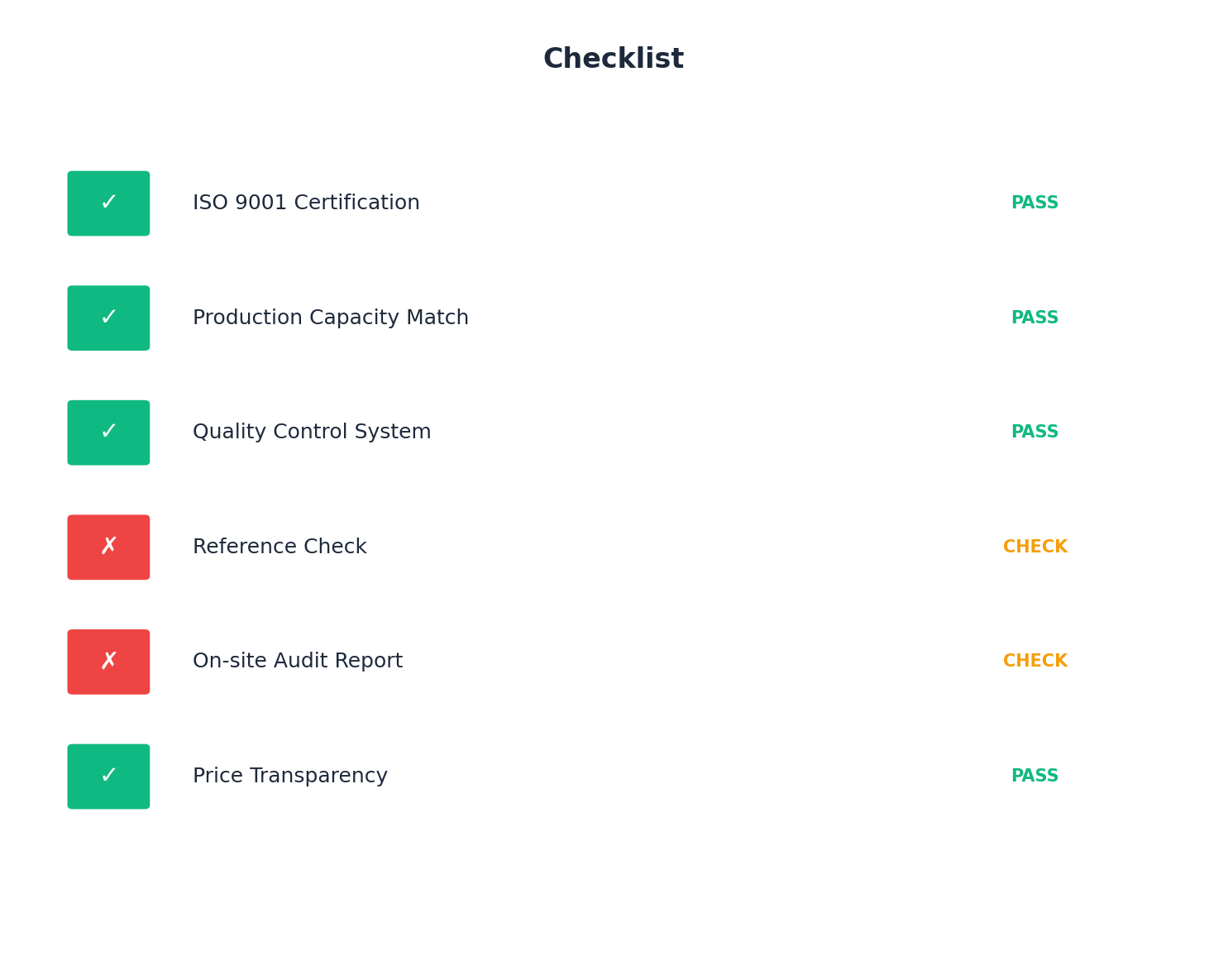
A verified embedded emissions report per installation. Not per company, not per product family — per installation, broken down for the specific CN code you import. A group with three foundries needs three reports.
Twelve months of energy data. Electricity consumption in MWh, fuel by carrier (coke, natural gas, LPG), and the emission factor used for the grid. Ask for the raw monthly figures rather than a summary. If you get a summary, ask again.
Precursor and scrap sourcing. Embedded emissions include precursors: pig iron, ferroalloys, scrap, and for aluminium, the primary metal itself. A die caster buying primary ingot from a smelter inherits that smelter's carbon. You need the smelter's data too. This is the most common gap in the supplier submissions I have reviewed.
Verifier accreditation. Under the CBAM verification rules, verifiers need accreditation under a recognised scheme and, from 2026 onward, approval by the Commission. A report signed by a domestic consultancy with a nice logo is not a verification.
Heat numbers and certificates of analysis. Traceability from melt to shipment, generally issued to EN 10204 3.1 (works certificate) or 3.2 (witnessed by an independent inspector). Under the new Product Liability Directive this traceability doubles as your defence file.
CN classification confirmation. The supplier should state the code they believe applies. You should verify it independently. More on that below.
EU responsible person and importer details. Required under the General Product Safety Regulation, and documented before goods ship rather than after.
Duty exposure is a separate problem from CBAM
CBAM gets the attention. Duty quietly costs more.
Start with the CN code. Castings scatter across the tariff: 7325 for other cast articles of iron or steel, 7326 for other iron or steel articles, 7616 for other aluminium articles, and then a range of machinery-specific headings — 8413 for pump parts, 8481 for valves, 8708 for vehicle parts — where the casting is classified as the finished component rather than as a casting.
That classification matters twice. It sets your duty rate, and it determines whether the goods fall inside CBAM Annex I at all. Iron and steel CBAM goods span most of Chapter 72 plus a defined list of downstream articles. If your casting lands in a machinery chapter heading, it may sit outside CBAM entirely. If it is a plain casting under 7325, it is in.
Do not guess. Check TARIC for the specific code. Where classification is genuinely ambiguous — which it often is for machined-then-assembled parts — apply for a Binding Tariff Information decision. A few weeks of waiting buys you three years of certainty.
Then check for trade defence measures. The EU has anti-dumping and anti-subsidy measures in force across a range of Chinese iron and steel articles, including certain cast iron products and pipe fittings. These are not covered by CBAM. They stack on top of it, and they change. The EU steel safeguard regime has also been in flux through 2026 as the Commission reworks the post-safeguard framework. Before you model anything, pull the measures currently in force for your code from the Commission's Access2Markets database.
And watch origin. This is the trap I see most often with castings. A part poured in Hebei, shipped to Vietnam for machining, then exported to Rotterdam from a Vietnamese port is still, for non-preferential origin purposes, a Chinese casting — if the casting operation gave it its essential character. Facing a flange does not change origin. Customs authorities know the trick and they look for it. Anti-dumping duties can be recovered retroactively, with interest attached.
The other 2027 deadlines sitting in your supply chain
CBAM is not the only thing moving.
20 January 2027 — Machinery Regulation (EU) 2023/1230
The Machinery Directive becomes history. For anyone buying castings that end up inside a machine, this changes technical file requirements: digital instruction obligations, revised risk assessment scope, and a harmonised standards list that was still incomplete through 2026. If your casting is a safety component, classification and documentation requirements differ from what you built in 2023. Ask the machine builder whether their technical file has been updated, and get the answer in writing.
9 December 2026 — new Product Liability Directive (EU) 2024/2853
Slightly before 2027, but it lands on your 2027 claims. The importer is treated as the manufacturer when goods are placed on the market under its own name or brand. The burden of proof has been eased in the claimant's favour for technically complex products, and the scope explicitly covers components. Keep inspection records, heat numbers and traceability for the full ten-year period. That retention window is longer than most ERP systems default to.
26 July 2027 — corporate due diligence, maybe
The Corporate Sustainability Due Diligence Directive was supposed to start in 2027. The 2025 omnibus package proposed pushing the first wave to 2028 and raising thresholds substantially. As of late 2026 the position is still moving. If your customers are large EU manufacturers, they will ask for due diligence data regardless of where the directive lands. Building it now costs less than building it under a deadline.
14 December 2027 — Forced Labour Regulation (EU) 2024/3015
No size threshold. No tonnage threshold. No de minimis. Once it applies, any product made wholly or partly with forced labour can be ordered off the market and withdrawn, with the burden on the importer to show the supply chain is clean. Foundries themselves are rarely the issue. The risk sits upstream — pig iron, ferroalloys, and particularly silicon metal and certain ferroalloy chains where Chinese production concentrates in regions with documented labour transfer programmes. Ask your foundry where their ferroalloys and pig iron come from, and be suspicious of a supplier who has not thought about it.
Packaging
The Packaging and Packaging Waste Regulation has applied since August 2026. Wooden crates and pallets need ISPM 15 heat treatment marks, and recyclability and weight-reduction obligations tighten through the decade. Check that your supplier is not shipping 40 kg of timber around a 12 kg casting. I have seen it.
What landed cost actually looks like in 2027
Full model for 120 tonnes of ductile iron castings, FOB Chinese port, delivered to a plant in the Netherlands. Round numbers, planning purposes, and a mid-range foundry carbon profile.
| Cost line | Per tonne | On 120 tonnes | Notes |
|---|---|---|---|
| Ex-works casting price | €1,450 | €174,000 | Negotiated, pre-CBAM |
| Inland China, port, ocean freight, insurance | €120 | €14,400 | FCL, roughly 35 days transit |
| EU import duty | €45 | €5,400 | Verify the rate in TARIC for your CN code |
| CBAM certificates | €90 | €10,800 | 1.2 tCO2e/t at €75 |
| Customs brokerage, port handling | €60 | €7,200 | CBAM declarations add broker hours |
| Inland EU transport | €55 | €6,600 | Rotterdam to the Ruhr |
| Inspection and quality reserve | €35 | €4,200 | Pre-shipment inspection, 2% defect reserve |
| Landed cost | €1,855 | €222,600 |
CBAM is 4.9% of landed cost in this scenario. On default values with a 20% mark-up it becomes 5.8%. If the foundry runs a cupola and you are at 2.0 tCO2e/t, it becomes 8.1%. That spread is the difference between a casting programme that works and one that does not.
For a budgeting number you can carry into next quarter's plan: assume €90 a tonne on ductile iron, €130 on grey iron from a cupola, €75 to €190 on recycled-feed aluminium, and north of €600 on primary-feed aluminium. Those are the figures to put in front of your controller. Everything else is detail until the certified data arrives.
Now compare it to freight, which everybody obsesses over. Freight is €14,400. CBAM is €10,800. Same order of magnitude. Buyers who have spent three years grinding freight rates and zero hours understanding their foundry's carbon intensity have optimised the wrong half of the cost stack. If you want the underlying cost structure of castings themselves, the die casting cost breakdown covers that side of the equation.
Six mistakes that will cost you in 2027
Treating ISO 14001 as carbon data. An environmental management certificate tells you the foundry has a process. It tells you nothing about embedded emissions per tonne for your CN code — that is an EN ISO 14067 product carbon footprint calculation, or a CBAM-method installation figure. Different documents, different purposes.
Buying through a trading company and expecting installation data. Traders buy and resell. They do not hold furnace-level energy records. If there is a middleman between you and the melt shop, you have a data problem to solve in 2026, not in 2028 when the declaration is due.
Assuming the CBAM bill starts in 2027. It does not. The liability accrues on goods imported from 1 January 2026. The 2027 date is when you pay and when the first declaration is due. If you imported through 2026 without capturing embedded emissions data, you are reconstructing it from invoices right now.
Using default values as a permanent strategy. They exist as a fallback and they are priced as a penalty. Every year you stay on them costs more than the year before.
Ignoring aluminium precursor carbon. A die caster quoting a good price on primary ingot is quoting you a nine-fold carbon liability. Ask what share of the melt is recycled. Then ask for the smelter's emissions data.
Forgetting the 50-tonne de minimis. The 2025 simplification introduced an exemption for importers bringing in under 50 tonnes of CBAM goods per year, aggregated across all CBAM categories. If you are near that line, model it. Note that it is measured on mass of goods, not value, so a mixed programme of iron and aluminium counts together. See our CBAM reporting guide for casting importers for the filing mechanics.
Questions buyers keep asking
Do I pay CBAM if I import less than 50 tonnes a year?
Under the de minimis introduced in the 2025 simplification, importers below 50 tonnes of CBAM goods per calendar year are exempt from the core obligations. The threshold is measured on total mass across all CBAM goods, not per CN code. If you sit close to it, track it monthly — crossing the line mid-year changes your status. Confirm the current position with your national competent authority, because the simplification has been implemented in stages.
Is CBAM charged on the physical weight of the casting, or on the carbon?
On the embedded carbon. Weight only enters as the multiplier for emissions per tonne. That is why material choice matters so much: a tonne of recycled-content aluminium casting and a tonne of primary aluminium casting weigh the same and carry wildly different certificate costs.
Can my Chinese foundry give me the numbers to avoid default values?
Mechanically yes. Practically it depends on whether they keep installation-level records. Ask for twelve months of monthly electricity data, furnace type and capacity, fuel mix, scrap ratio, and the origin of pig iron, ferroalloys and any primary aluminium. If they answer within ten working days with real figures, they can support you. If they send a certificate and a brochure, they cannot — and you should be pricing a 20% mark-up into your next negotiation.
Does CBAM cover aluminium castings from China?
Aluminium is a CBAM sector, and Annex I covers a defined list of aluminium articles. Whether your specific casting is in scope depends on its CN code, which is the same classification question that sets your duty rate. Check TARIC. Aluminium castings can carry five to ten times the embedded carbon of iron castings per tonne, so getting this wrong is expensive.
What happens if I get the 2027 declaration wrong?
Penalties are set by member states and vary, but the pattern is per tonne omitted or per incorrect declaration, plus the obligation to surrender the missing certificates. The bigger cost is usually retrospective: authorities can assess undeclared imports from earlier years. If your 2026 position is uncertain, resolve it before September 2027 rather than after.
What to do before February 2027
The certificate sales window opens in February 2027. Work backwards from there.
Confirm you hold, or have applied for, authorised CBAM declarant status. That is the gating item. If you imported CBAM goods during 2026 without it, you are already behind.
Map your castings to CN codes and check each one against CBAM Annex I and the current trade defence measures. Two days of tariff work now beats a retroactive anti-dumping assessment later.
Send every casting supplier one document request: twelve months of installation energy data, precursor sourcing, and verifier details. Score the replies. The suppliers who cannot answer are the ones whose prices are about to become expensive, whatever the quotation says today.
Then renegotiate. Not on price per tonne — on data. A foundry willing to shift to a higher scrap charge or a lower-carbon alloy route is worth more to you in 2027 than one that shaves 2% off the unit price and leaves you stranded on default values.
The buyers who come out of 2027 clean are the ones asking these questions in 2026. That window is closing.
Get the CBAM-ready supplier questionnaire
Ten questions on one page, built from the document pack above. Send it to every casting supplier on your list and score the replies against a simple pass/fail grid. If you would rather have someone else run the data collection and chase verifiers before the February window opens, that conversation is worth having now.
Need Help with Importing Castings from China to the EU: 2027 CBAM Costs?
Get matched with 3 verified foundries in 24 hours. No markup, transparent pricing.
Request Quotes →