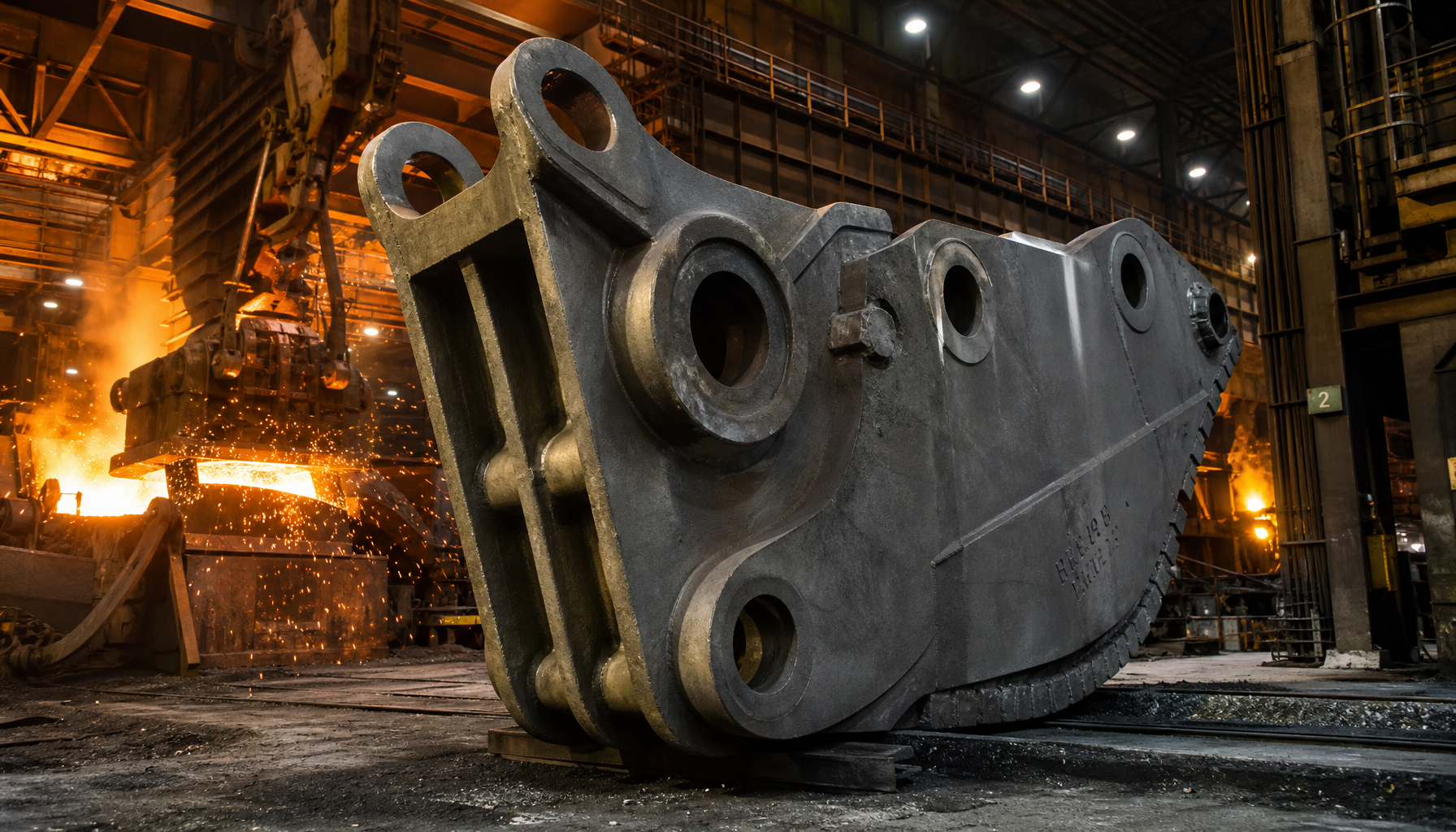
The numbers hit hard. A 4.2-ton excavator bucket that fails at 900 hours instead of 15,000 isn't a warranty line item. On a working mine site, it's $47,000 in unplanned downtime, lost production, and a crane rental. The casting that failed probably cost you $3,800. That asymmetry is why heavy equipment castings demand a different sourcing playbook than commodity machined parts.
The global market for castings in heavy equipment sits at roughly $48 billion in 2026. China pours about 40 million tons of steel castings a year — close to 70% of world production. India adds another 3.1 million tons. The United States, for context, produces around 1.6 million tons. So if you're buying heavy equipment castings at scale, your supply chain probably already crosses an ocean. The question is whether you're crossing it blind.
After a decade spent working with foundries across China, India, and the US — and watching exactly where sourcing programs break down — I've put together the field guide I wish I'd had on my first RFQ. This guide walks through the data that matters — market benchmarks, defect rates, cost per kilo, lead times — and hands you a verification framework you can drop onto your next RFQ. No fluff, no supplier pitch. Just what works.
What the defect data actually tells you
The Steel Founders' Society of America has tracked casting failures since 1946. Their failure-analysis database keeps surfacing the same uncomfortable finding: 70–80% of casting defects trace back to the design and supplier-selection phase, not the foundry floor.
Sit with that for a second. If you pick the wrong supplier, no amount of incoming inspection saves you. You'll reject 15–20% of what shows up — costly, but survivable. But when a supplier-understanding gap meets a borderline design, you don't get rejection rates. You get field failures. Those cost $40,000 in downtime. Or worse, someone gets hurt.
A 2025 industry survey of 380 equipment manufacturers put the number at 62% — that's the share of respondents who'd experienced at least one major casting failure in the previous three years. Here's the part that should bother you: of those, fewer than a third ran a root-cause metallurgical analysis before switching suppliers. Everyone else just got angry, found a new foundry, and repeated the cycle.
Don't be that buyer.
The casting method that dominates heavy equipment
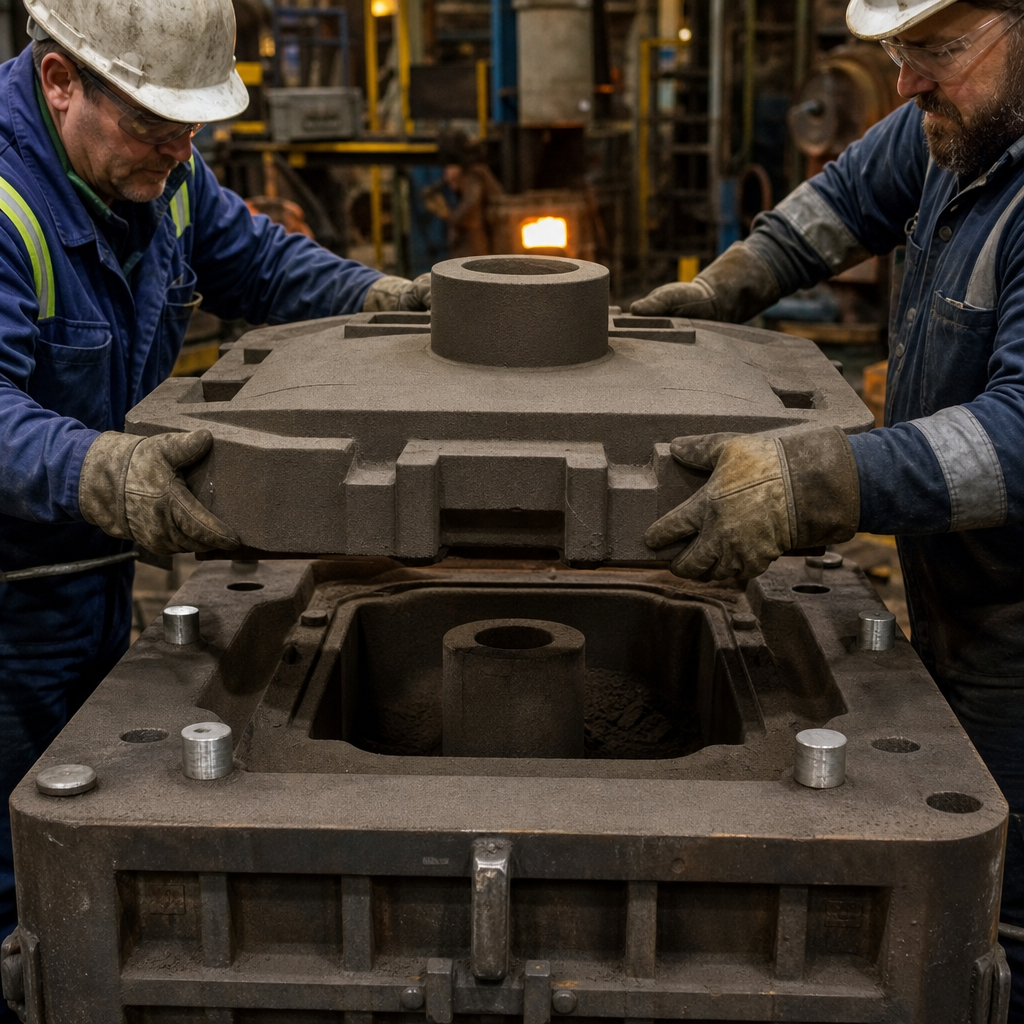
For heavy structural components, one method carries the bulk of production: no-bake sand casting. Roughly 65% of heavy equipment castings by tonnage are made this way. It's not glamorous. It's practical.
No-bake molds use chemically bonded sand that cures at room temperature. That chemistry is what gives you two things green sand can't: the strength to hold a 30-ton pour, and dimensional consistency you can actually predict. You'll also see V-process casting — a vacuum-assisted sand method — on large flat parts like boom sections and counterweights, where surface finish matters more than internal complexity.
What you won't see much of in heavy equipment is investment casting. It's brilliant for precision components — valves, fittings, small drivetrain bits — but it practically tops out around 50 kg. That rules it out for buckets, frames, and linkages. Choose the method that matches the part, not the one that sounds impressive in a brochure.
One more method worth knowing: centrifugal casting, used for cylindrical parts like hydraulic cylinder tubes, bushings, and rollers. Molten metal is poured into a rotating mold, and the centrifugal force pushes impurities to the inner surface where they're machined away. The result is a dense, clean microstructure that forgings can't easily match at this size. But it only makes sense for round parts — the mold rotation dictates the geometry.
| Method | Weight Range | Tolerance (CT) | Surface Finish | Best For |
|---|---|---|---|---|
| No-bake sand | 50 kg – 30+ t | CT13–15 | Ra 12.5–50 µm | Frames, buckets, structural parts |
| V-process | 50 – 1,500 kg | CT12–14 | Ra 6.3–25 µm | Large flat parts, counterweights |
| Investment | up to 50 kg | CT5–7 | Ra 1.6–6.3 µm | Valves, small precision components |
| Centrifugal | 30 kg – 18 t | CT10–12 | Ra 6.3–25 µm | Sleeves, bushings, rollers |
Matching the grade to the job
Now we get to chemistry. And this is where a lot of buyers get lazy, because steel is steel, right? No. The alloy spec is the difference between a boom that lasts a decade and a boom that cracks in week three.
Carbon steel per ASTM A27 covers the mundane structural duty. Grade 65-35 is the workhorse for base frames, mounting plates, and anything that mostly sits there and takes static load. When you need more strength per pound, A148 takes over — the 90-60 grade shows up in boom sections and swing frames where fatigue cycling punishes weaker material.
Here's the subtlety most buyers miss: A27 and A148 parts can look identical on a drawing, but the heat treatment is completely different. A148 Grade 90-60 typically requires quench and temper — which means the foundry needs a working quench tank big enough for your part, and a heat-treatment furnace with accurate recording. If the foundry quotes you A148 but their furnace chart shows a normalizing cycle only, they're either cutting a corner or about to learn a costly lesson. Ask to see the heat-treatment spec before you place the PO, not after the first batch fails.
Wear parts are a game of their own. If a bucket lip needs to survive rock abrasion, you're looking at manganese steel per ASTM A128, Grade B-4. It work-hardens: the more it gets pounded, the harder the surface gets. Brinell hardness starts around 200 and climbs past 550 in service. That's why crusher jaws and bucket lips are made of the stuff. But here's the catch nobody warns you about — it's nearly impossible to machine. The same work-hardening that makes it tough in the field makes it a nightmare in the shop. Quote your machining accordingly.
And don't sleep on ductile iron per ASTM A536, Grade 80-55-06. It gives you good stiffness at lower cost than steel, which is why you see it in counterweights, pump housings, and gearcases. It's a different alloy class built for rigidity and damping, not impact. Use it where it belongs, and it'll save you money.
For components exposed to sub-zero temperatures — think Arctic mining equipment or offshore deck machinery — standard carbon steel becomes brittle. That's when you need LCC or LCB grades per ASTM A352 for low-temperature service. They carry higher nickel content and a more demanding heat-treatment cycle. A sourcing engineer who specifies LCB for a −40°C application is a sourcing engineer who has seen what brittle fracture does to a crane boom. Learn from them.
The 7-point verification checklist
Here's the thing about heavy equipment castings: the foundry floor is where quality is made, but it's also where it can quietly die. You need a checklist that goes beyond "send me a COA."
- Melt certificate traceable to a heat number. Not a generic material cert. The heat number must match the actual pour.
- Test coupons from the same heat. Coupons poured from a different melt tell you nothing about your parts.
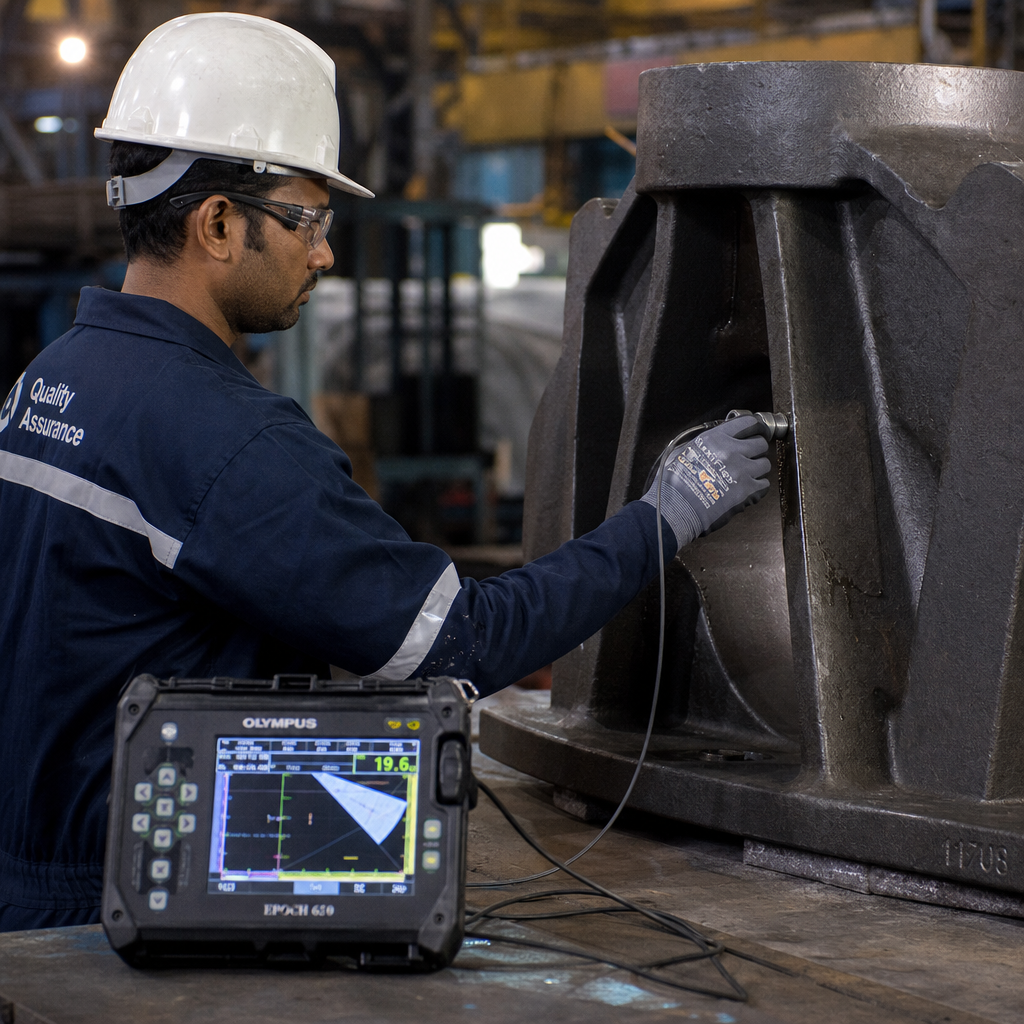
- Ultrasonic test report on structural sections. Demand it from an independent inspector, not just the foundry's in-house guy.
- First-article dimensional report. Check it against the drawing, not against a tolerance the supplier chose.
- Heat treatment charts. Time-temperature curves, not just a final hardness number. Normalizing and quenching cycles matter.
- Surface acceptance samples. Agree on what "acceptable" looks like before production, not after.
- Core and mold assembly photos. If they won't send photos before closing the mold, ask why.
Robert Davis, who spends $1.2 million a year on castings for his Georgia equipment line, puts a finer point on it: "Rejecting parts at incoming inspection isn't quality control. It's archaeology." He's right. By the time you're catching defects on the dock, the failure already cost you weeks.
There's a deeper point underneath this checklist. Ask any veteran foundry metallurgist and they'll tell you the same thing: a foundry's culture shows up in the melt deck before it ever shows up in the inspection report. When you visit a foundry, watch whether the melt operator records the chemistry before or after the tap. Watch whether the lab sits next to the foundry floor, or in an air-conditioned office remote from the noise. Watch whether the floor workers understand why a heat number matters, or just know that they're supposed to stamp it. Those are the indicators that no certificate can capture — and the ones that predict your field failure rate a year from now.
What you're actually paying for
Let's talk price. Real numbers for medium-to-large steel castings (200–2,000 kg), quoted across 2026:
| Country | Price Range (USD/kg) |
|---|---|
| China | $2.40 – $3.80 |
| India | $2.80 – $4.20 |
| Vietnam | $3.20 – $4.80 |
| Brazil | $3.50 – $5.00 |
| United States | $5.50 – $9.80 |
| European Union | $7.00 – $12.00 |
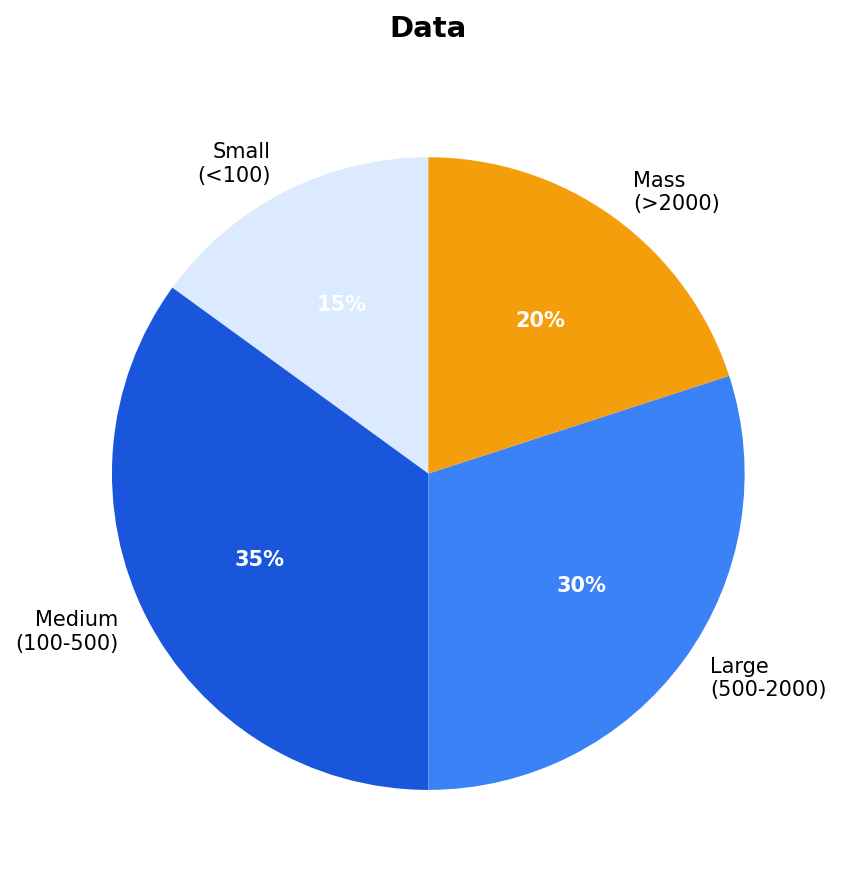
Freight from Shanghai to Sydney or Los Angeles runs roughly $180–250 per cubic meter for breakbulk, and heavy parts add 10–15% packing cost. A typical 1,200 kg casting, crated, ends up around $1,100–1,300 just to move. That's why you'll see CIF quotes that look dramatically cheaper than FOB — the seller isn't being generous, they're just rolling in costs you can't see.
But here's the number to really watch: the pattern cost. For heavy equipment castings, tooling is often the single largest line item in your first-year budget. A pattern set for a 500 kg bucket section — pattern plates, core boxes, rigging — runs $8,000 to $25,000 depending on complexity and whether it's CNC-machined or hand-rammed. That's a sunk cost you carry regardless of order volume. Some buyers try to dodge it by using the foundry's existing "standard" patterns. In heavy equipment, there are almost no standard patterns — every OEM's geometry is different. Budget for tooling upfront, and don't be seduced by a quote that excludes it.
Davis stopped accepting lump-sum quotes years ago. "If a foundry can't break down the price into pattern, melt, machining, inspection, and freight, they're hiding margin somewhere," he says. "Now I require a breakdown sheet with every quote. The suppliers hate it. But it kills the surprises."
Certifications that matter — and how to verify them
"ISO 9001 certified" gets stamped onto everything these days. Some of those stamps are real. Many aren't.
"We vetted a foundry with ISO 9001 plastered on every email footer," Davis recalls. "One phone call to their registrar revealed the certificate had lapsed 14 months earlier. You'd be amazed how few buyers actually call the registrar."
Here's what actually matters, depending on what you're buying:
- ISO 9001:2015 — the baseline. Verify it directly on the registrar's public database. Don't call the foundry. Call the registrar.
- PED 2014/68/EU — required for pressure-bearing components in Europe. If your part sees internal pressure, this isn't optional.
- API Q1 or API 20A/20C — for oilfield and drilling equipment. A real API monogram audit is brutal. That's why it means something.
- Lloyd's Register, DNV, or ABS — class approvals for marine and offshore castings. Check the actual class certificate, not the logo on the website.
And be careful of the gap between "certified" and "actually compliant." A foundry can hold ISO 9001 perfectly and still ship you garbage if the QMS is window dressing. The certificate gets you in the door. The audit tells you whether they live it.
One more trap: certificates that list the wrong scope. An ISO 9001 certificate that covers "trading of steel products" but not "manufacture of steel castings" is a certificate that vendors love to wave around and auditors love to catch. Read the scope line. If it says trading or sourcing rather than manufacturing, that's your cue to ask who actually pours their metal.
Shortlisting suppliers without guessing
You've got the data. Now apply it. Here's a five-step shortlisting process that doesn't require you to fly to Hebei every quarter:
- Request a foundry profile plus a sample heat report. Real heat numbers, real chemistry, real test curves. If they can't produce these from last month, they're not a foundry — they're a trading office.
- Call the registrar. Ten minutes on the phone verifies ISO/API status. Do this before you even book a call with the sales rep.
- Run a sample order. One part, full inspection protocol. Watch how they handle a small, low-margin order. That's how they'll treat your big ones.
- Conduct an on-site audit. Send someone or hire a third-party inspector. You're looking for melt control discipline, housekeeping, and whether the heat-treatment furnace has a functioning recorder.
- Set up a supplier scorecard. On-time delivery, defect rate, response time, document accuracy. Score every shipment. Fire suppliers below 80.

Red flags that should end the conversation:
- "We can cast anything." No. Nobody can. Specialization is a sign of competence, not limitation.
- No in-house NDT capability, or they outsource it to someone you can't verify.
- Quoting impossibly fast lead times. No-bake casting of a 2-ton part in three weeks? They haven't started your order yet.
- No actual foundry. Just an office with a website. Ask for a video tour of the floor with a live date stamp.
And if you're shortlisting between two foundries that both pass the technical screen, add a tiebreaker: what happens when things go wrong. Ask each foundry to walk you through their last major non-conformance — how they found it, how they dispositioned it, what they changed. The foundry that can name a specific process change (new filter set, revised gating, different pouring temperature) is showing you a functioning quality system. The one that says "we don't have issues" is preparing you for a very expensive surprise.
Getting the castings across the ocean
Logistics quietly eats margins if you don't plan for it. Realistic timeframes for heavy equipment castings:
- Tooling: 4–8 weeks
- First article: 2–4 weeks after tooling approval
- Production: 4–6 weeks
- Sea freight: 18–25 days to the US West Coast, 22–30 to Europe, 15–20 to Australia
Add two weeks of buffer to every schedule. You'll thank yourself later.
Rust prevention is another area where cheap suppliers cut corners. Your parts will sit in a container for three weeks, ride across the Pacific in salt air, and then wait on a dock. If you don't specify VCI paper and rust-preventative oil, you'll be sandblasting parts on arrival and adding days to your installation schedule. Put it in writing.
And choose your Incoterms deliberately. FOB gives you control over the freight and inspection timing. CIF sounds convenient but bundles costs you can't audit. For heavy parts, you want the control.
One more logistics note that's rarely in the brochure: overweight surcharges and port equipment limits. A 15-ton single-piece casting is not the same logistics challenge as fifteen 1-ton castings. Some ports and container lines have per-unit weight limits that require breakbulk or project cargo handling. Confirm the route can actually handle your part's dimensions and weight before you commit to a delivery date. A casting that's physically too big for a standard container can add weeks and thousands of dollars to your freight bill.
Heavy equipment casting FAQ
What is the minimum order quantity for heavy equipment castings?
For no-bake sand casting, MOQs are typically low — 10 to 50 pieces — because patterns are reusable. The real cost threshold is tooling, which runs $3,000 to $25,000 depending on part complexity. Budget for tooling, not for MOQ.
How long does tooling take?
Patterns, rigging, and core boxes typically take 4 to 8 weeks. CNC-machined patterns cost more but improve dimensional consistency and last far longer than hand-rammed alternatives. Don't skip the CNC patterns for anything you'll reorder.
What tolerance should I expect?
Large no-bake sand castings typically hold CT13 to CT15 tolerances — roughly ±3 to ±6 mm on meter-scale parts. Machined surfaces are held much tighter. If your design requires better as-cast precision, your supplier should have said so before quoting.
How much can I actually save sourcing from China?
On comparable quality, buyers typically save 35% to 55% versus US or EU foundries. But that delta shrinks fast once you add freight, inspection, and the cost of your time managing the relationship. Run the full landed-cost math before you celebrate.
How do I handle design defects found after casting?
Get a metallurgical analysis before assigning blame. If the fracture pattern points to a design issue — stress riser, poor section transition — request a pattern modification from the foundry. If it's a process issue, the foundry owns it. Don't referee a blame game; follow the data.
What is the difference between a first article and a pre-production sample?
A first article is produced from production tooling under production conditions, then verified against the full drawing with a complete dimensional and material report. A pre-production sample can be made from prototype tooling or even manually finished — it proves the design, not the process. Always require a first article from the actual production tooling before approving mass production. Signing off on a pre-production sample and expecting identical production parts is how 15% rejection rates start.
Your next move
Here's the condensed version: verify the certifications, demand the heat data, inspect the process, and build a real scorecard. The 62% of buyers who've lived through a major casting failure weren't stupid. They just skipped a verification step somewhere. Usually the same one, over and over.
Heavy equipment castings are a long-game supply chain. The supplier you choose today determines your maintenance costs two years from now. The structure in this guide — the 7-point checklist, the call-to-the-registrar rule, the cost breakdown requirement — is built to protect you from the failure you can't see coming.
The difference between a sourcing program that works and one that bleeds money rarely comes down to the price per kilo. It comes down to whether someone on your team actually verified the foundry, actually read the heat treatment chart, and actually asked the uncomfortable questions in this guide. That someone can be you — or it can be a sourcing partner with engineers on the ground who do this every week.
If you're tired of doing blind RFQs and chasing quotes from suppliers you can't verify, a sourcing partner with engineers on the ground in China can run the audit leg for you: one visit, one written report, then you decide. It's a lot cheaper than one field failure.
Need Help with Heavy Equipment Castings: The 2026 Sourcing Playbook?
Get matched with 3 verified foundries in 24 hours. No markup, transparent pricing.
Request Quotes →