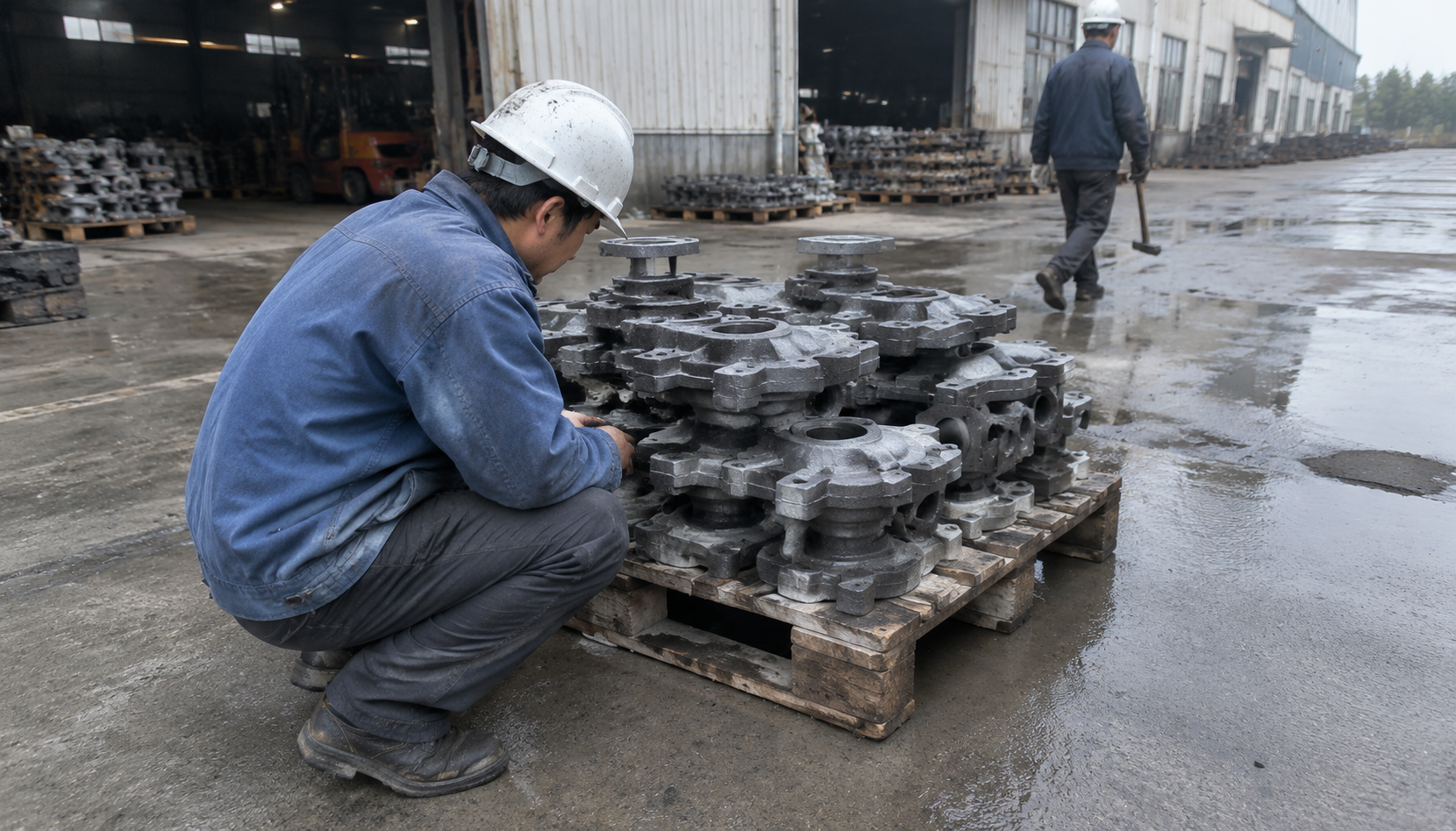
The container cleared customs on a Tuesday. By Thursday you'd opened six cartons and found porosity on the machined face of every third ductile iron housing — not enough to scrap, enough that your customer's incoming inspection kicked the whole lot back to you.
You call the foundry. Someone named Kevin, or the Chinese equivalent of Kevin, tells you the parts met ASTM A536 65-45-12 and they have test reports to prove it. Which they do. The tensile bar passed. The bar has nothing to do with the gas holes sitting under the machined surface.
Then comes the sentence every buyer hears exactly once and never forgets: "This is normal for this process."
It isn't normal. It's a process control problem that a two-hour plant walk would have caught, and you didn't do the walk because the website looked professional and the samples were beautiful and the price was 22% under the next quote.
That was a $38,000 lesson for one buyer I know. Not the scrap value — that was maybe $9,000. The rest was air freight for the replacement, expedite fees, a customer relationship that never quite recovered, and eleven months of a quality engineer's time writing 8D reports nobody read.
I've been on the buying end of that phone call. So has almost everyone who sources castings long enough to have a bad story. What separates the buyers who get burned once from the buyers who keep getting burned is rarely the foundry. It's whether they walked the floor with a list in their hand and a number at the end of it.
So here's the checklist. Forty-seven points, seven sections, weighted so you get a score you can compare across plants instead of a vague feeling about the lobby. Print it, take it on the plane, fill it in with a pen while the production manager is watching you. Nobody volunteers the scrap rate when they think you're only there for the tour.
Why most foundry audits fail before anyone lands
Three structural problems, and none of them are about the factory.
You audit the sample, not the process. The samples in the sales office were made on a Tuesday morning by the A-team, with a pattern that gets pulled out for visitors. Your production order will run on a Friday night on the C-line. If your audit doesn't include walking the actual line that will make your part, you've audited a showroom.
You audit against a generic template. Most downloadable inspection forms are written for electronics and shoe factories. They ask about ESD wrist straps and needle control. They do not ask about inoculation practice, mold hardness, or whether the spectrometer gets standardized twice a shift. For castings, those three questions matter more than everything else on the form combined.
You audit without weights. If a plant fails "business license on file" and passes everything else, it still scores 46 out of 47 and you give it a green light. A scoring system where a missing export license costs the same as a broken spectrometer isn't a scoring system. It's a form.
Rule of thumb from a decade of sourcing: about 1 in 5 Chinese and Indian foundries that quote you can actually hold a dimensional and metallurgical spec over 12 months of repeat orders. The audit exists to find out which fifth.
The 47-point foundry audit checklist
Score each line 0, 1 or 2. Zero means absent or unverifiable. One means it exists but is inconsistent or undocumented. Two means documented, current, and demonstrated during the visit while you're standing there. Ask to see the record, not a promise that the record exists — those are different conversations and you can hear which one you're having.
Section 1 — Legal, certification and paperwork (8 points, weight 1.5×)
Do this before you book the flight. Five of these eight you can clear from a desk in an afternoon, and any single failure saves you the ticket price.
- Business license — check the registered scope actually lists casting production, not "trading" or "machinery parts". Look at the incorporation date too. A trading company posing as a factory is the single most common misrepresentation in this industry.
- ISO 9001 certificate — verify the certificate number on the issuing body's own website, not the PDF the sales rep emailed. Check the expiry date and the certified scope. An expired certificate that nobody mentioned is a data point about how they manage records.
- IATF 16949 if automotive, PED/AD 2000 if pressure equipment, EN 10204 3.1 capability if you're selling into Europe. Ask who signs the 3.1 certificate — it must be the manufacturer's authorised inspection representative, not a trading agent with a stamp.
- Third-party lab relationship — which lab do they use for chemical and mechanical verification, and can you nominate your own? A plant that refuses your nominated lab is telling you something, and you only have to listen once.
- Test report samples — pull three from the last six months for a part similar to yours. Do the heat numbers match anything in the shipping documents you already have?
- Export license and customs record — how many years exporting, which countries. If your market isn't on the list, ask why, and listen to whether the answer is a fact or a plan.
- Product liability insurance — certificate of insurance, coverage limit, and whether it covers export destinations. Many policies don't.
- Sub-supplier disclosure — who does their heat treatment, machining and surface finishing? Undisclosed subcontracting is where your traceability chain quietly dies, usually six months later when a claim lands.
Section 2 — Facility and equipment (8 points, weight 1×)
Bring a tape measure and a phone with a working camera. Neither is optional.
- Building condition — a leaking roof drips onto molds. Look up. Then look down at the floor for standing water and oil.
- Melting capacity — number of furnaces, tonnes per hour each, and daily output. Cross-check against the tonnage they claim they can supply you monthly. If they promise 400 tonnes a month from two 3-ton induction furnaces, do the arithmetic on the drive home.
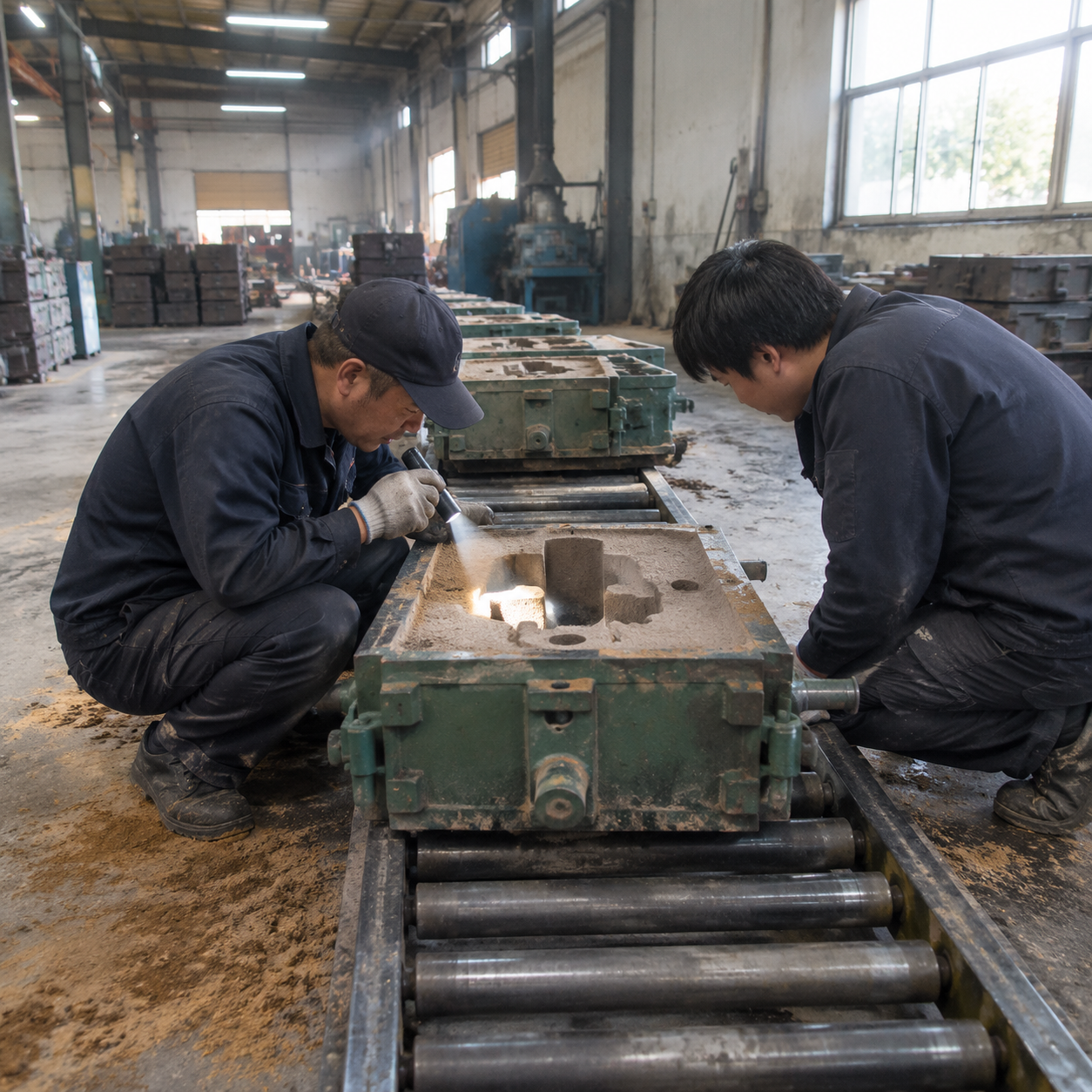
- Molding lines — count them, photograph the nameplates, note flask sizes. Then ask which specific line will run your job. Write the answer down and put it in the PO.
- Sand system — mixer, muller, sand cooler, and whether they test sand daily. Ask to see the sand test log for the last week. No log, no control, regardless of what the sand looks like in your hand.
- Pattern shop — in-house or outsourced. In-house pattern storage with rack labels and condition tags is a strong positive signal, and it's cheap to check.
- Heat treatment — furnace with a chart recorder and a current calibration certificate. A digital display with no printed record isn't traceable, no matter what the operator tells you.
- Finishing — shot blasting, grinding stations, and dust extraction that's actually running rather than sitting there with a dead motor.
- Crane and lifting capacity — matters more than people think once your part hits 80 kg and the plant has to figure out how to move a mold box safely.
Section 3 — Melting and metallurgy (7 points, weight 2×)
This is where the porosity in your housing came from. Weight it heavily and don't let the sales manager walk you past it quickly.
- Charge material control — sorted scrap, known chemistry, no mystery steel in the pile. Ask what's in the bins and watch whether the answer is specific or vague.
- Spectrometer — make and model, calibration stickers, standardization log. It should be standardized at least every shift with a certified reference standard. Open the log book with your own hands and look at the last date.
- Inoculation practice — for gray and ductile iron: what inoculant, what addition rate, what method (in-stream, sandwich, wire), and who records it. Inconsistent inoculation is the number one cause of chilled edges and poor machinability, and it never shows up on a tensile test.
- Magnesium treatment for ductile iron — which process, how Mg recovery is verified, and whether they keep treatment records by heat number.
- Pouring temperature — optical pyrometer on the floor, calibrated, and a record per ladle. Not a number shouted across the bay that nobody writes down.
- Carbon equivalent control — do they calculate CE, or just run chemistry and hope the numbers land where they usually land?
- Slag and dross handling — clean ladles, skimmed before pour. Dirty ladles put inclusions into your casting and no amount of final inspection takes them back out.
Section 4 — Molding and core making (6 points, weight 1×)
- Mold hardness — is it measured? A simple spring hardness tester on the mold face, recorded per pattern, tells you whether they control compaction or just compact.
- Core making — shell, cold box or hot box, and core venting practice. Poorly vented cores are gas defects with a delivery date.
- Pattern condition — check the actual pattern for your part, not a photo of one. Worn patterns drift dimensionally over thousands of pulls and nobody notices until the parts stop fitting.
- Gating and riser design — who designed it, and was it validated with a first-article or a simulation? "We always do it this way" is an answer. It's just not the one you're looking for.
- Mold handling — cores set and secured against flotation, and mold closure time controlled rather than "whenever the line gets to it".
- First-article dimensional report — full layout, not three critical dimensions. Ask to see one from a recent similar job, not the one they made for the trade show.
Section 5 — Quality lab and NDT (7 points, weight 2×)
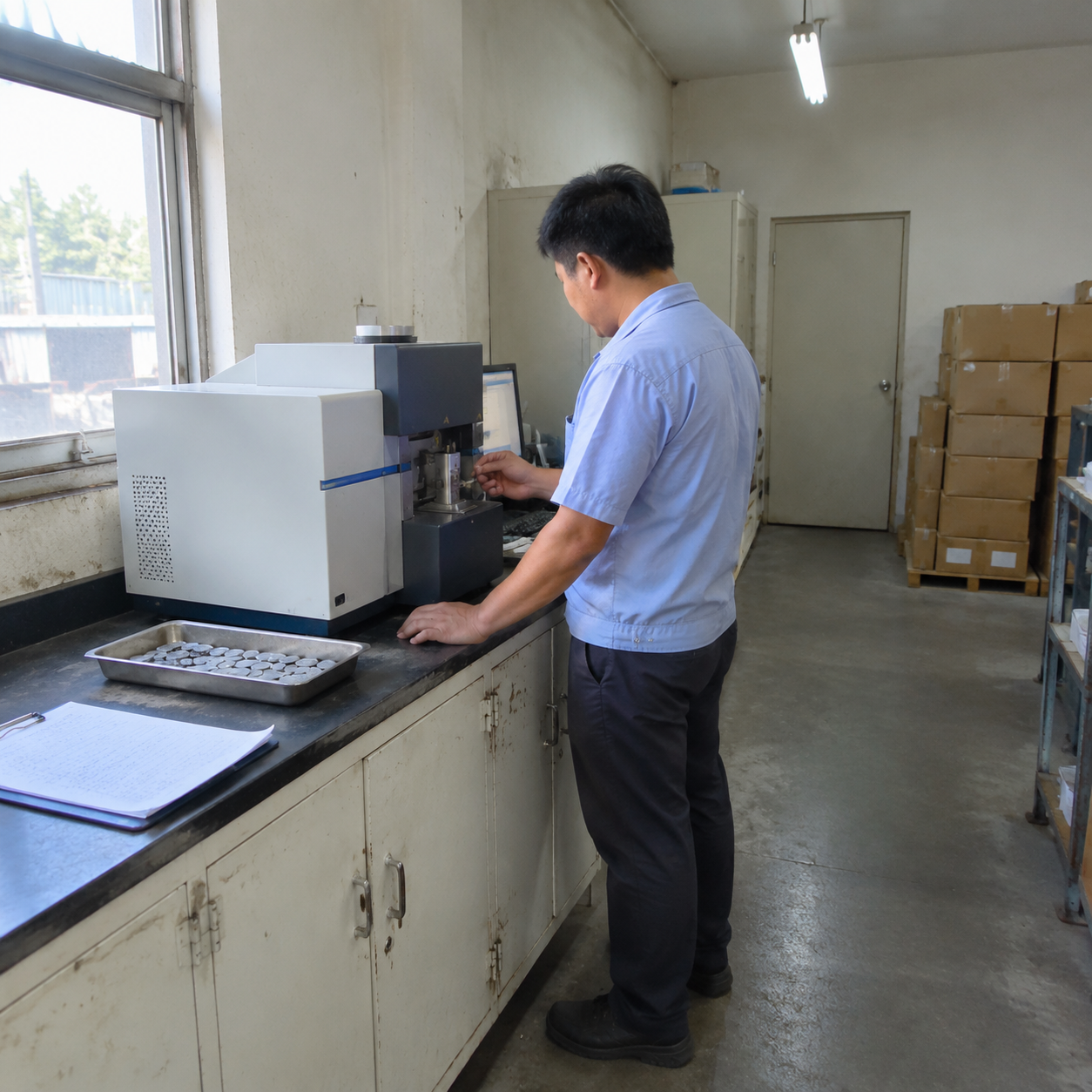
A lab is easy to buy and hard to run. The tell is whether the equipment looks used.
- Tensile testing machine — current calibration certificate, and a specimen in the machine or in the drawer showing that it gets used more than once a quarter.
- Hardness testing — Brinell or Rockwell, calibration verified, and a record of results by heat number rather than a notebook of numbers with no date.
- NDT personnel certification — ASNT Level II or equivalent for UT, MT and PT. Ask for the certificate with the person's name and expiry date, then ask to meet that person. Certificates get borrowed between plants in the same industrial park.
- Radiography — in-house or subcontracted, and how the films or digital images are retained and linked to a part. Untraceable films are decoration.
- Metallographic capability — microscope, sample prep, and whether they actually look at microstructure (nodularity for ductile iron, graphite form, pearlite content) or keep the equipment for show and the door locked.
- Sand laboratory — green strength, moisture, permeability, compactability, LOI. Daily testing is the baseline. Weekly is a warning. Monthly is a story you're being told.
- Calibration register — one list, all instruments, with dates. If nobody can produce the register within five minutes, the system is aspirational.
Section 6 — Process control and traceability (6 points, weight 2×)
- Heat number traceability — pick a finished casting off the floor at random and ask them to trace it back to chemistry, pour temperature and the tensile result. If it takes forty minutes and two phone calls, that's your answer, and it's the same answer you'll get in a claim.
- Welding and repair control — is repair of casting defects permitted? Under what procedure, with whose approval, and is it recorded? Undisclosed weld repair on a pressure part is a recall event with your name on it.
- Nonconforming material area — physically separated, labelled, and actually used. Look for red tags. A plant with an empty reject area either has a flawless process or, far more likely, a process for making rejects disappear.
- First article inspection process — defined trigger, defined approval, signed. New pattern, pattern change, material change, machine change. If the trigger list is vague, the FAI is theatre.
- CAPA records — pull two customer complaints from the past year and read the corrective action. Generic "operator retrained" responses tell you the system is theatre too.
- Process parameters displayed — on the line, does an operator know the pouring temperature window for the job they're running right now? Ask one. Not the supervisor. The operator.
Section 7 — Packing, logistics and commercial (5 points, weight 1×)

- Packing specification — written, agreed, and photographed at loading. Vibration damage in transit is far more common than people assume for heavy castings, and it always gets blamed on the foundry or on you.
- ISPM 15 treatment for any wood packaging — stamp visible on the pallet itself. Untreated wood gets your container held at destination and the demurrage is yours.
- Loading photos and container seal number — sent to you before the container leaves the yard. Make this a contractual requirement rather than a favour from the shipping clerk.
- Pre-shipment inspection rights — written into the PO, at your cost, before the balance payment goes out. Non-negotiable for a first order, and worth the argument.
- Warranty and claim clause — how long, what evidence triggers a claim, who pays freight on replacement. Get it in the contract, not in a WeChat message that scrolls away.
How to run the day
Order matters as much as content. Once the production manager works out what you're looking for, the floor stops looking like a normal Tuesday, and everything you see after that is a performance. So front-load the things that are hard to stage.
| Time | What you do | Why it goes here |
|---|---|---|
| 08:30 | Opening meeting, twenty minutes, document pack requested in writing | Ask early and watch which documents appear quickly and which need "someone to find them" |
| 09:00 | Document review — Section 1 and the calibration register | Cheap to check, and a failure here cancels the rest of the day |
| 10:30 | First plant walk — melting, molding, pouring, finishing | Do this before lunch, before anyone has had time to tidy a corner |
| 12:30 | Lunch with the quality manager, not the sales director | Forty minutes with the person who owns the scrap numbers beats two hours of slides |
| 13:30 | Lab and NDT — Section 5 | The quality manager is now expecting you, so this is where you ask for the log books |
| 14:30 | Traceability drill — item 37, a random casting on the floor | Do it late, after they've relaxed, and pick the part yourself |
| 15:30 | Closing meeting — open findings written down with owner and date | An audit without a written findings list is a plant tour with extra steps |
Two things about the walk itself. Go to the line that will actually run your job, and if they steer you elsewhere, ask why out loud. And take the long way round at least once — the pattern shop, the scrap yard, the corner where the rejected parts go. The interesting information is never on the main aisle.
How to score it
For each section, take the points you awarded, divide by that section's maximum, and multiply by the section weight. Add the seven weighted numbers, divide by 10.5 — the sum of all the weights — and multiply by 100. That's your score out of a hundred.
Worked example. Say a plant scores 7/8 on paperwork, 6/8 on equipment, 5/7 on melting, 5/6 on molding, 5/7 on the lab, 4/6 on traceability, 4/5 on packing. Weighted, that comes out at 75. Unweighted, it's 36 out of 47 — about 77%. Close enough that the weights look cosmetic, right up until you notice the four points this plant lost in Section 6 were the four that would have let you prove what material went into your parts.
Sections 3, 5 and 6 carry double weight because that's where castings actually fail. A plant can have a beautiful building and lose 30 points in melting and traceability, which is exactly the outcome you want from the scoring.
| Weighted score | Verdict | What to do |
|---|---|---|
| 85–100 | Strong | Proceed. Still put pre-shipment inspection in the PO for the first two orders. |
| 70–84 | Workable | Proceed with conditions: named line, agreed process parameters, 100% visual plus sampling NDT, pre-shipment inspection paid by you. |
| 55–69 | Risky | Only for non-critical, low-value, one-off jobs. Get a sample run through your own lab first. |
| Below 55 | Walk | No. The price was 22% lower for a reason, and you're now paying the difference in freight. |
One caveat that saves people a lot of grief: a low score in Section 1 with everything else strong usually means you're buying from a smaller, newer plant that hasn't done the paperwork yet. That's fixable, and sometimes you get a better price for tolerating it. A low score in Sections 3 or 6 is not fixable by asking nicely — that's a management culture problem, and it'll still be there next year with a different sales rep telling you about it.
Six red flags that end the conversation
These override the score. Any one of them, and you stop politely and get on a plane home.
1. They won't let you photograph. A plant that forbids photos of the molding line you're going to buy from is protecting something. Reasonable confidentiality rules exclude patterns and customer drawings, not the floor.
2. The heat number doesn't trace. If item 37 fails, everything downstream is a story. You have no way to prove what material is in the parts you're shipping, and neither does your customer's auditor.
3. Repair is undocumented. Ask directly: "Is any weld repair done on this part?" A clear "yes, under this procedure, and it's recorded" is a professional answer. A quick "no, never" followed by an operator looking at the floor is not.
4. The spectrometer isn't standardized. Check the log. If the last entry is three weeks old, the chemistry data they've been emailing you is roughly decorative.
5. The reject bin is empty but the scrap yard is full. Something is being reclassified, and it isn't the scrap.
6. Different answers from sales and production. Ask the same question twice — once in the meeting room, once on the floor. If the tonnage numbers differ by more than 20%, the sales version was written by the marketing department.
Mistakes buyers keep making
Auditing the plant that made the sample. Confirm in writing, before you book the flight, that you're auditing the site that will produce your order. Group structures make this less obvious than it sounds.
Skipping the operator interview. Twenty seconds asking an operator what temperature window they're running tells you more about the quality system than forty minutes in the conference room. Management systems describe what should happen. Operators describe what does.
Skipping the pattern shop and the sand lab because they're dirty and boring. They are. They're also where dimensional drift and mold-related defects start, and they're the two rooms a plant is least prepared to have you walk into unannounced.
Not writing down open findings with a date. Every audit produces a short list of things to fix. Write them, put a date on them, and require photographic evidence of closure before the deposit goes out. Without that, the audit was a pleasant afternoon.
Letting the foundry choose the inspector. If you hire third-party inspection, book the firm yourself. Finding an inspector who agrees with management is not difficult, and it's the oldest trick in the industry.
Auditing once and never again. The plant that passes in year one can drift by year three. A light re-audit every 18 to 24 months, focused on Sections 3 and 6, catches most of the drift for a day of your time.
If you're still building out the commercial side of the relationship, the cost breakdown walkthrough shows where foundries typically pad quotes, and the sourcing process guide covers what to negotiate alongside the quality clauses.
FAQ
What is a foundry audit?
A structured on-site review of a casting supplier's certification, equipment, melting practice, molding process, quality lab and traceability, scored against a fixed checklist so you can compare three plants on the same basis instead of on how good their showroom looks.
How long does a foundry audit take?
One full day for a plant under 300 employees, two days if heat treatment, machining or NDT is in scope. Half a day only if you already hold a recent third-party report and you're just verifying that the open findings were closed.
Do I have to visit in person?
For a first order above roughly $20,000, yes. Remote audits are fine for re-verification, but they can't tell you whether the pattern shop is clean or whether the molding line actually runs at the speed you were quoted.
What's a passing score?
70 for non-critical parts, 80 for anything safety-related or automotive. Below 70, walk unless it's a sample order under a few thousand dollars.
Can I use a third-party inspector instead?
Yes, and at $300–$800 per man-day it's usually money well spent. But give them your checklist. Generic templates check what's easy to photograph and routinely skip melting practice, inoculation control and traceability — which is exactly where casting failures live.
Download the checklist
Forty-seven points, seven weighted sections, a scoring sheet and a one-page open-findings log you can fill in on the plane. No registration, no email gate.
Get the 47-point foundry audit checklist (PDF)
The printable version includes the weighted scoring table, the red-flag page, and a blank findings log with a closure-evidence column. Take it to the next plant visit.
Also useful: the incoming inspection checklist for when the first container actually lands.
One last thing. An audit isn't a pass-or-fail exam you hand to the factory. It's a snapshot of how they run on an ordinary Tuesday, with a stranger standing in the aisle taking notes. The plants worth keeping look roughly the same whether you're there or not. You'll know within ten minutes which kind you're standing in.