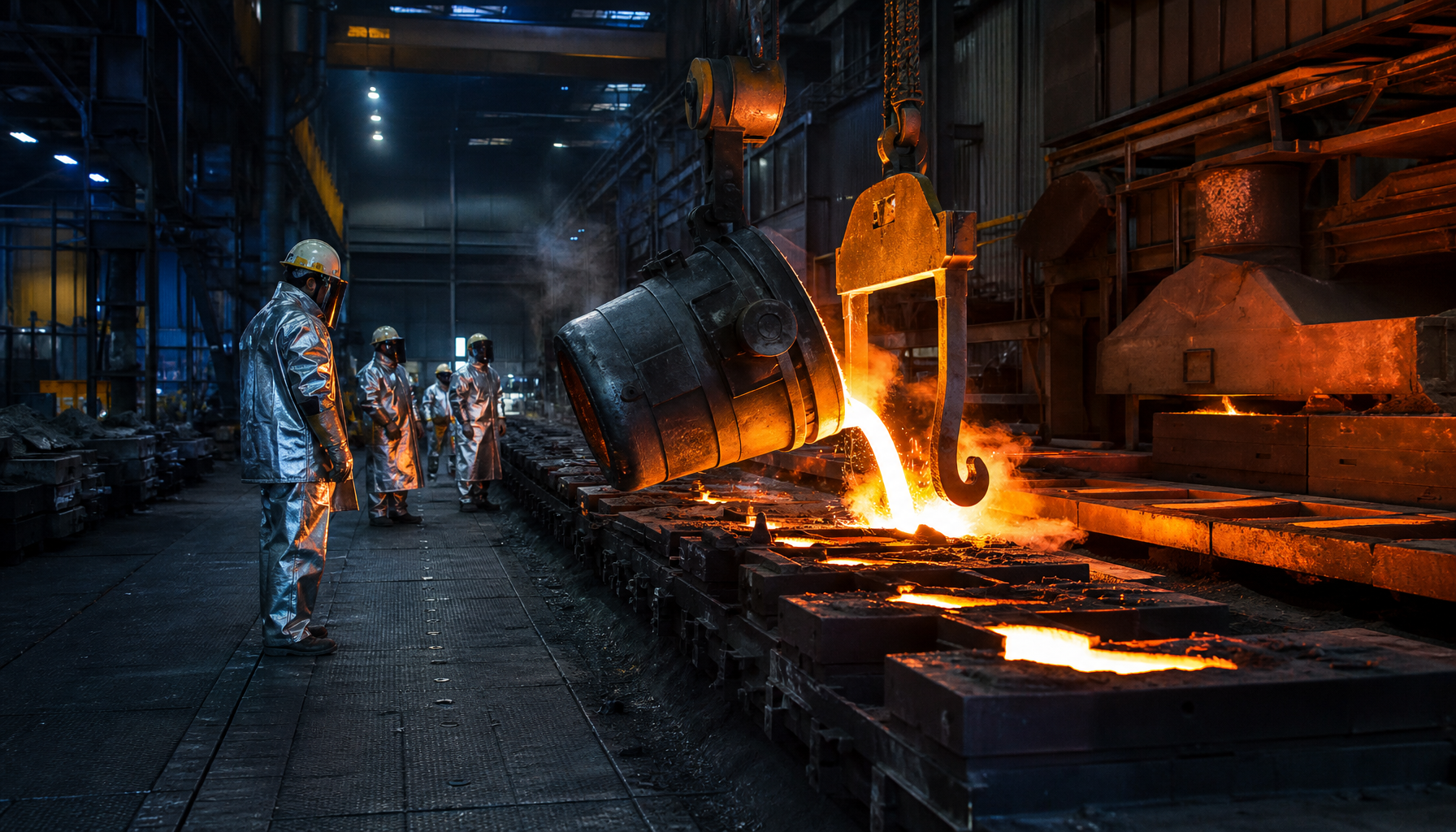
European foundries poured somewhere around 10 million tonnes of metal castings last year. Iron castings made up roughly 70% of that tonnage, and the bulk of it falls under two documents nobody reads until something goes wrong: EN 1561 for grey iron and EN 1563 for ductile iron.
Here's the part that keeps buyers awake. The difference between those two standards is a single letter in the grade designation. L or S. EN-GJL-250 or EN-GJS-500-7. That one character changes the graphite shape inside the metal, the cost per kilogram, the machining window, and whether your part survives a fatigue cycle at −40 °C.
If you approve drawings or release POs into a European supply chain, you need to read those codes fluently. Not "ask the supplier and trust the answer" fluently. Actually fluently — the way you read a dimensional tolerance.
This guide breaks down the EN naming system, walks through every grade you'll realistically see on an EU drawing, and gives you the cross-standard conversions that matter when an Asian foundry quotes against an ASTM or GB callout.
The naming code, decoded
Start with EN 1560, the standard that governs how cast irons get named. Once you know the pattern, you can read any grade in about four seconds.
Take EN-GJS-500-7.
- EN — the grade is defined by a European Norm.
- GJ — from Gusseisen, German for cast iron. The whole designation system is German in origin, which is why DIN-era engineers still read these faster than anyone else.
- S — the graphite form. This is the letter that matters most.
- 500 — minimum tensile strength in MPa.
- 7 — minimum elongation in percent. Only the ductile grades carry this number.
The graphite-form letter is the whole ballgame:
| Letter | Graphite form | Common name |
|---|---|---|
| L | Lamellar (flake) | Grey iron |
| S | Spheroidal (nodular) | Ductile iron |
| V | Vermicular (compacted) | CGI |
| M | Malleable (temper carbon) | Malleable iron |
So EN-GJL is grey cast iron. EN-GJS is ductile (nodular) cast iron. EN-GJV is compacted graphite iron — the one that shows up on modern high-output diesel cylinder blocks. EN-GJMB and EN-GJMW are the blackheart and whiteheart malleable grades, now mostly legacy work.
Notice what's missing from a grey iron designation: there's no yield-strength number. That's not an oversight. Grey iron doesn't have a meaningful yield point, because it fails in a brittle manner. The standard measures tensile strength instead and leaves the compression side of the curve to the designer. Ductile iron, which does yield, gets the elongation figure as its second number.
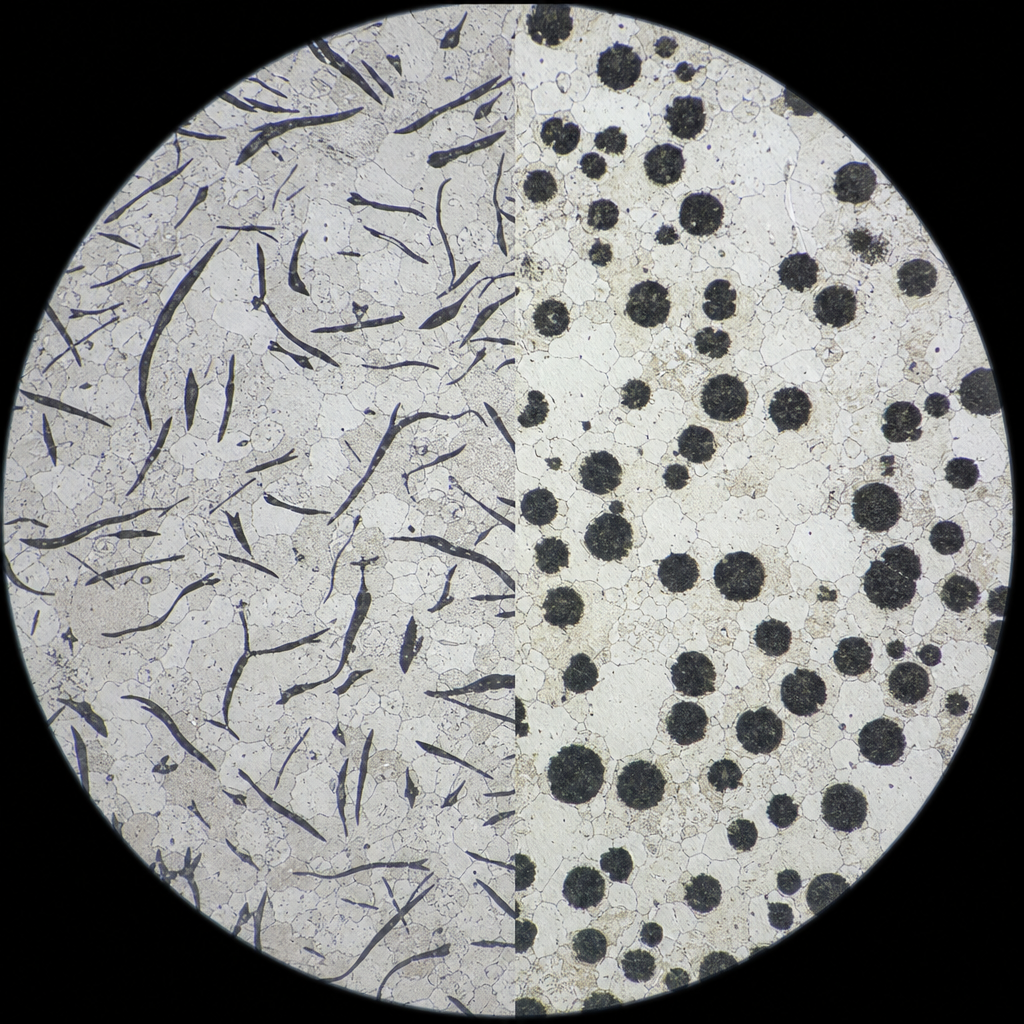
EN-GJL: the grey iron grades under EN 1561
Grey iron is the workhorse. It's cheap, machines beautifully, damps vibration better than steel, and conducts heat well. Roughly speaking, if your part doesn't need to bend, it's probably grey iron.
The grades run from EN-GJL-100 up to EN-GJL-350.
| Grade | Min. Rm (MPa) | Typical Rm range (MPa) | Typical hardness (HB) | Where it lands |
|---|---|---|---|---|
| EN-GJL-150 | 150 | 150–250 | 155–210 | brackets, covers, low-load housings |
| EN-GJL-200 | 200 | 200–300 | 165–220 | pump bodies, gearbox housings |
| EN-GJL-250 | 250 | 250–350 | 178–232 | brake drums, engine blocks, manifolds |
| EN-GJL-300 | 300 | 300–400 | 195–255 | cylinder heads, high-rigidity frames |
| EN-GJL-350 | 350 | 350–450 | 207–265 | pressure-resistant housings, liners |
Two things to internalise here.
First, the number is a floor, not a target. EN-GJL-250 means the test bar gives you at least 250 MPa. A well-run foundry pouring to that grade will land somewhere between 270 and 290 MPa on a 30 mm bar without breaking a sweat. That spread is real, and it's exactly why you should never specify a grade when what you actually need is a property at a specific wall thickness.
Second — and this is where buyers get burned — grey iron is thickness-sensitive. The EN 1561 test bar is 30 mm in diameter. On a 30 mm section, EN-GJL-250 behaves like EN-GJL-250. Push that same metal into an 80 mm section and cooling slows down, graphite flakes grow coarser, and the local strength can drop to 170–200 MPa. EN 1561 acknowledges this with its "relevant wall thickness" concept, but a surprising number of drawings don't.
If your component has a section thicker than about 60 mm, ask the foundry for properties at that actual wall thickness — not the 30 mm test bar value. It's a completely legitimate engineering question, and a competent foundry will already have the data.
One more thing worth knowing: grey iron has no usable elongation. You'll get 0.5–1% before it snaps. Its compressive strength runs three to four times the tensile figure, which is why grey iron is superb for machine bases and hopeless for anything that sees an impact load. If your application mixes static stiffness with a shock load, that trade-off is the one to design around, not the tensile number.
EN-GJS: the ductile iron grades under EN 1563
Ductile iron gets its properties from magnesium treatment. A small amount of Mg or a Mg-alloy is added to the melt, and the graphite solidifies as spheres instead of flakes. Those spheres blunt crack propagation, and the result is a metal that yields, elongates, and takes impact loads without shattering.
EN 1563:2018 lists the following grades:
| Grade | Min. Rm (MPa) | Min. Rp0.2 (MPa) | Min. A (%) | Typical HB | Typical use |
|---|---|---|---|---|---|
| EN-GJS-350-22-LT | 350 | 220 | 22 | 130–175 | low-temp housings, arctic equipment |
| EN-GJS-400-18-LT | 400 | 250 | 18 | 140–190 | wind turbine hubs, cold-chain parts |
| EN-GJS-400-15 | 400 | 250 | 15 | 130–180 | general engineering, brackets, valves |
| EN-GJS-450-10 | 450 | 280 | 10 | 160–210 | steering knuckles, suspension arms |
| EN-GJS-500-7 | 500 | 320 | 7 | 170–230 | gears, crankshafts, high-load housings |
| EN-GJS-600-3 | 600 | 370 | 3 | 190–270 | heavy-duty gears, camshafts |
| EN-GJS-700-2 | 700 | 420 | 2 | 230–300 | high-strength driveline parts |
| EN-GJS-800-2 | 800 | 480 | 2 | 250–320 | austempered, ADI territory |
| EN-GJS-900-2 | 900 | 600 | 2 | 280–340 | austempered, wear applications |
Three practical notes.
The 400-15 versus 400-18 distinction matters more than it looks. Both are 400 MPa tensile. But 18% elongation means the material passed a tougher impact test, usually at lower temperature. If your part is a safety-relevant chassis component destined for a Nordic market, the drawing will say 400-18-LT and there's a reason for it. Substituting 400-15 because "it's the same strength" is the kind of shortcut that turns into a field failure report eighteen months later.
Elongation is the tell. When a supplier quotes you "ductile iron" without a grade, ask for the elongation number. 15% and 3% are both ductile iron, and they behave nothing alike. A foundry that can only hit 5% elongation on a 500 MPa grade is not making EN-GJS-500-7, no matter what the certificate says.
Wall thickness still matters, just less. Ductile iron is far less thickness-sensitive than grey iron, but thick sections risk graphite flotation and chunky graphite — both of which quietly destroy elongation. On sections over 100 mm, expect a conversation about inoculation practice and rare-earth additions before you sign off.
Choosing between them
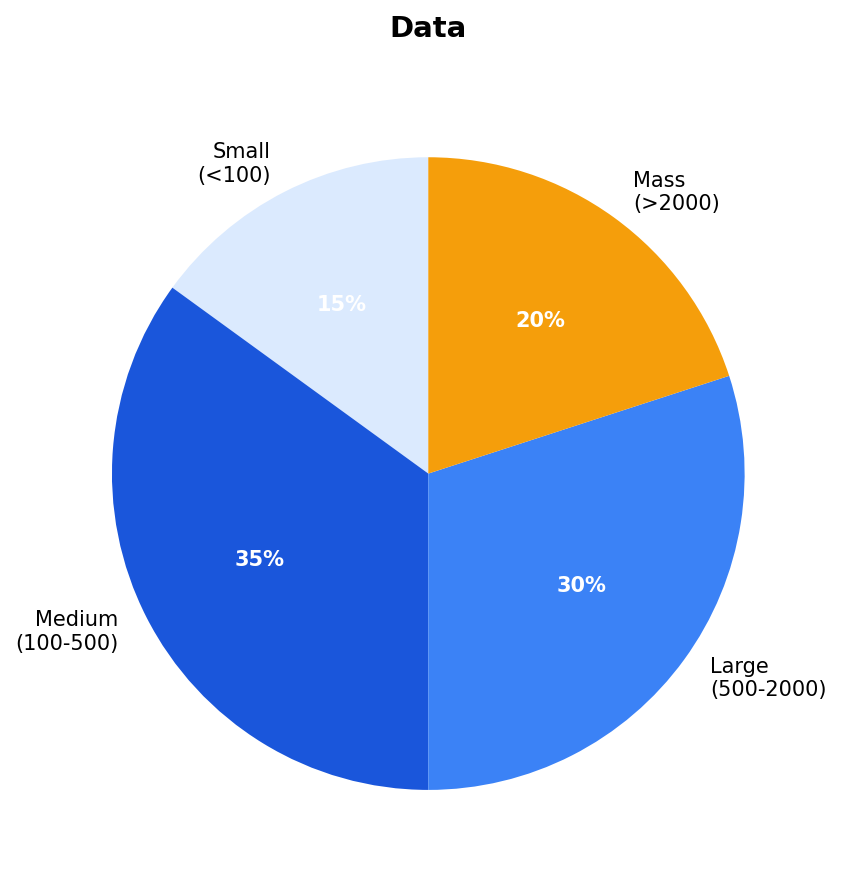
This is the decision your drawing reviewer makes, and it's worth having an opinion about.
| Requirement | Grey iron (EN-GJL) | Ductile iron (EN-GJS) |
|---|---|---|
| Vibration damping | Excellent | Moderate |
| Thermal conductivity | High | Lower |
| Machinability | Very good | Good (nodules wear tooling) |
| Impact resistance | Poor | Good to excellent |
| Fatigue strength | Low | 2–3× grey iron |
| Weldability | Very poor | Limited but possible |
| Cost per kg | Baseline | +15% to +35% |
| Casting complexity | Simple to moderate | Moderate to complex |
The rule of thumb: grey iron for stiffness, damping and heat. Ductile iron for anything that moves, bends or takes a load cycle.
A few things buyers routinely get wrong here.
Specifying ductile iron "to be safe". It costs 15–35% more per kilogram, machines slower, and often buys you nothing. If the part is a static cover plate, grey iron is correct and you just saved real money.
Specifying grey iron for a fatigue-loaded bracket. Grey iron's fatigue limit sits at roughly 40–50% of its tensile strength on a smooth bar, and considerably lower once you add a stress concentration. A ductile grade at the same tensile strength will outperform it substantially in fatigue — this is the single biggest material-selection error in European chassis components.
Ignoring machining cost in the trade. Ductile iron nodules are abrasive. Tool life on a 500 MPa ductile part can be 30–40% shorter than on a grey iron part of similar strength. That shows up in your piece price three months later, and it's already too late to renegotiate.
EN to ASTM, JIS and GB: the cross-reference you actually need
This is where European drawings meet Asian supply chains, and where an expensive class of mistake happens.
Grey iron — approximate correspondence:
| EN (EN 1561) | ASTM A48 | JIS G5501 | GB/T 9439 |
|---|---|---|---|
| EN-GJL-150 | Class 20 | FC150 | HT150 |
| EN-GJL-200 | Class 30 | FC200 | HT200 |
| EN-GJL-250 | Class 35 | FC250 | HT250 |
| EN-GJL-300 | Class 40 | FC300 | HT300 |
| EN-GJL-350 | Class 50 | FC350 | HT350 |
Ductile iron — approximate correspondence:
| EN (EN 1563) | ASTM A536 | JIS G5502 | GB/T 1348 |
|---|---|---|---|
| EN-GJS-400-15 | 60-40-18 | FCD400-15 | QT400-15 |
| EN-GJS-450-10 | 65-45-12 | FCD450-10 | QT450-10 |
| EN-GJS-500-7 | 80-55-06 | FCD500-7 | QT500-7 |
| EN-GJS-600-3 | 80-55-06 / 100-70-03 | FCD600-3 | QT600-3 |
| EN-GJS-700-2 | 100-70-03 | FCD700-2 | QT700-2 |
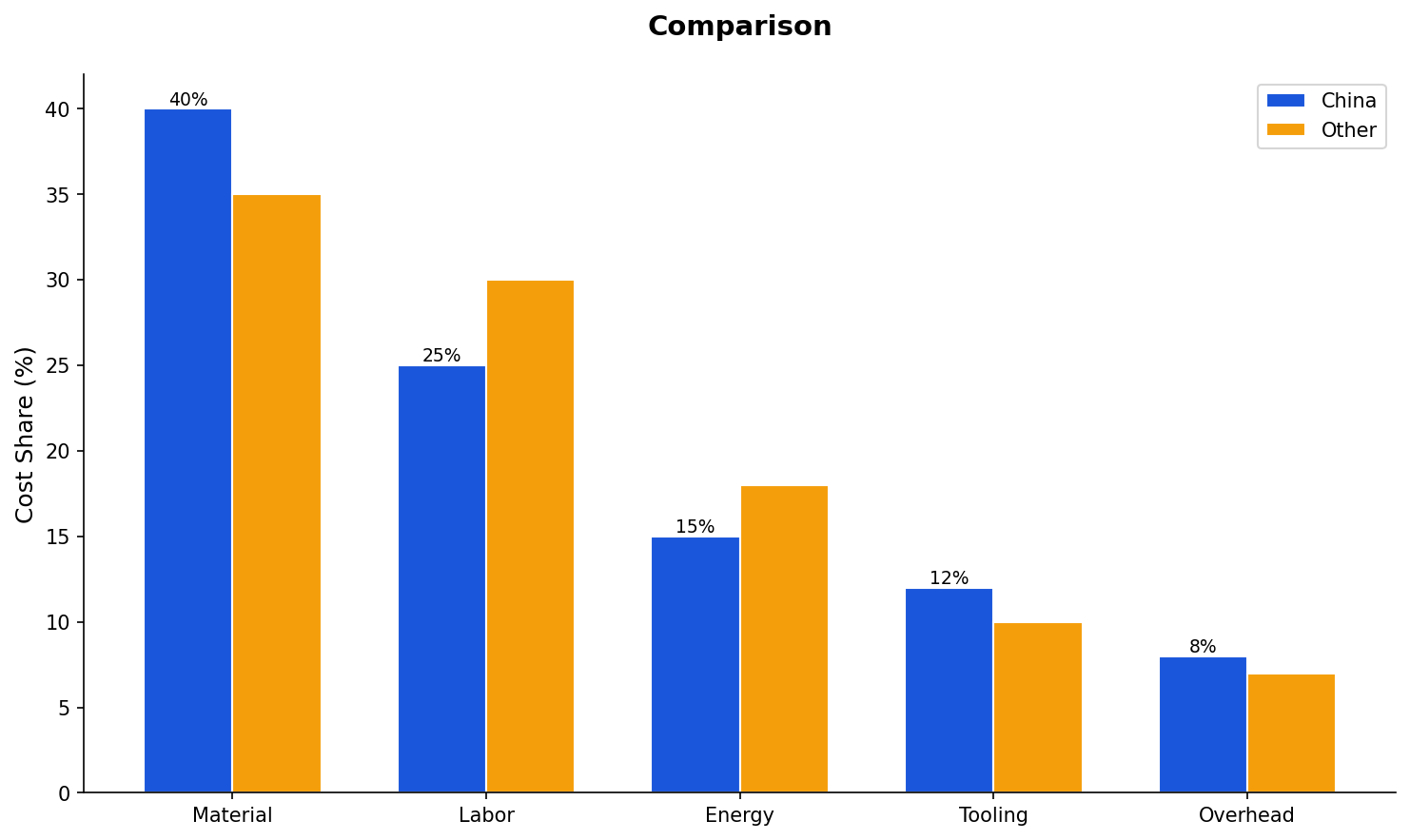
Read that table with one rule in mind: these are for orientation, not substitution.
The ASTM A536 designation is a three-number code — tensile in ksi, yield in ksi, elongation in percent. So 60-40-18 means 60 ksi tensile, 40 ksi yield, 18% elongation. Convert 60 ksi and you get about 414 MPa, which sits nominally above EN-GJS-400-15's 400 MPa floor. Looks equivalent. It isn't necessarily.
The test bar geometry, sampling location and acceptance rules differ between the standards. ASTM A536 uses separately cast test coupons per its own rules. EN 1563 defines its own. A foundry qualifying to one is not automatically qualifying to the other.
Practical consequence: you can absolutely source an EN-GJS-400-15 part from a foundry holding an ASTM A536 qualification. What you cannot do is assume that ASTM certificate proves EN compliance. The certificate has to name EN 1563 and the specific grade, with test data taken at the required bar size.
I've watched a Tier-1 reject an entire shipment over exactly this. The metallurgy was fine. The paperwork said A536. The drawing said EN-GJS-450-10. Nobody wanted to argue it, and nobody had to — the goods went back.
Reading a European drawing: what the spec sheet won't tell you
A grade callout is roughly 20% of what you need to approve a casting. The rest is documentation, and it's where the rejections live.
1. The test bar type. EN 1561 and EN 1563 both allow separately cast test pieces or cast-on test pieces. These give different numbers. On a 300 kg casting, a separately cast 30 mm bar is not representative of a 60 mm flange. Get the test bar definition in writing before PPAP starts, not after the first submission fails.
2. The certificate type. EN 10204 defines the certificate levels. For automotive and safety-relevant parts, you want 3.1 — an inspection certificate issued by the manufacturer's independent inspection representative and tied to the specific heat. A 2.2 is a test report signed by the producer alone. It's cheaper, it's common, and it is not what a PPAP submission needs.
3. Graphite structure requirements. Most European drawings don't specify nodularity for ductile iron, because EN 1563 assumes it as a baseline. In practice, nodularity above 85% with a defined nodule count range is what keeps elongation on target. Ask for the metallographic report, not just the tensile sheet. A tensile result alone can pass while the microstructure quietly sits at 70% nodularity.
4. Hardness range, not a hardness value. A single hardness number is close to useless. What you want is a specified range tied to the grade, because hardness drives your machining cycle time. On EN-GJL-250, a spread from 180 to 230 HB is entirely normal, and it will move your tool life by more than 20%.
5. Heat treatment condition. Some EN-GJS grades can be supplied as-cast or normalised, and the designation doesn't always tell you which. EN-GJS-700-2 in the as-cast condition requires tight process control. Normalised is more common and far more reproducible. If the drawing is silent on this, you're leaving a decision to the foundry that you probably want to keep.
6. Section-sensitive properties. Covered above, but repeat it on the drawing itself: if the part has a heavy section, the grade callout alone doesn't guarantee properties there. Spell out the requirement at the critical section.
Common mistakes to avoid
Treating the grade number as a full specification. EN-GJL-250 tells you one mechanical property on one test bar. It says nothing about microstructure, residual stress, dimensional capability or surface condition. If those matter — and on a machined automotive part they always do — they need to be in the spec.
Assuming cross-standard equivalence runs both ways. An EU-approved EN-GJS-500-7 material may or may not satisfy ASTM A536 80-55-06 acceptance criteria. The reverse is also true. Approve to the standard on the drawing, and require that exact standard on the certificate.
Skipping the 400-18 versus 400-15 check on cold-climate parts. Both grades exist for a reason. The 18% variant carries a low-temperature impact requirement that the 15% variant does not. If your product ends up in Scandinavia, Canada or the Nordics, that difference is the whole point.
Letting the foundry choose the grade. Foundries optimise for yield and cost. If your drawing is ambiguous, you'll get the cheaper option every single time. Put the grade in the RFQ, the PO, and the material certificate requirement. Three places, no exceptions.
Accepting 2.2 certificates on PPAP-level parts. Already said once, worth saying again. This is the most common documentation gap on European automotive castings sourced from Asia, and it's entirely avoidable.
Forgetting that vermicular iron exists. EN-GJV-400, 450 and 500 sit between grey and ductile in both properties and cost. If your part is a modern cylinder block or head, this may be the correct material — and it's a conversation worth having before you release the drawing, not after.
FAQ
What does the number in EN-GJL-250 mean?
250 is the minimum tensile strength in MPa, measured on the standard test bar specified in EN 1561. The actual value on a production casting depends on the section thickness at the point that matters. Thick sections will run below the test bar figure.
Can I substitute EN-GJS-500-7 for EN-GJS-450-10?
Not automatically. Higher strength in ductile iron usually comes with lower elongation — 500-7 gives 7% where 450-10 gives 10%. If your part needs the ductility, the upgrade in strength is a downgrade in toughness. Check the application and the load case before you approve it.
Is EN-GJL-250 the same as ASTM A48 Class 35?
They're close. EN-GJL-250 requires at least 250 MPa on its test bar, while ASTM A48 Class 35 requires roughly 241 MPa. But the test bar geometry and sampling rules differ, so treat them as comparable, not interchangeable. If the drawing says EN, the certificate must say EN.
What's the difference between EN-GJS-400-15 and EN-GJS-400-18?
Elongation requirement, and in the -LT variants, a low-temperature impact requirement. Both are 400 MPa minimum tensile. The 18% grade is tougher and is used wherever impact or cold service is a factor — wind turbine hubs, cold-chain equipment, arctic-rated machinery.
Do I need an EN 10204 3.1 certificate?
For automotive, pressure equipment and any safety-relevant casting — yes. It's the certificate the notified body and your customer's auditor will expect at PPAP. A 2.2 report is a producer's declaration, not independent verification.
What is EN-GJV and when is it used?
Compacted graphite iron, or CGI. The graphite is partly spheroidal and partly lamellar, which gives you roughly double the fatigue strength of grey iron at a lower cost penalty than ductile. Modern high-output diesel blocks and heads are the classic application.
Before you release the next drawing
The grade code on a European casting drawing packs a lot of information into a very short string. Once you can read it — graphite form, strength, elongation, standard of origin — you can spot a mismatched quotation before it becomes a production problem instead of after.
Two things worth doing next.
First, get the full cross-reference sheet covering EN 1561, EN 1563, ASTM A48, ASTM A536, JIS G5501, JIS G5502, GB/T 9439 and GB/T 1348, with the test bar and certificate notes attached to each line. That's the version that actually settles arguments with a supplier, because it answers the question before it's asked.
Second, run your next casting RFQ against a seven-point documentation checklist: grade callout, test bar type, certificate level, hardness range, nodularity requirement, section-thickness properties and heat treatment condition. If a quote comes back without all seven, it isn't a quote you can compare against the others.
Both take about ten minutes. Both save considerably more than that.