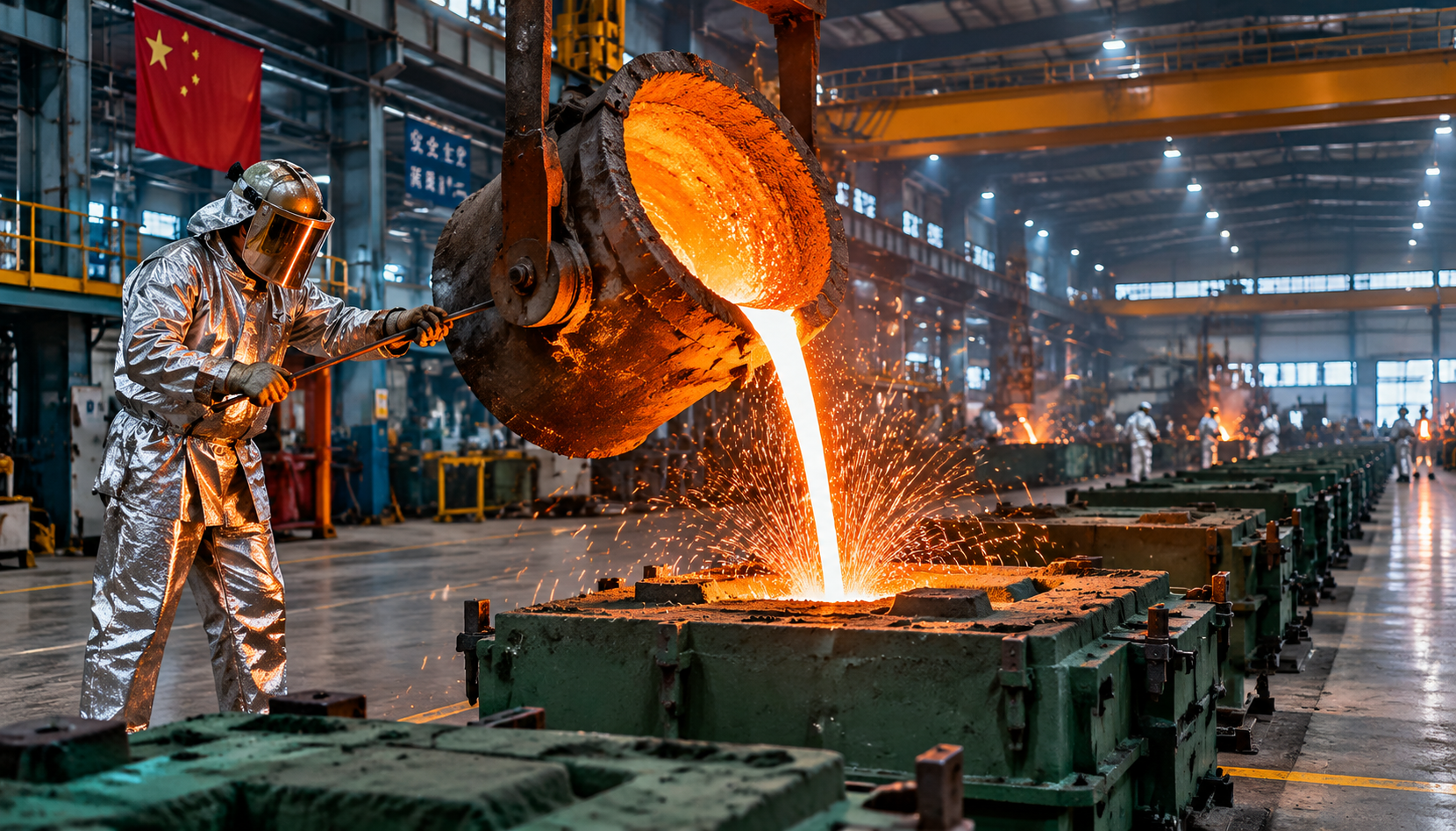
Two castings land on your receiving dock. Same drawing envelope. Same weight on the scale.
One is ductile iron to ASTM A536 grade 65-45-12: 448 MPa tensile, 310 MPa yield, 12% elongation. The other is carbon steel to ASTM A216 WCB: 485 MPa tensile, 250 MPa yield, 22% elongation.
On the certificate, the steel wins on tensile by 37 MPa. It loses on yield by 60 MPa. And if the part in question is a pressure-retaining valve body, a gearbox housing, or a 240 kg mounting bracket, yield is the number that keeps you out of a warranty claim.
That 250-versus-310 gap is where most ductile iron vs cast steel decisions actually get made — usually six weeks after the PO was cut.
This page gives you the real strength data for both families, the three ratios that never appear on a spec sheet, and the section-size trap that quietly turns a certified 552 MPa grade into a 390 MPa part. No vendor spin. Just the numbers, the standards clause behind each one, and how to use them in an RFQ.
The Three Numbers That Decide Whether Your Part Survives
Every casting certificate carries a wall of digits. Three of them matter.
Tensile strength (UTS) is the marketing number. It tells you the point at which the material tears apart. Useful for brochures and not much else, because a part that reaches ultimate tensile has already permanently deformed and, in most engineering contexts, already failed.
Yield strength (0.2% offset proof stress, in most casting specs) is the design number. It is the stress at which the material stops snapping back and starts staying bent. Every safety factor, every FEA result, every pressure rating you care about is built on this value.
Elongation at break is the warning number. It tells you how much the material stretches before it gives out. High elongation means bending, denting, and warning before fracture. Low elongation means the fracture arrives without notice, sometimes at a stress concentration you never saw in the model.
A buyer who specifies "high strength casting, min 500 MPa" has specified nothing. You need all three, plus the surface condition and the section thickness at which they were measured.
Ductile Iron vs Cast Steel Strength: The Side-by-Side Data
Here is what the standards actually specify. Ductile iron values come from ASTM A536 (separately cast test coupons). Steel casting values come from ASTM A216 and ASTM A148.
Ductile iron — ASTM A536 grades
| Grade | Tensile, MPa (ksi) | Yield, MPa (ksi) | Elongation % | Typical hardness, HBW |
|---|---|---|---|---|
| 60-40-18 | 414 (60) | 276 (40) | 18 | ≤ 170 |
| 65-45-12 | 448 (65) | 310 (45) | 12 | 156–217 |
| 70-50-05 | 483 (70) | 345 (50) | 5 | 187–241 |
| 80-55-06 | 552 (80) | 379 (55) | 6 | 187–255 |
| 100-70-03 | 689 (100) | 483 (70) | 3 | 217–269 |
| 120-90-02 | 827 (120) | 621 (90) | 2 | 240–300 |
Cast steel — ASTM A216 and A148 grades
| Spec / Grade | Tensile, MPa (ksi) | Yield, MPa (ksi) | Elongation % |
|---|---|---|---|
| A216 WCB (carbon steel) | 485–655 (70–95) | 250 (36) | 22 |
| A27 Class 60-30 | 415–550 (60–80) | 205 (30) | 24 |
| A148 80-50 | 550–690 (80–100) | 345 (50) | 18 |
| A148 90-60 | 620–760 (90–110) | 415 (60) | 14 |
| A148 105-85 | 725–860 (105–125) | 585 (85) | 12 |
| A148 130-115 | 895–1035 (130–150) | 795 (115) | 6 |
| A148 150-125 | 1035–1170 (150–170) | 860 (125) | 5 |
| A148 165-150 | 1140–1240 (165–180) | 1035 (150) | 5 |
Read those two tables together and three things jump out.
First, in the window most buyers actually operate in — 400 to 600 MPa tensile — the two materials are nearly interchangeable on paper. The separation happens above 700 MPa, where cast steel pulls away without needing a heat-treat furnace upgrade.
Second, elongation collapses faster in ductile iron. Drop from 60-40-18 to 100-70-03 and you lose 15 percentage points of ductility. The steel table loses roughly 17 points going from A27 to A148 130-115. Similar trade, but the absolute floor is different: steel castings keep 5% elongation at 1035 MPa. Ductile iron is down to 2% at 827 MPa.
Third — and this is the one that kills projects — the ductile iron numbers assume a separately cast test coupon. More on that in a moment.
Yield-to-Tensile Ratio: The Number Nobody Puts on the RFQ
Divide yield by tensile and you get the yield-to-tensile ratio, sometimes called the strength ratio. It is the single most under-used number in casting procurement.
- Ductile iron 65-45-12: 310 / 448 = 0.69
- Ductile iron 80-55-06: 379 / 552 = 0.69
- Ductile iron 120-90-02: 621 / 827 = 0.75
- Cast steel A216 WCB: 250 / 485 = 0.52
- Cast steel A148 80-50: 345 / 550 = 0.63
- Cast steel A148 150-125: 860 / 1035 = 0.83
What does a high ratio mean for you? It means the material uses a bigger share of its tensile capacity before it yields. Good in one sense — you get more usable strength per kilogram. Bad in another — there is less plastic reserve between first yield and final fracture, so a part that starts yielding has less distance to travel before it tears.
Standard unalloyed ductile iron sits at 0.65–0.75. Normalized carbon steel castings sit at 0.50–0.60, and quenched-and-tempered steel climbs into the 0.80s.
Practical takeaway: if your design has a safety factor built on tensile strength divided by a number someone picked in 1998, you are probably over-building the ductile iron part and under-building the steel part. Rebuild the calculation on yield. That single change routinely takes 10–20% of the weight out of a ductile iron component without touching the material grade.
Fatigue Strength: Where the Comparison Gets Interesting
Static strength data is easy. Most castings in the field — pump housings, axle brackets, valve bodies on a reciprocating line, gearbox covers bolted to a vibrating frame — fail in fatigue, not in a single overload event.
Smooth-bar rotating-bending fatigue limits for both families land near 40–45% of ultimate tensile strength. So a 552 MPa ductile iron gives you roughly 220–250 MPa smooth-bar fatigue strength, and a 690 MPa steel casting gives roughly 275–310 MPa. Steel wins. Slightly.
Now put a fillet radius on it. Or a keyway. Or a thread root. Real castings always have one.
This is where the comparison flips. Ductile iron's fatigue notch factor runs about 1.0–1.2. Cast steel's runs about 1.5–1.8. The reason is graphite. The nodule at the root of a fillet behaves like a small internal notch that is already there, so an external notch adds comparatively little. Steel has no such pre-existing population, so an external notch bites harder.
Run the arithmetic on a part with Kt = 2.5:
- Ductile iron 80-55-06: 235 MPa smooth / 1.15 = ~204 MPa notched
- Cast steel A148 90-60: 290 MPa smooth / 1.65 = ~176 MPa notched
The ductile iron part wins — with a lower tensile strength on the certificate.
Two caveats, and they are real. First, fatigue performance in ductile iron is dominated by defect population. A 3 mm shrinkage pore or a dross inclusion at the fillet surface will sink the number no matter what the certificate says. You need radiographic or ultrasonic acceptance criteria on the drawing, not just a materials spec. Second, surface finish matters more than grade. A machined fillet in 65-45-12 outperforms an as-cast fillet in 100-70-03 roughly every time.
Impact Toughness and Low-Temperature Service
Tensile data tells you what happens slowly. Charpy V-notch data tells you what happens when a loader bucket hits the part at 4 °C on a Tuesday morning.
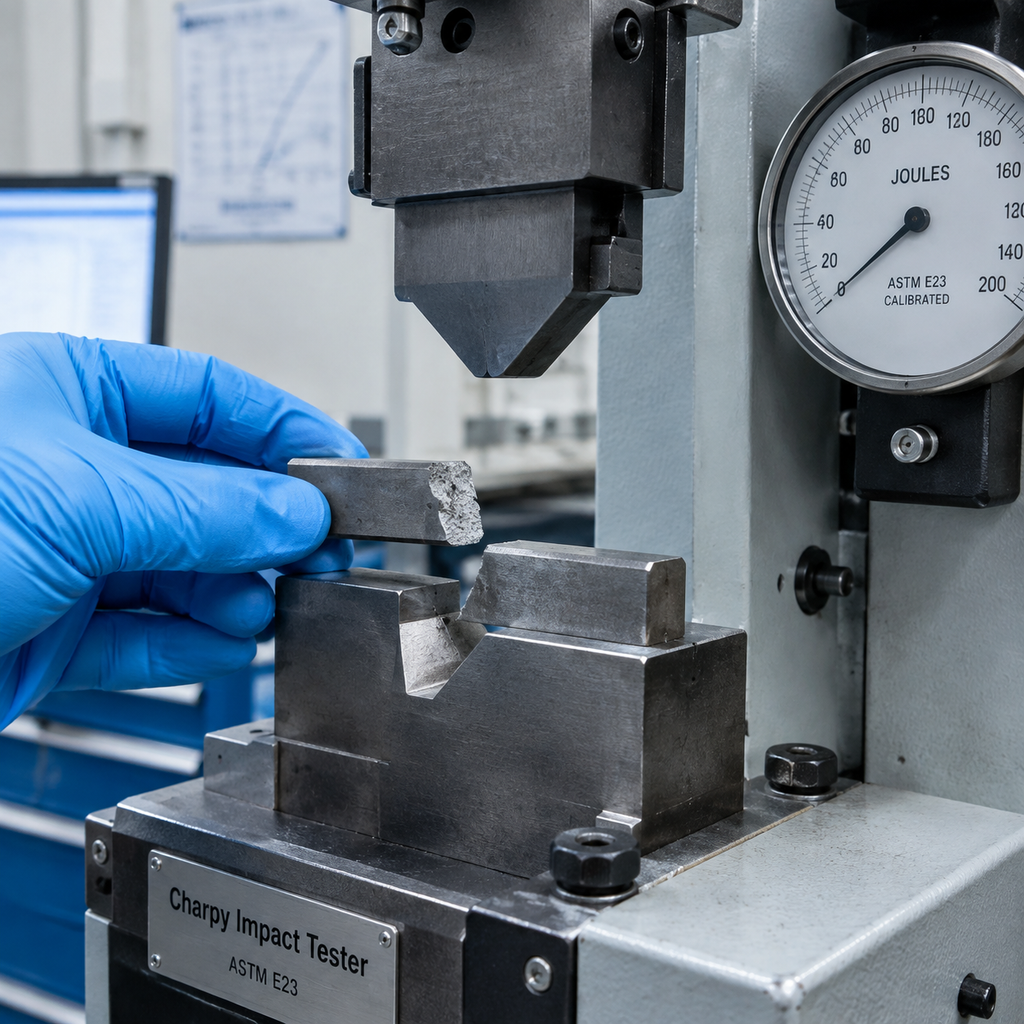
Standard ferritic ductile iron (60-40-18) delivers notched Charpy energy in the range of roughly 12–18 J at room temperature, with a ductile-to-brittle transition that starts to matter below about -20 °C. Below that, unalloyed ductile iron gets unpredictable fast, and the mechanism is ugly: the matrix goes brittle, the graphite nodules act as stress risers, and the fracture runs.
Cast steel behaves differently. A216 WCB with a proper normalizing heat treatment hits roughly 20–27 J at room temperature and holds useful toughness well below freezing. Step up to ASTM A352 LCB or LCC — carbon steel castings qualified for low-temperature service — and you get certified Charpy energy down to -46 °C. With 3.5% nickel or austenitic grades, you can push further.
If your part lives below -20 °C and carries load, you want cast steel. Full stop. There are specialized low-temperature ductile iron specs (ASTM A874, and ASME SA-395 for pressure-retaining service) that extend the range with tight chemistry control and guaranteed impact testing. They work. They also cost more per kilogram than a plain carbon steel casting, which erases the usual price advantage — so make that comparison honestly before you commit.
The Section-Size Trap That Costs Buyers Real Money
Now the part most sourcing teams learn the hard way.
ASTM A536's tensile requirements are measured on separately cast test coupons — either a keel block or a Y-block, typically poured alongside the production molds and machined into a specimen. Those coupons cool at a rate that a 120 mm thick production casting does not.
Cooling rate controls nodule count. It also controls whether you get ferrite, pearlite, or a banded mix of both across a thick wall.
Thin section (25 mm): nodule count can run 150–250 per mm², the matrix is uniform, and you hit the published grade.
Thick section (100–150 mm): nodule count drops to 30–60 per mm², graphite flotation shows up in hypereutectic chemistries, and pearlite bands form where cooling was slowest. Tensile strength on a specimen cut from the actual casting can come in 20–35% below the certified grade in unalloyed iron.
A 552 MPa ductile iron part suddenly behaves like 380–450 MPa in its heaviest wall. That is not a foundry defect. It is metallurgy, and the standard tells you to account for it.
Cast steel has the same physics but a better escape route: you can heat-treat after casting. Normalizing, quenching, and tempering a thick steel casting restores the structure uniformly, so a 150 mm section can still meet A148 105-85. Ductile iron can be heat-treated too — austenitizing and controlled cooling will get you there — but every furnace cycle adds cost, adds distortion risk, and adds a lead-time week.
What to do about it: on any ductile iron part with a section thicker than 50 mm, write the RFQ to require either (a) a cast-on test coupon from a designated heavy section, or (b) a specimen cut from a prolongation attached to the casting, tested to the drawing requirement. Then add a minimum nodularity of 85–90% and a minimum nodule count. Without those three clauses, your certificate of conformance is measuring the wrong piece of metal.
If the heavy-section route is unavoidable, look at austempered ductile iron (ADI). ADI grades per ASTM A897 reach 1250–1580 MPa tensile with 10% elongation in Grade 1, and it holds up much better in thick sections because the austempering step is a controlled isothermal transformation through the whole part, not a function of sand cooling rate.
Strength per Dollar: The Full Cost Comparison
Strength numbers only matter once you know what they cost to buy and to finish.
Typical ex-works pricing for medium-volume castings from Asian foundries, first quarter 2026, is roughly:
- Ductile iron, as-cast: USD 1.20–1.90 / kg
- Carbon steel castings (WCB-class): USD 1.60–2.60 / kg
- Low-alloy steel castings: USD 2.60–4.50 / kg
- ADI, incl. austempering: add USD 0.55–1.10 / kg to the ductile iron base
Those are ranges because foundry pricing responds to section thickness, tooling amortization, machining content, and heat-treat scope. Treat them as a sanity check, not a quote.
Now the part that changes the ranking: machining.
Ductile iron machines at roughly 1.8–2.5 times the surface speed of an equivalent carbon steel casting on the same carbide grade, with better chip formation and longer insert life. On a finish-machined part, that shows up as 30–55% less cycle time in turning and boring operations, and it is not a small line item on a 40 kg housing.
Put a number on it. A 40 kg ductile iron housing at 1.55/kg is about 62 in raw material. The same part in a steel casting at 2.10/kg is about 84 — a 22 gap. Now machine both. If finishing takes 3.2 hours in steel and 2.0 hours in ductile iron at a 45 per hour shop rate, that is 144 against 90. The gap widens to 76 on a part with a raw-material difference of 22.
Across the RFQ comparisons that pass through a sourcing desk, finish-machined ductile iron parts land 18–32% cheaper than the steel equivalent — when the geometry allows the substitution at all.
Where does it not? When the part needs more than about 700 MPa tensile in a section over 60 mm, or needs certified low-temperature impact, or needs to be welded in the field. Any one of those three kills the arithmetic.
Weight, Stiffness, and What Your Design Team Should Know
Density matters more than most buyers expect.
- Ductile iron: 7.1 g/cm³
- Carbon steel: 7.85 g/cm³
Same volume, roughly 10% lighter. Combined with the yield strength comparison, the specific strength picture (strength divided by density) is lopsided:
- Ductile iron 80-55-06 yield: 379 / 7.1 = 53.4 kN·m/kg
- Cast steel A216 WCB yield: 250 / 7.85 = 31.8 kN·m/kg
Ductile iron carries about 68% more yield strength per kilogram. On a strength-driven part, that is real mass you can take out of the design.
The counterweight is stiffness. Ductile iron's elastic modulus runs 165–170 GPa against roughly 200 GPa for steel. So for a deflection-limited part — a machine tool bed, a precision frame, anything where the number the customer cares about is "how far does it move under load" — steel's extra 18% modulus is not negotiable. Swap a deflection-limited steel casting to ductile iron and you must thicken the section, which eats the weight and cost advantage in the same move.
Rule of thumb: strength-driven parts favor ductile iron, stiffness-driven parts favor cast steel.
When Cast Steel Genuinely Wins
Ductile iron is not the default answer. Here are the four conditions where you should stop evaluating it and move straight to steel castings.
- Service temperature above roughly 400 °C. Ductile iron oxidizes and grows above this in continuous service. A216 WCB is rated to 425 °C under ASME B16.34 pressure-temperature tables; alloy grades like A217 WC6 and WC9 go to 540–650 °C. If you need high-temperature creep resistance, ductile iron is off the table.
- Certified impact energy below -20 °C. Covered above. Unless the foundry is running a qualified low-temperature chemistry with guaranteed Charpy testing, cast steel — LCB, LCC, or a nickel-bearing grade — is the safe pick.
- Field welding or post-casting fabrication. Ductile iron can be welded, but it is slow, it needs preheat and controlled cooling, and the weld zone's properties will not match the base metal. A repair weld on a ductile iron casting is a documented procedure with a qualified welder. A repair weld on a steel casting is Tuesday.
- Large thick sections needing both high strength and real ductility. A 150 mm section that must hold 860 MPa yield with 5% elongation is a quenched-and-tempered steel casting job. Ductile iron can get close with heavy alloying and heat treatment, but the cost crosses over and the risk does not.
Seven Mistakes Buyers Make on This Comparison
These come up repeatedly, and every one of them costs money downstream. If you want the inspection side of this covered in more detail, our casting inspection checklist walks through the witness points that catch most of them before shipment.
1. Comparing tensile strength only. The two data sheets look close at 448 vs 485 MPa. The yield numbers — 310 vs 250 — and the elongation numbers — 12% vs 22% — tell the real story. Ask for all three.
2. Ignoring the section thickness the grade was certified at. A 552 MPa certificate from a keel block tells you almost nothing about a 120 mm production wall. See the section-size section above.
3. Forgetting the machining budget. Raw material price is roughly a third of the landed cost of a machined casting. If your comparison stops at the kg rate, you are comparing the wrong numbers.
4. Assuming all ductile iron is the same. "Ductile iron" covers anything from 414 MPa with 18% elongation to 827 MPa with 2%. Two foundries quoting "ductile iron GGG-40" could be shipping materially different parts. Nail the grade, the nodularity minimum, and the nodule count on the drawing.
5. Specifying ADI without an inspection plan. Austempered ductile iron is excellent, and it is also unforgiving. The austempering window is narrow, and a missed window shows up as retained austenite, which shows up as dimensional instability six months later. If you spec ADI, spec the microstructure callout and the hardness verification with it.
6. Missing the low-temperature impact requirement in the RFQ. Adding "Charpy impact testing at -40 °C, 20 J minimum" after the tooling is cut is a change order, a re-quote, and often a re-design. Put it in the first RFQ if there is any chance the part sees cold service.
7. Accepting a certificate without a specimen traceability chain. A materials certificate that does not trace to a specific heat number, a specific test coupon, and a specific casting is decoration. Ask how the coupon was attached, when it was poured, and who witnessed the test.
Six-Point Verification Checklist Before You Cut the PO
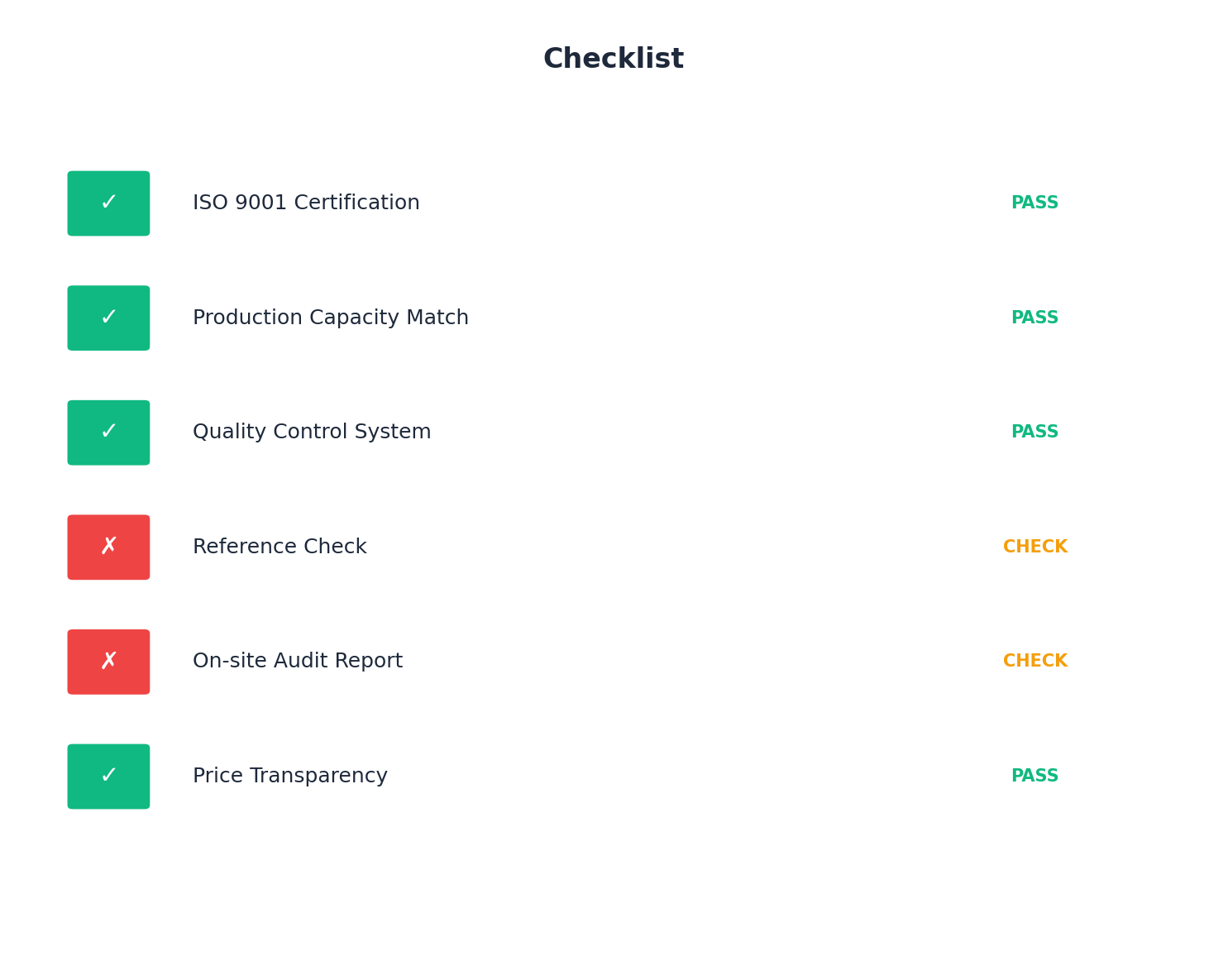
Run this before the tooling deposit, not after first article.
- Grade and spec number. Not "ductile iron." Write "ASTM A536 80-55-06" or "ASTM A148 90-60" on the drawing, with the year of the standard edition.
- Specimen location. Separately cast coupon, cast-on coupon, or specimen cut from a prolongation. Pick one and say so.
- Microstructure callout for ductile iron. Minimum 85% nodularity, minimum 100 nodules per mm², maximum 5% carbide, and a stated matrix (ferritic, pearlitic, or a named mix).
- Impact requirement with temperature. If it's not in the spec, it isn't going to be tested. State the temperature, the energy minimum, and the specimen orientation.
- NDT acceptance criteria. Radiographic or ultrasonic level per ASTM E446/E186. A fatigue-critical part with no NDT clause is a part waiting to fail at a pore. See our guide to casting NDT methods for how the acceptance levels map to part criticality.
- Heat treat and verification. For steel castings, state normalizing or Q&T, and require hardness verification on the production part, not just the coupon.
Six clauses. Ten minutes of drawing revision. They eliminate most of the failure modes that turn a 12% saving into a recall.
Frequently Asked Questions
Is ductile iron stronger than cast steel?
Depends which strength. Standard ductile iron 65-45-12 gives 448 MPa tensile and 310 MPa yield. A216 WCB carbon steel gives 485 MPa tensile but only 250 MPa yield. Ductile iron wins on yield by roughly 24% — and yield is the design number. Push into heat-treated steel like A148 150-125 at 1035 MPa tensile and 860 MPa yield, and no unalloyed ductile iron comes close. Austempered ductile iron lands in between, at 1250–1580 MPa.
Can ductile iron replace cast steel parts?
For ambient-temperature structural parts under 100 mm section — brackets, housings, gear blanks, valve bodies, pump casings — yes, in most cases, and usually cheaper. It stops working when you need service above 400 °C, guaranteed impact energy below -20 °C, thick-section ductility above 12% elongation, or field weldability. Those four conditions should end the debate.
Which is cheaper, ductile iron or cast steel?
Ductile iron wins on both material and machining. Ex-works rates typically land at USD 1.20–1.90/kg for ductile iron against USD 1.60–2.60/kg for carbon steel castings, and ductile iron cuts at 1.8–2.5 times the surface speed. On a finish-machined part, the landed-cost gap usually runs 18–32%.
What is the fatigue strength of ductile iron compared with cast steel?
Smooth-bar fatigue limits sit near 40–45% of tensile for both. The difference appears in notched parts: ductile iron's fatigue notch factor is about 1.0–1.2 against 1.5–1.8 for cast steel. On a part with a stress concentration factor of 2.5, 552 MPa ductile iron can match a 690 MPa steel casting. In exchange, ductile iron's fatigue life is far more sensitive to porosity, so NDT clauses are not optional.
Does ductile iron rust as fast as cast steel?
No. Ductile iron corrodes roughly 2–4 times slower than plain carbon steel in atmospheric exposure because the graphite network holds the oxide layer in place rather than letting it flake off. It is not stainless. Buried service, chloride environments, and immersion still need coating or lining.
Next Step: Get Specimen-Level Data Before You Get Prices
Most of the cost in a ductile iron vs cast steel decision is not in the metal. It is in the re-quote after the first article fails, the change order for a Charpy requirement nobody wrote down, and the second tooling set after the substitution turns out not to work.
Three things worth doing this week:
- Pull the two heaviest section thicknesses off your current drawing set and check whether your certified grade is actually achievable there.
- Rewrite the RFQ to specify specimen location, microstructure callout, and impact temperature — the three clauses that decide whether the certificate means anything.
- Re-run your last three steel-casting quotes against a ductile iron equivalent, including machining hours, before you assume the substitute is only about the kg rate.
If you want the strength data applied to a specific part rather than a table, send the drawing and the service conditions. You will get a written comparison — grade by grade, cost per finished part, and the exact clauses to put on the PO.
Submit a part for a ductile iron vs cast steel comparison →
Figures cited from ASTM A536, ASTM A216, ASTM A148, ASTM A897, ASTM A874, and ASME B16.34 and SA-395. Pricing ranges are first-quarter 2026 market indications from medium-volume sourcing activity and vary with section, volume, and machining content. Verify all values against the current edition of the applicable standard before specifying.
Need Help with Ductile Iron vs Cast Steel Strength: Real Data for Buyers?
Get matched with 3 verified foundries in 24 hours. No markup, transparent pricing.
Request Quotes →